Danielle Wood, Mothers Grimm (Review)

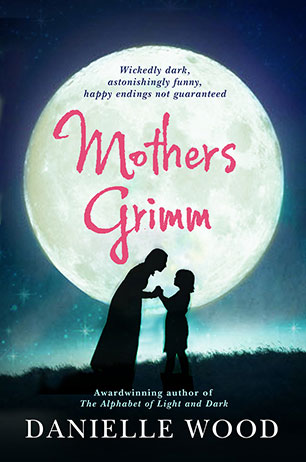
Danielle Wood, Mothers Grimm, book cover

Courtesy: Allen & Unwin

If you thought from the title of Danielle Wood’s latest novel, Mothers Grimm, that it comprises a retelling of fairytales you’d be right – and wrong. Right, because the stories contained within do springboard from specific fairytales, but wrong if you expect the new stories to be retellings. The wordplay on the title – Mothers Grimm/Brothers Grimm/Grim Mothers – sets the tone. This is a clever, wicked, funny but also heartrending look at modern motherhood.

Now, if you’re not an expert in fairytales, you might be relieved to know that it’s not necessary to know the source story to understand Wood’s “version”. While knowing the source story may add a lovely (and clever) fillip to our understanding, Wood’s stories stand well on their own. The collection starts with a prologue, which also draws from a fairytale, Hans My Hedghog. Here, Wood puts on a pedestal and then takes apart the idea of “the good mother” showing it for the myth it is, that is, an idea primarily concocted by advertisers to show us the way to perfect family life. Wood writes this opening section in second person, gathering us effectively into her wisdom. She shows us the “truth” behind the myth but assumes that, deep down at least, we already know it: “You could tell them [the literary scholars and psychoanalysts, she means] exactly why it is, in fairy tales, the Good Mother is always dead”. I knew by the end of the Prologue that I was going to like this book.

The thing about the myth, of course, is that no matter how much we might see its falsity, we still get pulled in. Why? Because we want to be the best mothers we can, we want to do the best for our children, we want them to be better and happier than we were/are. It’s a big ask, as life has a way of showing – and if life hasn’t, Wood certainly does. So, how does she do it? After the prologue, there are four stories: Lettuce (“Rapunzel“), Cottage (“Hansel and Gretel“), Sleep (“Sleeping Beauty“), and Nag (“The Goose Girl“). In each, Wood takes the original concept and spins a tale that can be darkly funny at times, but that is always devastatingly honest. This is a book which must surely bring a rueful laugh to most parents, but is perhaps best kept away from potential or new ones – though, if I remember my own youth, I probably wouldn’t have believed it anyhow. Sometimes empathy really does spring best out of one’s own experience!

In “Lettuce”, a beautiful pregnant woman is envied by the other women in a pregnancy yoga class. She seems perfect and becomes the focus of their obsession and envy. The story is told, third person, through the eyes of one of the mothers, Meg. Now Meg grew up with an earnest, sheltering mother who somehow missed the point about joy and pleasure. So when young Meg is introduced by a school friend to the delights of eating only the cream out of cream biscuits (Orange Slices, to be exact), she is shocked. She

couldn’t have said what exactly it was that was so profoundly bad about eating only the cream out of the biscuit, but she knew it was worse than just the waste.

Through gorgeous descriptions of familiar actions – such as how you twist a biscuit to separate its two parts and thus expose the cream – and by conveying often inchoate feelings or longings, Wood manages to expose the quiet deceptions and jealousies, but also the fear, confusion and love, on which motherhood is often built.

If “Lettuce” focuses on imagining an impossibly ideal “good mother”, “Cottage”, explores the guilt mothers feel about leaving their children in childcare. Nina makes a deal with her husband: he will support her staying home until their son goes to school, and she will not ask for another child. Best-laid plans – but of course we all know what happens to them. In this story Wood explores that still-familiar territory – the vexed question of child-care and the distressing way women judge each other. Indeed, mothers judging each other is one of the darker, sadder themes of the book. In this story, Nina’s dreams and ideals of motherhood are brought down, partly by her own unrealistic expectations (and oh, how I recognised those), but partly too by the economic pressures of modern life.

In “Sleep”, Wood turns to a teenage Mum. While the previous two stories are told third person from the perspective of one mother, in “Sleep” the perspective, though still third person, is shared, mainly between two sisters, Liv and Lauren. This is a well-to-do family, shamed by a teen pregnancy. There are wicked twists and wordplay here on the main motifs of “Sleeping Beauty” – the prick, and sleep – but in the end the story is about new mothers who do it alone. It’s about how easy it is to lose self and perspective when you have no support and don’t get enough sleep. It’s the most shocking of the stories – particularly because Liv doesn’t get the support she needs from the one she most needs it from, her mother.

And then there’s “Nag”, about Stella, a young woman who, trained as a nurse, goes about as far away as she can from her loving, but long-suffering mother. The story starts in 1958, and unlike the previous three, is told first person by Stella, who is telling her story to her daughter. She describes how she married:

He was twenty-two years old and starting to look about for a wife and I came to him like a lost banknote on a windy street: a windfall that he quite reasonably thought he may as well put in his wallet as throw back on the ground.

Stella finds herself, lonely, on a dusty farm with a remote, unsupportive mother-in law, and a nagging (I won’t reveal the gorgeous wordplay on this one) voice that tells her “If your mother could see you now, it would break her heart in two”. The focus here is the often fraught mother-daughter relationship.

What Wood shows is that grandmothers, mothers, and daughters are all complicit in maintaining and perpetuating the myth of “the good mother”. There is the occasional subversive mother, or the one who seems to steer an easy course through the minefield, or the one who manages to rise above the competition to reach out to a sister-mother, but for most the gap between ideal and reality defeats them. The “F” word – Feminism I mean – is not explicitly discussed but it lurks underneath. Indeed, I suspect many of the characters would eschew the word, but their lives and expectations are shaped by it nonetheless – and not, it seems for the better.

The accommodations and compromises, together with the emotional and physical losses, are grinding. I’m making it all sound rather grim (excuse the pun), and there is that, but it’s not what I came away with. The humour, warmth and lack of judgement with which Wood delivers her truths suggest that her aim is not to be negative but to shine a light on the issues and encourage discussion. If there’s a lesson to learn, it’s that there are many ways of being good mothers … and they start with being easy on yourself.

awwchallenge2015Danielle Wood
Mothers Grimm
Sydney: Allen & Unwin, 2014
214pp.
ISBN: 9781741756746
Monday musings on Australian literature: Literary fellowships

In past Monday Musings I’ve written about Writers’ retreats and Writers’ development programs. Related to these are fellowships. They involve providing a writer with money and/or resources to enable them to develop a new work. Fellowships usually involve a significant amount of money, and tend to be granted for specific projects.

Australia Council Fellowships are offered across a wide range of arts practice. They are worth $80,000 and support “outstanding, established artists’ creative activity and professional development for a period of up to two years”. Applicants must be Australian practising artists, such as writers, dancers, musicians, and visual artists.

CAUL-ASA Fellowship is offered by the Council of Australian University Librarians and the Australian Society of Authors. As far as I can work out it was first offered in 2014. Its aim is to support creative projects that use one or more of the university libraries’ special collections. Although it’s jointly offered by the ASA, it is in fact open to Australian artists, authors, scholars and researchers. It offers $15,000 which can be used for “travel, accommodation or other project-related expenses”.  From what I can tell, the outcome doesn’t have to be a book.

Copyright Agency Author Fellowship was established in 2014 to mark the Agency’s 40th anniversary “honouring the courage and imagination of the author, publisher and copyright lawyer founders that came together in 1974 to stand up for creators”. The inaugural Author Fellowship was targeted at mid- to late-career authors, because the Agency believed there were many prizes and awards available for new and emerging talent, but fewer opportunities for financial support for authors further along in their careers. The inaugural award, worth $40,000 and announced in September, was given to Mark Henshaw to enable him to work on his third novel, Missing. (I recently reviewed Henshaw’s second novel, The snow kimono, which I understand had its origins in a story Henshaw wrote in 1990 while in Paris on an Arts Council Fellowship.)

Creative Arts Fellowship for Australian Writing is offered by the National Library of Australia, with the support of the Eva Kollsman and Ray Mathew Trust (which I’ve referred to before). It is open to established and emerging writers, working in any literary genre. It enables the writer to undertake an intensive period of creative development at the Library, using the the Library’s collections “as inspiration or to incorporate or transform sources into new creative work”. It includes $10,000 which can be used for travel, accommodation, project costs, as needed. I searched to find the names of past fellows but it looks like this is a new fellowship, one of several replacing the old Harold White and Japan fellowship schemes.

The Kit Denton Fellowship was established in 2007 by the Australian Writers Foundation and Zapruder’s Other Films (the company owned by Kit’s son Andrew Denton). This award offers $30,000 and aims “to promote courage, to champion bold and challenging ideas, and to reward talent and excellence in performance writing”. The winner must be “a writer who has shown courage in their work and demonstrated a willingness to challenge the status quo with their writing”. That sounds like Andrew Denton!  In 2011 it was relaunched as the Kit Denton Disfellowship “because winning it may mean that your nan disowns you, your neighbours shun you and the shock jocks call for you to be locked up”. There is a list of winners on Wikipedia, but only up to 2012. I hope it is still being offered.

Have you heard of any other literary fellowships that sound interesting? Or are you a writer who has benefited from one? What did it mean for you?

Paddy O’Reilly, Peripheral vision: Stories (Review)

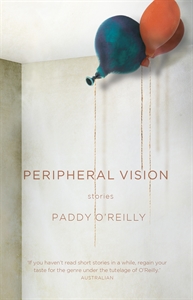
Paddy O'Reilly, Peripheral vision Book cover

The title of Paddy O’Reilly’s latest collection of short stories, Peripheral vision, comes from the story “Restraints”, in which the narrator, standing in a robotics lab where things have gone awry, says:

… and I caught again a flicker in my peripheral vision.

It’s a good title for the book because the stories are about people or events that happen to the side of “ordinary” life, however we might frame that. (I don’t talk enough about titles in my reviews, but they are important.) O’Reilly’s characters vary greatly – in gender and age. Short story writers, I’ve noticed, pay little attention to the criticism novelists often face regarding the voice they write in, like, can a man write a woman, can an anglo-Australian write an indigenous or immigrant person, and so on. Short story writers frequently range far and wide in the voices they write in. As I was reading this collection, I found myself thinking about short story writers, and what writing short stories might mean to them. While some people see short stories as a training ground for the “real” thing, novels, the writers themselves, I suspect, see them as a form in which they can let their imaginations fly. They can try being anyone or anything, anywhere, and are less likely to be taken to task for it. Certainly, in Peripheral vision, O’Reilly’s characters range from a teenage schoolgirl to a homeless man, from a twenty-something brother to a ten-year-old step-daughter, from a Filipino man to a young Australian teacher in Japan.

There are 18 stories in this collection, of which 12 have been published before. I had in fact read two of them: “The salesman”, a powerful and confronting story that I reviewed here as an individual story, and “Serenity prayer”, which was published under the title “Reality TV” in Angela Meyer’s The great unknown (my review). Another story also underwent a title change, from “Friday nights” to “Territory”. Titles! Clearly important. Well, I presume these title changes are O’Reilly’s and that she thought the same story presented in a different collection would work better under a different title. “Reality TV”, for example, is a straightforward descriptive title, with a little hint of irony, for an anthology about inexplicable things. “Serenity prayer” is a more subtle title encouraging multiple readings, particularly if you consider the ways in which this prayer is, and has been, used. This story, about a publicly betrayed wife, gets you in, and then, at the end, makes you wonder.

Simplistically speaking, the stories can be divided into two types, plot-driven and character-driven. “Territory” is a fairly traditional plot-driven story about a group of six girls out on the town on a Friday night, but, there are clues that there’s something more going on. For one, there’s the way they dress:

That was the one thing you might question about us. Other girls who went out in a group looked more alike. Arty types with arty types; girls who knew how to pick up wearing the uniform of short hip-hugging skirt, skyscraper heels, mascara and lipstick … We were a mixed-up crowd …

Then there’s the reference to a seventh girl, Suze, and the suggestion that everything might be alright now she’s been accepted into medical studies. Gradually hint upon hint is dropped suggesting that these girls aren’t just out for a good time. A very effective story. “Serenity prayer”, mentioned above, is another with a strong plot line. “One good thing”, one of the longer but still nicely sustained stories, is about the friendship between two school girls, and a violent act that occurs during a holiday visit. Its resolution, as in most of the stories, is open, leaving us to consider the short and long-term ramifications of such acts. Each of these explores a core idea – but sharing that idea could spoil the plot, so I’ll leave it here.

I can though talk about the ideas underpinning the character-focused stories. “Caramels”, for example, is about a homeless man. The ideas underpinning it relate to pride and dignity. It has a story of course, describing his life, but in these character-focused stories, plot is not the driving force. “After the Goths” is about a young twenty-four-year-old man working through guilt about something that happened in his teens. It makes him behave meanly to his older brother but, in a nice touch, his brother doesn’t rise to the occasion. Not everything, O’Reilly knows, has to be high drama to be interesting.

Other stories are perhaps better described as slice-of-life. “Deja vu”, set in a small town in France known for its medicinal hot springs, is one. It’s about holiday relationships. There’s Anthony with unexplained concerns of his own, who meets an older couple and finds himself drawn into their company against his will, as can happen when you travel. And there’s the older couple, comprising a whining dissatisfied wife and a long-suffering husband. It’s, partly anyhow, about the accommodations you make. Martin “had never been able to speak rudely to anyone” and George, the husband, seems to do a good job of accommodating his wife. The language here is delicious. The whining wife’s “mouth held the shape of a drawstring purse”. A little later, “her lips grew tighter, as if someone had pulled the drawstring”.

There’s wry humour in some of the stories, like “Breaking up” and “The word”, and a couple of the stories, “Procession” and “Restraints”, tip, intriguingly, into the speculative genre. In all, though, O’Reilly presents humans facing challenging situations – some violent, some threatening or risky, and others confusing or unsettling. Whatever it is, she rarely fully resolves the tension, leaving it instead to the reader to think about the morality, the values, the accommodations at play. This can be disconcerting if you like closure. But I like it, not only because closure can be boring and, frankly, not realistic, but also because it means you can read the stories again and again, and come to a slightly different conclusion or, should I say, understanding, each time.

Peripheral vision is exciting to read. Each story is so different that I was driven on to the next one, wondering what I’d find there. What I invariably found was a new world with another challenge to my way of seeing. I wonder what her peripheral vision will pick up next.

awwchallenge2015

Paddy O’Reilly
Peripheral vision
St Lucia: UQP, 2015
200pp.
ISBN: 9780702253607

(Review copy supplied by UQP)

Monday musings on Australian literature: Nature writing in Australia

Blogger Michelle (Adventures in Biography) posted last week on a presentation by literary agent, Mary Cunnane, at the HARDCOPY writers’ workshop she attended here in Canberra. Answering a question about narrative non-fiction, Cunnane apparently said “I do wonder, for example, why there isn’t more really good nature writing in Australia”. Quite coincidentally, last week another blogger, Stefanie (So Many Books), asked her readers for recommendations for “good nature books”. Both these posts got me thinking about nature writing in Australia. We have such varied landscapes not to mention interesting flora and fauna, that you would think examples of nature writing would roll off our tongues – but it doesn’t seem to.

What is “nature writing”?

Let’s start with Wikipedia which offers a definition, albeit an unsourced one. Nature writing, it says, “is nonfiction or fiction prose or poetry about the natural environment”. I must admit that when I think of “nature writing” my mind immediately leaps to the strong tradition from Stefanie’s home, the USA, with non-fiction authors like Henry David Thoreau, Edward Abbey, John Muir ( “A wind-storm in the forests”) and Mary Austin (“The scavengers” and “The land”). These writers focus very closely on landscape and the nature within it.

Cunnane, as far as I know, didn’t elaborate her understanding of “nature writing”, but Stefanie did, taking a broad view:

It might be a science-y book on moss or a sociology/psychology/philosophy kind of book on coping with climate change or a travel through the jungle/desert/forest/arctic sort of book or it could be about a cabin on a pond and planting beans and watching ants or about a garden or a farm … Something to take my mind outdoors while my body is stuck indoors.

Looking a little further … Last year, I wrote a Monday Musings about Australia’s relatively new Nature Writing Prize. This essay prize has been described as being about “relationship and interaction with some aspect of the Australian landscape” or for writing that “demonstrates a deep appreciation of Australia’s magnificent landscapes”. The sponsor, the Nature Conservancy, calls it the genre of “writing of place”. “Place” seems to me to be a little broader than nature, but presumably the entrants know what the prize is looking for.

Mark Tredinnick, A place on earth

Published by Bison Books

Briefly researching this topic, I came across an article Charlotte Wood wrote in 2004 on an anthology edited by Mark Tredinnick and titled A place on earth: An anthology of nature writing From North America and Australia. Tredinnick, Wood says, wanted to kickstart a new genre, “an Australian ‘literature of place'”! There’s that word “place” again. Wood discusses form and content, starting with the idea that the essay is a natural fit “with this subject matter”. But, not all writers in the anthology agree. Eric Rolls sees no reason why the “essay should be considered the most suitable form for writing about place”, and Patrice Newell, whose farm-memoir The olive grove I read before blogging, says “I’m simply a story-teller. I tell stories about our family, our farm, the flora and fauna, our river, our olive grove”. She refers to the issue of place saying:

There’s a lot of talk about ‘place’ but every place is a place. A tram is a place as crowded with memories as passengers. I’m troubled that ‘place’ is becoming a descriptive term for somewhere in the natural world. It can be too precious.

I’m with Newell. Conceptually, place can include nature, but I don’t think it’s useful as a synonym.

All of this confirms for me that “nature writing” is a rather broad church: it can be fiction or non-fiction, poetry or prose, but its focus must be nature and the environment.

Nature writing in Australia

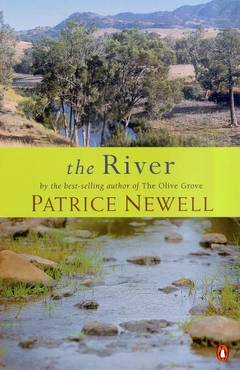
NewellRiverWood, in her article cited above, quotes essayist Peter Hay as agreeing that an Australian tradition of nature writing has been lacking, though he says that poetry is an exception. He’s right. Many of the early ballads focused closely on the interaction of humans with nature, and then there are those poets he names, like Henry Kendall and Judith Wright. He also says that “Australian fictionalists [a new word for me!] have always unselfconsciously written of the natural world”. In other words, he says, we haven’t “neglected the natural world in our writing”, we just don’t have a “literary genre specifically devoted to these themes as there is in North America”.

And so, while the names of Australian nature writers don’t jump immediately into my head, as they do when I think of the USA, it doesn’t take long for some to float to the surface. How about the two Tims – Flannery and Winton – for example? Tim Flannery’s books on palaeontology and climate – such as The Future Eaters: An Ecological History of the Australasian Lands and People, and The weather makers: The history and future impact of climate change – are obvious. In much of Tim Winton’s fiction, the environment is almost a character itself. Breath, The turning and Dirt Music are three examples, but landscape is critical to most of his books. Winton has written non-fiction about the environment too, including Land’s edge and Down to earth. Murray Bail’s Eucalyptus is an obvious contender with its specific focus on gum trees.

What about those “farm books” which explore human interaction with the landscape? Carrie Tiffany’s Everyman’s rules for scientific living and Mateship with birds (my review), Andrew McGahan’s White earth, Gillian Mears’ Foals’ bread (my review), Jessica White’s Entitlement (my review) and Alice Robinson’s Anchor point (my revieware all good examples.

And then, of course, there’s the relationship of indigenous Australians with the land, or country. Alexis Wright’s Carpentaria (my review) and Kim Scott’s That deadman dance (my review) jump immediately to mind, but much indigenous literature encompasses relationship with and responsibility for country.

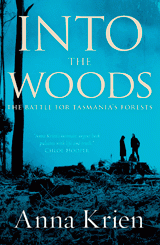
Anna Krien, Into the woods

Cover image (Courtesy: Black Inc)

Wood’s article raises another aspect of nature writing – “eco-activism”. She feared, she said, that this would be the main thrust of the anthology – but it wasn’t so. However, Tredinnick does admit there’s a connection between “creating a literature of place and creating a practical sympathy for the land”. Some writers are conscious of this connection, while others aren’t, but the contributors to the anthology agreed that such writing is not about “preaching”, but about “showing”, about creating the “sympathy” Tredinnick talks about. Anna Krein’s investigative, analytical Into the woods (my review) about the forestry conflict in Tasmania and her quarterly essay about our relationship with animals, Us and them: On the importance of animals (my review), are conscious exemplars of this aspect: they actively grapple with ecological/enviromental issues.

I’ve barely introduced the subject, but it has confirmed for me that while Australia may not have an easily definable tradition of “nature writing”, nature and landscape are integral to our literature, across forms and genres. So, let’s end with the opening of one of Judith Wright’s most famous poems:

South of my days’ circle, part of my blood’s country,
rises that tableland, high delicate outline
of bony slopes wincing under the winter,
low trees, blue-leaved and olive, outcropping granite-
clean, lean, hungry country. The creek’s leaf-silenced,
willow choked, the slope a tangle of medlar and crabapple
branching over and under, blotched with a green lichen;
and the old cottage lurches in for shelter.

(from Judith Wright’s “South of my days” at PoemHunter)

What does nature writing mean to you? And, does it interest you?


Author Talk with Kate Llewellyn, Barbara Hill and Ruth Bacchus

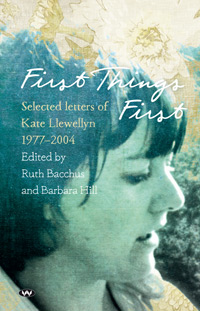
Ruth Bacchus and Barbara Hill, First things first

Having attended Robert Drewe’s Seymour Biography lecture at the National Library of Australia last week, I was thrilled to see another event come up this week. It was billed as an author talk with Kate Llewellyn, and with Barbara Hill and Ruth Bacchus who edited First things first, the collection of Llewellyn’s letters which I reviewed a few months ago. They also discussed Llewellyn’s most recent “journal”, A fig at the gate. In the end, it was Llewellyn who did most of the talking, but that didn’t matter – sorry Barbara and Ruth – because she was the main one we’d all come to see.

I’m not going summarise the whole talk, but just share a few ideas that interested or, in some cases, tickled me. Llewellyn is an engaging speaker.

On letters and letter writing

Naturally some of the discussion focused on letters. Llewellyn explained that the letters included in First things first were held in the ADFA library collection, and that they’d been acquired from the recipients of her letters.  She doesn’t keep copies of letters she writes, she said, horrified that we might think she did. In fact, she’d rather recipients of her letters would destroy them! However, she sang the praises of the American ADFA librarian who initiated the project of collecting the papers of Australian poets.

Llewellyn confirmed that she did not censor Bacchus and Hill’s choice of letters. She trusted them not to include anything that would do her harm. Some names, though, have been changed to avoid hurting people. Don’t believe everything you read, she said! There is artifice at work, even here. The project had some specific principles, including that the focus would be letters to other writers or artists, and not family.

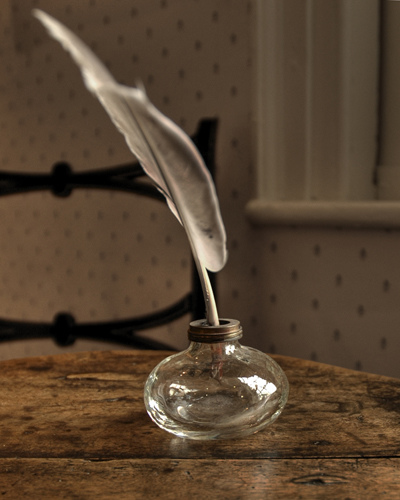
Austen's desk, Chawton. (Photo: Monster @ flickr.com)
Austen’s desk, Chawton. (Photo: Monster @ flickr.com)

Llewellyn was asked about her current letter writing activity, but she said that she rarely writes letters now because of emails. She only writes now when “something means a lot” and she wants to share it. She sees letters as capturing the important things in life.

She likes to write by hand, so her books are written that way. She believes that the hand-to-brain sensibility is different to the hand-to-machine one, and that she doesn’t have “ardour”, an important quality for her, when using a machine.

The letters in her books, like A fig at the gate, are made up, she said. For example, the letters to her daughter are a device to enable her to talk about her relationship with her daughter, and about Australia.

I found all this fascinating because I have read and discussed Jane Austen’s letters with my local Jane Austen group, looking at how or whether they could contribute to our understanding of her times and her novels. And then, this month, we discussed how Austen used letters in her novels – to develop character (the writer’s and/or the recipient’s), to progress the plot, and to provide information and solve mysteries.

The writer-reader relationship

Llewellyn talked about the complex relationship between reader and writer, particularly highly autobiographical writers like her. A fig at the gate is true, she said, because she is writing to a reader with whom she shares a trust. It is her pact with the reader that what she writes is true.  However, a problem arises when readers think they know her. They mix up life with art. There’s no winning in this she said. After all, she has done it: she has created the relationship, she has made that sacred writer’s pact to not lie, to not betray the reader. However, some readers misunderstand the protocol, they forget that the meeting is one of writer-reader, not of friends. That’s when, she says, she uses her umbrella to create a physical barrier!

Llewellyn shared a few amusing stories. One concerned being asked why she had titled her last book A fig at the gate. Because, she said, there’s a fig at my gate. But why call the book that, the reader apparently persisted. At this point Llewellyn said she had to admit that some things just aren’t deep! (She admitted, though, that she often does think metaphorically.) She also talked about the origin of the book. Now in her 70s, she wanted to write about ageing but believed that would not sell, so she decided to write a book whose “flesh would be the garden, but the bones would be ageing”.

Weather, the great story of life

I can’t remember how this topic came up, but it tickled me immensely because I have been sharing a weekly snail-mail correspondence with a wonderful American friend for over 20 years. Writing about the weather has become a bit of a running joke between us. We try to hold off for at least a couple of paragraphs and then admit we can’t hold out any longer! The weather will out.

Anyhow, Llewellyn’s story relates to meeting an English-born lecturer, who was her lover at the time, for lunch, and he started to talk about the weather. She thought that was boring and that maybe he wasn’t for her, but he told her that the English love the weather. He taught her, she said, that the weather is a good subject. (Of course, anyone who has read a good symbolic Shakespearean storm, for example, knows that.)

There was another lovely connection here for me because I had just finished, the day before, Karen Lamb’s biography Thea Astley: Inventing her own weather (my review) whose title comes from Astley’s idea of weather as representing the highs and lows, the fluctuations in life.

To recap: Lessons learned

  • Don’t believe everything you read.
  • Don’t confuse life with art. Art – even autobiographical art – is artifice.
  • Respect the writer-reader protocol.
  • And, most importantly, the weather is a perfectly fine topic to write (or talk) about!

Llewellyn concluded by reading aloud her clever, funny, wicked poem, “The breast”. Do read it online if you don’t know it.

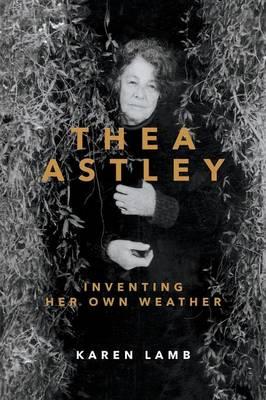
Karen Lamb, Thea Astley: Inventing her own weather (Review)

Karen Lamb, Thea Astley
Courtesy: UQP

One of the threads that runs through Karen Lamb’s biography, Thea Astley: Inventing her own weather, is Astley’s ongoing frustration about her work not being appreciated or recognised. On the face of it, this seems neurotic or, perhaps, paranoid. After all, she was the first writer to win the Miles Franklin Award four times, a feat only equalled to date by Tim Winton, and  she won pretty well every other major Australian literary award including the Christina Stead Award for Fiction and The Age Book of the Year Award. Yet, as I have often mentioned on this blog, I would agree that she is under-appreciated. Indeed, winning the Patrick White Award when she was 64 and had published 11 of her 16 books somewhat supports her case. It is awarded to a writer who has been highly creative over a long period but has “not received due recognition”. Lamb quotes her as saying “Ya know what it’s for, it’s for people who fail”! Not quite, if you look at the list of winners, but …

“a writer’s writer”

Why is this? Well, part of it could be gender-based. Astley’s satire and, yes, ferocity were not the fare “expected” of a woman. And part could be because, as author Matthew Condon put it, she’s a “writer’s writer”. This means, I’d say, that she doesn’t pull any punches to prettify her feelings and attitudes, her language is complex and imagistic, her works don’t necessarily neatly fit traditional forms, and she doesn’t dumb down. (It helps to have a dictionary nearby when you read her). But, she is so worth the effort, because she can move you to laughter or tears or just plain anger and shock with her way of expressing the world she saw. You may have heard her four ages of women – “bimbo, breeder, baby-sitter, burden” (Coda) – but what about her description of time as “the great heel”?

“My novels are 90% ME”

Let’s now, though, get to the biography. Why do we read author biographies? Why not just read – and re-read – more of their works? Is it simply a voyeuristic activity or can biographies add something of value to our understanding? And if the latter, what sort of understanding? Is it valid to try to understand an author’s works though his or her life, or, vice versa, to understand the life through the works*? These can be minefields for literary biographers, but they’re minefields Lamb has stepped lightly across. Astley’s statement that “My novels are 90% ME” helped, yet the question is still valid.

How has Lamb done it? For a start, she doesn’t attempt any pop psychology. She presents the story of Astley’s life, noting points of interest, of stress and tension – such as her very strict Catholic upbringing – but she doesn’t labour the point. She lets the reader make most of the assumptions or connections. Similarly, she situates the works in Astley’s time-line, describing what was going on at the time and drawing out themes and concerns – such as those of the outcast and misfit – that recur in her novels. She tracks changes in Astley’s thinking, such as her complex attitude to gender and feminism, through both her life and her work. Astley’s early works from the 1950s and 60s, for example, were mostly written from a male or “neuter” perspective, but later in her career, as times changed, she shifted to a female point of view.

Lamb tells the story, like most biographies, in a generally chronological manner. The book is logically organised into four parts – youth, early career, middle career, and later career – with gorgeously evocative chapter titles most of which come from Thea’s own words. Chapter 2, for example, is “Suspected of reading” from Beachmasters, and Chapter 9’s “I merely crave an intelligent buddy” is from a letter. Underpinning this chronology are recurring themes, including her anxieties about critical recognition and her ongoing battle with publishers to get a fair deal for literary writing; her awareness of her “difficult” style; her persistent focus on and interest in outsiders and misfits, gender, and male-female relationships; her smoking; her long, complicated but loving marriage; and what Lamb describes as her “twin modes of existence”, that is, her adoption of an insider-outsider role or persona. As the book progresses, all these appear and reappear, creating a coherent picture of Astley as a complex, idiosyncratic, frequently funny and often irascible, but oh so very human person.

I was, naturally, interested to read about Astley’s life. I loved that Lamb confirmed the Astley I thought I knew, while filling in the gaps and the backstory that helped me understand her better. I was thrilled, for example, to discover that Astley loved Gerard Manley Hopkins. That made complete sense, considering her style, but how I wish my love of Hopkins had the same effect on me! Anyhow, I was also, of course, keen to read about the writing and the publishing, about the works and how they fitted into her life. Lamb met this intelligently, slotting the works into the chronology, and explaining salient points, as relevant, about what inspired them, who edited and published them, what the critical response was, how they relate to her oeuvre, and so on. I’ll be returning to these – via the thorough index – as and when I read and/or re-read her works.

“It can be lonely at the bottom”

So far I have written mostly, as I should, about the biography itself, but, before I finish, I do want to shine a light a little more specifically on Astley and her work. One of the recurrent issues in Lamb’s book is Astley’s ongoing concern, mentioned earlier, regarding her lack of, or mixed, critical reception. Lamb suggests that, partly to defend herself from critics but partly also because it was how she wrote, Astley described herself as “intensely interested in style”, the subtext being that style was more important to her than plot. In this, Lamb suggests, she was like Patrick White and Randolph Stow. She could be hard on herself, saying early in her career that

It’s a fearful thing to have de luxe standards and be limited by technique and self. I know the country I want to explore but I only seem able to chart its coasts.

Yet she didn’t take (negative) criticism well. This is interesting, given she often opened herself up to it. Perhaps it is partly because she didn’t feel understood. It’s difficult to accept criticism when the basis of that criticism misses the mark, as it often did. Astley, for example, experimented with style and form throughout, but not everyone appreciated that. However, it is also very likely that gender played a role. In 1981 she wrote:

Perhaps it is because I am a woman – and no reviewer, especially a male one, can believe for a split infinitive of a second that irony or a sense of comedy or the grotesque in a woman is activated by anything but the nutrients derived from ‘backyard malice’ … the Salem judgement comes into play and the lady writer is more certainly for burning.

The other point I want to make relates to her themes. Lamb argues that Astley consistently explored outsiders and misfits, and ideas about gender, and male-female relationships, particularly in relation to power and responsibility. Her subject matter may have changed from her early treatment of “teachers, small towns and islands”, and then of suburban life, to wider social concerns about justice, development and indigenous dispossession, but her “obsessions” persisted. I think, as does Lamb, that by the end she’d come full circle, but to a more sophisticated expression, from the lonely, isolated teacher in 1958’s A girl with a monkey to a despairing Janet writing for the last reader in 1999’s Drylands. Such an impressive, tightly focused but never boring oeuvre.

I could say the same about this biography. At just over 300 pages (excluding the end-matter), it manages to be both extensive and intensive. It is tightly focused but never feels like a mere recording of facts. It is honest and affectionate but not hagiographic. It portrays that paradox typical of creators, the self-protective writer who lays herself bare. And it demonstrates that Astley’s concerns are as relevant today as they were when she died in 2004. Lamb’s biography goes some way towards according Astley the recognition she wanted and deserved. May it be just the start.

Lisa (ANZLitLovers) would agree.

awwchallenge2015

Karen Lamb
Thea Astley: Inventing her own weather
St Lucia: UQP, 2015
360pp.
ISBN: 9780702253560

(Review copy supplied by UQP)

* Carol Shields’ biography of Jane Austen is an interesting example, because it’s a case of a novelist writing about a novelist about whom little is known. Shields was upfront about using Austen’s work to fill in the gaps. It worked because she was honest about what she was doing.

Monday musings on Australian literature: Australian literary biographies

Given that a literary biography won the National Biography Award this year, that I’ve recently posted Musings on literary autobiographies/memories, and that my next review will be for a literary biography, it seemed high time that I devoted a Monday Musings to the form, don’t you think?

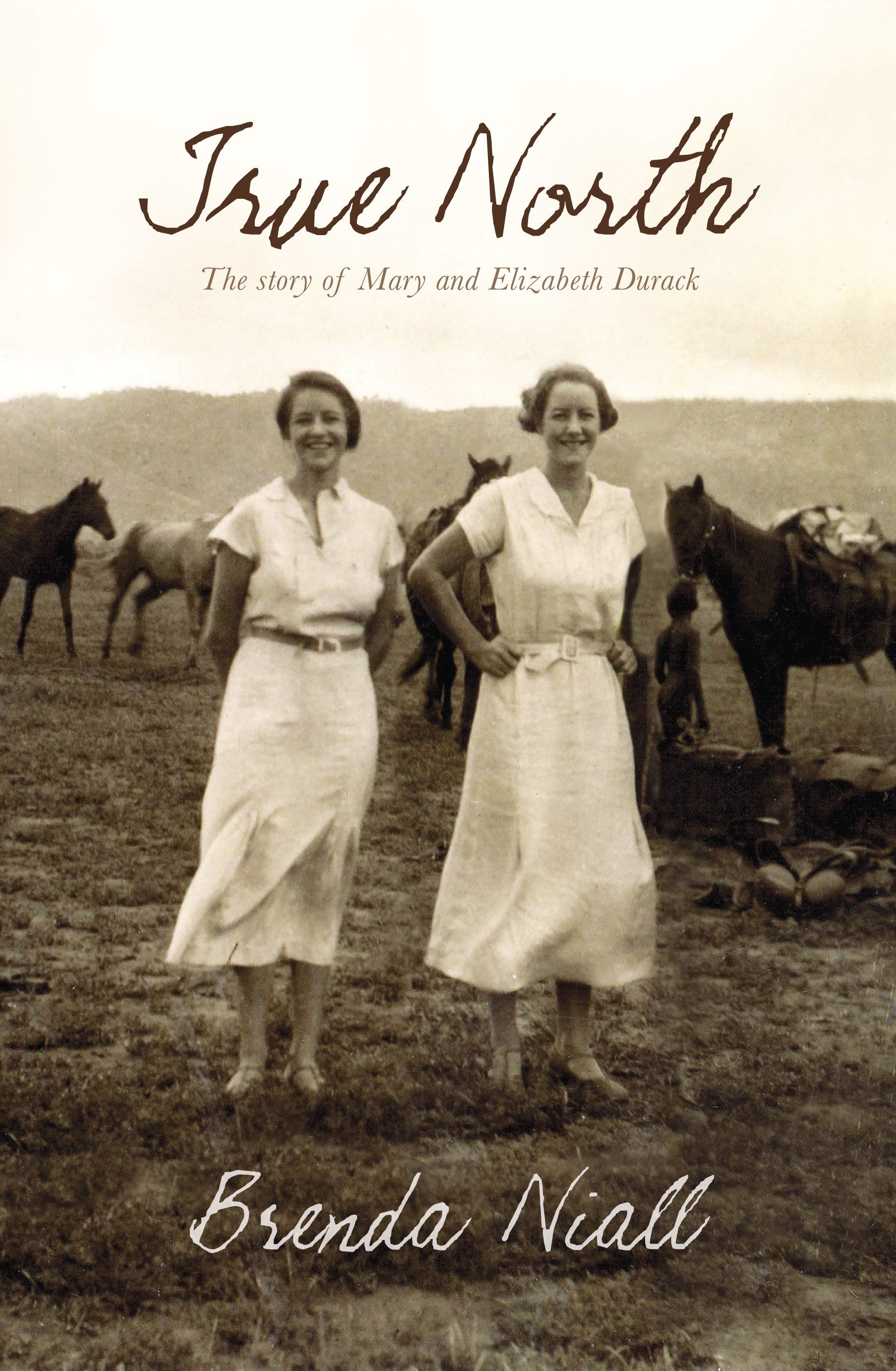
Brenda Niall's True North

Brenda Niall’s True North: The story of Mary and Elizabeth Durack (Courtesy: Text Publishing)

Biographies make up a pretty small proportion of my reading diet, and when I do read them I tend to prefer literary biographies – for obvious reasons. I can, though, be persuaded to read others if the subject is really of interest to me and/or the biographer is one I admire. An example of such a book I’ve reviewed here is Hazel Rowley’s wonderful Franklin and Eleanor.

Do you read biographies? If so, why do you read them? I have, at times, worried that my interest is voyeuristic. I have felt uncertain about whether I’d be better to focus my attention on reading more of authors’ works than biographies about them? And yet, biography is, I think, a serious literary form in its own right. Indeed, at the Australian National University, there is the National Centre of Biography, about which I’ve written before. Its role, to summarise greatly, is to foster and encourage expert and innovative biographical writing in Australia. This, together with the fact that significant institutions like the National Library of Australia with its Seymour Biography Lecture and the State Library of New South Wales with its National Biography Award, suggests that I should worry no more.

What makes a good literary biography? Well, I know what I look for: well-researched (with foot-notes/end-notes), an intelligent but readable style, honest rather than hagiographic (or its opposite!) tone, and an analytical approach to the writer’s work situating it within the writer’s life and times. I also like it when the biographer engages the reader in the form of the biography, in the challenges they may have confronted, in how and why they chose the approach they did.

So, here I’ll list a few Australian literary biographies, that I’ve read or would like to, in alphabetical order, as libraries do it, by the subject. Inclusion here does not mean they are all the best of the form, but simply that they represent a variety in style and subject.

  • Jennifer Walker’s Elizabeth of the German Garden: A literary journey (2013). A recent addition to my TBR, I’m very keen to read this biography of the not-so-well-known Australian-born writer, Elizabeth von Arnim. I’ve read several of her works – fiction and non-fiction – and love her writing. (As an aside, given recent discussions on this blog regarding memoirs, she’s another author who has played with the memoir form in her writing.)
  • Karen Lamb’s Thea Astley: Inventing her own weather (2015). This is the book I am just finishing now and will review in the next few days.
  • Philip Butterss’ An unsentimental bloke: The life and work of CJ Dennis (2014) (my review). This year’s National Biography Award winner. The judges wrote that it’s “meticulously researched”, “fluent in style”, and that it “provides an illuminating analysis of the oeuvre, and its spinoffs, for which Dennis was famous and, briefly, rich”.
  • Brenda Niall’s True north: The story of Mary and Elizabeth Durack (2012) (my review). This is, really, more than a traditional literary biography. Elizabeth was an artist, and the two were daughters of a pioneering cattle family. I enjoyed it, but it suffered, perhaps, from the breadth of its focus.
  • Jill Roe’e Stella Miles Franklin: A biography (2008). This is a biography that I should read, given the importance of its subject to Australian literature and given the reputation of the biography itself. I can, though, suggest you check out Lisa’s (ANZLitLovers) review.
  • Helen Trinca’s Madeleine: A life of Madeleine St John (2013). (my review). St John is not regarded as “high” Australian literature – nor is Mary Durack, for that matter – but she was the first female Australian writer to be nominated for the Booker Prize and, like the Duracks, came from a family which had a public profile.
  • Hazel Rowley’s Christina Stead: A life (1993). Rowley was regarded as one of Australia’s best biographers until she died too young, in her 60th year, in 2011. Her subjects included the French couple Jean-Paul Sartre and Simone de Beauvoir, and American writer, Richard Wright. Her biography of Stead was universally praised, with, for example, critic Michael Upchurch at the New York Review of Books describing it as “everything a literary biography should be”. He wrote: “It’s a model of clarity. Ms. Rowley’s shrewd selectivity and handling of anecdote makes the book compellingly readable”.
  • David Marr’s Patrick White: A life (1991). Another biography I should read, but it’s a big tome, so will need time. Well-reviewed when it came out, it’s still the authoritative biography of Australia’s only Nobel Laureate in literature.

In 2010, journalist Gideon Haigh wrote an article titled “Sleaze-hounds and artist on oath: The state of Australian biography” in Kill Your Darlings. He bemoaned the scarcity of Australian biography “of quality”. I’d certainly agree that we’d like more good biographies. He suggested various reasons for the dearth, including that it “could be as simple as that there are easier ways to earn a living, and that living in the shadow of a subject for the years required to craft something really worthwhile involves a determination and a humility no longer common among those with writing aspirations”. I’m not sure I like the dig about “humility” but it is clear to me that writing a comprehensive, thoughtful biography is a huge task, one that takes not months but years, and that requires extensive research that must be expensive (even in today’s more digitally accessible world). I don’t know how well supported the endeavour is.

Do you have any thoughts or preferences about biographies?

Who me?: Robert Drewe’s Seymour Biography Lecture

One of the best parts of living in Canberra – and there are many best parts, despite what the politicians and media seem to say! – is that we have the National Library of Australia. It presents many literary events each year, to which I only ever manage to make a few. Some of them I’ve written about here, some not – but I am going to share the latest, Robert Drewe’s Seymour Biography Lecture.

Robert Drewe, Shark netThe Seymour Biography Lecture, endowed by the Seymours in 2005, is an annual lecture devoted to life writing. The inaugural lecture was given by one of Australia’s most respected biographers, Brenda Niall. Later speakers have included Robert Dessaix and Drusilla Modjeska. Initially hosted by the Humanities Research Centre‘s Biography Institute, it was transferred to the National Library in 2010. When I saw that Robert Drewe was to give this year’s lecture, I had to go. While I haven’t reviewed Drewe here yet, I have mentioned him a few times, and have read some of his work in the past. He has written novels, short stories, essays and memoir. The shark net, his first memoir, was adapted to a well-regarded miniseries in 2003, and his second, Montebello, was published in 2012. (I mentioned these in my recent Monday Musings on literary autobiographies.)

The lecture will I’m sure, like those before it, be made available via the Seymour Biography page (link above), but I would like to share a few ideas that struck me.

Memoir, or autobiography?

Drewe talked about how memoir is viewed, the fact that some see it as self-absorption or as narcissistic, about revenge or self-justification. He quoted American critic William Gass (author of Autobiography in the age of narcissism) who attacked memoir for being about self-absorption. Gass ridiculed the genre: “Look, Ma, I’m breathing. See me take my initial toddle, use the potty, scratch my sister; win spin the bottle. Gee whiz, my first adultery-what a guy!” Hmm, I have friends who don’t like memoir for this very reason.

Drewe gave a brief history of memoir – particularly memoir as confession, or redemption – through the writings of St. Augustine who made memoir, he said, an interior exercise, and Rousseau who moved the confession or memoir into the literary arena. He told us that Patrick White described his Flaws in the glass as not a memoir but a “self-portrait in sketches”! Flaws, Drewe said, is regularly criticised. English critic, Richard Davenport-Hines, for example, wrote that White’s “spiteful bestseller Flaws in the Glass must rank as the most inadvertently self-diminishing memoir since Somerset Maugham’s”.

Memoirs, Drewe said – looking at works like St Augustine’s – predated autobiographies. He defined the two forms as follows: memoirs are written from a life, while autobiographies are of a life. The change in preposition here is significant. As Gore Vidal would describe it, memoirs are about memory, while autobiography and biography are about history. In a memoir, a writer can take a memory and describe or expand it to tell a story about his/her life or experiences. Facts can be played with in order to find the emotional truths. Autobiography on the other hand – despite George Bernard Shaw’s “All autobiographies are lies… deliberate lies” – are expected to be factual.

Drewe told us that Sigmund Freud, when asked to write about his life, refused, arguing that it would be a reckless project. To tell his complete life would require so much discretion, it would be an exercise in mendacity. No wonder that, as Drewe told us, 99% of memoirists wait until their parents have died. Oh dear! I do hope my writing-oriented children are among this 99%! We did our best!

All this might sound dry and boring, but Drewe’s presentation was entertaining. He told us that when he thinks of autobiography he thinks of Father’s Day – and sports (particularly cricket) and political autobiographies. He regaled us with the punning titles of cricket autobiographies, such as At the close of playOver to meTime to declare (two in fact); Over but not out; and No boundaries. 

Before we had a chance to call him sexist, Drewe said that Mother’s Day made him think of WOTOs, that is, Women Overcoming the Odds, like, you know, widowed women running a cattle station in the outback, or a woman sailing solo around the world or saving an endangered animal!

Drewe returned several times in his talk to the issue of “facts” versus “truths”. He quoted Louise Adler who commissions political autobiographies for Melbourne University Press, including Mark Latham’s The Latham Diaries, Peter Costello’s The Costello Memoirs, Tony Abbott’s Battlelines, and Malcolm Fraser’s The Political Memoirs. Politicians have a good memory for insults and slights. Being memoirs, they are not necessarily verifiably factual. However, Adler, Drewe said, argues that their unreliability makes them riveting reading. They may be myopic, partisan, but they deliver riches. Drewe didn’t say this, but I’ll add that this requires a certain level of sophistication in the readers, that is, we readers need to understand the memoir genre and read with that understanding. I have no problem with that!

There is, however, what he called “the veracity squad”. These include the righteous readers or burgeoning historians – his descriptions – who are pedantic about facts. They don’t believe, for example, that you can remember dialogue from a family Christmas dinner twenty years ago and so they discount works that include such content. They wouldn’t approve, also, of crafting a particular person into a standout character.

Around here, Drewe referred to his first memoir, The shark net. He said he decided not to focus on the ego, but on the serial murderer with whom his family had contact, Eric Edgar Cooke. It’s basically factual he said, but he did imagine a couple of scenes – that is, he “fictionalized fact” – because he wanted to show Cooke as a human being.

I recently posted a review of Rochelle Siemienowicz’s Fallen. She tells us, in the Epilogue, that she’d initially written the story as a novel but her editor, I believe, suggested it would be better as a memoir. Drewe said in his lecture that “some stories are best kept true, some best as fiction”. The challenge is to decide which form is best. Some writers don’t make the right decision and find themselves in a literary furore, such as Norma Khouri with her fake memoir, Forbidden love. A more complex situation is Helen Demidenko with her fiction, The hand that signed the paper, which she falsely claimed was autobiographical. What both these writers failed to realise is that the first rule of memoir is that you shouldn’t lie!

Memoirs named by Drewe

During his lecture, Drewe identified a number of memoirs, some of which I’ll share as we all like lists:

Top selling Australian memoirs

  • Clive James, Unreliable memoirs
  • Albert Facey, A fortunate life
  • Errol Flynn, My wicked, wicked ways

Other memoirs

  • Vladimir Nabokov’s Speak, memory (in my TBR)
  • Maya Angelou’s I know why the caged bird sings (read before blogging)
  • Joan Didion’s The year of magical thinking (read before blogging)
  • Anne Frank’s Diary of a young girl (read before blogging)
  • Sally Morgan’s My place (read before blogging)

So …

Towards the end of the lecture, Drewe referred to an article titled “Reflection and retrospection” by American critic Phillip Lopate. It commences:

In writing memoir, the trick, it seems to me, is to establish a double perspective, that will allow the reader to participate vicariously in the experience as it was lived (the confusions and misapprehensions of the child one was, say), while conveying the sophisticated wisdom of one’s current self.

Makes sense to me …

Monday musings on Australian literature: Where is Australia’s George Orwell?

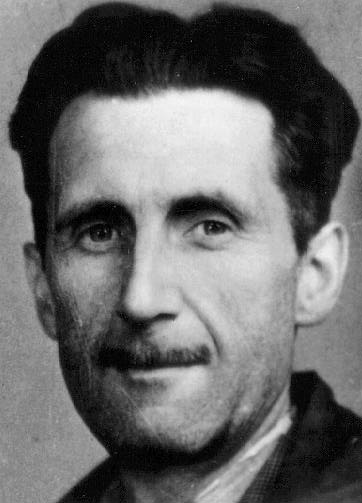
George Orwell, 1933 (Presumed Public Domain, from Wikipedia)

George Orwell, 1933 (Presumed Public Domain, from Wikipedia)

In a comment on my review last week of Kate Grenville’s One life, Lisa (ANZLitLovers) asked “Where’s Australia’s George Orwell?”. This was in reference to the idea that more novelists should write about climate change to help change public opinion. Interesting question, I thought, and one that I could explore in a Monday Musings. You might all be relieved, in fact, to have something different from my recent list-focused musings.

Before I answer the question – and then throw it open to you – it would be sensible to clarify my understanding of the question. (See, I’ve been well-grounded in essay skills: first, define your terms!) To put it simply, I believe Lisa was asking where is the Australian author who is driven to identify injustice, oppose inhumanity, and promote social conscience? That is, an author like Orwell – the man who coined terms like “cold war”, “big brother” and “thought police”, the man who used satire, allegory and other rhetorical devices in his fiction and non-fiction to show us the error of our ways. I hope this is what Lisa meant; this is, anyhow, how I am reading her question.

An Australian Orwell?

Well, a name did pop immediately into my head – Thea Astley. Of course, she’s dead, but so is George Orwell. I suspect Lisa was looking for a living Orwell to speak to us right now on “now” topics”, but, bear with me anyhow.

Astley, like Orwell, wrote in multiple forms – novels, short stories, essays – though Astley didn’t write the sorts of personal experience memoirs that Orwell did in books like Down and Out in Paris and London, The Road to Wigan Pier and Homage to Catalonia. And, unlike Orwell who travelled far and wide, physically and with his pen, Astley’s works were firmly based on Australia. But, like Orwell, she had an acerbic eye and a satiric pen, and she used it to good effect.

Ashley was also a wordsmith, albeit of a different sort to Orwell. She used words that frequently sent (and still send) her readers to the dictionary, and her passion was to “carve a good sentence”.

So far so good. However, having considered Astley, I’m now going to, reluctantly, reject her as our George Orwell. Not because she isn’t a satirist because she is, but because her satire isn’t as explicitly political as his. She was interested in the treatment of outcasts and misfits, regardless of the reason for their “otherness”, which could be race, religion, economic status, age, gender, and so on.  She satirised suburban and small town life, particularly in her first novels. She also tackled more political issues such as white Australia’s treatment of indigenous people in A kindness cup and It’s raining in mango. In Coda she satirised the treatment of ageing. And in her last novel, Drylands, issues like gender, power, modern technology, and sport attracted the attention of her sharp pen.

Astley was surely aware of the political implications of the issues she targeted, but she didn’t explicitly focus on the politics. She was, I think, more interested in the social, cultural and personal ramifications of the behaviours she put before us.

We certainly have political satirists, but they tend to be performers rather than authors.

In 2013, the Sydney Writers’ Festival included a panel discussion titled  The Satirists, which asked the question:

If Australians claim to be anti-authoritarian rabble-rousers, where is the canon of contemporary satirical novels reflecting this stereotype? What are the satirical traditions in Australian literature?

The panel included novelist David Foster, actor/novelist/memoirist William McInnes and poet Alan Wearne. I haven’t read Foster (my bad, I know) or Alan Wearne. And, I don’t think McInnes’ brand of humour, entertaining though it is, is quite what Lisa was asking. Contemporary writers I’ve read included Peter Carey and Richard Flanagan who have written some satirical novels but they are not known primarily as satirists.

So, is there anyone else – writing now – who is making it his or her business to tackle the big questions of our time, questions to do with refugees, indigenous dispossession, climate change? In Australia, or elsewhere?

POSTSCRIPT: I had just scheduled this post for publishing when up popped a blog post from today’s The Guardian. Written by Sam Twyford-Moore and titled “Why so serious: does Australian literature have a funny person problem?”, it starts with the following:

Australian authors show off their satirical chops on social media every day. So why doesn’t more of that wit spill on to the published page?

Of course, not all satire is “funny”, but, regardless, he doesn’t have an answer.

Rochelle Siemienowicz, Fallen (Review)

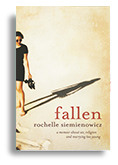
SiemienowiczFallenAffirmBeing a reader who focuses more on “truths” than “facts”, I’m not averse to writers playing around with fact in their fiction or fiction in their fact. This issue raises its head most frequently in historical fiction of course, but it’s also present in autobiographies, memoirs and even biographies. And so, here I am, having just reviewed Kate Grenville’s biography-cum-memoir of her mother, talking about another memoir, Rochelle Siemienowicz’s Fallen.

“It is a story …”

Siemienowicz’s memoir commences with – well, a literary in-joke – “Call me Eve”. What? It’s a memoir the front cover tells us, and the author’s fist name is Rochelle. Who’s this Eve? Rochelle explains in her brief introductory note, a note that precedes the Prologue, that her parents would never have named her for “that original sinner” but that it’s the name she gives herself when she thinks back to that time when she was a young wife, “so very young, so very hungry”, when she “picked the fruit and ate and drank until I was drunk with freedom and covered in juice and guilt”. The name Eve then has a symbolic meaning that forces us, as we read the book, to consider the idea of “fallen women”, but it also enables Siemienowicz to distance her present self from that young woman she once was. This reminded me of Kate Holden’s memoir, The romantic (my review), in which she chose a different path to create that separation – the third person voice.

Anyhow, having explained the name issue, Siemienowicz continues with the point that interests me, the form of her memoir. She writes that “it is a story, with parts made up and fragments rearranged like a dream half remembered now that twenty years have passed”. In the Epilogue, she mentions, almost in passing, that she’d originally written the book as a novel.

So, in Fallen we have a memoir that has strong novelistic elements, including a tight cast of characters, a deliberate narrative structure, and dialogue. You don’t find dialogue in traditional autobiographies. We readers would not believe that the writer could remember verbatim conversations held so long ago. But, dialogue is increasingly being incorporated into memoirs. Dialogue can engage readers, and while it may not represent verbatim “fact” it can convey the “truth”.  If you are starting to question by now whether this really is a memoir, I should confirm that it is fact-based, at least I believe it is, unless Siemienowicz has pushed artifice so far that her apologetic-cum-warning phone-call to her ex-husband in the Epilogue is fake! But I don’t think this is the case. There does come a point where you must suspend your disbelief and go with the writer after all.

“I feel something breaking inside of me”

Now, having spent paragraphs on introductory discussion, it’s time to say something substantial about the book’s content. Fallen is the story of a young woman raised by devout Seventh-Day Adventists (SDA) who believe, among other things, that premarital sex is a sin. To satisfy her intense sexual longings and remain “clean in the Lord’s sight”, Eve, who feels a freak in a freakish religion, marries Isaac, another SDA, in 1992 when she’s only 20. She’s deliriously happy. They love each other, and they’re free. They rebel – drink alcohol, eat meat, spend hours in bed – but then, within a couple of years, Isaac starts to withdraw, losing interest in their sexual relationship. The solution – because they love each other, and are committed to their vows (to stay married, at least) – is to have an open marriage. There’s only one rule, they must always ask permission first.

Most of the book is set in Perth in 1996, when Eve returns home to attend a conference and catch up with old friends. Her lover, Jay, is to follow for a week, followed by her husband the week later. Before Jay arrives, she reconnects with her first love, and has a fling with another conference attendee. Oh what tangled webs! Things, in other words, start to unravel, and Eve’s faith in her marriage and her vows starts to break down under the weight of secrets. She begins to question whether their rules can work “in the real world” – but the alternative, and its implications, are confronting.

“Can the centre hold …”

Memoirs are interesting beasts. Why do we read them? Sometimes it’s obvious. The memoirist is famous, or is writing about something we love (like literature, for example, for me). Sometimes it’s less obvious. It might be that the memoirist has experienced something we are experiencing like, say, grief. With Fallen, however, neither of these reasons really apply for me. So why read this one? Well, for two main reasons. One is that while the circumstances – a young woman of a strict religious upbringing trying open marriage – are rather narrowly specific, there are some broad themes. One has to do with sexual freedom. What does it mean, before, within and without marriage? How does it affect relationships? What has it to do with sincerity, intimacy and honesty? How do principles fit with feelings? There’s a broader theme too – the formation of identity. The subtitle of the memoir, “marrying too young”, hints at this. How easy is it to sustain a marriage made before you have fully formed your identity?

I feel myself spread all over the nation, with loyalties and loves and lusts from the east coast to the west, and no idea what to do with them. I’m a girl with no qualities and no boundaries, with legs wide open and a beating heart exposed. I’m appalled by myself, but also intrigued. How many tiny pieces of myself can I give away before there is nothing left? How curiously exhilarating. It feels like vertigo.

The other reason for reading this memoir is the writing. Siemienowicz knows how to tell a story. She structures the memoir around a trip back home, which she tells chronologically, but into it she weaves the story of her life and relationships to that point. We see a young woman who can be confident and brazen one moment, and vulnerable and uncertain the next, who throws herself wholeheartedly into life but doesn’t always think about where she’s pointing. And we see all this through a focused narrative and clear, direct but spirited language.

Fallen is, at times, an uncomfortable read but Siemienowicz’s honesty, her angst about her “fraying code of honour” versus her desire to fully engage in her life, captured my imagination and had me wanting her to find an honourable conclusion to a painful part of her life. This memoir is testament, I’d say, that she does.

Rochelle Siemienowicz
Fallen: A memoir of sex, religion and marrying too young
South Melbourne: Affirm Press, 2015
263pp.
ISBN: 9781922213655

(Review copy supplied by Affirm Press)