Monday musings on Australian literature: A dry or not so dry continent?

It’s rather ironic that  in the last week or two when I’ve written a couple of posts about Australia’s image* as a “sunburned land” (Barbara Hanrahan) or “sunburnt country” (Dorothea Mackellar), the image the world has been seeing is somewhat opposite – a raindrenched land. Then again, Dorothea Mackellar did also write that this is a land “of drought and flooding rains”.

So, I thought this week I’d share a few images from current poets – from The best Australian poems 2009 book which I was given a year ago. For most of these poets the imagery might come from the land and the weather, but the subject is not necessarily so …

Sarah Day‘s poem, “A dry winter (Some observations about rain)” is particularly poignant – though no less real – given current events:

… This rain moves on swiftly
leaving sun and silence in its wake …

And the poem ends with

Mostly too little rain falls here.
There is only the silence of the sun.

Even in winter after low skies
and the impression of rain

for days and weeks, the earth is dry as dust
under trees. Cracks refuse to close up

in the cold months. This makes rain exotic.
Something to pay attention to.

John Leonard’s “Rain in March” captures the cleansing effect of rain. His poem ends with:

Chirping crickets and autumn peepers
Trilling with the carolling of magpies
And currawongs, and a brief clamour
Of cockatoos.

In the muted darkness
The front passes, single drops
Spitting from a matt black sky –
Rain has washed through the world,
A faint, cool wind lifts
Branches heavy with wet leaves.

“Fred’s Farm” by Astrid Lorange is about more than the land, but it starts with

yes this is a field of gunmetal glinting like weather
an entire ecology of dead thistles mapping a drought

That imagery rather sets a tone doesn’t it … The poem is not so much about Fred’s farm – a self-consciously neutral title – as the poet’s stream of consciousness reflection on remembering a past. She’s a new young poet and one to watch…

Road to Hermannsburg, Central Australia

Road in Central Australia

For Robyn Rowland too, in “Is the light right?”, landscape and weather are closely related to mood, but there’s no simple polarity to the imagery. The water, for example, is “blood-warming” but “dark”. Her poem ends:

What if tomorrow, light is too big when it comes,
never a shadow to rest in,
no blood-warming pools of dark water to drink from,
sky never again boot-black and anxious,
and I forever driving through burning day
along ten thousand miles of loneliness.

In “The orchardist”, by Petra White, the tough needing-to-be-irrigated land breeds tough farmers. Here is a description of the landscape, with “we” being fruit pickers:

At night we walked the river, following its curves
that wound us out to where a redgum
stood marooned at water’s edge, fossilised in thirst

And then the farmer:

All day the farmer circled on his tractor, mad as a bull-rider,
lurching on thick dry mud-tracks…

Finally, a poem that harks back to the terrible fires in Victoria just two years ago, reminding us again of the extremes wrought by our “drought and flooding rains”. The poem is titled “Kinglake“, a town which bore the brunt of the Black Saturday fires. It’s by Fiona Wright and she concludes her poem about the devastation with:

Your orchard eaten into black dust.
I send you irises,
and try to write
some kind of greening.

This post is, I know, rather bitsy-piecy. The poems, which vary in theme and style, aren’t necessarily my favourites in the collection, but they show that sun and water still pervade the Australian consciousness even if the purpose to which they are put, poetically speaking, has diversified. I may return to this book in the future … but in the meantime would love to know if there’s particular imagery that represents your nation’s “being”, or, if you’re Australian, whether agree with what I’ve written?

* After all, wasn’t Bill Bryson’s book on Australia published overseas as A suburnt country?

Monday musings on Australian literature: Mountain murmurings

Mountain? Because this week’s Monday musings was inspired by my recent sojourn in the mountains. Murmurings? Because it will be more pictorial than textual. And what does all this to have with Australian literature? Two things, primarily:

  • My definition of “Australian literature” for this blog series is a broad one – it is intended to not only be about Australian literature but also about the things that our literature draws on, such as culture and landscape. This post is about a very specific part of Australian landscape.
  • In my last post, on Barbara Hanrahan, I referred to her looking in vain for “the sunburned land” she learned was her home. My aim in this post is to support her, to show that in fact much* of Australia, albeit a dry continent, is not sunburned.

Here’s a little context. The second – and most well-known – verse of Dorothea McKellar‘s famous (in Australia) poem “My country” starts with “I love a sunburnt country“. This is the image which Hanrahan rails against in her novel, and it is probably still the prevailing image Australians have (or like to have) of our country. And yet, there are other images – real ones as you’ll see in this post, and poetic ones, like the following:

By channels of coolness the echoes are calling,
And down the dim gorges I hear the creek falling
(The opening lines of  “Bell-birds”, by Henry Kendall)

There are, in other words, many ways of seeing Australia: not all of them are “sunburnt”, and neither are they all romantic or nostalgic, but those are not for today’s just-back-from-holiday mood.

So, to cut to the chase, here is a small selection of images from the Snowy Mountains (in Kosciuszko National Park). Enjoy, because next week we’ll be back to more serious stuff!

Through the stringy barks and saplings, on the rough and broken ground,
Down the hillside at a racing pace he went
(From “The man from Snowy River“, by Banjo Paterson)

Snowy Mountains, near Thredbo
In the Snowy Mountains, taken from the Thredbo riverside walk
Near the top of Dead Horse Gap walk, on the Main Range

It's mid-summer, but not so sunburnt here

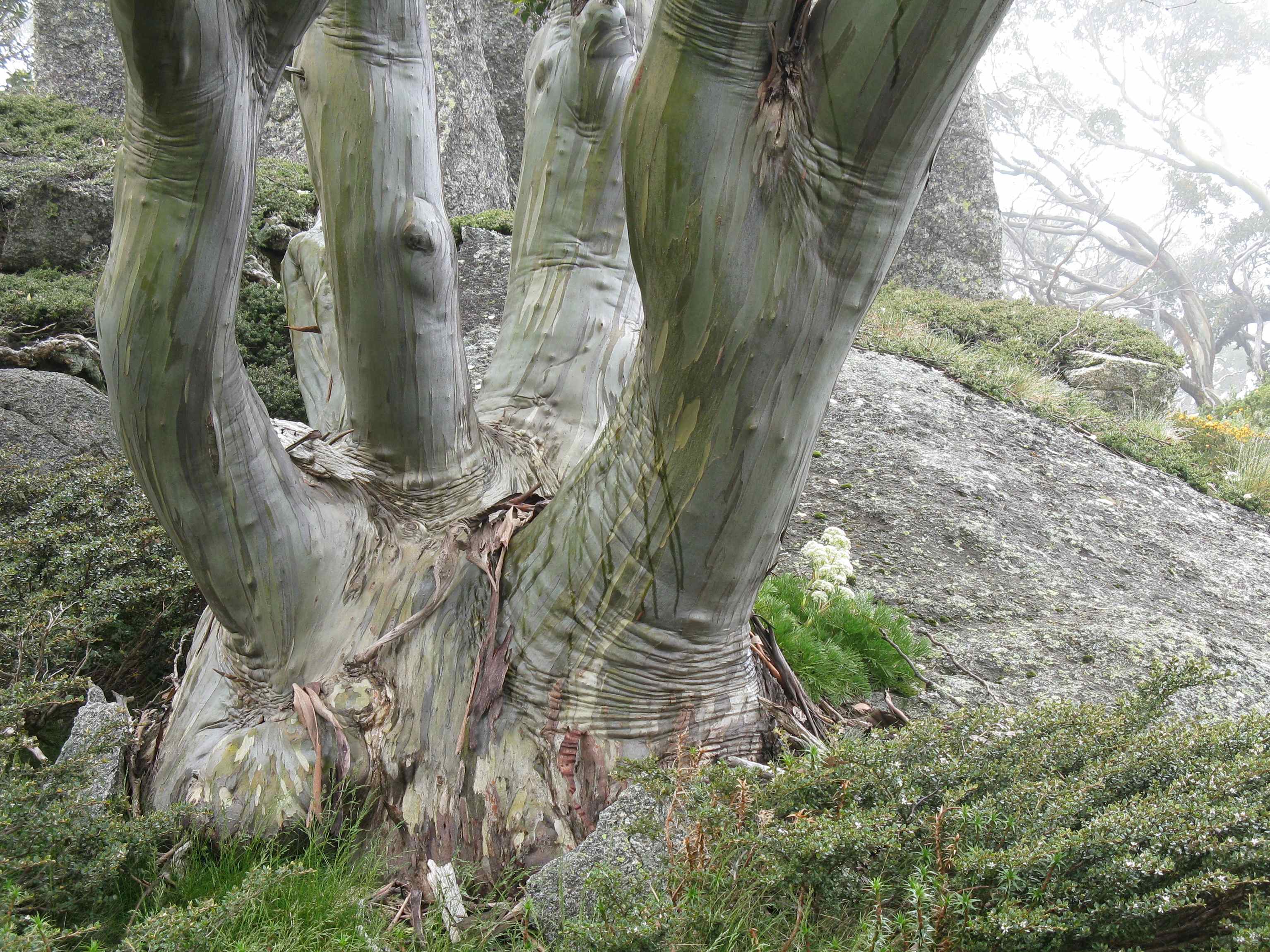
Eucalyptus Stellulata or Black Sallee

Weird but wonderful, a gum just at the tree-line

Snow Daisy close-up

Snow Daisy and friends

Gunn's Willow-herb

Gunn's Willow-herb may not be on the tip of every Australian writer's tongue but how pretty it is

Short-beaked echidna

You never know who you might meet on a bushwalk - such as a Short-beaked echidna nosing around for food

And finally, one bit of Australiana that all Aussies know: (Eastern grey) kangaroos, in the bush.

* Defined as the parts of Australia where the majority live. Much of the Australian continent is indeed pretty sunburnt!

Monday musings on Australian literature: The King’s Speech (Movie)

His Majesty King George VI of the United Kingdom.

King George VI, c. 1942 (Presumed Public Domain: From the United Nations Information Office, via Wikipedia)

I wasn’t going to review The King’s Speech, the current biopic about how Lionel Logue helped cure George VI‘s stuttering, because I mostly review Australian films. But, I do like a biopic and this film does have some Australian connections. These connections may not be particularly literary but, what the heck, at least one of the connections does relate to language … and so I’ve decided to make the review my first Monday musings of 2011.

Like most who’ve seen this film, I was engaged by it and would happily see it again to further explore its subtleties and nuances. Of course it helps that it stars Colin Firth. Anyone who has played Mr Darcy as well as he did is a friend of mine! And, it stars other actors from that wonderful 1995 miniseries of Pride and prejudice: Jennifer Ehle (Lizzie Bennet then, Myrtle Logue now) and David Bamber (Mr Collins then, a theatrical producer now). In addition, its actors include some Australians, including Geoffrey Rush as Lionel Logue and Guy Pearce as David, the abdicating King Edward VIII. And, let’s not forget the often underappreciated Helena Bonham Carter who plays George VI’s wife (later to become the much beloved Queen Mum). (Did you know that Helena’s distant cousin, Crispin, played Mr Bingley in the Firth-Ehle Pride and prejudice? Oh, the tangled webs!)

Now, I’m no expert in the history of George VI. I knew he was a shy man who did not want the monarchy; I knew he was a very popular monarch; and I was vaguely aware that he had stammered. I knew, however, absolutely nothing about the role an Australian played in the management (cure?) of this stammer. Consequently, I’m not going to comment, as I believe some others have done, on the veracity of the film. It is a biopic after all. Rather, I’ll just mention a couple of issues.

One relates to the fact that it was an Australian who helped George (Bertie to his family). At the time, the 1920s-1940s, Australians were very much seen as the “colonials” and not, really, as people who could teach the Brits anything. In the film this is portrayed pretty clearly through the Archbishop of Canterbury’s (played by another British acting great, Derek Jacobi) disdain for Logue and his lack of formal credentials, despite the successes he had already achieved with Bertie. I was tickled by the subtle way the film conveyed this little part of the history between our two nations. The tension between the two men is not subtle, but this particular subtext is.

The other issue has nothing to do with Australia, but is related to the film’s very effective sound design. First though, let’s talk Colin Firth. Can you imagine being an actor playing someone who can’t speak? What a challenge, but Firth pulls it off. The film is not afraid to let time drag when Bertie/George tries to speak. It lets the clicks and stutters reverberate as he struggles to get a word out . It’s excruciating – and is sustained just to the point at which we feel his pain and that of those around him but are not irritated by it. The score underpinning the movie is pretty spot on too – lovely original music combined with well-known music (particularly by Mozart and Beethoven). But, here’s my issue. I was intrigued by the use of a favourite piece of mine, the first movement of Beethoven’s 7th Symphony, to background the King’s first war-time speech. Beethoven? For a speech about a second war with the Germans? That was to me weird … Was it intended to be ironic in some way? The King’s triumphant speech set against the reality of what was to come?

Whatever, it’s an engaging film which not only tells a specific story about English royalty, but is also about universals: perseverance and hard work (the King’s in overcoming his speech problem), supporting, encouraging and standing by the one you love (his wife), and the value of experience and ingenuity over paper qualifications (Logue).

If you haven’t seen it yet, do … and tell them an Australian sent you!

Monday musings on Australian literature: My top Australian reads of 2010

Eva Hornung, Dogboy

Dog Boy: Winner of 2010 Prime Minister's Literary Award (Courtesy: Text Publishing)

In last week’s Monday musings I said that this series would resume in the New Year. But then the thought occurred to me: this is an Australian focused litblog, so why don’t I divide my top reads of the year into those by Australian writers, and the rest? That decision made, it seemed logical to devote the last Monday musings of the year to my top Australian reads, so – surprise – here I am again.

I never read as many books in a year as I would like to, but this year I did manage to read a range of Australian writers, including some older works I’ve been wanting to get to. I hope to achieve similarly in 2011. You never know, 2011 might be the year I finally read Christina Stead.

I’ll list the books in alphabetical order under categories (some being very short categories as we are talking top reads here).

Top recent (post 2000) fiction:

  • Eva Hornung‘s Dog Boy: Won this year’s Prime Minister’s Literary Award. It’s a visceral read which contemplates the nature of humanity.
  • MJ Hyland‘s This is how. I’m not really sure that we can claim Hyland as Australian. She wasn’t born here, and she no longer lives here. She did however do some secondary and tertiary education here. This is the sort of writing I love. The writing is tight, the tone is beautifully controlled, and the central character is so complex that even by the end you are not completely sure who you have before you.
  • David Malouf‘s Ransom: Although I had some reservations about this book in terms of its point, I did love it nonetheless. Does that make sense? Malouf’s writing is beautiful, and I love his humanity. I guess that should be enough, eh?

Two other recent Australian novels I enjoyed this year were Alex Miller‘s Lovesong and Peter Carey‘s Parrot and Olivier in America.

Top older (pre 2000) fiction:

  • Thea Astley‘s: The multiple effects of rainshadow. A re-read. I love Astley’s “imagistic” writing. This is a multiple point-of-view novel set in early 20th century northern Queensland, and deals with the emotional and social consequences of living in a difficult place at a difficult time.
  • Martin Boyd‘s A difficult young man. Part of his semi-autobiographical trilogy, this book explores the challenges of living an artistic life, of being a different person in an extraordinary family in an ordinary world. Martin Boyd is a member of one of Australia’s leading creative families.
  • Katharine Susannah Prichard‘s The pioneers. Won the Hodder and Stoughton All Empire Literature Prize for Australasia in 1915. It’s an historical novel exploring pioneer Australia, particularly in relation to our convict heritage, but I’ll say more in the coming review.

Three other older Australian novels I particularly enjoyed this year were Kate JenningsSnake, Hanz Bergner’s Between sky and sea, and Ruth Park’s Missus.

Top short stories

Regular readers of this blog know that I enjoy short stories and try to include them in my regular reading schedule. Mostly, I read one-offs, but I also enjoy collections. I only read one collection of Australian short stories this year, but it was excellent and so easily qualifies for a top read:

  • Gretchen Shirm’s Having cried wolf. Shirm is a new Australian voice. I was impressed by the tight, controlled writing she demonstrated in this set of connected stories. I hope we see more of her.

Top non-fiction

As this is primarily a litblog, I don’t read a lot of non-fiction, but there were two standouts this year:

  • Kate Jennings’ Trouble: The evolution of a radical. This is the memoir you write when you are not writing a memoir. Jennings tells her story through thematically grouped writings from her past, each group introduced by current commentary. I loved her honesty and provocativeness.
  • Anna Krien’s Into the woods. A history – exposé really – of Tasmania’s logging history. Krien may not have been as objective as she set out to be, but the book is an insightful read nonetheless.

I am reading another Australian book at present, but I don’t expect it to quite qualify for this list – and, anyhow, this is the last Monday of the year so there you have it…

I’d love to know what your favourite Australian reads of the year were – or, if you didn’t read any, whether my list above has inspired you to read any next year!

Monday musings on Australian literature: Australian Christmas imagery

As a 50-something Australian, I grew up with a big disconnect regarding Christmas. Our Christmas occurs in summer but the cards we received (and could buy) and the carols we sang (and still do) tended to be winter-focused. And then we discovered the carols by Wheeler and James. John Wheeler (lyricist) and William G James (composer) both worked for the ABC, our government-funded broadcaster. In the late 1940s-mid 1950s they wrote Christmas carols for Australians.

The most famous of the Wheeler-James carols is the “Carol of the birds”. Not only is it a lovely song, but its chorus includes, significantly, an indigenous Australian word, Orana, which means “welcome”. Our (sheet music) version of Wheeler and James’ Christmas carols comes in three sets of five carols:

  • Set 1 (1948): The three drovers; The silver stars are in the sky; Christmas Day; Carol of the birds; Christmas bush for His adorning.
  • Set 2 (1954): The day that Christ was born on; Christmas night; The little town where Christ was born; Sing Gloria; Noel-time.
  • Set 3 (1953*): The Christmas tree; Our lady of December; Golden day; Country carol (The oxen); Merry Christmas.
Paddocks in Lake George, 2005

Sheep in brown paddocks in Lake George, 2005

So, what makes these songs Australian? Most reference the Christian aspect of Christmas, as you can tell from some of the titles, but the important point is that they also evoke Australian colour and sound through celebrating our landscape, flora and fauna. Here are some examples:

The North wind is tossing the leaves,
The red dust is over the town;
The sparrows are under the eaves,
And the grass in the paddock is brown;
As we lift up our voices and sing
To the Christ-Child our Heavenly King.
(the beginning of  “Christmas Day”)

Friar birds sip the nectar of flowers,
Currawongs chant in wattle-tree bowers;
In the blue ranges Lorikeets calling-
Carol of the bushbirds rising and falling-
Chorus: Orana! Orana! Orana to Christmas Day
(Verse 3 and chorus of “Carol of the birds”)

When the sun’s a golden rose,
And the magpie carols clear,
You can say, and I can say,
On the summer morning,
Here at last is Christmas Day,
The day that Christ was born on…
(The beginning of “The Day that Christ was born on”)

Sheep in fold, Shine like gold,
As the day is dawning,
Riding by, Stockmen cry,
Welcome Christmas morning.
(Middle of first verse of “Merry Christmas”)

Interestingly, Geoff Strong, writing in The Age newspaper, believes that these songs have failed to endure, but I’m not so sure. Just because they don’t feature in shopping mall carol “musak” doesn’t mean that they’re forgotten. They are taught in schools, and recordings do exist of them. Most Australians, I believe, know at least a couple of them.

There are also more humorous, non-Christian-focused Australian Christmas songs. A couple of favourites are:

I hope you’ve enjoyed my little nod to the season. As this is the last Monday musings before Christmas, I wish all those who visit and comment on my blog, a very happy holiday season and a peaceful 2011. Monday musings will continue in the New Year.

* Don’t ask me why the date for Set 3 is before the date for Set 2, but that’s how it is.

POSTSCRIPT: The complete words to all the songs can be found on A Growing Delight’s blog.

Monday musings on Australian literature: Aussie writers and Jane Austen

Jane Austen sketch by Cassandra

Cassandra's portrait of her sister, c. 1810

Funnily enough, I’m not the only Australian who loves Jane Austen – and so we too have our very own Jane Austen juggernaut. We see the films and miniseries, we have the Jane Austen Society of Australia – and we have academics and others researching and writing on all sorts of topics relating to her. Today, I thought I’d post about one of the lighter Australian-published books on her because it is, after all, that time of year when we tend to relax the brain power a little – or, at least, I do. The book is Jane Austen: Antipodean views (edited by Suzannah Fullerton and Anne Harbers).

I clearly remember when this book was published, nearly 10 years ago, because it included comments that I related to – that tickled me, in some cases – by some Aussie writers, and so this is what I’m going to share now.

The comment that made the greatest impression on me was the one from John Marsden, a popular and award-winning Australian children’s writer:

I’ve deliberately refrained from reading Persuasion, so that I would never get to the point where I had no more Jane Austens left to read. When the doctor, with grave countenance, gives me the news that I have only three months, the grief will be mitigated by delight that at last I am allowed to read Persuasion. In the meantime, I am avoiding crossing roads when busses are in sight.

Now, I can relate to this because I too saved a Jane Austen for quite a long time. Although I’d reread all of the others a few times, I was saving Mansfield Park for the same reason. Finally, a decade or so ago, I decided that I could put it off no longer (mainly because the Patricia Rozema film version was coming and I wanted to read the book first!). I’m glad I changed my mind and I hope Marsden has too, as rereading Jane Austen is as enjoyable, really, as reading her the first time. Why deny yourself that pleasure?

Close to that one is the following from one of my very favourite Australian writers, Elizabeth Jolley:

I find in old age, I have forgotten the novels, in particular the magic of being lifted into other lives and background. Re-reading is one of the Best Things of old age. Forgetfulness – it’s like having a present.

This one tickles me because my reading group often jokes that when we get to a certain age – and it’s moving rapidly closer – we’ll read the same book over and over because it’ll be new every time! I’ll be very happy if that one book is a Jane Austen…

My third favourite comment – and those of you who regularly read my blog will soon see why – comes from the mellifluous broadcaster and writer, Phillip Adams:

The longer I live the more bored and irritated I am by excess  – and the more grateful to find such a wide range of emotions, and such accuracy of observation, in the less-is-more prose of that remarkable woman.

“Less-is-more”. Exactly so! Need I say more?

There are many more comments along similar lines to those above but, just to be even-handed, I’ll end with the words of the award-winning but clearly unenlightened children’s book author and illustrator, Graeme Base:

Jane who?

The cheek of it!

Suzannah Fullerton and Anne Harbers (eds)
Jane Austen: Antipodean views
Neutral Bay: Wellington Lane Press, 2001
168pp
ISBN: 9780908022168

Monday musings on Australian literature: Silly names for the silly season

Burrumbuttock sign

22 kms to Burrumbuttock (Courtesy: Carolyn I)

It’s nearing Christmas, and I’m getting busy, so today’s Monday musings will be short …

Ever since I started this blog series, I have wanted to write about Australian place names. We are not, I know, the only country to have interesting or fun place names – and I’d love it if you shared your favourites in the comments – but we do have some good’uns Downunder.

Oodnadatta,
Parramatta
Names to make your tonsils chatter

(From “Patter”, by Ronald Oliver Brierley)

Oodnadatta and Parramatta are just the beginning. What about Cabramatta, Wangaratta and Coolangatta? And then there’s Woolloomooloo. You have to concentrate to spell that one! (It’s a bit like, I suppose, Mississippi, isn’t it?) Many of these places appear in Lucky Starr‘s tongue twisting “I’ve been everywhere” song. You can listen to it online if you like… I love all these names. They tend to sound silly and poetic at the same time, and because of this many of them have found (and still find) their way into Australian verse and song.

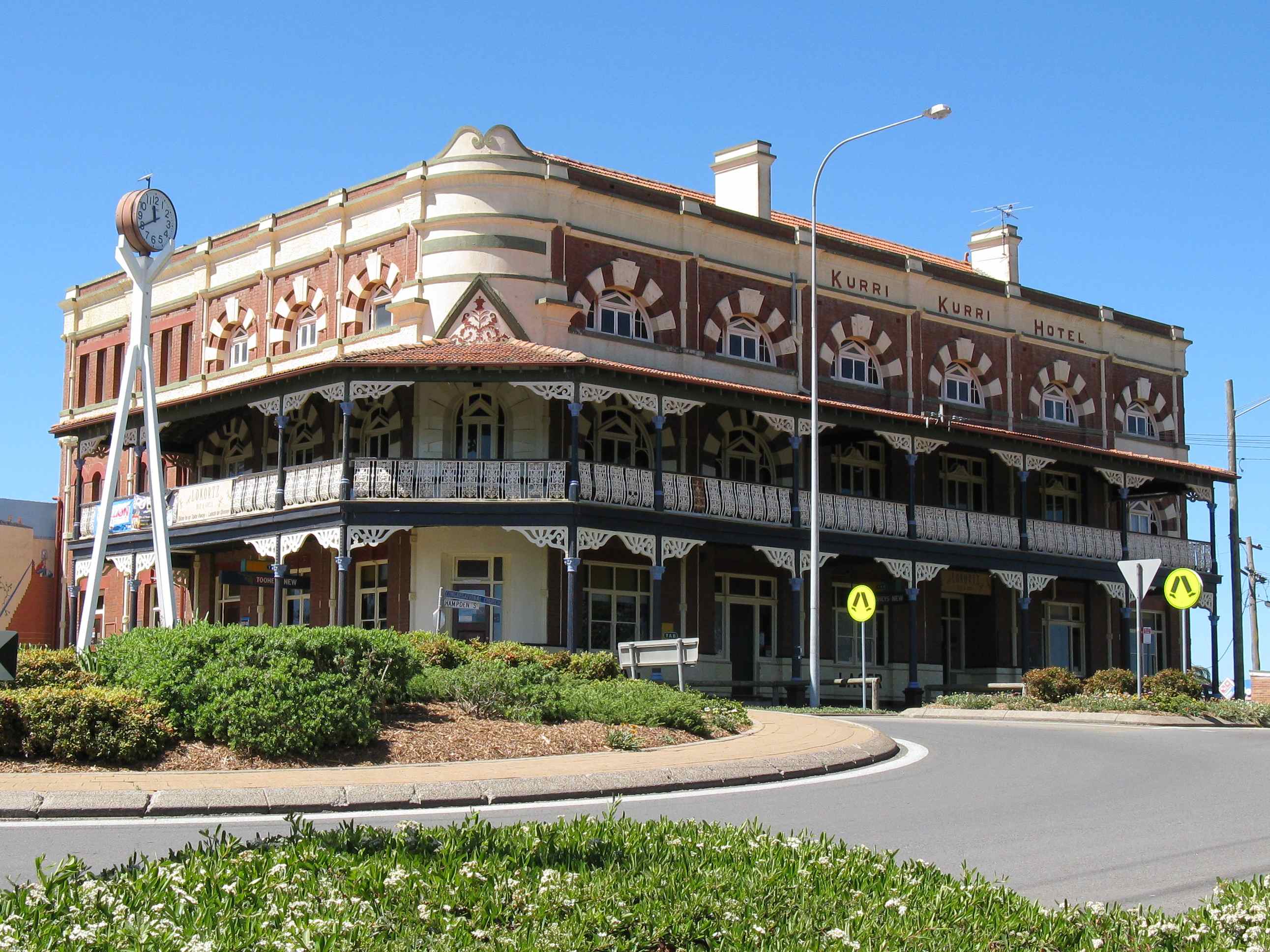
Kurri Kurri Hotel

Kurri Kurri Hotel, Kurri Kurri, NSW

But, there is a type of name that is rather endemic here, and that is the reduplicated place name. The best known one is probably Wagga Wagga – “Don’t call Wagga Wagga Wagga”* – but it’s just one of many. Here are some of my favourites: Bong Bong, Drik Drik, Gatum Gatum, Grong Grong, Kurri Kurri, Tilba Tilba and Woy Woy. You can find more in Wikipedia. English comedian Spike Milligan‘s parents moved to Woy Woy in the 1950s, and Spike wasn’t above making fun of the town. In his novel Puckoon, he wrote

There is, somewhere in the steaming bush of Australia, a waterside town called Woy Woy (Woy it is called Woy Woy Oi will never know).

Finally, in a related but somewhat different vein, is the poem, “The Integrated Adjective” about the great Australian adjective. If you don’t know what that is, you soon will. The poem was written by John O’Grady, who wrote, under the pseudonym Nino Culotta, the 1957 novel, They’re a weird mob, a comic tale of an Italian migrant’s struggles to understand and fit into his new country. Anyhow, “The Integrated Adjective” is set in a bar and is the narrator’s record of the bar-time talk he overhears:

“…. Been off the bloody booze,
Up at Tumba-bloody-rumba shootin’ kanga-bloody-roos.”

Now the bar was pretty quiet, and everybody heard
The peculiar integration of this adjectival word.

The town of course is really Tumbarumba, but do we let that spoil our story here? Abso-bloody-lutely not!

*Song by Greg Champion and Jim Haynes.

Monday musings on Australian literature: The Victorian Literary Map

This week’s Monday Musings will be a brief one, partly because my time is tight (I really must finish Parrot and Olivier in America by tomorrow) and partly because I’m primarily going to post a link to a map: the online interactive Victorian Literary Map.

As you might have guessed from my various Literary Road postings, I am rather partial to maps, particularly when they are combined with a subject of interest to me. Consequently, I was rather thrilled when I came across the Victorian Literary Map. It is a project of the State Library of Victoria, and was part of the Library’s Independent Type: Books and Writing in Victoria exhibition which celebrated Melbourne’s establishment as a UNESCO city of literature. It has Flash (with a clickable map) and Text (with a clickable alphabetical listing of towns) versions. The introduction to the text version says, simply:

Victoria is a state of rich and diverse literary culture.
View the places where some of our greatest writing was created or set, and learn about our writers and their origins.

Clicking on a place (in the map or index) can retrieve:

  • the name/s of writer/s associated with the place. Click on an author and the little pop-up “card” contains an image of the writer, a brief biography, a list of references and, where they exist, related links to another writer in the map
  • work/s set in or about the place. Click on the work and the little pop-up comprises an excerpt from the work
  • events or other literary activities associated with the place, such as Clunes Booktown

The map seems a little limited though, because the text version introduction also contains the following:

NOTE: Only towns and places that have literary records will show in the index.

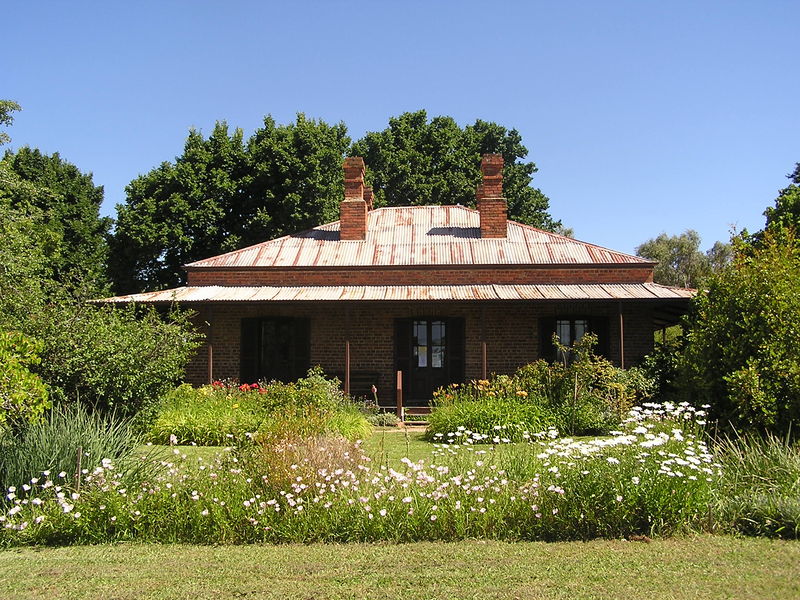
Lake View House, Chiltern
Lake View House, Chiltern (Courtesy Golden Wattle, via Wikipedia, using CC-BY-SA 2.5)

This must be why Chiltern does not appear in the map, because it certainly has literary associations. The Australian author Henry Handel Richardson lived in Lake View House for a short time, and set the early years of what is probably her most famous novel (trilogy), The fortunes of Richard Mahoney, in the town. It’s a pretty little town well worth visiting, and so it’s a shame it doesn’t appear on the map.

Anyhow, click on the map and have a look around. It’s a nice idea, though it could do with updating, in a technological sense (such as implementing some Web 2.o functionality), and expansion, in terms of content (as Victoria’s literary heritage is clearly richer than the map shows).

Oh, and I’d love to know if there are other web-based initiatives designed to help we literary travellers.

Monday musings on Australian literature: The future of Australian literature

‘If their [Australian writers’] work is so interesting,’ comes the query, ‘why isn’t it known here [London]?’

This query was put to Australian novelist and literary figure, Vance Palmer, in 1935! When I read it, I couldn’t help thinking plus ça change. A few months ago I wrote on Hilary McPhee‘s concern about the continued low profile of Australian literature overseas. She said that, while the situation has improved since the 1980s when she first wrote on the issue, it is uneven because Australian writers are “cherry-picked”. In other words, Tim Winton, Peter Carey and maybe David Malouf are known, but who else?

Anyhow, back to Palmer and 1935. His response to the question was

No use to reply that it [Australian writers’ work] is hardly known on their native heath!

That was probably so … and during the 193os and 1940s, Vance and his wife Nettie Palmer, along with writers like Flora Eldershaw, Marjorie Barnard and Frank Dalby Davison worked hard to raise awareness in Australia of Australian literature, and to secure good funding support for writers. The Palmers personally mentored writers like Eldershaw, Barnard and Davison. Nettie Palmer, in particular, corresponded regularly with writers, advising and encouraging them. Vance Palmer wrote for newspapers and journals, and lectured widely, on Australian literature.

Why do we need a national literature?

In the article “The future of Australian literature”, Palmer discusses why it’s important to have a national literature. He asks, “Why all this fuss about having a literature of our own? Why waste time writing books when ‘all the best and the latest’ can be imported from overseas?” His answer is not surprising to we readers:

The answer, of course, is that books which are revelations of our own life can’t be imported, and that they are necessary to our full growth. … since the world is divided into nations and societies, it is necessary that these shall find their own forms of expression, each subtly different from the others.

… we have to discover ourselves – our character, the character of the country, the particular kind of society that has developed here – and this can only be done through the searching explorations of literature. It is one of the limitations of the human mind that it can never grasp things fully till they are presented through the medium of art. The ordinary world is a chaos, a kaleidoscope, full of swift, meaningless impressions that efface one another; the world of a well-pondered novel or drama is designed as an orderly microcosm where people and things are shown their true significance. And so, unless a country has its life fully mirrored in books it will not show a very rich intelligence in the business of living.

He goes on to suggest that through literature, we

  • learn to understand and adjust to our surroundings or landscape (the physical, I suppose). In Australia at that time this meant learning “to live with our bonny earth with a spirit of affection. It is not the same haggard landscape our ancestors looked on with loathing” but has its own beauty in its, for example, wattle and gums.
  • discover our roots, find out who we are (what he calls, the social). In Australia at that time, that included exploring themes of exile and immigration, “the theme of the vanishing race, with its wild charm and its tragic doom”, and themes related to Australia-at-war and coping with universal economic conditions.

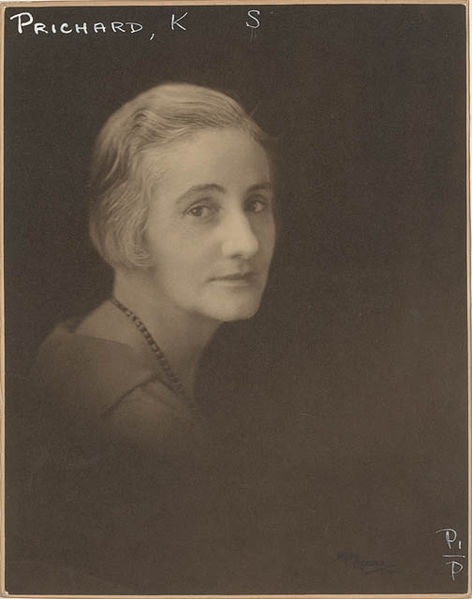
Katharine Susannah Prichard

Katharine Susannah Prichard, by May Moore (Presumed Public Domain, State Library of NSW)

He argues that change was occurring, that a national literature was developing – and gave many examples including works by those mentioned above, as well as writers like Katharine Susannah Prichard and Christina Stead.  He suggests that one of the reasons for improvement was the growth of publishing in Australia. What these publishers produce might be uneven in quantity and literary value, he said, “but at least they have taken the Australian background for granted, and that has marked an advance”. However, he bemoans the lack of “lively and intelligent [literary] criticism” which he believes is essential to writers finding “their proper audience”.

Palmer concludes positively, believing that there has been “a bubbling in our drought-scaled springs”. He says that the new literary pulse will have a significant impact on Australia in the next 50 years and will “quicken its imagination, stimulate its powers of introspection, and make it as interesting to itself as every country should be”.

There’s a lot to think about here – in terms of how Australian literature has progressed (within and without the country) and how we see the role of national literatures in our more globalised world. How important is national literature? My answer is that while nationalism, taken to exclusionist extremes, can be rather scary, we still do need to understand our own little corners of the world, in both their local, unique and their wider, universal meanings and implications.

What do you think? And how important is it, particularly with so many writers on the move, to define nationality?

Vance Palmer
“The future of Australian literature”
First published in The Age, February 9, 1935
Availability: Online

Monday musings on Australian literature: Guest post by Lisa from ANZLitLovers

When I started this Monday musings series, I said that I’d have the occasional guest post. The first one, I decided then, had to be Lisa at ANZLitLovers. Not only did she give me a lot of encouragement when I started blogging (thanks Lisa!) but she is one of our most committed bloggers on Australian literature. In her day life she is a primary school librarian, and so she decided to do her Guest Post on a subject dear to her heart. Read on …

How do we raise the next generation of booklovers?

In recent weeks there’s been a lot of chat in the blogosphere about the impact of eBooks in the marketplace, but I think reading is under more pressure from the diversity of entertainment choices that are available now, than it is from the method used to deliver the book.  I grew up without TV, so weekly visits to the library with my father were an essential component of my life from the time I first learned to read, and I’ve never lost that reading habit. Children now have so many choices, it can be hard for them to find time for a book.

So how do we raise the next generation of booklovers?  If you’re a booklover yourself, it’s important to you that your kids are too, but it’s important for all of us because reading books makes better people of us.  The world needs better people, right?

As a booklover myself I think children are deprived if they don’t have access to lovely books, so all the children in my life get books for presents until they turn into sulky teenagers, and then they’re on their own.  But getting books for presents doesn’t necessarily turn a child into one who loves books…

Remember little Scout, in To Kill A Mockingbird, when her foolish teacher forbids her to read with her father anymore? Scout is appalled.  ‘Until I feared I would lose it, I never loved to read. One does not love breathing.’  She learned to read not with pretty picture books but by reading the most boring of texts over her father’s shoulder.  She loved to do it because she was with him.  However that was in a different age, and there’s nothing to tell us that Scout went on voraciously reading books into adulthood.

As a teacher-librarian, it’s my job to share books with children.  Primary librarians don’t just manage library acquisitions and book processing, or guide students with their book borrowing and research.  We teach as well.  I have 17 classes for an hour each week.  I’m supposed to teach them research skills, and I do, but I think the literature part of my curriculum is much more important.  The kids I teach might not remember how to takes notes for a project but they will always remember the meaning of the word ‘perfidy’ – and the moral issues that lie behind it – because I read them Kate DiCamillo’s Tale of Despereaux.  They’ll also remember joining in that pleasurable gasp of woe at the end of the lesson because they have to wait till the following week to find out what will happen next.  Suspense is good!

Our definition of literature is ‘those books that you always remember, forever and ever’. What are the ones that they apply this definition to? Here are some of them:
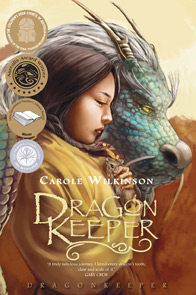
Dragon Keeper book cover
Cover image from Black Dog Books


DragonKeeper by Carole Wilkinson is a compelling fantasy/adventure series about a nameless slave girl in Ancient China whose job it is to feed the dragons.  Most boys past a certain age won’t put up with female central characters, but they sit still and listen for this one.  When the evil dragon hunter turns up to kill the last dragon for its body parts, she flees with it on an epic journey to protect a mysterious stone.  The book won the CBCA (Children’s Book Council of Australia) Book of the Year and took out a host of other awards, and my students and I went on to become keen fans of this wonderful Melbourne author. The sequel, Garden of the Purple Dragon, was shortlisted everywhere in 2006, Dragon Moon won the CBCA Award in 2008, and now there is a prequel – Dragon Dawn – which shows us Danzi as a young dragon, a mere 1000 years old.  A great favourite.

Sticking with dragons for the time being, I always read Lily Quench and the Dragon of Ashby by Natalie Prior to lure Years 3 and 4 students to reading.  Once again there is a female hero plagued by self-doubt, but she rises to the occasion (literally) when Queen Dragon lands in the grey, miserable town of Ashby and challenges the evil Black Count who has taken over everything and rules with an iron fist.  This one is rich in opportunities for discussion too, but it also features droll humour which eight and nine year old students can appreciate.  This is one of a series of seven, so the other six books are whisked off the shelves by borrowers before I’ve got to the end of chapter two…

The Deltora Quest by Emily Rodda series is a blockbuster.   Three trusty companions travel across Deltora to retrieve magic artefacts and defeat the evil Shadow Lord.  It’s a particular favourite with kids who play computer games involving collecting artefacts to fight off the Bad Guys.  No matter how many of these books I buy there are never enough, and I’ve given up trying to shelve them where they belong on the R shelf.  They have a tub of their own where the kids can riffle through looking for the title they want. (There are 15 in the series).

Another favourite is Truck Dogs, A Novel in Four Bites by Graeme Base.  He’s a picture book author and first editions of this book have full colour artwork, showing the bizarre creatures featured in this SF adventure.  It takes place at some time in the future in outback Australia when dogs have mutated into hybrid vehicles, part canine-part machine.  The hero, Sparky, (a Jack Russell/ute cross) is a scamp forever in trouble, but when a gang of Rottweilers come into town to steal all the town’s petrol, he leads the Mongrel Pack street gang to defeat Mr Big, (a Chihuahua/BMW cross) and save the day.  It’s an exciting romp with tongue-in-cheek humour and kids love it.

Do-Wrong Ron by Steven Herrick is completely different.  It’s a novel in free verse, and it tells the story of Ron who is good-hearted but manages to do almost everything wrong.  He tries to help Isabella’s grandmother who is too sad and lonely to go out of her house, and as usual things go wrong – but turn out right.  This is a great book for those under-confident kids who think they’re never going to belong, and the gentle humour is lovely.

Billy Mack’s War by James Roy is a great antidote to boys’ enthusiasm for war.   It’s set in 1945 and it tells the story of how shamefully the POWs were treated when they were evacuated back to Australia from Japan.  Billy doesn’t know his father, and he’s embarrassed and his loyalties are tested when he hears people talk about the POWs ‘sitting out the war’ while others fought.  His father’s experienced such horrors that he’s not coping with freedom very well. Not a book for under 11s, but a book that will intrigue older readers around Anzac Day…

Finally, although it’s British, I can’t resist including my favourite, Sir Gawain and the Green Knight, retold brilliantly by Michael Morpurgo, Britain’s Children’s Laureate.  This ancient tale from the 14th century takes place in Camelot, where on New Year’s Eve the feasting is interrupted by a strange green man who confronts the reputation of King Arthur’s knights with a fearsome challenge.  It is Sir Gawain who has to prove that he has courage, determination and honour, and it is this one that has my students pleading for me to read the finale even after the bell is long gone for them to go out to play.  We talk about the seven knightly virtues, and whether they still apply today; we talk about why Gawain says his life is less important than his king’s, and we talk about why flirting with your best mate’s girl is so wrong.  I read Michael Morpurgo’s version of Beowulf to Years 5 & 6 too and they love that as well (especially the gory bits), but it is Sir Gawain and his quest to do the right thing when tempted not to, who speaks to them across the centuries.

While nearly all my students love listening to stories in the library each week, I know that they don’t all turn into booklovers.  However some kids, who never used to borrow, now do so regularly and they’re in the library before school pestering me to buy new books as well.  I wish I knew the secret that makes this happen for more of them…

Back to Sue … Thanks Lisa for this inspired and inspiring guest post. Now, we’d love to hear your thoughts on the issue …