Monday musings on Australian literature: The Australian bildungsroman

Miles Franklin

Miles Franklin, c. 1940s (Presumed Public Domain, via Wikipedia)

I know the sad truth. About everything.
(Craig Silvey, Jasper Jones)

In past posts, I’ve talked of enjoying coming-of-age novels (aka bildungsroman) and so today I thought I’d share 5 (cos 5 seems like a manageable number for a list like this – and gives you an opportunity to contribute your own!) Australian novels in the genre.

In the introduction to a course on “The European bildungsroman” at Columbia University in the USA, there is a brief discussion on the definition of the term. The unnamed writer (so let’s call him/her Columbia) of the introduction says:

My particular approach to defining the genre … returns to Dilthey‘s original definition. According to Dilthey, the prototypical Bildungsroman is Goethe’s Wilhelm Meister’s Apprenticeship in which the hero engages in a double task of self-integration and integration into society.

Columbia then expounds a little on this definition arguing that, while Dilthey see this as an affirmative, conservative genre which aims to find the “hero” a productive place in a valid society, s/he sees it as involving a tension – that between “the priorities of self-integration and social integration”, between personal desire and social obligation. For Columbia this tension is a major criterion for the Bildungsroman genre. This makes sense to me … perhaps this tension isn’t an issue for every young person who is coming of age, but a coming-of-age story without that tension, without some conflict to resolve, is probably not going to be interesting to read!

(By the way, I’m not sure that this necessarily negates Dilthey’s definition. The difference between Dilthey and Columbia seems to me to be that Dilthey focuses on the end result, while Columbia focuses on the process which may or may not culminate in Dilthey’s goal.)

And so, five Australian coming-of-age novels (choosing from those I’ve read):

  • Miles Franklin‘s My brilliant career (1901) is probably Australia’s best known book of the genre. It’s a semi-autobiographical novel about Sybylla, a young girl on an outback property who must choose between her passion for a man and her passion to be a writer. It was made into a film by Australian director Gillian Armstrong.
  • Henry Handel Richardson‘s The getting of wisdom (1910) is another novel about a blue-stocking girl. Laura’s innocence and idealism are sorely tested by the city sophistication of her well-to-do peers. In this story, the awakening is more intellectual and philosophical than sexual. According to the Henry Handel Richardson Society, this novel was admired by HG Wells. It was also made into a film.
  • Melina Marchetta‘s Looking for Alibrandi (1992) is a young adult novel (and, later, a film) which adds an immigrant background to the heroine’s challenge. Not only is she a young intelligent girl who confronts her awakening sexuality but she must do so within the strictures of a conservative Italian family.
  • Tim Winton‘s Breath (2008) explores the youthful drive to prove oneself, to take risks, and the complications that arise from choosing an imperfect male role model and from becoming embroiled in a rather unhealthy sexual relationship with an older woman. Eva is no Mrs Robinson. The question left for the reader at the end goes to the heart of Columbia’s disagreement with Dilthey.
  • Craig Silvey‘s Jasper Jones (2009) is set in rural 1960s Western Australia and, with a nod to To kill a mockingbird, combines a somewhat Gothic mystery with a more traditional coming-of-age story. Racism (against immigrants and indigenous people), sexuality and learning who you can trust are some of the adult issues that Charlie confronts in his growth to maturity.

I’m intrigued by how many of these books have a rural or small town setting. (Even Laura, in The getting of wisdom, is a country child, though the book is set in a city boarding school. Looking for Alibrandi is the only truly urban novel here.) Is this because we equate country with innocence? Because rural life tends to be more conservative and therefore presents a greater challenge to a burgeoning self? Is it simply that the books I’ve chosen are not representative? Or? What do you think?

Monday musings on Australian literature: West Coast Writers

Western Australian cities, towns, settlements ...

Adapted by Mark Ryan (Image from Wikipedia under the GNU Free Documentation License)

For the non-Australians among you, Western Australia is our biggest state and, for many of us, is further away from where we live than New Zealand. Moreover, its main population areas are on the coast: there is a lot of desert between the eastern states and where most Western Australians live. Consequently, it would be true to say that more eastern Australians visit places like New Zealand and Bali than visit Western Australia – and, conversely, more Western Australians visit Bali than visit the eastern states. Every now and then they rattle the cage and speak of secession!

Western Australia was one of the first parts of the Australian mainland to have been visited by European explorers. Dutch explorer Dirk Hartog famously (to Australians) affixed a pewter plate when he visited the west coast in 1616. The first white settlement though did not occur until 1826 in Albany, followed by Swan River (now Perth) in 1829, some 40 years after Botany Bay was settled on the east. But, I am not here to give you a history of Western Australia. Rather, I’d like to introduce you to some of the writers the state has produced.

The state’s most famous writer – past or present – has to be Tim Winton. He has won the Miles Franklin award four times (only the second writer to do so) and he is still producing. He writes novels, short stories and children’s books – and he is a significant advocate for the environment. If there is such a thing as the GAN, Winton is currently seen as a major contender. Winton loves the land, and particularly the Western Australian coast. Most of his books are set there and place is significant in the lives of his characters. He once said to an Australian literary editor that “The place comes first. If the place isn’t interesting to me then I can’t feel it. I can’t feel any people in it. I can’t feel what the people are on about or likely to get up to”. He is the writer to read if you want to “feel” the state. Here are a couple of excerpts from Dirt music, on the more remote northwest:

Fitzroy River

Aerial shot of the Fitzroy River

… and Fox [in a plane] sees how the land is with its crone-skin patterns, its wens and scars and open wounds. The plains, with their sparse, grey tufts of mulga scrub, rise into the high skeletal  disarray of the sandstone ranges where rivers run like green gashes towards the sea. All rigid geometry falls away; no roads, no fences, just a confusion of colour. Out at the horizon the jagged, island-choked coast.

AND

The water is like shot silk and he barely raises a crease. It’s so hot out there, so still and clear that the distances seem to expand until everything looks twice as far as it did on the map.

But he’s not the only writer to evoke life in the West. Robert Drewe, who moved to Western Australia when he was 6 and spent his formative years there, has also written evocatively about the place. His autobiographical-cum-fictional book The shark net is a pretty confronting story about his childhood and, in particular, the role played in it by serial killer Eric Cooke who committed 8 murders the late 1950s to early 1960s.

And then there’s one of my favourite writers, Elizabeth Jolley. She migrated to Western Australia with her husband in 1959. Her writing though tends to be more interior, with place and setting used symbolically, metaphorically. Alienation and marginalisation are big themes for her, so I can’t help surmising that her dislocation from England combined with the remoteness of Western Australia contributed to this sense in her work, but it mightn’t be quite that simple. Here she is in an essay titled “A small fragment of the earth”:

In a country where a 10-centimetre map would produce sheets of blank spaces, the emptiness and the silence are impressive.

At times, in this silence, the traveller is tempted to stop the car with the idea of walking. To get out of the car and to walk. The road between empty paddocks is quiet and deserted. When walking it would be possible to accept a different view of time and journey. It would be possible to feel small and safe, walking and then pausing to stand still.

The occupation of a small fragment of the earth is known only to the person who is alone in it. It is possible to imagine the feelings of being unseen and not known about while standing alone in one isolated place, low down under the immense, clear blue sky. It might even be possible to think that all anxieties and fears will disappear. They might dissolve, dissipate themselves into the silence.

There are other significant writers too – such as Katharine Susannah Prichard, Randolph StowSally Morgan, Dorothy Hewett, Gail Jones and Craig Silvey – but I can’t possibly write about them all without becoming rather tedious. They are all worth checking out though.

Monday musings on Australian literature: Japan and Australia

I had another post partly drafted for today but, due to the events of last week in Japan, I’ve decided to postpone that idea for another time. Australia (and we are not the only country in this) has a close relationship with Japan – much of it positive, some of it negative (this latter to do with, most recently, whaling, and before that the Second World War). Like most good relationships though we accommodate the good and the bad and strive always to improve it. And here endeth that particular lesson!

Canberra Nara Candle Festival, 2008

Canberra Nara Candle Festival, 2008

I’m not going to detail the full history of our relationship now, but Japanese people have lived and worked in Australia since the nineteenth century – back then, in industries like pearl diving and sugar cane farming. Japan is an important trading partner for Australia – and so, largely for this reason, not only is Japanese a popular language taught in schools, but many cities, towns and schools across the country have sister relationships with their counterparts in Japan. Our city, Australia’s capital, is sister city to Nara, a previous Japanese capital. Our son taught English in Japan for three years. Mr Gums and I have visited Japan twice, and are booked to go again this May.

In other words, Australia’s connections with Japan are political, economic and cultural. Consequently, things Japanese are not hard to spot. Food, cars, computers and other electronic goods are the obvious manifestations, but they are in our culture too. Manga and anime for a start. However, for today’s post I’m choosing just one example. It’s a poem that was written in response to the 2004 earthquake and subsequent tsunami in the Indian Ocean. I’ve chosen it because it’s relevant now, and because it shows how language transcends boundaries. After all, when I grew up, we talked of tidal waves.

Tsunami
such a pretty word
trips off
the tongue
saltily
in pleasing phonemes
(Japanese
– you know –
like sakura and
kimono)
[ … ]

Tsunami
a slash
of syllables
– tabloid terrible –
a crackle of images
ravage
our screens.
[ … ]
lives shatter [ … ]

(from “Tsunami”, by Anita Patel, in Summer conversations, 6(2), 2006)

It’s a beautifully conceived poem, with a very Japanese sense of form and  symmetry, but for copyright reasons I don’t believe I can quote it in full.

And now, in respect for those suffering, I’ll finish here and leave further discussion of Japanese culture and Australia for better times.

Note: I have not here, or in previous posts, provided links for donations to relief efforts for the way-too-many disasters that have occurred during the time I’ve been blogging. I’m sure, after all, that you, like us, have your favourite charities to use if you wish to donate.

Monday musings on Australian literature: SPUNC has spunk

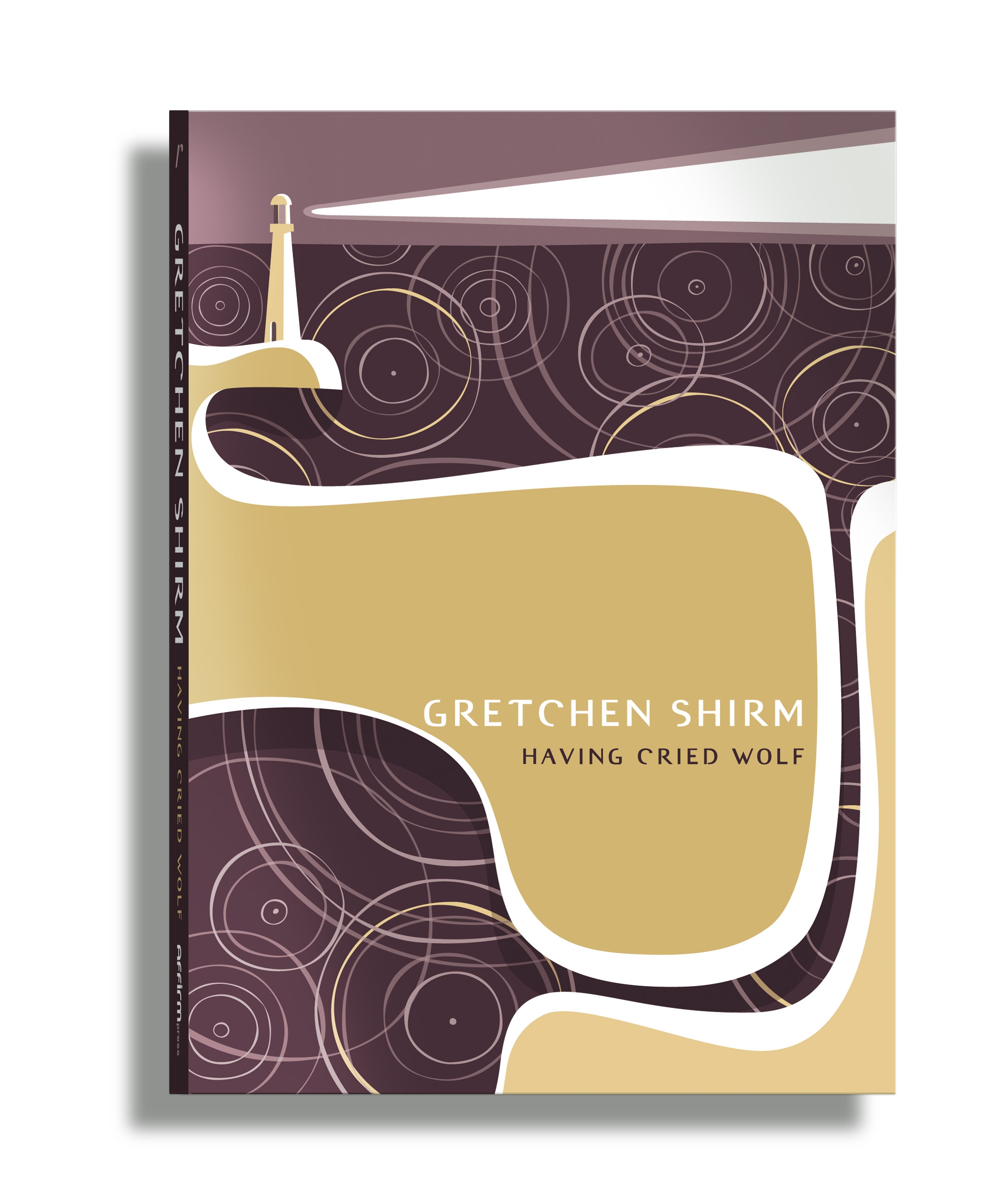
Having cried wolf, book cover

Isn’t this cover gorgeous? (Courtesy: Affirm Press)

Yes, come here for your wit. I bet I’m the first one to have thought of that line! SPUNC*, in case you haven’t heard of them and you probably haven’t, is the Small Press Network (in Australia). The acronym actually stands for Small Press Underground Networking Community. It was formed in Melbourne in 2006 and its aim – as you would have guessed – is, in its own words, “to promote independent publishing and support the principle of diversity within the publishing industry as a vital component of Australian literary culture”.

Its definition of small is, I think, pretty broad. I suspect the key word is “independent” more than “small” as its members range from what seems to me to be well-established companies, like Text Publishing, which publishes some high volume works, to smaller more boutique publishers like Ginninderra Press and, a new kid on the block, Affirm Press.

In 2007, SPUNC commissioned a report into independent publishing in Australia. It was titled A lovely kind of madness: Small and independent publishing in Australia. Aha, there it is “small” and “independent” and it seems that for the purposes of this report the focus was on the smaller end of the scale.

In fact, definition is one of the issues the report confronted and so, using the evidence they gathered from their survey and overseas research, they came up with one. Their suggested guidelines for ‘small press’ is that they are independent publishers who:

  • Have published at least one book title or journal issue (in hardcopy);
  • Have an annual turnover of $500 000 or less;
  • Have print runs of usually less than 2000;
  • Have published more than one author;
  • Publish fewer than 10 book titles per year; and
  • Usually do not charge authors fees for production, editing or distribution.
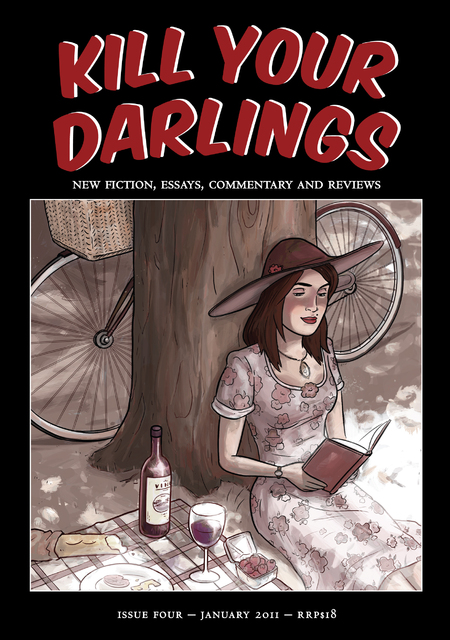
Kill Your Darlings Issue 4

Kill Your Darlings

Guess what the report found? Well, in case you can’t, I’ll tell you: it’s that the main problems faced by smaller presses are publicity and distribution. Who’da thought it?! They do admit though, that distribution in particular is a problem for all publishers, not just the small ones, due to “the combined effects of a crowded market, a geographically wide distribution area, low margins and relatively small print runs”. It’s hard running any business in “a wide brown land”.

Why am I writing this? Because I do read books from small presses, including Affirm Press, Black Inc, Ginninderra PressGiramondo Publishing, Griffith Review, and Kill Your Darlings to name just a few. And because I want them to survive: they pick up new upcoming writers; they publish poetry; they publish essays; they, in fact, make the major contribution to the diversity of publishing in Australia; they foster local talent; and they are often simply just beautiful to look at and hold.

Do you read small presses? Do they contribute to your literary scene? What do you think they could do to lift their visibility?

* POSTSCRIPT: SPUNC link removed due to Small Press Network changing its “name” from SPUNC to SPN (for obvious reasons), 20 Feb 2022.

Monday musings on Australian literature: Two Australian icons

Donald Horne (1920-2005) and Geoffrey Blainey (b. 1930) are Australian icons, not only for their body of work – which is significant – but for phrases they coined which have become part of our national consciousness. Not all Australians today will know who coined them, but most will have heard the phrases themselves.

The lucky country

The lucky country was written in 1964. The title comes from a sentence in the book:

Australia is a lucky country, run by second-rate people who share its luck.

An ironic statement, clearly! From Horne’s point of view Australia had a lot going for it – including its natural resources upon which the boom of the 1950s and 60s was primarily based – but was limited by a lack of innovative and “clever” thinking. Over the years, the phrase has been used in may ways – both ironic and literal – but for Horne the intention was clear. It was a wake-up call to Australia to grow up, throw off its colonial shackles, and start thinking for itself.

Rosa Cappiello used the phrase for the title of her book Oh lucky country. It’s still on my TBR pile, but Lisa of ANZLitLovers reviewed it in 2009. It was published in Italian in 1981, with an English translation being published by the University of Queensland Press in 1984. It is about migrant workers in Sydney … and presents an unflattering view of Australians, particularly in their (our) attitude to and acceptance of migrants. (I referred to a similar attitude in my recent review of The women in black.) Cappiello takes up the irony, albeit from a different perspective, and the book was not particularly popular (here) when it was first published! Here is the opening paragraph:

The sky here compensates for solitude. Blue-clouded. Cloudy blue. Intensely blue. It’s not the promised land. Maybe in the distant future it’ll be the last one on earth – the basis is here for the much-vaunted lucky country – but for the moment it’s neither the realisation of one’s dreams nor the land of milk and honey.

Anyhow, back to Horne. He was a prolific writer and commentator but I have only read two of his books – The lucky country (back in the 1970s) and Dying: a memoir, in which he chronicles his death from pulmonary fibrosis and passes on valuable reflections and practical information while doing so. A teacher and sharer to the end.

Mereenie Loop, Central Australia

Mereenie Loop, Central Australia

The tyranny of distance

Geoffrey Blainey’s Tyranny of distance was written two years later, in 1966, and is subtitled “how distance shaped Australia’s history”.

Australia is a big country, with a relatively small population. There’s a reason for this: much of the centre is excessively dry and barren. Consequently, the majority of the population lives on the coast – mostly in the east, but there are urban pockets and major cities in the south (Melbourne, Hobart and Adelaide), the west (Perth) and the north (Darwin). And there are thousands of kilometres between most of these. Our distance challenges are many-fold: they draw from the immense internal distances, and from geographical isolation from the world’s major centres. The latter though is gradually reducing through improved transportation, increased electronic communications, and shifts in the international balance of power (to, say, China and India).

Given the various discussions we’ve had on this blog, I’m not going to talk a lot here about distance and the Australian landscape, and how this plays out in Australian consciousness and thence in our art and literature. From the beginnings of white settlement in the late 18th century, Australians have been conscious of distance in its many forms. For example, physical distance translated into a psychological tyranny, and there is the distance between urban and rural life and culture (something I’ve touched on elsewhere).

Distance results in loneliness and alienation. It was a practical and psychological issue for pioneer women. Katharine Susannah Prichard captured that well in The pioneers (1915), particularly when the young wife is left on her own for several days while her husband goes to town for provisions:

The air was empty without the sound of Donald’s axe …

The day seemed endless …

She glanced at the child every now and then, laughing and telling him that his mother had found the wherewithal to keep her busy and gay, as a bonny baby’s mother ought to be, and that the song she was singing was a song that the women sang over their spinning wheels in the dear country that she had come from far across the sea.

Patrick White‘s Voss is an eloquent exploration of a relationship, a spiritual connection, maintained between Laura in town and Voss exploring remote regions. Its themes are not so much the tyranny of distance, but it’s under the tyranny of distance that the themes are played out. Here is Voss in a letter to Laura:

… but life and dreams of such far-reaching splendour you will surely share them in your quiet room. So we are riding together across the plains, we sit together in this black night, I reach over and touch your cheek (not for the first time). You see that separation has brought us far, far closer. Could we perhaps converse with each other at last, expressing inexpressible ideas with simple words.

In fact, for Voss and Laura distance has a freeing effect … physical absence encourages spiritual presence as it were. Distance in Australia, then, is a complex issue … it informs the foundations of our society from the mundanities of commerce to the “finest” expressions of culture. You’ve seen it already in this blog … and you’ll see it again.

To return to Blainey, he too has a significant oeuvre including, as Gideon Haigh said in that radio program I blogged about, several works of business literature. He is also known for another well-known phrase in Australian culture, the black armband view of history, but that is a story for another day.

Monday musings on Australian literature: The triumvirate

Flora Eldershaw

Flora Eldershaw, c. 1915 (Presumed Public Domain, from the National Library of Australia, via Wikipedia)

I’ve mentioned Marjorie Barnard in a couple of posts recently, but I suspect few Australians and even fewer readers from overseas (except of course Tony of Tony’s Bookworld) have ever heard of her. Rather than write specifically about her, though, I thought I’d talk a little about the Australian literary scene of the 1920s to 1940s, and about three writers in particular – Marjorie Barnard, Flora Eldershaw and Frank Dalby Davison.

I’m probably cheating here a little because, while I have read quite a bit about them over the last few years, I have read only a smidgin of their actual works. I’ve read (and re-read) Barnard’s The persimmon tree and other stories (1943) and Davison’s Man-shy (1931). I’ve dipped into Barnard and Eldershaw’s collaborative work A house is built (1929) and some of their other writings.

These three writers were part of a pretty active literary scene in Australia at the time. It included writers such as Vance and Nettie Palmer, Miles Franklin, Katharine Susannah Prichard (whom I reviewed recently), Eleanor Dark, Xavier Herbert and, yes, even, towards the end of the period, Patrick White. (Another contemporary, Christina Stead left Australia in 1928.) The reason I decided to start with these three is because of their friendship and “political activism”, mainly through the Fellowship of Australian Writers (FAW), which resulted in their being known for a time as “the triumvirate”. They were liberals who were concerned about the rise of Fascism in Europe – and the potential ramifications at “home”. Through them, in the late 1930s, the FAW engaged in political debate, particularly in relation to the protection of freedoms, such as that of speech. A topic, of course, dear to the heart of writers.

Barnard and Eldershaw wrote three novels, as M. Barnard Eldershaw, but they also wrote literary criticism and history. These days though, they are probably most read (when they are read at all) as early feminists. Neither Barnard nor Eldershaw married, though Barnard had an affair with Davison, and both lived independent lives supporting themselves through whatever work they could find. They were active in professional societies, judged literary competitions and edited anthologies. Eldershaw was a particularly skilled negotiator and worked hard to secure support for writers (via grants, pensions and other mechanisms). Vance Palmer admired Eldershaw for her ability to “neutralise conventional masculine expectations of the threat posed by women in ‘public life'”. At one stage they shared a flat, and held what could only be called a “salon”. It was attended by the literati of the day, including of course Davison.

That’s enough, though, of information you can pretty easily find in Wikipedia and other online sources. My aim here is to whet your appetite (I hope). I’ll finish with a quote from A house is built, which is set in mid-nineteenth century Sydney:

Her life was as full of ‘ifs’ as any woman’s. If she had not been so restricted, if her really considerable powers of mind and character had been given scope, Fanny would not have fallen victim to the first colourful stranger she met.

Barnard, it is reported, once said “Australia is still a man’s world”. I’d love to know what younger Australian readers of this blog think about Australia now – and whether anyone (besides Tony!) has read works by these three authors.

[Note: Some of the information for this post came from writings by Maryanne Dever whose PhD was on M. Barnard Eldershaw.]

Monday musings on Australian literature: The lost child motif

Lost

Lost, by Frederick McCubbin (Presumed Public Domain, from National Gallery of Victoria, via Wikipedia)

In his rather notorious review (1955) of Patrick White‘s The tree of man, Australian poet, A.D. Hope, at his caustic best, described the requisite features of the Great Australian novel (GAN). One of these was that it must include a child lost in the bush, a reference to the prevalence of this motif in Australian literature. The tree of man did not have such a plot line … but that wasn’t the reason Hope discarded its claims to be the GAN. Why he discarded these claims though is not the subject of this week’s Monday Musings, so let’s move on. The lost-child-in-the-bush motif can, in fact, be found throughout 19th and 20th century Australian cultural output – in literature, art and film.

My first introduction to “the lost child in the bush” story was through Banjo Paterson‘s tragic poem, “Lost” (1887):

The old man walked to the sliprail, and peered up the dark’ning track
And looked and longed for the rider who would never more come back.
The rider was a boy who had fallen from his horse and was never found, “for the ranges held him precious, and guarded their treasure well”. Oh the pathos! Around the same time that this poem was written, Australian artist Frederick McCubbin painted “Lost” (1886). It was inspired by the disappearance of 12-year-old Clara Crosbie, who was lost in the bush near Lilydale, Victoria, in 1885, but was found alive three weeks later.

One of my favourite representations of the motif is in John Heyer’s award-winning docudrama, Back of beyond (1954). It is about Tom Kruse, the Birsdville Track mailman who, every fortnight or so, made the 325-mile trip from Birdsville to Marree to deliver the mail. Inserted into this chronicle of a “typical” journey (it includes re-enactments to convey Tom Kruse’s “experience” rather than recording one actual trip) is a fictional story about two little girls becoming lost in the desert. The movie was sponsored by the Shell Oil Company with the aim of associating the company with Australia and Australianness! And so myths are made (or entrenched!).

A book I have not read (but have read about) is Charles Rowcroft‘s novel Tales of the Colonies (1843). It “features the tropes of the Aborigine as a flawless tracker or a treacherous murderer, as well as the already well-worn motif of the lost white child who falls into the hands of bushrangers and blacks”. I mention it because this idea – the lost white child and the Aboriginal tracker – is found in the most recent example I’ve experienced of the lost-child-in-the-bush idea, the short film One night the moon (2001) which was directed by indigenous Australian filmmaker, Rachel Perkins, and stars, among others, Australian musicians, Paul Kelly and Ruby Hunter.  This film’s main message is the refusal of white Australia to respect the skills and knowledge of its indigenous inhabitants – with tragic consequences. Rachel Perkins says that she wanted to make a film “about the space between black and white Australians”. How appropriate to use an age-old Australian motif for such a purpose.

Why this motif became particularly common in the Australian cultural landscape is a topic of much discussion, but the most common reasoning relates to the discomfort the early European settlers felt when confronted with a landscape that seemed harsh and alien. The fact that many of those children who actually became lost were those most familiar with the bush is perhaps the truth that spoils the story!

I’d love to hear about the motifs that run through your nation’s cultural representations – and from Australians who would like to add to my discussion here of the “lost child” motif. Do you have other examples to share?

Monday musings on Australian literature: The beach

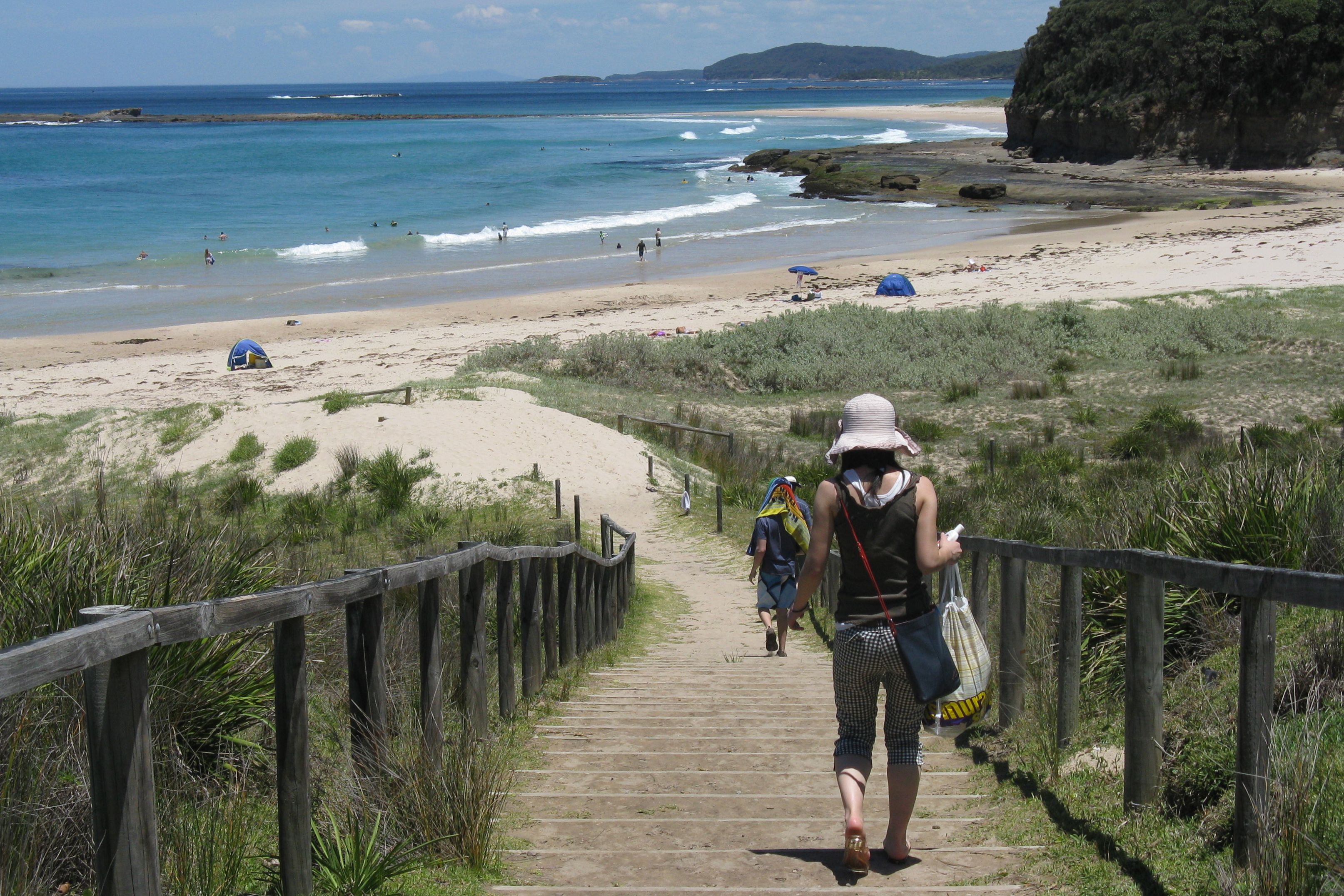
South Coast Beach, NSW

South Coast Beach, NSW

Not only do the majority of Australians live in urban areas but, given that much of Australia is dry, the majority of these urban areas are on the coast. You can guess what’s coming next – yes, the majority of Australians live near the sea. And, if they don’t, they gravitate to it in their holidays. (Australia has, it must be said, one of the highest skin cancer rates in the world.)

The sea and the beach therefore are another significant aspect of Australian cultural identity … and probably the best known contemporary writer about the beach is Tim Winton. Breath is his most recent novel, but most of his works are set in coastal areas and deal in some way with their characters’ relationship to the beach. For Winton, the beach and the surf stand for – not to beat around the bush – the meaning of life. In an interview with surfing writer Tim Baker, he says:

To me, surfing has always been soul-business. It’s the pointless things that give your life meaning. Friendship, compassion, art, love. All of them pointless. But they’re what keeps life from being meaningless. Catching a wave and turning and dancing and looping in toward the beach is one of the nicest forms of pointlessness I can think of.

That’s not to say that the beach is always positive in his work. The people who populate the stories in The turning, for example, live pretty disappointed lives in their coastal town/s. Nonetheless, when we think of Winton, it’s the love that tends to come through in the end. This love has apparently been explained in his recent memoir Land’s edge (2010), in which, according to the promos, he “records his life-long affair with the sea”. This is a book I must read.

Robert Drewe, like Winton, is based in Western Australia and writes regularly about the beach. His memoirs, novels and short story collections include The shark netThe bodysurfers, The drowner, and the The rip. He also edited The Penguin (originally, Picador) book of the beach. He, like Winton, claims to be drawn to the beach, but his books and stories explore the dangers and traps (as is pretty obvious from some of the titles!) of the beach and sea, as well as the beauty. Here is one character in The bodysurfers:

Parnell gave the impression he was king of the beach as well as of the mutton birds. He was what used to be known as a man’s man, meaning that he was a hearty male chauvinist … (from “The silver medallist”)

and, another

The coast is not what I expected. Not only is the pace faster, but there is a careless violent hedonism that astonished me at first. … When I can’t face the beach night-life, the coarse aimless lives, I close my window … (from “Shark logic”)

This mention of hedonism reminds me of the way the beach can draw into sharp relief our Western culture’s obsession with body image. Here is poet Les Murray in “On Home Beaches”:

Back, in my fifties, fatter than I was then,
I  step on the sand, belch down slight horror to walk
a wincing pit edge, waiting for the pistol shot
laughter …

So far this post has been male-dominated but there is one particularly well-known “beach” book (and later film) by women writers, and that is Puberty blues by Gabrielle Carey and Kathy Lette. It’s about two teen girls who want to become part of the cool, in-crowd on the beach, the surfie gangs, and is pretty critical of peer group pressure and male chauvinism. It’s a long time since I’ve read (and seen) it but I still remember the pain of their desperation to belong.

Hmmm … I think I have somehow managed to convey more negatives than positives about the beach and beach culture in Australia, so perhaps I will return to Winton (and Breath) to end on a high note:

I will always remember my first wave that morning … I leant across the wall of upstanding water and the board came with me as though it was part of my body and mind. The blur of spray. The billion shards of light. I remember the solitary figure watching on the beach and the flash of Loonie’s smile as I flew by; I was intoxicated. And though I’ve lived to be an old man with my own share of happiness for all the mess I made, I still judge every joyous moment, every victory and revelation against those few seconds of living.

Now is the time for me to ‘fess up. I am not really a beach person – but if anyone could convince me, it would probably be Winton.

Monday musings on Australian literature: Outback continent, urban culture?

I am sitting in my dingy little office, where a stingy
Ray of sunlight struggles feebly down between the houses tall,
And the foetid air and gritty of the dusty, dirty city
Through the open window floating, spreads its foulness over all

(From “Clancy of the Overflow“, by Banjo Paterson)

Sydney Skyline

Sydney Skyline

In “Clancy of the Overflow”, Banjo Paterson opposes the freedom of Clancy’s droving life to the narrator’s dull life in the city: “For the drover’s life has pleasures that the townsfolk never know”. This poem popped into my mind recently and made me realise that it was time I came clean. You see, I suspect I’ve been misleading my non-Aussie readers with all my posts about our sunburnt (or not) country, our gum trees, bell-birds and the like. You might, just might, have been led to believe that we Aussies are an outback, country-sort of people, but that is far from the truth. We are in fact a highly urban nation: while our population density is around 2.6 people per square kilometre, some 89% of us live in urban areas (capital and regional cities).

So, how is this reflected in our literature? Well, I’m going to look at just five examples, chronologically, starting with the late nineteenth century.

1892: William Lane’s The workingman’s paradise

is set in Sydney, though the two protagonists come from the bush, and one still works primarily on the land. It’s a political novel focusing on improving conditions for the poor in Sydney, and for shearers in the outback. The bulk of it though is about Sydney where “the streets, some wider, some narrower, all told of sordid struggling”, a Sydney that is somewhat similar to that described by Ruth Park half a century later. That is, one in which the poor struggle, in which the beauty so loved by tourists is rarely seen.

1943: Marjorie Barnard‘s The persimmon tree, and other stories

is not her most famous work but is one of that small number of books that I’ve read twice. The themes are universal – love, loss, disappointment – but they are mostly told in an urban setting. A newly widowed woman buys a new hat, a young girl buys a new dress for a special date, people meet in buffets and tea rooms, a woman goes to a party in a

block of flats. The imitation stone stair-case, mock baronial, mock grandeur, and behind the closed doors with their heavy antique knockers the same ordinary little flats … it is shattering to go up to a smug, unknown door and ring the bell, knowing that a party lurks behind it.

1948: Ruth Park‘s Harp in the south

which is set in the slums of Sydney, was controversial when it was published because of its realistic portrayal of urban poverty and the struggles that accompany living in such conditions. There were those who felt she was fostering a “cult of ugliness” and that no good could come of it. Little did they know that 60 years later this book would be regarded as an Australian classic.

1977: Helen Garner‘s Monkey grip

is also now regarded by many as an Australian classic. It’s set in inner city Melbourne, in the “bohemian” home of musicians, students, actors and, yes, drug-takers. Helen Garner’s characters – particularly her women – strive to live independent lives that are not bound by societal constrictions, the sort of lives that are hard to live in the more conservative country or the ‘burbs.

2009: Christos TsiolkasThe slap

is, by contrast, set in the ‘burbs – of Melbourne. It explores a wide range of “issues” typical (more-or-less) of middle-class suburbia. You know what they are:  relationships, employment, education and politics, not to mention aging, drugs and sex. And they are played out in backyards, workplaces, carparks, bars and all sorts of homes ranging from modest bungalows to the mansions of the nouveau riche. The setting is modern Australia – but many of us hope that the people are rather less so!

According to the Australian Government Culture Portal, Australia was well-urbanised by 1910 … and our literature to some degree reflects that. Yet, the idea of “the bush” doesn’t go away – and is still highly visible in our literature. I can think of no better recent example than Murray Bail‘s The pages (2008) in which sophisticated city meets pragmatic country. Paragraph 2 starts with two women setting out from Sydney:

They were city women. Comfortably seated and warm they were hoping to experience the unexpected, an event or person, preferably person, to enter and alter their lives. There is a certain optimism behind all travel. The passenger, who wore a chunky necklace like pebbles made out of beer bottles, had never been over the mountains before. And she was forty-three. Directions had been given in biro, on a page torn out of an exercise book. It would take all day getting there. Over the mountains, into the interior, in the backblocks of western New South Wales, which in the end is towards the sun.

Need I say more?

Monday musings on Australian literature: the Great Australian Novel, or?

Henry Handel Richardson in 1945, a year before...

Henry Handel Richardson, 1945 (Presumed Public Domain, via Wikipedia)

First, a confession. I am not one who believes we need to define such a beast as “The Great [name your country] Novel”. However, just to be perverse, I thought that for this week’s Monday musings it would be interesting to look at what might qualify for such a label – and, in doing so, consider what might constitute an Australian canon.

A canon gets us away from having to define the “Great Australian Novel”*, from having to decide whether it must be written by an Australian, must reflect “Australia” in some sort of specific way. In fact, on the latter, Professor Gelder, a literature professor from Melbourne argued in 2009 that globalisation and transnationalism make “the great Australian novel” “almost impossible”. This is because he defines the GAN in terms of being “a nationalist project”. And, perhaps, that’s the only way you can define a GAN. A canon, on the other hand, can be more diverse, can reflect the variety – in space, time, theme, and so on – that makes up our – and, any, really – national literature.

Without getting into the pros and cons, rights and wrongs, of polls, I thought I’d list the top ten Australian books (mostly novels) from  three different and reasonably recent polls to see what they tell us.

Poll 1: The Australian Society of Authors Top 10 as voted by their members in 2003:

  1. Cloudstreet (1991), Tim Winton
  2. The man who loved children (1940), Christina Stead
  3. The fortunes of Richard Mahony (1930), Henry Handel Richardson
  4. Dirt music (2001) Tim Winton
  5. Voss (1957) Patrick White
  6. The tree of man (1955), Patrick White
  7. The magic pudding (1918), Norman Lindsay (children’s)
  8. An imaginary life (1978), David Malouf
  9. Tirra lirra by the river (1978), Jessica Anderson
  10. My brother Jack (1964), George Johnston

Poll 2: The Australian Broadcasting Corporations’s Top 10, as voted by Australians via ABC promotions in 2003:

  1. Cloudstreet (1991), Tim Winton
  2. A fortunate life (1981), AB Facey (memoir)
  3. Dirt music (2001),Tim Winton
  4. My brother Jack (1964), George Johnston
  5. The magic pudding (1918), Norman Lindsay (children’s)
  6. The tree of man (1955), Patrick White
  7. Seven little Australians (1894), Ethel Turner (children’s)
  8. The fortunes of Richard Mahony (1930), Henry Handel Richardson
  9. Tomorrow when the war began (1993), John Marsden (young adult)
  10. My place (1987), Sally Morgan (memoir)

Poll 3: The Australian Book Review’s (ABR) Top 10, as voted by Australians via ABR promotions, 0ver 2009/10 (and reported by me last March)

  1. Cloudstreet (1991), Tim Winton
  2. The fortunes of Richard Mahony (1930), Henry Handel Richardson
  3. Voss (1957), by Patrick White
  4. Breath (2008) Tim Winton
  5. Oscar and Lucinda (1988), Peter Carey
  6. My brother Jack (1964), George Johnston
  7. The secret river (2005), by Kate Grenville
  8. Eucalyptus (1998), by Murray Bail
  9. The man who loved children (1940), by Christina Stead
  10. The tree of man (1955), Patrick White

Hmm … accounting for the fact that the third poll was taken several years after the first two and so includes a couple more recent books, the noticeable thing is the remarkable congruence between the three. You would have to say that, in the early twenty-first century, Tim Winton’s Cloudstreet would get the GAN gong, though Professor Gelder would disagree. He argued that only Patrick White would qualify. He said that

Tim Winton’s ‘Cloudstreet’ got close to being a ‘great Australian novel’, but at a cost. It was nostalgic, homely, remote from reality, and conservative.

Oh dear, maybe these are the very reasons the novel is popular with readers (though authors, too, liked it!)!

Anyhow, the appealing thing to me is that, despite the to-be-expected inclusion of recent authors, these lists do also take a relatively (given the youth of our country) long view. It’s good to see the inclusion of Henry Handel Richardson, Christina Stead and George Johnston, alongside the also to-be-expected inclusion of our only literary Nobel Laureate, Patrick White. And, it’s satisfying to see a goodly number of women writers recognised – not only Richardson and Stead, but also Jessica Anderson, Ethel Turner, Kate Grenville and the artist/memoirst Sally Morgan.

You might think that such agreement might be reflected in what is being taught in Australian universities but you’d be wrong, at least according to the Teaching Australian Literature website. Its Top Ten texts (that is, those appearing on most reading lists) are:

  1. The secret river (2005), Kate Grenville
  2. My brilliant career (1901), Miles Franklin
  3. Remembering Babylon (1993), David Malouf
  4. Loaded (1995), Christos Tsiolkas
  5. Carpentaria (2006), Alexis Wright
  6. True history of the Kelly Gang (2000), Peter Carey
  7. Summer of the seventeenth doll (1953), Ray Lawler (play)
  8. The monkey’s mask (1994), Dorothy Porter
  9. My place (1987), Sally Morgan (memoir)
  10. Swallow the air (2006), Tara June Winch
    True country (1993), Kim Scott

A (generally) more “edgy” list and, in its own way, rather encouraging. But, where does that leave the canon? Perhaps as a work-in-progress … to which we might (or might not!) return to in Monday musings.  Meanwhile, talking about works-in-progress, Lisa at ANZLitLovers is working on a somewhat different tack. She is developing a List of Australian/New Zealand Books You Must Read. Go check it out – and if you’d like to make a suggestion, please do …

Do you think there is value to the idea of a canon? Or does it discourage wide and open-minded reading and coincidentally encourage a too narrow view of the culture it refers to?

* the GAN, not to be confused with another GAN, the “Great American Novel”.