
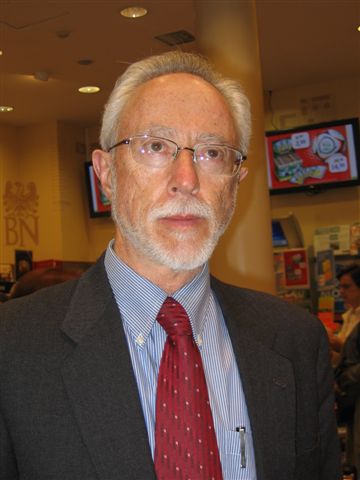
David Malouf, 2006. (Courtesy: Dariusz Peczek, via Wikipedia, using CC-BY-SA 3.0)
Queensland is the state of my birth, and that makes it special to me! It is a large state and one of our most geographically diverse, ranging from the tropical north to the arid west, from the subtropical south to the temperate inland southeast. It has one of Australia’s most popular tourist destinations, the Great Barrier Reef, and our best-known commercial tourist (and, retirement) mecca, the Gold Coast. It is unlikely, though, to be the first state people think of when asked about Australian writers …
Nonetheless, many significant writers have come from Queensland, including the indigenous poet Oodgeroo Noonuccal.
Of our contemporary writers, though, the best known Queenslander has to be David Malouf. Like most Queenslanders, he “emigrated” from there long ago and has lived in England and Tuscany as well as Sydney, but that doesn’t mean that his ties aren’t strong. Johnno, his first novel and the first one I read, is, like so many first novels, somewhat autobiographical. It describes a young boy growing up in Brisbane in the 1940s and 1950s and, as I recollect, evokes the place and time well. One of my favourite novels of his, Fly away Peter, is partly set in the (above-mentioned) Gold Coast and partly on the Western Front during World War 1. It’s a beautiful novella which explores friendship, love and life, not only against the challenges of war but also of class. And, while his most recent novel, Ransom, re-explores the story of Priam and Achilles, it was inspired by his introduction to the story of Troy in his schoolboy days. It seems, with Malouf, that you can take the boy out of Queensland but you can’t take Queensland out of the boy!
Like Malouf, Janette Turner Hospital left Queensland in early adulthood, and has spent most of her life in the United States and Canada, though she does return down under occasionally. She’s a writer who’s not afraid to take risks, and can push metaphors, sometimes to their limits (as in Charades and Borderline). Her novels range over the countries in which she’s lived, including for example, southern India in The ivory swing. Due preparations for the plague is one of those post 9/11 novels that deals with terrorism, and Orpheus lost also explores what happens when people get caught up, inadvertently for the most part, in political action. Few of her novels are set in Australia, but there’s often an Australian character.
By contrast, Andrew McGahan has remained in Australia, even if not in Queensland. He currently lives in Melbourne (I believe). His first two books, Praise and 1988, are the only books I’ve read in the “grunge” style – and I liked them. His Gen X characters are pretty aimless, and were an eye-opener for baby-boomer me. They are primarily set in Queensland. His novel The white earth won the Miles Franklin award, and is set in the Darling Downs of Queensland. It’s a coming-of-age story in which the protagonist is caught between his (white) uncle’s obsession with land and his growing awareness of indigenous people’s connection to land.
And this brings me to Alexis Wright, an indigenous Queensland writer whose larger-than-life wild-ride of a novel Carpentaria also won the Miles Franklin award. It deals with indigenous disenfranchisement, with how disconnection from the land results not only in conflict with white society but also within indigenous groups. Wright cleverly marries tragedy with comedy, and tosses in a little surrealism and magic, to demonstrate just how complex the situation is. The following excerpt captures something of the tone of the novel:
Old stories circulating around the Pricklebush were full of the utmost intrigues concerning the world. Legends of the sea were told in instalments every time you walked in the door of some old person’s house. Stories lasted months on end, and if you did not visit often, you would never know how the story ended.
That’s probably enough really, except I can’t finish without briefly mentioning two writers who were not born in Queensland but have strong associations with it. One is Thea Astley who wrote several novels set in Queensland including The multiple effects of rainshadow which I reviewed some time ago, and the poet Judith Wright about whom I must post in future. Wright used poetry not only to celebrate the landscapes she loved, but to promote issues of concern to her, including indigenous rights and environmental degradation.
Have you noticed the high proportion of women writers in this post? Queensland is often the butt of jokes in Australia for being conservative and yet, without design, I have come up with more women than men to represent writing in this state. Go figure (as they say)!





 Whispering Gums