Monday musings on Australian literature: Women writers and politics in the 1930s

I have written before about the fact that there’s been two periods in Australian literature when women writers seem to have flourished. One was around the 1920s to 1930s and the other around the 1970s to 1980s. Today I want to write a little about this first period because, from the perspective of 80 plus years later, it was an exciting period for women writers – that wasn’t sustained.

Australian academic Maryanne Dever says that “women represented a significant section of the writing community” in the interwar years and that this concentration “could be said to be one of the major distinguishing features of the then Australian literary landscape”.* Women were significant in the reviewing community, held office in major literary societies, judged literary competitions and edited anthologies. Many were also active politically. So, who were these women? I’m going to list just a few here.

Marjorie Barnard (1897-1987) and Flora Eldershaw (1897-1956)

Barnard and Eldershaw were major players in the Australian literary scene. They met at university and in 1929 won the Bulletin literary prize with their collaborative novel A house is built. Like all their collaborative works, they tackled in this book social issues, including gender stereotyping. Both held strong viewpoints regarding social justice and both were active in the Fellowship of Australian Writers, with Eldershaw becoming its first woman president in 1935. In their late thirties they shared a flat together and held what can best be described as “salons” at which a range of literary and political issues were explored with many of the intellectual luminaries of the time. Eldershaw was, not unusually for writers of the period, pro-Soviet. And she negotiated hard for writers to be supported, particularly in their old age.

Katharine Susannah Prichard (1883-1969)
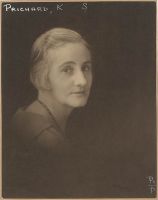
Katharine Susannah Prichard

Prichard, 1927/8 (Courtesy: State Library of NSW, via Wikimedia Commons)

Prichard, whose book The pioneers I’ve reviewed here, shared the 1929 Bulletin prize with M. Barnard Eldershaw, for her book Coonardoo (which I have also read, but many years ago). Coonardoo is one of the first Australian books to deal with a relationship between a white and an indigenous Australian. Prichard was a founding member of the Communist Party of Australia. Her novels documented people’s struggles, in work and relationships with each other. Her son, Ric Throssell, became an Australian diplomat and writer.

Miles Franklin (1879-1954)

Franklin’s career started long before the period I’m writing about here – My brilliant career was published in 1901 – but she was still active during this period and in fact won a prize in 1936 for her novel All that swagger**. I can’t resist sharing this excerpt which describes the hero, Danny, chopping down gum trees:

Guarding the illusive land were throngs of giants–the stateliest trees on the globe. Delacy was like an ant in the aisles of box trees and towering river gums, but he attacked them as an army, grunting with effort, sweat dripping from him. His slight form grew as wiry as steel; his hands were corneous and scarred with the work of felling and grubbing. (All that swagger, Ch. 3)

A contemporary reviewer described it as “probably the finest Australian novel ever written”. It deals with an Irish immigrant and his family’s history in Australia over 100 years, up to 1933. The Bulletin ‘s reviewer suggests that the hero, Danny, “seems certain to take a lasting place in Australian literary tradition.” The reviewer, I think, got that wrong, but Miles Franklin herself has achieved this through the eponymous prize she bequested. What is less well-known is that Franklin was politically active much of her life, and in fact spent around 9 years working for the National Women’s Trade Union League in Chicago from 1906 to 1915. On her return to Australia she worked hard to promote Australian literature, supporting, for example, the creation of fellowships for writers.

Other writers

Other politically active writers at the time included Jean Devanny, who was a Communist and who used her writing to promote her ideology; Eleanor Dark, who was active in the Labor left; and Nettie Palmer, who actively mentored younger writers like Marjorie Barnard and Flora Eldershaw and who, with her husband Vance, was anti-Fascist and a proponent of egalitarianism.

Literary histories about the period rarely mention any of these writers in isolation, which tells us something about the richness of the literary life of the time and of their collaborative approach to promoting not only Australian literature but also the values they thought should underpin Australian life. I never tire of reading about them, but I still have a way to go before I can feel well-read in their writings.

*From my research for Wikipedia. The citation is: Dever, Maryanne (1994) “Conventional women of ability: M. Barnard Eldershaw and the question of women’s cultural authority” in Dever, Maryanne (ed) Wildflowers and Witches: Women and Culture in Australia 1910-1945, St Lucia, University of Queensland Press, pp. 133–146

** Accessible online at Project Gutenberg Australia

DISCLAIMER: I have read works by most of these writers, but mostly long ago. I hope, in future months and years, to (re)read their works, and review them here.

Monday musings on Australian literature: Australian Living Treasures

English: Kate Grenville, Australian author.

Grenville, 2011 (Courtesy: Kathleen Smith, via Wikipedia, using CC-BY-SA 3.0)

Over the weekend, the list of Australian Living Treasures was updated. This has to happen every now then because, you know, our living treasures have a habit of dying eventually, which rather disqualifies them from the list!

I’ve chosen to write this post this week for two reasons. The most obvious one is the updating of the list over the weekend, but the other reason is that this week that contains International Women’s Day, which is a good week to highlight the place of women in our culture. And for me a good place to start is our women writers.

Well, now, how many Australian women writers – and by writers I mean novelists and poets, those people who use their imagination to hold a mirror up to humanity – do you think appear in the current list? ONE*! Yep, Colleen McCullough is the ONLY female novelist included in the list. FOUR men are included, novelists Thomas Keneally, David Malouf and Tim Winton, and poet Les Murray. (I won’t discuss here the other significant fact, that only around 30 of the 100 treasures are women.)

I have no problems, of course, with the inclusion of Keneally, Malouf and Winton. Good writers all, who have excellent track records not only with their writing but with their wider contribution to public thought on significant political, ethical and environmental issues. But, only one woman? And that, a woman who, though popular, would not be the first to spring to our lips when we think of significant Australian women novelists. Moreover, she’s had her share of controversy that may suggest her contribution to our society is not of the ilk of Keneally et al. But that’s something you can check out yourselves to make up your own minds. She is though, to use a word commonly applied to women, feisty, and that is not a bad thing.

Australian Women Writers Challenge 2012 Badge

Australian Women Writers Challenge (Design: Book'dout - Shelleyrae)

But where, for example, is Helen Garner? Her body of fiction and non-fiction has, from the time she first hit the bookstands a few decades ago, made us think and argue about literature, values and ethics. And what about Kate Grenville? Or, Marion Halligan? Or … well there are many other Australian women writers with significant bodies of work but they are JUST NOT WELL KNOWN and there’s the rub … because this list is a popularly voted list coordinated by the National Trust of Australia. And so the story continues … if you don’t get the airplay, you don’t get well-known and if you don’t get well-known, you don’t get the airplay …

This is, I know, a simplistic post on a complex issue … but sometimes simple does the job.

* Two excellent women writers have been removed from the list due to their deaths, Elizabeth Jolley and Judith Wright. Thea Astley, though, has not been removed – because she was never there. Why!

Monday musings on Australian literature: Guest post from Tony of Tony’s Book World

As with most of my guest posters to date, I came across Tony (of Tony’s Book World) not long after I commenced blogging. He stood out like a beacon because he was a non-Aussie blogger who had read a significant amount of Australian literature, including Patrick White no less. If you check his blog, you will find that he even has a page listing his favourite Australian fiction. He (so far, anyhow) doesn’t have any other nationally focused pages. How could I not ask him to write a guest post here! Thanks Tony, it’s been great getting to know you through blogging. Not only have I enjoyed getting to know my own literature through other eyes but you’ve introduced me to some writers – like Dawn Powell – that I know will be up my alley.

Tony has chosen for his topic one of the grand dames of Australian literature …

Henry Handel Richardson and The Fortunes of Richard Mahony

English:

Henry Handel Richardson, 1945, by Coster (Presumed Public Domain, via Wikipedia)

It is terrific and I am grateful to Sue for having this opportunity to guest write in “Whispering Gums”. It took me long enough to figure out that a Whispering Gum is a tree, an Australian (eucalyptus?) tree.

I have never been to Australia. In fact I live about as far on Earth from Australia as you can get in Minneapolis, Minnesota, US, where most of our trees are either oaks or pine trees. Yet over the years I’ve developed a passion for Australian literature starting with Christina Stead and Patrick White (whom I consider probably the greatest novelist ever, just to give you an idea where I’m coming from). My appreciation of Australian literature has continued through the years with many writers including such recent writers as Tim Winton, M. J. Hyland, and Joan London.

Today I want to write about the “The Fortunes of Richard Mahony” trilogy by Henry Handel Richardson which I consider the high point of Australian literature along with Patrick White’s novels. Henry Handel Richardson was the male pseudonym of woman writer Ethel Florence Lindesay Richardson who lived from 1870 to 1946. I read this entire trilogy back in 1991 and 1992, and it was one of my most moving reading experiences.

Each of her (Henry Handel Richardson’s) novels is an effort to understand and to make us understand the complexities of a human situation, and this is in itself an invigorating and sometimes subversive exercise in following truth along unexpected paths. — Karen MacLeod, Henry Handel Richardson (1985)

Richardson later wrote that the character of Richard Mahony was based on her own physician father. What makes this trilogy so moving is the complexity and unsparing honesty that Richardson brings to the character of Richard Mahony. Just as perceptive parents know their own children, faults and all, better than anyone else in the world, children as they grow up observe their parents closely. Most children love their parents, but that does not mean they aren’t aware of their faults. From your own children, you can run but you can’t hide. Richardson gives the reader the full portrait of Richard Mahony entirely free of sentimentality. In fact Richardson said that so much had been written about the great successes among the Australian people, she wanted to give a picture of one of the many failures, and so we have this story of the slow decline of Richard Mahony.

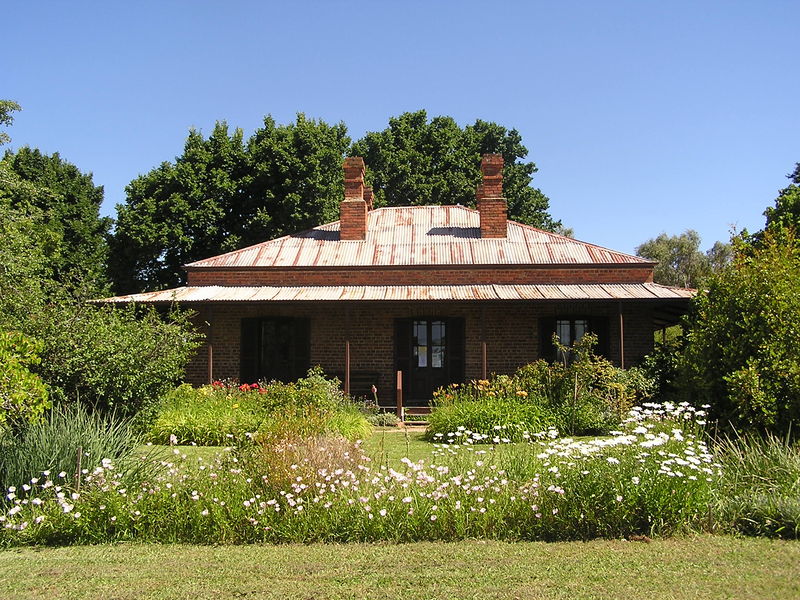
Lake View House, Chiltern

Lake View House, Chiltern, where Richardson lived when young (By Golden Wattle, via Wikipedia, using CC-BY-SA 2.5)

The first volume of the trilogy, “Australia Felix” begins at the goldfields near Melbourne in 1852. Richard is a young man just arrived from Dublin, Ireland and he is running the Diggers Emporium on the goldfields. He is more interested in reading philosophy than drinking and socializing, and most of his neighbors dislike him, thinking he is arrogant. He does meet fifteen year-old Polly whom he marries. Polly, later known as Mary, becomes a strong female figure in the trilogy. After losing his store due to accidentally selling spoiled flour, Richard takes up his original profession as a doctor

In the second volume, “The Way Home” Richard and Mary go back to the British Isles, this time to Glasgow, but soon Richard decides they can never be successful there and the couple returns to Australia and locate in the goldfields in Ballarat where he establishes a practice as a doctor. Here they finally have a daughter.

When the first two volumes of The Fortunes of Richard Mahony were originally published, there was little fanfare and few sales. All that changed when the third volume, “Ultima Thule”, was published in 1929. It was greeted with a chorus of praise from the critics, had good sales, and overnight Richardson became famous. Readers finally latched on to the tragedy of Richard Mahony and his family.

As the story in the trilogy continues, a strange thing happens. As I mentioned before, Richardson’s portrayal of Richard Mahony is honest and unsparing. Yet the reader is sympathetic and cares more about what happens to this man because of his faults and failures, not in spite of them. Richardson presents a total human being defects and all, and this complete blunt account gives the trilogy its power. Richardson applies these same forthright techniques to the wife Mary and the daughter.

Another distinctive feature of the trilogy is the style of the writing. Richardson’s writing has a visceral natural quality that puts you in to whatever scene she is depicting. I still remember some of the intense goldfield scenes vividly. There are similarities in her style to that of Patrick White, and I can’t help but think that White had read The Fortunes of Richard Mahony carefully sometime before writing his own novels.

One of Richardson’s literary heroes was Leo Tolstoy. “This is not a novel, it is a world”, wrote W. D. Howells of Tolstoy’s War and Peace, and the same line applies to The Fortunes of Richard Mahony. All of life is in these pages. As an unknown English critic said of The Fortunes of Richard Mahony, it is “one of the great inexorable books of the world’’.

The book Henry Handel Richardson – A Study by Nettie Palmer (1950) was very helpful to me in writing this article.

Monday musings on Australian literature: Judging a book by its cover

“Don’t judge a book by its cover” is one of those mantras that we’ve all heard. It’s a pretty valid one too – literally and metaphorically – but that doesn’t mean that we can’t enjoy looking at bookcovers and handling beautifully produced books, does it? At least that’s how I see it as a reader. For sellers, it’s a different matter. For them, there is everything to be gained and nothing to be lost in having beautiful looking and feeling books on their shelves. They know that even a nerdy reader like me will be attracted by a gorgeously produced book, will want to pick it up and fondle it and, if content matches the form, will then go ahead and buy it.

I am not going to go into the art and economics of book design here, but there is some new thinking afoot with the rise of the ebook. Publishers are starting to think again about form (and content, of course!). If you are interested in the topic, read this Guardian article by Kathryn Hughes.

Monday Musings though is about Australian literature and so I’m just going to talk about a few Australian book designers. This will be completely serendipitous because, while I do love to handle a beautiful book, I’m one of those readers who tends to be oblivious to the hard work of those behind its production. So, here goes, with apologies to all those wonderful designers I’ve overlooked.

Dean Gorissen

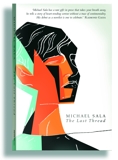
Michael Sala The last thread bookcover

The last thread (Courtesy: Affirm Press)

I discovered Gorissen only recently through the books he has designed for Affirm Press. I’ve reviewed three books in the Long Story Short Series and Michael Sala’s The last thread, all of which were designed by Gorissen. On his blog he has announced that he received a Bronze award in New York’s 3×3 Illustration Annual for the Long Story Short series and that the last three books in this series – the three I reviewed – won Gold in the Illustrators Australia Awards for 2012. What can I say? These are beautiful books – just a little smaller than the usual paperback which makes them nice to hold and tote around, and with intriguing cover designs that make you think.

On his blog Dean says this about designing his cover for The last thread:

It’s an inspiring often disturbing book and its challenge to me was to try and bring out the qualities of loneliness, sorrow, hope and ultimate strength of Michael’s story

Sandy Cull (gogoGinkgo)

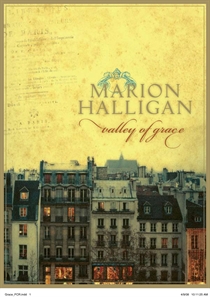
Valley of Grace book cover (Courtesy: Allen & Unwin)

One of my favourite recent(ish) paperbacks – to read and hold – is Marion Halligan‘s Valley of Grace. It’s one of those books that falls open beautifully, making it easy to read. Its font type and size is – yes – easy to read. It has a rich, yellow cover that almost glitters, and yet is subtle at the same time. And, it has flaps, like a hardback. In other words, lovely to hold and read.

Cull, who has twice won the APA Best Designed Book of the Year award, worked for Penguin for many years, before setting up her own company, gogoGinkgo, in 2005. In 2010 she started a blog, aboutbookdesign, to “chinwag about designing for the publishing industry in Australia”. It’s worth a peek. Oh, and she judged the Illustrators Australia Awards in 2011, for which Dean Gorissen designed the “call for entries”.

WH Chong

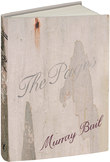
Murray Bail, The pages

The pages (Courtesy: Text Publishing)

My third example of a book I like is a hardback.  I tend to prefer paperbacks, mainly because they are smaller and lighter to carry. You won’t be surprised to hear, then, that my favourite hardbacks, from a design point of view, tend to be short books. Murray Bail‘s The pages is such a book. The cover was designed by WH Chong, who apparently works regularly with Susan Miller, an “internal designer”. Chong is a long time designer with Text Publishing, and he too, like Cull, writes a blog, called Culture Mulcher. And, like Gorissen and Cull, he has won awards for his covers. One of his awards was for John Marsden’s Hamlet. You might like to read his comments about it on this Book Design blog.

Anyhow, back to The pages. I like it because the cover is subtle and understated, which works well for this spare book about a man’s attempt to write a new philosophy. It has rough cut pages. At least some of the pages are, which works well because they give the book a lovely tactility without making it too tricky to open and turn the pages …

… which brings me to my reader’s manifesto about book design. A book must function well as a book. I do wish more publishers would think about that when they choose binding, paper edges, paper type, and font type and size.

There’s so much more to explore about book design – and particularly about how designers are meeting current challenges, not only those presented by the e-book phenomenon but also by the demand for sustainability. Meanwhile, though, you know what I’m going to ask! How important is book design to you, and what are your favourite books from a design perspective?

Monday musings on Australian literature: Favourite first (Australian) lines

This is a bit of a copout, I know, but I’m travelling this week and don’t have a lot of time to write a seriously considered post. So, I’ve decided to simply do a list – of some of my favourite first lines from Australian literature. Like most readers I think, I do love a good first line, and the way it can get you into the story from the get-go. We all know the famous ones from books like Pride and prejudice, Moby Dick, A tale of two citiesAnna Karenina but these books haven’t cornered the market on great first lines. Here are some of my favourites from Australian works (in alphabetical order by author):

“I’m losing my nouns”, she admitted. (from Thea Astley‘s Coda)

“I’ve never sailed the Amazon.” (from Thea Astley’s Drylands)

No one knew or cared where the Newspaper of Claremont Street went in her spare time. (from Elizabeth Jolley‘s The newspaper of Claremont Street)

What have you brought me Hester? (from Elizabeth Jolley’s The well)

The sea has many voices. (from David Malouf‘s Ransom)

Breed ’em tough, the old man says … (from Geoff Page‘s verse novel, The scarring)

There was movement at the station, for the word had passed around/That the colt from old Regret had got away … (from Banjo Paterson‘s poem, “The man from Snowy River)

“There is a man here, miss, asking for your uncle,” said Rose. (from Patrick White‘s Voss)

What makes a great first line? Here are some of the features that grab me – though not every great first line has all of these:

  • Is brief or spare (though there are some good long ones like A tale of two cities)
  • Reads well, particularly in terms of rhythm
  • Surprises me, shocks me or makes me laugh
  • Is puzzling or mysterious
  • Contains wordplay or intriguing imagery

There are practical things good first lines may do too, such as give an idea of what the novel is about and/or its theme/s (even if this isn’t immediately clear), set the tone and, perhaps, introduce the main (or, a significant) character. But these are additional benefits. I don’t think they are essential to grabbing the first-time reader.

How important is a first line to you? Guy Dammann, writing in The Guardian bookblog argues they are critical:

They say you should never judge a book by its cover, but they didn’t say anything about opening lines, which are surely fair game. For it seems to me that if the author can’t take the trouble, or hasn’t got the nous, to sculpt those words from which all the rest flow, then they probably won’t have taken the trouble in all those other key moments of the text when the interpretative pressure is at its highest, when the duty to capture a whole fictional world in a single breath is at its most pressing. Screw up the opening, screw up the book.

Do you have favourite first lines? I’d love to hear them – and your reasons if you’d like to share that too.

Monday musings on Australian literature: Jessica Anderson

Every now and then I feature a specific writer in my Monday Musings – and they’ve usually been women because they tend to be overlooked. Take Jessica Anderson (1916-2010), for example. Most keen AusLit readers will know her because her novel Tirra lirra by the river made quite a splash when it was published in 1978, but my sense is that her “fame” doesn’t go much past this.

She is, however, one of our great writers:

  • She won the Miles Franklin Award award, twice: Tirra lirra by the river in 1978, and The impersonators in 1980.
  • The impersonators also won the New South Wales Premier’s Literary Award in 1981.
  • Her book of short stories, Stories from the warm zone and Sydney stories, won The Age Book of the Year in 1987.
  • Tirra lirra by the river was included in Australian classics: 50 great writers and their celebrated works, by Jane Gleeson-White.
  • Tirra lirra by the river was also included in the admittedly eclectic, but international, The modern library: The 200 best novels in English since 1950, by Carmen Callil and Colm Tóibín
  • She is taught in many university (and, I believe, high school) literature courses.
  • She’s a good example of a late bloomer, with her first novel, An ordinary lunacy, being published when she was 47.

An ordinary lunacy was, in fact, published in England, having been rejected by Australian publisher, Angus and Robertson. Gleeson-White quotes Anderson saying that she didn’t think Australian publishers in the 1960s would like her novel about “how a utilitarian society treats those with unserviceable gifts”. Ouch!

Of course, like most late bloomers, Anderson had been writing long before she was first published. It was probably the increased focus on women stemming from the second wave of feminism in the 1970s which resulted in authors like her getting their chance. There’s that fashion thing again, eh? But this doesn’t mean that she didn’t deserve it. Beatrice Davis, one of the Miles Franklin judges, said that Tirra lirra by the river “has an unpretentious elegance, an individual quality so different from the realistic documentary that still dominates the field in Australian novels”. Here is the opening sentence:

I arrive at the house wearing a suit – greyish, it doesn’t matter. It is wool because even in these sub-tropical places spring afternoons can be cold. I am wearing a plain felt hat with a brim, and my bi-focal spectacles with the chain attached. I am not wearing the gloves Fred gave me because I have left them behind in the car, but I don’t know that yet.

I love this opening, which introduces us to the narrator, Nora Porteous, late in her life, as she returns “home” after many decades away. It’s so precise, and yet with tantalising hints of uncertainty. Oh dear, as I pick it up, I feel I want to read it all over again and follow Nora as she reviews her life, and the decisions she made in search of “her place”, only to end up back where she started, thinking, processing and wondering.

Most of Anderson’s work was contemporary, but she did write one historical novel, The commandant (1975), which she calls her favourite. I reviewed it as part of Sydney University Press’s Australian Classics Library. Like Nora in Tirra lirra, the main character here, Frances, is not in her “place”. She’s with family, but her views, her aspirations, are different to those around her. She must navigate this family, this society, to develop her self.

According to Gleeson-White, Anderson greatly admired the novelist, Henry Green (recently featured by Stu at Winston’s Dad) for his “poetic brevity”. I think this brevity is partly what draws me to Anderson. Stories of women feeling at odds with their lot are not, after all, unusual, but it takes some skill to cover several decades in less than 150 pages, as Anderson does in Tirra lirra. Anderson was also, says Gleeson-White, inspired by Christina Stead for showing her “there was an Australian background I could use: the urban background of For love alone“. I’d love to understand this a little more … what was it about Stead’s urban background that differed from that of other Australian writers?

Near the end of Tirra Lirra, Nora says:

I find myself thinking that we were all great story-tellers at number six. Yes, all of us, meeting in passages or assembling in each other’s quarters or in the square, were busily collating, and presenting to ourselves and the other three, the truthful fictions of our lives.

“Truthful fictions”. An intriguing concept that we can read several ways … but that is for another day. In the meantime, I commend Jessica Anderson to those of you who haven’t read her. Meanwhile, I must read her One of the wattle birds which has been languishing on my TBR for far too long.

Note: This post is not a review for the Australian Women Writers 2012 challenge, but I plan this year to write a number of posts supporting the challenge’s promotion of Australian women writers … which is not a hard ask given my reading priorities!

Monday musings on Australian literature: On the making of a classic

Having completed the book, I tried to get it published, but everyone to whom I offered it refused even to look at the manuscript on the ground that no Colonial could write anything worth reading. They gave no reason for this extraordinary opinion, but it was sufficient for them, and they laughed to scorn the idea that any good could come out of Nazareth – i.e. the Colonies. (Fergus Hume in the Preface to the 1898 revised edition of his The mystery of a hansom cab)

Rather coincidentally, I finished reading Fergus Hume’s The mystery of a hansom cab a few days after I wrote last week’s Monday Musings on nurturing Australian classics. The quote above doesn’t exactly relate to today’s topic on the creation of a classic but to the difficult business of getting published in the first place. However, it does lead nicely into today’s discussion, partly because a book must be published before it can hope to be a classic (duh!), but mainly because today’s topic was inspired by the new introduction to Sydney University Press’s 2010 edition of Hume’s novel.

In this introduction, Robert Dixon of Sydney University commences by stating that when people are asked to nominate the most popular Australian writers of the late nineteenth century they tend to name Marcus Clarke (The term of his natural life), Rolf Boldrewood (Robbery under arms), Banjo Paterson and Henry Lawson. They do not, in other words, mention Fergus Hume whose book achieved “impressive sales”. Nor do they mention writers like Ada Cambridge (whom I’ve featured in a past Monday musings). Why?

Dixon has some suggestions. One is commercial, that is availability. He quotes another academic in the field, Paul Eggert, as saying that a “consensus about the nineteenth-century classics emerged quite suddenly among reviewers around the Centenary year of 1888, which hardened into an orthodoxy” in early histories of literature. This resulted in Clarke’s, Boldrewood’s and Kinsley’s (The recollections of Geoffrey Hamlyn) novels becoming available cheaply and in quantity. But why these particular works? Well, Dixon says that there was a growing interest in the colonial past, an “emerging literary nationalism”, which

not only displaced a generation of female authors of domestic realism, such as Catherine Spence, Ada Cambridge and Catherine Martin, but also male writers of urban-based popular fiction, including Fergus Hume and Nat Gould.

He continues:

By the time the first critical evaluations of Australian literature came to be written in the early decades of the new century, Eggert notes, ‘the die had been cast’. The mystery of a hansom cab was urban, not pastoral, international rather than national in outlook, and ‘neither a detective story nor a turf tale* was going to compete seriously with the Kingsley-Clarke-Boldrewood trio’.

Interesting, eh? The logical outcome, of course, is that if a book is overlooked early in its life (due to “fashion” or the “fickle finger of fate”) it has a hard road back to serious recognition. But then, feminist studies over the last half century have already shown us how books (art, music, or whatever endeavour you care to mention) by women have regularly been overlooked by the creators of “the canon”.

It would be nice to think that “quality” (I’m not going to get into definitions of that now) will rise to the top but, while we probably agree in general that those books currently labelled “classics” are so, it’s pretty clear that there are many more works out there equally deserving of the label – if only we knew about them. That’s the real pity of it … so I’d like to thank all those publishers who, over recent years, have sussed out “quality” older works and re-introduced them to us. I hope they keep doing so.

All that said, it begs the question about today’s authors and books, doesn’t it? Will the swag of awards we have now be the arbiter of what become future classics? Or will best-selling status be the go? Will future publishers suss out the overlooked – and what will they be? Oh for a crystal ball.

Addendum to last week

In last week’s post I reported that Melbourne University did not teach one Australian literature course in 2011. Here is student Stephanie Guest’s take on the situation as she reported in the Australian Book Review (undated):

… at the University of Melbourne, there was only one subject on Australian literature, ‘The Australian Imaginary’. To my chagrin, the handbook reported that it was not available in 2011. There may be specialised branches of Australian literature taught in Croatia and Texas, but at Melbourne there was not even a general course on offer. The carelessness towards Australian literary studies was clear from the listing in the course curriculum of Murray Bail as ‘Murray Bird’.

The head of the English department told me that staff shortages, reduced funding for the Arts Faculty, and low student interest in the subject were responsible for the absence of Australian Literature in 2011.

* Nat Gould’s milieu

Monday musings on Australian literature: On nurturing Australian literary classics

Over the weekend an article appeared in The Age describing the parlous situation regarding recognition of classic Australian literature. Written by Michael Heyward of Text Publishing, it’s titled “Classics going to waste” and argues that those who have the power

to choose and influence what people might read – publishers, professors, teachers, journalists, commentators, editors – have done a lamentable job of curating the primary materials of our literary history.

Heyward provides some embarrassing arguments to support his case. Here are three of them. In 2011, he says:

  • Melbourne University did not offer one course in Australian literature;
  • not a single (university, I presume) course taught Henry Handel Richardson‘s The fortunes of Richard Mahony, which he equated with not one Russian University teaching Anna Karenina; and
  • David Ireland‘s The glass canoe, which won the Miles Franklin in 1976, was not in print, while new copies can be bought of that year’s Pulitzer Prize winner, Saul Bellow‘s Humboldt’s gift.

The good old cultural cringe is with us still. I was very disappointed when in the late 1990s/early 2000s my children were taught little or no Australian literature at high school but were taught, instead, books (albeit worthy) like Steinbeck’s Of mice and men. They read, while growing up, a lot of excellent Australian children’s literature but as soon as they moved into adult literature the situation changed, particularly in terms of their formal studies. Heyward quotes a Melbourne University academic, GH Cowling, saying, admittedly back in 1935, that

The rewards of Australian literature are not good enough to make it attract the best minds … Good Australian novels which are entirely Australian are bound to be few … Australian life is too lacking in tradition, and too confused, to make many first class novels.

Really! Really? This rather reminds me of VS Naipul’s recent statement that no women writers are his literary match because of their “sentimentality, the narrow view of the world”. Both views are pretty prescriptive, and seem to define good literature more by the importance of its subject matter rather than by the quality of its expression of ideas and experience. It’s why many people still – men more often – discount Jane Austen. But I digress!

Heyward then announces that Text plans to help rectify the accessibility issue by publishing a series of cheap versions of Australian classics – which seems, in publisher jargon, to include books only 20-30 years old, but who’s going to quibble? Good for them, I say. However, there are other publishers working in this arena. Here (excluding libraries and secondhand booksellers) are some current sources of Australian Classics:

For these initiatives to succeed, we need to buy the books. But to buy them we need to know they exist. How do we do that? Well, through reviews (hail litbloggers, for a start), through film and movie adaptations (of which there aren’t enough, says Heyward), through their being taught in schools and universities, and through online initiatives such as those I wrote about earlier this month.

Do you have any other ideas? And what, if any, is your favourite Aussie classic?

Monday musings on Australian literature: Australia’s first Children’s Laureates

Australian Children's Laureate logo

Logo Courtesy: Australian Children's Laureate

It has been so busy here at Monday Musings that I am late with this announcement … but that doesn’t mean it’s not worth making! On December 6th, 2011, the idea of an Australian Children’s Laureate was inaugurated with the appointment of not one, but two, children’s authors to the role. They are

Alison Lester and Boori Monty Pryor

and they will be our laureates for two years, 2012-2013. I understand that the idea of a Children’s Laureate was instigated in the United Kingdom in 1999. In 2008, the Library of Congress inaugurated a similar role, but called theirs National Ambassador for Young People’s Literature. What’s in a name, eh? The main point is that these initiatives promote reading among children. The Australian program is organised by the Australian Children’s Literature Alliance and on their Laureate website they describe the laureate’s role as follows:

The Children’s Laureate will be an Australian author and/or illustrator of children’s and/or youth literature who is making a significant contribution to the children’s literature canon of this country. The Laureate will be appointed on a biennial basis and will promote the transformational power of reading, creativity and story in the lives of young Australians, while acting as a national and international ambassador for Australian children’s literature.

So, a little about Australia’s inaugural laureates …

Alison Lester (b. 1952)

I became aware of writer-illustrator Lester through my own children when, like most parents who are readers, I sought out good books to read aloud to them. Lester is an author/illustrator best known for her picture books, though she has also written a couple of young adult novels. My favourites were two of her picture books, Imagine (1988) and Rosie sips spiders (1989), and the “chapter” book (as new readers like to call them) Thingnapped, written by Robin Klein and illustrated by Lester. She has a lovely sense of fun while also conveying important values to children (such as respecting difference, a critical value at a time when rejecting other seems to be on the rise again.)

Boori Monty Pryor (b. 1950)

I did not know of Boori Monty Pryor – writer, artist, performer, storyteller – when my children were growing up. In fact, I only heard of him a couple of years ago when a friend lent me his memoir Maybe tomorrow which I reviewed in the early days of this blog. I came across him again last year when he was on the Prime Minister’s Literary Awards panel I attended. He impressed me – in both “meetings” – with his strength, his humour, and his ability and willingness to overcome his anger at the way his people have been treated. He’s an indigenous Australian, and he’s committed to forging good relationships among all Australians while at the same time shoring up traditional culture and values among indigenous people. No easy task, but his appointment to the laureate role is testament to his achievements.

To conclude, I must note that our inaugural laureates are a woman and an indigenous Australian. I’m sure there are many worthy white male contenders out there, but I believe that Lester and Pryor were not token appointments. They are worthy recipients who have proven track records in the quality and significance of their contributions to encouraging reading, story-telling and self-expression among Australian children.

Monday musings on Australian literature: Guest post from Kim of Reading Matters

This week’s Monday musings brings you my fourth guest post, this time from Kim of Reading Matters. Like Guy, Kim started commenting on my blog in its infancy and I soon discovered that this blogger from England was actually an Australian. Naturally we developed a rapport. I have appreciated Kim’s support of my blog – through regular commenting  (particularly in my fledgling days) and through inviting me to be a Triple Choice Tuesday guest. She is one of England’s top litbloggers and this month is hosting an Australian literature month as I advised in last week’s Monday Musings.

I’m thrilled that Kim decided to write on children’s literature. Her guest post on children’s classics beautifully complements Louise’s recent post on current writers/illustrators.

Australian classic books from an Australian childhood

When you are an Australian expat who’s lived overseas for as long as I have (13 years and counting…) it’s easy to think you’ve never lived anywhere else. Then you have little “cultural blips” that rudely remind you that you grew up on the other side of the world.

For me, these “blips” usually occur when friends and colleagues start reminiscing about sweets (or should that be lollies?) from their childhood that are no longer available, or British TV shows they watched when they were growing up which were never screened in Australia. Once I had to sit in on a lengthy discussion about children’s literature where many of the references went completely over my head.

This got me thinking about my favourite books from childhood, all by Australian authors, which do not appear to have ever attracted an international audience. Here are three classics, none of which have been out of print in Australia, that mean a lot to me:

Blinky Bill by Dorothy Wall

Dorothy Wall (1894-1942), a New Zealand-born Australian, originally illustrated books for other writers before creating her own series about a mischievous male koala called Blinky Bill. The first book — Blinky Bill: The Quaint Little Australian— was published in 1933 and two others followed — Blinky Bill Grows Up (1934) and Blinky Bill and Nutsy (1937).

My aunt had three books in one beautifully bound volume. I still remember the distinctive red cover and the cheeky little picture of Blinky Bill, wearing bright orange trousers, toting a swag and billy can on a stick slung over his shoulder. It was always a real treat when I was allowed to take the book down from the shelf and look at the colour-plates inside. I remember turning the pages with awe and being very careful not to mark the book in any way.

Funnily enough I can’t really remember what the stories were about, but I remember the pictures with almost perfect clarity, they were so vivid and funny.

I’m delighted to say that you can read the text online at Project Gutenberg Australia

The Muddle-Headed Wombat by Ruth Park

The muddle-headed wombat by Ruth Park, book cover

Ruth Park (1917-2010), yet another New Zealand born author who called Australia home, also turned to Australian wildlife for inspiration.

Her main character was a wombat — a creature with which many non-Australians may not be familiar, think of a very cute furry pig with a cheeky face and short stumpy legs — whom was very muddle-headed.  He spoke in spoonerisms and misused similar sounding words — for instance “sensibubble” instead of “sensible” — which meant he often said very funny things without realizing it.

Wombat, as he was officially known, had two friends — a skinny grey cat called Tabby and a practical female mouse called Mouse — whom accompanied him on all kinds of adventures.

I can only recall vague details of particular stories — there were more than 16 in the series, all written between 1962 and 1971 to accompany an ABC radio show, which was cancelled by the time I was born. For instance, in one story Wombat bought a bicycle with shiny red wheels and in another he ate some chalk that made him sick.

But it was the quite hilarious illustrations that I remember most — along with the cute red jacket and floppy purple hat Wombat used to wear!

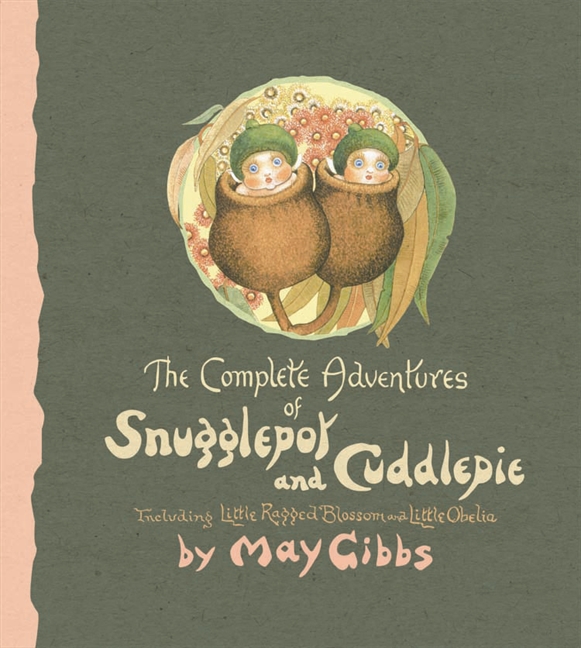
The Adventures of Snugglepot and Cuddlepie by May Gibbs

May Gibbs' Snugglepot and Cuddlepie

May Gibbs (1877-1969) was an English-born Australian writer and illustrator whose stories were inspired by Australian native flora.

She’s probably best known for her gumnut babies, Snugglepot and Cuddlepie, who are cute little foster brothers that resemble eucalyptus nuts.

The pair go on an adventure in the Australian bush, but they have to take care not to run into the big bad Banksia men — horrible creatures modeled on banksia cones, which are a bit like hairy pinecones.

As a child I remember being physically scared of the Banksia men, but as ever in the world of children’s literature, good overcomes evil and they sink to the bottom of the sea!

The best part about Snugglepot and Cuddlepie, which was first published in 1918, are the truly beautiful illustrations by the author. To this day these illustrations are used on all kinds of merchandise, but what I hadn’t realized until I started writing this piece is that all profits go to UNICEF, the Spastic Centre of NSW and the NSW Society for Crippled Children (now the Northcott Society), according to the wishes of May Gibbs’ bequest.

May Gibbs home Nutcote, on the shores of Sydney Harbour, is also open to the public.

I suspect that all three books, with their emphasis on Australia’s unique plants and animals, may be responsible, not only for my love of Australian literature, but my love and respect of the Australian bush, too.