Monday musings on Australian literature: Writing the Australian landscape (2)

In this week’s Monday Musings*, I plan to continue last week’s discussion of some of the ideas that arose from the National Library of Australia’s Writing the Australian Landscape conference.

But first, I’ll recap the two questions posed by the keynote speakers:

  • Day 1, author Murray Bail suggested that only when we are at ease with ourselves will our need to discuss place (or landscape) fall away.
  • Day 2, historian Bill Gammage asked How long must we continue to write our landscape as outsiders?

Thinking about these over the past week, I’ve come to the notion that these could (almost) be seen as two sides of the same coin. That is, as I understood him, Bail wasn’t so much suggesting that we’ll end up not discussing place or landscape but that we won’t “need” to focus on it to prove our Australianness, to confirm our identity. Landscape would then become part of the background, it would be part of us, and we would no longer be outsiders to it. Does this make sense or am I twisting their words, I wonder?

The meaning of place

Several “place” related concepts were discussed over the weekend, sometimes with clear definitions, and sometimes more loosely. Many speakers talked about the relationship between Landscape, Place, Country and Culture. Landscape was not seen as purely physical but as something that we relate to and/or that impacts on us. Gammage argued that it takes time and memory to translate “landscape” to “country” or “culture”. Historian Matthew Higgins talked about “place memory” and suggested that when we talk about and remember place, “life is as important as the landscape”.

Gammage, and several other writers including Sue Woolfe, Charles Massy and Ros Moriarty, spoke of learning about indigenous Australians’ relationship to the land, a relationship in which the physicality of the land is inextricably entwined with spirituality. People, land and law are three aspects, he said, of the one thing.  While westerners objectify the land – as in, “isn’t it beautiful?” – indigenous Australians see their ancestors in it. Landcare is the business of life. Climate change activist, Anna Rose, and Adrian Hyland, who wrote Kinglake 350 about the Black Saturday fires, would agree, albeit from a different perspective.
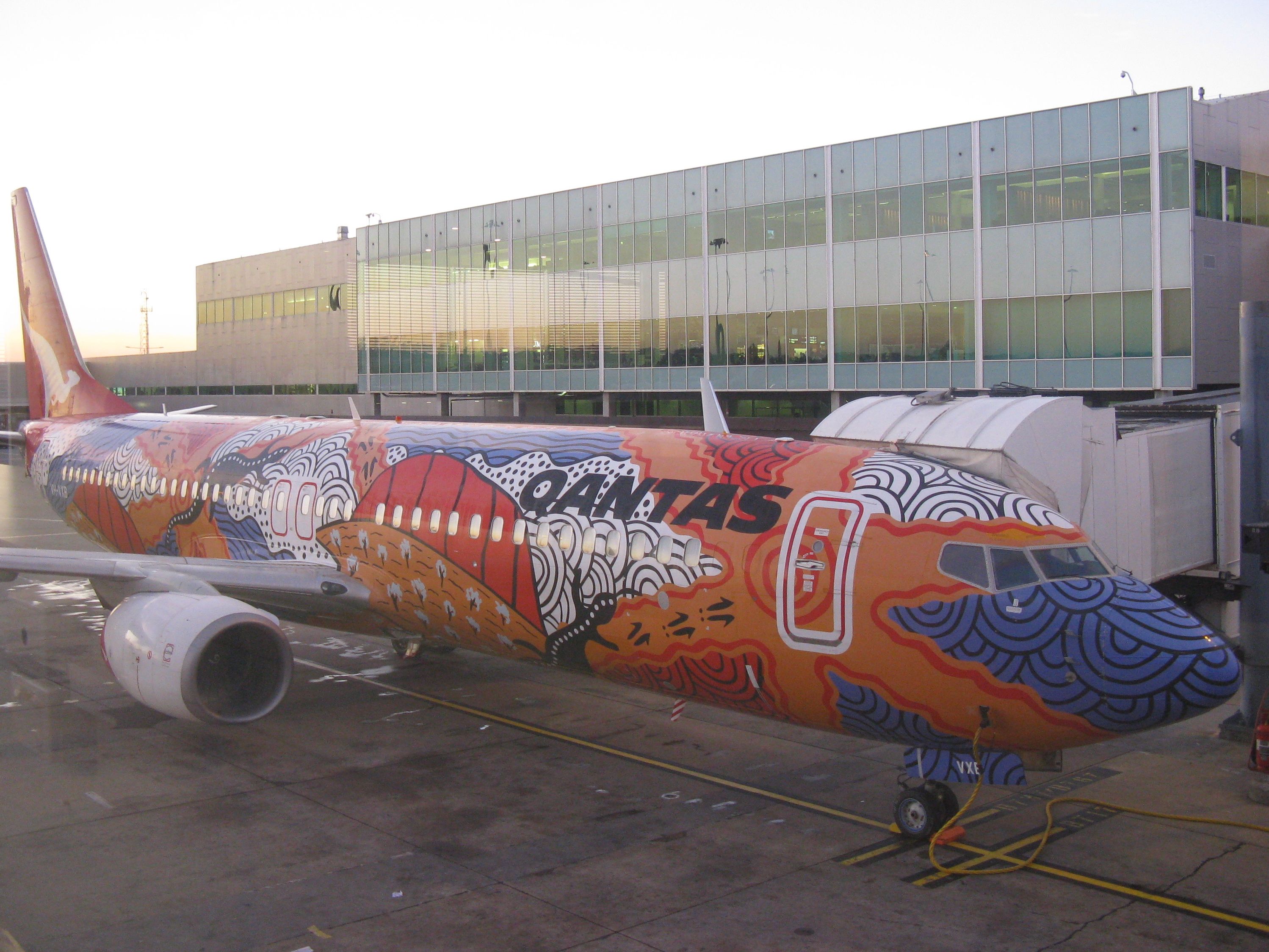
John Moriarty Qantas Plane

John Moriarty Qantas Plane

Non-indigenous woman Ros Moriarty, who is married to indigenous Australian John Moriarty, said:

Australians have no idea that the singing of the continent continues. We sip at the edge of its physicality when we could gulp from the well of its spirit.

This message, reiterated slightly differently by many of the speakers, was the most powerful message (for me, anyhow) of the weekend. It wasn’t a new concept to many of us I think, but the strength and clarity of its communication was moving and inspiring.

… And then, late in the conference came …

Jeanine Leane

I’m singling out Jeanine Leane because she was, as far as I’m aware, the only indigenous writer to speak at the conference. I have read and reviewed Leane’s gently powerful Purple threads, and was looking forward to seeing her in the flesh. She had a big task, but she was up for the challenge. She reiterated the points made by other speakers regarding country and its meaning for indigenous Australians but she, of course, spoke from the experience of having walked the talk. She knew intimately whereof she spoke and showed how much we westerners, albeit with a lot of goodwill, stumble around in our understanding.

For example, she spoke of the notion of Australian “classics”. She argued that the works of writers like Xavier Herbert, Patrick White, David Malouf, and Kate Grenville, which are regularly identified as “classics”, are classics of the settler quest written for settler readers. Within the concept of “classic”, she argued, is the question, “Whose classic?” Leane pushed the point further by referencing Alexis Wright, author of Carpentaria (my review). Western (white) critics, she said, see magical realism in Wright’s work. (Ouch!) But the notion of “magic”, she argued, is used by settler critics for things they can’t understand. For Wright, though, the point is that “if you can’t see that tree behaving strangely, that’s your problem”.

Leane seemed, however, more optimistic than angry, for all the strength of her argument. She said that there is a proliferation of Aboriginal writing across genres, and that this writing expresses not only the “generational story of loss and longing” but also people’s aspirations. I hope she’s right, but even more, I hope more of it is taught is Australian schools and read by Australians of all backgrounds.

And this brings me back to Bail and Gammage. How should we “settler” Australians proceed? How do we relate to the “place” in which we live in a way that isn’t superficial or tokenistic but that doesn’t (arrogantly) presume a connection that we don’t have?  We have a way to go yet.

* There is more to say, but this will be the last post for the moment. I may share more again later, perhaps after the papers become available on the NLA’s website.
Monday musings on Australian literature: Writing the Australian landscape

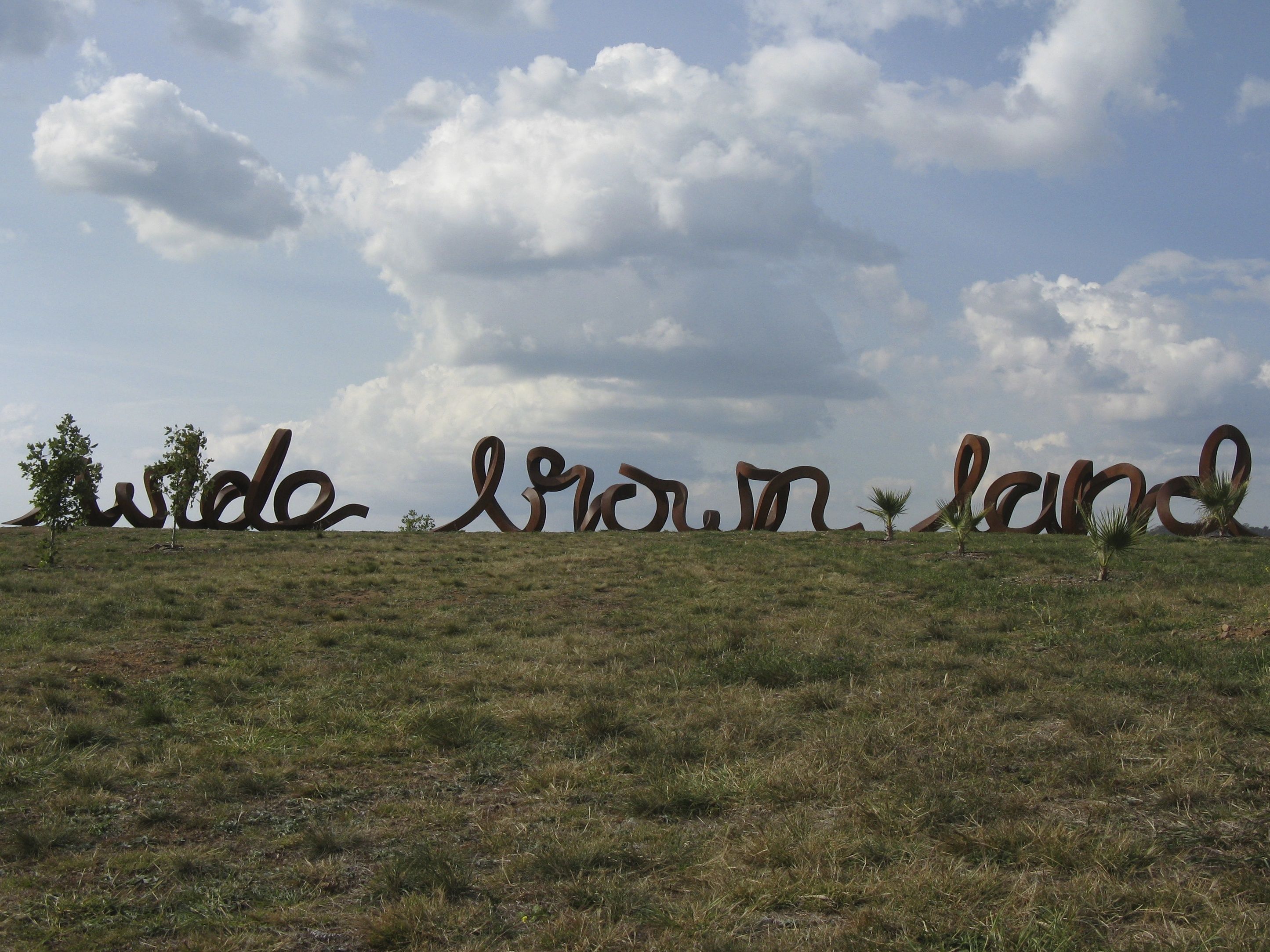
Wide Brown Land sculpture

Wide Brown Land (National Arboretum)

This weekend just gone I had the privilege – well, I paid to go, but still it was a privilege – to attend a conference at the National Library of Australia titled Writing the Australian landscape. You can see why I had to go … wild brumbies couldn’t keep me away.

But if, perchance, the topic hadn’t attracted me, the line-up of speakers sure would have. They included:

There wasn’t a boring one among them. (The full list of speakers, and chairs, is available online) Kudos to the National Library* for putting together an excellent program and to the speakers who had all taken the topic seriously and offered much for the audience to think about. I think I can speak for all who attended when I say that we laughed, cried and winced (though perhaps not always at the same things.)

All that’s by way of introduction. Now I’d better do the hard yakka and share some thoughts and ideas, but that’s not going to be easy.

I’ll start with a little manifesto, if I can call it that. The way I see it, to be a white (non-indigenous) Australian today is to feel a little uncomfortable. Many of us love being Australian, love the land or country we call home, and yet are aware of the cost to others of our being here, of the dispossession we brought to others. But, we can’t be ashamed of being western**. That’s our heritage, that’s what informed our thought processes. However, we can be ashamed of assuming that others think the way we do and, worse, of assuming that others want to think the way we do (or be the way we are). My – our – challenge is to be open to other ways of thinking, to respect them and to learn what we can from them. While almost all the conference speakers were non-indigenous, there was a lot of goodwill amongst the speakers and the audience in the room, a lot of willingness to open our eyes. Please read my notes on the conference with this in mind.

Why write (about) the landscape?

And so, I really do have to start now. The conference got off to a rather provocative start with Miles Franklin award-winning author Murray Bail giving the Kenneth Binns lecture. Speaking from his western-writer standpoint, Bail was concerned that we were even having the conversation. Other western literatures, he argued, are not preoccupied as we are with landscape and, related to that in his mind, with national distinctiveness. Did Tolstoy, he asked, worry about his “Russianness”? No, he said, we read Tolstoy for the moral questions he explores, to learn how to live, be happy, be wise. For Bail, landscape is a New World concern, which that quintessential New World country the USA has now shaken.

Bail suggested that only when we are at ease with ourselves will our need to discuss place (or landscape) fall away. I found this a fascinating idea and will be thinking about it for a long time:

  • Is our fascination with landscape a bad thing?
  • Is our landscape so different, so forbidding, that it will always play on us? (But then, aren’t other landscapes, such as the Siberian desert forbidding?).
  • Does our particular history of occupation and dispossession mean that place and landscape will for a long time yet be a fraught issue?
  • Will the fact that for indigenous Australians morality is tied to the land, to country, mean that considering landscape will always be part of our literature?

What does (the) landscape mean?

Historian Bill Gammage gave the keynote address on the second day. His focus was very much on indigenous relationship to land, to country, which is the subject of his most recent multiple award-winning book The biggest estate on earth. His argument was that “country” is not about nature (about landscape) but about culture, and that non-indigenous Australians could learn a lot about our country by learning from indigenous Australians what they know and are able, within their laws, to tell us. I loved his glass-half-full statement that the point is not how much knowledge indigenous Australians have lost but how much they still know. Gammage, like Bail, recognised we are challenged by our landscape, but his conclusion was not that we should aim to stop writing about it but How long must we continue to write our landscape as outsiders?

I will share more from the weekend – including Jeanine Leane’s powerful paper – but for now these two keynote papers nicely encapsulate the weekend in which we explored the progression from Landscape to Place to Country to Culture.

* I understand audio and printed versions of the talks will be available on the NLA’s website. I’ll provide a link when they become available.

** * Yes, I know, not all non-indigenous Australians are western but I’m using this partly by way of comparison, and partly because it’s my heritage. And yes, we can be ashamed of things westerners have done but not, I think, of being who we are.

Monday musings on Australian literature: Best Young Australian Novelists

Back in May, the Sydney Morning Herald (SMH) announced its Best Young Australian Novelists awards. They have been doing this for 17 years, though I only became aware of them a few years ago. They are usually announced at or to coincide with the Sydney Writers Festival.

The judges this year were Marc McEvoy, SMH Literary Editor Susan Wyndham and Melbourne author Kristin Krauth whom I’ve only become aware of through the Australian Women Writers Challenge. To be eligible, writers have to be “35 years or younger when their book is published”. So, the award is called “Best Young Australian Novelists” but it is apparently granted on the basis of a specific book.

This year’s winners are:

  • Romy Ash whose Floundering was short-listed for this year’s Stella Prize, Dobbie Literary Award, and Miles Franklin Literary Award, among others. An impressive achievement for her debut novel. She has also written short stories, and I’ve read one, “Damming”, which was published in Griffith Review Edition 39. I have not, though, read Floundering. It apparently explores “the menace of a hostile landscape”. I’m fascinated by the fact that the outback continues to be a significant presence or theme in Australian literature. Ash argues that while writing about the outback may seem a cliche, the point is that much of Australia is “not benign”. That surely is the point, and is what makes it so rich with dramatic possibility.
  • Paul D Carter for Eleven Seasons which won the 2012 Vogel Literary Award and was shortlisted for the UTS Glenda Adams Award for New Writing in the 2013 New South Wales Premier’s Literary Awards. The novel is apparently about “boys obsessed with football and the men who live by its rules”. Sounds like one that would be interesting ro read in the context of Anna Krien’s Night Games which I reviewed last month. Interestingly Carter’s day-job is teaching English in a Melbourne girls’ school.
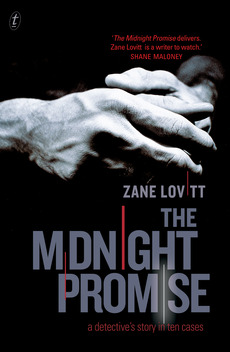
  • Zane Lovitt, Midnight Promise

    Book cover (Courtesy: Text Publishing)

    Zane Lovitt whose Midnight promise I have – woo hoo – read and reviewed here. It’s more a collection of interconnected short stories, but there is a loose narrative thread running through it following the career of its  private detective protagonist.

  • Emily Maguire for Fishing for tigers. Maguire, unlike most of the winners, has quite a few books, including three other novels, to her name, and has won the Best Young Australian Novelist award before. She teaches creative writing, and it sounds like she’s well qualified to do so, doesn’t it? Fishing with tigers was inspired by Grahame Greene’s The quiet American, and is about “divorcee Mischa Reeve, 35, whose affair with Vietnamese-Australian Cal, 18, upsets her friends, including Cal’s father, Matthew”.
  • Ruby J. Murray whose Running dogs was, like Carter’s Eleven seasons, also shortlisted for the UTS Glenda Adams Award for New Writing in the 2013 New South Wales Premier’s Literary Awards. I hadn’t heard of Murray, I must admit, but this book sounds interesting. It’s set in Indonesia, which is a significant country for Australia, and like Maguire’s Vietnam-located Fishing for tigers, it is about an expat Australian aid worker. Murray, who worked in Indonesia in 2009, was horrified at how little Australians knew (know!) about Indonesia despite its importance to us economically and politically, not to mention being a major holiday destination for Australians.
  • Majok Tulba for Beneath the darkening sky. It, like Maguire and Murray’s books, is set outside Australia, in this case, in Sudan. And, like Romy Ash’s Floundering, it was shortlisted for the Commonwealth Book Prize. It’s narrated by an 11-year-old village boy and is “about child soldiers in Africa”. It’s fiction. Tulba says he used some experiences he and his brother had, but he was not himself a child soldier. Apparently Sudanese rebels tried to recruit him but he “failed the test – he was shorter than an AK-47 assault rifle“! Lucky him, eh?
They sound like an interesting bunch of authors and books, don’t they? And, I’m rather intrigued that half of them are not set in Australia, which reflects our increasingly multicultural society. It’s good to see our literature recognising this.
In 2012, only three awards were made – Melanie Joosten for Berlin Syndrome, Jennifer Mills for Gone (which is waiting patiently in my shelves to be read), and Rohan Wilson for The Roving Party. Past winners have included Nam Le, Christos Tsiolkas, Chloe Hooper and Markus Zusak.

Monday musings on Australian literature: Role of Aboriginal literature

Most keen readers have firm views about the value of reading to them. Some, I think, read mainly to escape. Others like to be opened to other ways of being and thinking. Others like the things they learn – yes, even from fiction! And still others love beautiful or interesting language. These aren’t the only reasons, and aren’t mutually exclusive, but are I think among the main reasons …

Last week I reviewed Anita Heiss‘s Am I black enough for you? Heiss has a PhD in Aboriginal literature and publishing, and is active in promoting Aboriginal literature. She has co-edited The Macquarie PEN Anthology of Australian Aboriginal literature, and she was the guiding force behind BlackWords, the topic of last week’s Monday Musings. She is a writer herself (of novels, poetry and non-fiction) and has published two children’s books co-written with students of La Perouse Primary School as the result of workshopping stories with them. She is regularly invited to talk about Aboriginal literature – in Australia and overseas – at conferences and seminars. You won’t be surprised then to know that she has very clear ideas about the role of Aboriginal literature.

Here is what she says in Am I black enough for you?:

Aboriginal literature from Australia serves many purposes: it records our ‘truths’ about history; it functions as a tool for reconciliation, allowing non-Indigenous Australians to engage with us in non-confrontational ways; it provides a means of self-representation in Australian and world literature and assists understanding of the diversity of our identities; finally, it challenges subjective and often negative media stereotypes and interpretations in our lives.

While this feeds into some of the reasons we read, it is a far more political manifesto for literature than we are used to. But then Indigenous Australians are in a very particular, and minority, position.

By some definitions, aspects of this could almost be seen as propaganda – in the sense that she’s essentially talking about promoting a cause – but propaganda, once a neutral term, now has very negative connotations. It contains notions of ‘skewing” facts, and of coercion and control, usually by the state. This of course is not what Heiss is talking about – but she is talking about the role literature can play in reflecting and expressing, to both the self and other, a particular view of things. Whether this is conscious – as Heiss clearly is with her chicklit books (see my review of Paris dreaming) – or subconscious is not really the point. (If it’s too conscious, too manipulative, and/or not believable, readers will stay away). The point for Heiss is that more indigenous writers need to be able to express themselves so that indigenous and non-indigenous people will better understand and know the reality of indigenous Australian life and experience, rather than rely on non-indigenous-written texts and stereotyping. Education, more than persuasion, is what she sees as the goal.

Heiss’s manifesto, as I’m calling it, also made me think of “ideological” novels, that is, those novels which consciously argue a philosophical or political, that is, ideological, line. But this too, I think, is not really what Heiss is saying – though individual indigenous novels could very well fit this specific definition. She is recognising, rather, that all literature functions as part of the prevailing ideology (or culture) within which it is written and therefore can’t help but impact this ideology simply by being, regardless of whether it reinforces or questions or rejects existing norms. The more Aboriginal literature is published, the more it is likely to shift the prevailing ideology, which is a good thing.

Why am I writing this? Just, I guess, because as a reader I like to think about who writes and why they write the things I read, and about the role literature plays in my life (and our collective lives). I appreciated Heiss’s clear manifesto on what she believes and thus on why she does what she does. I wanted to share it – and tease it out a little. I’ve done that, and now I’m happy!

Monday musings on Australian literature: BlackWords

NAIDOC Week, to which last week’s Monday Musings was dedicated, officially finished yesterday, but I’ve decided to bookend it with another Monday Musings focusing on indigenous Australian literature. This post, in fact, also harks back to two Monday Musings ago which talked about the AustLit database – because I want to introduce you to one of AustLit’s projects, BlackWords.

BlackWords was established in 2006 under the guidance of Dr Anita Heiss (whose Paris dreaming I reviewed earlier this year and whose memoir Am I black enough? for you I’ll be reviewing this week). It is a resource for and database of Aboriginal and Torres Strait Island writers and storytellers. It contains, where available, the standard information provided throughout the database:

  • author biography
  • lists of works by the author and about the author

Aboriginal and Torres Strait Islander Australians are the traditional keepers of their oral history, we are the custodians presiding over Indigenous Australian literature … (Indigenous writer and David Unaipon Award winner Yvette Holt)

It now contains records for over 5,000 people and organisations. Wow! The database aims to cover “published and unpublished books, stories, plays, poems, and criticism associated with eligible writers and storytellers … in English, in Australian languages, and in translations.” Given that the loss of language is a significant concern for our indigenous peoples, capturing works in Australian languages is a particularly important goal.

… each time we translate black words onto white paper we are reclaiming an integral piece of our heritage, culture and language.” (Yvette Holt)

Tara June WInch

Tara June Winch (Photo: Howcheng, using CC-BY-SA 3.0, via Wikipedia)

Currently the BlackWords homepage spotlights three featured authors: Tara June Winch, Anita Heiss and Samuel Wagan Watson. Click on the author’s name and you get taken to their AustLit page. In the right sidebar of their page is something called Resource Maps. For Anita Heiss and Tara June Winch these include Wiradjuri Trail (Wiradjuri being the nation they both belong to). The Resources Maps contain hand-built links to internet sources on the topic. As with all of AustLit, these maps are works in progress.

The left sidebar contains a variety of links, encouraging other explorations, such as “Teaching with BlackWords”,  “Publishers” and “Translations”.

Specifically for BlackWords, the site also includes a timeline of historical dates significant for Aboriginal and Torres Strait Islander people. It starts at 1788 … the date when white people established their first settlement in Australia. The text entries for these dates include links to works and authors in the database. Also, under the dates – where relevant – are links for search terms that will lead searchers to works indexed in the database about the event/date. So, for example, under 1788, are links for Pemulwuy, an Aboriginal warrior who resisted the white invasion, and Bennelong, who was captured by Governor Phillip and found himself caught between two cultures. (The timeline is a little tricky to find. It would be more obvious if placed in the left sidebar, but instead it’s a dot point under “About” on the About page.)

… when storytellers speak, their words will inextricably tie indigenous peoples to their lands and to their mobs … (Yvette Holt)

BlackWords is a wonderful initiative and has now reached the critical mass to be of value to indigenous and non-indigenous Australians alike. It is for resources like this that the Internet is at its best, don’t you think?

Monday musings on Australian literature: Indigenous Australian memoirs

As Australians would know, this week – July 7-14 – is NAIDOC week. NAIDOC originally stood for an organisation – ‘National Aborigines and Islanders Day Observance Committee’ – but the acronym has now become the name of the week itself. Fascinating how acronyms can take on lives of their own, isn’t it? Anyhow, the theme for this year’s celebrations is We value vision: Yirrkala Bark Petitions 1963.

This theme commemorates the 50th anniversary of two bark petitions which were sent by the Yolngu people of Yirrkala in northeast Arnhem Land to the Australian Parliament. The petitions concerned the Commonwealth Government’s granting of mining rights on land excised from Arnhem Land. They asked the Government to recognise the Yolngu peoples’ traditional rights and ownership of their lands. These petitions were the first indigenous Australian documents recognised by the Government and helped, the NAIDOC website says, to “set into motion a long process of legislative and constitutional reforms for Aboriginal and Torres Strait Islander people”. Many Australians know of Eddie Mabo and the Native Title Act of 1993, but I wonder how many know of actions like this which occurred decades earlier?

In this spirit of commemorating the past, I thought today’s Monday Musings could focus on indigenous Australian memoirs/autobiographies. I’ve written on this topic before, and so will try to avoid repeating myself too much. Interestingly, all of the books I mention below are by women. The Cambridge companion to Australian literature says, in fact, that since the 1970s, Aboriginal women have dominated indigenous autobiography.

A number of themes run through indigenous memoirs/autobiographies and, of course, identity is a big one. One of the best known examples of a memoir about identity is Sally Morgan‘s My place which was published in 1988, Australia’s bicentenary year – the bicentenary, that is, of white settlement in Australia. It was not a year that was universally celebrated by indigenous Australians, for good reason. My place was, possibly, the first book by an indigenous Australian that many non-indigenous Australians had read – and it became a best-seller. Morgan, also an artist, told the story of her family – and of their shame that was so strong that she had not been told she was indigenous. She’d been let think she was of Indian (that is, from the subcontinent) extraction, until she was well into her teens. I haven’t read My place since 1988, but I expect it would still stand up well today. Morgan is a great story-teller.

Anita Heiss‘s Am I black enough for you, which was published in 2012, is also about identity, but in a different more confident way. I’m reading this one now. In it, Heiss aims to educate Australians about the breadth of indigenous life and experience in Australia, to show us that people do not have to be living a traditional indigenous life in the desert to identify as indigenous.

A big topic for indigenous memoirs is the experience of the Stolen Generation. Many of these also deal with identity, but from a specific point of view. I mentioned one – Doris Pilkington‘s Following the Rabbit Proof Fence – in my previous post. While I’ve read a couple of novels dealing with this issue since that post, I haven’t read more memoirs. There are many out there, though, including Rosalie Fraser’s Shadow Child: A Memoir of the Stolen Generation (1998), Doris Kartinyeri’s Kick the tin (2000), Donna Meehan’s It is no secret: The story of a stolen child (2000).

As Australians would know, the most comprehensive study of the Stolen Generation appeared in the government report Bringing them home (1997). This 700-page report contains excerpts from the testimonies of over 500 indigenous people about their or their families’ experiences of being stolen.

A common style of memoir – for indigenous and non-indigenous people alike – is what I’d call the “success memoir”. You know, those chronicling major success or high achievement. Sydney 2000 Olympic Games gold medallist Cathy Freeman wrote Cathy: Her own story in 2003. As often happens with memoirs written by non-writers, she had a co-author, the sportswriter Scott Gullan.

Last but not least is the simple story-of-my-life memoir, though most memoirists wouldn’t be writing their stories if they really were simple! Ruby Langford Ginibi would fall into this category – I think, as I haven’t read her yet. Ginibi published her first book, the gorgeously titled Don’t take your love to town, in 1988 when she was 54. She won a Human Rights Literary Award for it. Ginibi was a lecturer in and historian of Aboriginal history, but her start was way different. She married young, had nine children, lived and worked in the bush, and also worked as a clothing machinist. One of the obituaries written after her death says:

Through her numerous books, short stories, poetry, interviews and public appearances and her commitment to ‘edu-ma-cating’ non-Aboriginal people about Indigenous peoples’ circumstances and struggle she made a distinctive and substantial contribution to Australian history and literature.

 “‘Edu-ma-cating’ non-Aboriginal people”. That’s what all these writers are doing in their different ways … I’m glad they are, and will continue to read a few each year.

Unfortunately, many of these books are likely to be out of print but most should be available in libraries – in Australia at least. If you’d like to read one, I suggest you do so now and join ANZLitLovers Indigenous Literature Week. Lisa will, I understand, accept reviews after the week has finished.

Monday musings on Australian literature: AustLit FREE TRIAL

When I first discovered AustLit (Australian Literature Resource) in the early 2000s I was thrilled. What fan of Aussie literature wouldn’t be excited by a database for Australian writers and writing? Created in 2000 by Australia’s university sector and led by the University of Queensland, AustLit “aims to be the definitive virtual research environment and information resource for Australian literary, print, and narrative culture” (from AustLit’s About page) – and it pretty much is, I’d say.

However, it is also a subscription service – and an expensive one at that – so my use of it has been limited to when I’ve been able to access it, either through public/national library logons (on-site at the library) or through my occasional contract work for a university (logon at home). But, during June and July (2013), AustLit is offering a free trial. Why didn’t I know? I’ve wasted a month’s good research! OK, I probably should have known. It was very likely announced in one of the many emails I receive and I missed it. Hands up who manages to read every email from every service they subscribe to?

Anyhow, I’d say, if you are interested in Australian literature and have some writers or works you want to research, hop to it now by clicking through to the AustLit website. Search, for example, on Elizabeth Jolley and you will get a link to AustLit’s author page for her. Author pages contain the following information, where applicable:

  • Most referenced works (with a link to all the author’s works)
  • Brief but useful biography
  • Awards
  • Awards for works

There are also – and here is where it gets exciting – links to:

  • Works about the author
  • Works about the author’s works

Click on these to get a listing of articles, books, essays etc about the author (349 for Jolley) or the works (546 for Jolley). They are listed alphabetically by title, but in the right sidebar are options for sorting and filtering. So, for example, you can sort the list by date or filter it by form, such as to retrieve just “reviews” or “criticism”.

But here is also where the disappointment hits. These lists comprise citations to the articles, essays etc. In most cases, you then need to find the journal or book in which they are located – through a journal database or the old way through a library catalogue. Being a person of the digital age, I want the content and I want it now! Admittedly, some are available on-line – indicated by a clickable arrow over which you can hover to see an abstract – but, not surprisingly, they are mostly recent works and there aren’t many of them. I’m sure DRM issues are involved here, in addition to availability in electronic form. To locate this content quickly, you can limit your search by clicking the “full text only” box. Do that on the main search page where you’ve also entered Elizabeth Jolley – did I tell you I’m a Jolley fan? – and you get 20 hits. Not a lot, but a good start. I understand that digitisation is an ongoing project so more and more content will become available.

There is more to AustLit. There are full text versions of poems and novels (either on the site or linked to from the site) and there’s a wide range of projects including ScreenLit, BlackWords and Banned in Australia. But, if you are interested, get in quick. Your free trial access has 30 days to go!

Seriously though, AustLit is a seriously good site.

Have you used the AustLit database, and if so what do you think? If you are not from Australia, are you aware of similar database projects for your national literature – and if so, what is it?

Monday musings on Australian literature: ASA’s Authors Unlimited eBook portal

In her comment on my recent Monday musings about e-Publishing, Australian author Dorothy Johnston, whose novel The house at number 10 I reviewed recently, mentioned Authors Unlimited. I responded that I’d look into it and perhaps post on it. I did and now I am. Never let it be said that Whispering Gums is not true to her word. (Hmmm … perhaps you should ignore that … I don’t always follow through methinks, at least not promptly.)

Anyhow, Authors Unlimited is the “information and sales portal for authors, books and eBooks” for the Australian Society of Authors (ASA). The masthead on the homepage has the tagline “buy eBooks from Australian authors” but in fact it also contains pretty extensive information about Australian authors, who are members of the ASA, and their books*. So, for example, if you click on J under Authors, and then click on Dorothy Johnston you get some information about her (written by her) and a list of her books. To find out more about any particular book, click on a title and you’re taken to a page describing the book and providing publication details. If the book has an e-version – in ePub or mobi format generally – you can purchase it from that page … as I did for …

Kindle ebook ereader

Kindle (Courtesy: OCAL via clker.com)

… Johnston’s collection of short stories Eight pieces on prostitution. It includes her first story, “The man who came with the news”, which was published by Frank Moorhouse in State of the Art in 1983. It also includes a long story – almost a novella, she says – titled “Where the ladders start” and “Mrs B” which was included in Meanjin’s The Canberra Issue this year (my review). I have bought this book – for AUD9.95 – and plan to read it when I travel later in the year. Prices vary, but they all seem pretty reasonable to me.

I’m not an author or publisher, as you know, but Dorothy Johnston is enthusiastic about this initiative. I notice that popular Australian children’s writer Hazel Edwards (whom I mentioned in my post on the inaugural Canberra Readers’ Festival) is selling her novel Fake I.D. available through the site. It was originally published in 2002, and in her description of the book she writes “Originally a popular print book, now only available in e-format”.

And there’s the thing … Authors Unlimited provides a great opportunity for authors to publish their out-of-print books with the help of ASA. I presume most (all?) books published in the last two or more decades were published from electronic versions. It should be a relatively easy matter, technically, to convert them to one of the e-Book standards. Some books’ rights are, presumably, still held by publishers – and some publishers are now using e-publication for out-of-print backlists but it’s good to know that authors have another option. They can publish via ASA using its conversion process, sell via ASA’s ordering and delivery mechanisms, and promote via their own websites, Facebook pages, and so on …

Here’s to more options for authors  – to republish old works, as is or in new permutations, and to publish new work.

* I believe the author listings here are automatically fed through from ASA, and so includes many authors who do not have books for sale through the portal.

Monday musings on Australian literature: Prime Minister’s Literary Awards 2013 shortlist

We have been waiting, waiting, waiting for the announcement of the shortlist for the Prime Minister’s Literary Awards. The sudden resignation of the Minister for the Arts a couple of months ago seems to have caused a delay in this announcement, which was expected in May. It’s one of my favourite awards on the Australian literary calendar – partly because it operates out of my home town but mainly because the winners are often not the “usual suspects” from the other awards around the country. It will be a shame if politics gets in the way of its smooth running!

The press release announcing the shortlist reminded me that these awards are now in their sixth year – which is right because they were one of the exciting initiatives of the new Labor Government after it came into power in late 2007.

The winners are usually announced in July but I can’t see a date in the press release or on the page the release links to. More waiting methinks!

Anyhow, without anymore preamble, this year’s shortlist, drawn from books published in 2012, is:

Fiction
Floundering by Romy Ash (Also shortlisted for the Stella Prize and the Miles Franklin Award)
The Chemistry of Tears by Peter Carey (my review)
Questions of Travel by Michelle de Kretser (I’ll be reading this in July, at last! Also shortlisted for the Stella Prize and the Miles Franklin Award)
Lost Voices by Christopher Koch
Mateship with Birds by Carrie Tiffany (my review. Won the Stella Prize and shortlisted for the Miles Franklin Award)

Poetry
Burning Rice by Eileen Chong
The Sunlit Zone by Lisa Jacobson (also shortlisted for the Stella Prize)
Jam Tree Gully: Poems by John Kinsella
Liquid Nitrogen by Jennifer Maiden
Crimson Crop by Peter Rose

Non-fiction
Bradman’s War by Malcolm Knox
Uncommon Soldier by Chris Masters
Plein Airs and Graces by Adrian Mitchell
The Australian Moment by George Megalogenis
Bold Palates by Barbara Santich

Australian History
The Sex Lives of Australians: A History by Frank Bongiorno
Sandakan by Paul Ham
Gough Whitlam by Jenny Hocking
Farewell, Dear People by Ross McMullin
The Censor’s Library by Nicole Moore

Young adult fiction
Everything left unsaid by Jessica Davidson
The Children of the King by Sonya Hartnett
Grace Beside Me by Sue McPherson
Fog a Dox by Bruce Pascoe
Friday Brown by Vikki Wakefield

Children’s fiction
Red by Libby Gleeson
Today We Have No Plans by Jane Godwin, illustrated by Anna Walker
What’s the Matter, Aunty May? by Peter Friend, illustrated by Andrew Joyner
The Beginner’s Guide to Revenge by Marianne Musgrove

Congratulations to all the authors and publishers shortlisted. May they not have to wait too long for the winners’ announcement!

Monday musings on Australian literature: Specialist presses

I’ve written Monday musings before about publishers, including posts on small presses and university presses. Today I’m bringing you another – about publishers which specialise in a certain “type” of literature. As with my other posts of this type, this won’t be comprehensive, but will comprise a selection whose specialties interest me! Here they are – listed in their order of longevity, as far as I can tell.

Currency Press

subtitles itself, “the performing arts publisher”. It’s the one I’ve known for the longest, which is partly due to the fact that it’s over 40 years old and partly because its subject area crossed my professional life. It started in 1971 as a publisher of plays, but has expanded significantly since then to “screenplays, professional handbooks, biographies, cultural histories, critical studies and reference works” in the performing arts area. In 2011, its 40th year, Currency Press received an AWGIE Award for its outstanding contribution to the performing arts. Among their new releases is a book that was launched at the Sydney Film Festival today. It’s by film academic, Sylvia Lawson, and is about my favourite Australian documentary, The Back of Beyond (1954). If you want to find the script of a film or play by Australian greats like, say, Andrew Bovell or David Williamson, Currency Press would be your first stop.

Five Islands Press

is one of several small publishers which specialise in Australian poetry. I’ve chosen them to represent this special interest area because it is one that I often see around the traps though I haven’t yet reviewed any of their publications. They were established in 1986, and aim to publish both established and emerging poets. In 2012 they published Lisa Jacobson’s verse novel, The sunlit zone, which was shortlisted for this year’s inaugural Stella Prize.

Magabala Books

describes itself as “Australia’s oldest independent Indigenous publishing house”. It was established in 1990, and is located in gorgeous Broome. It is a non-profit organisation that aims “to preserve, develop and promote Australian Aboriginal and Torres Strait Islander cultures”. It has, to date, published more than 100 titles in a wide range of forms and genres from children’s picture books to adult fiction, from poetry to contemporary non-fiction. Their list of authors is extensive and would be a great place to start, particularly for authors not well-known in the mainstream.

Spinifex Press

describes itself as “an award-winning independent feminist press, publishing innovative and controversial feminist books with an optimistic edge”. I’ve read a few books from them during my blogging career – Merlinda BobisFish-hair woman, Francesca Rendle-Short’s Bite your tongue, Sefi Atta‘s A bit of difference and, just yesterday, Susan Hawthorne’s Limen. According to the About Us page on their site, the press was established by Susan Hawthorne and Renate Klein in 1991, one year after Magabala, and now has over 200 titles in print. They were, they say, the first publisher to set up an interactive site based on a book (for Building Babel in 1996) and the first small press in Australia to release eBooks through an eBookstore attached to their own website. They publish Australian and overseas writers, including many works in translation. I’ve thoroughly enjoyed the books of theirs that I’ve read. Their books aren’t all overtly political but all deal in some way with women’s experience. Spinifex seems to be a good example of what a small publisher with a very focused goal can do.

Spineless Wonders

is a relatively new kid on the block, having been established, as far as I can tell, around 2011. (Don’t you wish all organisations included a little bit of their history on their websites?) Anyhow, Spineless Wonders is “devoted to short, quality fiction produced by Australian writers … [to] brief fiction in all its forms – short story, novella, sudden fiction and prose poetry”. Their name refers to the fact that their publications are “delivered to readers via  smart phones and laptops”, but they do publish in print form, and also audio. Check Litblogger Angela Meyer’s interview at crikey.com with the founder, Bronwyn Mehan, for some background to her philosophy.

To conclude …

That’s five, and probably enough to get you thinking about the breadth of publishing out there. There are plenty of others, including publishers for genre fiction (such as Pulp Fiction Press), children’s literature (such as New Frontier Publishing), regionally-focused publishers (such as Backroom Press in the Kimberleys), not to mention education publishers, religion publishers, and so on.

Do you have any favourite specialist presses you go to for specific reading interests?