Monday musings on Australian literature: Aussie writers name their pick reads of 2015

It’s the month of the lists, and so, while I’ll be saving my lists until the END of 2015, I thought today I’d share some of the lists that have already been published. I appreciate that there’s value in publishing these lists now, as they might just help people with their Christmas shopping (or with compiling their Santa lists for other people’s shopping!).

Because my Monday Musings series is about Australian literature, I’m only going to list the favourite Australian books chosen by Australian writers. Most of the books nominated were published in the last 12 months or so, but writers were allowed to choose the best of what they’d read during the year, so some have chosen older books.

So, here’s the list of books, in alphabetical order (with the nominating author/s in parentheses at the end):

  • ***Robert Adamson’s Net needle (poetry) (Luke Davies, Jennifer Maiden, Gig Ryan)
  • Debra Adelaide’s Letter to George Clooney (short stories) (Christos Tsiolkas)
  • Nigel Bartlett’s King of the road (crime novel) (Debra Adelaide)
  • Tony Birch’s Ghost river (novel) (Omar Musa) (reviewed 2016)
  • Stephanie Bishop’s The other side of the world (novel) Susan Johnson)
  • Frank Bongiorno’s The eighties (non-fiction) (Tom Keneally)
  • Margaret Bowman’s (comp. & ed.) Every hill got a story (history) (Alexis Wright)
  • James Bradley’s Clade (novel) (Luke Davies)
  • Tania Chandler’s Please don’t leave me (novel) Graeme Simsion)
  • **Tegan Bennett Daylight’s short story collection, Six bedrooms (Susan Johnson, Charlotte Wood) (reviewed later) (reviewed 2016)
  • Ceridwen Dovey’s Only the animals (novel) (Chris Wallace-Crabbe)
  • Peter Doyle’s The big whatever (crime novel) (Debra Adelaide)
  • **Ali Cobby Eckermann’s, Inside my mother (poetry) (Robert Adamson, Jennifer Maiden)
  • Delia Falconer’s The lost thoughts of soldiers (novel) (Luke Davies)
  • Michael Farrell’s Cocky’s joy (poetry) (Gig Ryan)
  • **Martin Flanagan’s The short long book (biography) (Anita Heiss, Favel Parrett)
  • Bill Garner’s Born in a tent (non-fiction) (Don Watson)
  • Lisa Gorton’s The life of houses (novel) (Chris Wallace-Crabbe)
  • Barbara Hanrahan’s The scent of eucalyptus (novel) (Peter Goldsworthy) (my review)
  • Lesley Harding and Kenneth Morgan’s Modern love (biography) (Steven Carroll)
  • Natalie Harkin’s Dirty words (poetry) (Anita Heiss)
  • **Martin Harrison’s Happiness (poetry) (Robert Adamson, Lisa Gorton)
  • Elizabeth Harrower’s A few days in the country and Other stories (short stories) (Joan London) (reviewed 2016)
  • Sonya Hartnett’s Golden boys (novel) (Robert Adamson) (reviewed 2016)
  • John Hawke’s Aurelia (poetry) (Gig Ryan)
  • Antonia Hayes’ Relativity (memoir) (Graeme Simsion)
  • Lisa Heidke’s The Callahan split (self-published novel) (Anita Heiss)
  • Marty Hiatt’s Hard-line (poetry) Gig Ryan)
  • **Sarah Holland-Batt’s The hazards (poetry) (Chris Wallace-Crabbe, Fiona Wright)
  • Chloe Hooper’s The tall man (non-fiction) (Abigail Ulman) (read before blogging)
  • Clive James’ Poetry notebook (essays) (Peter Goldsworthy)
  • Karen James’ On purpose: Why great leaders start with the PLOT (non-fiction) (Anita Heiss)
  • **Gail Jones’ A guide to Berlin (novel) (Debra Adelaide, Fiona Wright)
  • Mireilla Juchau’s The world without us (novel) (Fiona Wright)
  • **Leah Kaminsky’s The waiting room (novel) (Graeme Simsion, Clare Wright)
  • Krissy Kneen’s Eating my grandmother (poetry) (Kristina Olsson)
  • **Malcolm Knox’s The wonder lover (novel) (Christos Tsiolkas, Don Watson)
  • Lee Kofman’s The dangerous bride (Clare Wright)
  • **Ramona Koval’s Bloodhound (memoir) (Shane Maloney, Clare Wright)
  • Anna Krien’s Night games (non-fiction) (Abigail Ulman) (my review)
  • Chip Le Grand’s The straight dope (non-fiction) (Steven Carroll)
  • Joan London’s The golden age (novel) (Don Watson)
  • Alan Loney’s Crankhandle (poetry) (Gig Ryan)
  • Tim Low’s Where song began (non-fiction) (Don Watson)
  • Helen Macrae’s Dinner with the devil (history) (Favel Parrett)
  • Jennifer Maiden’s The fox petition (poetry) (Fiona Wright)
  • Chris Mansell’s avian triptych, Aves (poetry) (Jennifer Maiden)
  • Drusilla Modjeska’s Second half first (memoir) (Joan London)
  • Gerald Murnane’s Something for the pain (memoir – and on my actual TBR) (Gregory Day) (reviewed 2016)
  • Les Murray’s On bunyah (poetry) (Peter Goldsworthy)
  • **Pi O’s Fitzroy: The biography (poetry) (Maxine Beneba Clarke, Gig Ryan)
  • Kerry O’Brien’s Keating (biography) (Tom Keneally)
  • Anthony Reid’s Southeast Asia in the Age of Commerce, 1450-1680 (non-fiction) (Omar Musa)
  • Michael Robotham’s Life or death (crime novel) (Shane Maloney)
  • Margaret Simons’ Six square metres (gardening, with reflections) (Helen Garner)
  • Rebecca Starford’s Bad behaviour (memoir) (Abigail Ulman)
  • TGH Strehlow’s Journey to Horseshoe Bend (memoir) (Lisa Gorton)
  • **Magda Szubanski’s Reckoning (memoir) (Graeme Simsion, Christos Tsiolkas)
  • **John Tranter’s Heart starter (poetry collection) (Jennifer Maiden, Gig Ryan)
  • Ellen van Neerven’s Heat and light (fiction/short stories) (Omar Musa) (my review)
  • Abigail Ulman’s Hot little hands (short stories) (Omar Musa)
  • Ann Vickery’s The complete pocketbook of swoon (poetry) (Gig Ryan)
  • Susan Whelan’s Don’t think about purple elephants (children’s) (Anita Heiss)
  • Petra White’s A hunger (poetry) (Chris Wallace-Crabbe)
  • Anne Whitehead’s Betsy and the emperor (history) (Tom Keneally)
  • Jessica L Wilkinson’s Suite for Percy Grainger (poetry) (Jennifer Maiden)
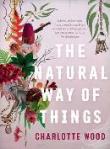
  • WoodNatural*****Charlotte Wood’s The natural way of things (novel) (James Bradley, Maxine Beneba Clarke, Susan Johnson, Kristina Olsson, Fiona Wright) (reviewed 2016)
  • Fiona Wright’s Small acts of disappearance (essays) (Luke Davies) (reviewed 2016)
  • Beth Yahp’s Eat first, talk later (memoir) (Drusilla Modjeska)
  • Ouyang Yu’s Fainting with freedom (poetry) (Alex Miller)

There are some surprises for me here, that is, some books and/or writers I’ve never heard of, such as Abigail Ulman, not to mention some of the poets. I was also surprised – or, perhaps just interested – in the variety of books chosen, that not only is there fiction and poetry, but also quite a diverse selection of non-fiction. I had never heard of Anne Whitehead, for example, until I did some research on the New Australia movement in Paraguay, during which I discovered that she’d written a book about Mary Gilmore, and now, here’s Tom Keneally nominating a recent book of hers. Hmmm … poor TBR.

Unless I’ve made a mistake, a few Australian writers didn’t choose any Aussie books – Geraldine Brooks, Jessie Cole (though she did mention several Australian literary journals), Malcolm Knox, Tim Flannery, and Michael Robotham. I’m naming them to shame them! Well, not really, but still … I do hope they read their peer Aussie writers.

On the other hand, there’s Alex Miller who only chose ONE book, and that was Chinese-born Australian writer Ouyang Yu’s poetry collection, Fainting with freedom. Miller describes it as “some of the finest poetry ever written this century”. No beating about the bush there, no feet in multiple camps as I’ll do with my list – when I get to it! I love such bravery!

Finally, it’s very clear I need to read Charlotte Wood’s The natural way of things.

And now, over to you: Do you read top pick lists in your neck of the woods (no pun intended!)? And if so, have you been surprised, delighted, or perhaps, shocked?

________________________________________________________________

Source: Panorama section, The Canberra Times, 12/12/2015

* Asterisks denote those books nominated more than once – the number of asterisks identify the number of nominations.
Monday musings on Australian literature: Aussie writers on writing

As I was writing my review of Carmel Bird’s Fair game yesterday, I was reminded that in addition to novels, short stories, and essays, she has also written a book on writing, titled Dear writer. I’ve dipped into it, but not being a professional writer – and having no plans myself to write a book – I must say I haven’t specifically sought out these sorts of books. Nonetheless, I thought it might be interesting to suss some out and share them with you – partly because I think they may have something to offer readers, and partly because it’s interesting to see who has chosen to write about writing.

Here goes (in chronological order of publication):

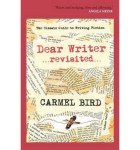
BirdDearWriterSpinelessCarmel Bird’s Dear writer (1988, republished 1996). This book comprises writing advice in the form of a series of letters. As Bird writes on her website, it’s been used by students and teachers, individually and in courses, as well as by readers “interested in the writer’s art”. An updated edition, Dear writer revisited, was published in 2013. This is the one I’ve been dipping into. In addition to her own advice, she includes advice from other writers, such as America’s Mark Twain and Australia’s Marion Halligan. In Letter 2 she discusses the use – or, non-use, more like it – of adjectives and adverbs. She says:

Perhaps you thought that you, as the writer, were the one who had to do all the imaging, and that the reader was to get every detail of the picture from your words. The reader of fiction takes pleasure in doing some of the work, and will more readily believe you and trust you if there is work to do. Strangely enough, the strength of fiction seems to lies much in what is left out as what is included …

Hmmm … I thought a book on writing fiction mightn’t be relevant to me but this, this is. I struggle with avoiding cliches, and particularly with trying to find fresh adjectives, but perhaps I should think about avoiding them altogether? Something for me to think about, as I try to describe in my posts the impact or value of a work.

Bird has also written Writing the story of your life.

Kate Grenville’s The writing book (1990) is, if can remember that far back, the first of these books to come to my attention. Grenville, about whom I’ve written several times, lists it on her own site. She says it has become a classic, being used, like Bird’s book, by individual writers and in writing courses. She shares some of her advice on this page. I particularly like this response to a popular notion:

‘Writing has to have a strong story.’

How interesting is it to have someone tell you the plot of a book they’ve just read? Not very. This means that plot alone isn’t what makes a book interesting. What makes it interesting isn’t what’s told but the way it’s told. In some of the best stories, almost nothing happens.

I think she’s right – and I have always said so! Plot is not necessarily the main or only point.

Grenville has written other books on the topic, including Writing from start to finish: A six-step guide.

John Marsden’s Everything I know about writing (1993, republished in 1998). For those of you who don’t know, Marsden is best known as a writer for children and young adults, including the bestselling Tomorrow, when the war began series. I’ve loved some of his YA books, including the unforgettable Letters from the inside. I found this advice from his book on GoodReads:

Use strong words sparingly – less is more. Minimise your use of qualifiers. Recognise words that are at the limits already (e.g. Boiling, delicious, evil), there is nothing you can do to strengthen them.

My family will tell you that one of my favourite mantras is “less is more” so, as I said of Bird’s advice above regarding the use of descriptive words, I love this.

As with Grenville’s book, you can find excerpts on Marsden’s own website.

Mark Tredinnick’s The little red writing book (2006). Of the writers I’ve mentioned here, Tredinnick is the one I know the least, that is, I know of him, but have not read him. He is a poet and essayist, and teaches writing, particularly “creative nonfiction” according to the GoodReads biography. He also edited Inkerman and Blunt’s Australian love poems. (You may remember that I reviewed their Australian love stories). Anyhow, Scott Downman, reviewing this book, says that it is pitched to “a broad audience who simply desire to write better”. Tredinnick says that he aims not to teach students to be writers but to teach them how to write. Summing up the book, Downman writes:

Tredinnick in the opening chapter urges the reader to not just tell a story but to make their writing sing: ‘In song, it’s how you sing, not just what you utter, that counts. And so it is with writing’

This, of course, is similar to what Grenville, above, said – the content is only part of the point.

Do you read books about writing? And if so, what are your favourites or, what are the most important lessons have you learnt?

Monday musings on Australian literature: Utopia, Paraguay and Australian writers

The workingman's paradise (Courtesy: Sydney University Press)

The workingman’s paradise (Courtesy: Sydney University Press)

Utopia, Paraguay, Australia? I’m referring, of course, as many Australians will know, to the Utopian colony, New Australia or Colonia Nueva Australia, which was established in Paraguay in 1893 by the New Australia Movement, with the support of the Paraguayan government. This movement was founded by William Lane, whose novel The workingman’s paradise I reviewed quite early in this blog. The settlement did not succeed. According to Wikipedia (linked to above), conflict started early “over prohibition of alcohol, relations with the locals and Lane’s leadership”. Colonist Tom Westwood is quoted as saying, “I can’t help feeling that the movement cannot result in success if that incompetent man Lane continues to mismanage so utterly as he has done up to the present”. Oh dear.

The settlement has been written about by historians (Gavin Souter’s A Peculiar People and Anne Whitehead’s Paradise Mislaid) and at least one novelist, Michael Wilding‘s The Paraguayan Experiment. Australian travel writer Ben Stubbs has written about his trip to talk to “remnants” of that settlement in his Ticket to paradise: A journey to find the Australian colony in Paraguay among Nazis, Mennonites and Japanese beekeepers. Several musicians have also written songs about it, according to Wikipedia.

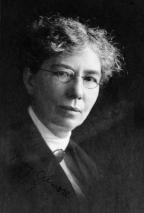
Mary Gilmore, 1927 (Public Domain, at State Library of QLD, via Wikipedia)

Mary Gilmore, 1927 (Public Domain, at State Library of QLD, via Wikipedia)

So why am I mentioning all this now? Well, it has to do with those creative Griffyns and their last concert for the year, titled The Utopia Experiment, which is inspired by this settlement. I’ve known, of course, all year that it was coming up, but an article in today’s Canberra Times, which reminded me of other (contemporary) literary links besides Lane, encouraged me to write this post. The main link is Dame Mary Gilmore (née Mary Jean Cameron) who, in the first half of the twentieth century, was regarded Australia’s greatest woman poet. According to NSW’s Migration Heritage Centre website, she said of Lane’s The workingman’s paradise that:

 the whole book is true and of historical value as Lane transcribed our conversations as well as those of others.

Gilmore, in fact, became one of the 200-odd settlers, but returned after 5 years. She said in an interview over 60 years later that:

It was purely communistic. I wouldn’t say it was a success, but I certainly wouldn’t say it was a failure. The reason it had to break up, or disappear, is because William Lane would only have British people in it…

The aforementioned Anne Whitehead has written a book specifically on Gilmore’s Paraguayan story, Bluestocking in Patagonia: Mary Gilmore’s quest for love and Utopia at the world’s end, suggesting, says reviewer Sarah Macdonald, that Gilmore joined the settlers as much in search of a prospective husband as for the socialist ideal. Perhaps so, but she must have been looking for a particular type of husband to take such a trip!

A 1911 newspaper article quotes Renmark Pioneer editor, who knew Gilmore at the time, as stating that she:

joined the Cosme Colony in Paraguay, where a number of us, under the leadership of William Lane, were giving communism a trial. We were at that time a very happy family, and Mary Gilmore entered into the life whole-heartedly. She rendered good service to the colony, not only taking charge of the school (thereby releasing the former teacher, John Lane, for work in the fields), but doing much to add to the success of the social gatherings that were a marked feature in the life of our little community.

Mary Gilmore went on to live a long and highly productive life, dying in 1962 when she was 97. She was a socialist and activist, a poet and journalist, who argued for better conditions for working women, children and indigenous Australians. (Critic A.G. says in the Age in 1941 that “Her association with the early days of the Australian Labor movement has deepened and widened her social outlook … she speaks especially for the “little” people”).

Her Paraguay experience followed her for the rest of her life, as the National Library of Australia’s Trove reveals. Here is a description of her in a 1923 newspaper, Melbourne’s Advocate, when she would have been 58:

Mrs. Gilmore, who was one of the band that went to Paraguay with the late William Lane on the New Australia adventure, is a proven Irish sympathiser as well as a good Australian.

“A proven Irish sympathiser as well as a good Australian”. What I love about reading old newspapers is the insight they give into the thinking and values of the times.

The literary links don’t end here, however, because Gilmore was very keen for that other great Australian poet-writer of the time, Henry Lawson, to join the settlers. Certainly Lawson had the appropriate socialistic leanings. In 1893, he wrote a poem, “Something better” supporting the Paraguayan vision:

Give a man all earthly treasures – give him genuine love and pelf* —
Yet at times he’ll get disgusted with the world and with himself;
And at times there comes a vision in his conscience-stricken nights,
Of a land where “Vice” is cleanly, of a land of pure delights;
And the better state of living which we sneer at as “ideal”,
Seems before him in the distance — very far, but very real.

However, he didn’t join the settlers.

I could explore these two writers more, but life is busy right now – and, you never know, I might return to the subject after the Griffyns have presented their musical version.

Monday musings on Australian literature: Novels set in Sydney

Oh, it's fun driving on Pennant Hills Road!
Oh, it’s fun driving on Pennant Hills Road! (With apologies to Sydney-lovers)

My life has been rather topsy-turvy in recent weeks. My aunt died on 30 October, as regular readers here know, which has necessitated two five-day trips to Sydney, not to mention other related work in between.  Consequently, I haven’t had much time for reading or, even, for thinking about Monday Musings, but I have been thinking a little about Sydney … particularly since these trips have been to the part of Sydney in which I spent my teen and university years.

My family moved to Sydney in 1966, and it was from this time that my relationship with my aunt was really established, although I have many memories of her before that. Alison loved having two teen nieces in town to take out and show off her beloved Sydney to. And we loved having an aunt who was fun company and keen to take us out. It was she who taught us about Sydney’s history and culture. She took us to the Sydney Rocks area, long before it was cool, where she showed us old buildings like the Garrison Church. She took us to an early settlement re-enactment on historic Fort Denison (aka Pinchgut, or Mat-te-wan-ye, as it was to local Aboriginal people). And, being a beach lover, she took us frequently to Sydney’s famous beaches.

It suddenly occurred to me that one way I could honour my aunt would be to share some novels about her city, so that’s this week’s plan. I will list them in chronological order of their setting (not of when they were written). They are of course a very small selection of the books I’ve read, and an even smaller selection of those written about the place.

  • Kate Grenville’s The secret river, despite the controversy it engendered, made a significant contribution to our understanding of Sydney’s origins, because Grenville, finding a dearth of detailed evidence, tried to imagine what may have happened at an individual level between the European immigrants/settlers and the indigenous people when those settlers “took up” land in the Sydney region. (Grenville followed her exploration of early Sydney in the other books in the trilogy, The lieutenant and Sarah Thornhill). I appreciate that Grenville’s novel is not “history”, but I liked her attempt to present a possible scenario of how things may have gone, and why.
  • William Lane’s The workingman’s paradise (my review) is probably the least well-known of the books I’m listing here, but I’m including it not only because it’s one that I’ve read and reviewed on my blog, but because it’s set in the late nineteenth century, just prior to Australia’s Federation, during a time of social and political unrest when socialist ideas were being explored. It contains some gorgeous physical descriptions of Sydney in that time, as well as providing insight into contemporary intellectual debates about how to improve conditions for workers.
  • Emma Ashmere’s The floating garden (my review) captures Sydney at one of the most significant times in its life, physically speaking that is. Set in the late 1920s to early 1930s, it tells of the dispossession of working class people of their homes to make way for the Sydney Harbour Bridge. Funny, isn’t it, how so often it’s those who have the least resources who end up wearing the biggest costs of “progress”.
  • Kylie Tennant’s Tell morning this is set in Sydney during World War 2. Tennant wrote several novels about Sydney in the 1940s and 1950s, but the first that I read was Tell morning this. I enjoyed it for the vivid picture Tennant paints of Sydney at a time when young women met American servicemen. She doesn’t pull any punches in her story of Rene who is jailed for living with one of these Americans, and of David who is also jailed, but for being a conscientious objector. The irony of this – of jailing those who were practising the freedoms we were apparently fighting for – may not be lost on contemporary audiences!
  • Ruth Park’s The harp in the south tells the story of a poor working class family living in Sydney’s Surry Hills in the immediate post-war era. It’s a good example of the social realist novel – the sort of novel some criticise for being “too” documentary and not imaginative enough, but which, when well done, can starkly show what life is like for the have-nots, that is, for those whose hold on employment is tenuous, and for whom, therefore, survival can be a daily struggle. Harp’s picture of Surry Hills is warm and vivid, and remains popular today. As novelist Delia Falconer wrote in The Griffith Review, it “still bludgeons us about the heart”.
  • Madeleine St John’s The women in black (my review) is set in the 1950s in a Sydney department store. Its characters tend to be middle-class, but they range from conservative suburban Australians through aspirational working women to educated European immigrants. All, though, face pressures – to do with acceptance, aspiration for improvement, and/or escaping stultifying expectations. St John’s book is more a comedy of manners, than Tennant and Park’s social realist approach, but nonetheless presents a thoughtful picture of a city in flux.
  • Melina Marchetta’s Looking for Alibrandi is a young adult novel that is fast becoming a classic. Published in the early 1990s, it is set in what had become by then a well-established multicultural Sydney. Marchetta explores the tensions experienced by the children born of immigrant parents, as they negotiate the expectations of their parents’ culture and those of the culture into which they’ve been born. Marchetta also touches on class, unrealistic expectations, and the public-private school divide.
  • Michelle de Kretser’s Questions of travel (my review) continues the theme of immigration, among other ideas, through the alternating stories of travel-writer Laura and Sri Lankan immigrant Ravi. De Kretser analyses from multiple angles, and for both characters, the idea that “geography is destiny”. She looks at the role of place in modern life: to what extent is it a physical construct, and what role does it play in a virtual world in which we travel by choice or necessity in order to find our lives? Sydney, Australia’s first settler city, seems a perfect place from which to base such exploration – for Kretser who has set her previous books in France, Sri Lanka and Melbourne.

These are just a few of the novels I’ve read that are set in Sydney. Other favourites include Shirley Hazzard’s The transit of Venus, Elizabeth Harrower’s The watch tower (my review), and Patrick White’s The solid mandala, to name a few. You can find more ideas in Wikipedia’s list of novels set in Sydney (though interestingly not all of mine are there).

Reviewing my list, I see that each book explores Sydney at a time of change – social, cultural and/or economic. Perhaps that’s a fact that differentiates cities – they never stand still?

Do you have favourite books about a city that’s been significant to you?

Monday musings on Australian literature: More on small books

Why is it that when we humans see change, we tend to prognosticate doom? I’m thinking how it was argued that TV would be the end of radio, and videos the end of cinema. It hasn’t happened has it? These older industries may have had to rearranged themselves a little but they have survived. Then a few years ago, with the advent of e-books, it happened again with commentators forecasting the end of the printed book. That hasn’t happened – yet, anyhow, and I really don’t think it will happen anytime soon. What drives all this? Fear I suppose. Enough of that, though, as my aim here is not to philosophise about change. Rather, I want to talk about the small book …

Yes, I know that I wrote about them only a couple of weeks ago, but since then I’ve come across more discussion of them, and more initiatives. Short books, it seems, are gaining in popularity – or at least a number of publishers seem willing to give them a go, and not just for publishing cheap classics which they can expect to have an audience. No, as I wrote in my previous post on the topic, some are publishing contemporary material, sometimes specifically commissioning or putting a call out for contributions or even holding competitions.

Giramondo, an independent Australian publisher, started their Shorts program back around 2012. Giramondo Shorts is, they say:

a new series of short form, short print run books, designed to take account of the new technologies of digital printing, and to appeal to a community of literary readers. The series carries a quote from Les Murray’s poem ‘The Dream of Wearing Shorts Forever’: ‘it is time perhaps to cherish the culture of shorts.’

There are now 8 books in the series, and the books have an unusual square format. At $19.95 each, they are priced a little higher than many small books, but the fact that they are continuing suggests some level of success. It seems like digital printing technologies are enabling Giramondo to produce their books more efficiently.

One of the reasons that I decided to write this follow-up post was because in my role as Literary and Classics coordinator for the Australian Women Writers Challenge, I came across Jonathan Shaw’s review (for his blog Me Fail? I Fly!) of the Going Down Swinging Longbox. This is a set of  “five slim books” containing pieces the literary magazine had rejected for publication in its magazine. Shaw calls this little collection “a beautiful artefact”. It is for this reason that I particularly wanted to mention it, because not only are these small books, but beautiful design is an important part of their production. In other words, they are a long way from the cheap Penguin 60s initiative. After all, there’s nothing like holding a beautifully designed book is there – something that is hard to experience in the e-format. (Going Down Swinging is a literary magazine that has been publishing in print, and later also online, since 1979.)

Finally, for this post anyhow, there’s Griffith Review’s novella project. Including this is a bit of a cheat, really, because in this case the book itself is not especially small, and these two posts have been focussed on physical smallness, not just smallness (or shortness) of content. However, I thought it was worth mentioning because it represents a commitment to the novella form, which as you know is a favourite form for me. Here is what they say:

In 2012, Griffith Review 38: The Novella Project played a major role in enabling Australian and New Zealand authors to gain a foothold in the English language revival of the novella underway internationally. In 2014, Griffith Review 46: Forgotten Stories – The Novella Project II published five novellas with an historical dimension in a confronting, moving and provocative collection.

And so, Griffith Review 50: Tall Tales Short – The Novella Project III has just been published. It contains five novellas which were selected in a blind-judged nationwide competition.

The printed book, in other words, looks to me like it’s not going anywhere soon. There might be a bit of a shake-down as publishers explore what is going to work best and for whom, but it is exciting to see them continuing to explore the possibilities of print, including producing short works in new forms and formats.

Monday musings on Australian literature: Fiction about death and dying

Today’s Monday Musings is more personal than these posts usually are. Ten days ago, the last aunt of my aunts and uncles died. She’d been failing for some time, really, but she fought death to the end. Indeed, when we were in her house last week starting that awful job of clearing a house, we were told we needed to find five library books. We found four but where was the last? We searched all the likely places but to no avail – and then it came to light. She’d packed it in her hospital bag. Just hours before she died, in a state described as “gravely ill”, she went to hospital and took a book, of course! This got me thinking, once again, about the role of literature in our lives – and, particularly, what we can learn from reading.

So, what have I learnt about death and dying from books? I’ve read several non-fiction books – mostly non-Australian, but one, Bianca Nogrady’s The end: The human experience of death, is by an Australian and I’ve reviewed it here. These books have been interesting, but they tend not to get to the heart of things. For that, think, we need fiction (or, poetry, but I’m limiting my discussion here to fiction). Learning, though, is perhaps not quite the right word. Experience might be better, because when we read fiction, we don’t so much “learn” facts, as “feel” or “experience” the emotions and ideas being shared. A memorable dying scene for me comes from English writer Penelope Lively’s Moon tiger. Claudia is seized by joy and wellbeing at the sight of the sun catching raindrops on trees, sending out sparks of colour, and then:

The sun sinks and the glittering tree is extinguished. The room darkens again. Presently it is quite dim; the window is violet now, showing the black tracery of branches and a line of houses packed with squares of light. And within the room a change has taken place. It is empty. Void. It has the stillness of a place in which there are only inanimate objects: metal, wood, glass, plastic. No life. Something creaks; the involuntary sound of expansion or contraction. Beyond the window a car starts up, an aeroplane passes overhead. The world moves on. And beside the bed the radio gives the time signal and a voice starts to read the six o’clock news.

Maybe it’s just me … but I found this sense of the person being there one minute and then gone the next, and of life continuing regardless, quietly powerful. It has framed my ideas of dying ever since, I think.

Fiction about death and dying tends to deal with three broad aspects: fighting or rejecting death, reflecting on it, and accepting it. Most books, naturally, encompass two or three of these aspects. Anyhow, here is a small selection of Australian novels that deal with death in some way, that don’t simply have deaths “in” them but tackle in some way the meaning or implication of death. I’ve listed in alphabetical order by author:

  • Peter Carey’s The chemistry of tears (my review) tells the story of two people – a contemporary museum conservator who is devastated by the loss of her (secret married) lover and a 19th century father who commissions an automaton to entertain his consumptive son. Grief, and how to live with it, underpins this novel, though it explores many other issues too.
  • Brooke Davis’ Lost & found (my review) was inspired by the untimely, freakish death of her mother. Its three characters, a young girl and two old people, are all facing the death of a significant person and end up on a quest together searching how to live with loss – something we all face at least once, and mostly many times, in our lives.
  • Helen Garner’s The spare room is an uncompromising novel about a woman caring for a friend with terminal cancer. The friend is fighting her prognosis, including trying some alternative treatments that seem to be having no beneficial effects whatsoever, though the friend maintains the faith. The narrator – significantly called Helen – becomes increasingly frustrated with her friend’s inability to accept the facts, and finds it increasingly difficult to maintain her caring role. It’s a confronting story. I admire Garner’s honesty in presenting a story that is not pretty.
  • Hannah Kent, Burial Rites bookcover

    Courtesy: Picador

    Hannah Kent’s Burial rites (my review) was inspired by the story of Agnes Magnusdottir, the last woman executed in Iceland. The book takes place between the time when Agnes is convicted and sentenced and when the sentence is actually carried out. Kent explores the reactions of people to Agnes, and Agnes’s own sense of who she is. Death hangs over this novel, in the way it forces people to confront mortality, their own values, and justice.

  • David Malouf’s The conversations at Curlow Creek is set in the 1820s and concerns the conversations that occur between a military officer and an arrested bushranger who is to be executed in the morning. It’s about the connections made between the two men, between the captor’s reflections on his own life and the condemned man’s concerns about death, God and forgiveness. It’s a long time since I read this book, but it has a mesmerising quality, a sense of grace, that has stuck with me.
  • David Malouf’s Ransom was inspired by the section of the Iliad which chronicles Achilles’ revenge killing of the Trojan prince Hector and Priam’s visiting Achilles to ask for his son’s body back. The story plays out much the way it does in the original, except that Malouf’s Priam does attempt to cut through the brutal, revenge-fuelled pattern of behaviour to something more humane. I am always attracted to works which question the revenge code.
  • Marcus Zusak’s The book thief (my review) is quite different altogether. A Holocaust novel, it is about state-sanctioned death. It is also, and some reviewers find this a little twee, narrated by Death, who is fascinated by what defines humanity. He concludes that there is no simple answer, that humans are capable of wondrous things and of heinous things. Zusak takes that idea that it is death which defines life, which gives it meaning, and runs with it in a pretty audacious way.

Ella Berthoud and Susan Elderkin’s book, The novel cure, includes dying as one of the “ailments” they deal with. Their focus of course, given their therapeutic goal, is on literature “which consoles and stills, while gently encouraging acceptance”. However, what I like about the books I’ve listed here is the way they look at wider issues – from managing grief to how the presence of death helps us understand humanity. I’m reminded of a favourite line from Marion Halligan’s novel, The fog garden, which was inspired by her grief over her husband’s death. She wrote “read a wise book and lay its balm on your soul”. Amen to that!

I’d love to know if you have any favourite books about death.


Monday musings on Australian literature: Little books

Christmas is coming and those stockings are wanting inspiration. I know I’m jumping the gun a little in terms of the traditional round of Christmas book talk, but it’s never too early to think of book gifts, and I’ve been wanting to write about little book initiatives for a while now. I can’t wait any longer!

Do you remember those Penguin 60s, the little books that Penguin published twenty years ago, in 1995, to celebrate its 60th anniversary? The books were around 80 pages and, before the days of smart phones, they were handy little items to carry around for those reading moments that suddenly open up out of the blue. I loved them, and still own several. I particularly remember reading Edith Wharton’s Madame de Treymes and Jean Rhys’ Let them call it Jazz. They were so popular that they spawned – at least I think it was the Penguin initiative that came first – similar small books by other publishers like Bloomsbury. I have some of those too. Anyhow, for its 80th birthday this year, Penguin has published a Little Black Classics series – and again they have proved successful, according, at least to The Guardian, which concluded that, even in this era of the e-book, it “proves people like their reading matter cheap… and portable”.

I hope they’re right about this because a few Australian publishers are producing their own “little” books, and I thought I’d share them here, as I don’t think they have the same visibility as Penguin – funnily enough!

FL Smalls 7: Carmel Bird's Fair Game

FL Smalls 7: Carmel Bird’s Fair Game

FL Smalls  are published by a small independent publisher in Braidwood about an hour’s drive away from me, Finlay Lloyd. Finlay Lloyd describes the project as

an ongoing project where we give its authors sixty pages to create a book. Published together in groups, the first five Smalls came out in 2013, and now we have commissioned another five to be released in early September this year, shoulder to shoulder, as an offering of vital writing by Australian authors.

You might have picked up a difference here between these and Penguin’s little books. FL Smalls are not classics, and are not reissues of works published elsewhere. They are commissioned, meaning of course that they provide a publishing opportunity for living writers. I love that. They include fiction, non-fiction, poetry, graphic works. I have the recent set, kindly sent to me by Finlay Lloyd. They are priced at $10 each. Reviews will start appearing here, soon. Meanwhile, you can check out Lisa at ANZLitLovers’ discussion of them.

Short Blacks – isn’t that a great name – are published by another Australian independent publisher, Black Inc. They describe the project as being

gems of recent Australian writing – brisk reads that quicken the pulse and stimulate the mind.

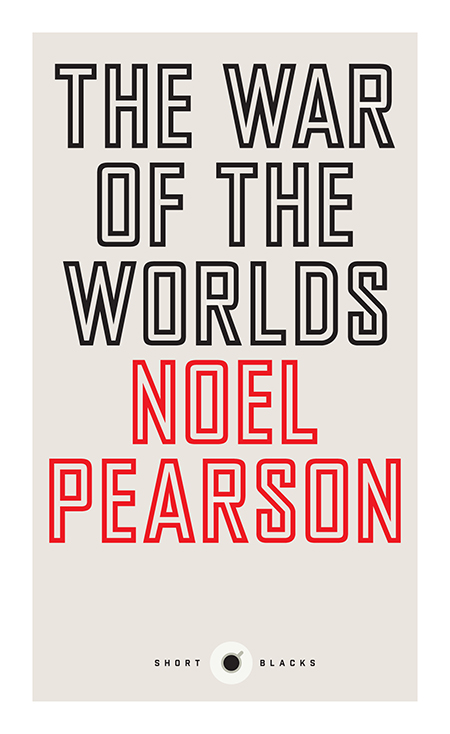
Noel Pearson in Short Blacks

Noel Pearson in Short Blacks

These then have been published before – but they are not classics. They are recent works, and seem to be non-fiction. They include Robyn Davidson’s No fixed address which was originally published by Black Inc as a Quarterly Essay, David Malouf’s One day about ANZAC Day, and Noel Pearson’s cleverly titled The war of the worlds about the “colonial project” and genocide in Australia. I bought a couple of these from the wonderful, independent Hobart Bookshop on my recent visit to Tasmania. Twelve have been published and it’s not clear from the website whether it’s an ongoing project. Like FL Smalls they are appealingly, if more simply, designed, and cost only $6.99 each. What a bargain.

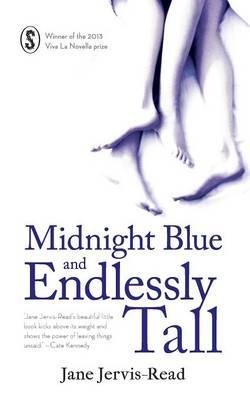
Viva La Novella is a slightly different project. An initiative of the online publisher Seizure Inc, it is a prize that was established in 2012

Jane Jervis-Read, Midnight blue and endlesslly tall

First Viva La Novella Winner

to celebrate and promote short novels – because we like them and believe some of the greatest works in the English language are actually novellas.

I wouldn’t argue with that! Since 2012, Seizure has, with the support of the Copyright Agency Cultural Fund, expanded the award to produce more than one “winner” each year. Like FL Smalls, these are new works, but unlike the Smalls, they are all fiction. Also, unlike the previous two initiatives they are not a standard size, due to the wide the definition of a novella. For Seizure, the range is 20–50,000 words, which means that some books some books are 100 or so pages while others might be 190.  I’ve included them here, however, because they are priced at the cheaper end of the Australian paperback market, $14.95 each, and it is a project dedicated to the shorter book. I have bought one of the 2015 winners, so you will see a review of that too in the coming weeks or months.

Do you like little books? I’d love to hear if you have any favourites – and of any initiatives, in Australia or elsewhere, that you’ve come across.

Monday musings on Australian literature: Serendipitous finds in Tasmania

Well folks, I’ve not posted here for a week. As I wrote last Monday, I’ve been travelling in Tasmania, and have only returned home this afternoon. I have some ideas for future Monday Musings, and could have researched one for today, but I can’t resist sharing a few more of my Tasmanian literary experiences.

Tasmania is home to many Australian writers including Booker Prize winner Richard Flanagan (see my review of his The narrow road to the deep north), National Biography Award winner Alison Alexander, commentator and memoirist Robert Dessaix, and novelist Danielle Wood (see my review of her Mothers Grimm). But there are other, quieter, literary treasures to be had here.

Take gravestones for example …

We visited the historic Bothwell Cemetery, and read some poetically poignant (or, do I mean, poignantly poetic?!) gravestones. Poor Elizabeth, wife of Edward Simon Arnett, died in 1841 at the age of 33. Here are the words on her gravestone:

Now husband dear my life is past
My love was true while life did last.
Bereaved of me no sorrow take
But love our children for my sake.

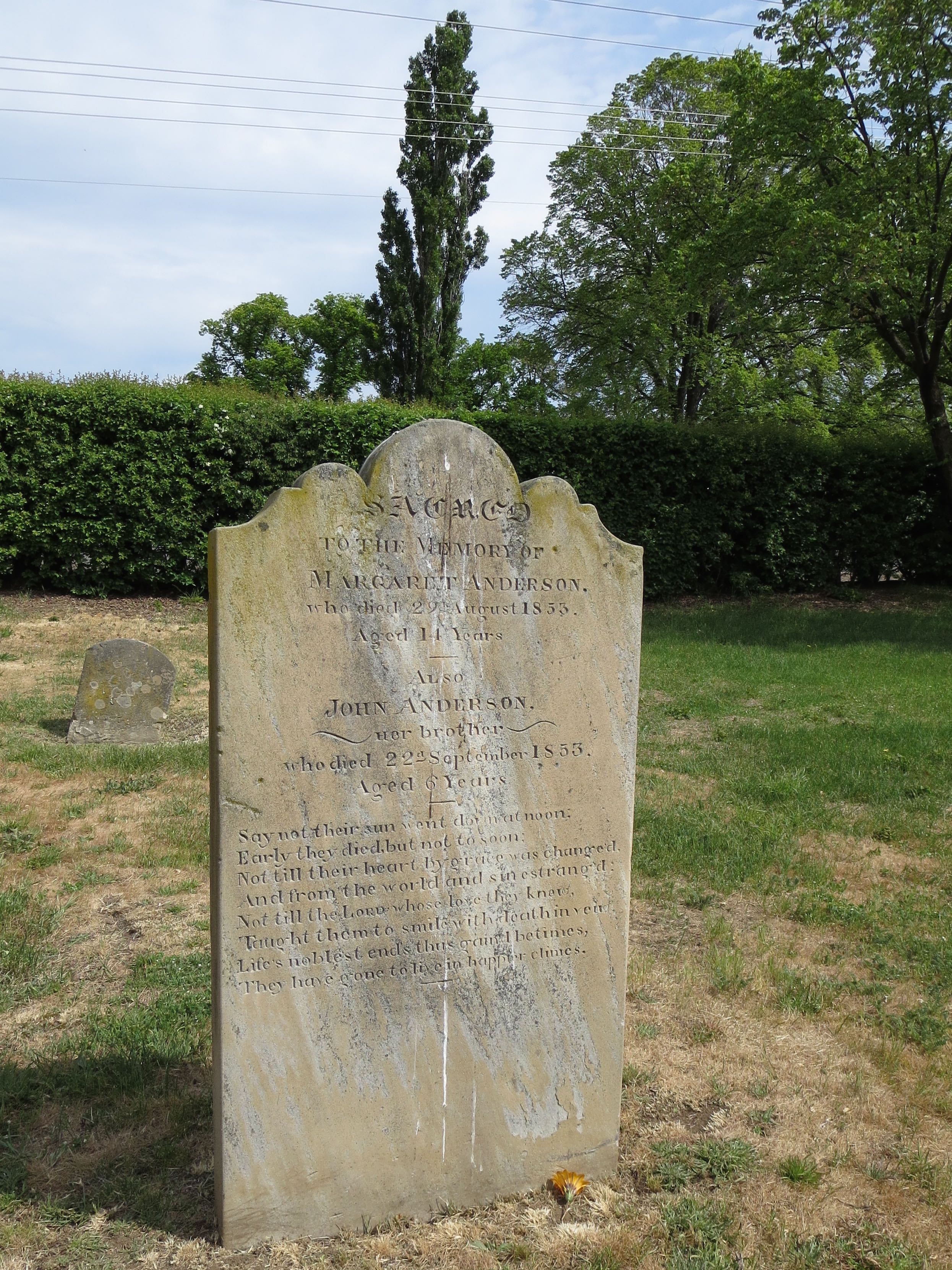
I wonder who wrote that? Did she, knowing she was dying, write it? So sadly, but probably, typically, self-effacing if she did. And then there’s the grave for siblings Margaret and John Anderson, 14 and 6 years old respectively, who died within a month of each other in 1853. On their grave is:

Margaret and John Anderson, Bothwell Cemetery

Margaret and John Anderson, Bothwell Cemetery

Say not their sun went down at noon.
Early they died, but not too soon,
Not till their heart by grace had changed
And from the world and sun estranged.
Not till the Lord whose love they knew
Taught them to smile with death in view.
Life’s noblest ends thus gain’d betimes
They have gone to live in happier climes.

Poor little things. Presumably they died of an illness contracted one from the other, but did they really learn to “smile with death in view”? These and the other gravestones – and I know I’m not telling you anything here – provide such insight into nineteenth century life and thinking.

Then there’s the urban environment

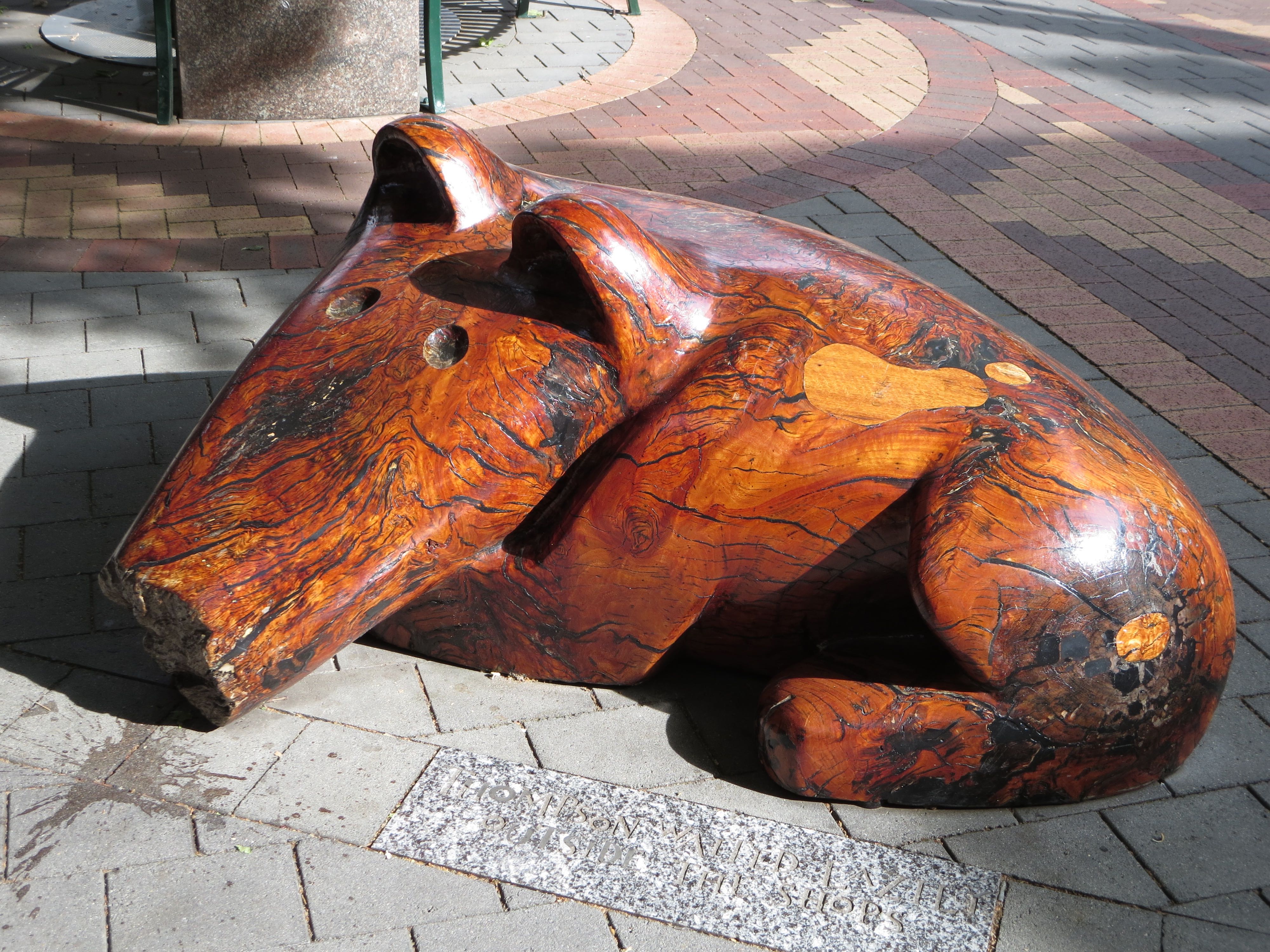
Wooden dog sculpture

Thompson waited lazily outside the shops

The redevelopment of Elizabeth Street Mall in Hobart’s CBD in the 1990s was carried out with a view to humanising the space, to, if I understand correctly, making it aesthetically appealing and artistically interesting, not to mention fun and a little bit provocative too. Much of the art was, I understand, commissioned from the versatile Tasmanian artist Patrick Hall. He did street signs, sculptures, and “granite stories”. The sculptures include a “fish out of water” drink fountain (metalwork), Maurice the pig (moulded hebel) and Thompson the dog (woodcarving).

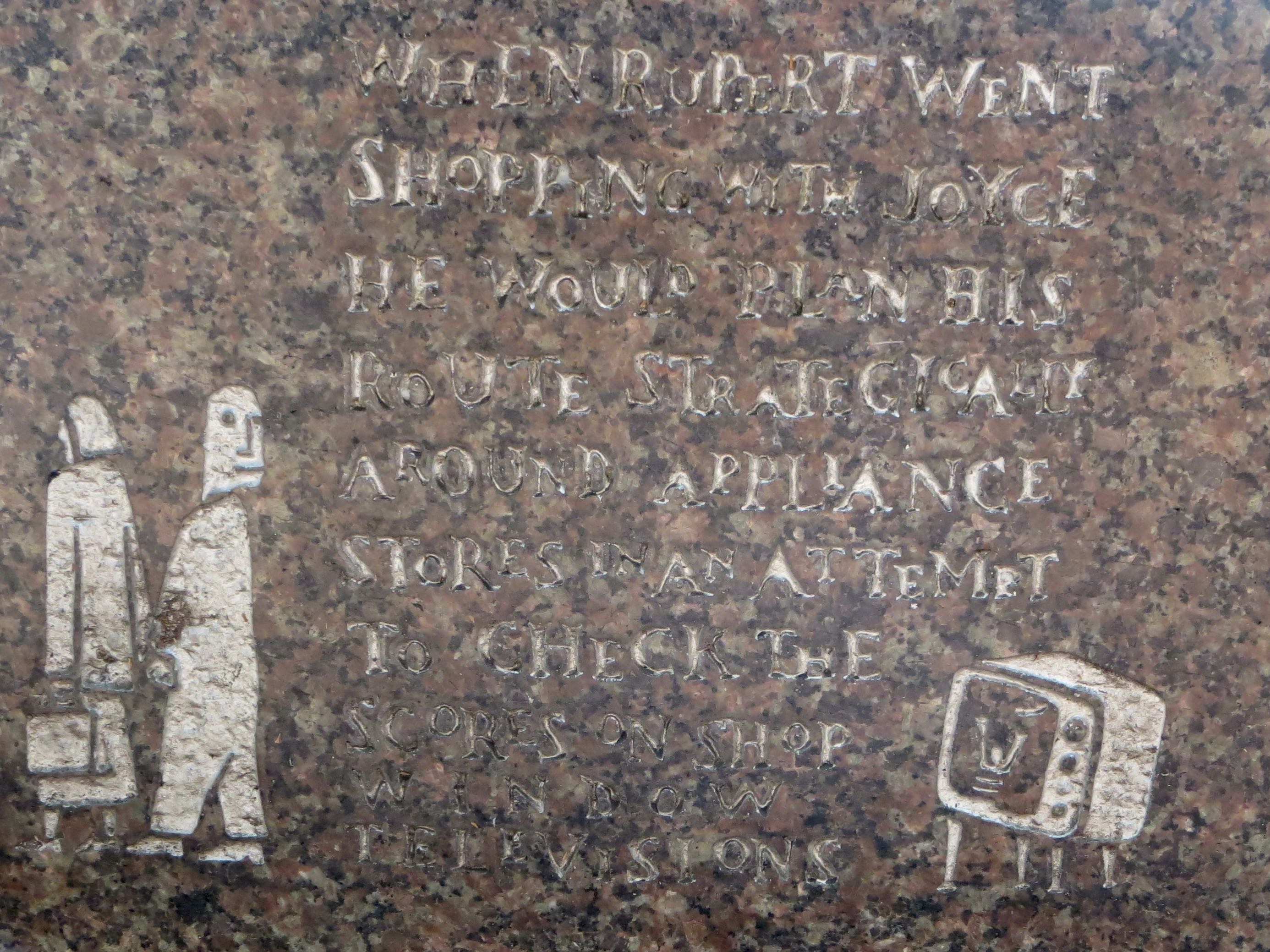
The sculptures would be hard to miss by anyone walking through the mall, but not so obvious are the tiny stories and images etched into the granite pedestals supporting the mall’s public seating. I suspect these are mostly discovered by word of mouth, but they are addictive once you discover them – that is, you want to find and read them all. Here are a few:

Rupert going shopping etching

Rupert going shopping

Beneath their feet lay buried the intersecting tracks and paths of the lives that went before.

AND

To the casual observer Hubert seemed lost in thought, when in fact he was trying not to tread on the cracks.

AND

Zoe tied her bicycle next to a pole and said “stay” before she went shopping.

AND

When Rupert went shopping with Joyce he would plan his route strategically around appliance stores in an attempt to check the scores on shop window televisions.

AND

They would sit with their collars rolled up against the chill winds & imagine they could peer over the edge of the planet.

I love the mix of whimsy, commentary and philosophy here. They are universal, but also seem to be very much of Tasmania.

Just around the corner, more or less, from Elizabeth Street Mall is Mathers Place. Unfortunately I didn’t have my camera when my trusty guide took me through it, but displayed there, on large billboards, are some of the stories by young writers produced under the Young Writers in the City program, which is run by the Tasmanian Writers Centre and the City of Hobart. The idea was that the young writers (under 30 years old) would sit somewhere in the city, and “compose an essay between 1500 to 5000 words … in an observational or experimental style inspired by the [chosen] space”. Not surprisingly, I enjoyed Claire Jensen’s piece about a space where older people meet. Only the beginning of it is displayed on the billboard:

In Hobart’s CBD there is a place where retired women and men meet their friends. They play scrabble, take art and writing classes, computer and ukulele lessons, hold book clubs, discuss family history and grey nomad road trips. For the last few weeks I have been invited into this secret society. They tell me stories, let me eat lunch with them, and beat me at scrabble. In the quiet afternoons, I escape the chatter to sit typing by the windows.

Ben Armstrong, in his piece, “Unified Mall Theory”, tackled the challenge to be inspired head on. (I can’t recollect whether his is displayed in Mathers Place). I like his tongue-in-cheek-up-frontedness:

I have a set of assumptions about the form my benefactors hope this inspiration will take. They want me to contribute to the cultural landscape. They expect me to write about history and stories and the interweaving of history and stories. The phrase “nooks and crannies” has not been explicitly mentioned, but I feel it is implied. Place and context also seem like things I should probably mention. Probably something about David Walsh* as well.

And now, since it is half-an-hour or more into Tuesday on my clock, I shall publish this, without a proper conclusion but hoping you have enjoyed my two little idiosyncratic Tasmanian posts. Normal Monday Musings will resume next week!

* David Walsh is the owner/benefactor of Hobart’s famous, and very popular, private art museum, MONA.

Monday musings on Australian literature: A Tasmanian interlude

You may have noticed that it’s been fairly quiet here at the Gums over the last week or so. This is because I’ve been travelling for nearly two weeks now in Australia’s island state of Tasmania. I scheduled last week’s Monday Musings in advance and had planned to also schedule a Tasmanian “Let’s get physical” post before I left, but it didn’t happen. Once here, I’ve been so busy catching up with my brother and then road-tripping with Mr Gums that I’ve not had time to do the necessary research to do such a post justice, so today I’m just going to post three photos, each with an associated quote to at least give you a taste of this gorgeous place.

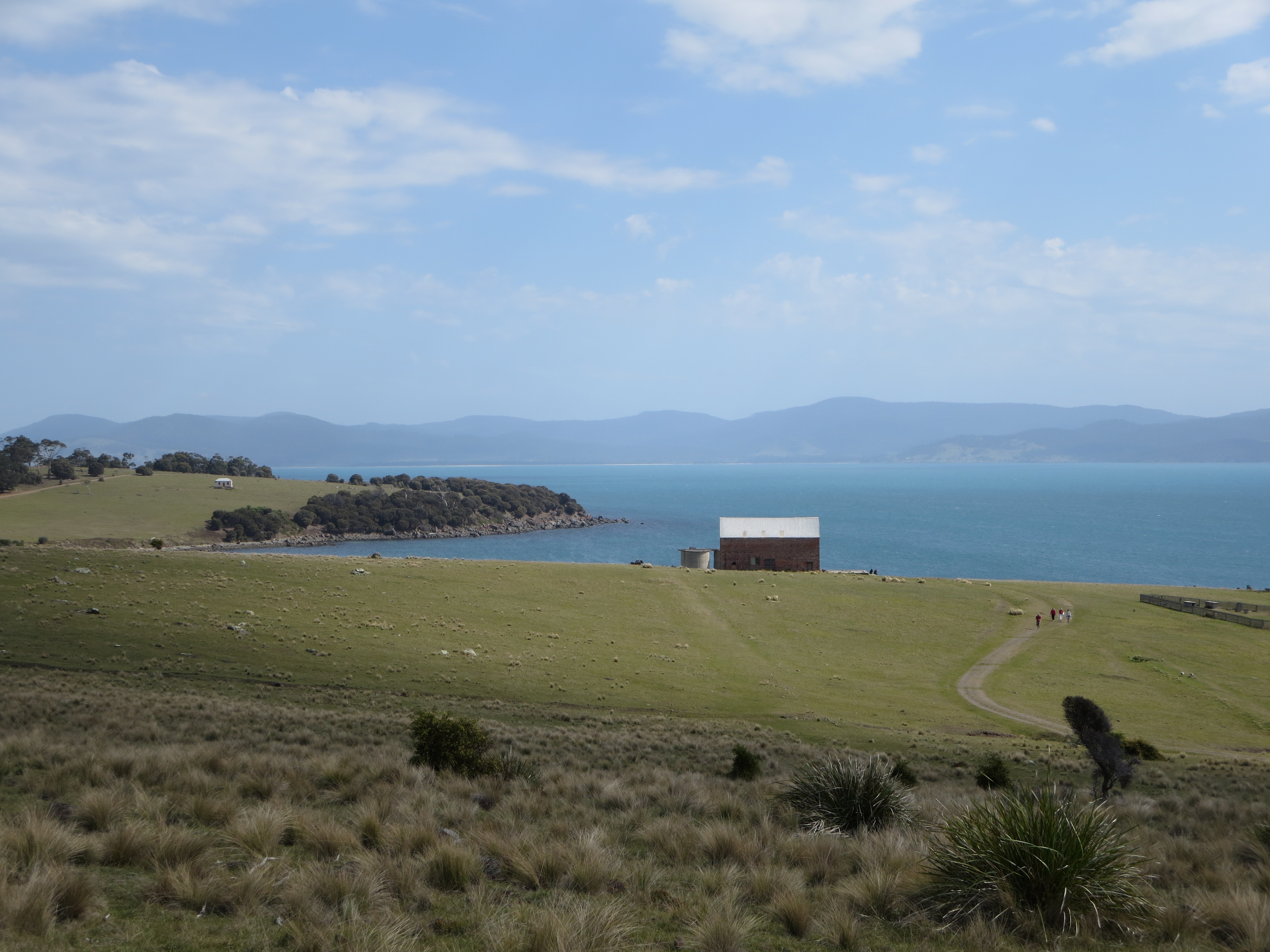
IMG_8328

Looking across western Maria Island to the main island of Tasmania

Maria Island, off south-east Tasmania, was a convict settlement, with two waves, the first from 1825 to 1832, and the second from 1842 to 1850. An inmate of that time was William Smith O’Brien, a leader of the Young Irelander Rebellion of 1848. He is quoted as saying, as he arrived at Maria Island:

To find a gaol in one of the loveliest spots formed by the hand of Nature in one of her loneliest solitude creates a revulsion of feeling I cannot describe.

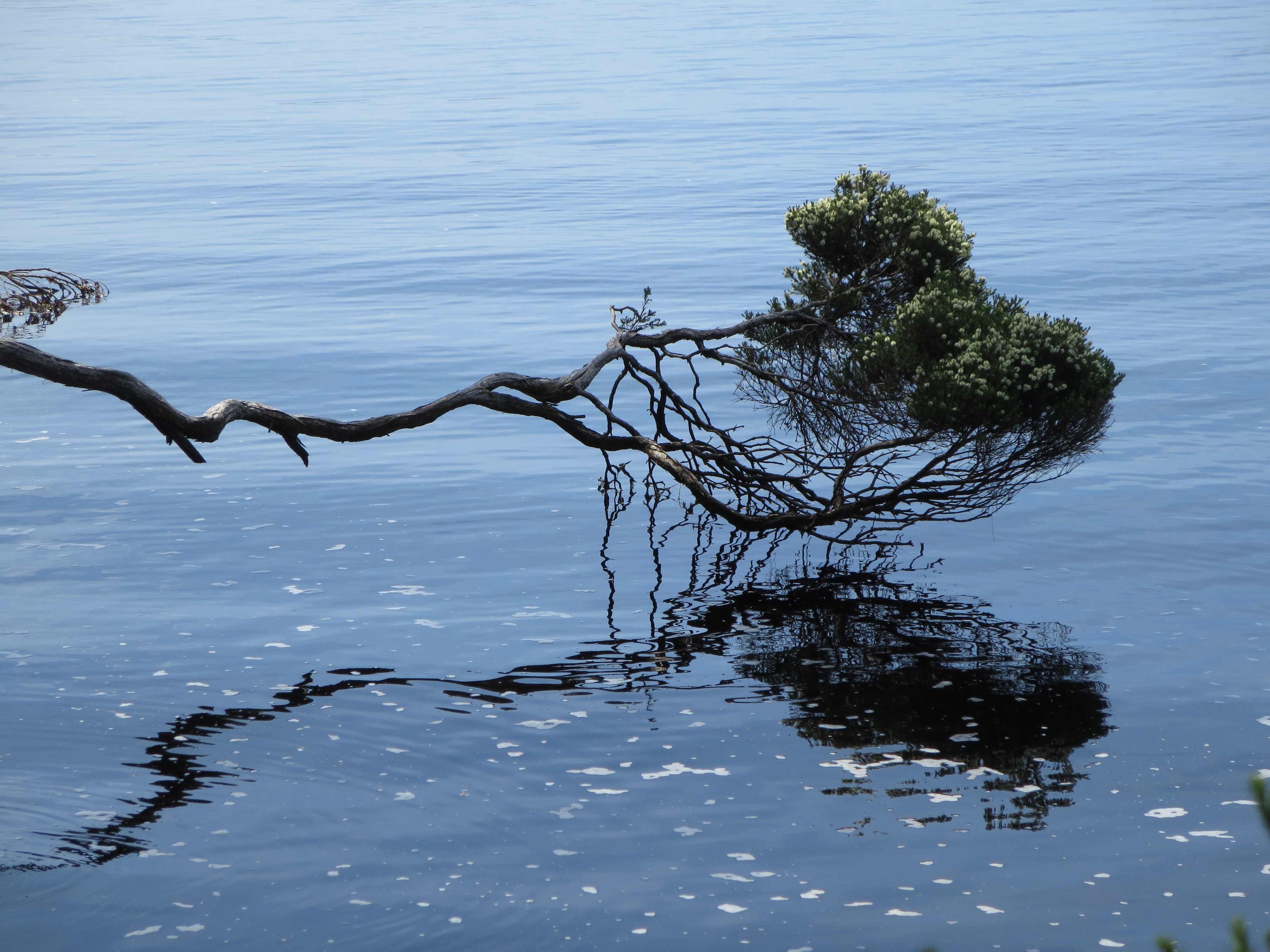
Sarah Island

Sarah Island

Macquarie Harbour and the Gordon River on the west coast was also a convict settlement, at least Sarah Island, which is located in the river, was. It was infamous for its brutality, and is in fact the setting for Marcus Clarke’s classic move, For the term of his natural life. However, the Gordon River has another claim to infamy. From the late 1970s to early 1980s it was the centre of a bitter conservation battle when the Tasmanian government proposed building a dam as part of its ongoing hydroelectricity program. But this is wilderness of high order. In fact, when the Tasmanian Wilderness was granted World Heritage status for which you need to satisfy at least one of ten cultural and/or natural criteria, it satisfied 7. Only one other site has apparently achieved this. Like many people our age we supported the protest, donating to the Australian Conservation Foundation and sporting the yellow “No Dams” sticker on our car. The conservationists won, in a landmark decision that had Australia’s High Court supporting the Federal Government’s case for stopping the dam, overruling the State Government. What a joyful day that was. One of the supporters of the movement was the historian Manning Clark. He said in 1980:

Keep this treasure and hand it on to posterity so that those who come after will learn about beauty, about awe, about wonder, because it is in the southwest of Tasmania that you will have a chance to solve the mystery at the heart of things.

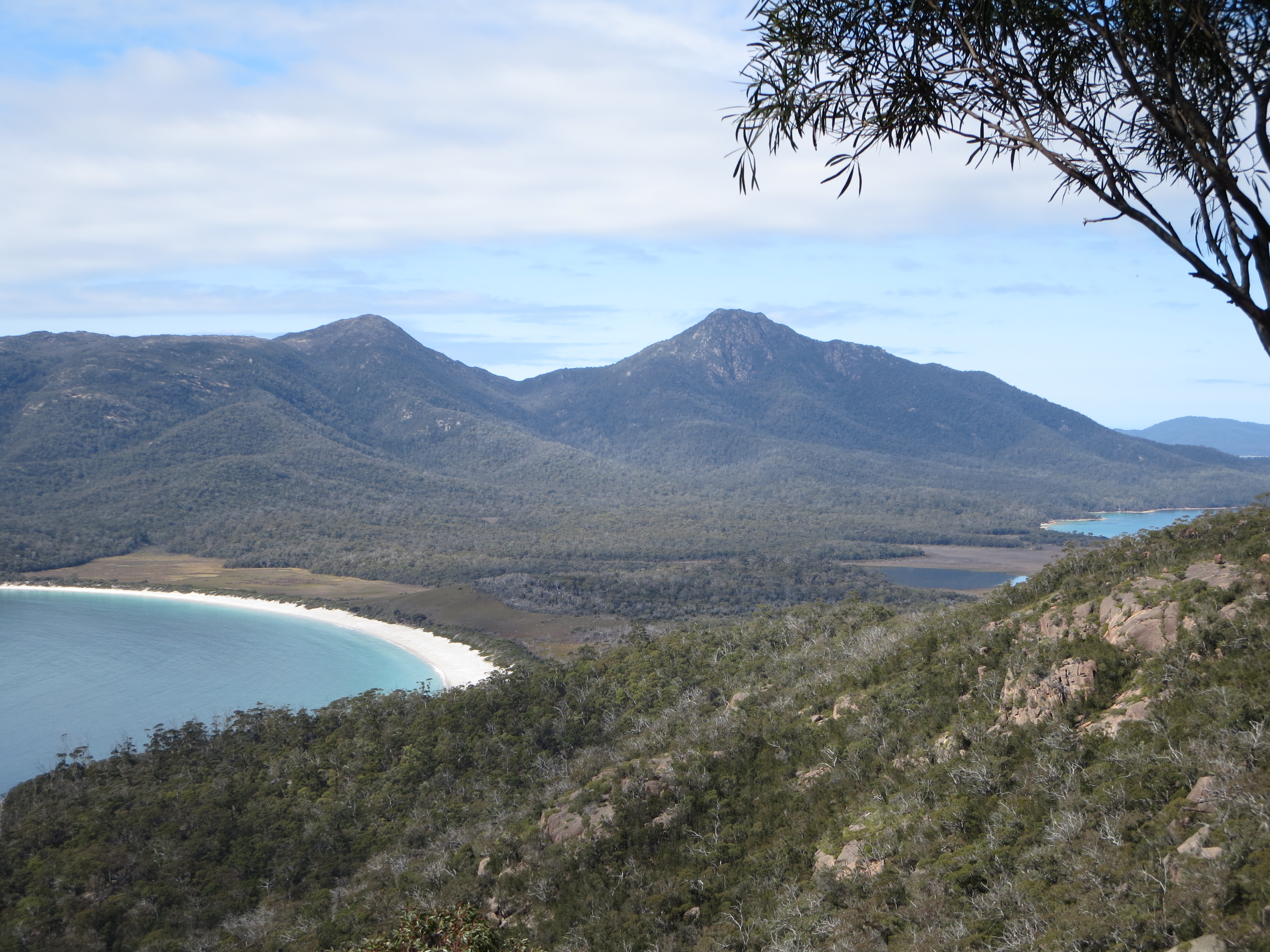
Winegalss Bay to the left, and Hazards Beach just visible to the right

Wineglass Bay to the left, and Hazards Beach just visible to the right

Finally, though I only say finally because I have to stop somewhere, there’s Freycinet National Park, which takes us back to the east again, a little north of Maria Island. This is a stunningly beautiful place of clear bays, pristine beaches and pretty pink granite mountains. Australian poet James McAuley loved this area. Here are some lines from his poem “Coles Bay Images”:

Turquoise – coloured waters in small bays
Shawling towards the beach say shalom, peace.

And that is exactly the feeling you get walking in this part of the world – a sense of peace.


Monday musings on Australian literature: Writer-in-residence programs

I’ve written before about Writers’ Retreats, which are sometimes framed as writer-in-residence programs. However, for this post, I want to focus not on those programs that are designed for writers to withdraw (retreat) to focus on a personal project, but on those for which engagement with the community in which they reside is a significant part of their role. I don’t know about you, but I come across these quite often out of the blue and love that they exist. Some of them are ongoing programs, while others are one-offs. Some are specifically targeted to writers while others, usually described as artist-in-residence, are open to any arts practitioner. The most common ones I’ve seen are those offered at schools and universities, but they can be offered by anyone. They can vary greatly in purpose, targeting all sorts of people from school students to other writers, from potential clients to the general public. And they range from non-profit programs to rather commercial ones. All of this will become obvious from the small selection below:

Accor Hotels MGallery Literary Collection is a program in collaboration with Melbourne’s The Wheeler Centre. It involved providing eight award-winning Australian writers with a short residence in one of Accor’s boutique MGallery hotels and commissioning those authors to write a short story which will be published in a book which will be “presented exclusively to guests at MGallery Hotels”. Associated with these are author events at the hotels, such as that with Favel Parrett at Mount Lofty House in Adelaide in April 2015.

Bayside City Council Artist-in-Residence is open to visual artists, multimedia practitioners, writers and composers. They describe it as a public program in which the resident artist is “required to be involved in community engagement activities. This may take the form of artist’s talks, community workshops, master classes for local artists, participation in Bayside festivals or exhibitions or other activities agreed upon”.

Birrong High School Writer-in-residence was part of the ASA’s (Australian Society of Authors) Authors in Priority Schools program which aims to build “the narrative and literacy skills of school students, from K-12.” It involves authors running creative writing courses at a school, but the exact style of program varies a little in each school in accordance with the school’s needs. The Birrong program involved author Laurene Croasdale who has worked both in publishing and as a writer.

Cocoon Floatation floating writer-in-residence program is a program that runs in partnership with the Wollongong Writers’ Festival. The program involves the Festival choosing an author from the festival line-up  “to receive two free floats in exchange for producing a piece of work to be donated back to WWF and Cocoon Floatation”. The 2015 writer is Candy Royalle, who is “a performance artist, poet, storyteller and educator”.

Editing in Paradise writer-in-residence is part of the organisation’s business of running workshops and retreats for writers. The writer-in-residence is their program for including a writer on their retreats to give “an added dimension to the teaching and sharing of industry knowledge”. So, for example, at their Bali retreat, this October, they will have Ashley Hay whose most recent novel was The Railwayman’s Wife. Previous writers have included Charlotte Wood and Susan Wyndham. I’m assuming the writer is paid to attend and provide expertise at the retreat.

Lotus Asian-Australian Playwriting Project is a project aimed at bringing more Asian-Australian stories to the Australian stage, by “installing” an Asian-Australian resident playwright in three theatre companies by 2017. Supported, at least initially, by the Australia Council and Arts Victoria, this program also includes other initiatives including salon-style play-readings

RMIT Writers-in-residence program is a fairly typical university program. The program aims to make “a significant contribution to RMIT, its writing program and to Melbourne’s broader literary culture”. RMIT writers-in-residence have included Robert Dessaix, Chloe Hooper and Nam Le. It was supported from 2009 to 2012 by the Copyright Agency Limited (CAL)’s Cultural Fund. The web-page implies that it is an ongoing-program, but it is not clear whether this really is the case or not.

I found references to programs in several universities, such as the University of Adelaide and UTS (the University if Technology Sydney), but no clear evidence that they were ongoing programs. Indeed it seems that these programs often have short lives, which is a shame. I wonder why they seem often to be flashes-in-the-pan?

Despite this uncertain history, whenever I come across these programs I feel a little excited – even if I’m not going to have any involvement – because I imagine the stimulation, excitement and creativity that the participants will experience. A little starry-eyed, I suppose, but I hope this is the common outcome!

Have you experienced a writer-in-residence program, either as a writer or a “consumer”? If so, what value did you get out of it?