Monday musings on Australian literature: Neilma Sidney Literary Travel Fund

We all know that a writer’s life is not a well-paid one. One way that writers keep going, that is, that enables them to continue writing, is through winning awards and grants. I report often on awards, and they also regularly appear in the media, but how much do we know about grants? And what exactly is a grant?

I’m not sure what the official definition of an artist’s grant is, but I’d define it broadly to encompass any monies or, other in-kind products or services (like residencies), intended to support creators doing their work. Grants tend to be offered by government bodies, foundations, trusts and non-profit organisations, with the best-known ones in Australia being, probably, those offered by the Australia Council for the Arts and the Copyright Agency. However, there are many other grants – big and small, general and specific – that writers can apply for. Darned if I know how they find out about them all, but their state writers centres, most of which I’ve now covered in this blog, are probably a good start.

I don’t want to get into the politics of funding artists. There’s the politics involved in grant-making (as anyone who has followed the Australia Council over the years knows only too well) but there’s also the bigger issue of how (or if, some would say) we should, as a society, support artists in the first place. Instead, today, I just want to share one specific grant, as an example of the sort of support artists (in this case writers) need and can get.

Neilma Sidney Literary Travel Fund

The Neilma Sidney Literary Travel Fund was established in 2017 by Writers Victoria, with funding from the Myer Foundation, in the name of poet, novelist and short story writer Neilma Gantner (1922-2015). Gantner was the daughter of businessman and philanthropist Sidney Myer. The Fund recognises, says the Writers Victoria webpage, “the unique value of travel in the development of new writing and literary careers”.

The grants, which range between $2000 and $10,000, are “intended to support emerging, midcareer and established Australian writers and literary sector workers. This includes writers, editors, agents, publishers, librarians, booksellers, employees and associates of literary organisations and journals, and other literary professionals currently living in Australia”.

Last week, Books + Publishing advised that Writers Victoria had announced the fifth round of recipients for the Fund. This round was the second offered in 2019. The judges change for each round, with those for Round 5 being writer Eugen Bacon, podcaster Astrid Edwards, and Black Inc. publisher Kirstie Innes-Will.

Here are the recipients (in grant amount order), showing the sorts of activities the fund supports:

  • Evelyn Araluen and Jonathan Dunk ($9656): to research Aboriginal and settler–colonial literary and cultural relations in England and the Czech Republic. Araluen is an Indigenous Australian poet, educator and researcher, while Dunk is a poet, critic, fiction-writer and academic.
  • Cate Kennedy ($7000): to attend writers’ festivals in Ireland and Jamaica, and residencies and reading events in the US. I’ve read some of Kennedy’s short stories, and have reviewed the excellent anthology Australian love stories which she edited.
  • Ruhi Lee ($6850): to research her memoir in India. Lee is a Melbourne-based writer, and was, in fact,  part of this year’s HARDCOPY program, run by the ACT Writers Centre (about which I wrote in 2015).
  • Mirandi Riwoe ($6062): for a residency at the Tyrone Guthrie Centre in Ireland. I’ve reviewed her powerful novella, The fish girl.
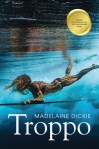
  • Book cover for Madelaine Dickie's TroppoMadelaine Dickie ($4374): to research a proposed biography of Wayne Bergmann in Broome. I’ve reviewed Dickie’s debut novel, Troppo, and will be attending the launch of her second book, the intriguingly titled Red can origami, this month. Dickie won the T.A.G Hungerford Award for Troppo, and it was also shortlisted for the Dobbie Literary Award and the Barbara Jefferis Award.
  • Fiona Hardy ($3920): to research and begin her middle-grade fiction book on Christmas Island. Hardy is a children’s book writer, reviewer and bookseller.
  • Robert Lukins ($3473): to research a novel in Carter Lake, Iowa–Nebraska, US. Lukins’ debut novel, The everlasting Sunday, was short or longlisted for some major literary awards this year.
  • Maria Takolander ($3177): to attend the Arteles artist-in-residency in Finland. I have Takolander’s short story collection, The double, on my TBR, but keep not getting to it! My bad.
  • Sara Saleh ($3100): to take part in the inaugural Arab–Palestinian literature festival in New York. Saleh is an Arab-Australian poet, creative artist and activist.
  • Tamara Lazaroff ($2723): to research her memoir on De Witt Island, Tasmania. Lazaroff is a Queensland-based writer of fiction and nonfiction, who took part in last year’s HARDCOPY program.

Books + Publishing referred to “eleven successful writers, booksellers and publishers” but in fact all these grants have been given to writers and/or for writing projects. This is not surprising really, given their generally insecure funding base, but it would be interesting to know how often other literary professionals have been given grants.

It’s darned hard work applying for grants, I know. The above 11 (for ten projects) were selected from 99 applicants, which is probably not a bad ratio. Still, writers must have to juggle the time spent on writing grant applications against writing their books. I congratulate the above 11 on their success, and hope they find spending their money both fruitful and enjoyable!
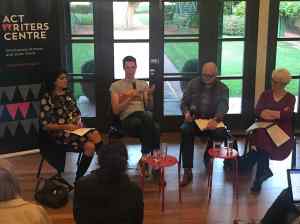
The Constructive Critic (Panel discussion)

For some reason that I can’t quite explain – a sudden rush to the head methinks – I agreed to be part of a panel being organised by the ACT Writers Centre for this year’s Design Canberra Festival. The panel, called The Constructive Critic, was described as
a unique panel discussion about art criticism across multiple disciplines including visual arts, design, theatre and literature, and its importance and impact.

What is the point of arts criticism? What has changed now everyone has a voice via social media? What is the relationship between artist and critic, and what about the blurred lines of artists who critique others?

The panelists (check bios on the event website) were art curator and critic Peter Haynes (also the moderator), local authors Jack Heath and Karen Viggers, and me. This is not one of my verbatim reports because I was too busy taking part, but I want to document some of the things I remember that we discussed.

It was an enjoyable evening – for me, anyhow – largely because both the panel and the audience were friendly and engaged. We didn’t always completely agree on topics, but the ensuing discussion invigorated rather than diminished our thoughts and ideas.

My favourite description of arts criticism came from the most experienced critic amongst us, Peter, who said that:

For me writing criticism is about opening a dialogue and first the critique is for me to explore the work. Whatever medium. A review should start with a question. The critic opens the questions that the artist and curator have posed. (Tweeted by the ACT Writers’ Centre whom I thank for capturing this so nicely!)

I love this, the idea of opening the questions posed by the creator of the work (the book, the play, the exhibition, the film, etc), and will try to do it more. [PS: I forgot to say that we later talked about how social media at its best can encourage this dialogue/conversation.]

The topics we covered included defining what criticism is, what creators want from criticism, who criticism is for, the role of social media in contemporary criticism (is everyone really a critic?), the economic impact of criticism, whether creators can critique or review each other’s work, and what we think about negative criticism.

Most of us seemed to agree that there is a review-criticism continuum. The highest level of criticism we saw as comprehensive, academic, knowledgeable about the wider culture/genre/context within the work fits, while reviewing at its most basic can be short, narrowly focused and, perhaps, more oriented to promoting the work. This is not to say, however, that high level criticism can’t/doesn’t promote a work too, but the link is, I’d say, more tenuous.

Related to how we define criticism is the question of who/what criticism is for. For some critics*, it seems to be for the consumer (the reader, for example), for some it can be for the creators (the authors), and for others seems to be more for the producers (the publishers). At least, this last is how it looks when you get to the emerging “influencer” role, upon which we touched briefly. For the authors in our panel, the second was particularly relevant. They appreciate criticism which can help them develop their own work. There is a fourth option, which is the one I ascribe to. It’s that criticism is about contributing to the wider culture. While of course what critics write will encourage or discourage people from reading the book, going to the show, whatever, the main loyalty is to the culture. This means I’m keen to see the work I’m discussing within the context of both literary and social culture, to talk about how it adds to the body of work to which it belongs and how it addresses or contributes to the society in which we live. Looking at it this way, I’m less interested in ascribing value – this is a “good” or “bad” book – than in where it fits. I’m not sure I achieve this, but that’s my goal.

We talked briefly about social media: the destructive impact of thoughtless negative comments on authors; the positive and negative economic impact social media can have; the impact and application of ratings (like those on GoodReads); the current plethora of free review copies which can result in reduced early sales; and the value of hindsight versus the immediate response that is common in social media.

Opposing opinions were offered about whether artists can critique artists. The affirmative suggested that artists know what’s involved in creating the work and can therefore bring that understanding to their review, while the negative suggested that it is hard to properly critique people you know, and that creators, knowing the techniques involved, will often focus on technical aspects rather than the work as a whole.

Negative reviews came up several times throughout the discussion, and again at the end. Peter announced early on that he didn’t write negative reviews, which, regular readers here know, would appeal to me. What he meant by this – and how I also see it – is that if he doesn’t like something, he won’t review it. However, he will, in an overall positive review, refer to aspects that might not have worked so well. Yes! However, a question came from the floor about negatively reviewing a work that is against current social values – that is blatantly sexist, racist, ableist, for example. Karen spoke for all of us when she said that such ideas should be called out. Jack, earlier in the session, had entertained us by describing how he had learnt from a one-star review. The reviewer had missed the main point of his work he felt, but nonetheless the comment had made a valid observation, one that he used in the next book in his series!

Of course, like my old school exam days, I came away thinking about all that I could have, or wished I’d, said. One issue we didn’t discuss in any detail was the critic him/herself: the degree to which critics should aim to be “impartial” (whatever that is) versus put their preferences and background on the table, and, indeed, whether, in our current environment regarding who can write what, whether there’s also a question concerning who can critique what? But, I’ll leave those for another day!

Meanwhile, thanks to Paul and the ACT Writers Centre for asking me to be on the panel, and to Peter, Karen and Jack for being such fun and so interesting to talk with.

* I’m using the term “critic” broadly in this write-up to cover the whole continuum of arts writers, and my examples are mostly from the book world (but in most cases you can substitute your art form of choice!)

The Constructive Critic
Design Canberra Festival 2019
Gorman Arts Centre, Main Hall
12 November 2019

Monday musings on Australian literature: Writers Victoria

When I wrote my last post in this Monday Musings series on Australia’s writers centres, author Angela Savage, who is also the current Director of Writers Victoria, commented that the centre was celebrating its 30th anniversary this year. She was hinting, in the nicest way of course, that I should “do” Writers Victoria this year – so, here I am.

Like Writing NSW and Writers SA, Writers Victoria changed its name (in 2011) from its original name, the Victorian Writers’ Centre. A not-for-profit membership organisation, it was created in 1989 by a group of writers who believed Victoria’s writing community needed a professional organisation. I love the clarity and comprehensiveness of their overall goal:

Writers Victoria supports and connects all types of writers at all stages of their writing careers.

This is supported by more specific purposes as listed on their About Us page. It’s not surprising that what they do is similar to other centres, but, like the others, they have their own flavour. They also operate within a very specific environment, given Melbourne’s status as a UNESCO City of Literature and the presence of The Wheeler Centre (for Books, Writing, Ideas). The then Victorian Writers Centre played an instrumental role in achieving both of these. Writers Victoria is, apparently, “the largest writers’ organisation in the country” and “the country’s leading employer of writers” through their programs.

You will have read enough of these writers centre posts now to know what they offer – courses and workshops, mentorships, manuscript assessments, fellowships, writing spaces or studios, to name the main activities. Writers Victoria also specifically supports regional writers, young writers, diverse writers, and writers with a disability. They also advocate for writers and the literary culture.

Book coverTheir diverse writers program, for example, supports “writers who face barriers in the development of their writing careers”. The programs are, well, diverse, catering for women of colour, Asian Australian writers, Aboriginal and Torres Strait Islander people, refugee writers, and so on. The program recognises that money can be an issue for these writers, so among the support it offers are bursaries, and paid commissions. The indigenous writing program has used writers you’ve met here – Tony Birch, Anita Heiss and Bruce Pascoe.

For writers with a disability they have a program called Write-ability. Its aim is “to remove some of the barriers that have traditionally prevented people with disability from connecting with writing and publishing”. This support includes regional and online programs, and fellowships.

30 Years

However, because this year is their 30th anniversary, I thought I’d focus mainly on how they are celebrating this milestone – particularly since October was their establishment month.

Here are some of the ways they are celebrating their anniversary:

Flash fiction challenge

In April – the first month of the year with 30 days – they held a Flash Fiction Challenge, which they promoted as “30 days. 30 prompts. 30 Words.” For each day they offered a word prompt, and writers had to submit their 30-word works of flash fiction inspired by that word by midnight of that day. The 30 winners are shared at the link I’ve given, with the first winner, for the word Grit, being blogger Tony Messenger. As a wordlover, I enjoyed the variety of the prompt words, which included Baroque, Gloss, Remember, Nacreous, and Perfectionism.

For a clever, pointed piece, check out Sumitra Shankar’s Beginning, on April 21. It’s a perfect example of the power of flash fiction.

Writers on Writers Vic

Book cover for Toni Jordan's AdditionFor each month – they are up to September – a Victorian writer comments on what Writers Victoria means to them. The writers to date are:
  • Lee Kofman (who co-edited Rebellious daughters which I’ve reviewed)
  • Mark Brandi
  • Toni Jordan (whose Addition, Fall girl and Nine days, I’ve reviewed)
  • Melanie Cheng (whose Australia Day I really must read)
  • Shivaun Plozza
  • Fiona Wood
  • Andy Griffiths (with whom I’m sure to soon have a close acquaintance through my grandson!)
  • Anna Spargo-Ryan (whose The paper house I’ve reviewed)
  • Else Fitzgerald

You can check them all out by going to the site’s page, but to whet your appetite, here are some of the things they say:

… the main antidote to that famous writer’s malady – loneliness, isolation – is in hanging around with peers. Today writers’ centres seem to serve a similar function to that of literary salons from the previous centuries. (Lee Kofman)

I always tell aspiring and emerging writers about Writers Victoria. Many, like me, are just bumbling along, feeling lost and isolated. Writers’ centres like Writers Victoria are invaluable in making writers feel less alone. (Melanie Cheng)

First, I would wholeheartedly recommend it [joining Writrs Victoria]. But second, know what you want to get out of it. A centre like Writers Victoria has something to offer writers at all stages. (Anna Spargo-Ryan)

And so, a very big Happy Birthday to another active writers centre. Australians should be proud of the energy and commitment centres like this one are putting into both supporting all writers and keeping our literary culture alive. Oh, and thanks to Angela Savage for the birthday heads up!

Writers Centres covered to date: the ACT, New South Wales, the Northern Territory, Queensland, South Australia and Tasmania.

Monday musings on Australian literature: Writers SA

Time, I decided, for the next Monday Musings in my little series on Australia’s writers centres, this time South Australia’s. And it, like Writing NSW did, has recently changed its name, in this case from SA Writers Centre to Writers SA It is, says its About page, Australia’s first writers’ centre, and is located at the State Library of South Australia..

The Chair at the time of the change, Amy Matthews, said that it will ‘turn its attention in an even more dedicated way to helping South Australian writers achieve their creative dreams’, and that they are ‘going to do even more all over the city and the state, with more free events, more writing workshops and three targeted year-long programs for writers at all stages of their careers’. One can be cynical about name changes, but if they result in real improvements, then who cares. Let’s hope that’s happening here.

Like other writers centres, Writers SA is a membership organisation, but also obtains funding and support from others, particularly from federal and state governments.

Here are some of the things the centre does:

Courses/Workshops

Courses and workshops are, as I’ve said in previous posts, a major component of what writers centres do, and so it is with Writers SA, and it’s clear that this centre makes a particular effort to support and encourage young writers. Here is a small selection of Writing SA’s current offerings:

  • Teen Writers Club (with Jason Fischer, a science fiction writer who has won and been shortlisted for Ditmar and Aurealis Awards): geared to teens 15–17 years old, but this is a guide only, they say. That said, they also have a group for younger people aged 12–14 years old. It’s a weekly group that meets on Saturday mornings during school term time.
  • Manuscript Incubator (with Bronwyn Tilley): a 5-month program for “writers looking towards publication”. It’s far easier to quit than to finish! This program says it’s for a whole range of needs from turning a draft into a “final polished product”, to finding/approaching an agent or publisher.
  • Story to Screen (with Holly Lyons, who is been script-writer or script editor on many Australian television series, including, most recently, Home and away): a one-off workshop on how to transform “an original idea for a story that you’re happy to share with the group … into a story with impact suitable for film or TV.”
  • Book coverWriting for Change (with Tory Shepherd, journalist who has written On freedom, published by MUP): a one-off workshop on the challenge of crafting “a piece that will (hopefully!) withstand the scrutiny of subeditors, editors, and of course readers”. The promotion for this workshop says that “there’s more demand than ever before for opinion pieces, which means more opportunities for freelancers. It’s also a powerful way that advocates and lobbyists can make their case.”

These are just four of many courses and workshops they offer on topics that include, in addition to the above, creating comics and writing YA fiction, the future of fantasy, finding an agent, and even on how to keep your motivation up!

Events/Networking

  • Monthly meet-up: A monthly informal get-together led by staff from Writers SA and Adelaide City Library that is “usually genre specific or practice specific”. The promotion says “ask for advice, ask questions, tell stories or make up stories. You’ll come away motivated and ready to go home and put pen to paper.” The August meet-up is on Journalism.
  • Literary drinks: These are regular (or semi-regular, it’s not clear) evening which they describe as “relaxed networking opportunities for writers, readers and everyone in or interested in the writing industry. Meet your writing peers, connect with your community, and find out what’s happening in the world of words in SA.” The next one occurs in September and is called “Spring Mixer”.
  • Salisbury Writers Festival: This annual festival, now 15 years old, is organised by Writers SA and the City of Salisbury. The program for the 2019 festival to be held at the end of August is on their website.

In addition to the above, Writers SA also offers a wide range of professional resources and services, including manuscript assessment, something they call “first feedback”, and individual consultations. It has a blog, which seems to be published regularly, and which covers a wide range of topics, from professional to fun things like giveaways.

Book coverIn 2018, the centre created a Writers and Readers in Residence Project specifically designed to support regional communities. It involves South Australian and international writers undertaking “an artistic residency in regional communities to activate reading as well as writing in the town”. It seems to have funding (from the Australia Council of the Arts) to run from 2018 to 2020. You can read about it on their website.
Writers who have been involved to date include Jennifer Mills (author of the Miles Franklin shortlisted Dyschronia) who was based in the Eyre Peninsula; New Zealand novelist and playwright Whiti Hereaka who is currently based at Roxby Downs Community Library; and writer Karen Wyld who took part in the ACT Writers Centre’s Hardcopy program and was based at Ceduna. The project involves writers working on their own projects and offering workshops or other activities in the communities in which they are based. Karen Wyld was hosted by the local public library while another participant, novelist and poet Bernice Chauly, worked with Ali Cobby Eckermann (who has appeared several times on my blog.) It sounds like an active, exciting program, one that recognises the needs of South Australia’s many remote communities, while offering development opportunities for the writers too. It also clearly puts diversity into practice in its selection of writers for the project. (Oh, and this sounds like just the sort of thing the newly-renamed organisation was aiming for!)

.. and here ends my post on another busy, active Writers Centre.

Writers Centres covered to date: the ACT, New South Wales, the Northern Territory, Queensland, and Tasmania.

Monday musings on Australian literature: New Territory 2019

New Territory LogoFor the third year I am a mentor for the ACT Writers’ Centre arts writing program, which was called in its first year, ACT Lit-bloggers of the Future program, but rebadged last year as New Territory or, Adventures in Arts Writing. It was broadened then to include theatre, when the Street Theatre joined the National Library of Australia and the Canberra Writers Festival as program partners.

I’ve greatly enjoyed my role, as I’ve met some wonderful people – Angharad and Emma in 2017, and Amy in 2018. This year, we increased the number of participants to three, but one has since withdrawn due to being offered work in Kyrgyzstan! Canberra, Kyrgyzstan, Kyrgyzstan, Canberra … What would you choose?

So, to recap the program before I introduce this year’s participants. Its overall aim, as the Writers Centre says, is to develop:

a deeper conversation about the arts: why we make art, how do we engage in art, and to what end? We aim to develop the arts writers, thinkers and provocateurs of the future.

This is done by providing for the selected emerging ACT-region writers to attend events at the National Library of Australia, the Street Theatre and the Canberra Writers Festival, and post their responses (which “document/explore/critique the experience”) on a blog. And this year, we have a dedicated New Territory Blog for the writers. It is still managed by the Writers Centre, but is separate from their own blogWe expect each blogger to write around 6 posts over the 6 or so months that the program runs. The Writers Centre plans to populate this blog with all the posts that have been written for the program since its inception.

The three writers were chosen in May, and the program is now well under way, so I’d like to introduce the two continuing writers to you:

  • Shelley Burr is working on a novel, and took part in the ACT Writers Centre’s well-regarded Hard Copy program last year (the same program, though a different year of course, that helped Michelle Scott Tucker with her biography of Elizabeth Macarthur, which I’ve reviewed.) She is particularly interested in what she calls “drought noir”, which term sounds perfect for some of the crime coming out of Australia at present. Shelley has had her writing place well in the Stockholm Writers Festival First Pages program. She hasn’t posted to the blog yet as she wants to focus on the Canberra Writers Festival, which takes place at the end of August.
  • Rosalind Moran already has quite a CV, having written for anthologies, websites, and journals including Meanjin, Overland, Feminartsy, Demos, and Writer’s Edit. She has also featured in several festivals – the Emerging Writers’ Festival, the National Young Writers’ Festival, the National Multicultural Festival, and Noted Festival. Oh, and she’s the co-founder of a new literary venture, Cicerone Journal. Rosalind has already written three posts on the blog: on the National Library’s Inked cartoon exhibition; on a puppet show titled BRUCE at the Street Theatre; and on a play at the Street Theatre, A Doll’s House, Part 2. Rosalind has her own website, here.

As in previous years, I plan to ask Shelley and Rosalind whether they’d like to write a guest post here during the program. Regardless, I will also report back later in the year, but meanwhile please do check out their posts on the blog (linked above).

Until then, thanks again to the ACT Writers Centre, the National Library of Australia, the Street Theatre and the Canberra Writers Festival for sponsoring this program – and a special thanks to author Nigel Featherstone for initiating and overseeing this program. I love being involved. I reckon I gain as much, if not more, from meeting and talking with other local arts writing enthusiasts, as they do from my involvement.

Previous posts on the program:

Bangarra: Thirty years old and still going strong

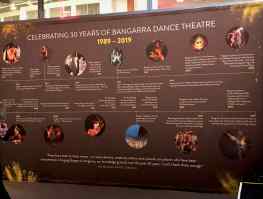
Bangarra 30 yearsLast night we attended Bangarra Dance Theatre’s current touring program, 30 Years of Sixty Five Thousand. This title refers to the fact that Bangarra, Australia’s indigenous dance company, is thirty years old this year and that, as they write in their program, they present “stories through a dance form that is forged from more than 65,000 years of culture”. It was, in a word, stunning.

Now, I am not, as I’ve said before, a dance critic. That is, I don’t have the “right” language to describe dance, but I do have the words to describe the impact of this particular program. It was, essentially, a triple bill designed to showcase and celebrate Bangarra Dance Theatre’s story, so I’ll briefly describe the three works in the program.

Unaipon

Unaipon (45 mins) was created in 2004 by Frances Rings (whom I first encountered, long before blogging, in Leah Purcell’s book Black chicks talking). At a Bangarra event we attended in Sydney in May, Rings talked about the research she’d done for this work and the thinking behind the dances in it. Regular readers of this blog will know who Unaipon is, because I named him in a recent Monday Musings as the first indigenous Australian writer to publish a book. I also, in 2015, devoted a Monday Musings to the literary awards made in his name. He was an amazing man – inventor, philosopher, writer and storyteller.

Bangarra Artistic Director Stephen Page writes in the program that the work was “a pivotal moment in her [Rings’] transition from dancer to dance-maker … it was also the first time in our repertoire that we focused on the biographical story of one character”. Since then, they’ve done a few that Mr Gums and I have seen, including Mathinna, Patyegarang (about which I posted) and Bennelong. They’ve also done, as readers here will be interested to know, a dance adaptation (on which I also posted) of Bruce Pascoe’s book, Dark emu.

Anyhow, Unaipon captures the diversity of its subject’s life and interests, from his traditional Ngarrindjeri origins, his scientific interests in such topics as perpetual motion, and his interest in religion. The work comprises seven dances under three subjects: Ngarrindjeri, Science and Religion. “String Games” (Ngarrindjeri) is exciting to watch – and to wonder about the work involved in creating and choreographing it, and then in learning and performing it. “Motion” (Science) is a fun and evocative piece. Who knew physics could be so visual! And, the final piece, “Religion” is quietly moving, and perfectly accompanied by that spine-tingling choral music from Allegri’s Miserere.

You can watch the whole of Unaipon on YouTube, from the recent Sydney Opera House season of the program we saw.

Stamping Ground

Stamping Ground (20 mins) is the first work created by a non-indigenous choreographer to be performed by Bangarra. It was created in 1983 by Czech Jiří Kylián, after attending a “huge corroboree” on Groote Eylandt, which in fact he initiated, in 1980. This work was preceded and concluded by video footage, in which Kylián describes its genesis (with footage of some of that dancing from 1980), explaining that the work he created three years later (and which he cleared with the indigenous people) was inspired by but not intended to imitate (or appropriate) what he’d experienced. And that’s how it came across.

What an absolute delight it was. Witty, but respectful, it was performed by six dancers, who all performed solos, as well as dancing together. Stephen Page, at the after-event, described it as “a cheeky humorous take on the dances he saw”. It sure was – as anyone who has seen traditional indigenous dances could see – and we’d see it again in a flash, as we would the whole program, in fact.

To Make Fire

To Make Fire (40 mins) was something different again, a sort of medley of excerpts from previous works (including Mathinna) and organised into three sections, “Mathinna”, “About” and “Clan”, all performed against the rock-face style backdrop used in Patyegarang. The title, “To make fire”, is the English translation of the Wiradjuri word, Bangarra. I wondered how they were going to make this conglomeration work without its being bitsy-piecy but, drawing from the fire theme, the transitions were managed by small groups of dancers coming on stage carrying smoking sticks. As they crossed the stage, they left the dancers for the next dance behind, and picked up the dancers who had just finished. Clever, moving, and seamless.

This work, as a whole, evoked past wrongs (represented by the sad story of Mathinna) followed by dances conveying traditional and contemporary life and culture. There were solos, and small ensemble pieces, with, as you’d expect, the full company on stage for the finale. As To Make Fire, and thus the night’s performance, drew to a close, the dancers were bathed in a warm glow of light – sunlight, I presume – which I read as suggesting hope, for Bangarra, for indigenous Australians, and for a unified Australia.

After Event

As subscribers, we had tickets to the Gala Opening after the show. We were treated to an inspired Welcome to Country by local elder Paul House, who spoke in language and then translated into English, telling some stories about this country that we, here in Canberra, live on.

I’ve said nothing about the individual dancers. It’s hard to single people out in what is truly an ensemble company. We wondered how the company would be without the presence of Elma Kriss who retired from dancing this year but who has been such a luminous presence on Bangarra’s stage for so long. Some dancers did stand out for us, including the sinuously, lithe Tyrel Dulvarie and the powerful Beau Dean Riley Smith. I also watched out for two particular dancers – Ella Havelka (about whom the documentary Ella was made a few years ago), and Baden Hitchcock whom we met at the Bangarra event back in May. Both featured in the six-hand (is that how you say it?) Stamping Ground. I loved the opportunity this provided me to really watch and enjoy their expressive, engaged dancing. But, as I said, this is an ensemble company, and every dancer captured our attention at one moment or another.

We left the theatre on a high, realising that we had seen something special. Bangarra has well and truly established itself as a classy, sophisticated dance company, and yet still manages to keep itself real, relevant and true to its origins.

If you’ve never seen Bangarra perform, do go see this if it comes to a theatre near you.

30 Years of Sixty Five Thousand, by Bangarra Dance Theatre
Canberra Theatre
18 July 2019

Monday musings on Australian literature: the Australian Common Reader

The Australian Common Reader is, says its website, “a world-leading database of digitised reading records” which “contains thousands of records of library borrowers between 1860 and 1918.” Initiated by Western Australia’s Curtin University professor Tim Dolin in 2008*, it was acquired by ANU in 2013, and is managed by its Centre for Digital Humanities Research. It was officially launched two weeks ago on June 18 – a fact which was brought to my attention by Bill (The Australian Legend.) Thanks Bill.

The libraries whose circulation records are in the database include:

  • Collie Mechanics’ Institute (WA)
  • Lambton Mechanics’ and Miners’ Institute (Newcastle, NSW)
  • Maitland Institute (Yorke Peninsula, SA)
  • Port Germein Institute (regional SA)
  • Rosedale Mechanics’ Institute (Gippsland, Vic)
  • South Australian Institute (Adelaide, SA)

These are all, I understand, mechanics’ institutes (about which I’ve written before), and are mostly located in mining towns and farming communities. Although these institutes were set up to support worker education and recreation, members of the public could also join.

The database is publicly accessible, making it a rich resource, surely, for all sorts of researchers. Certainly, Dr Julieanne Lamond, who manages the project, argues that we are lucky to have it.

The database has been designed, she says, to facilitate researchers sifting through pages of records to create a picture of Australia’s borrowing and literary history. You can search the database on:

  • Borrower occupation
  • Borrower gender
  • Book title
  • Book author
  • Borrower name

This means, Lamond said, that “you can see what the local doctor or politicians were reading, what books and authors were popular, and a library’s most prolific borrowers”. As a result “we can see that doctors were borrowing more books than solicitors and butchers were reading more than engineers.” (Hmm … I’m feeling quite glad that I’m not a big library user right now! Seriously though, this is pretty fascinating.)

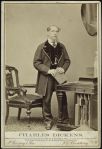
Charles Dicken, c1860

Dickens, c. 1860 (Presumed Public Domain, via Wikipedia)

Stephanie Convery, writing for The Guardian Weekly, reported on the launch and says that the records tell us, for example, that:

Australian butchers in the 19th century preferred to read thrillers, miners loved novels about horse racing, while the most popular author among doctors – and the Adelaide working class in 1861 – was Charles Dickens.

Lamond points out that the records include Mathew Charlton, one of the earliest leaders of the Australian Labor Party. He was, she says, “quite an avid reader, making a total of 264 loans over a 10-year period” and “his favourite author appears to have been Edward Phillips Oppenheim, an English novelist known for writing thrillers.” Oppenheim is, in fact, the second most borrowed author in the database.

She said that the website shows Australians were diverse in their reading habits. They read Dickens, for example, but they also read the latest magazines. They read Australian fiction, as well as overseas authors. And, probably just like now, some were avid readers, while others would “borrow the same book over and over again.”

The records show that male borrowers far exceeded women, but Lamond argues that this is probably due to the sorts of libraries they were. Interestingly, she says, the data “shows that men and women read very widely across all these kinds of genres that now we think of as being quite gendered.”

Nonetheless, the data does show some different favourites. The most popular book for women was On the wings of the wind by Welsh author Anne Adaliza Puddicombe who used the male pen name of Allen Raine. She was one of the bestselling authors of the time, apparently. Woo hoo, though, women reading women! In fact, their research shows that four of the top five works borrowed by women were written by women!

By contrast, the most popular reading for men was a weekly magazine – Household Words which was edited by Charles Dickens (and about which I have also written before.) It was specifically aimed, as I quoted in my post, at “the masses” and it intended to both entertain and “shape discussion and debate on the important social questions of the time”. I love discovering that it was, indeed, popular among the people it was created for.

Overall, Lamond, quoted by Convery, says that

“People’s reading was very diverse, much more diverse than I think most of our reading is now. These people just read incredibly widely. They were reading sporting novels and political thrillers, they were reading George Eliot and Jane Austen at the same time.”

(Hmm, is she basing this comparison regarding diversity today on any evidence? Anecdotally, and defending my era, I’d say there’s a lot of diversity in today’s reading today!)

Convey makes a few other observations, including that:

  • miners were the most abundant profession represented in the data, making up nearly 13%, with the most prolific borrower being a South Australian miner named John Pellew, who borrowed 877 books from the Port Germein Institute.
  • fiction was, overall, more borrowed than non-fiction.
  • the most popularly borrowed author was Cornish Christian novelist Joseph Hocking, reflecting, perhaps the preponderance of Cornish and Welsh miners in the borrowing communities.

Lamond hopes to obtain funding to digitise more records to broaden our insight into reading habits of the past. She notes that they don’t have good data about metropolitan reading, and that these records are not really in existence:

“The stars have to align for these kinds of records to survive because often they were run by volunteer management committees, and they sat in boxes in people’s attics; they threw them out; they burnt down – a lot of historical library records have gone up in smoke, literally.”

Don’t you hate hearing about the destruction of records?

A little example

Anyhow, of course, I had to have a little play in the database myself, so I looked at the Borrower by Occupation. They are listed in order of quantity, starting with Miners (5,666 borrowings) and ending with six occupations represented by 1 borrowing, including “Authoress” and “Tea merchant”. However, it looks like the occupations were entered “free text” and that the ANU has not tried to concatenate them in any way, so, for example, there are State School Teachers, School Teachers and School Masters (and maybe even more permutations).

Using the “visualisation” option, I found state school teacher, Frances Cairns, who borrowed 326 books, of which 318 were fiction. The author she borrowed most was Scottish author and minister, George MacDonald, but I was delighted to see that she also borrowed a book by the cheeky Australian author Elizabeth von Arnim. One of the eight non-fiction works she borrowed was Daniel Crawford’s Thinking black, which, says Wikipedia, “was recommended reading for those Europeans who wanted to work in partnership with, rather than over, Africans.” I wonder what was behind this? The visualisation option was fun, but probably more useful is the fact that you can also download spreadsheets of your searches to do further analysis.

And here I will close on this fascinating project, but do have a play if you are interested,

* Another report says that the database commenced in 2001! Who knows? Maybe both are right, and it’s a matter of defining “start”?

Favourite quotes: from the artist Hans Heysen

I started this little Favourite Quotes series some time ago, with a specific purpose in mind, but it fell by the way-side in the busy-ness of life. However, I regularly come across statements that I’d love to document somewhere useful so that I don’t lose them – and so I am resurrecting this series with a broader ambit.

This new plan was inspired by my visit to the Hans and Nora Heysen: Two Generations of Australian Art Exhibition this week, at NGV Australia, Federation Square, in Melbourne. Their art is very accessible and a joy to see, but also offers much to think about. Hans Heysen (1877-1968) focused largely on landscapes. He particularly loved gums – woo hoo – and has been described, in fact, as an early conservationist. His daughter, Nora (1911-2003), focused more on still lifes and portraits. She was also Australia’s first woman war artist. Lisa (ANZLitLovers) posted recently on Nora. Both were significant Australian artists. Hans won our prestigious landscape prize, the Wynne Prize, nine times, and Nora won our top portrait prize, the Archibald.

However, my goal here is not to review the exhibition, but to share two statements made by Hans Heysen which I think can apply to all art – not just the visual arts.

Quote 1

… while as an artist I love Australia, art has no country, but is in essence cosmopolitan.

Droving into the light (Hans Heysen, 1914-21)

Much of Hans Heysen’s work seems quintessentially Australian in content but his technique – obvious when you look at his work – is strongly informed by 19th century artists and movements, by, for example, the Pre-Raphaelites, the Impressionists, the Romantics like Turner, and artists like Van Gogh. Anyhow, I like his argument that, in essence, art is bigger than “country”. The Exhibition argues that Heysen disavowed nationalism, which is not surprising given the tough time that he, as a German-born Australian, experienced during World War 1. The label for “Droving into the light” argues that “not so much nationalist as pantheist, Heysen’s landscapes do not refer merely to what it is to be Australian but rather to explore what it is to belong to nature in a more holistic sense.” So, for example, Heysen biographer Klepac says that Heysen was “inspired by the light and the landscape of Hahndorf and the Adelaide Hills, which he transformed into an Arcadian vision that can still haunt us with its sense of timeless beauty”.

I like these interpretations of his work, and would argue that taking a broader perspective is the aim of many creators, regardless of how specific their settings are.

Quote 2

I am trying only to paint as truthfully as I can, and that which my eyes see and perhaps what I unconsciously feel. Truth to Nature after all is the goal, but Truth interpreted through temperament.

Hans Heysen wrote this to his artist friend Lionel Lindsay in 1919. I like his clarification that while his aim is “Truth”, it can only be a truth that he sees and feels. I may be drawing a long bow – and perhaps even mixing up different meanings of “truth” – but it reminded me that although “truths” can be universal, they are also individually interpreted. Why else, I suppose, would we keep looking at art, reading literature, listening to music, and so on? It would be pretty boring, if not meaningless, if everyone expressed these “truths” the same way. Just compare Heyson’s Australian landscapes with those of other artists and we can quickly see how differently the “truth” of the landscape can be conveyed – one seeing it as Arcadian (idyllic), for example, and another as Gothic (terrifying.)

Anyhow, the aim of these posts is to share some interesting ideas, rather than become too bogged down in explication. Hopefully, you can see why I wanted to “keep” these quotes?

Monday musings on Australian literature: Pianos in Australian literature

A rather left-of-field topic for Monday Musings, but did you know that last Friday, March 29th, was World Piano Day? The Piano Day site asks how we are going to celebrate it. Well, three days late, I’m celebrating it by talking about Australian literature that features pianos. Why not?

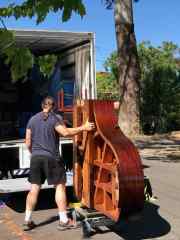
Farewelling my late aunt’s precious Bechstein

World Piano Day is new – the first being 2015 – and it is a slightly shifting feast in that its date is related to the number of keys on a piano, 88. That is, it occurs on the 88th day of the year which is, except for leap years, the 29th of March.

Why do we need a World Piano Day? Its creator, the German musician Nils Frahm, says:

For many reasons. But mostly, because it doesn’t hurt to celebrate the piano and everything around it: performers, composers, piano builders, tuners, movers and most important, the listener.

Any keen reader of Australian fiction will know that pianos abound in Australian literature – hmm, “abound” might be pushing it a bit, but they do occur more frequently than you might think. In John Lang’s mid-19th century novel The forger’s wife (1853) (my review), the wife Emily tries to support herself by giving piano lessons. Elizabeth Jolley features piano teachers and piano playing in many of her novels. And so on…

Consequently my list is an eclectic selection, presented chronologically.

Fiction

Miles Franklin’s My brilliant career (1901) (Karen’s BookerTalk review): Protagonist Sybylla loves music and the piano. For her music represents the life/world she desires. When she is exiled to work at the M’Swats’ farm she finds their piano produces only “jarring, clanging, discordant clatter” and their neighbours “lived the same slow life, and their soul’s existence fed on the same small ideas. I was keenly disappointed that none of them had a piano, as my hunger for music could be understood only by one with a passion for that art.” Harry Beecham, however, is a “fine pianist”, but unfortunately for him, Sybylla’s desire for independence outweighs even that!

Henry Handel Richardson’s Maurice Guest (1908)(Lisa’s ANZLitLovers review) and The young Cosima (1939) (Bill’s TheAustralianLegend review): Both feature pianists, which is not surprising given Richardson was a keen musician who studied music at the Leipzig Conservatorium. Although it barely references the music, I can’t resist this contemporary review of Maurice Guest (from The Sydney Morning Herald, 24 October, 1908):

Maurice Guest (Heinemann) is an elaborate study of the soul progress of a young student of music in Leipzig. It is very long for a modern novel, but it shows a finished style and considerable powers of analysis. The picture of life in Leipzig is very minute, and though the detail is rather overwhelming, it all fits in Its place. Mr. [sic] Richardson is to be congratulated on a fine and careful piece of work of more than ephemeral Interest.

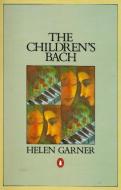
Helen Garner, The children BachHelen Garner’s The children’s Bach (1984) (my review): Protagonist Athena has a piano in her kitchen:

There was a piano in the kitchen and during the day Athena would shut herself in there under the portrait of Dexter’s father and pick away at Bartok’s Mikrokosmos or the easiest of Bach’s Small Preludes. Preludes to what? Even under her ignorant fingers those simple chords rang out like a shout of triumph, and she would run to stick her hot face out of the window.

Peter Goldsworthy’s Maestro (1989): Goldsworthy is a writer, doctor and music lover, who has also written libretti. His daughter Anna, see below, is a concert pianist. Maestro, his debut novel, is a coming-of-age novel about a young boy who is taught the piano by the titular maestro (for whom the piano provides sustenance and escape.)

Sonia Orchard’s The virtuoso (2009) (Lisa’s ANZLitLovers review): While Richardson’s The young Cosima draws on the life of Richard Wagner, and the pianist Cosima von Bülow whom he married, Sonia Orchard’s debut novel draws on the life of the much lesser known Australian pianist Noel Mewton-Wood, who committed suicide when he was 31 years old, and was found next to his Steinway.

Murray Bail’s The voyage (2012) (my review): Most of the books here are about pianists, but Bail’s is about an Australian piano inventor who goes to Vienna to try to sell his piano. It’s a clever motif – an inventor from the New World taking his new piano to sell to the Old World. It goes to the heart of some of Bail’s thoughts about the challenges we face as Australians, not to mention the challenges artists face.

Zoe Morrison’s Music and freedom (2016) (Lisa’s ANZlitLovers review): Morrison is a professional musician, who learnt the violin and piano, but she is also a feminist interested in social justice. Music and freedom, which tells the story of concert pianist Alice from childhood through marriage to old age, combines these two interests.

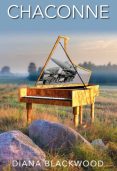
Diana Blackwood, ChaconneDiana Blackwood’s Chaconne (2018) (my review): Blackwood’s debut novel features a harpsichord on the front cover – next to a Pershing missile – the harpsichord referencing protagonist Eleanor’s piano-playing childhood and love of Baroque music, and the missile, the novel’s Cold War setting. This novel is about a young “lost” woman whose reconnection to music helps her get her life together.

Justine Ettler’s Bohemia Beach (2018) (Bill’s TheAustralianLegend review): Another novel about a concert pianist, written by a writer who is also an accomplished musician. Protagonist Catherine Bell’s life has run off the rails and she is self-medicating with alcohol.

Non-fiction

My main interest here, really, is fiction, but I’ll list a few non-fiction books which feature pianos or pianists:

  • Anna Goldsworthy, Piano lessons (memoir) (2009) (Lisa’s ANZLitLovers review): Goldsworthy’s life in music from childhood piano lessons to becoming an internationally successful concert pianist.
  • Michael Atherton, A coveted possession: The rise and fall of the piano in Australia (2018) (history) (Lisa’s ANZLitLovers review): a cultural history of the piano in Australia, from their arrival with the first boats in the late 18th century.
  • Virginia Lloyd’s Girls at the piano (2018) (memoir): Lloyd muses on learning the piano as a child, and the role the piano and music played in her subsequent life.

And, I have to mention Diane Bell’s Generations, in which she discusses, in the chapter “Familiar things”, the way pianos are passed down through generations of women. The piano was seen, she writes, as a symbol of “civilisation, status and sociality”. It provided an opportunity to learn to play music, a way of socialising with people, and of “keeping alive the folk music” of the countries from which people had emigrated. Bell writes that at the turn of the 20th century Australia’s population was under 4 million, but “there was about one piano for every six people.” No wonder, she says, there are many stories about buying and moving them, playing them, and socialising around them.

All these books are very different, but all have one thing in common, the capacity for music to incite some passion or vision for life. Irresistible.

Do you like reading about music? If so, please share your favourites.

The Griffyns “play” music

Musical Instrument Playground

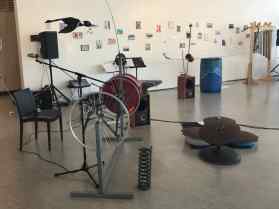
Some of the instruments, including the Bicycle Hurdy-Gurdy.

We always say that musicians play music, or play their instruments, but the Griffyns took this to a whole new level last weekend when they presented their “Giant All-Ages Instrument Playground” concert. Were we surprised? No, because this was the Griffyns, after all …

However, being prepared to be surprised also meant that we didn’t know what to expect. Here are some of the descriptions they used to promote this concert, which, they explained, was created by them and their “crackpot team”! You get the drift:

Griffyn have brought in Jim Sharrock (famous for his Musical Mushroom Gardens), and visual artist Byrd (one of Canberra’s pre-eminent mural and graffiti artists) to join West Australian Mark Cain (of AC/PVC fame), to collaborate in making this unique collection.

AND

We’ve transformed satellite dishes, PVC pipes, foot pumps, balloons, skis, tin cans, fence-posts bicycles, wooden boxes, garden utensils, and more into some of the most incredible musical instruments you’ve never seen!

AND

The Circularsawruses have come to town – Roll up to Belconnen Arts Centre to experience the launch of the Griffyn Ensemble’s Instrument Playground! The Griffyn Ensemble have assembled a crackpot team of musical musicians and makers from across the country and the Canberra community to create and compose on some of the most curious sounds to have ever hit the capital. Hear such wondrous musical inventions such as the wintry Ski Bass, the Bicycle Hurdy Gurdy, and the Flutes of Many Mouths.

Although this concert has been in Griffyn director Michael Sollis’ mind for some time, its timing was perfect because it followed the recent three-part ABC documentary, Don’t stop the music, on the importance of music education for children. One of Sollis’ hats is Music Viva’s Artistic Director for Education, a role which involved him, at least in the beginning, working with the late (wonderful) Richard Gill.

Anyhow, some of the concert was beautiful, some exciting, and some – yes, we have to admit – challenged the ears, but it was all good fun. It started with fun, in fact, with a musical pun sort of fun, when soprano Susan Ellis, supported by other members of the ensemble, entered the performance space singing a “Walking Bass” complete with hiking poles. From there Susan Ellis featured again, singing Cold Chisel’s “Flame trees”, with Kiri and Michael Sollis on “flutes”, and Holly Downes on her quad bass – but look, there were, at my rough count, some 13 or so pieces performed, so I’m not going to list them all. Instead, I’ll just share some representative highlights.

Performing the Little Drummer Boy

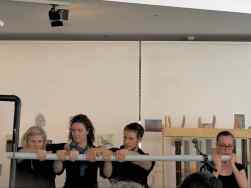
The audience was flummoxed when asked to identify the Bicycle Hurdy-Gurdy version of the Beatles “Blackbird” and was entertained by the Flutes of Many Mouths (or was it Many Hands?) version of “The little drummer boy”. The Surgical Glove Bagpipe was a sight for sore eyes – and, well, what it was for the ears depends a bit on your attitude to the bagpipes – but I recognised the tune, which was a start! Most of the pieces were familiar, or recognisable, which was probably a good thing given the instruments were all invented. Best to ease us in gently!

However, there were some original pieces, such as Michael Sollis’ “Baloons” (the spello remaining because, he said, it’s hard to erase highlighters, in which the music was written). It was performed by Holly Downes, Michael and Kiri Sollis, and Chris Stone on their chosen, more-or-less appropriate-to-them instruments. Audience members had copies of the colourful score and were asked to identify which “line” was for which instrument. We passed – just – I think!

There was, in fact, quite a bit of audience participation. Jim Sharrock, on a sort of slide-guitar-with a tin-can soundbox, was joined by Susan Ellis, to lead us in “Tannenbaum”. Towards the end, young students from Aranda Primary School, who were scattered around the audience, joined in, playing their parts, as conducted by Michael Sollis, on tiny wind instruments made of PVC pipes.

And I must mention an appropriate piece for the time of year, “Cicada”, composed by Paul Kopetz, and from his Australian Backyard Suite. The words go:

A hazy Australian summer. A scorching stifling day. All creatures of water, bush, and sky are still, awaiting the coolness of sunset. All except one – the cicada. His relentless tune defies stillness and is stillness. His metronomic song drips from gum trees. His symphony of survival deafens our senses.

It seemed well-suited to a “buzzing” performance on the Griffyns’ invented instruments. (You can hear a version on YouTube.)

This might all sound a bit “silly” but it wasn’t. It was fun – and it was about serious musicians showing us how you can make music out of just about anything, and how it’s more important to give it a go than to stay on the side and watch (as we did, skedaddling before the audience was let loose on the instruments at the end. We did, in our defence, have another event to go to.)

For a little introduction to what we experienced, check out this promo video:

Once again, it was something completely different from the Griffyns. It wasn’t the most restful concert we’ve been to, but it was one of the most joyful, not to mention inventive. And we can all do with a bit of joy and invention in our lives, can’t we?

Griffyn Ensemble (and Friends): Michael Sollis (director), Holly Downes, Susan Ellis, Kiri Sollis, and Chris Stone with special guests Jim Sharrock, Mark Cain, the Circular-sawruses and some children from Aranda Primary School.