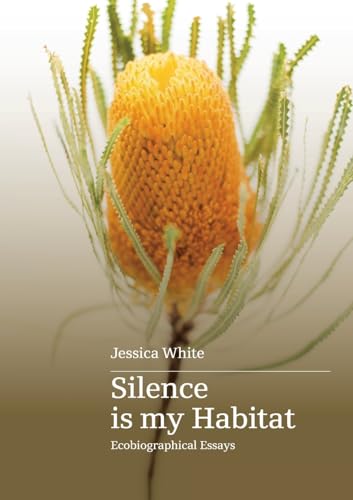
Nearly five years ago, I wrote a Monday Musings on a branch of writing dubbed “eco-literature”. Since then I have reviewed a few works that I have tagged “eco-literature“, including, just yesterday, Jessica White’s collection of essays, Silence is my habitat: Ecobiographical essays. Coincidentally, a couple of weeks ago, critic/artistic director/literary judge Beejay Silcox sent me a link to her article in The Guardian on new Australian releases. In it, she grouped the releases under headings, one of which was “Eco-lit flourishes”. So, I thought, why not do a little update …
In that first Musings, I started with definitions, including one from Wikipedia, but it was limited to “ecofiction” (as were a few other sources I cited). Five years on, Wikipedia still doesn’t have an article on “eco-literature”. This is a bit surprising, as I do think it is a much broader church, as does The Wire’s Rajesh Subramanian, whom I quoted in that previous post. He asked in 2017 whether “Eco-Literature” could be “the Next Major Literary Wave”, and defined it as encompassing
the whole gamut of literary works, including fiction, poetry and criticism, which lay stress on ecological issues. Cli-fi (climate fiction), which deals with climate change and global warming, is logically a sub-set of eco-literature.
Five years on, I think we could say it is an established field in contemporary literature – and that it does compass all those forms Subramanian lists, and more (like essays, for example).
Indeed, I’d argue that it is so established that there are bona-fide sub-categories, if not sub-sub categories (such as cli-fi or climate fiction being a sub-category of eco-fiction which itself would be a sub-category of eco-literature).
Eco-literature in Australia
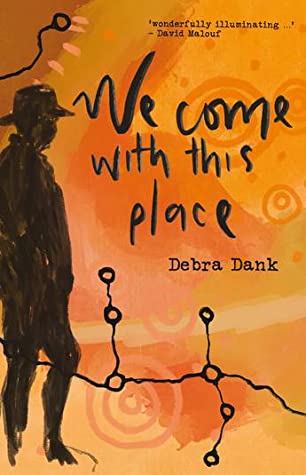
So, if I look at the Australian works I have categorised as eco-literature over the last five years, they include a work of literary fiction, Robbie Arnott’s Limberlost (my review), two works in the crime genre, Donna Cameron’s Rewilding (my review) and Shelley Burr’s Vanish (my review), and Jessica White’s book of essays. Other books which I haven’t tagged, but should have, include First Nations books, because the land, and our use and (mostly rapacious) treatment of it, is never far from the story being told, whether it be fiction, like Melissa Lucashenko’s Edenglassie (my review) or nonfiction, like Debra Dank’s We come with this place (my review).
This is a tiny and narrow selection of what is being written, but it provides some sense of the variety out there, as does Beejay Silcox’s list of what is coming in 2026. She opens this section of her article with “It is a dark irony that our most alive fiction is anchored to extinction: the wilder our grief and awe, the wilder our storytelling”. I will dot point the books she lists, for simplicity’s sake, but will include any description she provided:
- Romy Ash, Mantle: one of the three “apocalyptic eco-fables”, Silcox identifies, this one about “a virulent rash”, Ultimo, April
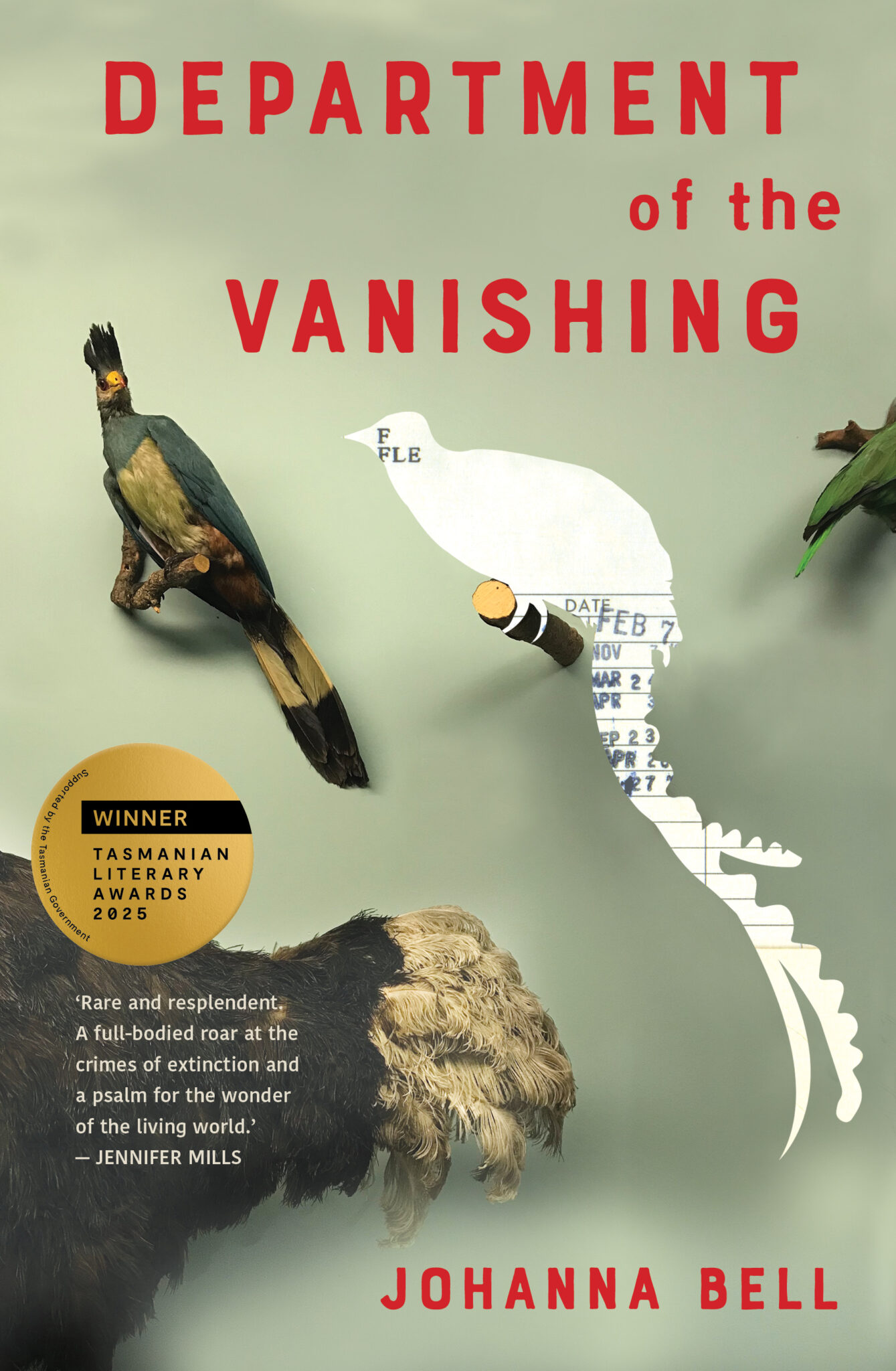
- Johanna Bell’s The Department of the Vanishing: documentary poetry/archival image/verse, “the literary equivalent of a murder board”, Transit Lounge, March, on my TBR
- Tim and Emma Flannery’s A brief history of climate folly: nonfiction, “stranger than fiction. It collects real-world tales of humanity’s attempts to control the weather – like Hitler’s plan to drain the Mediterranean”, Text, August
- Keely Jobe’s The endling: the second of the three “apocalyptic eco-fables”, this one about “immaculate conception in a feminist utopia”, Scribe, March
- John Morrissey, Bird deity: the third of the three “apocalyptic eco-fables”, this one about “the wakeful ruins of an alien civilisation”, Text, February, on my TBR
- Adam Ouston‘s Mine: novel, which “follows a climate activist trapped at the bottom of an abandoned goldmine and is told in a single, wheeling 278-page sentence”, Transit Lounge, August
Silcox also named other authors bringing out “eco-inflected fiction” this year. I have added the titles, where I know them: Eva Hornung’s The minstrels, Katherine Johnson, Inga Simpson, Maria Takolander and Sarah Walker.
The thing about eco-literature, perhaps more than most other forms or genres, is that its very nature implies a desire to effect change. Regarding this, I found an article written in 2023* which surveyed readers of eco-crime fiction. Their starting point was “whether narratives can persuade readers to reflect on and perhaps reconsider their own moral beliefs”, and their reader-response research focused on investigating “how Australian readers respond to works of Australian eco-crime fiction that portray non-humans and global ecological issues such as climate change in a local Australian context”. They concluded:
One potentially restrictive element of eco-crime fiction in terms of its potential to engage readers with pro-environmental understandings is the dark and confronting atmosphere of most of these texts. Crime fiction by nature is grim. Add to this an emphasis on catastrophic ecological crises and the connections between such crises and violent crime, and there is a strong possibility that such texts may not do much to convince people that positive change is possible. It is significant that this hopelessness may actually be a deterrent for some readers to engage with climate action in the real world.
Oh dear! And, presumably dystopian eco-fiction would generate a similar response? But maybe not all types of eco-literature?
So, over to you. Do you read “eco-literature”? And if so, what sort do you read and does it encourage you to take action?
* Rachel Fetherston, Emily Potter, Kelly Miller, Devin Bowles, “Seeking greener pages: An analysis of reader response to Australian eco-crime fiction” in Australian Humanities Review, Iss. 71, (May 2023): 1-21.
 Whispering Gums
Finally! A definition of literature that I can get on board with! The Subramanian (and you, it seems) aren’t looking just for fiction but books about address ecology in conjunction with whatever other subjects the author is interested in. Hooray! This is a landmark day for me, haha. Gaah, and then you used “literary fiction” to describe fiction. You contradicting yourself, my friend.
Is there any chatter about the role either horror or science fiction play in climate stories? I think they are truly important, and often they are not far off from where we are, predicting the reactions humans and animals will have when we are at the point of no return. I mean, some of them SOUND like sci-fi, especially the title with aliens.
Lastly, I will add that I don’t like the big blockbuster eco movies in which the whole world floods or freezes or whatever, but in the end, there is great hope for us rebuilding. There is no focus on the millions who died with the exception of our Mark Wahlberg-like “hero.” There is no clear path to how people will continue to survive; we get warm and fuzzies.
Oops, Melanie, I forgot to mention your last point re movies. Couldn’t agree more. I guess they satisfy a need but it’s not my need.
Haha, Melanie, I’m glad you like the definition because I do like it too. But, I’m sorry though that you don’t like my use of “literary fiction” because I do think it tells readers something about the different sorts of novels that fall into the eco-literature field – crime, spec fic, historical, etc?
I’ve seen quite a bit of talk about sci fi/spec fic in this area. I’m not sure I’ve seen as much about horror but that may be because I tend to move past mentions of horror. You are my horror source!
But doesn’t literature mean books, e.g. novels, poetry, nonfiction, essays, etc? That’s what I meant. Would you write literary literature? You and many others might…
Yes it does and no I wouldn’t! I understand your point … but
As you know there is something called literary nonfiction aka creative nonfiction or narrative nonfiction. I prefer creative nonfiction in this case because it avoids the “literary” problem!
And
I have heard some poets make a distinction between verse and poetry, implying the latter is more “literary”.
So, I understand what you are saying but these distinctions do cross other forms of literature in some way. I can’t think of a better way of defining works we call “literary fiction”. If I could I would because I always feel a little uncomfortable about it.
In Australia at least Charlotte Wood’s The Natural Way of Things, a decade ago, seemed to mark a turn towards dystopian fiction becoming mainstream, encompassing both ecological disaster and excessive surveillance/authoritarianism. Of course dystopian fiction has long been around, as a subset of SF, though that is a label mainstream writers avoid like the devil.
Now that global warming is quite definitely here and increasing towards levels that will make the planet uninhabitable, writers have no choice but to take notice. The question is whether we need a new definition or will all new writing be eco-lit.
Good question Bill … certainly I think climate change is becoming a normal part of the background where it’s not a foreground issue in much writing, which has made me wonder sometimes about tagging books as eco-lit.
Is this different to cli-fi (climate fiction), do you think? I would put Arborescence by Rhett Davis in that list, along with Inga Simpson’s The Thinning, Tim Winton’s Juice and Madeleine Watts’ The Inland Sea.
Thanks Kimbofo … no I don’t think different. Rather I think cli-fi is a subset. But the climate, even in those books that are not “straight” cli-fi, is often in my experience not far away.
And thanks for your suggestions. I’ve read none of them, but know of them all and have a couple on my TBR. (BTW my list is of books coming in 2026 which is why none of your books are in the list.)
I’m a fan of eco-fiction, Sue, including books by Charlotte McConaghey, James Bradley and most recently Emma Sloley’s debut, ‘The Island of Last Things’.
We held a public forum for libraries a few years back, that suggested cli-fi novels offer a protective fictionality, enabling people to get their heads around things they switched off to in the news. But it was just a theory!
I like that theory Angela. I love that you did that.
I have McConaghey and Bradley in my sights. I really should have read Bradley by now I know. I hadn’t heard of Sloley, so thanks for that one.
I certainly will read eco-lit and cli-fi but I don’t gravitate towards it, especially the latter – I feel like there’s not much new to say. One interesting/often irritating trend I’ve noticed is literary writers having personified bits of the environment integrated into their novels to comment on climate change – e.g. the wind in Sarah Hall’s Helm, or the moss in Anna North’s Bog Queen.
Oh thanks for that observation Laura … I haven’t seen that in the books I’ve read but it accords with my sense that these issues are finding their way into fiction that isn’t specifically eco or climate focused.
Definitely a kind of writing I seek out, but not necessarily constantly; in recent years, I’ve read it in little binges rather than my old habit of dribbling them through my stack as they appeared (maybe because there are so many more of them now, so one simply can’t read them all anymore, so it’s nice to let a little time pass and then see which ones feel particularly compelling in a given moment). One that I’ve been wanting to read for awhile now, and I hope to actually get to it this year, is Richard Powers (The Overstory in particular, but more of his work in general, too).
Oh yes, Marcie. My reading group did Overstory, but it was the month my Mum died, and I just couldn’t read it. I was so sorry about that because it’s such a big book I never did get time to go back and read it as I planned to. But, every time I hear it mentioned I have this little sad, guilty feeling!
Like any story it needs to be done well. I loved ‘Under the Eye of the Big Bird’, and was okay with Ian McEwan’s ‘What Can We Know’. I think it is more the quality of the story. Generally though I will avoid dystopian, even though Under the Eye was certainly that!
As you probably don’t need to guess, I love eco-literature! I am in the holds queue of Endling at my library currently and look forward to reading it sometime this spring. Poetry, fiction, nonfiction, memoir–yes please! Does it encourage me to take action? Since I already am taking actions of various sorts I have to say no. Does it provide fuel for my passion? Absolutely.
As you expected Stefanie this answer is exactly what I’d expect from you. You read a lot more of it than I do but I always look forward to it when I come across it.