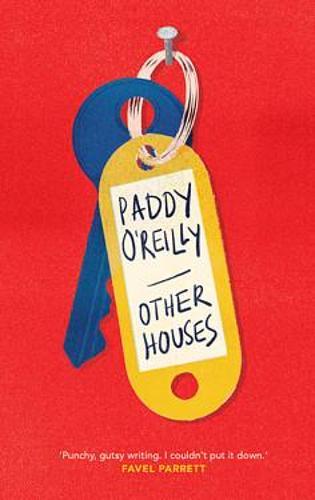
It’s not totally coincidental that this week’s Monday Musings post was about a publisher of realist or social novels, that is, of novels which aim to explore social problems of their time. My reading group’s March book, Paddy O’Reilly’s Other houses, belongs to this tradition. I have been wanting to read it since it was published in 2022.
Searches of the Internet, including of Wikipedia, retrieve various definitions of the social novel (also called social problem or social protest or social justice novel), but they essentially agree that these are works of fiction which tackle some sort of inequality, prejudice, or injustice, through the experiences of their characters, and that their intention is to encourage social change. In Other houses, O’Reilly interrogates the idea of social mobility. Her protagonists, Lily and Janks, are “battlers“, working class people who struggle payday to payday, but they want more for their now 15-year-old daughter, Jewelee, who had started to run wild, heading down the path of delinquency.
“Good people live here” (Lily)
So, they move from their working class suburb to one they “could barely afford”, and enrol Jewelee in “a good school”. Jewelee might now behave as though she’s “too good” for her “bogan” parents, but they believe it was worth it. The problem is, Janks, now working in a food-factory, has mysteriously disappeared. The novel opens with Lily driving through her old neighbourhood at night, hoping to find Janks there. “Good people live here”, she says. “They try”.
From here the novel is told in the alternating first person voices of Lily and Janks, with Lily’s story occupying the greater part of the narrative. Having worked as a supermarket cashier in her old home, she is now a cleaner, which is where the title comes in. The novel is beautifully constructed around the cleaning jobs Lily does with her cleaning partner, the older, and wearing out, Shannon. While they clean houses, Lily reflects on her current and past lives, on the “entitled” Jewelee, on the lives and aspirations of the people they clean for, all the while worrying about Janks, and trying to find him. She prints “have you seen” leaflets and scours all the places he might possibly be. She does not believe he has deserted her willingly.
And, we know that he hasn’t. Having borrowed money from a bikie gang, he’d been “snatched” off the street, and coerced into paying off the loan by doing a job for them. The novel’s plot comes from this: will Janks get the job done, without being caught, and be allowed to return safely to the life they are building? Many of us in the group called this book a page-turner, but some disagreed. The plot is too straightforward, they said. It doesn’t have the breath-catching twists and turns of a thriller. Others of us, however, define page-turners differently. Ours don’t require an edge-of-the-seat plot. Rather, they are books that compel us on, because of the characters, or the writing, or the ideas, or the plot, or any combination of these. What do you think?
“Things, world, wrong” (Shannon)
Anyhow, there is a plot – whether you see it as a page-turning one or not – and there is also lightness, despite the seriousness of the protagonists’ plight. Much of the lightness comes from the house-cleaning scenes. Lily and Shannon name the houses they clean, such as the House of Hands (with its profusion of chrome dirtied by sticky hands), the House of Doom (whose owners see the world as “blighted”), Horror House (inhabited by a hoarder), and Lily’s favourite, the House of Light (which lets the sun shine in). They share their thoughts about the inhabitants and the lives they know (or think) they lead. If anyone knows how we live, it’s likely to be cleaners, eh? Lily’s and Shannon’s perspectives – their observations, opinions and reflections on how others live – are what gives this book its real heart.
Lily speaks with the dignity of a worker, when she says:
We know things no one else knows about our clients. I sometimes pick up objects in the places we clean – a vase, a notebook, a scarf … I give them attention, these things that I believe hold meaning for someone … It’s my moment of saying what I can’t say to their faces. I respect what you hold dear, even when you’re rude to me or barely acknowledge I exist. (p. 30)
Meanwhile, the older Shannon has her own mantra for how things are going, says Lily:
Something has gone wrong in the world … Shannon uses it about the eating habits for the population, the number of appliances in the kitchens we clean, leaf blowers, hair straighteners, so-called superfoods, weird weather events, toilets that wash your bottom, plastic wrapping on fruit that already has its own natural wrapping, quiz shows where she disagrees with the answers, tap water sold in plastic bottles and so much more. (p. 29)
Most definitions of the social novel say “through the experiences of their characters”, and this is true here. Telling her story through the experiences of Lily, Shannon and Janks enables O’Reilly to show what she wants to explore, without being didactic. Through these authentic characters we come to see just what the much-touted upward social mobility really is, means, and feels like. We see Lily and Janks recognising that the poverty faced daily in their old working class suburb results in lives that are lived on the edge with little opportunity to improve one’s chances, but we also see that it’s not easy to simply transplant yourselves into a different life and, essentially, culture:
Tonight my water-stained ceiling and the creeping draught taunt me that although we’ve adjusted to living here, it might be because we brought things with us when we crossed: rental damp and rot, clothes that fall apart, bank accounts that bounce between payday and zero. (p. 74)
For Lily, Broadie feels like “home” and it’s where she returns to find a solution to the problem of the missing Janks.
Other houses is a slim and accessible book, but it offers no simple answers. Rather than support the comfortable view that upward social mobility is the answer to the problems posed by socioeconomic inequity, it asks us to consider instead, how do we overcome the problems caused by inequity – indeed, how do we remove inequity – without expecting people to give up everything they hold dear about where they come from? It’s a quietly provocative novel that speaks to one of the most urgent issues of our time.
Paddy O’Reilly
Other houses
South Melbourne: Affirm Press, 2022
245pp.
ISBN: 9781922626950
 Whispering Gums
I saw 6 likes and 0 comments. Imo, it’s because this review is so much an example of how a real reader – a person who can strip down and reassemble a book – is kind of like someone creating a pangram without any effort at all. One of your reviews that makes me gasp …
Oh thanks MR, but it did take effort! However I really liked this book so it was a joy to write about. It spoke to me in a very real way.
I don’t know whether this will work, Madame Gums. I maybe- just maybe- have cracked the WP code. Anyway, very glad to read about Paddy O’Reilly’s Other Houses. She’s a writer whose work I’ve always admired. (I did send an earlier comment but it may have buzzed off into cyberspace.)
I think you’ve cracked it Sara … I don’t think the earlier comment made it but this one did. Woo hoo!
I’ve only read her short stories before but was very keen to read this (having missed getting onto her previous novels, a couple of which I was keen to read.) I’m guessing you haven’t read this one?
Not yet, WG but will order it. Thanks.
Great, Sara. Would love to hear your thoughts if/when you read it.
Excellent review of an excellent book, Sue. I was delighted to see it shortlisted for the Prime Minister‘s awards a couple of years ago.
Thanks Angela. Yes, I remember that shortlisting. And, I was further inspired to read the book when I was at a cultural (but not book) event last year where Tony Burke spoke, and he specifically mentioned liking this book. Seemed right up his alley and reminded me that I really wanted to read it (particularly as I already had it in my bedside pile.)
It sounds like I would enjoy this. And you know that I don’t mind a quiet plot.
Just earlier today I saw a review of Lucia Berlin’s A Manual for Cleaning Women…also a taunt of not-yet-read-ness.
I think you would Marcie … we have quite similar tastes (at least in some areas, including these social justice areas, and the slow or quiet plot.)
What MR said. You really make me want to read this book
Thanks Jonathan … I’d love to hear your thoughts. I think you’d like it.
Oddly, the plot of this book sounds very American to me and is similar to several films I’ve seen, such as Gone in 60 Seconds.
Thanks Melanie … I don’t know that film, but my sense is that this story is probably translatable to most western developed nations? Which probably reinforces what they are saying about western capitalism!