World Poetry Day was declared by UNESCO in 1999. It is a day, says UNESCO “to honour poets, revive oral traditions of poetry recitals, promote the reading, writing and teaching of poetry, foster the convergence between poetry and other arts such as theatre, dance, music and painting, and raise the visibility of poetry in the media”. In Australia, and we are not unique in this, we also have National Poetry Month that aims to do this too, but that is in August.
I’ve let World Poetry Day slip in recent years, and I let it slip a day this year as the actual day is 21 March, but … I have two recent poetry books on my TBR so decided to use this day to give them a little outing.
Australia’s version of the Twinkl educational resource site, tells me that the theme for the 2025 World Poetry Day is – and it’s not surprising – Poetry as a Bridge for Peace and Inclusion. It aims “to highlight poetry’s transformative role in the promotion of peace, inclusion and creativity”. Do my two books suit this theme?
The two books were both published in 2024, and it’s a little amusing because Tasmanian poet Helen Swain’s collection, Calibrating home, was published by the New South Wales-based 5 Islands Press, while Sydney poet Vanessa Proctor’s collection, On wonder, was published by the Tasmanian-based Walleah Press.

Helen Swain’s Calibrating home is the second of hers given to me by my Tasmanian-based brother. I still hope to read the previous one, a verse novel titled When the time comes. It is speaking to me! (Sometimes I think I should give up blogging so I can read more.) The brief bio in the book tells me that Swain “lives and works on the foothills of kunanyi/Mt Wellington” and that “she works as a poet in residence in the health sector”. Calibrating home is her third poetry book.
I read the first few poems when I received the book, and then put it on my bedside table for more reading – but, well, you all know how that goes! So, I picked it up again, and somehow the very first poem, “Traced”, seems to speak to the theme. It’s about a fossilised creature, possibly a moth, that has been transformed over time. The poet asks about the traces she finds of an “unnamed creature” in the rock:
How to tell what will leave a mark,
Which struggle will be recorded?
How indeed?
She wants to hold, to own this little piece of rock. She wants to set it on a ledge in her kitchen and
draw from a soft compressible insect
rock-solid endurance.
Wouldn’t we all? I love the language, the imagery here, from the domestic kitchen and the idea of softness but also of violence in the insect’s compressibility, to a desire – and need for – something hard, for endurance. It’s a strong end to the poem – and a strong opening to the collection.
The poems in this collection slip between past, present and future, often within the same poem, as you can see in “Traced”. There is a sense of struggle, but also of tenacity and endurance. War is evident, in specific poems like “Meeting up (for Michael O’Neill, killed in Ukraine May 2022” and in gentle poems like “Teacups” (“Grandmother’s teacups/survived the war”) where the domestic collides with violence. The shock of violence or war, and the cold displacement of people, is never far away in these poems. But, neither is the domestic, the peace, the connections, the gentleness (in “Suzi and the Spider”), and the humour (in “Mary”).
And of course, there is thinking and wondering. Listening to her neighbour who is bemoaning capitalism and the ills of the world, the poet says:
and I don’t know what to think
but I do think…
and somehow
I still know deeply
about the goodness of people
(“Leaning on the Fence Listening to my Neighbour in the Garden”)
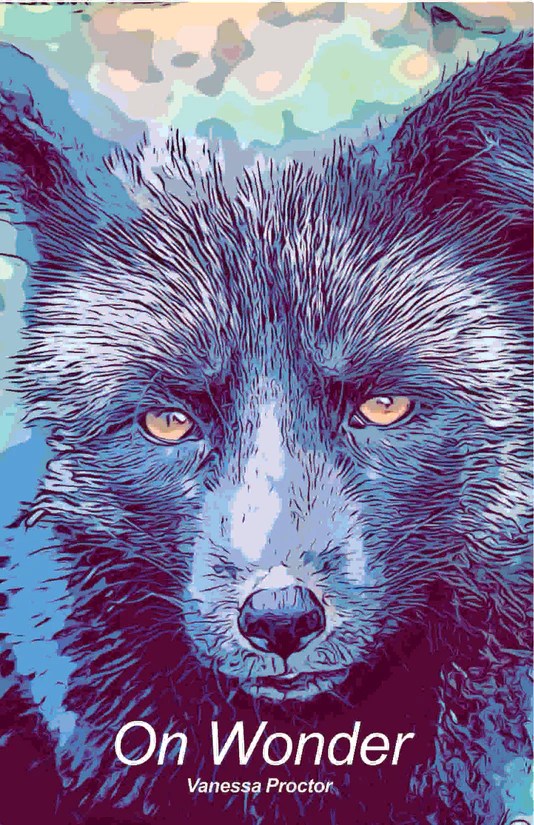
Vanessa Proctor’s On wonder was given to me by on old schoolfriend. It comes from a poet steeped in the haiku tradition, but it meets Swain at various points. One delightful synchronicity occurs between Swain’s “Suzi and the spider” which tells of Suzi gently releasing back into the wild a spider that has come into her house, and Proctor’s “A dragonfly” in which the narrator carefully unravels a spider’s silk from a dragonfly to set it free. Both speak of gentleness and respect for nature, and of connections between living things.
But now, a bit about Proctor. On wonder is her first volume of free verse, but she is an experienced haiku poet of over thirty years standing. She has been published in Australia and overseas, and her poems have been translated into many languages including Croatian, French, Hungarian, Japanese and Romanian. Her haiku artistry is evident throughout this collection in the tight gorgeous little images that appear in so many of the poems.
Other poems, however, branch out into something more expansive – not that tight images can’t also be expansive, of course. I enjoyed the gentle humour in the title poem, which, referencing Rosemary Dobson’s poem, “Wonder”, suggests a gap in understanding between teacher and student. Or, is there? There is cheeky humour too in “Helleborus Niger” whose
… roots may be used in witchcraft
to summon demons or to fight them.
Such a practical plant to grow
in the quiet of the suburbs.
Like Swain’s poems, many here are grounded in the domestic. Here too are kitchen sinks, bathrooms and gardens, but Proctor also opens with nature “stripped down” (“In the park”), albeit in her case it’s to “this moment/this place, this now”. It’s a centring to what is essential – now. “Bathroom orchid”, partway through the collection, conveys a different, but perhaps related, sense of being. “An impulse buy … a guilty pleasure”, it is “placed by the sink”:
With its glossy leaves
and velvet tongue
it knows exactly
how to be.
There’s something both unsettling and grounded here.
Proctor’s poems range widely over place – across Australia, and overseas – and over time, from 11th century Japan through world wars to now. Some respond to, or reflect on other works – on an Olive Cotton photograph, for example – or we meet historical figures like Chiune Sugihara and Murasaki Shikibu. We visit gardens and museums, experience childhood and other family memories, and are nurtured by nature. The titular theme of wonder is not laboured, but through the poems that I have read, we confront it in its various meanings of awe, curiosity, amazement, fascination – and, in the final poem, joy.
While I haven’t read these books thoroughly, my sense is they engage deeply with ideas about peace, inclusion and creativity.
This is my sixth World Poetry Day post.
And now, do you enjoy poetry? And if so, care to share any favourite poets or poems?
 Whispering Gums
But poetry is so … so … SUBJECTIVE …
And … your point is, MR?! Seriously, I agree but there is something special when you find poetry that speaks to you I think.
Indeed and indeed, ST.
Should it rhyme ?
Should it scan ?
Should it have a foot ?
Or is it just nice concepts …?
Haha, exactly MR.
Our book store, Fullers, has some poetry events happening for this day.
Ooh Pam … I wonder if Helen Swain will be there?
I have no idea but if I hear I will let you know. I think they have more people coming in for the Good reading day this week. The poetry events I believe are the poetry reading group members.
Ah thanks … but I will be interested!
You need to read When the time comes. I’m certain that it will speak very deeply to you.
I think it will Ian, you are right. I had a little look and realised I should have read it earlier. It will take time though, still, for me to fit in.
I enjoyed the lines you quoted here.
One of my favorite poems is Philip Larkin’s “Home is So Sad” https://poets.org/poem/home-so-sad
Thanks Jeanne … I’ve looked at that poem. What a great poem … this “A joyous shot at how things ought to be” is so real.
These both sound lovely!
Thanks Cathy … they truly are. I should read poetry more often!
I pretty much only read poetry when it’s included on a longlist and have occasionally really enjoyed it (The Jaguar comes to mind). I think the problem for me is that when you sit down to read a whole collection, it seems to lose its impact – each poem blurs into the next. If I spread the reading out, I tend to savour the words more but this way, lose the themes or patterns in the whole collection.
You’ve nailed it in one Kate … I felt badly in one way about not reading every poem in these two in detail, but I greatly enjoyed what I did read of them. Both I’d read the first few poems when I got them, and then for this post I read more, but in a more scattered order. What you miss by doing it the way I did is getting a strong sense of the ordering of the poems, but I still got some I think.
As a 9 or 10 year old I was the one that the teacher got up in front of the class to recite poetry.
The first three lines of the Snowflake by Walter de la Mere are forever embedded in my memory.
Before I melt,
Come, look at me!
This lovely icy filigree!
I hated it and never read poetry again until recently. With that I have read a few online of the more famous and they take a lot of getting used to. Do Not Go Gentle Into that Good Night by Dylan Thomas is the one that has made me consider that I need to give thought to what the poet is trying to achieve. I have just finished John Kinsella’s The Mahler Erasures and his delivery at times was poetical in both form and structure and had me spellbound. I think I know what Kinsella is setting out to achieve.
I have also just watched a very good BBC production called The Art that Made Us. They discussed Larkins Going, Going that I read through after the show and was enthralled by it. I see Jeanne in reply to you has linked another of his.
I think Kate W point that “when you sit down to read a whole collection, it seems to lose its impact – each poem blurs into the next.” is how I may feel. A whole collection would for me be something to just dabble in as apposed to read in a sitting. If it is used in something like Kinsella’s The Mahler Erasures I might be much more receptive as that has been a reading experience of the highest order.
Hi Sue, I read poems when I am in the mood. I have a couple on poetry books on my messy tv coffee table. I pick up one every now and then to read. However, as I am going to Greece later in the year, I am now reading the Odyssey, but in bursts!
Oh Greece, Meg, have only been there once but would love to go again. I’m with you re poetry … the trick is to have poems on those tables nearby isn’t it?
Alison Whittaker is a First Nations poet I have read a bit of now and really admire for opening my eyes to another way of seeing.
But the one book of poetry I still think about and visualise is Yuiquimbiang | Louise Crisp
Thanks Brona … I have read some FN poetry but not Whittaker yet. And don’t know Crisp at all. Will add her to my list.
I included blakwork in one of my posts for #IndieReads. What a fine work!
I really must read it, Marcie … I love how often you include Aussie books in your posts.
Happy belated World Poetry Day! Love the snips you shared! I always have a poetry book in my in progress pile. I just wrote a poetry letter to a dear friend in the Netherlands with whom I trade poetry–not poems I write but collections we read and write to each other about. The one I just read was Cloud Missives by Kenzie Allen. I’m currently reading Helen of Troy: 1993 by Maria Zoccola. Good stuff!
Oh I love that you write poetry letters with a friend Stefanie. Do you hand write them? Or word process them? Or email them?
I usually have poetry next to my bed too, but I don’t always choose Goldberger to read it. I should make more of a practice of that.
We used to hand write letters and post them in the mail but started sending email letters several years ago when suddenly they began to take a month or more to arrive. I miss the paper letters, but it’s much easier to type out a poem or scan it to share and the poem conversation can have a bit more back and forth while it’s still fresh 🙂
That sounds exactly like my Californian friend and me. We did snail mail letters until COVID really, but for some time the snail mail was taking 3 weeks or more (for a 15 hour flight from Sydney to LA (she lives in Orange Country and I live an hour’s flight from Sydney). That was just ridiculous. What we do is we do a proper word-processed letter and send it as an email or sms attachment. Writing it as a letter rather than an email somehow ensures that we write properly rather than a more stream of consciousness that email often encourages. My weekly letters to her are the closest thing I have to a diary. I think what you do is great. You are a busy person, anything that helps ensure you keep up this lovely activity – in a meaningful way- is the way to go I think.
We do word processor letters too and attach them to the email 🙂 Then we just email back and forth a few times to discuss the poem. It manages to both feel like a letter and a more immediate back and forth discussion. I love that we have both found ways to keep letter writing alive!
Exactly … it does both of those things, the immediacy of the email but the composition of a letter. Interesting that you are I have both come up with this solution. I wonder how many others have too?
For a couple of years I began each day by reading a single poem. It was such a lovely habit, because, really, you always have time for just one poem, right? But I lost track of that and missed it as time passed. Last year with that in mind, I resolved to read through Ruth Padel’s 52 Ways of Looking at a Poem, which originally ran weekly in a U.K. paper, and that was just great too because it lasted all year (with the added bonus that, twenty years later, many of these poets had a substantial body of work, and many of them are Irish, which is extra-appealing for me, so it made for great follow-up possibilities). This year I have been keeping a single collection in my stack at all times and that translates into reading a few every few days. That’s not quite so satisfying and I’m not sure why, but I think what I’ve learned is that poetry has a unique place in my reading, but it’s not necessarily simple to secure that place (when one is mainly obsessed with fiction heheh).
I like this idea of reading one poem a day. It makes it hard to review the collection as Brona said but it is a more satisfying way to read poetry I think. I wonder if I could read some to Mr Gums? I’d probably have to read it to myself a few times to make sure I got the flow well enough to read aloud! That would start making it hard work – albeit useful hard work!
Poetry has a unique place in my reading too, but it’s a rather random place too.