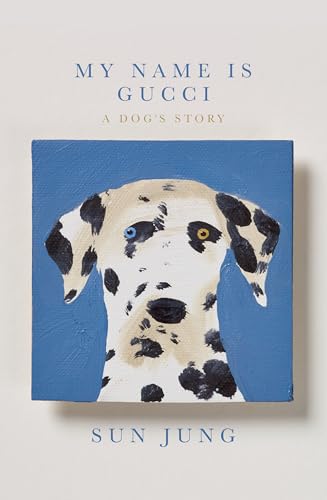
Some reading synchronicities – those coincidental connections that happen between books we read in a short period of time – are zeitgeist-related. For example, grief is not my go-to, but it is a common theme in contemporary writing so it’s not entirely remarkable that I have written three reviews since January about books focused on grief. What is remarkable is that, in the same period, I have read two books, written nearly 80 years apart, which are told from the perspective of dogs. This surely takes synchronicity to a whole new level – wouldn’t you agree?
A canine perspective is, however, where the synchronicity ends, because Dusty (my review) is told third person through two main voices, Dusty’s and his owner’s, and Dusty is very much a dog. He has no knowledge beyond what he knows as a dog. Gucci, in Sun Jung’s My name is Gucci, is something very different. Not only is he the novel’s sole first person narrator, but he has been reincarnated many times, so has a wealth of knowledge and experience way beyond that of a typical dog. Indeed, as he tells us, he is a “sage”, and an erudite one at that. Now, before you click away, thinking non-human narrators and ideas of reincarnation are not for you, do read on, because Jung makes this work, creating a story that is not only charming and often delightfully humorous, but also thoughtful about life and the connections we make.
Gucci is a Dalmation-like bitzer. At the book’s opening, he is five-years-old and living in a Singaporean animal shelter. He’d given up ever being rescued, when, seemingly out of the blue, “she” appears, and whisks him off to Sydney. Is this destiny? This never-named she, it turns out, has been connected to Gucci, in earlier lives, through their inyeon. Inyeon, the book’s glossary explains, is “Karmic relation or destiny”, but in fact our two are connected through the rarer form of “perpetual-inyeon”. This is “a persistently recurring Karmic relation between two beings through their numerous past lives”, one built on the understanding that “interactions must be mutually beneficial”. Gucci tells us:
I have been reborn three times during her present life; interestingly, and quite unusually, all three rebirth were dogs and all had one absolute karmic duty – to help her to collect and rekindle the shattered smithereens of inyeon that she had long lost.
Notwithstanding this idea of inyeon, the obvious question is, of course, why choose a dog as narrator. Telling a story through a non-human character is not only not easy, it’s a risk, so why? I don’t know Jung’s reasons, but the driver must surely be that unusual narrators have something useful to offer – tone, maybe, or experience or a different way of thinking. Gucci meets all of these. He has some painful things to share about her life, but does so in a lighter tone, which feels more acceptable from a non-human character. Further, as a dog who has experienced the world differently from humans, he can offer different insights into her experiences, not to mention those of humans in general. And, finally, he can illuminate important things about human-animal relationships.
“nothing is absurd”
My name is Gucci is not a hard read, but it does require concentration because we move back and forth in time, in her life, as it intersects with Gucci’s lives – as Nari, the Jindo dog, who dies in an accident when she is 9; as General, the Sapsal-cross dog, who was forced to work as a fighting dog, and is euthanased when she is 13; and of course as Gucci in her present life, now helping her confront and perhaps reconcile the traumas of her past. She had a difficult childhood in Korea, which is where Nari and General know her. The product of an adulterous union between a married man and a melancholic young woman (jageun umma), she is removed from this birth mother when she is 4 years old to live with her father’s wife (keun umma). Keun umma accepts her, with kindness and love, but not so keun umma’s mother, the “old hyena”, who is cruel to this “filthy child” brought into her home.
The time shifting, then, occurs between her past life in Korea, with Nari and General, and her current life in Sydney’s Kings Cross and Darlinghurst, where she is married to an Irishman, but haunted by her past. It’s no surprise to Gucci that she is a “horror novelist … [of] … spinechilling and gory urban mythologies”. In telling his and her story, Gucci is often insouciant if not downright playful, but he is also wise and philosophical, as he guides her and us through the challenges of coping with past experiences which threaten to undermine the present.
Closely associated with this idea of past and present is that of “destiny”. It is a constant thread in the book, and it discomforted me a little, perhaps because as a Westerner, the idea of destiny doesn’t sit easily with my world view. However, if we reframe it to encompass the way past experiences impact present and future actions, then it works – for me, and for the book, where the idea of fate/destiny/luck is variously respected, or upended or foiled, or treated sceptically by her Irish husband. There’s no one answer – just perspective and tolerance for difference.
Much of this story is serious. Bad things happened to her in her childhood, and Gucci reflects on the hows and whys. Early on, she is ostracised at school because of her “impure heritage”. Thinking back to their Seoul home in the suburb of Itaewon, which means “village of strangers”, Gucci wonders “what is being strange or different? Different to what?” Why do humans demonise, or make fun of, those who are different? My name is Gucci is full of good questions and wise ideas, but they are not laboured. Instead, Gucci keeps the story moving forward, with warmth and compassion, leavened by humour that is, at times, lightly satirical. There is a delightful scene when she takes her young Irish boyfriend to Korea, and, after a boozy night they go out for a “hangover cure” breakfast:
Bleary-eyed and with a severe hangover, he could not believe his misfortune as he stared at the abalone congee bowl.
Finally, there are the stories about human-animal relationships. Some of the funniest scenes in the book come from these, such as the Kings Cross apartment dog-wars, between dog-lovers and dog-haters. But there are tough stories too, like the sport of dog-fighting which destroys General’s life. This book pays tribute to the importance of our relationships with our animals.
Early on, Gucci forestalls our potential scepticism about his story by claiming that “if you look at everything in the world as connected by the complex web of inyeon, nothing is absurd”. Well, I have a high tolerance for the absurd, anyhow, but even if I didn’t, Gucci is such a delightful guide that I was in for the duration. If you want to read something that’s meaningful but doesn’t weigh you down, try this one.
Sun Jung
My name is Gucci: A dog’s story
Melbourne: Transit Lounge, 2024
254pp.
ISBN: 9781923023178
(Review copy courtesy Transit Lounge, via Scott Eathorne, Quikmark Media)
 Whispering Gums
I have been wondering if there have always been so many books about grief or if I am simply noticing them more (or if the publishers are more concertedly marketing them… there’s a cynical thought…guaranteed market? nearly everyone has grieved something or someone?) but this does sound like a different approach. One by a Canadian author who successfully channelled dog in my mind, was Erika Ritter’s The Hidden Life of Humans. It’s been many years since I read it, but it was quite funny at the time. I also loved The Ballad of Edgar Sawtelle, which is a Shakespeare retelling (akin to Jane Smiley’s A Thousand Acres), with multiple povs, but one of them is a dog, Almondine. I don’t remember any of the human characters’ names.
Ah Marcie, this is not a grief book. I just used grief as another example of recent coincidence or synchronicity in my reading. I did wonder too about your question regarding whether there are more books about grief at the moment? While I think they always have been grief books, I feel there might be more at the moment. We had a period where misery memoirs were a popular thing but those misery memoirs weren’t about grief as much as about other causes of misery in people’s lives. I’m not seeing so much of those at the moment but I am seeing many stories about grief. This is a very anecdotal response though! Aussie blogger Kate could tell us as grief is her field. Anyhow if it is more popular at the moment, I guess we could see it as a cynical marketing thing or we could see it as Western society becoming more open to talking about death and grief?
I love your examples of odd narrators/perspectives. Almondine is an unforgettable dog name.
Do you remember ‘Fifteen Dogs’ by André Alexis, which won the Giller in 2015. I think that might have put me off reading books narrated by animals for life. LOL!
Oh no, I don’t Kimbofo … I haven’t been good about the Giller – or, are you asking this of Marcie?
What put you off?
I was asking Marcie, but the way WP is structured the comment looks like I’m replying to you 🤷🏻♀️ I just couldn’t buy the premise and disliked the tone of voice. I’m not a fan of anthropomorphising animals in general so I was never going to be a fan…
Yes I suddenly realised that that’s probably what you were doing given the Canadian connection. I guess I’m pretty good at suspending disbelief so premises like that don’t bother me, even though I never read fantasy. Weird, eh?
HAH! I only wish I could forget that book. I still flash back to some of those scenes (particularly knowing some of the locations so well). I admire Andre Alexis’s Quincunx (Fifteen Dogs is the second of the five books) and I was raised on animal stories and found the different dogs as interesting as different people, but there are some heartbreaking scenes in Fifteen Dogs for sure, so I can see why it would have leapt to your mind on this topic.
And I hadn’t heard of this at all, Marcie. The idea of different dogs sounds interesting.
Not my cup of tea sorry — I struggle with any narratives not told from a human perspective. Glad you enjoyed it though
I understand that Karen. I don’t like a lot fantasy-like stuff, but for some reason I’m not put off by non-human narrators in a realistic world. They don’t all work but the idea doesn’t put me off.
“if we reframe it to encompass the way past experiences impact present and future actions, then it works” – this is far too much like hard work, for me, ST.
In fact, I’m amazed at your enjoyment of this book: you’re the person who was polite in dismissing my mentioning that wonderful Oz classic,<i>The Magic Pudding</i>, on account of its being animal characters !
It is A Very Good Thing that you and your opinions are not set in stone: flexibility is a precious commodity. 🙂
Haha, I appreciate that commendation MR … but I can’t take all the kudos. Part of it is just growing up. I was a kid then! I did for example love Animal farm when I read it at 17 or 18.
BTW I was reading some old letters I wrote about my children back when our son was seven or eight and I wrote that he read the magic pudding to himself. My mum had given it to him so clearly he loved it but then he liked fantasy.
Nope, can’t read books about dogs and hear about them getting hurt. I wonder if there are so many grief books out now (as I agree there seem to be many) because the baby boomers are now of the age they are leaving life in droves. I;m glad you enjoyed the book. I would be interested only if no mention of dog shelters or fighting. I’ve become such a wimp.
I understand that, Pam, though Gucci himself in his current life is fine and so much fun to read. Still I get it!
Good idea re current grief books and baby boomers, albeit the three I reviewed were all about young people dying, from 6 months to 38.
Haha I take my comment back.
Isn’t it strange how books on a theme sort of just happen sometimes? This one sounds lovely and the cover is adorable.
It sure is Stefanie … and I love the cover. I had a medical procedure a couple of weeks ago and I took this in with me – two nurses commented on the cover and asked if it was about a dog! It’s eye catching!
Archimedes and the Seagle by David ireland was narrated by the the dog. It was a pleasant read that if you find a copy of you may enjoy.
My review from some please else 🙂
In this book we get the thoughts of a Red Setter called Archimedes.
I say that his name is Archimedes but as Archimedes himself writes “My name is Harrison B Guest. ‘Happy for short’” His human family, or employers as Archimedes explains early in the book, call him various names with the initial birth name being Spangler Red Brian Boru. “Other aliases I have, courtesy of human superiority are Blue (because I am red) Dog, Mr Dogg, Towser, Buster, Red, Here Boy, Hey You and Hey Mong”.
Archimedes has learnt to also understand what not only humans say but other animals. Archimedes can read. Archimedes is very articulate and can explain things to us human reader’s about dog thinking in a very human way. Archimedes explains the way dogs smell us for example. The reality is that we stink. We humans are repulsive to dogs. Not as in the way we physically smell but in the way we smell of things as unedifying as death and desperation. Archimedes can smell our loneliness, defeat, fear but then also our joy. Even our criminality. Archimedes notices that things pray on man’s minds, money issues for example. He notices when we are unwell. He sometimes tries to let us know but we never quite get that. He is good at observing us and is interested in everything. Archimedes says that if anyone can tell him of anything that is not interesting he would be “…..interested to see it”
Archimedes watches Seagulls. He watches a protest one day. Gay seagulls are protesting about the “discriminating practises by heterosexual Gulls” As they protest Archimedes asks a profound question as to why they walk when they can fly.
Archimedes observes that he is one of The Fortunate Few. He writes that many dogs lose employment. With that their employers either take them a long way away and dump them or at worst take them to a concentration camp where they get a needle and then are incinerated. All that for just losing their jobs.
Archimedes observes two dogs fighting over territory. Apparently one had once been into “oblivion” but he heard a cat explain that after death there was a beautiful place where there was peace. Now said dog did nothing but fight. Archimedes profoundly observed that perhaps he fought “…to counter the threat of endless peace….”
Archimedes observes human debt. The fact that humans don’t have any money but are out to buy the world. In Archimedes opinion “…..the taker of credit is a thief of the future, and the giver of credit aids and abets the theft.”
Archimedes comments on democracy in Australia. He thinks that lies come from the government, press, business, educationalists, and are left lying around. He thinks that the spirit of Australia is the people. Though “not in the land they squat on”. The spirit of the land he thinks will stay a secret forever.
Archimedes see a Gulls wedding. He hears them chatter and finds that the groom is a member of the fire watch and that the bride a food researcher. Interestingly the couple’s parents are conservationists who “…..work to save the customs and the attitudes of the past….”
Archimedes wonders why humans think the way they do. He heard a beautiful bird song one day and jumped about to bring it to the attention of his family, they thought he wanted to eat the bird. He was almost annoyed at their presumption.
But in the end Archimedes is satisfied with his lot in life. He is happy in that kindness is “the foundation” of his religious beliefs and he finds kindness most temperate and fair. He has passed through all the stages of a dog’s life. And he has written a book! What more can he want!
We have a novel in similar structures of style from the past that David Ireland has written, the standard short, sharp essay like chapters. But the tone of his writing has changed considerably. Interestingly the most positive of his past books was for me The Glass Canoe but this one outshines that as it just glows with a future that is positive. David Ireland delivers Archimedes happy with his lot in life, able to observe human inanity and foibles but able to shrug them all off. Ireland writes with a wittiness beyond his usual dark satire and irony. The book ends on a hopeful note.
Does it work? To a degree but its whimsiness just leaves it short of being very good. Plus the themes of the past appear periodically and that in itself leaves it a little too close to being ‘more of the same’. But I would recommend it. Those that like light fantasy and dogs should enjoy Archimedes and the Seagle. Plus the joke about a dog called Dogenes is worth the entrance fee alone. At 228 pages easy to read. A sunny afternoon book.
Because this book has a subtitle, I assumed at first it was a memoir!
I remember that animal books brought me great comfort during lock down. I read about sheep farms and bird behavior and chicken care. I wonder what it was about animals that made me feel safe. Perhaps the way we can connect to animals, be it as pets or working animals or producing animals or as creatures sharing our world.
Both really interesting points Melanie. Love the temp subtitle gave you a sense that it was lucky to be a memoir I guess on top of the sort of title it is. And that’s an interesting point about animal books giving comfort during lockdown. I guess too that it can feel like animals are immune to or outside human cares and worries though pets had to have been affected to some degree by the human lockdown. I know many people got pets at that time which reinforces your point doesn’t it!
I hope that once those lockdown protocols were relaxed people did not give up their pets. I know there was concern about this because people went back to work and may not have known how to entertain or care for a pet that had been trained to be with their person all day.
It did happen here a bit … over crowding in pet shelters was in the news in the year or so after. But the issue associated with is complicated by the increasing cost of living that coincided with the end of COVID.