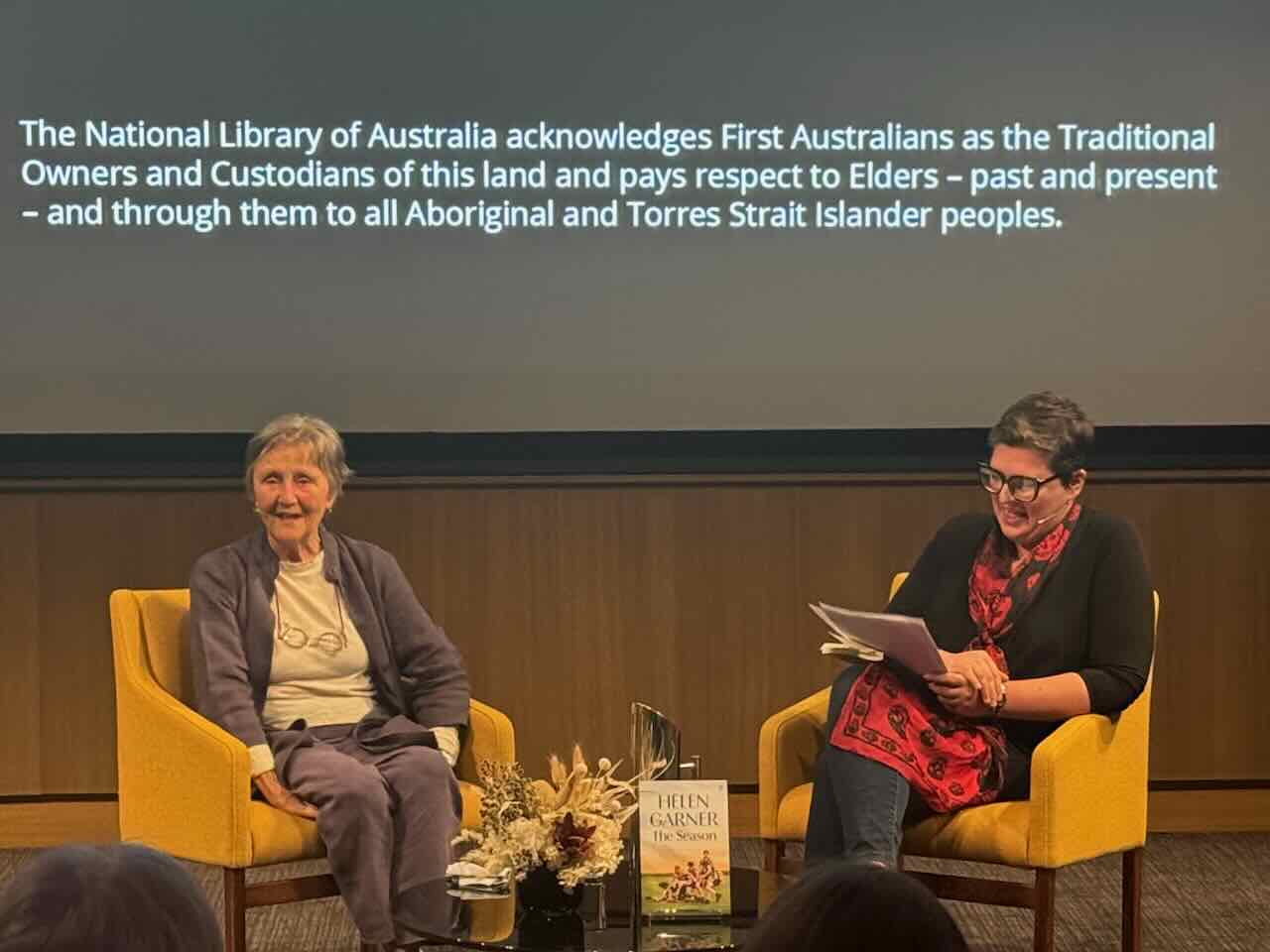
It is a measure of the love and respect readers have for Helen Garner that this event, held in the National Library of Australia’s 300-seat theatre, had a 200-strong waiting list. And, it was well worth booking early for.
The evening was emceed by Luke Hickey, the National Library’s Assistant Director-General Engagement. He started with a welcome, acknowledgement of country and an introduction of the participants, who were:
- Helen Garner (my posts): multi-award winning author of novels, stories, screenplays and works of non-fiction.
- Beejay Silcox: writer, literary critic and about-to-retire Artistic Director of Canberra Writers Festival.
The conversation
This was a joyful but engaged conversation that flowed easily, while gently getting to the nub of some great ideas.
Beejay started by reminding us that “Canberra” means “meeting place” and that for millennia people have met here to “talk about things that matter”. She then tried to define what Helen Garner means to us. She is a writer who destablises and discomforts us, who energises us, who provokes us but not for provocation’s sake. She’s a writer who doubts, is uncertain, and who, because of this, brings us along with her.
On writing The season
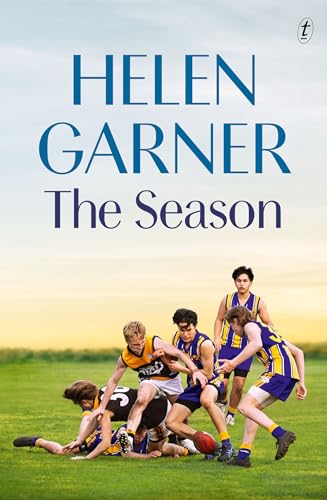
Beejay called The season a graceful book, a love letter from a grandmother to boys and men. Some see it as very different from her previous work, but Beejay was not so sure. What did Garner think?
Garner said this was the most fun writing she had done. It was an “extraordinary experience” and came at a time when she felt burnt out. Preparing her three diaries had involved many “squirmy 2ams”. She also saw it as her last chance to get close to a grandchild.
Contrary to her normal practice, which is not to ask permission, Garner had asked her grandson and his coach whether it would be ok for her to attend training sessions with a view to writing about the experience.
Beejay commented on Garner’s reference in the book to being an invisible older woman. Was it a superpower or curse. Oh, superpower, said Garner! She didn’t want to interview the players, just observe.
Garner didn’t know anything about teams, so she’d sit back, an invisible figure in her straw hat and overalls, and watch. The boys were, generally, oblivious of her presence, and had no sense of this being rude. She was fascinated by their behaviour versus that of girls, with which she is more familiar. They would dump their stuff any which way – bags, bikes, phones – and keep on walking to wherever they were going. Girls, by comparison, place their bikes, say, neatly against a tree. Women scan the territory, whereas these boys had tunnel vision, a “tremendous ability to concentrate” or focus.
She observed that during training the coach would exhort the boys to widen their field of vision. It was “thrilling to watch”. Garner conveyed such joy about watching the young men. I remember feeling the same about watching my son’s cricket team. Those boys were so enthusiastic, so sure, after getting out for a duck, that they’d hit that six next time. Their confidence was infectious.
On football, and writing about it
Garner admitted to being a Western Bulldogs fan, and talked about her love of footy. She “can’t stand it when it’s not footy season”, which drew some perhaps surprised but warm-hearted laughter from the audience.
Beejay spoke of Garner’s “narrative love of the game”, of her anchoring her writing about it in terms of writers like Blake, and Homeric epics, of her referencing “elemental” ideas like mercy, triumph, vengeance.
Garner talked about her introduction to the sport – her origin story as Beejay framed it – via the 1997 documentary Year of the dogs. It was a time of great change in the sport, and she was moved by the decisions made by some players to not chase the money.
While she knows the rules and understands the play, she will “never” understand the game, but doesn’t care. She didn’t want to take a position on football. Some expected her, for example, to take a feminist position, and explore the brutal aspects, but she wanted to glorify.
Beejay asked how hard it was to not write what people expected. Garner didn’t know how to write a polemical book about football. In fact, she struggled to turn her experience into a book. She started writing it in the past, but that gave it an historical feel. As soon as she changed to present tense, she knew she had her story.
Beejay asked her to read the opening two paragraphs:
I pull up at the kerb. I love this park they train in. I must have walked the figure-of-eight round its ovals hundreds of times, at dawn, in winter and summer, to throw the ball for Dozer, our red heeler-but he’s buried now, in the backyard, under the crepe myrtle near the chook pen.
The boy jumps out with his footy and trots away, bouncing. it. Boy? Look at him. He’s been playing with our suburban club since he was a tubby little eight-year-old; I have never paid more than token attention to his sporting life. But this year he’s in the Under-16s. The shoulders on him! He must be almost six feet tall. He’s the youngest of my three grand-children. The last, and there will be no more.
Beejay described this as a masterclass in writing. Everything is in these two paragraphs – relationships, rhythm of life, her sense of place, death.
Garner said, simply (modestly, some of us would say):
“What I’m good at is saying what happens”.
On Garner, the writer and grandmother
Garner loves being a grandmother, and got more laughs when she admitted that after three marriages she was no good at being married, but had found a place to be in the world. She sees the role of a grandmother as being “a servant”, that is, as serving the family, helping the family grow, being the backstop.
Beejay returned to her introduction of Garner as self-effacing, as a writer who doubts. In this book, she describes herself as “a bore”. Is this questioning of herself a whim, and what is the gap between the book she imagines and the one she creates.
Garner never has an idea of what her book is to be. She writes sentence by sentence. She talked about being “a small piece of shit”. While one husband told her he didn’t feel that way, she thinks most of us feel small, at least sometimes. They are valuable times; they balance “the insane moments of triumph”.
On values, lessons, manners
Garner loves football because the discipline of sport puts boundaries around the urge to fight. (She referenced the Iliad with its sense of enormous power). Garner and Beejay discussed a photo Garner loves of two footballers at a moment of defeat, with its Homeric sense of valour and duty, of intimacy, loss and pain. Garner sees these footballers as young, and perfect. She loves “noble postures of defeat” rather than Achilles-style roaring, bellowing triumph.
Garner thinks football can teach boys manners. There can be moral teaching, to not think of themselves and to trust each other .
Beejay also noted that The season is a love letter to volatile youth but is also about age. What did Garner mean by feeling envy. Was it of youth? Of boys doing things she couldn’t? Or related to the presentism of youth, and being unweighted by the past? A bit of all of this. Garner envies youth, its fearlessness. The discussion then turned to what happens to boys who are tender when young but are forced to harden when they get older. Garner hates “the clamp” that is put on emotion in boys.
For all the talk about youth envy, Garner also accepts her age. At 82, she is bothered that people try to deny her age, as in “you’re not old”!
Q & A
On boys and masculinity: a couple of questions/comments concerned this. One audience member thanked her for her “lovely writing” about boys compared to all the “toxic masculinity” talk that confronts them today. Garner hates that those two words – “toxic” and “masculinity” – are glued together, and that boys have to face it. Another questioner wondered how parents can help boys become the boys we’d like them to be. Garner shared an experience she had of Tim Winton calming his distraught 4-year-old by simply sitting with the child and repeatedly naming his feelings, “you’re so angry, you’re so sad”, rather than telling him to get over it, etc.
On Garner being a great observer of human emotions and whether she has questions in mind when she is observing. Nope! Garner just barges in! She’s no good at planning. People love it if you are interested in their work. She realises she is “completely un-bore-able”. (I can relate to this.) She quoted a French writer who said “ignorance and curiosity” form the basis of their writing.
On whether writing The season cured her feeling of burnout: Garner has signed a contract to deliver another book in December but “has nothing say”!
Conclusion
I loved this conversation, not only because Beejay asked perceptive, interesting questions and because Garner is – well, Garner – but also because Garner confirmed my own feelings about sport. It is life – it’s narrative, character, drama, emotion. It can play out so many of the big things we feel and experience.
Beejay clearly liked this too because she concluded the conversation on the idea that football is bigger than just the game. Was there one lesson we could take away from it. Garner’s response?
”Don’t turn your back on the play”!
And with that the session closed to enthusiastic and appreciative applause.
Author Talk: The season with Helen Garner
With Beejay Silcox
National Library of Australia, presented in partnership with the Canberra Writers Festival
Thursday 20 February 2025
 Whispering Gums
Thanks for this excellent report, Sue! How lucky you were to attend.
I detest football, having grown up with a Western Bulldogs fan as a father, who also played a key role in local footy and was never at home because of it. I also grew up in a small town where footy was everything but so very misogynist so I really don’t have much time for it. Nor do I like the way the media glorifies male power/violence and turns young men into heroes who can do no wrong. Yet I ate up this book and adored the writing! I thought it was refreshing to see her take on being old and being a grandmother at the heart of her family.
Haha Thanks Kimbofo. I’m glad you liked the book – which I can’t wait to read – and my post. I hear all you are saying about football. I’m not a fan either but either but, with both our kids in Melbourne we are being drawn in on the edges. Sport is a good thing overall. We just need to harness what’s good about it and get rid of the rest, and we need to share the money around that is poured into it so that other good things also get supported, don’t we.
She’s written a bit about being a grandmother hasn’t she, so I’m looking forward to that aspect of this book too.
THANK-YOU, ST !!!!! XO
My pleasure MR!!!
I loved this talk. We were so lucky to be in the audience. Thank you for summing it up.
When Beejay mentioned ‘attention being a form of prayer’ (ref. Simone Weil), I thought well, that’s what we’re doing as the audience! Paying rapt attention, seeing many moments of grace.
Thanks Qin Qin … we were. I nearly included that great quote in my post but I didn’t feel Garner took it anywhere so I deleted it feeling my post was long enough – but you are right, that is what we were doing!
It’s been so long since I attended an author event, I think that the last one I went to was Margaret Atwood at the Sydney Opera House. I always feel more connected to an author with the opportunity to hear them speak and engage with the audience.
I have heard Margaret Atwood once, Becky, but it was a long time ago, here in Canberra. It was over 20 years ago, and she was interviewed by Marion Halligan, and was a memorable evening. I enjoy hearing authors speak too.
How wonderful you were one of the lucky ones to get tickets! Sounds like a lovely evening.
Thanks Stefanie. I love Garnet and she doesn’t do many public events so I hopped on to it the minute I saw it. It sold out quite quickly.
The (American football) quarterback Y.A. Tittle fathered a daughter who grew up to be a poet, and wrote a memoir of him, with references to epic heroes. NPR interviewed them, and he seemed mildly pleased, but mostly bemused. This is mentioned near the bottom of Wikipedia’s article on him. (Where I found that his first name was in fact Yelberton, not Yelverton, as I had supposed for sixty-odd years.)
Thanks George … I’ll be interested to see how she handles this in the book, but I like that he was “mildly pleased, but mostly bemused”. This warrior, hero stuff can be overdone but there’s an element of truth in it too.
Mr Gums is fascinated by the names of so many American football players.
I’m sure it was a wonderful evening, but I just don’t like the idea of writers as performers. I don’t expect my writers to perform, nor my performers to write.
Did I throw my bike on the ground when I was a kid? I don’t remember. I certainly wouldn’t now.
I like the idea of grandparents as ‘servants’. I have never felt that I was head of the family, and I think that one of my daughters probably is these days (If we had a family business I might not so easily relinquish control!) Milly and I do what we can to help while the younger generations get on with their lives.
Thanks Bill. I don’t EXPECT writers to perform. I would certainly hate to have to perform if I were a writer. But I love hearing from those who are prepared to. The worst experience I had was attending a JM Coetzee event. He really didn’t want to be there and I think he only did a reading. Fair enough I thought. I don’t ever want to be part of something like that again.
Yes, I like that “servant” idea too, though she said there were gasps in an audience recently when she said that. Hopefully, they understood when she explained. I am sure Mr Gums doesn’t feel head of the family but I suspect my father had some sense of that. Not autocratically but probably with some sense of leadership and maybe a little control – but he was loving and conclusive too so it felt more old world than anything autocratic or bossy.
I swear sports are for men what romance novels are for women. There is so much big emotion in sports that it basically follows a narrative arc, the ending of which you hope goes one way, but could go the other. I think it’s strange to say she doesn’t like the phrase toxic masculinity and then goes in to describe how someone addressed the boy who was upset by helping him label his feelings, which is the opposite of toxic masculinity.
That’s a good point Melanie about sport playing the same role as romance does for women. I strongly believe that sport is story but I love how you frame the ending!
I’m sorry, but I don’t understand why that story about Winton makes her saying she doesn’t like the phrase “toxic masculinity” strange?
Basically, Winton is describing the opposite of toxic masculinity — to name your feelings and work through them. If one side of the coin exists, the other must, too.
Thanks Melanie … I thought that’s what you meant but wasn’t quite sure!
Thanks for this wonderful report Sue. I loved this book and crossing my fingers that Garner makes an appearance at the Melbourne Writers Festival – I would love to hear her speak about the book (and footy!)
Given everything going on in the world right now, it could be very easy to drop out, tune out, put one’s head in the sand. But your final line ”Don’t turn your back on the play” sums up why we shouldn’t ignore or close our eyes to what’s happening.
Keeping an eye on the game is the only way to make informed decisions about what to do next.
Exactly, Brona … it’s perfect isn’t it. It’s one of her epigraphs for the book.
Pingback: 52 Book Club 2025 – #24 Title is a spoiler & #25 Breaks the fourth wall – Yarra Book Club
I just noticed there’s a Helen Garner story in a collection I’ve got in my stack for March. I’m quite looking forward to it!
Oh good, Marcie … I look forward to hearing about it.