A regular part of my Jane Austen group’s monthly meeting is a show-and-tell which means of course that we share anything new we’ve acquired, seen or heard about relating to Jane Austen. At our February meeting, a member brought along a first edition (I think) of a book a friend had given him as a result of that friend’s downsizing. It pays to have your friends know your enthusiasms!
The book was G.E. Mitton’s Jane Austen and her times, 1775-1817 (1st ed. 1905). We were intrigued as none of us had heard of this book or its author. Who is Mitton? The assumption from some in the group was male, but others of us were not so sure – and we were right to be, because G.E. Mitton is Geraldine Edith Mitton (1868-1955). She was, according to Wikipedia which cites Who’s who from 1907, “an English novelist, biographer, editor, and guide-book writer”.
Wikipedia provides a brief biography for her – drawn primarily from a couple of obituaries – followed by a list of works. It’s not much, but provides some background. She was born in Bishop Auckland, Country Durham, the third daughter of Rev. Henry Arthur Mitton, who was a master of Sherburn Hospital. In her late twenties, Mitton moved to London, where in 1899 she was employed by the publishing company A & C Black, and worked on the editorial staff of Who’s who. In 1920, she became the third wife of colonial administrator Sir George Scott and collaborated with him on several novels set in Burma. (Wikipedia lists four collaborative novels.) Her biography of him, Scott of the Shan Hills (1936), was published the year after his death. Several of her books are available at Project Gutenberg.
I could research her further, and, who knows, I might one day, but she’s not the main point of this post. What I want to share is how she starts her book. Chapter 1 is titled “Preliminary and Discursive”, and it opens with:
Of Jane Austen’s life there is little to tell, and that little has been told more than once by writers whose relationship to her made them competent to do so. It is impossible to make even microscopic additions to the sum-total of the facts already known of that simple biography, and if by chance a few more original letters were discovered they could hardly alter the case, for in truth of her it may be said, “Story there is none to tell, sir.” To the very pertinent question which naturally follows, reply may thus be given.
Little did Mitton know! Despite the significant gaps in her biography, Austen is surely up there as a biographer’s subject. There have been many traditional biographies, including, in alphabetical order, those by David Cecil, yasmine Gooneratne, Park Honan, Elizabeth Jenkins, David Nokes, Carol Shield and Claire Tomalin. But, perhaps partly because of the gaps and partly because books about Austen are popular (and presumably sell well), her life has been written about from almost every imaginable angle, such as:
- through the places she lived (Lucy Worsley’s Jane Austen at home) and the objects she owned (Paula Byrne’s The real Jane Austen: A life in small things);
- through her beliefs and values (Helen Kelly’s Jane Austen: The secret radical and Paula Hollingworth’s The spirituality of Jane Austen);
- through her relationships (E.J. Clery’s Jane Austen: The banker’s sister, Irene Collins’ Jane Austen: The parson’s daughter and Jon Spence’s “imagined biography” Becoming Jane Austen);
- through (or by) her fans (Constance Hill’s Jane Austen: Her homes and her friends); and
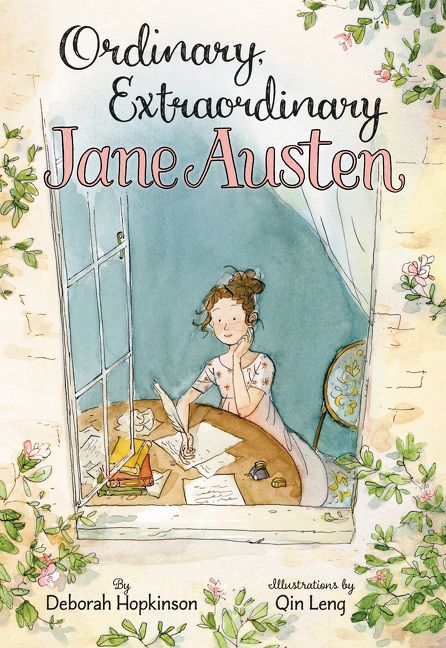
- for children (such as Deborah Hopkinson and Qin Leng’s picture book biography, Ordinary, extraordinary Jane Austen: The story of six novels, three notebooks, a writing box and one clever girl).
Need I continue?
But all that’s an aside. The opening paragraph then continues, and here is the main point of my post:
Jane Austen stands absolutely alone, unapproached, in a quality in which women are usually supposed to be deficient, a humorous and brilliant insight into the foibles of human nature, and a strong sense of the ludicrous. As a writer in The Times (November 25, 1904) neatly puts it, “Of its kind the comedy of Jane Austen is incomparable. It is utterly merciless. Prancing victims of their illusions, her men and women are utterly bare to our understanding, and their gyrations are irresistibly comic.”
Remember, this was written in 1905. Austen may not stand “absolutely alone” – and I would hope that women are no longer seen as “deficient” – in having “a humorous and brilliant insight into the foibles of human nature, and a strong sense of the ludicrous”, but I appreciate Mitton’s recognition of her wit. And that last sentence from The Times is close to perfect.
My Jane Austen group plans to discuss this subject later in the year, so you might see more on this topic, particularly regarding whether we see her comedy as “utterly merciless”. Meanwhile, you are more than welcome to share your thoughts.
 Whispering Gums
I see the anticipatory smile on your face as the group member offers up this delightful and unknown item, ST !!
Perhaps there should be monthly (?) awards for those members who come up with the topics lending themselves best to your researching genius. 🙂
Haha MR … yes, i researched the author’s name on the spot but most of us in the group love researching our Jane.
I dunno about that phrase: I find it too modern for her. And also I doubt she would’ve wanted to appear so – or maybe it’s just a matter of removing the adverb …
You mean “utterly”?
Sure thing.
Yes, this is something I’ll be thinking about when we discuss it – “utterly merciless” seems too strong. She could be merciless at times I think, but “utterly”? I think I’m with you.
Yaaaaay ! – that’s a win for me ! 🙂
Chalk it up!
Not against you, ST – just a win for me coz of making an acceptable point. 🙂
I understood that MR – but I’m glad you made the point because it forced me out!
I shared the beginning of Northanger Abbey with a dear friend (the poet Miriel Lenore). We got as far as ‘her father was a clergyman, without being neglected, or poor, and a very respectable man, though his name was Richard’. At that point of course we both laughed out loud, though Moo was very short of breath and in fact died the next day. I’m glad we had that laugh together.
The note in my 1971 OUP edition says ‘though his name was Richard’ was thought to be an Austen family joke. Wikipedia says Dick has had a sexual connotation since the 17th century but I think JA’s version is funny anyway.
Oh this is great Margaret … not about your friend dying but about Austen making you laugh so much. She does that a lot doesn’t she!
There are theories about this joke … and maybe it is “utterly merciless” though poor Mr Morland!
But he maintains his equanimity. Mr and Mrs Morland must be the calmest parents in the whole of English literature?
They are among the best in Austen, that’s for sure, not that there’s a lot of competition!
But he maintains his equanimity. Mr and Mrs Morland must be the calmest parents in the whole of English literature?
To the biographer’s point, I do wonder when there has been enough picking and digging and conjecture about an author. I’ve read other biographies that sprawl so far out from the subject that I wonder if what I’m reading adds value or is a cash grab.
Yes, the cash grab is the question sometimes re Austen. I suspect though, too, that some people love her so much that they are desperate to write about her, but what? Some of them do find an interesting or useful angle but I admit I don’t read many of them. I’d rather read the books again.
What wonderful fun – finding Geraldine who needs to be added to the gigantic Austen file. And I agree with the removal of ‘utterly’. Perhaps, more often than not, life is improved by the removal of an adverb.
Thanks Carmel … Geraldine is a lovely find. I hope to check out more of this book.
I agree about “utterly” and will think more about adverbs in general. Microsoft Word’s grammar check picks me up on adverbs in my correspondence with my Californian friend. I am partial to their qualifying capacity, like “the restaurant was fairly quiet”. MS Word does not like that. But, I say, the restaurant was not “quiet”. This is an ongoing battle between MS and me.
Yes. I did say ‘more often than not’. There is a place for adverbs.
Haha, Carmel, yes, I noticed that … and it gave me hope that MS Word is not always right!
What a treat your group member was gifted! As to Austen’s humor, not sure about merciless, but she is definitely utterly delightful
Oh wonderful Stefanie, “utterly delightful” perfectly covers it, even when it is delightful because it has bite.
I’ll have to come back and reread your rich post. 2025 is 250th anniversary of Jane’s birth, I think I just might read her novels once again. And God willing, visit England, Bath, and all the JA places if I have the chance.
It is Arti … but I reckon this is the year to avoid those places! But that’s just me – I hate travelling amongst crowds. I reckon, read her this year and travel next.
Haha! You’re right of course. Just my speaking out loud of a dream. Reading can always be done with no need to stand in lines or fight crowds. 😉
I wrote a comment and WP replied “I’m sorry this comment could not be posted”. I wonder what they had against it, it was only about my changing attitude to Mr Bennet and whether or not JA was making fun of in particular Mrs Bennet and Mary.
I don’t know why it does that sometimes Bill. I can’t find any reason. I can’t imagine it was content.
I think Mr Bennet is an interesting character whom we have tended to give more leeway than he deserves because we’ve been distracted by his wife. I think Austen wants us to see his faults, but to forgive him a bit too?
What I see, and don’t ever see discussed, is that Mr B married one class down, from the gentilty to the wealthy trades and merchants, to get a wife with money. Elizabeth and presumably JA have only favourable opinions of Mr Gardiner, Mrs B’s brother, but Mrs B’s lack of class makes her a figure of fun. Sometimes I see Mr B as remote and disapproving and sometimes I think he rather enjoys the relative lack of class of his wife and younger daughters. After all Mrs B must have been a Lydia herself once, or at least a Kitty, and Mr B a staid young man with an exciting girlfriend,
What a delightful post! Firstly, I have bookmarked Mitton’s book on Project Gutenberg and secondly wish to remind you of Fay Weldon’s foray into Austenland – Letters to Alice: On First Reading Jane Austen | Fay Weldon.
I have read the Paula Byrnes book and have a lovely anniversary edition of the Wolsley to enjoy some time this year. I’ve read the Tomalin and Shields bio’s – are any of the others ones highly recommended by you?
And finally, I’m not sure that I can agree at all that Jane is without mercy. She can be pointed, unkind and even cruel at times, like Emma, but we still love her and she is redeemable. One of the reasons I love rereading her novels is for her wry, witty observations about her characters and all their foibles. She laughs at them some and so do we, but we also laugh with them. Merciless suggests an unfeeling nature and for me, Jane was far from unfeeling!
Thanks Brona … thought you’d like this post.
I have got and read Fay Weldon but a LONG time ago. I have frequently thought I’d like t reread it and think again on her thoughts from this time in my life.
I think those are probably the best biographies. Jenkins is probably good too but I’m not sure it adds much at this stage. My frequent go to when researching Austen is the Cambridge anthology edited by Janet Todd called Jane Austen in context. It’s excellent for background to the era with references to Austen and her work.
And thanks for adding to the anti-merciless chorus. I’m so far agreeing. Some of her characters can be merciless but I don’t see her as merciless towards them.
Do you use Chat GPT? You can ask a certain numbers of questions for free on any topicc. Lots of fun to play with. Your Jane Austen club sounds like a lot of fun. I actually have a deck of Jane Austen Tarot cards. I saw them somewhere, don’t remember, and just could not walk past them .
Yes I do Pam … but not on books, except I have a couple of times just to experiment. I don’t find it great for that though I think it could provide some starting points for a student writing an essay.
But I do use it for other things, like a specific itinerary for a new town I’m visiting.
I like the AI generated summaries at the top of my internet searches (on health issues for example) … they are great and then I can decide whether I want or need to investigate further.
My group played that Tarot game once. I can’t remember the details now though. It was a bit of a hoot.
I have fun with the AI. Like you mention, fun to experiment. My sister is looking at buying a Dodge ram, 1998 camper and AI told me about it and what to look for as it is old. It was quite interesting.
That quotation about biographies says as much about her as it does about biography! It suggests that there really is one perfect way to tell a person’s story, based on the facts, completely overlooking that every bit of writing is subjective, which dramatically alters the final product. Each biographer’s “take” on JA would necessarily be quite different. But I understand that, even today, many people still believe in the idea of one objective (i.e. “correct”) truth. And maybe she did not have quite so many Austen biographies to “consult” and compare in “her time”.
Haha good point Marcie re people’s expectations re objective/correct truth. It’s a worry isn’t it.
BTW Mitton would have had almost no biographies to draw on in 1905. There’s the Memoir written in 1870 by a nephew and something by Constance Hill in 1901. Neither of these – certainly not the Memoir – contain a lot because so little was known. I suspect Chapman’s publication of her letters in 1932 gave the JA biography industry its big fillip.
Pingback: Reading Austen 2025 Masterpost – This Reading Life
Pingback: Winding Up the Week #416 – Book Jotter
Intereseing. Although I personally look to a writer’s works. Jane A is great!! However, Biographies are mostly far less great and I like my imagined history better. But that’s just me. 🤣😎🙃
Just me is fine Mr Ohh, particularly if you like Austen! Thanks for commenting.
Pingback: 💚Happy 250th Birthday Jane Austen💚 – This Reading Life