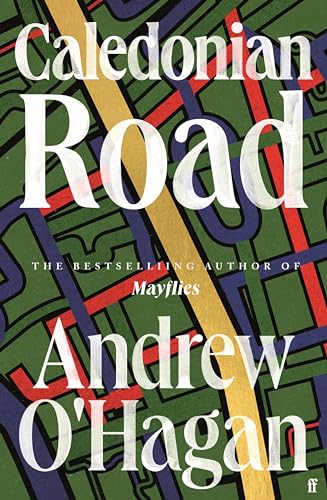
When my reading group started back in 1988, most of us were time-poor mothers so we had a rule-of-thumb that our books could not be longer than 350 pages. Those days, however, are long gone, and some time ago we agreed that our January (aka summer) read could be a BIG book. Last year, for example, it was Demon Copperhead (my review). This year, some were keen to read Andrew O’Hagan’s Caledonian Road, so that’s what we scheduled.
My problem is that while it’s summer, January is also tennis season. I don’t watch much sport, but I do love the tennis. Reading a big book while trying to keep up with the tennis is always a challenge. As is the fact that, as most of you know, I love short books. Give me a novella and I’m (usually) happy. However, I also love my reading group, and so I gave myself extra time and got stuck in. I was immediately engaged. The protagonist, fifty-two year old Campbell Flynn, art historian, writer and academic, captured me. There was a certain Jane Austen tone to the opening:
Tall and sharp at fifty-two, Campbell Flynn was a tinderbox in a Savile Row suit, a man who believed his childhood was so far behind him that all its threats had vanished.
Ha! He certainly was a tinderbox, as he was about to slowly implode. Further, as we soon discover, his childhood was not at all behind him, and is implicated in his unravelling. The first paragraph ends with some foreshadowing telling us that the first of his “huge mistakes” was not to “take people half as seriously as they took themselves”, with the second being “the proof copy” he had in his briefcase.
It is Thursday 20 May 2021, so the first wave of the pandemic is over but its long shadow provides a quiet background to the novel which is told over five parts, from Spring 2021 to Winter 2022, concluding around the time of the invasion of Ukraine in February 2022.
Now, back to my reading journey. I was interested, but as I read on, following the ups and increasing downs of Campbell’s life, along with those of an ever-growing cast of characters, there was a point where I started to baulk. It felt like a long wallowing in the ills of the modern western world. Did I need 640 pages of it? And then it clicked. I realised I was reading a modern take on the 19th century “condition-of-England” novel. These novels, as the The Victorian Web explains, “sought to engage directly with the contemporary social and political issues with a focus on the representation of class, gender, and labour relations, as well as on social unrest and the growing antagonism between the rich and the poor in England”. We’re talking Dickens’ “big” novels, Elizabeth Gaskell’s North and south and Mary Barton, and so on. I loved them.
“a deep dive into the era’s shallows” (Campbell)
These novels have to be big, because a nation’s “condition” does not comprise one issue but a network of them, and this is what O’Hagan pulls apart in Caledonian Road. Through a cast of around 60 characters, O’Hagan explores a grab bag of the various ills we read about every day, with a British spin. All the big issues are here, including toxic masculinity; intergenerational wars; racism; modern technology with its related concerns like security, privacy, hacking, and digital identity; disruption as activist action; financial corruption and malfeasance; foreign interference; and human trafficking. Grab bag these might sound, but they are overlaid and connected by the traditional biggies – class, entitlement and privilege, economic inequality, and now, globalisation.
There’s a lot going on, but O’Hagan’s characters are vividly drawn, the plot is compelling if complicated, it is satirical in tone, and the language is so captivating that I enjoyed reading it after all. It is, necessarily, a disjointed read with the narrative constantly switching between the different storylines that make the whole, but I found I didn’t need the cast of characters helpfully provided at the beginning because the context always made clear who they were.
Before I return to the subject matter, I must share a couple of perfect character descriptions. First is Milo, a person whom Campbell doesn’t take seriously enough, and second is Candy, Campbell’s sister-in-law, the fey do-gooder wife of the egregious Duke of Kendal:
The young man had edges and they often glinted on the blade of his charm. (p. 76)
and
Candy stood like an emaciated meerkat looking out for an opportunity to enthuse. (p. 262)
So now, back to the “condition-of-England” idea. The characters range across the breadth of British society, from twenty-somethings to eighty-somethings, and include MPs, aristocrats, academics, journalists, business people, actors, criminals, activists, do-gooders, hackers, landowners, renters, gang members, migrants, factory workers, and lorry drivers. But, what most of them have in common is an idea of what England is. The most poignant comes from the migrants, like Polish Mrs Krupa and her son’s undocumented employee, also Polish, Jakub. As Jakub’s life, under the control of human-traffickers-cum-drug-lords, starts looking different to what he expected, he begins “to wonder if England was anything like the myth he … had bought into”.
O’Hagan, then, explores with clarity and a healthy sense of irony, today’s England (or Britain). The flawed but self-questioning Campbell – increasingly conflicted by his middle-class success and working-class origins – is our guide through a story in which hope, promise and sincerity are set against hypocrisy, greed and hatred. Desperate to remain relevant to the times, and to be a decent person, Campbell lets his guard down, allowing the driven, idealistic Milo into his life. Both are complex characters, who test our moral compass. Others not so much, like the aristocratic Duke of Kendal and Lord Scullion, the Russian oligarch Aleksandr Bykov, the corrupt billionaire William Byre, and the criminal Bozydar, all of whom, indirectly or directly, slash and burn those around them. In between are the decent, including women like Campbell’s wife Elizabeth and sister Moira, and the powerless, like rapper Travis and undocumented migrant worker Jakub.
Towards the end of the novel, the unravelling Campbell, who has become “lost in the sprawling web of it all”, inverts my favourite EM Forster quote when he reflects to himself, “only disconnect”. It’s a paradox. Campbell’s survival will depend on disconnecting from all that is wrong in his world (technologically and personally), while hanging tight – keeping connected, in other words – to all that is good. Ultimately, while O’Hagan paints a grim picture of what is wrong – the superficial, the hypocritical, the greedy and the cruel – in England, he also leaves us with a glimmer of hope. There are good people and they can prevail – but, will they, is the question we are left with.
PS Caledonian Road, being a big book, invites multiple responses. You can read those by Brona and Jonathan, who approached it from different angles and perspectives.
Andrew O’Hagan
Caledonian Road
London: Faber & Faber, 2024
642pp.
ISBN: 9780571381388 (Kindle edition.)
 Whispering Gums
Thanks for the mention, Sue. I don’t think I’d met the term ‘state of England/Britain novel’ before. It’s exactly right for thus novel, which I think you enjoyed a lot more than I did
You’re welcome Jonathan … interestingly I came across the term not at university but some years ago in a discussion about Mansfield Park which is not your traditional condition of England novel but someone was proposing that it was. And at that time I learned a bit more about that genre if you can call it that and yes, I did enjoy it once I had that sort of framework for it plus the fact that I enjoyed his writing and found many of the characters interesting.
Hi Sue, a great review and a great read. I just finished reading Caledonian Road and have been recommending it to my friends with some reservations. It is an intoxicating read, with such annoying characters and situations that sucked me in. I think this is how the world runs, with bad people and a few good ones.
Oh thanks Meg … “intoxicating” is a good way to describe it. I think you are probably right though I’d add and a lot of in-between people who are neither, in the sense that they’re not bad but they don’t do much to contribute to the world either. There aren’t so many of those in the book though I guess because they don’t do anything so aren’t very interesting to write about!
Your usual classy review, ST – but I cannot decide whether I want to listen to 640pp about, as meggsbook puts it, “how the world runs, with bad people and a few good ones”, or run away fast …
Thanks M-R… someone in my reading. Group did listen to the audiobook and I think she liked it though she had some reservations about the reader. I think it was a Scottish voice which makes sense because the author is Scottish. I’m trying to remember what she said about keeping track of all the characters in the audio version. I think she said it worked well.
Ah ! – then that means I SHALL listen to it; for I adore Scottish accents !! 🙂
I hope you like it … there are some great lines …
This comment really IS off-topic coz I dunno where to write about following up something we briefly discussed before. 😦
The Dinuka McKenzie trio of Aussie detective books ? – BRILLIANT. Her plots are truly magnificent – of the kind that make me wonder and wonder how in the name of any god she managed to develop them.
Her protagonist does still pack an awful lot of angst, but. [grin]
Great … thanks very much MR … it’s Mr Gums’ birthday on Tuesday and I was thinking of a crime novel. I will see if I can get the first one. Except, will he like all the angst?
I think the plots carry these books, ST: any crime aficionado will more than likely accept Miles’ self-doubt under the circ.s (to be revealed upon reading !).
Gotcha … ! He is a picky semi-aficionado … loves Chris Hammer. Likes Garry Disher. Didn’t like the one you-know-who that he read!!
I do not wish to be reminded of his execrable taste !! 😉
Haha M-R!
640 pp! Rather you than me. Though MR’s comment reminds me I don’t mind long audiobooks, they fill in the time – just under 23 hours, maybe a bit much, though I checked 1Q84, one of my favourites, and it’s 46+ hours.
So there you go – easy peasy then! IQ84 was a book I was never going to read despite the fact that I like Murakami.
Caledonian Road will feed perfectly into your political world view I think! The capitalists don’t come out well and there’s some anarchic disruption going on!
I have seen a few people talk about this book, great to read your perspectives… I don’t mind a 600+ page book, but it has to be good given the time commitment 😀
Thanks Rach … if you don’t mind a 600+ page book you might like this then. Particularly if you like satire?
Oh, this sounds delicious! And my library even has it with a surprising number of holds on it even! Just as well since my in progress pile has gotten a bit unwieldy of late.
Haha Stefanie … I know about that pile though I try to keep the in progress pile under control. I’m glad it has a waiting list … hope people are liking it. I guess they won’t be allowed extensions if there are people lined up?
You are correct. If there is a holds queue you get the book for three weeks and that’s it. Makes reading popular chunky books rather stressful sometimes.
I imagine … I don’t use libraries much now though I should start again as there’s a lovely one – albeit a small branch – within walking distance of our now not so new (nearly 2 years) home.
This book is already in my reading pile, and just got moved up based on your review, Sue.
Oh great Jennifer… I will look out for your review. I hope you enjoy the read.
I wrote out a long comment and WordPress said it couldn’t be posted…?
What? That shouldn’t happen Melanie … someone posted 2000 words recently … I can’t imagine yours was as long as that!
No, definitely not that long.
That’s weird … and I’m sorry you lost all the thought you put into it.
I had that happen with two posts later last week as well. I wasn’t able to figure out the issue, but there was some login silliness (having to rekey credentials for some sites but not all) alongside.
The login silliness on some sites and not others, including erratic login silliness in that it can be different on different sites, drives me spare.
I’m tempted by this – the last State of the Nation book I read was John Lanchester’s “Capital” which I thoroughly enjoyed.
I’ve heard that was good Liz. I’d be interested in your reaction to O’Hagan’s and how you think it compares (if you ever manage to squeeze it in!)
I had heard many reviewers talk about the Dickensian nature of this book, but I’m not sure I’ve heard of the term, condition-of-England novel before.
Naturally I’ve now googled it and found the whole Thomas Carlyle/Chartism question fascinating, and I can also see how a case could be made to include Mansfield Park in the number. Although I’m not sure if that’s what JA had in mind. I believe her thoughts had been to write a novel about the clergy with regard to MP.
Yes you can see it in MP. She did say re MP she was going to write about “ordination” but whether that’s what she thinks she did write? Of course Edmund’s ordination is the main conflict between him, Mary and Fanny isn’t it?
I’ll be interested to see what my annotations bring out when I get to MP as I’ve always suspected that I have missed something important in MP.
Several in my JA group have those annotated editions. I’m tempted but my JA bookcase is getting packed.
There is a lot in MP … I won’t say much but another issue, besides ordination (which is not simple idea but about JA’s moral/religious views) I think is the city versus country values. It’s worth thinking about that I think as you read.
Then there’s … no I’ll stop. We can discuss when you get to it!
I loved O’Hagan’s previous novel, Mayflies, and am tempted by this, although the novel’s length is a bit of a mental barrier for me. (Like you, I often find myself gravitating towards novellas these days.) He’s a fascinating writer/critic, and his long-form pieces for the LRB and other journals are always interesting to read. As you say, he’s great with characterisation and state-of-the-nation issues, so this does sound appealing…
Thanks Jacqui … I’m glad I’m not the only one gravitating to novellas. And I’m glad to hear a positive report on Mayflies. Of course id love to hear your thoughts on this but I’m the last one to put pressure on people!
I’ve only read his Maf the dog book before, and then he sort of disappeared from my view. I should look out some of his long form journalism as you are not the only one to recommend these pieces.
I had a similar experience with another long one (Catton’s Birnham Wood); it took a very long time to see what she was about with it all. (Well, it took me a long time anyway. Quite likely it was apparent more quickly but I wasn’t catching her drift. heheh) I thought for sure I’d read one of O’Hagan’s, but instead, what I’ve noticed, is that I’ve done a fab job of collecting and a terrible job of reading. Glad it turned out to be so worthwhile in the end.
Thanks Marcie. It didn’t take me that long with this one … maybe only 10% or so as it does become obvious pretty quickly as he moves through the various scenarios. I haven’t read Birnam Wood but from my memory of The luminaries I am not surprised about it taking a while. I think she’s far more tricksy!
I have read one O’Hagan but I love your having done a good job of acquiring but not so good of reading. I can relate to that.