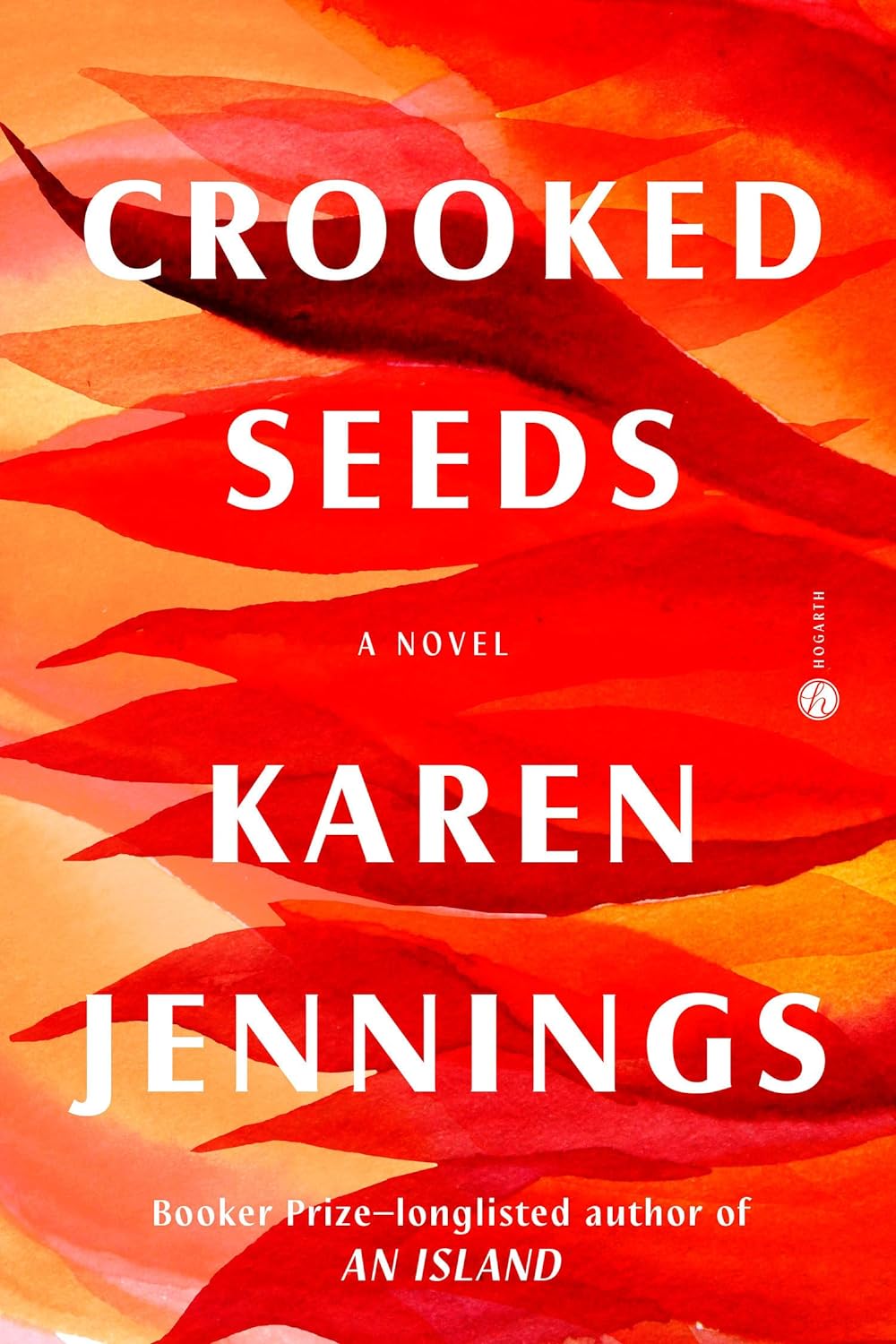
Crooked seeds is the third novel I’ve read by South African writer Karen Jennings, and she continues to intrigue and impress me, because she seems to be quietly bubbling away in her little corner of the world writing books that grapple with the difficult questions. Unfortunately, I didn’t read her Booker-longlisted novel, An island (2020), but the two I have read, Finding Soutbek (my review) and Upturned earth (my review) are historical novels with strong political underpinnings. Crooked seeds has political import too, but is set in a somewhat dystopian near-future.
I say near future because my calculation from the information we are given has Crooked seeds set in Cape Town in the late 2020s, and it certainly feels dystopian with dire water shortages, fire on the surrounding mountains and ash falling. This setting is not, in fact, farfetched. Cape Town did experience a severe water shortage problem from 2015 to 2018, and climate change is an increasing problem in South Africa. Climate change, however, is not Jennings’ prime concern here. Rather, it provides a perfect, disturbing environment against which to explore the personal problems being faced by her protagonist, 53-year-old Deidre van Deventer, and the political problems threatening to undo post-Apartheid South Africa. The near-future timing enables Jennings to imagine a setting that is hard to question, but that is close enough to feel more than plausible.
The novel opens strongly. Deidre wakes up thirsty, dirty and smelly. Her personal grooming is almost non-existent and she doesn’t seem to care. By paragraph two, we learn she has false teeth and by paragraph three that she needs crutches. It’s 5.18am, and at 6am the water truck will arrive, so she sets out to join the queue. She speaks to people she knows, mostly to cadge cigarettes or other help from them, things she never pays back. Clearly though, the sympathy card works because, as demanding as she is, people continue to help her, often at some cost to themselves. She is, I should add, white.
This is the background. An unappealing woman fighting a world that is tough and difficult for all those at the less advantaged end of the spectrum. Into this setting comes the plot, when, early in the novel, Deidre is contacted by police officer Mabombo concerning some bodies – infants’ bodies – in the yard of her old home. This is the same yard where, at the age of 18, she had lost her leg in an explosion caused by her pro-Apartheid activist brother Ross. Deidre wants none of this investigation. It’s nothing to do with her, she says, directing them to find the family that had lived there before.
“I’m the one that needs help. Me. Look at me. I’m the one!” (Deidre)
From here we follow Deidre, as Jennings drips out more and more of her story, matching flashbacks to an unhappy past where Deidre came a poor second to her mother’s beloved Ross, with a present where a highly unlikable but clearly damaged Deidre tries to survive in a desolate world. Deidre is one of those characters who can frustrate some readers. She’s a taker not a giver. She is rude to those who help her, including her kind but long-suffering Coloured neighbour Miriam, not to mention those at the perfectly-named Nine Lives Club where she wastes spends her days. She refuses to consider any advice that might make her life easier. And she certainly doesn’t think for herself about how she might improve her situation.
Meanwhile, Deidre’s estranged mother, Trudy, lives across the road in a nursing home. Suffering from dementia, she is lost in the patriarchal past, yearning for her son, but it is she who holds the key to the mystery.
Halfway through the novel, Miriam’s frustrations with Deidre’s self-centredness boil over when Deidre admits that she has never voted, because the government doesn’t care for her. Miriam, remarking that this government provides her disability grant, continues:
“You know what, Deidre, you’re really something else. Every time I think I’ve seen the worst of you, you come out with something even more terrible. Every single time, no matter what. Are you trying to be unpleasant, tell me? Is that your plan, to be unpleasant and make everyone dislike you. I really want to know?”
Deidre looked down into her lap. “No, it’s just the way I am.”
So, frustrating, yes, but Jennings had me engaged from the start. For all her faults, I cared about Deidre and about that
invisible thing that came at her from all directions … this thing that was always watching her, that never took its eyes off her. That saw what she was and punished her for it.
Also, I wanted to see where Jennings was going with her story, because, as I’ve already intimated, there is a political layer – not only the water shortages and encroaching fires, but the forced removals from homes (which Deidre and Miriam had experienced) and an overall sense that the state isn’t working.
I don’t think I’m going too much out on a limb to suggest that we could read white, damaged Deidre as representing white, privileged South Africans who see themselves as victims in the post-Apartheid world. Like Deidre in terms of those infants’ bodies, they may not have been personally responsible for the worst that happened under the regime, but they need to face the truth of what happened under their noses. Towards the end, Deidre asks Mabombo about the point of chasing it all up now, decades later. He responds:
“Miss van Deventer, this is difficult for you, of course, but you must agree that the truth has to come out. To leave the thing alone would have been to deny it and cover it up. And we must consider the other people involved. Families lost their children, and have been living with questions and pain for all these years.”
Ultimately, what Jennings shows in Crooked seeds is a society at odds with itself, and I use the word “shows” intentionally because this is such a spare, tight book. There is no telling, just a powerful story about a woman from whom everything was taken, in her mind at least, when she was 18, and who has never been able to rise above it, seeing only her own pain and loss, never recognising others’ loss or that the possibility of change lies at least partly in her hands. A personal story with a political heart. This is a stylish, clever novel, with an ending that hits just the right note.
Karen Jennings
Crooked seeds
Melbourne: Text Publishing, 2024
219pp.
ISBN: 9781922790675
(Review copy courtesy Text Publishing)
 Whispering Gums
I have a copy of this, sounds really impressive!
I’d love to hear what you thought Cathy. I think impressive is a fair assessment!
We have complementary experiences of her work; her first is the only one I’ve read. The others are vaguely on my TBR but I’ve just been reading in other directions. I admired her precision with words and the way that she presents difficult scenes.
Ah, that’s great to hear Marcie … I remember being surprised by her first. just because I’d never heard of her (obviously) and the book was sent to me by a small independent press from England that didn’t have big names in its list so I wasn’t sure at all what I was going to get. Then I got the second one and thought this writer really is interesting. So good to see her continuing.
This book strikes a chord with me in a weird way, but I will try to explain. When I was teaching at a community college about ten-twelve years ago, most of my students were white, and their families were struggling due to the poor economy. Right around the same time, the phrase “check your privilege” became popular, which made the students rather angry. It was hard to explain that despite all their families’ struggles, they never had hardship due to their skin. I think this was part of the chemistry that later had people supporting Trump for president. When you said the character was white and in a post-Apartheid society, that’s what made me think of all this. At some point, will the US look like South Africa? Do we now? Did we post-slavery? It’s an interesting thought.
This is interesting Melanie. I can see your point about the “privilege” thing, and their feeling they don’t have it feeding into support for Trump. I guess that’s part of the Vance thing, though he now had privilege doesn’t he (which buys into another whole “myth”). I think though that South Africa has such different racial complexities, and different political trajectory, that makes it not easily comparable to the USA?
Oh this sounds good! And it’s even been published in the US, and even better, my library has it! Now I just have to figure out how to fit it into my teetering pile of reads.
Sorry Stefanie… one thing in its favour re the teetering pile is that it’s relatively short!