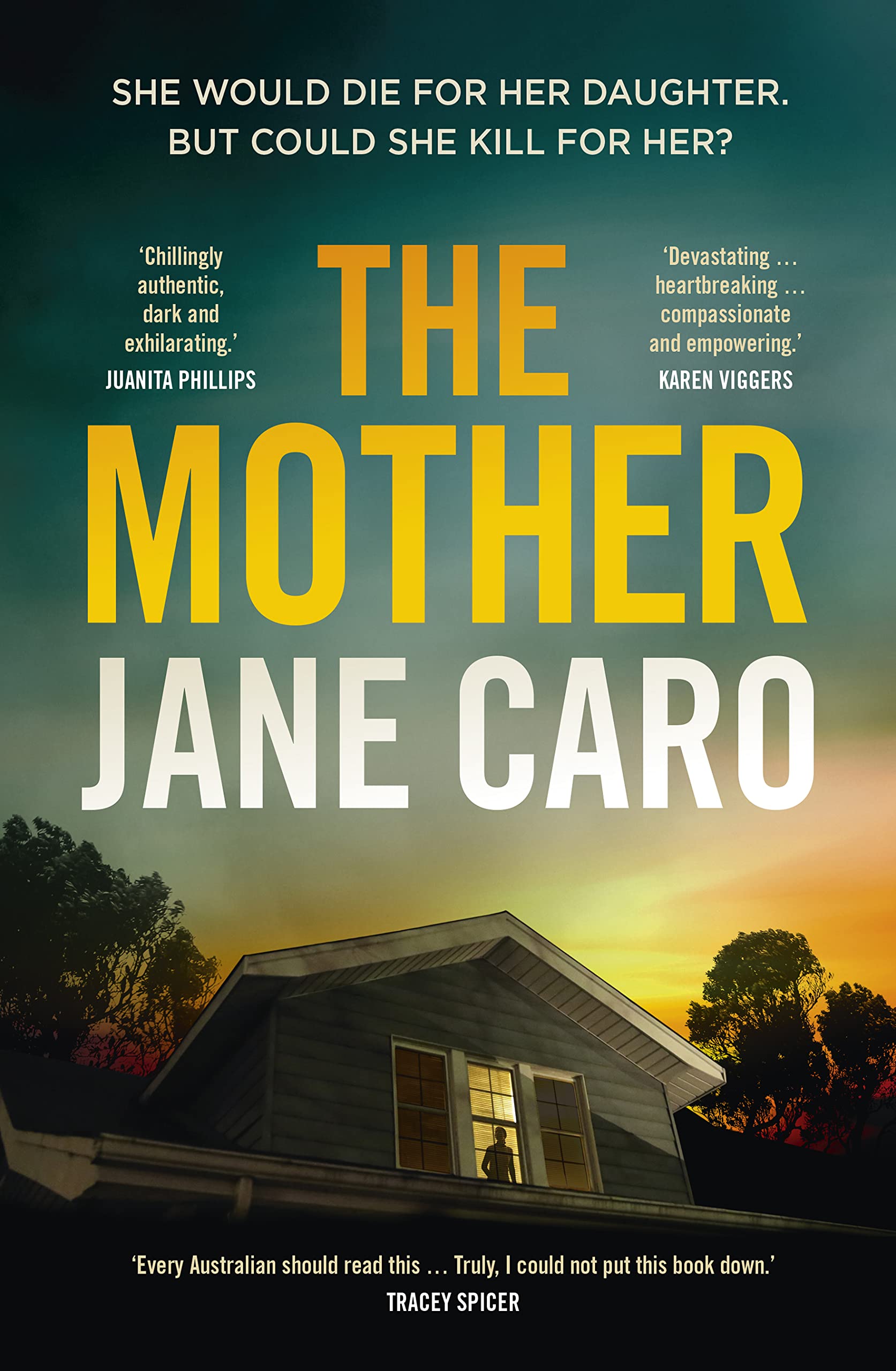
When my reading group scheduled Jane Caro’s debut novel, The mother, I was, I admit, not exactly enthusiastic, because my sense was that it was not going to be the sort of, shall I say, subtle writing I prefer. My sense was right, but I am not sorry I read it – partly because of the engaged discussion we had and partly for Caro’s intention.
The mother, then, is not a literary award-winner – the writing is fine but not exciting or breath-taking in the way I like – but, and it is a big but, it is an accessible, fictional exposé of the main points Jess Hill makes in her Stella Prize-winning See what you made me do: Power, control and domestic violence (my review). Hill explores family and domestic violence from every angle, but the most shocking and enlightening part for me concerned children, particularly the Family Court’s inability or refusal to see the risks to children from its parent access orders, even when the children themselves express fear. This point is powerfully made by Caro in her novel*.
But, let me step back a bit. The mother tells the story of 60-something middle-class Miriam Duffy who, widowed early in the novel, is pleased – and indeed grateful – when her emotional daughter, with whom she has had a tricky relationship, marries a perfect-seeming man. Gradually, however, little niggles about this relationship become bigger until one day they are confirmed when Ally returns home with two little children in tow, having left her husband. From here the situation deteriorates as the husband Nick escalates his bullying, predatory behaviour, and Miriam and Ally realise that the law is unable to protect them. The novel is described as a thriller, so I’ll give you just one more piece of information. It opens with a Prologue in which Miriam buys a handgun.
This brings me to the structure. After this Prologue, the novel is divided into two parts. In Part 1, Ally marries and soon after, Miriam is widowed. There is also a second, older, daughter who is in a stable marriage and has two children. During this part, Caro slowly drips out many of the flags that constitute coercive control, but that on their own don’t initially look like it or can be explained away – things like isolation from family and friends, use of a (demeaning) pet-name, jealousy, charm that is turned on and off at will, and surveillance, moving into sexual violence and gaslighting. This part ends with Ally’s return home. Part 2 commences four years later, and we are reminded of the Prologue, because Miriam is researching where she can buy a gun. Miriam and Ally have been systematically intimidated by Nick, and have reported his transgressions against Ally’s AVO (Apprehended Violence Order) again and again, but
Eventually they had stopped going to the police. It wasn’t that the cops weren’t sympathetic; it was just that they could not do anything.
In this part, Caro ratchets up the sense of helplessness (and hopelessness) the two women feel as Nick finds new ways to harass and terrify them. As I read it, I couldn’t help but think about all the news stories of recent years about murdered women and children. Nor could Miriam and Ally, but they turned the TV off the minute these stories came on. They were too close to home!
Like many issue-driven books, The mother did, as many in my reading group commented, feel didactic at times, and it is somewhat predictable. Some of us also felt that it was a little laboured in places. However, offsetting this is the novel’s characterisation and understanding of human nature. Caro conveys the complex human emotions we all experience under stress. She explores the lines and balance between what is acceptable in relationships and what is not, the fears about when to speak up, the justifications we try to find when things feel awry, and the feelings of guilt (particularly in mothers).
The mother is unapologetically a novel with a cause. With its compelling storyline and believable characters, it has a chance of reaching those who do not understand what coercive control is, and who do not realise that it crosses all demographics. Nick, for example, is a vet and Ally a PhD candidate. Miriam, a successful businesswoman, lives in comfortable North Shore Sydney.
This novel is being promoted primarily as a thriller, but I’m more inclined to see it as belonging to that long tradition of social problem novels. It may not be as sophisticated as the best of them, but its intention is clear, to drive social change. I hope it succeeds. I don’t imagine Jane Caro, or Jess Hill for that matter, will let matters lie until we see real, sustained change happening – and nor should we.
* This month there has been news about changes in family law in Australia, including removing the presumption of equal shared care, putting a focus on prioritising children’s best interests, and revamping the role of independent children’s lawyers. Time will tell what difference this makes in practice.
Jane Caro
The mother
Allen & Unwin, 2022
368pp.
ISBN: 9781761063893
ASIN: B09MQ3PN1W
 Whispering Gums
You have always been ready to forgive writing weaknesses in favour of whatever strengths remain to be found – this I know !!
You are so brilliant at reviewing because you have a heart.
That is a really nice thing to say MR … but I hope you are not using this to downplay my appreciation of your book.
Journalists always seem to think they have one book in them, I guess because they are so used to writing, but if they were writers rather than journalists the book would probably have popped out long ago.
Still, I can see the point of fictionalising issues, the news gets through to so few people, but I’m not going to read a book that leaves me feeling frustrated about my inability to do something.
There’s probably some truth in that though Caro is not exactly a journalist I think – was she marketing to start with? – and she has written some children’s books I believe.
“a feminist social commentator, writer and lecturer” (wiki) – you’re quite right. And I should check before I write.
You said it! Seriously, though, I did check before I wrote my post as I wasn’t quite sure exactly what she was. I had that Wiki description in my draft post but it felt a mouthful!
I want to be a social commentator !!!
Where do I sign ?!
What? You’re not already?!
I wanna be like Jane Caro – have my opinion sought on … everything ! [grin]
Haha … MR. You might have left your run too late … but, you know, where there’s life there’s hope!
I’ve watched some in-depth journalism about women’s experiences being stalked, and the incessant nature of it is enough to make me feel secondhand panic. Women who moved states away, changed phone numbers a dozen times, years and years in the justice system, him showing up at her job and getting her fired, alienating her from family and friends and new lovers, etc. etc.
Secondhand panic is a good way of describing it Melanie … these stories – real and fictional – can be quite visceral I think (for women at least. No matter how great our own husbands are, how safe we feel with them, we can still understand as a woman what the opposite must feel like, can’t we. Absolutely terrifying.