It’s another new month, meaning time for another Six Degrees. Last month, in my introduction, I said that one of the things I like about doing this meme is seeing what book Kate has chosen next. Little did I know when I was writing that post, that the book she had chosen for this month was inspired by a recent post of mine on writers and artists. What a surprise, but how lovely. However, before I share what that book is, I need to do the formalities, that is, to tell you that if you don’t know how the #SixDegrees meme works, please check host Kate’s blog – booksaremyfavouriteandbest.
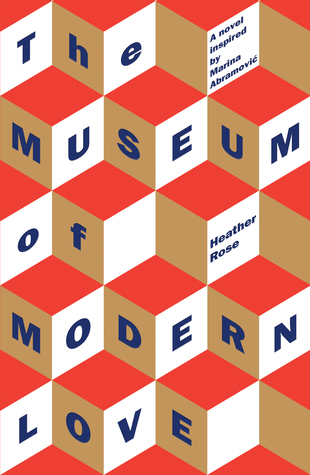
So, the first rule is that Kate sets our starting book, and as you know for this month she selected a book from a post of mine. The book is Heather Rose’s novel, The museum of modern love (my review) and – haha – I have actually read it! In case you haven’t, it was inspired by artist Marina Abramović’s 75-day performance piece, The Artist is Present, which she performed at MoMA (the Museum of Modern Art) in 2010. From this, Rose weaves two stories, one about the real Marina Abramović and the other about a fictional musician who regularly attends the performance.

Where to from here? There were many options, but I decided to go with something fairly obvious, another novel set in a museum, this one a fictional house museum devoted to an artist and her muse, Helen Meany’s novella Every day is Gertie Day (my review). This museum, like MoMA during Abramović’s performance, attracts a lot of attention, albeit for different reasons.
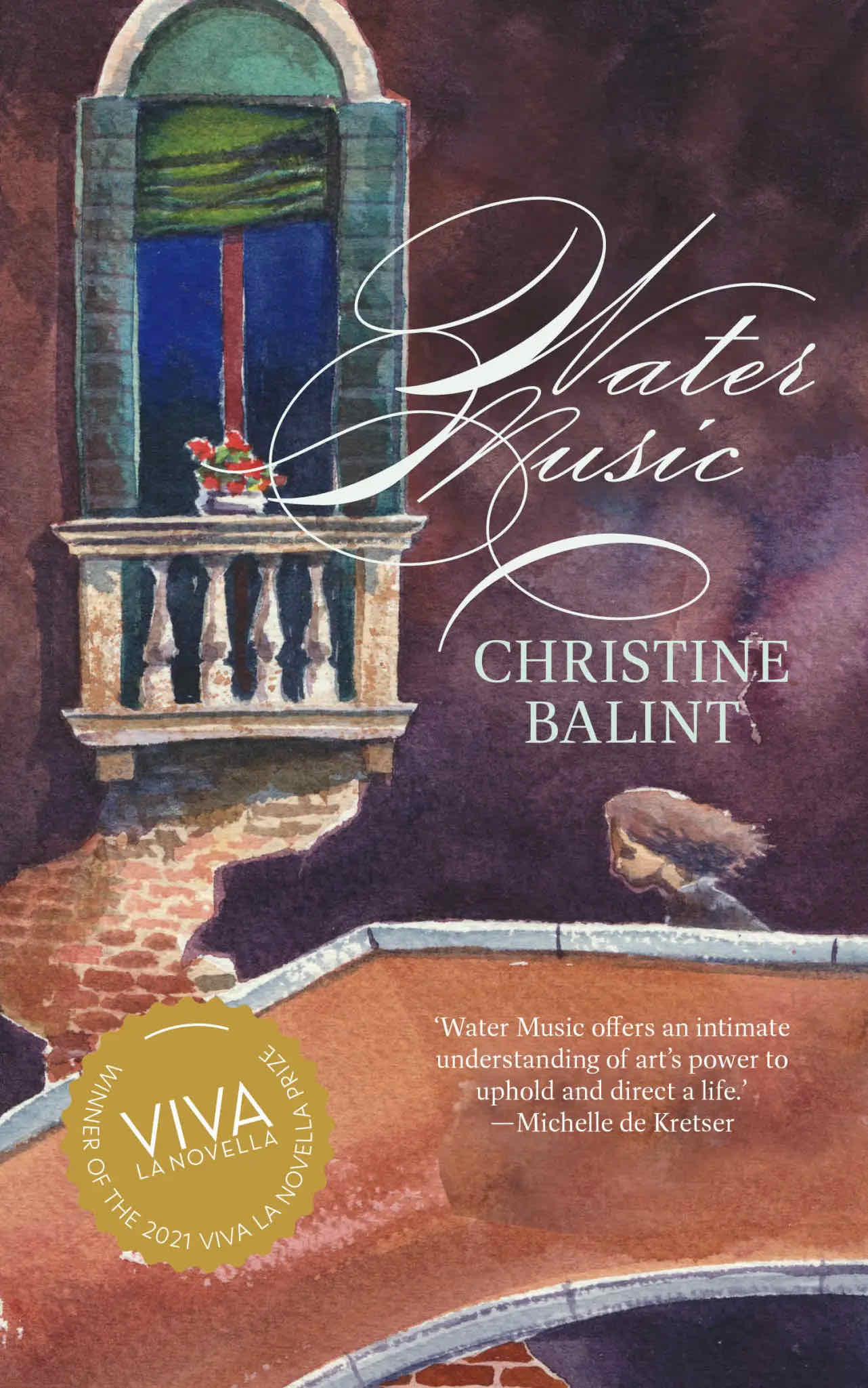
Meany’s novella was co-winner of Seizure’s 2021 Viva La Novella Prize with Christine Balint’s very different book, Water music (my review). Balint’s book, unlike Meany’s contemporary-near future novel, is an historical novel set in a musical orphanage for girls in 18th century Venice.

So next we are going to Venice and a book I read quite early in my blogging days, Geoff Dyer’s unusual Jeff in Venice, Death in Varanasi (my review). I could almost call it a double link because this book reads more like two loosely connected novellas, than a single novel, albeit both parts are set in watery cities.
My next link didn’t come naturally. Instead, it is the result of some research I did into Dyer’s book which turned up that it won the Bollinger Everyman Wodehouse Prize for Comic Fiction in 2009. Quite coincidentally, I have also read the 2010 winner, Ian McEwan’s climate-change inspired novel Solar (my review).

Next we go with something more obvious! That is, I’m linking on author’s name to another novel by Ian McEwan, Nutshell (my review), this one a literary mystery inspired more than a little by Hamlet.

My final link is not obvious if you don’t know the books, as it is on unusual narrators. Nutshell is narrated by a foetus, while my final book, Carmel Bird’s Family skeleton (my review), is narrated by the proverbial (or is it literal) skeleton in the closet. Either way, these unusual narrators provide a perfect link between two enjoyable – and witty – novels. (And neatly, our first book, The museum of modern love, also has a different sort of narrator.)
This is a different chain to my usual because four of my six books are witty, humorous and/or satirical. I like humour but it’s not always easy to find. The author gender split is 50/50, and we have travelled in space and time from 18th century Venice to 21st Century Australia.
Now, the usual: have you read The museum of modern love and, regardless, what would you link to?
 Whispering Gums
As I love strong, surprising narrative voices, this post was particularly pleasurable.
So imagine how thrilled I was to find Family Skeleton at the end of the chain.
I love strong, surprising narrative voices too Carmel – as I think you know! – so I do like bringing such books to attention when I can!
Ashamed to say I haven’t, because of being such a fan of two of her other books. For reasons that are fairly pathetic, I’m not drawn to this one … I think because it doesn’t sound in any way like The Butterfly Man or Bruny. Yesyes, I know: of course it doesn’t ! That’s why I say my reasoning is pathetic. And to top that off, I have to admit that my reaction to Nothing Bad ever Happens Here is just as half-witted. Sighh …
Fair enough MR. They are different books. I have Nothing bad ever happens here as I went to the talk, but the further I get away from it the less interested I am in reading it. But I did love The museum of modern love. I would think it would intrigue you, but who knows? It’s very different to Bruny, that’s for sure, and I liked it more than Bruny.
I am going to have to bite the bullet, dear ST !!
I’m saying nothing! (But tell me if you do.)
I haven’t read The Museum of Modern Love and it is on my list, but the reviews I read were mixed so I’m not sure if I will read it in the near future.
That’s interesting Claire. It was my reading group’s second favourite read (of 11 books) in 2017, and at our meeting almost all really liked it, which is not always the case. Which is not to say you will like it but to say that it really is an interesting read. It’s worth seeing the documentary The artist is present before you read it, because while it’s not necessary, I think it does enhance the reading. But, I know, so many books we really WANT to read that it is hard to fit in those were are less sure of, isn’t it.
I will look up the documentary to see what it is all about for sure. Sometimes it helps to have some insight into a subject.
It’s interesting to see regardless of whether you go on to read the book, Claire. Good luck with finding it – and finding the time to see it!
Yes, I looked it up and it’s not currently streaming anywhere but I’ll keep an eye out. I vaguely remember watching something about her when the guy she hadn’t seen for over a decade came there but I’ve no idea where I saw that.
Oh I love that you took the trouble to look it up – but I did fear that it may not be easy to find. A shame because it is an interesting story – as I recollect it interspersed the story of the that particularly performance art with the story of her life to date. (I may be misremembering but I’m pretty sure that’s it.)
I’ve only read Nutshell from your chain which was very cleverly done.
I’m glad you liked it too Joanne. Some don’t like different narrators but I think they can offer a different perspective in the hands of good writers.
Every Day is Gertie Day has been on my radar for a while now. Sounds great.
It’s a great novella Cathy – for Novella November perhaps? Or if you need a quick book to complete your Twenty Books of Summer! Just saying – haha!
Definitely on the list for Novellas in November. Looks like I can get a Kindle edition here, but no physical copies.
Kindle is good for small independent books.
Interesting chain. I have Solar on my shelf, but never read it. It looks like fun, but I don’t think I’d like Nutshell at all.
I’d like to say don’t discount it, Davida, but I know we all have our preferences.
A fetus narrator? Um… not for me, thanks! But I get how people would find it interesting and original. Solar sounds more my style.
What can I say but each to her own. I think Nutshell is a better book than Solar, but Solar is good. I usually like McEwan, but haven’t read his last couple of books.
What a lot of fascinating sounding entries here–and that last link definitely stands out, though I might want to start with a skeleton over a foetus as narrator–but that just shows how much I love my detective fiction!
Haha, Mallika, love your reasoning for preferring the skeleton! I can accept that.
😀
Of the books you list, I have read only Nutshell.
Degree one will be Laurie Colwin’s Happy All the Time, which begins in a museum, the Isabella Stewart Gardner Museum in Boston.
Degree two will be Dawn Powell’s The Wicked Pavilion, which has quite a few artists and patrons in it, and in which one character is seen sitting in a museum looking at a painting of herself as a girl. (It was a New York museum, but I can’t remember which.)
Degree three will be Edith Wharton’s The Age of Innocence, because a crucial discussion occurs in the New York Metropolitan Museum of Art. (I think at an earlier location, before it moved up to the 70s.)
Degree four will be Allison Lurie’s The War Between the Tates, which finds a character waiting in the Frick, and noticing the Holbeins either side of a fireplace: Thomas Cromwell here, Thomas More there.
Degree five is Janny Scott’s The Beneficiary, about her family and largely about her father Robert Scott, whose heavy drinking did not keep him from being an efficient president of the Philadelphia Museum of Art.
Degree six is Flannery O’Connor’s Wise Blood, mostly because the character Enoch Emery is deeply moved by a sign reading MVSEVM, which he pronounces “muvzeevum”.
I did not set out to make a list entirely of books by women, but after Wharton, and having O’Connor in mind, it seemed like the thing to do.
I like it George, though I’ve only read the Wharton. Still must read Dawn Powell and your Lurie example has intrigued me. As for Scott, whoever said drinkers can’t be efficient?!
Fun as always! I have not read the book but I think I would link to Martyr! by Kaveh Akbar. the main character, Cyrus, goes several times to see a performance artist at a museum who is dying from cancer. There are many options I could choose from there as you can imagine!
Oh, this is a perfect link Stefanie … and yes, I can see you would have many options from there.
Hi Sue, I like your selections. I have read Modern Love and did like it. My links are Bad Art Mother by Edwina Preston; The Museums of Modern Things by Alice Hoffman; The Goldfinch by Donna Tartt; An Object of Beauty by Steve Martin; Behind the Scenes at the Museum by Kate Atkinson, and the Museum of Innocence by Orthan Pamuk.
Thanks Meg … good choices though I’ve only read two, Preston and Atkinson. Pamuk is on the shelves somewhere.
I haven’t kept up with McEwan either (you’ve travelled further than I) but I was thinking about his books when Amsterdam showed up on the NYT list. He was SO shocking with his debut (was it The Cement Garden?); it’s hard to remember how influential he was back then, choosing such emotive and demanding scenes, and putting women at the heart of stories in places traditionally occupied by men (particularly with male novelists).
Yes, in a long career as you say, it is hard to remember. It’s almost a case of ”familiarity breeds contempt” with some of these authors, and I think that’s a bit sad. I should read Amsterdam again because for some reason I didn’t love it as much as others he wrote in those years.
Doh, I wrote Amsterdam and was picturing its cover in my mind (it didn’t impress me much at the time, relatively speaking, either), but it was Atonement that made it onto the NYT list. FWIW, I loved the film of Atonement too.
Ah, now I’m happier! Ha ha! Atonement was one of the ones I meant (plus Enduring love). I agree, Atonement was nicely adapted to film. I liked it too.