Many litbloggers, I know, also belong to reading groups or bookgroups. (I use the terms interchangeably.) Jonathan (Me fail? I fly!) regularly writes engaging posts about his groups and their discussions, such as this most recent one on Paul Murray’s The bee sting. And I often refer to mine, though not with the same detail that Jonathan does.
A good bookgroup is a special thing, and those of us in successful groups often receive requests from others to join them. Unfortunately, most of those requests get turned away. There are only so many people a group can sustain – both physically in terms of the homes where most of us meet, and practically in terms of managing discussion. There is a sweet point between too big and too small, but I digress. This post is not about discussing these bookgroups. Instead, I want to focus on what those people looking for a bookgroup can do if they can’t find one or start one of their own. So, here are some ideas that might help you know where to start looking …
Public libraries
Some public libraries, as you would expect, do run or host reading groups. An example is the City of Parramatta library system in Sydney. They meet monthly at different branch libraries to “to discuss books, share ideas and have fun in a casual friendly environment”.
Other public libraries offer book club sets or kits for use by reading groups, but these tend to be for off-site pre-existing reading groups. They can be useful if you are in a group, or even if you want to start a group. The ACT Library Service offers this service, as indeed does the City of Parramatta.
The website, Australia Reads, lists, by state, many such library book clubs, so it’s a good place to start if you are in Australia.
Sometimes, public libraries provide a venue for reading groups that are run by an external group. A special example of this is Melbourne’s (and maybe Australia’s) longest running book group, the Ivanhoe Reading Circle which started in 1920. This group, these days at least, is a large group at which, I understand, a member presents on the chosen book, and then the floor is opened for questions and discussion. One day, when I am in Melbourne, I hope to get to it.
Adult education
Adult education services have been in the business of encouraging and supporting book discussion in Australia since the early days of the colony. Mechanics Institutes and Schools of Art developed libraries for use by their members, who were often workers with few resources for books. Many also ran courses and some have organised, and still do, reading groups. For example the Sydney Mechanics’ School of Arts badges itself as supporting members since 1833. They currently have many members-only interest groups, and these include a Mystery and Crime Reading Group. Likewise, the Ballarat Mechanics Institute offers a reading group (though I’m not sure that it has survived COVID.)
Then, there are discussion groups run or offered by organisations like Sydney’s WEA (the Workers Education Association, established in 1913) and the U3A (University of the Third Age). These groups tend to be member run, so you join and then try to find a group near you. They can have waiting lists, but they are a good option. Teresa, who often comments here, has been running a U3A Landmarks in Australian literature discussion group in Melbourne for years. I notice that on the same webpage is another group which discusses American literature. My mother was a member of a Canberra U3A reading group, until she died.
And, rather like the public library book services mentioned above, there are groups like Victoria’s Council of Adult Education which has been providing books to reading groups, around Australia, since 1947. My own group used this service for a few years. They also offer a reading group finding service. How good is that!
Bookshops
And then, of course, there are bookshops. Pam (the Travelling Penguin) belongs to one at Fuller’s Bookshop in Hobart. They run quite a few groups, in fact. In her most recent post, Pam not only mentions what she’ll be reading next, but shares that Fuller’s has just won the Best Bookshop in Australia at this year’s Australian Book Industry Awards. The judges praised the store for its “first-class events program and investment in fostering literacy”. (It just so happens that I met Pam last year in the Fuller’s cafe when I went to Hobart for my brother’s book launch and exhibition opening.)
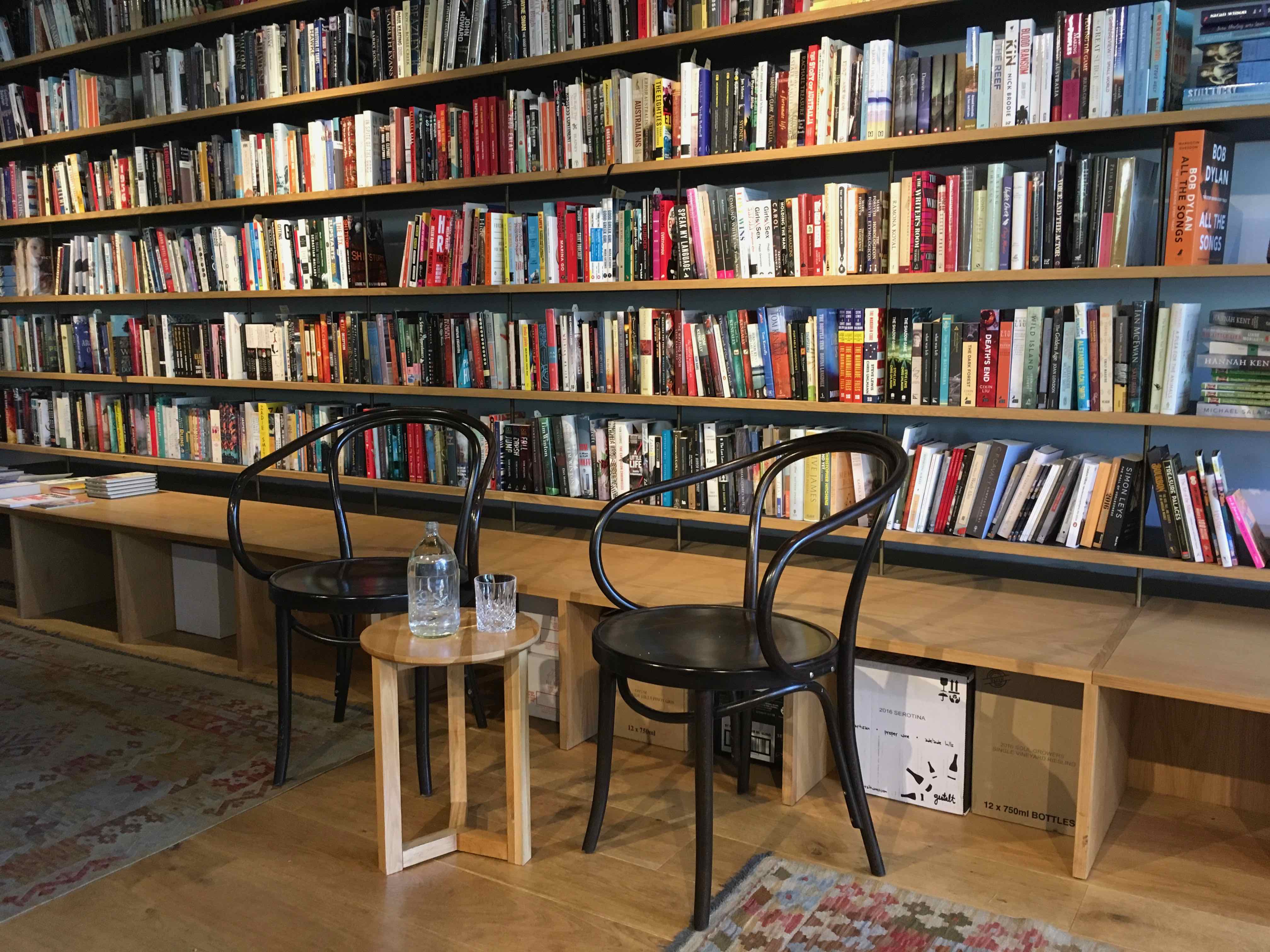
Closer to home is our very own Muse, about which I have posted many times, because they also run author conversations as well as two book groups. Unfortunately, I have not attended the bookgroups because they clash with my commitments. But, I regularly check out what they are discussing and, if I can catch him, talk to bookseller Dan about the chosen books and anything else we are reading. The two bookgroups Dan runs are the Translation Book Club and the OzLit Book Club.
Then, moving north up to Queensland, there’s the active Avid Reader bookshop in Brisbane. They have a Bookclubs Manager, and offer several bookclubs, including Fiona’s Open Bookclub, the High Noon Bookclub, the Her Voice Bookclub and, even, an Online Bookclub. The onsite bookclubs are free if you purchase your book from Avid Reader, or $10 if you don’t.
So…
This is not meant to be at all comprehensive – how could it be – but to provide some starting points for those who might be looking for a reading group. Or, just give you a sense of the breadth and depth of the book-ish world. You – and we – are not alone!
I’d love to know if you have had experience of looking for a reading group, and/or if you can add to the ideas here or just share your favourites.
 Whispering Gums
Such good information. I remember once years ago when looking for a book group a friend and I came up with an idea. Each if us invited one friend, who invited one friend who invited one friend. We stopped when we got to 12 members. Unfortunately 10 of them were teachers and all they wanted to talk about were their classes and kids. I couldn’t cope so left. I understand they are still going but I don’t think they finish many books. Lol😄🌻
Oh dear Pam. I guess the group satisfies a need, which is good, but it’s perhaps not really a bookgroup is it?I love hearing bookgroup stories, the good, the bad and the ugly. They are all interesting and enlightening about how important (or not) books are to our lives.
It is why I enjoy the group at Fullers as we are all serious readers (for the most part).🌻😄
It makes a great reading group doesn’t it?
I tried a couple when I was living in Sydney, well after Chic died. I found both to contain members who felt it their right to boss us all about, regardless of the theoretically management-free basis.
Of course, it could’ve been me and my resentment of people who were alive.
:
Oh dear MR… I’m sorry to hear that. Who knows what the reason was. A certain bossiness can be useful in reading groups but everyone has to agree that it’s needed and it needs to not be bossy! For me bring around people helps my grief but we are not all the same I know. And I haven’t lost that closest person of all do who am I to talk?
Thanks for the mention, Sue!
When I joined my group it was already up and running. A friend had been invited to join by his barber, and even though he was a newby he got to invite two more. We’re all men of a certain age: three who are parents of teenagers or maybe still younger at our younger end. A number of us are in the building / architecture field, and they sometimes get into their fields of interest, but never to the extent that the rest of us feel sidelined. I can see how that would be a problem.
A pleasure Jonathsn and thanks for the added info. I find testing groups endlessly fascinating – how they are formed; what their make-up is in terms of age gender, occupation; how they work.
More opportunities to bookchat? Sounds great!
Doesn’t it, Marcie!
I’ve enjoyed belonging to a couple of different book groups over the years, and have discovered many books that would otherwise have passed me by. Another option are online gatherings, and some are accessible through libraries via their online platforms. There is a monthly book through the Libby app, where you can borrow the book or download the audiobook and join in a discussion with the author at the end of the month. This has been a great – and free! – way to discover contemporary Australian writers.
Oh thanks jml… I did mention one online group under bookshops but I think now I should have made them a separate heading. I didn’t know about Libby’s. I was active in online bookgrouos from 1997 to 2009. They were wonderful and I’m still in touch with some I met there (mostly Americans! plus some Australians who like me are now blogging.)
The advantage of blogging is that people can’t see the faces I pull when I disagree with their opinions. I’m afraid I don’t have the people skills to discuss books (or anything else) f2f.
Haha, Bill. What, no poker face for you? I thought your people skills were fine when we met!
It is our club’s custom that the hosting household picks the book. Is it a violation of hospitality to say that the chosen book is awful? I probably do pull my punches a bit for that reason. I will say that nearly everyone hated a book we chose years ago, and nobody at all was shy about saying so.
Once other hosts invited the author, a man who lived perhaps two miles away. I worried about the etiquette of complaining about the book, not merely in front of the couple who had chosen it but in front of the author, for I had compiled a list of complaints. As it turned out, the author didn’t let anyone get a word in edgewise, so it didn’t matter.
I knew a group which did something like this George – ie the host chooses the book that month – but they also bought the copies for the attendees! My friend who was part of this group started getting a bit cross because some hosts bought books from remainder/sales tables and they weren’t necessarily great books. But, they were cheap! (It was a small couples group so they only needed about 5 books, one per couple.) I don’t know how the others handled the issue of not liking the book. This person is now in her mid-80s and I think the group has ended as most have died off, as she was one of the youngest.
We have had authors visit our group on occasions, and there is always that issue but I think in all cases the niggles have been small and generally not expressed or, perhaps, expressed as a question as in, “I thought XXX, and wondered what your aim was there?” We haven’t had an author take over I must say. We’ve had two male authors and four or so female authors to date.
This made me chuckle. 😀
Always glad to give readers a chuckle.
My Balmain book group has been going for about 25 yrs. I was invited to join it about 6-7 yrs ago when a member left. They like to have the group at about 10-12 members. Over they years they have experimented with different ways of selecting the books, but have now settled on the idea that the host of the meeting picks the book for the meeting two months away, so that we have two months to read each book.
Now I am in the mountains, I might be able to attend a couple of meetings throughout the year depending on other things we still have commitments for back in Sydney this year, but after that I will be looking for something up here. So thanks for the prompt/reminder to check what the local library and bookshop offers.
Thanks Brona… Good luck with finding a good group in the mountains. Keep us informed. Our group sticks to the 10-12 size too. We did get to 13 once as I recollect. We are 36 years old now, and and 5 of us are still there from that year.
That’s an interesting approach to selecting books. We do it twice a year by consensus. That has worked well for us. We did use a service for 6 books a year for a few years but the selections didn’t always work out and the coordination of getting and returning the books was a lot of work for someone.
That was one of the methods my book group used (before my time). Oftentimes, the host will actually put forward two book choices for the rest of us to vote on. Most of the group nominated books they had read and enjoyed/thought would be good for discussion which left them feeling rather anxious on the discussion night in case the rest of us didn’t like it. Whereas I always selected a book from my TBR that I hadn’t read, but really wanted to read soon. I didn’t feel as invested in whether everyone would like it or not. And as you no doubt know, the nights where the book had a wide range of opinions, actually made for an entertaining and vigorous discussion.
I always put forward books I haven’t read. Most in our group do the same but some will often suggest ones they’ve read. And yes, the best discussions usually come from when there’s a variety of opinions but a good complex book that everyone enjoys can produce good discussions too because we will often come at it from different angles.
Hi, Sue – thanks for the mention!
Just to clarify, I’m a volunteer tutor with U3A Yarra City. (As well as Landmarks in Australian Literature, I also teach Film Studies there.)
There are currently 104 different U3As in Victoria (and 60 in NSW). The City of Yarra covers the inner Melbourne suburbs of Richmond, Collingwood, Fitzroy and Carlton North, and U3A Yarra City operates in various venues across these suburbs.
For those who don’t know, the University of the Third Age was founded in Toulouse, France, in 1973. It’s a movement intended to provide life-long learning opportunities for people in their ‘third age’, i.e. the age of active retirement. It’s run entirely by volunteers, and a low annual membership fee enables people to attend as many courses and activities as they wish at no further cost.
Each U3A is unique and autonomous. The kinds of courses and activities they offer vary widely, depending on the demographics of the area and the interests of the members.
More information for Victorians is available at
https://u3avictoria.org.au/
For those in NSW, go to
https://nsw.u3anet.org.au/
Cheers, Teresa
Thanks Teresa…
We did not look for our neighborhood book club: our next-door neighbor was one of the founders.
My wife is an all-women’s group, which she joined through a friend. She was in another book club when we lived in the suburbs, joined the same way.
Well, you’re lucky George! At least, I hope it’s a good group because if you wanted out it could be tricky being a neighbour. My all-woman’s group started by a group of friends – we were mums – who realised we were all reading similar books and talking about them with each other. It grew out of our mums’ group and many of us were in the same babysitting club. We have gone through our kids as bubs, school children, university etc students, partnering up and now having children (our grandchildren). Alongside our own changing lives – careers, some broken marriages, retirement and now the rigours of ageing. It’s special. And we’ve read a lot of books!
You lived in the suburbs but now you live where?
(Phew, I caught that … I thought I wrote “you’re lucky” but when I checked before posting this, I noticed “it” had written “your lunch”! Took me a minute to work out what I had intended!)
As you say, it could be tricky to leave such a group.
We live in Washington, DC, proper, about three miles north of the White House.
Ah, I don’t know that area much but I have been to Georgetown, a few times. Our son was born in Washington DC – in the now defunct Columbia Hospital for Women – but we lived in Northern Virginia (Reston, to be exact) in the early to mid-1980s.
Anyhow, I only asked because we recently downsized from a house in the suburbs to an apartment in the sort of inner-suburbs of our city. The change in lifestyle/neighbourhood is interesting!
I like that idea of having a book club at a bookstore where you can either buy the book from that store, or you can pay a small fee to be part of the club. That feels fair to me. Most bookstores welcome you anyway, and that’s nice, but then you feel obligated to buy the book there. The last time my mom went to a book club hosted in a bookstore, she paid $36 for the book, and it was very short. She felt a bit ripped off. Around me, there’s a bookstore that will host book club events, but for some reason she hosts them at other businesses, like this tea store. Then she charges $20 tickets to get in. I don’t know about other people, but I don’t want to pay that much to talk about books with other people when there are so many other venues to do. So, I guess for me the bookstore book clubs just reinforce the importance of libraries!
I didn’t know your mom was a book club person, too. Did she only go after retirement, or has she been involved when you were small children? I asked because the library where I used to work was set up by a women’s group many many years ago. I guess I hadn’t thought about women organizing book clubs because there aren’t any women in my family who have done that. It sounds silly, but for a long time I thought that if something hadn’t happened in my family, it wasn’t a normal endeavor. I think it’s an odd sort of sheltered!
First part … I enjoyed reading your thoughts Melanie. It does seem fair. But, an event where they want you to buy the book AND they charge you $20 sounds like something I’d think twice about. But if it’s at the tea-store is she having to pay them for the venue? And is she offering tea (or refreshments) as part of the price? That might make a difference to how I felt.
Yes, my Mum only joined a bookclub after retirement, after she came to my city where she spent the last 20 years of her life (which she also said were the happiest of her life, because here she found her “tribe”. This included the book group, but also our Jane Austen group, and others). She did join the big Jane Austen group in Sydney, but that was after retirement too I think (and before she came to Canberra). She was always a reader though. From the time she started work, when she was about 17, she would buy a little Collins Classic book on payday. She got rid of many when she downsized, because their print was too small for her to read easily anymore, but kept some. I got rid of some of those when I downsized – as she had died a couple of years previously – but kept a few as a memento of Mum’s reading life.
I don’t think it’s unusual for us, when we are young, to think everyone lives like our family does! I can’t recollect quite when it dawned on my that they didn’t, but I think it dawned by degrees, as in noticing little differences at first until finally realising there were some huge differences in how families operate, the interests they encourage, the money they have and the way they spend it, the values they espouse, etc.
The story of your mom made me a little teary. I love that part about finding a tribe, and that her last years were some of her happiest. Most folks get bitter and depressed as they age because so much is different, etc. I also love the idea of buying a new book every payday. That is something I think I will keep in mind once I’m done with school!
Happy teary I hope… But yes, I like your understanding. My mum was a stoic who made the best of where she was so she never complained about aging except to comment on the impacts and then got on with enjoying the good things. I look forward to the next post-school phase in your life! You have worked so hard.
Yes, happy teary ☺️
I thought so but had to make sure!