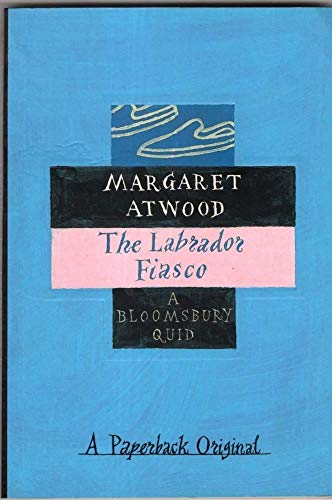
Although I am an Atwood fan from way back, I haven’t, to date, taken part in Marcie’s (Buried in Print) MARM (Margaret Atwood Reading Month) event. But I promised her I would this month, albeit with just one little short story probably, this one. I have had The Labrador fiasco on my “little book” TBR shelf since it was produced as a Bloomsbury Quid back in the 1996. I have no idea why I have not read all my little books, but, there you go!
Most of you will know Margaret Atwood (b. 1939). I read several of her books before blogging – including her dystopian novel, The handmaid’s tale; her historical fiction novels, Alias Grace and The blind assassin; and her more contemporary novels Cat’s eye and The robber bride – and I have more on my TBR. But, I have only reviewed her twice here, her novella, The Penelopiad (my review), and her recent poetry collection, Dearly (my review). Now, I bring you a short story. This woman is versatile.
As far as I can tell, “The Labrador fiasco” was first published in this edition. Many of my “little books” comprise previously published short prose works, but this doesn’t seem to be the case here. I have three other Bloomsbury Quids, two of which were previously published, with the other, Nadine Gordimer’s Harald, Claudia and the son Duncan (my review), also seeming to have been first published as a Quid. Interesting, but not relevant to my discussion of Atwood’s story, so let’s move on. The Quids, though, are gorgeous little books.
“The Labrador fiasco” is a “story-within-a-story” story. (Ha!) The framing story concerns the narrator and her aging father and mother. (The narrator’s sex is not provided, but let’s go with female as Atwood is female.) The father, in particular, is declining, having experienced a stroke six years before the story’s opening. It is told first person by the daughter, who regularly visits her parents.
The story within comes from Dillon Wallace’s The lure of the Labrador wild, published in 1905. Wallace was, says Wikipedia, “an American lawyer, outdoorsman, author of non-fiction, fiction and magazine articles” and this, his first book, was a bestseller. It tells of an exploratory trip through Labrador undertaken by Wallace and a man called Leonidas Hubbard, with their Cree Indian guide, George. The Cree bit is important as the Cree are not from the region they were travelling in. Anyhow, the aim was to explore a part of Labrador that hadn’t been explored by Europeans, with Hubbard wanting to “make his name”. However, as Wikipedia (and Atwood’s story) explains, they took the wrong river from the start, with tragic consequences.
Atwood’s story opens with:
It’s October; but which October? One of those Octobers, with quick intensities of light, their diminuendos, their red and orange leaves. My father is sitting in his armchair by the fire. He has on his black and white checked dressing gown, over his other clothes, and his old leather slippers, with his feet, propped up on a hassock. Therefore it must be evening.
There’s so much going on here, besides the gorgeously structure sentences. We are immediately put on the back foot with “which October”, and “it must be evening”, but at least the father is very much present. The uncertainty suggests that the story is being told from a later time. Whichever October it is, however, it is autumn – or fall – and that means the season of decline. Within a couple of paragraphs, we learn of the father’s stroke, and know he is declining. But, the question, “which October”, also hints at the October in the Wallace-Hubbard story when things have really started to sour – because not only is it cold of course, but our explorers have taken the wrong route and are running out of supplies.
This is the set up. As the story progresses, the narrator’s father, who was an experienced outdoorsman himself in his day, provides a running commentary on the explorers, with the narrator adding her own layer. “They took the wrong supplies”, the father says, pleased because he would have known what to take. However, our narrator wonders “what supplies could they have taken other than the wrong ones” … “No freeze-drying then” or “nylon vests”, for example.
“harsh and unmarked and jumbled”
What Margaret Atwood does in this story, then, is parallel the deterioration in the condition of the explorers as their expedition goes awry, with the narrator’s father’s decline as he ages. The explorers leave things behind, their feet suffer because they don’t have effective footwear. The father leaves hobbies behind, and says his feet are too sore to walk. The father thinks he would have done the expedition better, but he faces his own “forest” and in fact, like the explorers, he and his supporters are not fully equipped to deal with it.
And so it goes. In under 40 (very small) pages, Atwood combines commentary on a failed (colonial) expedition, conveying the poor planning and hubris of those involved, with a tender family story of an adult child and mother coping with a failing father. To do this she calls on her obvious love and knowledge of Canada’s history and “wilderness” (a contested term now, I know), and her keen interest in humans and how our lives play out.
We are all explorers, I think Atwood is saying, and the way, at least some of the time, can be “harsh and unmarked and jumbled”. It takes all our energy to traverse it. Good planning and the help of others can ease the way, but in the end, we each have to do it on our own. A clear-eyed, clever and tight story with an ending that encompasses genuine warmth with an acceptance of life’s realities. Beautiful.
Margaret Atwood
“The Labrador fiasco”
London: Bloomsbury, 1996 (A Bloomsbury Quid)
64pp.
ISBN: 9780747528890
Available online at Independent, 1996
 Whispering Gums
Lovely review. Have never forgotten ‘The Blind Assassin’, which we both read while travelling through la belle France in 2004. It was a wonderful holiday and a wonderful book.
It was one of those wonderful books to read wasn’t it MR. I’d almost read it again, except I looked at the length and thought, hmm, I could read 2 or 3 TBR books instead so perhaps I’d better do that instead.
That my first Atwood… and it made me an enthusiast!
I found it extraordinary .. sort of made me think of Italo Calvino, for reasons I cannot explain (well, other than for its extraordinariness !). 🙂
That’s an interesting comparison but, says she guiltily, one I can’t comment on because – slap wrists – I still haven’t read Calvino.
You need read only “If on a Winter’s Night a Traveler” to understand exactly, Sue – and I’m perfectly sure you will be fascinated !
I know I should … it’s been on the radar for a long time.
I hadn’t read Calvino then. I’d never heard of Atwood either until then, she wasn’t even on my radar.
Really, before the internet, I thought I was widely read with my degree in Lit and all, but once I started joining online reading groups, and then discovered blogs from all over the world, my horizons expanded every which way.
It was the appearance of the Viragos in the late 1970s and early 80s and awareness of the rise in women writers around the world that kickstarted my horizons opening. I think it was bookshops and good booksellers that did it. We lived in the USA In 1983-4 and that’s when I discovered Nadine Gordimer, Edith Wharton, Margaret Atwood, and Tom Morrison. Then I returned here and, spending time with my friends who like me were all new mums, we found we were all readers. Hence my reading group was founded in 1988. the online reading groups entered my life in 1996 or 1997.
It was great I agree Lisa, though it was my third or fourth. I read The handmaid’s tale and Bodily harm (in which order now I’ve not sure) before it. And, then my third one was either The blind assassin or Alias Grace. I just can’t recollect which order I read those two. Then fifth and sixth were The robber bride and Cat’s eye. I love the variety in her work. Such variety in form/genre across all these. I was so impressed.
Had not heard of this. Sounds an interesting concept. 🌲
It’s so well done Pam.
Oh, the joy to be found in blogging and so many of its adherents !!
Blogging is a joy isnt it MR.
This sounds like another superb story from Ms. Atwood, though to be honest, I have a love-hate relationship with her work.
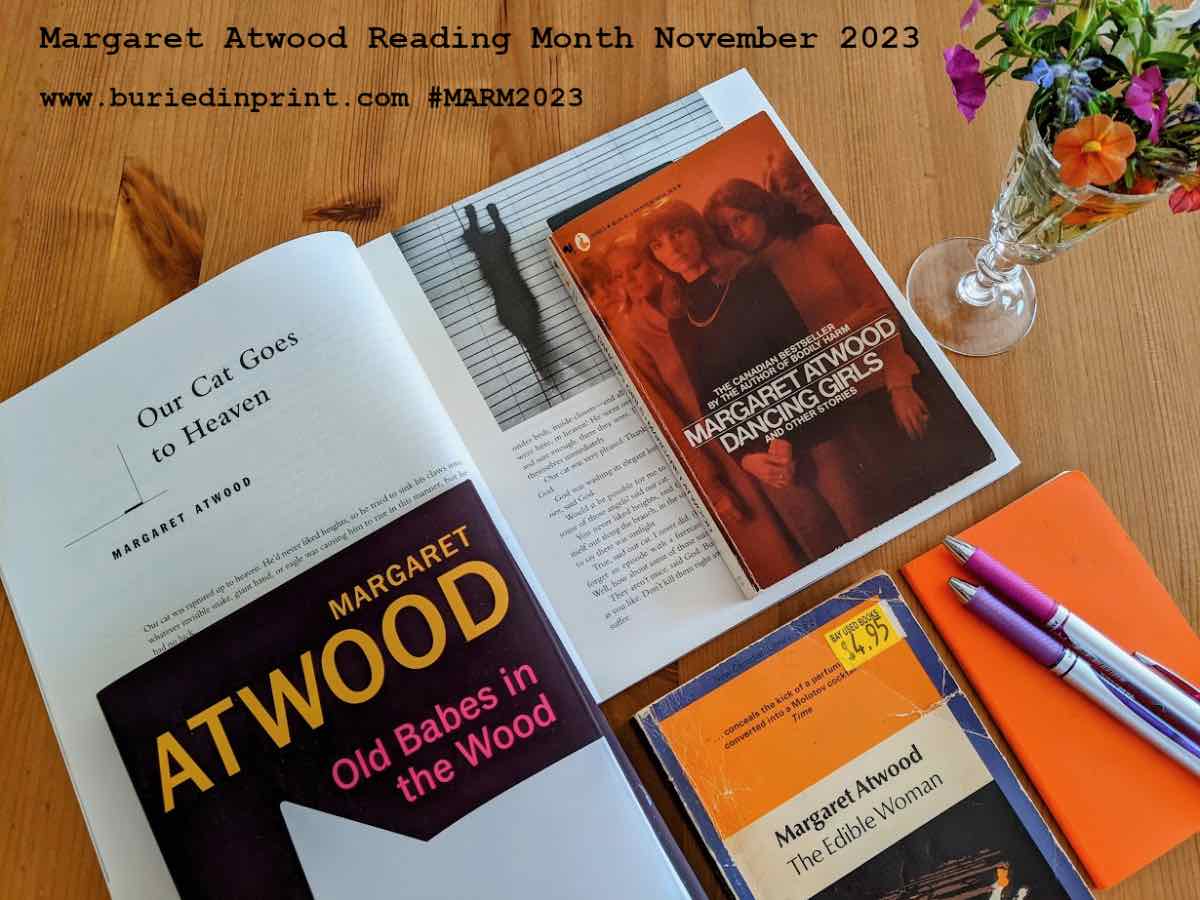
I’m Canadian (love), and a feminist (love), but I also value my mental health, which can only survive so many of her long-form works in a single decade because she can be DARK (hate)(LOL)! She has an incedible way with words (love), and I have found a true home in her ability to turn out memorable short works (love), but sometimes, these days, I feel she rests on her laurels (hate). (I just finished two books on your TBR, her latest short story collection (“Old Babes in the Wood”) and her first (“Dancing Girls”) for a comparison post for this week’s blog. Spoiler, I have mixed feelings about the former!) Okay, now that I’ve said all this, it’s mostly love! (I treasure a set of her stamps from when she won the Booker as if it were the one ring.)
But since the final stories in the collections, I have been missing her. I think I’ll give this one a shot! (You’ve got me curious about Quids, that I may have unwittingly participated in MARM(?) and whether the character’s genderlessness is significant . . .) Great post!
Thanks so much for this detailed response SSE. I love your love, hate distinctions. I don’t mind dark. I hate horror and psychological suspense / thrillers, but (so far) I can we with dark.
The genderlessness is interesting. I looked for gender markers and couldn’t really see any. She presumably didn’t feel it was relevant to the intention of the story – which is a good point in itself? It stops us from going down father-son or father-daughter relationship paths and keeps us focused on the critical issues which are genderless. (Or should be?)
00ps, sorry, MARM: Margaret Atwood Reading Month.
That’s a great analysis of it. I’m excited. I can think of dozen of stories with nameless character, but no hints of gender at all . . . I don’t know if I’ve read any stories like that! I found a used copy online and ordered it 🙂
I’m going to try and write a post about my accidental MARM this week. I’ll tag you in it if I do 🙂
Oh great… and do SSE! (I mean write a post and tag me.)
PS Your blog is not linked on your name – at least it doesn’t seem to be here.
It seems there is nothing Atwood can’t write! I have not read this story, but it sounds fantastic. I just finished reading her newest collection of stories Old Babes in the Woods and it was really good. But of course!
I am fascinated by the sound of these “little books” of yours 🙂
I think you would really like this story Stefanie.
Don’t you have any of those “little books”? Like the Penguin 60s, the Quids, to name a couple?
I will be sure to look for the story, it’s probably on my shelf in a collection somewhere 🙂
No, I don’t have any “little books,” at least none that I can remember owning. Now I’m feeling deprived 😀
And so you should – feel deprived I mean! ha ha.
My first Atwood was Oryx and Crake, though I remember why. I’ve since read all three MaddAddam books, Cat’s Eye, Alias Grace, and Wilderness Tips. I have purposely not read The Handmaid’s Tale because it would likely devastate me. I’ve been to one of her lectures, and I enjoyed her description of childhood.
Thanks Melanie, I haven’t read the MaddAddam books, and I think I gave them away in my downsize. Not because I think I wouldn’t like them but because I can see the end of my life looming – as in I’m getting old – and I decided they were lower priority than other books l want to read. The handmaid’s tale was a wonderful book, but I can understand your not wanting to read it.
You can read just the first novel of the trilogy. It ends on a cliffhanger than I lived with for years and was fine with. However, you may want to move on to an entirely different author if you’re seeing the end of the road ahead. Okay, that depresses me, but I get it.
Although I don’t own it, I did read this story in the same edition: they are adorable. I’m not sure if I’ve ever seen another one though. Maybe I just wasn’t buying books at that time (dark days lol).
Anyway, when I read it in 2003, I had been in a reading funk, and was browsing the library’s paperback shelves, deliberately looking for something different and fresh to jolt me back into the reading habit (it was high summer, the humidity was overwhelming, focus was scarce)… and I loved it.
It’s a terrific pick for MARM!
I have about three. I’m too lazy to get up to look but I’m pretty sure another is by T Coraghessan Boyle.
It’s so good isn’t it – I’m glad you approve my first ever MARM choice. I didn’t seep all by Atwood TBRs in the downsize because I figured I will move to eBooks for most OS reading, just because I hard to draw the space-available line somewhere.
Another writer I would like to explore more.
Downsizing calls for tough choices. I assume OS is out-standing? 😀
Ha ha – out size? Actually, over seas. I think authors get more royalties for print so I’d like to keep buying Aussies in print but reduce the physical load by going “e” for others.