This week’s question is new to me, and I like it. It goes:
Pick your top novellas in translation and think about new genres or authors you’ve been introduced to through novellas.
I love this question because it feels like I’ve read almost more novellas in translation than English language novellas. Is this because translation is such a difficult and expensive task that publishers tend to commission translations for shorter books more than for longer ones? But no, I don’t really think so. Just look at all those big Russian classics that have been translated – and translated more than once. My guess is something more simple, that perhaps some literary cultures value novellas more than others.
This idea is supported by something I read only a few months ago in Trove. The article, which appeared on 6 July 1907 in Sydney’s The Australian Star, cites an English writer named Basil Tozer, who had made a “plea for shorter novels”. He commented that
The habit of loading a story with indifferent descriptive passages still prevails to a great extent, though it might with considerable advantage be dispensed with. A beautiful woman loses her charm when every good point she possesses, from the creamy smoothness of her complexion to the alluring, curve of her eyebrow, is described separately and in detail; and in the same way a glorious scenic panorama metaphorically falls flat when every square mile of it is analysed and dissected.
He says these “faults” are “commonest among young writers” but also occur “among some of our novelists who have served a long apprenticeship”. He doesn’t name these offending writers, but he does name the opposite, French writers like Daudet, Hugo and de Maupassant, whose writing includes no “superfluous verbiage”. These are, he admits, three of France’s most polished fiction writers, but even “the rank and file” French novelists “seldom err upon the side of overloading their work with unnecessary vocables and third-rate descriptive passages”. He argued that British novels would be strengthened if they were more condensed. That was over 100 years ago, but I wonder – without much evidence to support it – whether there really is something cultural in this?
Whatever … I can say that of the translated fiction I’ve read over the years, novellas represent a large proportion. This started way before blogging, and is not because I specifically chose to read novellas. They just seemed to be the books most often recommended to me.
So, before blogging, my favourites included Albert Camus’ The outsider (French, and which I did first read in French, as L’étranger, at school), Alexander Solzhenitsyn’s One day in the life of Ivan Denisovich (Russian), and Gabriel Garcia Marquez’s Chronicle of a death foretold (Colombian). These three have stuck with me over a long time. Marquez’s has such a mesmerising opening, “On the day they were going to kill him…”
Since blogging, I have read so many compelling translated novellas that I find it hard to choose, but I’ll name three, in alphabetical order by author, that have captured my interest:
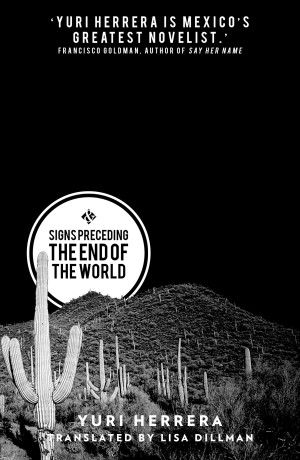
- Yuri Herrera, Signs preceding the end of the world (Mexican, my review), because it deals with the Mexican-USA migration issue, but with an almost mythical tone that overlays it with a bigger story about crossings and transitions.
- Patrick Modiano’s Sundays in August (French, my review), because of the carefully structured journey we are taken on, one that leaves us at the end with so many questions to think about, while also revealing enough about what had happened that we know its impact on the protagonist.
- Sayaka Murata’s Convenience store woman (Japanese, my review), because of the way Murata gets into the head of her mystified outsider in a culture that values conformity.
I found it hard limiting myself to three but, it had to be done or I’d go on forever.
In terms of how these have broadened my horizons, well, there’s the obvious thing to do with reading different cultures. Herrera’s and Murata’s books deal with issues I know to be significant in their cultures, but it means something to read about them from artists working within the culture rather than from the perspective of the news. Modiano’s exploration of disappearance, loss and memory is less obviously a specifically French issue, but it does I think have roots in a postwar European sensibility.
Each book uses the novella form a bit differently, but each is characterised by a sustained tone which can denote a novella. By this I mean that novels, being longer, will often vary the tone because not to do so could become oppressive, whereas the intensity of a sustained tone (whatever that tone may be) is part of what makes a novella. I’m generalising of course, but this seems to be the case in the novellas I love.
As for the other part of the question. I don’t think I’ve been introduced to new genres through novellas, just to different ways of writing those genres, but I have certainly been introduced to many great new writers – like the three above, for a start. But, moving away from translation, I have been introduced to other writers too through their novellas, such as Edith Wharton through her intense Ethan Frome. From that introduction, I went on to fall in love with Edith Wharton.
Novellas … any whichway, I love them.
What about you?
Written for Novellas in November 2023
 Whispering Gums
Novellas in translation have a wonderful addition to my reading, probably since I first took out a Peirene Press subscription, who only published novellas back then, mostly European language translated, then Charco who do the same for contemporary Latin American authors.
I think the most recent one I loved was Natalia Ginzburg’s The Dry Heart, translated from Italian published by Daunt Books, a classic revived. They are indeed a great way to sample a variety of storytelling from other cultures.
Thanks Claire. And I will add The dry heart to my list.
I love your reviews – they are unfailingly interesting even when the topic is somewhat remote in personal terms. But I doubt I’ve ever read a translated novella, ignoramus that I yam ! 🙂
That quote from Basil Tozer is, to me, really relevant: I’m quite often given cause to think “Oh, the writer has just decided that he needs a bit of padding !” – at which point I send email to Audible and ask them to remove {whatever} from my Library and refund the credit. (Because I have hundreds of titles now, they always do !)
I love that you find my reviews interesting even if the topic is not up your alley. That is the best praise.
Good on Audible for treating a good customer well. That’s how it should be. Presumably, unlike printed books people try to return, they can actually tell that you haven’t heard it all?
Yep, because I don’t download ’em but simply listen online on my phone (my Dell laptop has appalling audio). Works well. 🙂
Clearly does … and that’s good.
Sue, I can’t seem to keep up with your blog posts. You’re on fire lately! I got three posts in my inbox that all went up the same day (though this is affected by the fact that you are in wildly different time zone).
Anyway, I’ve noticed Binti Okafor and Martha Wells, both of whom write science fiction, seem to stick to novellas. I’m also a fan of authors who write 2-3 novellas and publish them in one book.
Yes, sorry Melanie. It’s something I really really hate doing but with novellas and nonfiction and Atwood (an Atwood post to come this week) all featuring this month it’s really hard to manage contributing to them all. Then throw in an author event or two. BTW I plan for tonight’s Monday Musings to be a short more fun one.
Oh no, I hate it when novellas are published in an omnibus! That loses one of the great advantages of the novella – something physically easy to read and carry! I think I have a Virago one … unless I downsized it out which I may have. It’s one I gave my mother as a gift many years ago, I thought about this issue.
BTW I have a feeling that there are more novellas in science fiction, than perhaps some other genres like crime and historical fiction. I think novellas can also be more common in romance. Do you have a sense of this?
I don’t mind the novella omnibus because I’ll pause, put it back on the shelf, and read another novella later.
I don’t recall any romance novellas. If anything, they tend to always be a solid 275-300 pages in the U.S.
I was thinking the Mills and Boon books were novella size but I’ve just researched that and no they were (are) more novel size. I’ve never read one so I was just going on what I thought I’d noticed. Silly me! I should check!
Same as you, I’ve read heaps of novellas in translation, probably for the same reason.
I think I read somewhere that (in Australia anyway) when an author signs a contract for a book, it specifies a certain number of words, and that there is pressure to conform to that because consumers don’t think they get their money’s worth if the book isn’t long enough.
Sometimes this ends in ridiculous results. An English example is Ali Smith’s Seasons quartet. I’ve only read one of them but it was the same size and no of pages as a trade paperback novel, but it was really a novella, printed in a very large font. It wasn’t what they call Large Print for people with visual problems. It was just done that way for marketing purposes.
Oh yes Lisa, that point about making a book LOOK bigger because of this value-for-money was also made by Tozer.
I must try to find out about that word limitation issue in book contracts. I wonder if it’s more common in commercial fiction contracts?
This is such a great post and really sums up why I love novellas in translation.
Thanks so much Cathy!
LOVED Convenience Store Woman!
Thanks Lisa. A great read isn’t it.
Yes–a lifetime favorite now
My first response to Tozer is humphh! Reading Hugo is not a good example to use in a plea for shorter novels!! Don’t get me wrong, I adored reading Les Mis, but short it is not!
All of the novellas I read this November were in translation and too still think about Convenience Store Woman.
Re commenting – I had no issues leaving a comment here, but I use my laptop for commenting. I wonder if the issue is device-specific?
Escept for the ‘never-miss-a beat’ pop up box that annoyed me after I pressed ‘reply’. you have to X out of it before the comment appears.
As you can see I was so annoyed I forgot to check my spelling!
And the pop up box appeared again, so it’s not anything to do with being signed in. It wants me to subscribe by email (even to my own blog). I don’t want to subscribe as I have enough emails every day without adding blogging notifications to the mix.
And just for fun, I’ve jumped into my phone to see what happens with this comment.
I use feedly to store/sort the blogs I follow & open the websites directly into the chrome app (the default option – safari – gave me too much grief when trying to visit other blogs).
I can see already that it wants me to log in again, so I’ll copy this comment in case it gets lost 😏
Oh, I don’t want to use Feedly or any other third party app or system. I did try feedly a long time ago, but I’m just starting to feel frustrated by all the different forms and permutations on my blog, other blogs, my phone, etc – and on Notifications, Email, Reader, etc. I feel I’m losing the plot in terms of who I’m following where.
Exactly … I’m getting that too. I’ve had many discussion with WP about it over the last few months and am getting nowhere. They seemed surprised that I didn’t like having to sign into my own blog to comment AND they didn’t seem to get the point that I have to sign in to comment on my own blog at the bottom of the post, but at the top of that same post I can just click the Edit button and it takes me straight to the edit version post to let me Edit without asking me to sign’/log in. So, the Edit button knows it’s me, but the Comment box doesn’t. Come on folks! That makes no sense to me.
Wow that is frustrating Sue and odd that it’s not happening to all of us. Do you allow your devices to save your passwords?
Yes, I do. Do you? I can’t help thinking that something is seriously corrupted with my WordPress profile. Sometimes I sign in on a blog comment (another blog, eg Lis’s yesterday) and then I get the pop up question. Are you really Sue TERRY and it asks me to sign in again. Then it been offered me one of those system-generated passwords even though my WordPress password is saved on my device with the details that I’ve just logged into on the blog comment. I just cannot work out what’s going on and describing it is really difficult because it doesn’t happen on every WordPress blog I comment on. I can’t see the consistency between hosted blogs and free blogs, between those using block editor and those not. There must be a consistency somewhere, but I can’t see it. It’s been like this for a couple of years now, coming and going. I have a trail of discussions with WP, but it just goes round in circles. It’s driving me beserk.
Oh I do sympathise Sue – sounds like me with Blogspot all those years!! I hope you find a solution soon.
Thanks Brona … I actually don’t hold out much hope because it’s been going on for a long time now, and WP just goes around in circles with me. But every now and then I give it another go trying to work out what is going on. Thanks for the sympathy!
I use laptop, phone and sometimes iPad. (I don’t have a desktop – if that’s the distinction you are making?) It’s commenting on blogs in the browser, that seems to be the main problem. And it seems to be the same for me on Safari and Firefox. I’m not prepared to try another browser. Those are my two, and they are big enough browsers that they should work.
You’d think so!
For me, too, novellas are more highly represented in my pool of translated reading. I’m reminded of David Chariandy, who’s well known in CanLit and is published by the Big Five, but perhaps isn’t as well known overseas, whose novel Brother took many years to writer and began at a normal length but, then, he kept polishing and now it presents as a novella, such a tidy published package (but to my mind, it’s a novel, and I’ve never heard him call it a novella either). Having just finished a 200-page novel that could have easily been edited into a powerful novella (and I wish it had been), I wonder whether more writers shouldn’t aim to be more concise (not that it would suit every project though). You’re right about the romance novellas, and SFF, and also in crime fiction. Perhaps they make good gifts for genre readers and it’s influenced by marketing?
Haha Marcie, I nearly asked you about the novel you’d written (the one you “just finished”, but then I realised you meant, “just finished reading”! Funny how something can suddenly read ambiguously though “I’ve just finished” is what we all say about the books we’ve just read.)
I think aiming for concision is not a bat thing, Marcie. It doesn’t work for every story, but even a long book can have concise writing, can’t it.
I don’t know about marketing and those genre novellas. My understanding is that overall publishers do not like novellas because readers don’t think they get bang for their buck, but I think there are “areas” where they work well – for readers as well as writers.
Hahaha That makes sense. (And it would be funny for a novel writer to say they wished they’d written a novella instead, it would certainly reduce their hours! lol)
That’s true! If Chariandy’s novel had started at Carpentaria length it would have ended up as a “regular” novel even after a few years of polishing for the tightest prose possible.
That’s true, I think. Although I have read some gothic suspense, horror, and romance novellas in print, for the most part where I see them is in the online catalogue, so digital pub’s, which aren’t as costly to produce (relatively). Then there’s a small injection of cash (for author and publisher) between books and, in time, there are enough of them to justify a booklength publication perhaps.