
Early in the month I reviewed the first of the two winners of Finlay Lloyd’s inaugural 20/40 Publishing Prize, Rebecca Burton’s Ravenous girls (my review). It was set in Sydney in the 1980s. Now, as promised, I bring you the other winner, Kim Kelly’s Ladies’ Rest and Writing Room. It is also set in Sydney, but in the early 1920s. Some of you will know Kim Kelly, as she has published around 12 novels, mostly historical fiction. Not only that but she was longlisted for the ARA Historical Novel Prize 2022 and shortlisted for the Viva La Novella 2021 prize with her novella, The rat catcher: A love story.
So, she has written novellas, before. A check on her GoodReads page revealed others, including what I think is her best known book, Wild chicory. So, she, like Rebecca Burton, is comfortable with the novella form (or length).
Finlay Lloyd describes the book on their website like this:
Two young women, brought up to expect conventional lives, are thrown together in unexpected circumstances. Each has suffered a devastating loss that challenges their belief in life and themselves. It’s rare to come across a work of deep psychological insight conveyed with such verve and lightness of touch.
As I said in my opening paragraph, Ladies’ Rest and Writing Room is set in 1920s Sydney. The title is explained in the first of two epigraphs. It comes from an advertisement in the Sydney Morning Herald, in 1922, for the Ladies’ Rest and Writing Room in Farmer’s department store. This “artistic room” was intended as a place of respite for busy shopping ladies. It was also where they could also write any “urgent notes” for “the very next mail”. Writing facilities were provided for the purpose. The room was, of course, intended for the well-heeled, as you paid a “nominal charge of 8d.” to avail yourself of its charming “rose shades”. The second epigraph comes from Sappho, which might or might not tell you something!
The story is told in from alternating third person perspectives of two young women. One is the apparently entitled Dotty, who comes from a wealthy business family and who uses the Room in the opening chapter. She is introduced, however, on the street outside where she plays chicken with a tram every Tuesday on her way to Farmer’s and its titular room. Why does she do this? We soon come to understand the pain this young woman, who seems on the outside to have it all, is dealing with. And it’s to do with World War 1, if you haven’t already guessed from the time setting.
The other young woman is down-on-her-luck Clarinda, who has just started work as the Room’s attendant. She went to school with Dotty, but Dotty, in her grief, doesn’t notice her, which doesn’t surprise Clarinda after her shooldays’ experiences with Dotty. Clarinda has her own sadness, partly stemming from losses in the War, but also from the fact that due to her father’s tragic death she and her mother are now on the proverbial hard times.
The narrative takes place over a few weeks encompassing Christmas, and comes to a head when Dotty’s pain becomes too much for her, resulting in a crisis in the Corset Salon (next door to the Ladies Rest and Writing Room). Clarinda steps in to protect Dotty, and, through what ensues, both young women grow. Clarinda treats Dotty with compassion and forgiveness, while Dotty wakes up to sadnesses in others.
What I most enjoyed about the book is its evocation of post WW1 1920s Sydney. Kim Kelly knows the place and the time well, and, despite the shortness of the novella form, she vividly captures a city and people in flux – the grief of wartime loss, the changing workforce as men return home after the war, the increasing migration, the excitement of change in the air, but with old social values and class structures still in place.
Clarinda, for example, was grateful for having finally landed a decently paid job:
It certainly beat unreliable casual waitressing at three shillings a luncheon, or three and six per dinner service, or sixty hours per week as a shop assistant at considerably less than two pounds, both of which she’d done, piecing together a living. All the better paying more respectable clerical positions for which she was qualified, were being given to returned soldiers, and that was fair enough, except that nothing fair had happened for Clarinda since her brothers were ripped from this life and …
So much is told in these words.
Kelly is also adept at characterisation, creating two well-differentiated characters in Dotty and Clarinda. They immediately come to life on the page, which is particularly important in a novella where there’s no time to waste. We care about them both, because we are privy to what’s going on for them, and thus to their isolation, even if those around them aren’t.
The writing and plotting are assured. Kelly is clearly experienced in writing historical fiction where description and rhetorical language are used to create the sort of atmosphere and tone needed to drive a plot forward. Kelly does this very well, and I quickly became engrossed in these two girls’ lives. It’s a novella that wears its heart on its sleeves, and I wondered at times whether some pulling back might have challenged us readers to delve into more of the complexities, and maybe leave us with more questions than answers. But, that would have been a different book. As it is, Ladies’ Rest and Writing Room is beautifully accessible and will hopefully attract more people to the novella form. It and Ravenous Girls would make excellent stocking stuffers for busy readers in your lives. And I don’t mean this condescendingly! I am referring to their perfect stocking-stuffer size!
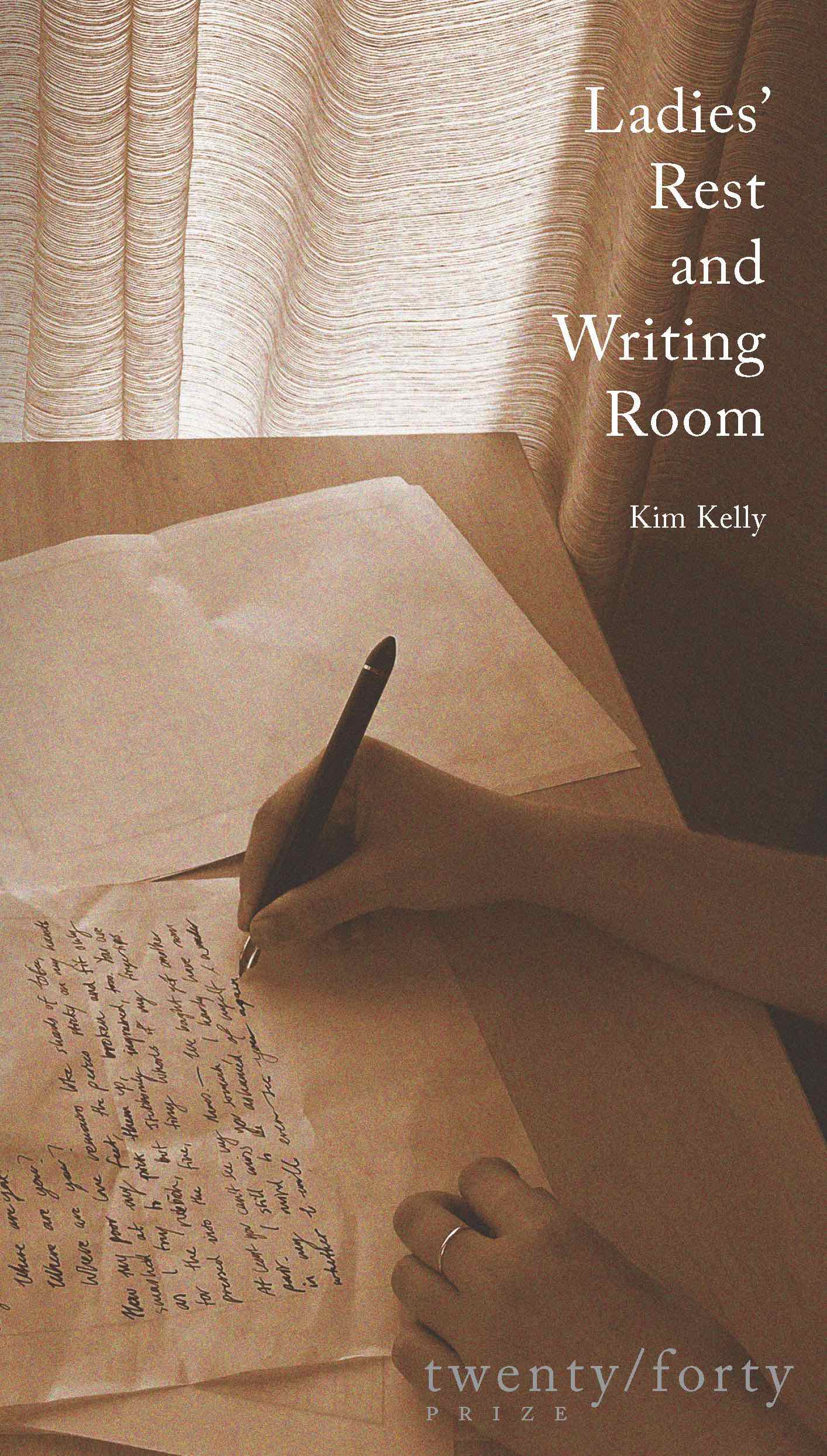
As with all Finlay Lloyd books, the design is gorgeous, with an appealing monochromatic cover featuring a woman’s hands writing a letter. Very different to your usual historical fiction cover.
Ladies Rest and Writing Room is a good read about a significant and complicated time in our history. Like Ravenous girls, it is a compassionate book, this one about navigating deep loss and the grief that attends it, and, even more, about the importance of generosity in dealing with others. I wish these two books well and thank Finlay Lloyd for sponsoring such an appealing, targeted prize.
Read for Novellas in November. Lisa (ANZ Litlovers) and Theresa (Theresa Smith Writes) have reviewed both winners in one post, but I have done them separately.
Kim Kelly
Ladies’ Rest and Writing Room
Braidwood: Finlay Lloyd, 2023
122pp.
ISBN: 9780994516596
 Whispering Gums
Thanks for the mention Sue. Glad to read you enjoyed this one also. I agree, Kim knows that era so well and conveys this perfectly through her writing.
She certainly does Theresa … I loved her evocation of the period. She did well to convey as much as she did, given she was working in the novella form.
Kim Kelly is underrated as a writer of popular historical fiction. Not my favourite genre of course, but I’m glad she has won this prize.
I am intrigued by your praise given your dislike of historical fiction, Bill, but she does convey the era very well. It rang true to me.
Is Lisa going to say something about sad girls ?? 😉
O, you temptress, you!
[grin]
Cheeky, MR! Lisa might but I don’t mind reading about sad girls, having been one myself – as long as the stories offer something a bit different. And these two winners do.
I’m surprised a novella won an award. It’s not a popular genre in the U.S. I searched around online before writing this response and see that most places that accept novella manuscripts are small presses that rely on the support of a college to which it is attached, or grants. They’re always under threat of closing, it seems.
Ah Melanie, this was a novella award – 20/20 means 20,000 to 40,000 words. BUT just this last week, Jessica Au’s novella won the Prime Minister’s Literary Award here so they CAN win though it’s not hugely common. I think here too they are more often published by small presses who are prepared to give them a go.
This sounds very appealing to me, both the era/theme and the tone/style.
It also brings to mind Carrie Tiffany’s Everyman’s Rules for Scientific Living (which I really loved, but I don’t even have my copy any longer, and maybe it’s actually not at ALL like this newer book).
Also…what are you doing awake and answering my comments?! Hahaha
It’s now 9am on my side of the continent Marcie! 6am on Bill’s!
They are very different t books but I love Tiffany’s too.
Ohmigawsh, everyone’s on opposite sides of everything these days! Heheh
Thank you for the geography refresher, and I will keep an eye out for this one for sure. 🙂
Haha, Marcie. It’s hard, I know, to remember these details, about people you’re not met and places you’ve not been to and can visualise.
For pretty much ever, I thought you and Lisa and Bill all lived close by because you were so chatty amongst yourselves, so it was such a shock to relocate Bill on the west coast that I guess the only alternative was to move you all there in my mind, one swoop.
Ha ha, love it Marcie. Makes sense, but I guess it was just shared culture and interests. I live about 700km north of Lisa. We’re met physically a couple of times, once in my city, once in hers, and I’ve met Bill once, in his.
Yes, I do like the sound of this one. And it is short…
Which is good when the TBR is long.