While searching Trove recently for my Monday Musings 1923 sub-series, I came across some articles on Jane Austen’s unfinished novel, The Watsons, and can’t resist sharing them with you.
I have written about unfinished books before, including on Jane Austen’s unfinished novels, The Watsons and Sanditon. Unfinished books aren’t to everyone’s taste but, if you love an author, you’ll read anything they wrote. Such is the case for me with Jane Austen.
So, The Watsons. Just as writers can’t seem to stop writing sequels, prequels and multifarious other versions of Austen’s six published novels, they are also drawn to her unfinished novels. The Watsons, for example, which Austen abandoned around 1805, has been “finished” several times. The first appeared in 1850, and was not presented at the time as a continuation. Wikipedia provides a good summary, explaining that it was an “adaptation” written by Austen’s niece Catherine Hubback, who titled it The younger sister. The initial chapters were based on Austen’s writing, but Hubback did not copy her words verbatim. The first real continuation came in 1923, and was written by L. Oulton. Since then, there have been several more, including versions of Hubback’s version! And so it goes ….
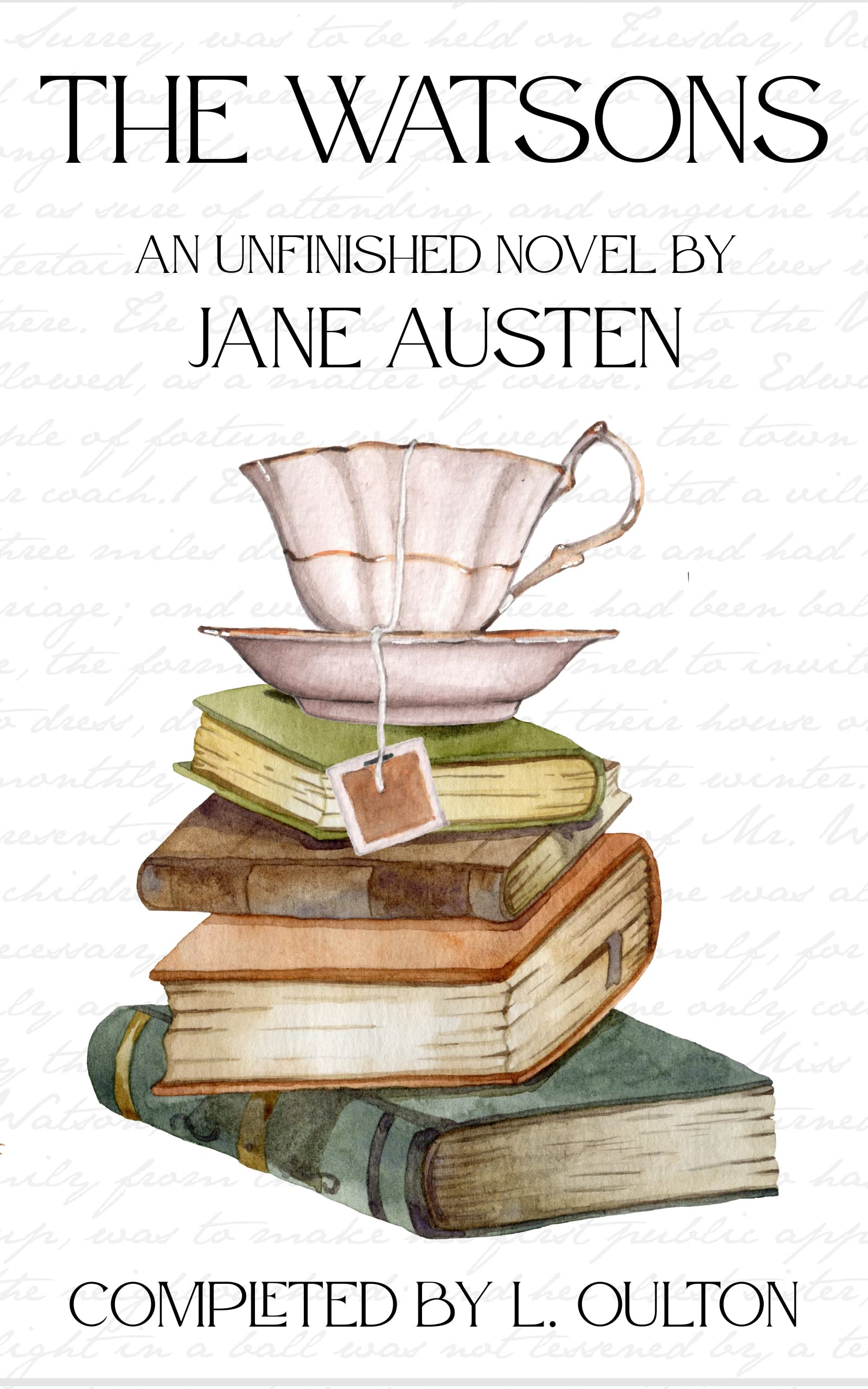
You can read all about it in the Wikipedia article above. Meanwhile, I’m returning to Trove, and the two articles that inspired this post. Both appeared in May 192 – in Melbourne’s The Age (May 5) and in Sydney’s The Sun (May 13). They refer to the publication of two “editions” that year of The Watsons – an unfinished edition with, says The Age, “a pleasant and informative introduction by A. B. Walkley”, and one completed by “Miss L. Oulton”. The Sun describes these two editions:
One firm publishes this fragment with an introduction by A. B. Walkley; the other firm actually calls upon L. Oulton to finish the story! The reader is advised to read only to the place where Jane Austen threw down her pen.
Good advice, I say – but that’s because I am more interested in Austen’s writing than in what others might think were her intentions. This, however, is not why I wanted to share these pieces. What interested me were their attitudes to Austen.
The Age says:
A return to Jane Austen after a course of modern fiction is an experience. The prim dignity of her diction; her bookish, almost stilted, conversation; her expression of fine sentiments and descriptions of good manners; her special acquaintance with the somewhat narrow insular life of the well-to-do in the English provinces a century and a quarter ago; her well-bred young ladies, whose only ambition in life is to secure husbands; her shrewd insight into the human heart, and her capacity as a storyteller— the reader renews acquaintance with much pleasure.
Not surprisingly, I don’t agree with this assessment of Austen’s writing. “The prim dignity of her diction”? Good diction perhaps, but prim? Not my Jane. Her conversation does tend to be formal compared with today’s writing, but you just have to read Lydia’s slangy “Lordy” to know that Austen can capture the nuance of character through her dialogue. Further, describing her subject matter as “the somewhat narrow insular life of the well-to-do in the English provinces” is, in fact, “somewhat narrow”. Of course, I agree with “her shrewd insight into the human heart, and her capacity as a storyteller”.
It is this – “her well-bred young ladies, whose only ambition in life is to secure husbands” – that most offends. It reduces Austen’s concerns to something not worth reading, or, to something worthy only of a few hours of escapism. Her heroines do tend to be “well-bred” in terms of manners, but many are by no means “well-to-do”. Marriage is the outcome of her novels, but her themes and her heroines’ ambitions are far more complex.
The Sun was more off-handed about why we might read Austen:
The story bears all the characteristics of the author, though it does not compare with her other established works … Through this fragment, however, the modern reader may pleasantly peer at a vanished age, with a ballroom etiquette already long forgotten, sententious speeches, a slavish admiration of “the quality” in the county, love affairs that are hidden by hints and evasions, and a painful obedience to the conventions.
“Pleasantly peer at a vanished age” and “painful obedience to the conventions”? Even in the beginning of The Watsons we see Austen’s eye for superficiality versus substance in her society, and her willingness to expose it. We also see her awareness that not all women were well-to-do, as shown in this quote from the novel. In it, our not-so-well-off heroine Emma speaks to the aristocratic Lord Osborne:
‘I wonder every lady does not. – A woman never looks better than on horseback. –’
‘But every woman may not have the inclination, or the means.’
‘If they knew how much it became them, they would all have the inclination, and I fancy Miss Watson – when once they had the inclination, the means would soon follow.’
‘Your lordship thinks we always have our own way. – That is a point on which ladies and gentlemen have long disagreed. – But without pretending to decide it, I may say that there are some circumstances which even women cannot control. – Female economy will do a great deal my Lord, but it cannot turn a small income into a large one.’
Sure, Austen’s heroines were not in the poor-house, but not all were carefree either when it came to money. Indeed, several – Fanny Price and the Dashwoods, for example – rely on the kindness or generosity of others to live in reasonable comfort. And many minor characters – such as the Bateses in Emma – were identifiably poor. Marriage was a necessity not a luxury for many (Emma’s Emma notwithstanding!)
You are welcome to check my Austen posts to see my thoughts on these and other matters.
I enjoyed finding these articles, but was disappointed to find the same-old misunderstandings of Austen in vogue then as they continue to be now.
 Whispering Gums
Flew to this post, of course ..
Imnsho, ST, those two opinions can be easily characterised by their lack of grasping that Our Jane wrote as her period necessitated: like, it was THEN.
How it’s possible to write of “her bookish, almost stilted, conversation” beats me – even in the ’20s ! – and “a ballroom etiquette already long forgotten, sententious speeches”. Words fail.
I agree of course MR. I guess we could also say that they were writing from the thoughts of their time, but it made me laugh.
As you say, anyone who sees her conversation as “bookish, almost stilted” really doesn’t get the irony contained within it, or the passion and sparkle in many of the conversations, or the wit in some of the repartee. And, I must say, vestiges of that ballroom etiquette were still a bit around when I was being taught how to behave at school dances, from primary school age. You waited for the boy to ask you, he walked you back to your seat at the end of the dance … etc etc.
Ghastly, it was. [grin]
It was, wasn’t it?!
“The prim dignity of her diction”. Love it. The exciting writer of Lady Susan grew up to be an old maid.
You and I will never agree, seemingly, that all of Austen’s characters are privileged, including Saint Fanny. You can’t read North and South without realising that Austen wrote of a very narrow little world indeed. Yes well, and bitingly. But no-one works, just the clergymen, and to Austen’s eternal credit, uncle Carpenter, and he is at that stage in life where he may as well be landed gentry.
Of course her novels are different to North and South, Bill. I don’t disagree with that at all. But that’s not to say that all her characters were privileged by which I mean financially secure. It’s all relative. As I said, her characters were not in the poor-house but their lives were not guaranteed to be comfortable either, as she knew only too well from her life after her father died until the well-off brother decided to/was able to provide for them. She may not have been destitute but it’s likely she wouldn’t have had time to write. Why else do we have no writings from when her father died (when she dropped The Watsons) to a few years later when her brother provided Chawton for them?
Who knows what would have happened to Jane, Elizabeth and sisters if they hadn’t married. Look what compromises Charlotte Lucas made in her marriage in order to be secure, and to save her parents from having to provide for her. Look at Jane Fairfax who looked like having to be a governess. History tells us how well they got on. Look at the Bateses and how they survived by the skin of their teeth due to the kindness of Mr Knightley, Mr Woodhouse and other neighbours. That was charity in action. Without it they were in trouble as Mr Knightley tells Emma very clearly. (Saint) Fanny’s life is likely to have been very challenging if she hadn’t been taken in by the Bertrams. The Dashwoods too. They needed to marry to obtain some level of security. If it hadn’t been for their mother’s distant cousin Sir John, they would have been living much poorer than they were in Barton Cottage. Austen lays all this out for us. She knew the risks and how precarious life was for women without independent means. They had very little agency, and no training for work.
I think your definition of “privilege” is different to mine. I can see where you are coming from, but I think your view doesn’t really appreciate the reality of the times and what Austen was on about regarding precarity.
PS Bill, I think you mean Uncle Gardiner?
Very droll, Sue!
Haha, thanks Lisa … Sue
Excellent critique of the narrow opinions/perspectives some have of Jane Austen. When reading Emma for the 1987 HSC (NSW) with my Year 12 class I was able to call upon Jane Austen “expert” Barbara Ker Wilson (who even wrote a novel: Jane Austen in Australia) to come to Nelson Bay and spend a Saturday taking the class through aspects of it – much beyond my understanding. After the visit she wrote up an excellent brief study guide and had it published. Barbara was later UQP Young Adult fiction editor – among many other matters. In her day with my students (and ever attentive me) she made exactly the points you have made here – among others.
Oh, thanks so much Jim. Sometimes I feel anxious when I come on strong like that with my perspective. I have read her novel. It’s one of the very few non-Austen Austens I’ve read, but it’s different of course because it’s more an alternative history about her than a riff of one of her novels.
I studied Emma in 5th or 6th form (probably 6th) and liked it but it was probably my least favourite until a few years ago when on a re-read I really got how clever it is.
I’ve just looked her up in Wikipedia, and found a delightful coincidence. She was born in 1929 and died in 2020, 14 days before her 91st birthday. My Mum was born in 1929 and died in 2020, 22 days before her 91st birthday.
Because it was the days of Covid – her memorial service was not till last year – and held in the The Queens Club on Elizabeth Street – directly opposite the entrance into St James Underground Station. Barbara was the book editor who retrieved from a pile of unsolicited manuscripts the one by an absolute unknown – his first effort – Michael Bond – his book – Paddington Bear! This was not long before she came to Australia in the early 1960s. She was prodigious in the breadth of her work. I met her at a book launch in 1984 for one of Olga Masters’ books. I knew only one other person – peripherally – and got chatting with Barbara – friendship thereafter and visits till not so long before her passing. Southern Highlands. A truly brilliant teller of stories…
Oh thanks Jim. Love that story about Paddington Bear … what a legacy … and love the Southern Highlands where I saw she’d spent the end of her life.
She sounds great. Mum died in June of 2020. The day before her funeral the funeral numbers were expanded to 50 which was enough for us to have lovely occasion though some people were of course still anxious. Things tightened up again later of course.
And at the Memorial Service – nearly everyone apart from her two daughters – associated with the book trade – and one teacher. And on a sideboard more-or-less overlooking those around the long table – Paddington Bear. You might remember that not so long after that that HM QEII had an afternoon tea with Paddington – both with marmalade sandwiches – Paddington’s under his hat HM’s in her handbag. And at the time of her passing – rear views of the two walking together off into the sunset…
Oh that’s lovely Jim. Of course who can forget that ER II and Paddington Bear scene.
I love the fragment of Sanditon, and I am certain if she had finished it, it might have been the best of her books. I’ve wanted to read the fragment of The Watsons and this post is encouraging. I’ll try to find a way to get hold of a copy. Thanks.
Thanks Davida … I agree re Sanditon. It’s so sad she didn’t finish it. The little bit of the Watsons is well worth reading too though it’s much more in the vein of her early books. You can find the text online. There’s not much of it.
I’m sure I can get it from Gutenberg.
Fascinating stuff Sue and of course I agree wholeheartedly with all your comments about JA – she is certainly on of those authors who continues to improve with each reread, or maybe it would be better to say that our understanding of what she did improves with each reread.
And thank you for the Barbara Ker Wilson mention. I did not know about her book about JA – is it worth my while to hunt it down?
Yes, well said Brona.
I wouldn’t call Wilson’s book a must read but I think it’s an enjoyable “what if” story about Austen, and interesting about the early days of the colony. I read it a long time ago so don’t know how I’d feel about that aspect with our current understanding of the era. I see on Goodreads, a later book called something like The lost years of Jane Austen … I didn’t research it but it looks like it’s a reissue under a new title of the one Jim and I are talking about.
Bravo WG!!😀
I really did understand Sense and Sensibility better with that large glossy version I read that included images, side notes, and money by inflation.
Every time someone mentions Austen, I get a hankering to watch the BBC Pride and Prejudice. Then, I have to remind myself that I do not have a spare 5 hours, or however long it is. I hope you don’t judge me too harshly for saying I really enjoyed the Pride and Prejudice and Zombies movie!
I’m really glad that annotated version helped your reading experience Melanie. It means you probably also “got” a lot of what Austen is about.
And no I won’t judge you too harshly for enjoying that Zombies movie. I went with some of my JA group. I can’t say we “liked” it but we were highly entertained. I’m more likely to judge you for not being able to find 5 hours to watch that P f P – haha!
I love the whole part during which Mr. Darcy is tracking flies to figure out who is dead at the social event. It’s really funny because it directly contrasts what the novel is doing.
What? Neither Mr Gums nor I recollect that scene and we’ve watched the series multiple times. Can you give me more? Oh, I’ve just thought … is this the Zombies movie …. I don’t recollect that. I don’t remember any details actually! It was just too too…well too everything!
Ha! Yes, I mean the zombie movie. It’s right at the beginning. There is a social event, and Mr. Darcy shows up and is subtly sleuthing for anyone who may be infected but not yet “turned.”
I was probably just trying to get a hold of the whole ambience to remember the specifics!