Since 2018 in the Australian Capital Territory, the first Monday after (or on) 27 May (the anniversary of the 1967 referendum) is a public holiday called Reconciliation Day. It is part of Reconciliation Week which, says Wikipedia, aims “to celebrate Indigenous history and culture in Australia and foster reconciliation discussion and activities”. Because Mr Gums and I have reached crunch time in our downsizing project, we did not engage in any of the focused activities around town. However, quite coincidentally, my decluttering task today included the books that set me off down my own reconciliation path, not that we called it that then. So, I thought to share them with you – and some of my own journey, from the keen but naive teenager to the better-educated person I hope I am today.
It all started at high school in Sydney, although there were beginnings in my early high school years in the outback town of Mt Isa. In Sydney, though, it was two women – the school librarian, Miss (Ellen) Reeve, and my modern history teacher, Mrs (Mary) Reynolds – who encouraged my interest in civil rights and to whom I am eternally grateful. When I was 15, I wrote my first piece on the need for fair treatment of “Australian Aborigines”* – for the school magazine. I intended well, but looking at it now I can see that it was naive and simplistic.
The books I read in those days included:
- Brian Hodge and Allen Whitehurst, Nation and people: An introduction to Australia in a changing world, 1967: its progress-focused tone was typical of the times. It did recognise, albeit in passing, “the first black owners of our continent” but it also conveyed that lie that they didn’t offer much opposition. It briefly discussed paternalism, assimilation, and integration, which, it says, “most thoughtful people are now favouring”.
- Douglas Lockwood, I, the Aboriginal (1960 Bill’s post) and We, the Aborigines (1963, my ed. 1970): written by a white man in the voice of his Aboriginal subjects, these were some of my first introductions to Indigenous lives – at least outback ones. Such an approach is politically incorrect now but, in its favour, the table of contents lists every person by name and “tribe”.
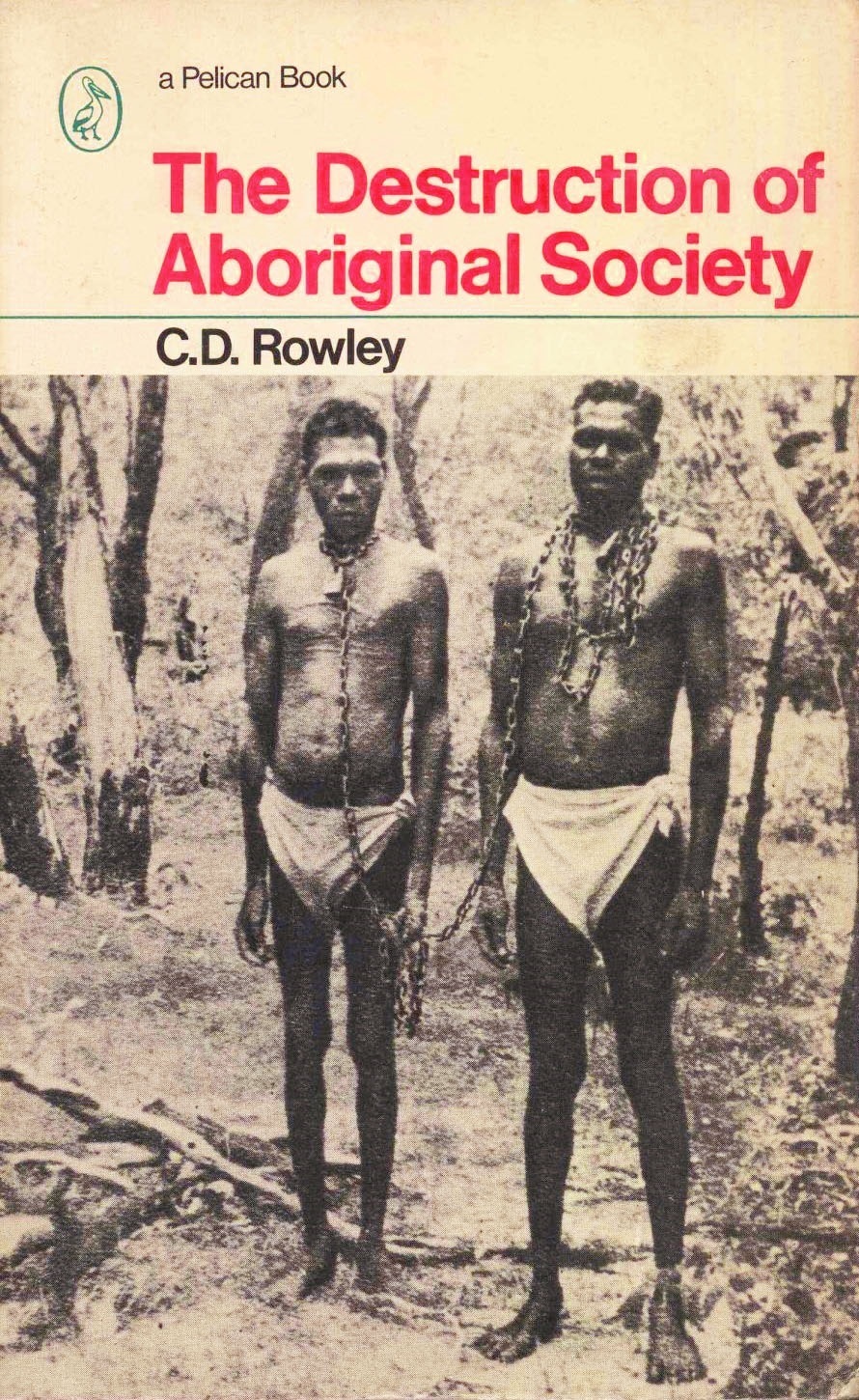
Then we move to my university years, and although my major was English literature, I also studied some anthropology. This included traditional ethnographic studies, using AP Elkin’s classic The Australian Aborigines (with its uncomfortable subtitle, How to understand them), but also involved more political reading, like CD Rowley’s The destruction of Aboriginal society (1970). It was my first serious literary introduction to the truths we are still learning now. Here is what the back cover of my 1972 Pelican edition says:
The destruction of Aboriginal society is a powerful and detailed study of the history and tragedy of the interaction between black and white Australians. Most white Australians today are unaware of the part the Aboriginal played in the history of settlement. Even if he only stood to be shot, he influenced profoundly the kind of man who made a successful settler.
The Aboriginal has been “written out” of Australian history; the tragic significance of conflicts have long been bowdlerised and forgotten. Yet, even if vicariously, our guilt remains, as does our responsibility. Aboriginal attitudes take on a new dimension in the light of history, and no policies should be formulated except in that light. This is a book to stir the sleeping white Australian conscience.
That was over 50 years ago! What have we been doing? Anyhow, it’s the book that informed my understanding, by which I mean it kickstarted my thinking from simple ideas about fairness and equality to comprehending the sociological complexity. It is also the book that, in 1982, the academic Peter Biskup said had begun, twelve years previously, “the process of rewriting the history of contact of Australian Aboriginals”.
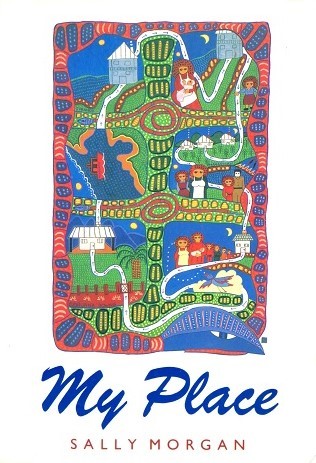
These writers were all white, however. The first work I read by a First Nations writer would have to be, as it was for many of my generation, Sally Morgan’s My place (1987). Sally Morgan conveyed the fear and shame that attended being Indigenous in modern Australia, how this caused her family members to try to hide their heritage if at all possible, and the devastating intergenerational (though we didn’t use that term then) impact this can have.
Since then, and particularly since 2000, my reading of First Nations writers has increased dramatically, much of it documented on this blog, so I’m not going to repeat all that now.
My main point is, really, how horrifyingly slow all this is. We have had, among other things, the 1967 Referendum; Mabo and Wik, and the related Native Title legislations in the 1990s; the Royal Commission into Aboriginal Deaths in Custody tabled in 1991; the Bringing Them Home report tabled in 1997; the National Apology in 2008; and most recently, the Uluru Statement from the Heart in 2017. Having come of age in the 1960s with all its idealistic fervour, I would never have believed that here I would be in the 2020s with so little real progress having been achieved, with relationships fraught and a referendum on constitutional recognition struggling to gain forward momentum.
But, it’s not about me, so I will share the theme of this year’s National Reconciliation Week, which is, appropraitely,
Be a Voice for Generations.
The theme encourages all Australians to be a voice for reconciliation in tangible ways in our everyday lives – where we live, work and socialise.
For the work of generations past, and the benefit of generations future, act today for a more just, equitable and reconciled country for all.
And will leave you with CD Rowley’s conclusion. The words are of his time but the meaning is still valid, wouldn’t you say?
The future status and role of the Aboriginal will be a significant indicator of the kind of society which eventually takes shape in Australia.
* Nomenclature has changed over time, but in this article I have used different terms as appropriate to the subject and time.
 Whispering Gums
“but looking at it now I can see that it was naive and simplistic”
Your conjunction there is not merited: you were FIFTEEN !!
Even so, I cringe, M-R, when I read it but yes, what you say, is what I would say is someone else had written this post!! So, thanks.
My journey to developing a greater understanding of these issues is similar, perhaps of our generation. Like you I remember writing about my puzzlement over racism in school; in my case , it was a poem in primary school. Terrible childish stuff but I was trying hard to understand the ‘why’ of racism.
Gradually over years I learnt more, understood a little more. I remember my shock when I realised that the stolen generations were not just an event from long ago in history, but was still happening during my own childhood.
My real education began, though, when I got a graduate role in the then Department of Aboriginal Affairs, in your city. Suddenly I was surrounded by indigenous colleagues; for part of my time there Charles Perkins was permanent head. His daughter Rachel did a stint of work experience in my section. I was learning fast there.
And yes, books helped. Sally Morgan was the among the First Nations authors I most remember from this early years of publishing by indigenous authors.
I’m pleased, when I walk into my local library in the Blue Mountains, to see the section right at the entrance, devoted to books by and about local Aboriginal history, culture and places.
In my opinion, despite our generation’s fairly dismal education about Aboriginal and Torres Strait Islander Australia, there is nowadays no excuse not to learn something. Books, podcasts, movies, TV… not perfect but there are now resources to educate ourselves, should we choose to.
Thanks Denise for sharing your story. What a great – and lucky – experience you had at the Department here. Unforgettable, I’m sure.
And you are right, there is no excuse for us all not to educate ourselves now even if it was lacking in our youths. There are so many opportunities to do so.
My experience as a Victorian in the 1960s was that The Fringe Dwellers was an accurate representation of Aboriginal life in the outback towns where we thought they mostly lived. In Victoria, to the best of my knowledge, the few survivors lived at Lake Tyers mission in Gippsland, as represented by the Aboriginal boxer Lionel Rose.
That was it, for years, decades. In all my life I may have been friends with two Aboriginal people and an acquaintance of a couple of others.
Black rights was a sideshow for Melbourne radicals during the Vietnam War years. And I certainly paid little attention until you started me reading Kim Scott less than a decade ago.
(And as M-R said, it would be sad not to be naive at 15.)
I am so glad my post encouraged you to read Kim Scott, Bill. Such things make our blogs worthwhile.
And yes, I think what education I did have in my teens – what with Lockwood et al – did tend to encourage me to think First Nations people all live in the bush and country towns. Until university anyhow when my sociology and anthropology classes touched on urban issues.
“Sad not to be naive at 15”. Yes, I suppose you are right. I’ll try to re-assess my reaction in future. (I haven’t thrown that school magazine away!)
Ah, I like your take, Bill !! 🙂
TBH I feel discouraged too. I was a teacher, and it was my responsibility to educate my students, my staff and my colleagues in the wider profession with whatever resources I had, so that the students had a better education about First Nations history and culture than any of us had. No child in my classes can say they weren’t taught. No teacher in my school or who attended the conferences where I shared my learning journey and my resources, can say they didn’t know what to do or have the resources to do it.
Every other teacher had the same responsibility from the time that the Australian Curriculum was first written, and certainly in Victoria, before that too. So there would have been thousands of us all doing our best with whatever we had at our disposal.
And yet, look where we find ourselves…
Exactly … it’s all so slow and the political and socioeconomic environment is not as positive as it has been which doesn’t help.
I’ve realised that I’ve been wandering around in my own little bubble of nice people who have integrity and who care — and it’s a dispiriting shock when people who are not like that come out of the woodwork. I mean, I expected some rednecks, but what’s happening is something else.
And I really don’t know what to make of such strident First Nations’ opposition to the voice… how do people of goodwill respond to it?
We all live mostly in our own echo-chamber bubbles I think Lisa. After all, it’s not surprising that our friends are people who think like us. I’m with Sara, though. I still think there’s a good chance that it will get through, but I wish the referendum were sooner rather than later!
As for your last question, I think the way we respond is as we would to any difference of opinion, we listen, and ask questions if the opportunity arises, and apply the arguments to our own thoughts. It’s unrealistic to expect all First Nations people to agree, and if some feel strongly why should we expect them not to voice (sorry!) their opinion. I’m finding the different reasons interesting, some making more sense than others, but for my own decisionmaking I have to go with my heart which says 1) this comes from the Uluru Statement from the Heart and is a consensus view from First Nations people; and 2) I feel that we HAVE to do something, and that this something, agreed to by the majority of FN people as far as I can tell, is way better than doing nothing. Doing nothing in my opinion would set First Nations rights and role in our society way back that would take so long to recover from (and maybe not in my lifetime. That would be devastating to me, says she making this about herself again!
Please update my email address in your address book/contacts to biffward88@gmail.com
From 6 June 2023 biffward@homemail.com.au will no longer be in use. Thank you
>
Hi Biff, the blog post notifications don’t come from my address book but from WordPress and I can’t see that I can change it. I think you need to unsubscribe in the blog sidebar and then subscribe again with your new one.
thanks, Sue.
Biff Ward Author http://www.biffward.com.au http://www.biffward.com.au/ https://www.facebook.com/biffwardauthor https://themoshshop.com.au/products/the-third-chopstick-by-biff-ward Buy Book https://themoshshop.com.au/products/the-third-chopstick-by-biff-ward
>
Let me know if you need any help Biff. I think you have my email address.
all good, Sue. You are now arriving on the new address. Bx
Biff Ward Author http://www.biffward.com.au http://www.biffward.com.au/ https://www.facebook.com/biffwardauthor https://themoshshop.com.au/products/the-third-chopstick-by-biff-ward Buy Book https://themoshshop.com.au/products/the-third-chopstick-by-biff-ward
>
Well done Biff! So glad it worked.
If you happen to read the Women and Whitlam book edited by Michelle Arrow and brought out recently by New South Publishing, you’ll come upon a chapter by Cathy Eatock about her mother Pat Eatock. Pat was an Aboriginal activist who came to Canberra for the Tent Embassy, bringing Cathy who was a baby with her. She stayed at the recently opened Women’s House on Bremer St (I think it was in Griffith), taught us feminists a lot and became one of us herself. In the 1972 election she ran as an independent for the seat of Canberra. Elizabeth Reid was her campaign manager. She didn’t win but continued her activism on both scores – Indigenous and feminist – and towards the end of her life she was the prime mover in the successful case against Andrew Bolt under the Racial Discrimination Act. A remarkable woman, who certainly opened my eyes, and was instrumental in my recognising what a remarkable nation we could be, if only given the chance.
Oh that’s agrarian story Sara – snd your final comment speaks to Rowley’s point doesn’t it. All pretty sad but I’m not giving up yet.
One day I am going to write a story entirely in WG autocorrect. I will be hailed as the next William Burroughs.
Haha, Bill but oh noooo… I am hopeless. Why don’t I notice what the keyboard is doing and why didn’t it autocorrect the “and” which it should have!
Ha!
Priceless eh! But very cheeky of Bill too to cast such aspersions on my carefully crafted words of wisdom.
I meant “a great” story, Sara!
I’m not either. In spite of the nastiness and deliberate muddying of the waters I think the Yes will prevail.
I really hope you’re right, Sara – and currently I have faith that it will. The nays are being loud, but the great majority are, I think, just keeping their thoughts to themselves which is understandable.
In the US, people confuse Native Americans with undocumented immigrants from Mexico, so I don’t think there’s much hope for us. Imagine the audacity to shout at a Native American, “go back to where you came from,” not realizing that they’re the original inhabitants.
Ah yes, Melanie. I think the US is so complicated by the Native Americans, the African Americans and the Hispanic immigrants. I can understand people over here getting a bit confused at times, but what you say here is horrifying (though, I suppose, not surprising. So many people just don’t think.)
A fascinating story, thank you for sharing, and to all who have commented so far, too. I didn’t know much about this issue and was only just starting to find out about it on my own so am grateful to the Australian bloggers who highlight resources (and Canadian, American, etc., too with the Indigenous people who first lived in their countries).