 Since 2013, I’ve written an indigenous Australian focused Monday Musings post to coincide with NAIDOC Week and Lisa’s ANZLitLovers Indigenous Literature Week. NAIDOC Week, for non-Aussies out there, occurs across Australia each July “to celebrate the history, culture and achievements of Aboriginal and Torres Strait Islander peoples”. One way litbloggers can recognise and celebrate it is to read indigenous Australian writers and contribute to the list of reviews maintained by Lisa on her blog. (Lisa also accepts reviews of indigenous authors from other nations.)
 This year’s NAIDOC Week theme is VOICE, TREATY, TRUTH. How better to celebrate this than through a post on early indigenous Australian literature which, like that of today, aimed to share truths about indigenous Australian experience. It’s a tricky topic because it’s only been relatively recently that indigenous Australian stories (novels, poetry, short stories, plays, memoirs) have been published. However, indigenous people have been writing since the early days of the colony.
This post can only be a brief introduction. The best source for the topic is, I believe, the Macquarie Pen anthology of Aboriginal literature (2008), edited by Anita Heiss and Peter Minter. Indigenous Australian academic Mick Dodson writes in the Foreword that it contains “a range of works that any serious student of Aboriginal history, life and culture will find valuable”. It also, he says, encapsulates Aboriginal “political and cultural activisms”.
The anthology starts with the first-known piece of written text in English by an Aboriginal author, a letter written by Bennelong in 1796 not long after he returned from England. Editors Heiss and Minter write that the anthology contains
writing ranging from the journalism, petitions and political letters of the nineteenth and early twentieth centuries, to the works of poetry and prose that are recognised widely today as significant contributions to the literature of the world.
They go on to say that “Aboriginal literary writing grew directly from a complex and ancient wellspring of oral and visual communication and exchange”. This is something that at least some non-indigenous Australians recognised. FS, writes in The Age in 1938, for example, about indigenous Australian “rock literature” or “picture writing”. FS is responding to a planned German scientific expedition to northwest Australia which was intending, among other things, to “study … rock carvings, cave paintings and similar work on wood to ascertain whether it is a desultory art or a method of writing” [my emph.] S/he believes this goal is unnecessary, because the “rock literature” clearly demonstrates that indigenous Australians have had a “literature” long pre-dating the English language.
Anyhow, back to Heiss and Minter who discuss the necessary nexus between the literary and the political in indigenous literature. They note that 19th century Aboriginal literature primarily comprised “genres that are common to political discourse” – letters, petitions and chronicles – and that between Federation and the 1960s, political manifestos and pronouncements of Aboriginal activist organisations were added to these genres.
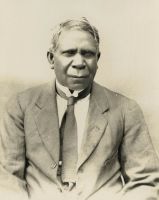
David Unaipon (State Library of NSW, Public Domain)
It wasn’t until 1929, in fact, that the first book by an indigenous Australian writer was published, David Unaipon’s Native legends. A report of the book’s publication appeared in January 1930 in South Australia’s Border Chronicle. The reviewer says (using the sort of tone and language typical of the time):
Not long since there entered the editorial den a full blood aboriginal who said, in that “moistened” voice that the Australian abo always wears, that he was distributing the only book ever written by an Australian aboriginal in the English language … The legends are told in English that will cause wonder in anyone who has tried to master any speech other than his mother tongue. Claudian, the Latin poet, was born an Egyptian, educated as a Greek, and the world has marvelled ever since that he became one of the great masters of Roman speech. Yet Unaipon, is in his way, as great a marvel as Claudian, since his natural atmosphere differs more widely from that in which he works than did the civilization of Claudian’s Egypt and Greece differ from that of Rome. The style of David’s writing is correct by all the formal rules, but differs widely from ordinary written speech. His legends are fairy tales in color, and in “The Song of Hun garrda”, which is an invocation to the God of Fire, he gets into a highly poetic region. Likewise, he is mysticc and writes of “earthly body subjective consciousness”, “earthly life experience”, as if those things had a real meaning to him, which is more than can be said of some of those who talk on such matters in their native speech. It is an interesting little contribution to Australian letters.
Heiss and Minter say the book is “literary in its adaptation of his cultural imagination to particular modes of authorship and narration”. They see his pioneering role in the development of indigenous literature, saying he “gave subsequent Aboriginal writers a significant precedent by which to imagine their authorship of a culturally grounded future literature”.
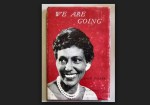 It would be over thirty years before another book by an indigenous writer was published, although during that time “letters, reports and petitions” continued to be written in support of “Aboriginal rights and constitutional transformation”. One of these activists was the poet and activist, Kath Walker (later Oodgeroo Noonuccal), and she was the author of that second book. Published in 1964, We are going was mistakenly described by The Canberra Times as “the first book written by an Australian aborigine”. Heiss and Minter again note its pioneering role, saying it “marks the arrival of Aboriginal poetry as one of the most important genres in contemporary Aboriginal political and creative literature.”
It took more time, however, before indigenous writers got a firm foothold. Heiss and Minter argue that it wasn’t until the late 1980s that “Aboriginal writing was firmly established as a major force in Australian letters. David Headon writing in the ANU’s Woroni in 1990 would agree:
Certainly Aboriginal literature is a growth industry of substantial proportions. The sheer number and range of books now available is all the more surprising when one considers that the first [!] published work by an Aboriginal writer, Oodgeroo Noonuccal’s (Kath Walker’s) book of poems, We Are Going, was published in 1964, and at the beginning of the 1980s the only black writers with any kind of national profile were Walker, Jack Davis, Kevin Gilbert, Mudrooroo Narogin (Colin Johnson) and possibly Bobbi Merritt and Faith Bandler. None of these were well-known outside their community. Australian literature has been profoundly altered by the emergence of so many Aboriginal texts in the last 10 hectic years.
He reviews an unknown-to-me 1990 anthology, the gorgeously titled Paperbark. It predates Heiss and Minter’s Macquarie anthology by nearly two decades. Published by the University of Queensland Press and described by them as “the first collection to span the diverse range of Black Australian writings”, it includes writings from the 1840s to 1990. The Aboriginal and Islander authors include “David Unaipon, Oodgeroo Noonuccal, Gerry Bostock, Ruby Langford, Robert Bropho, Jack Davis, Hyllus Maris, William Ferguson, Sally Morgan, Mudrooroo Narogin and Archie Weller.” Like the Macquarie anthology, it also includes “community writings such as petitions and letters”.
Headon’s review is well worth reading for his references to writings, many of which are new to me, but I’m going to leave him on his following point:
Books like Paperbark are in the vanguard of what will surely be one of the great (Australian) cultural debates of this decade: how long can an ex-colony like Australia allow some of its universities to continue to indulge their colonial habits? How long will Old and Middle English, 17th- and 18th-century English literature be the literature major staples at our universities? When will the dominant pressure be post-colonial? Change, Paperbark proclaims, is afoot.
Good question! Interestingly, in 1984, the ANU did offer a 10-week adult education course in ‘Aboriginal Literature’. It may, of course, have only been run that year.
Anyhow, I hope you have enjoyed this little introduction to what I’ll call the first wave of indigenous Australian writing.
Past NAIDOC Week-related Monday Musings
- 2018: about Arnhem Land
- 2017: Reading Indigenous Australian literature
- 2016: Spotlight on Larissa Behrendt
- 2016: Recent books by Indigenous Australians
- 2015: NAIDOC Week
- 2015: David Unaipon Award
- 2014: Indigenous Australian writers recommend …
- 2014: In Conversation with BlackWords
- 2013: BlackWords
- 2013: Indigenous Australian memoirs


 Whispering Gums