Betty McLellan, Ann Hannah, my (un)remarkable grandmother: A psychological biography (#BookReview)

BettyMcLellanAnnHannahBetty McLellan’s Ann Hannah, my (un)remarkable grandmother: A psychological biography disconcerted me at first. I’d never heard of a psychological biography (which, I presume, is the same as psychobiography) so I was intrigued by McLellan’s discussion in the Introduction of her decision to use this approach. I did feel, for a chapter or two that she was drawing a long bow, but I persevered and it was worth the effort.

McLellan commences her Introduction by telling us a little about who Ann Hannah Stickley was and why she decided to write the book. As you’ll have gathered from the title, Ann Hannah was her grandmother. Born in 1881, and emigrating to Australia with four children when she was 40, Ann Hannah was, writes McLellan, “an unremarkable woman who lived an unremarkable life and died an unremarkable death” (albeit at the, I’d say, remarkable age of 97!) However, McLellan came to realise, long after Ann Hannah had died, that this grandmother, who was already living with her family when she was born and who was still there when she left home at nineteen, was worth investigating. She sensed that her grandmother had had a “remarkable resilience” and wanted to know how she’d done it. But how was she to explore this, given her grandmother had been dead for nearly 40 years?

The problem was that she knew relatively little about this quiet, practical, hardworking woman, and that there was no one left who might have known more. So what, she questioned, “would be the best literary device to use to record her story, explore my own reactions to it and analyse it in terms of its relevance for other women?” A straight biography would not work, for the reasons already given. Consequently, she turned to this new-to-me genre of psychological biography which “seeks to discover a subject through analysis of their political pronouncements, decisions, writing, behaviour or art”. Ann Hannah, being a private, “ordinary”, person had none of those, but she did have a number of sayings – didn’t all our grandmothers? It is through these that McLellan decided to analyse Ann Hannah, “with a view to uncovering the deeper meaning behind her words” and in so doing to not only understand her grandmother more, but, among other things, “to present her as a representative of many women born in her time and circumstance”. It’s a big ask …

McLellan, a psychotherapist and feminist activist who has written other books, does this by taking each saying, explaining its meaning and how her grandmother had used it, and then exploring its wider implications or connotations. What exactly she explores is largely driven by the saying. The saying in Chapter 2, for example, is “I’m a Londoner”, and so McLellan explores – through historical and sociopolitical lenses – what life was like in the parts of London where Ann Hannah had lived until her migration to Australia in 1921.  She was uneducated, and part of “the working poor”. But, this was also the time of the women’s suffrage movement, which McLellan describes in some detail. Ann Hannah, she says, had never indicated she was aware of the “political machinations” going on around her, so in one sense we could question McLellan’s inclusion of the history here. However, McLellan concludes the chapter by saying her grandmother had lived her life as a “strong, determined woman”. It could be argued that this was in part made possible by the sociopolitical environments she found herself in.

By contrast, Chapter 4’s saying is “‘e was a wickid man” [ “wickid” being spelt that way to capture Ann Hannah’s pronunciation]. It deals with Ann Hannah’s second husband’s violence and sexual abuse of his step-daughter, as well as of Ann Hannah, herself, and one of their daughters. Here, not surprisingly, McLellan looks more at psychiatry, psychology and the law, than history and politics. She describes the lack of recourse women had during the time Ann Hannah lived, and concludes that her grandmother’s only choice, really, was to “accept her lot” and get on with it, which is exactly what she did. (Not surprisingly, Ann Hannah said it was “the ‘appiest day of my life when ‘e died”!)

These are just two of the six chapters exploring Ann Hannah’s sayings. Two others deal with the experience of migration and of the loss of a child, both of which particularly engaged my interest.

Overall, the approach makes for a somewhat disjointed book, skipping as it does around different fields of human knowledge and experience. Nonetheless, it all works reasonably well because there are unifying threads to which McLellan returns, one being Ann Hannah herself, and the other McLellan’s feminist perspective. I say “reasonably” well because there were times when, due I’m sure to lack of information, Ann Hannah seemed to slip though my fingers. I wanted, I suppose, a more traditional biography! Given that McLellan explained why she couldn’t produce that, it’s unreasonable of me to criticise the book for what it’s not, so I won’t. I’ll just say that it’s what I would have liked!

The real question is, then, does McLellan’s decision to write a psychological biography of her grandmother work? Does it provide, in other words, some useful insights into women’s lived experience, as McLellan intended? I think it does – and does so in a way that not only illuminates the past, but also contributes to our understanding of the present and why things are the way they are today. A different but interesting read.
aww2017 badgeBetty McLellan
Ann Hannah, my (un)remarkable grandmother: A psychological biography
Mission Beach: Spinifex Press, 2017
150pp.
ISBN: 9781925581287

(Review copy courtesy Spinifex Press)

Helen Garner, Why she broke: The woman, her children and the lake (#Review)

Three years ago I reviewed Helen Garner’s This house of grief about Robert Farquharson who drove his car into a dam in Victoria, resulting in the deaths of his three sons. It’s a grim grim story, so you might wonder why I am now writing about her essay “Why she broke: The woman, her children and the lake” about Akon Guode who, in 2015, drove her car into a lake in Victoria resulting in the deaths of three of the four children inside.

There are two reasons, the main one being that this essay was, last week, awarded the Walkley Award (about which I’ve written before) for Feature Writing Long (over 4000 words). I hadn’t read the article when it was published in June this year, and probably wouldn’t have read it now, except for this award. What, I wondered, when I heard the news, made this essay, on a topic so seemingly similar to her recent book, worthy of the Walkley Award? The other reason is that although there are similarities – both parents drove their cars into water resulting in the deaths of children – there is a big difference. One parent was a father, and the other a mother. I wanted to know what, if anything, Garner would make of that in her analysis.

I’ll start two-thirds through the essay, where Garner quotes Guode’s defence counsel using a statement made to the Victorian Law Commission in 2004:

While men kill to control or punish their children or partner, women kill children because they cannot cope with the extreme difficulties that they encounter in trying to care for their children.

Given the current political climate – Harvey Weinstein, Don Bourke, et al – this statement must surely be read as part of that bigger picture concerning women’s powerlessness.

In the first part of the essay, Garner describes Guode’s life. She was a Sudanese refugee to Australia who had been married as a teenager but had then lost her husband in the civil war there. In that culture women cannot remarry, but remain a possession of their husband’s family. Guode’s third child was fathered by a brother-in-law. Eventually, after more trauma in Africa, she was sponsored to come to Australia by another of her late husband’s brothers, Manyang. Her life here became difficult in a different way, with her bearing four children to this already married man. At the time of the incident she had seven children.

Garner details the difficulties of Guode’s life, including the traumatic birth of her seventh child, and her struggle to care for her family while also sending money back to family in Africa. To her, this was an obligation, but at the committal hearing, Garner writes, a local community leader said that “It is not an obligation. I would call it a moral duty”! Not surprisingly Garner’s reaction to this is that “under the circumstances this seems like a very fine distinction”! This sort of word play – “obligation” versus “moral duty” – can make such a mockery of the law (or of its practitioners), can’t it?

There was of course discussion during the hearing of Guode’s mental state, with the judge suggesting that “something dramatic” must have triggered her action. The psychiatrist, however, argued that “it can just be the ebb and flow of human suffering, and the person reaching the threshold at which they can … no longer go on.”

But Garner also proposes a possible “trigger event” that went back 16 months to the last traumatic birth. Postnatal haemorrhaging was so bad she was close to needing a hysterectomy. Guode initially refused treatment. Garner writes that she was

prepared to risk bleeding to death on a hospital gurney rather than consent to the surgical removal of the sole symbol of her worth, the site of her only dignity and power: her womb?

Surely, a woman whose life had lost all meaning apart from her motherhood would kill her children only in a fit of madness.

Garner also discusses the technicalities of infanticide versus murder in Victorian law, and Guode’s counsel’s argument that all three deaths should be viewed through “the prism of infanticide”, which would result in a lesser sentence, even though only one of the children met the age criterion. Her eventual sentence makes clear that he didn’t win his argument.

What makes this essay so good, besides the analysis, is Garner’s writing. Here she is on a jury trial versus a plea hearing (which this was):

If a full-bore jury trial is a symphony, a plea hearing is a string quartet. Its purpose seems to be to clear a space in which the quality of mercy might at least be contemplated. There is something moving in its quiet thoughtfulness, the intensity of its focus, the murmuring voices of judge and counsel, the absence of melodrama or posturing. It’s the law in action, working to fit the dry, clean planes of reason to the jagged edges of human wildness and suffering.

That last sentence! Breathtaking. It reminds me once again what an excellent essayist Garner is, and it’s not just for her style. She has the ability to take us on a journey, leading us logically, and empathically, to consider values and ethics, without ever being didactic.

In this essay, it’s her concluding comments and final question regarding mercy which gets to the nub of it. It concerns the idea of “mother”, which she calls “this great thundering archetype with the power to stop the intellect in its tracks”. Read Garner’s essay, and/or this report in The Age, and see what you think. I don’t envy Justice Lasry’s job, but I know, based on what I’ve read, where my intellect goes.

aww2017 badgeHelen Garner
“Why she broke: The woman, her children and the lake”
The Monthly, June 2017
Available online

Monday musings on Australian literature: Interviews with Aussie writers

Those of you who read my December Six Degrees meme will know that the starting book was Stephen King’s It. Not surprisingly, a couple of bloggers – Kate (booksaremyfavouriteandbest) and Lisa (anzlitlovers) – made their first link Stephen King’s On writing. Lisa then went on to link to an Australian book on writing, Kate Grenville’s The writing book.

Now, I’ve written about Aussie writers on writing before, so I thought that in this post I’d share some books containing interviews with Aussie writers, which I’ll list in order of publication.

Jennifer Ellison’s Rooms of their own (1986)

Ellison’s book, of course, takes its title from Virginia Woolf’s wonderful, pleading book on behalf of women creators. It comprises interviews Ellison conducted with significant writers at the time: Blanche d’Alpuget, Jessica Anderson, Thea Astley, Jean Bedford, Sara Dowse, Beverley Farmer, Helen Garner, Kate Grenville, Elizabeth Jolley, Gabrielle Lord, Olga Masters, and Georgia Savage.

Naturally, the gender issue is explored, but other issues relating to writing, publishing and the role of writers in society are also discussed. I often refer to it.

Candida Baker’s Yacker: Australian writers talk about their work, Vols 1, 2 and 3 (1986, 1989 and 1990)

Candida Baker, Yacker 3The three volumes of Yacker were the result of author-editor-festival director Candida Baker’s multi-year interview project which was inspired by the Paris Review’s “on writing” interviews. By the end of the project she had interviewed 36 Australian writers, representing a wonderful resource – both on writers no longer with us, and on the early or mid-careers of writers still here. Her interviewees were:

  • Yacker: Christina Stead, Peter Carey, Nicholas Hasluck, David Foster, Helen Garner, Blanche D’Alpuget, Dorothy Hewett, Elizabeth Jolley, David Malouf, Thomas Shapcott, Thea Astley and David Williamson.
  • Yacker 2: Jessica Anderson, Marjorie Barnard, Sumner Locke Elliot, Barbara Hanrahan, Jack Hibberd, Thomas Keneally, Ray Lawler, Roger McDonald, Gerald Murnane, Les A. Murray, Janette Turner Hospital and Kath Walker (Oodgeroo Noonuccal).
  • Yacker 3: Randolph Stow, A.D. Hope, Glenda Adams, Kate Grenville, Peter Porter, Robert Drewe, Peter Corris, Louis Nowra, John Tranter, Frank Moorehouse, C.J. Koch and Gwen Harwood.

Kate Grenville and Sue Woolfe’s Making stories: How ten Australian novels were written (1993)

This book takes a slightly different tack to the other books in today’s post in that it comprises authors discussing a particular book, demonstrating their creative process. The authors and books included are: Jessica Anderson’s The commandant (my review), Peter Carey’s Oscar and Lucinda, Helen Garner’s The children’s Bach (my review), Kate Grenville’s Lilian’s story, David Ireland’s A woman of the future, Elizabeth Jolley’s Mr Scobie’s riddle, Thomas Keneally’s The chant of Jimmie Blacksmith, Finola Moorhead’s Remember the tarantella, Patrick White’s Memoirs of many in one, and Sue Woolf’s Painted woman.

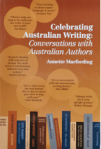
Annette Marfording’s Celebrating Australian Writing: Conversations with Australian Authors (2015)

Regular readers here might remember this book, as I’ve published several posts inspired by the interviews contained within. Marfording was, for several years program director for the Bellingen Writers Festival. She was also a radio presenter for the Bellingen community radio station, 2 bbb fm, on which these interviews were aired from around 2009 to 2014.  Her aim was, she said,

not to produce interviews “like those commonly done, focusing primarily on an author’s latest book. I wanted to inform listeners of their body of work, strengths – as I saw them – writing methods and work associated with their lives as authors, such as judging literary awards, editing short story collections, reviewing other writers’ works.”

Her interviewees are: Robert Dessaix, Cate Kennedy, David Malouf, Gregory Day, Charlotte Wood, Georgia Blain, Kate Howarth, Kristina Olsson, Larissa Behrendt, Debra Adelaide, Alex Miller, Kevin Rabalais, Di Morrissey, Peter Goldsworthy, Robert Drewe, Jon Bauer, Bryce Courtenay, Chris Womersley, Marele Day, Michael Robotham, and Barry Maitland.

In a really lovely, generous gesture, Marfording has directed that all profits from the sale of the book go to the Indigenous Literacy Foundation. A worthy cause and one that I support too.

Charlotte Wood’s The writer’s room: Conversations about writing (2016)

Wood’s book draws on interviews she did for her digital or on-line journal, also called The writer’s room, which ran from 2013 to December 2015. She, like Baker, was inspired by the Paris Review, and wanted to use their model which allowed writers to review and change the edited transcript of their interview. Her reason was that “having been interviewed about my own work so many times and then been embarrassed by my awkward words in print, I wanted ‘my’ writers to know that they would have complete and final control over anything that appeared in the magazine.” In the end, she says, they changed very little, mainly making “small but important clarifications” or expanding something “they’d been oblique about” or making statements or opinions more “definite”.

Because her project started in 2013, her interviewees include very recent writers on the Australian scene. The book contains a selection of the interviews she did: Tegan Bennett Daylight, James Bradley, Lloyd Jones (New Zealand writer), Malcolm Knox, Margo Lanagan, Amanda Lohrey, Joan London, Wayne Macauley, Emily Perkins, Kim Scott, Craig Sherbourne and Christos Tsiolkas.

*****

So, seven books containing interviews with writers, books that I believe provide a valuable contribution to Australia’s literary culture. And yet Marfording, in the Introduction to her self-published book, writes that publishers told her that “books of interviews don’t sell”. Who says, I want to know. I have bought three of the seven books I’ve listed here and wish that I’d bought them all!

What about you? Are you interested in reading interviews with authors? 

Six degrees of separation, FROM It TO …

And so we come to December and the last Six Degrees of Separation for the year. For newbies to blogging – because the rest of you surely know by now – this is a meme currently hosted by Kate (booksaremyfavouriteandbest). For information about how the meme works, please click the link on her blog-name. It’s fascinating to see the wild and wonderful paths different bloggers go, all starting with the same book – which, this month is a book I haven’t read (as is more common than not), Stephen King’s It. As always though, I have read all the books I link to.

Stephen King, ItThe reason I haven’t read It is that I’m not a big fan of horror, either to read or see in movies, and It is, I understand, horror. I have enjoyed some movie adaptations of King’s novellas, like The Shawshank Redemption, Stand by me, and Apt pupil, but the horror stories? Not so much. So, how to link a book that I have not only not read but is a genre I don’t like? Well, I’ve chosen something superficial …

Ian McEwan, NutshellOne-word-titles! How original, eh?! There are many possibilities here, but I’m going to choose one I read this year, Ian McEwan’s Nutshell (my review). It’s one of those books that some people love and some hate, mostly because of its narrator. Some people just don’t like a foetus as a narrator! Can’t understand it myself. After all, fiction is supposed to be about the imagination. Seriously, though, I do understand the uncertainty about such a device, but I thought McEwan pulled it off …

Courtney Collins, The burialAs did too, I felt, Courtney Collins with her dead baby narrator in The burial (my review). If you think a foetus is a little bizarre, a dead baby speaking from the grave may be a step too far for you, but again, I thought Collins carried it off to present a fascinating historical fiction work about an Australian female bushranger. I haven’t heard anything more about Collins since, but I do hope she’s working on another book.

Hannah Kent, Burial Rites bookcover

Anyhow, my next link is the obvious one. It’s on the word “burial” in the title and is, of course, Hannah Kent’s Burial rites (my review) Not only does it have “burial” in the title, but it is also a work of historical fiction, albeit one set in remote 19th century Iceland, not early 20th century outback Australia. Kent’s book, however, was not the first book set in Iceland that I’ve read. That honour goes to my next linked book …

Halldor Laxness, Independent peopleHalldór Laxness’ spare, mesmerising Independent people. Unfortunately, I read this book a few years before I started blogging, so I don’t have a review to link to. One day I might fish out my reading notes and try to concoct a review, just to have it recorded on my blog. But, I probably won’t – because I fear the result would be too superficial. I really need to have a book fresh in my mind to write my reviews.

Patrick White, Happy ValleyNow, the thing about Laxness, besides being Icelandic, is that he won the Nobel Prize for Literature, in 1955. He is, apparently, Iceland’s only Nobel Laureate. Aussies may see where this is going – it’s to Patrick White, who is not quite our only Nobel Laureate, but he is our only Nobel Laureate in Literature. The Nobel Prize goes, as you know, to a body of work, so I’m doing the logical thing and have chosen the novel that got him going, his debut novel, Happy Valley (my review).

Louise Mack, The world is roundI’m going to stick with this idea of debut novel for my last link – and choose another older debut novel, Louise Mack’s The world is round (my review). While White’s book was first published in 1939, the year he turned 27, Mack’s book was published in 1896 when she was 26. Mack may not have gone on to have the stellar literary career that White did, but she’s part of our early literary tradition and I don’t want her forgotten!

So, this month we’ve travelled the globe a bit, from America to England to Australia to Iceland and back to Australia! We’ve visited remote cold places and remote hot places. And we’ve met some unusual narrators. I’ve had fun – and I hope you have too.

And now, to end, have you read It? And whether or not you have, what would you link to? 

Unbreakable: Conversation with Jelena Dokic

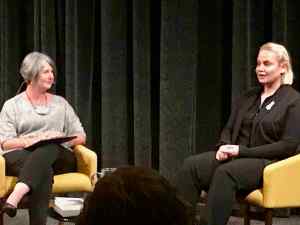
Louise Maher and Jelena Dokic

If you are a fan of professional tennis you will probably have heard of Jelena Dokic who hit the world stage during the 1999 Wimbledon Championships. She was just 16 years old, and, as Wikipedia writes, “achieved one of the biggest upsets in tennis history, beating Martina Hingis 6-2, 6-0. This remains the only time the women’s world No. 1 has ever lost to a qualifier at Wimbledon.” If you were an Australian tennis fan this was very exciting – or should have been. Unfortunately for Croatian-born Dokic, her tennis trajectory was one dogged by controversy, much of it caused by her abusive, controlling father. Her story, which she has documented in her book, Unbreakable, co-written with Jessica Halloran, is a tough one.

An author talk with a sportsperson about a co-written memoir would not necessarily be high priority for me, but if there’s one sport I love, it’s tennis, and Dokic’s story has implications that extend beyond tennis. So, with no competing events on that night, Mr Gums and I decided to go. It was in the form of a conversation between Dokic and local ABC presenter Louise Maher.

Jelena Dokic, Unbreakable

The conversation started with some introductory information. This included that Dokic had reached 4th in the world by the age of 19 years old, and that, due to the Yugoslav wars, she and her family had left Croatia for Serbia when she was 8 years old, and then emigrated to Australia in 1994 when she was 11. By 11 years of age, then, she’d already experienced far more trauma than most her age had experienced. When you add to this the fact that her father – who saw tennis as the opportunity for a good life – started abusing her from the minute he introduced her to tennis when she was 6 years old, you get the picture of a sad and lonely young person. It’s no wonder that the Australian tennis community – fans and players – found it hard to warm to her. No wonder, I say, but that’s no excuse. The failure of duty of care for this young person is clear – and her book has, apparently, got the international tennis world talking.

Now, I’m not going to give a blow-by-blow summary of the conversation, partly because it covered a lot of ground that is covered in the book, as well as in the various stories about her life that you can read on the Internet. Instead, I want to focus on the lessons and messages from the book (well, from what she told us about the book, as I haven’t read it.)

She had a few reasons for writing the book. One was to help others: she hopes by sharing her story, she will increase awareness of abusive parent-child relationships, particularly in sport, and thus help ensure it doesn’t happen to others.

Another reason is a more distressing one, in a way, and that is to enable Australians get to know her better – because the truth is that, due to her father’s abusive control of her, spectators never really got to know her, and as a result, they sometimes gave her a hard time. Some of this was racially or ethnically based – indeed she was told “to go back where you came from” – by several within and without the tennis world. The worst time for her, though, was when her father suddenly withdrew her from Australia, when she was 17 years old, to play for Yugoslavia. Her first major tournament after this was, unfortunately, the Australian Open – and the crowds jeered her. That’s hard enough for any-one, but for a 17-year-old girl who had no say in the matter, who was being abused by her father, it increased her sense of loneliness, of isolation, of having no support.

This issue of having no support is something she repeated several times in the conversation. When Louise Maher pressed her about her mother’s role, Dokic answered that her mother didn’t intervene. She wanted the family to stay together, and trusted her husband knew what he was doing!

Dokic provided various examples of her father’s abusive behaviour towards her, and of her desperation for a little praise that apparently never came (even after significant wins). She finally managed to “escape” home when she was 19-years-old – but life was tough, as she left with nothing, no money, no credit card. This is when, she said, she particularly needed support, but there was none.

I won’t continue, but there are some too-familiar lessons here, particularly the one that I’ll call the “turning a blind-eye syndrome”! There were people, Dokic said, who knew things weren’t right, but they were reluctant to get involved. And the media focussed on her father, enjoying the sensationalism of reporting on his behaviour – “Media thought he was funny, but he wasn’t”, she said. The didn’t pay any attention to what was happening to Dokic, or to the impact of their reporting on her. (I wished, that night, that I’d thought of my question about what she’d have liked the Media to do, before, not after, question-time finished!)

Dokic loved playing tennis, she said, but her father ruined her career. Tennis aficionados will, I’m sure, agree with her. She did look like achieving a come-back in her mid-to-late twenties but injury, illness, and surely the impact of all she’d suffered, meant there wasn’t the fairy-tale ending. Today she does sports commentating, motivational speaking and coaching.

There was a lot lot more – but if you’re interested, read the book!

Meanwhile, there are lessons to be learnt by the media, by spectators, and by tennis organisations about duty of care, particularly when reporting on, watching, or managing young players. What happened to Dokic could not have been completely avoided – its having started at home when she was a beginning 6-year old player – but it should not have gone on for as long as it did if people who knew, or even suspected, things were amiss, did something about it. I do hope this book has the effect that Dokic would like.

(Oh, and sitting next to me at this event was one of the ACT Litbloggers, the lovely Angharad of Tinted Edges. I look forward to seeing her post on it.)