Pottering around old Australian newspapers on Trove, I came across reports of a “plebiscite” on Australian poets and authors. Suggested by the Australian Literature Society, it asked readers of Melbourne’s The Argus newspaper to send in the names “of those whom they regard as the six leading poets and the six foremost writers of fiction of Australia and New Zealand”. Their aim was to discover which writers are held in esteem by their own people, and to gain some understanding of how interested the public is in the work of Australian and New Zealand writers.
I’m not going to focus on the “winners”, so before I continue, I’ll list the top six (with their “vote” count in brackets after their names). I understand about 4000 entries were received:
Poets
- Adam Lindsay Gordon (459)
- Henry Lawson (421)
- Henry Kendall (412)
- “Banjo” Paterson (393)
- C. J. Dennis (308)
- Bernard O’Dowd (189)
Prose
- Marcus Clarke (393)
- Rolf Boldrewood (315)
- Mrs Æneas Gunn (292)
- Henry Lawson (272)
- Roy Bridges (242)
- Ethel Turner (234)
They include two names I don’t know – poet Bernard O’Dowd and prose-writer Roy Bridges. It’s interesting to see no women among the poets, but two under prose. A woman, Mary Gilmore, did appear as the 7th poet, with 165 votes.
Dirty voting
How reliable though are these results? We aren’t told much about the source of the votes, but presumably most came from Melbourne and Victorian readers of The Argus. This plebiscite, like any, needs to be interpreted with regard to how it was conducted. There is, however, a complicating factor, as the unnamed author of the results announcement explains. S/he writes that:
in three instances concerted efforts were made to swing the voting … without regard to the merits of the writer for whom the votes were cast. These movements were entirely opposed to the spirit of the plebiscite, in which it was expected that the lists submitted would reflect the personal opinions of individual voters. These attempts were too obvious to escape notice, especially during the last few days, when several hundred lists were received bearing the same names with but slight variation. Had these votes been accepted the insult would have been that the names of writers who are comparatively obscure would have appeared at the head of each section.
Votes received via these “unfair” tactics – and we have to trust the administrators here – were not counted. The writer tells us they may not have identified all such votes, but believes the results give “a fair indication of public opinion”.
It was ever thus?
As we’ve discussed before in these historical reports, it is interesting, comforting even to some, that not much has changed over the decades. The unnamed author of the plebiscite announcement said that the aim of gauging interest in local writers
is of no little importance, in view of frequently repeated complaints that Australian authors do not receive the recognition that their work merits. Whether this feeling is justified or is the result of only an apparent indifference, there is some ground for the charge that Australians do not know as much about their own writers and their work as they might.
Sound a little familiar? Anyhow, because of this concern the Society was organising an Australian and New Zealand Authors Week in September 1927, the month after the plebiscite, to increase public awareness of its writers, to show “that we have a literature that is worthy of serious consideration”.
Have we made progress in this area? I’d like to think we have, and suspect we have, but we could still do better.
The dangers of prophecy
There were of course several articles discussing the results. One I’m saving for another post, as it contains a broader discussion of the state of Australian literature, but another by the Western Mail’s pseudonymous “Fairfax” is worth discussing here. He (I’m assuming) says that Katharine Susannah Prichard was the highest ranking Western Australian, appearing 12th in the prose list with 89 votes. He expresses surprise at Guy Boothby’s listing – for two reasons. First, he didn’t realise Boothby (who had lived much of his short his life in England) was Australian. And secondly, he was surprised at Boothby’s low vote, just 39. Boothby, though, had died in 1905, and according to Wikipedia was most noted for “sensational fiction”. Perhaps the voters knew what they were doing? Still, “Fairfax” calls him, seriously I think, “A Rare Talent” – and he was apparently mentored by Rudyard Kipling and appreciated by George Orwell.
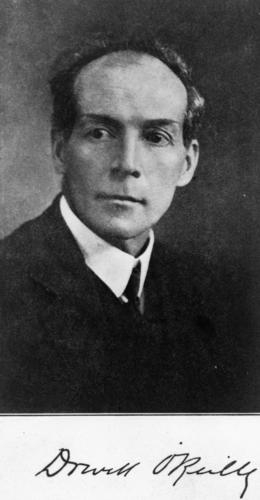
Dowell O’Reilly (Courtesy: State Library of Queensland)
Then “Fairfax” turns to poet and prose-writer Dowell O’Reilly who does not appear in the list of poets, and scored a mere 14 votes under prose. O’Reilly, a Sydney-based writer, teacher and politician, had died more recently than Boothby, in 1923. “Fairfax” admires him immensely, and devotes over three paragraphs, or half his article, to him. He discusses several of O’Reilly’s works, stating
There is feeling and a quick sense of beauty in his verse. In the best of his short stories and sketches … is a psychological penetration in understanding of character, actions, and emotions, a masterly economy and eloquent directness, in the presention of his matter a deep and understanding sympathy …
I love his description of O’Reilly’s short story titled “Crow”, in which, he says, “the horrors of a drought have moved O’Reilly to three pages of graphic pictorial quality akin to a sharp etching”. I found, via Google Books, a discussion of it, with excerpts, by Tom Inglis Moore (in a book titled Social patterns in Australian literature). It sounds powerful and bitter, and a little reminiscent, despite different concerns, of Barbara Baynton.
Anyhow, my point is that “Fairfax” argues:
I hazard that the volume containing The prose and the verse of Dowell O’Reilly which Angus and Robertson published in 1924 will survive when a great deal of work placed higher in these lists has been forgotten.
Hmmm … many of those higher in the list have been forgotten but so – at least to my knowledge – has been O’Reilly. “Fairfax” exhorts his readers to buy the book during Australasian Authors Week. I admire his enthusiasm if not his powers of prophecy!

 Whispering Gums