Satellite Boy (Movie review)

It’s disappointing to say the least that the new Australian film, Satellite Boy, is in very limited distribution. It was released 10 days ago, and in my city, with 6 cinema complexes, it is screening in only one. Why? It’s rather an indictment of Australian audiences that such a film is not receiving wider distribution.

Off the soapbox, now, and onto the film. Satellite Boy tells the story of Pete (Cameron Wallaby), who’s around 11 years old and who lives in an abandoned, derelict drive-in cinema on the edge of town with his grandfather, Old Jagamarra (David Gulpilil). His mother has left, but Pete is expecting her back to carry out their plan of turning the cinema into a restaurant. Meanwhile, Old Jagamarra and Pete learn that the land is to be taken over by a mining company, so Pete sets off, on bike, with his friend Kalmain (Joseph Pedley), to change the mining company’s mind. Shortly into what is supposed to be a 2-day ride, they end up on foot, walking through some pretty forbidding country. Pete confidently says to Kalmain:

If you walk country, country will look after you.
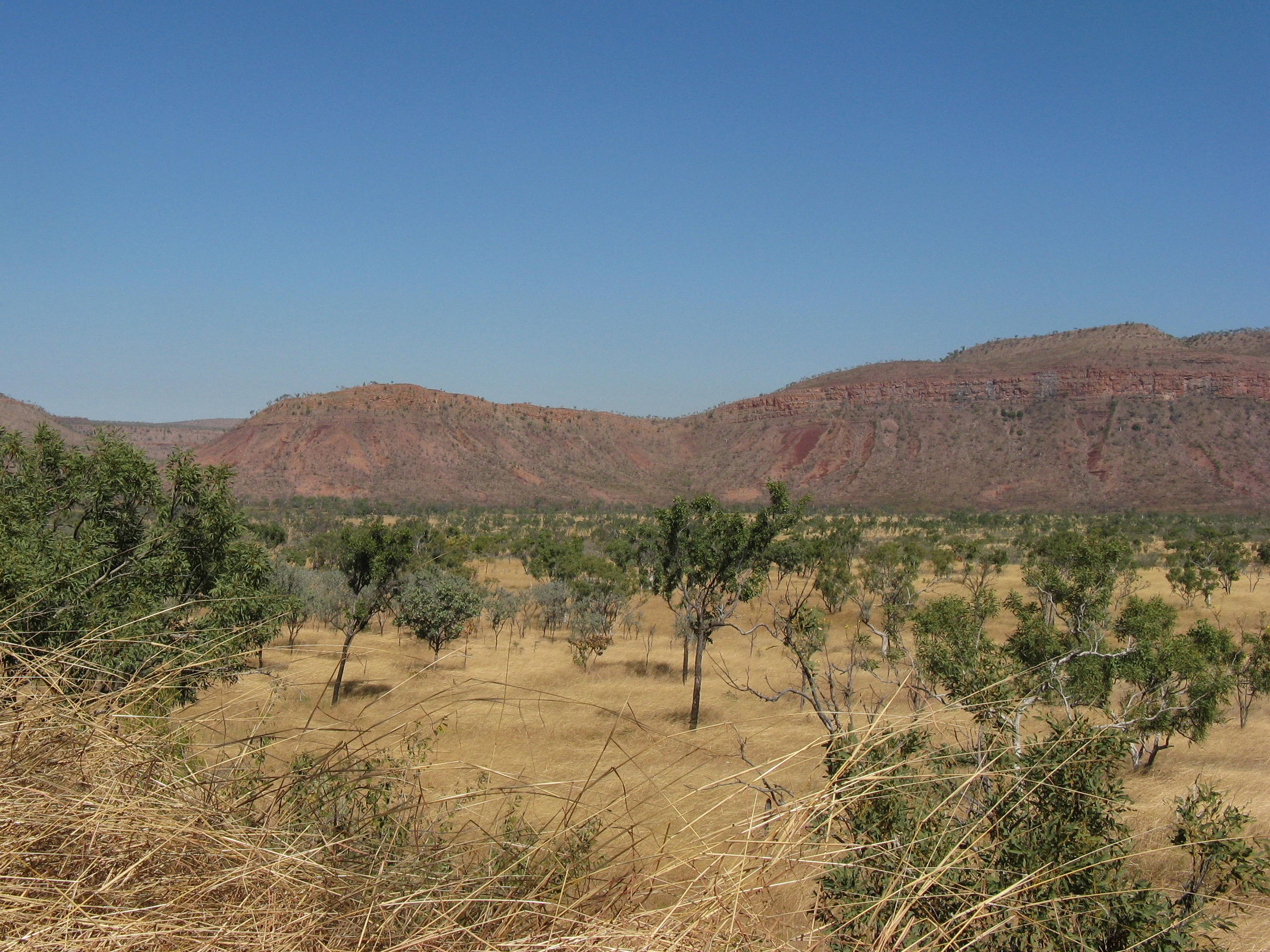
East Kimberley landscape

Between Wyndham and Kununurra

Of course, it’s not that simple. The Australian outback is a harsh place, and while indigenous Australians have traditionally lived in it, we know that Pete has not yet learnt enough to survive.  “I’m sick of your stories” he mutters at the beginning of the film as his grandfather tries to pass on knowledge. However, as indigenous director Catriona Mackenzie has said in interviews, Satellite Boy is not a realistic film.

This is an important point because, from a realism point of view, the film has holes. Firstly, for those who like accuracy in fiction, the story’s geography is out of whack. You don’t for example, travel to Kununurra from Wyndham via Purnululu (the Bungle Bungles) National Park. But then the destination is never named, so the geography only fails if you know the region. Not naming places helps McKenzie, who also wrote the script, give the film a mythic or fabular tone – and enables her to focus on country rather than place. The other “hole” is that the film does not confront, with any depth, the conflict between old and new, or the likely ramifications of Pete’s choice. Despite some hints of cultural conflict and dysfunction, particularly in Kalmain’s family, it’s not a gritty film, like, say, Samson and Delilah (my review).

Purnululu (The Bungle Bungles)

Walking in Purnululu (aka The Bungle Bungles)

And so, of course, Pete and Kalmain do make it through, albeit with some scary moments, particularly for Kalmain who doesn’t quite have Pete’s faith or knowledge (or the guiding spirit of a grandfather). Most of the film concerns their journey, which buys into both the picaresque tradition, and the “lost child” motif I’ve written about before. As the boys start to lose their way, moving deeper and deeper into forbidding landscape without food or water, the camera cuts between Pete trying to put into practice his grandfather’s lessons and Old Jagamarra, worrying, and willing them on.

At its heart, the film is a coming-of-age story, indigenous-style. It is about a young man learning about country and having to decide what it means for him. Catriona McKenzie said that

the notion of country from an Aboriginal perspective is that it supports your spirit. It sustains you on a spiritual level, as well as a physical one if you have that understanding. That’s what I was going for.

And is, I think, what she achieved.

I loved David Bridie’s music. It’s evocative and engaging, sometimes playfully toe-tapping as when the boys set off on their journey, other times moodily spiritual as when Old Jagamarra appeals to the sky spirits/ancestors to bring the boys home. That the sky and the Milky Way are important to indigenous Australians’ belief system is made clear in the film’s opening when Old Jagamara sings “Twinkle Twinkle Little Star” in language. This significance is reinforced when, a little later, the camera looks up from Pete’s bed to show us the ceiling decorated with star stickers – and again when, during their journey, the boys sleep in a satellite dish cradled between land and sky.

It’s a beautiful film, though also a slow one, which may be one reason why distribution is limited. Mr Gums felt the landscape photography was self-indulgent at times but, given the theme, I felt it was (mostly, anyhow) justified. The performances from the three main characters are excellent – Gulpilil is luminous, and newcomers Wallaby and Pedley are convincing.

The film was shown last year at Toronto International Film Festival. I wonder what that audience made of it. For me, it adds another perspective to the indigenous films that we are starting to see – not as tough as Samson and Delilah, not as joyful as Bran Nue Dae, but nonetheless thoughtful and relevant.

Satellite Boy
Dir: Catriona McKenzie
Prod: Satellite Films, 2012

Delicious descriptions from Down under: Hilary Mantel’s Cromwell on books

Portrait of Thomas Cromwell. New York, Frick C...

Thomas Cromwell, by Hans Holbein the Younger. New York, Frick Collection. (Photo: Wikipedia)

There are many delicious descriptions to choose from Hilary Mantel‘s Bring up the bodies, which I reviewed earlier this week, and some have already been posted by bloggers in other posts (such as John at Musings of a Literary Dilettante, Lisa at ANZ LitLovers, and Alex in Leeds). Their excerpts relate more to thematic issues, but I want to share one that just tickled my fancy. Thomas Cromwell is, we know, a reader. He comments, for example, on Machiavelli‘s The Prince, which was published in 1532.

I enjoyed this little description of Cromwell and books early in the novel:

After supper, if there are no messengers pounding at the door, he will often steal an hour to be among his books. He keeps them at all his properties: at Austin Friars, at the Rolls House in Chancery Lane, at Stepney, at Hackney. There are books these days on all sorts of subjects. Books that advise you how to be a good prince,  or a bad one. Poetry books, and books that tell you how to keep accounts, books of phrases for use abroad, dictionaries, books that tell you how to wipe your sins clean and books that tell you how to preserve fish. His friend Andrew Boorde, the physician, is writing a book on beards; he is against them. He thinks of what Gardiner said: you should write a book yourself, that would be something to see.

If he did, it would be The Book Called Henry: how to read him, how to serve him, how best to preserve him. …

I love this for several reasons, not the least of which is the insight it provides into publishing in the 16th century. I hadn’t realised quite how varied the output was. I’d also never heard of Andrew Boorde but he’s clearly well enough known to make it into Wikipedia (see the link on his name above). He’s also the subject of a delightful post I found from a blogger called Early Modern John who, as well as describing Boorde as “randy and carnivorous”, filled me in a little about the book on beards.

As with much of Mantel’s writing, though, this excerpt is enjoyable for other reasons, such as for the humorous reference to Machiavelli’s The prince; the sly reference to Stephen Gardiner whom Cromwell sees as his enemy; and the insight into Cromwell’s character, into his love of books and his focus on and loyalty to Henry (with whom, of course, he believes his own best chance of success lies!).

Hilary Mantel, Bring up the bodies (Review)

Hilary Mantel, Bring up the bodies

Courtesy: HarperCollins Australia

In her author’s note at the end of her second Thomas Cromwell novel, Bring up the bodies, Hilary Mantel writes that:

In this book I try to show how a few crucial weeks might have looked from Thomas Cromwell’s point of view. I am not claiming authority for my version; I am making the reader a proposal, an offer.

And what an offer it is! In my review of the first novel, Wolf Hall, I quote Cromwell’s statement that “…homo homini lupus, man is wolf to man”. This was related to the theme of the book – the machinations behind the scenes that change the world, something that we Australians are more familiar with right now than we’d like to be. (This is, in fact, a very modern book.) Anyhow, Bring up the bodies continues this theme but with a difference …

That difference is Thomas Cromwell’s motivations, but more on that anon. The plot concerns Henry’s desire to replace Anne Boleyn with Jane Seymour as his wife – and we all know where that led! It’s a much tighter plot – and a somewhat shorter book – than Wolf Hall. It takes place over about 9 months, from September 1535 to Summer 1536, and while the political climate is still evident – the continuing struggle to entrench the Church of England over the Roman Catholic Church and attempts at social welfare reform – politics and political change are not so much to the forefront in this second novel. Why? Well, because ….

Mantel wants to propose a motivation for Master Secretary Cromwell’s engineering of Anne’s downfall: revenge. Now, the word “revenge” is not, at least I don’t recollect it, actually used in the novel, though the softer word “grudge” appears a couple of times. But this is the motivation that Mantel proposes. It’s all to do with which men were and weren’t tried for treason (adultery with Anne) and their role in the downfall of Cromwell’s much-loved mentor, Cardinal Wolsey. Why, for example, was Thomas Wyatt never tried despite his professed attraction to Anne, while Henry Norris was? You’ll have to read the book – although you probably already have, given how late I am coming to it – to see Mantel’s proposition.

It is this revenge “take” on Cromwell that unifies Bring up the bodies in the way that the story of the separation of England from Rome and the Acts of Supremacy unified Wolf Hall even though both are ostensibly about the downfall of a queen. However, I don’t want to write a lot more about the plot and subject matter because I’m guessing many of the reviews before me have done that. What I want to write about is her writing. It’s breathtaking – the way she gets us into Cromwell’s head, the way she makes us feel the times, and particularly the way she uses language to drive the plot and themes.

Appealing to the subconscious, being almost subliminal, is common in fiction, I suppose, but Mantel does it with such aplomb. It’s the dropping of words and ideas that you barely notice or first notice and think they mean one thing only to find they are pointing to another. Take Wolsey for example. When he is first mentioned in the novel, it’s logical, it’s part of filling in the backstory that is common in sequels. But, the thing is, he is dead, long dead before this novel starts, and yet his name keeps cropping up. It’s always logical, but it starts to carry some larger weight – which becomes apparent as the denouement draws near. There are other words too – phantoms, spoils, truth, angels – which start to convey more than their literal meaning or which, through repetition, point us to larger meanings or themes. None of this is heavy-handed. You could almost miss it, but it’s there – drip, drip, drip.

If people had one criticism of Wolf Hall, it was Mantel’s use of the third person “he” for Thomas Cromwell. It seems Mantel took this to heart, so in Bring up the bodies she frequently qualifies the pronoun, using “he, Cromwell”. It does the job, though for one who didn’t find Wolf Hall a problem, it did feel a little clumsy to me at times – but I forgave her that. There’s so much to love.

Towards the end, during the process dissolving Henry VIII’s marriage to Anne Boleyn, the Lord Chancellor says

The truth is so rare and precious that sometimes it must be kept under lock and key.

This is deeply cynical (and ironic). The “council” of men has decided to grant the decree annulling the marriage but to keep the reason secret. Why? Because they really couldn’t agree on a valid one – they just knew it had to be done.

Bring up the bodies is a beautifully constructed but chilling novel in which Cromwell’s character becomes murkier and murkier. What’s to admire and what’s not is the question that confronts us every step of the way. Like many, I can’t wait for The mirror and the light, the next instalment of Cromwell’s story – and would love it if Mantel continued with the Tudors after that. What a fascinating time it was – and what a spin Mantel puts on it.

Hilary Mantel
Bring up the bodies
London: Fourth Estate, 2013
462pp.
ISBN: 9780007315109

Monday musings on Australian literature: ASA’s Authors Unlimited eBook portal

In her comment on my recent Monday musings about e-Publishing, Australian author Dorothy Johnston, whose novel The house at number 10 I reviewed recently, mentioned Authors Unlimited. I responded that I’d look into it and perhaps post on it. I did and now I am. Never let it be said that Whispering Gums is not true to her word. (Hmmm … perhaps you should ignore that … I don’t always follow through methinks, at least not promptly.)

Anyhow, Authors Unlimited is the “information and sales portal for authors, books and eBooks” for the Australian Society of Authors (ASA). The masthead on the homepage has the tagline “buy eBooks from Australian authors” but in fact it also contains pretty extensive information about Australian authors, who are members of the ASA, and their books*. So, for example, if you click on J under Authors, and then click on Dorothy Johnston you get some information about her (written by her) and a list of her books. To find out more about any particular book, click on a title and you’re taken to a page describing the book and providing publication details. If the book has an e-version – in ePub or mobi format generally – you can purchase it from that page … as I did for …

Kindle ebook ereader

Kindle (Courtesy: OCAL via clker.com)

… Johnston’s collection of short stories Eight pieces on prostitution. It includes her first story, “The man who came with the news”, which was published by Frank Moorhouse in State of the Art in 1983. It also includes a long story – almost a novella, she says – titled “Where the ladders start” and “Mrs B” which was included in Meanjin’s The Canberra Issue this year (my review). I have bought this book – for AUD9.95 – and plan to read it when I travel later in the year. Prices vary, but they all seem pretty reasonable to me.

I’m not an author or publisher, as you know, but Dorothy Johnston is enthusiastic about this initiative. I notice that popular Australian children’s writer Hazel Edwards (whom I mentioned in my post on the inaugural Canberra Readers’ Festival) is selling her novel Fake I.D. available through the site. It was originally published in 2002, and in her description of the book she writes “Originally a popular print book, now only available in e-format”.

And there’s the thing … Authors Unlimited provides a great opportunity for authors to publish their out-of-print books with the help of ASA. I presume most (all?) books published in the last two or more decades were published from electronic versions. It should be a relatively easy matter, technically, to convert them to one of the e-Book standards. Some books’ rights are, presumably, still held by publishers – and some publishers are now using e-publication for out-of-print backlists but it’s good to know that authors have another option. They can publish via ASA using its conversion process, sell via ASA’s ordering and delivery mechanisms, and promote via their own websites, Facebook pages, and so on …

Here’s to more options for authors  – to republish old works, as is or in new permutations, and to publish new work.

* I believe the author listings here are automatically fed through from ASA, and so includes many authors who do not have books for sale through the portal.

Vale Jeffrey Smart

There is a logic for writing a brief post on the death of an artist on my litblog …

For those of you who haven’t heard, the Australian artist Jeffrey Smart died today in Italy (20 June in the Northern Hemisphere), at the age of 91. He painted in a style described as Precisionism – and I wish I could include a couple of images here to show you, but of course they are still in copyright. A Google Images search on his name will, though, quickly introduce you to his work. His subject matter was urban – stark, often focusing on the industrial. Warehouses, roads, factories, high-rises – with nothing natural to soften them. There are often figures, but while they are to scale they tend to be overwhelmed by what’s around them. The figures are rarely personalised. The paintings are clean, geometric, stark and often bright in colour. They feel surreal.

I would call him spare (not minimalist which is something different). And regular readers here know I like spare. By spare in this context, I mean his art looks simple; your eyes can’t get lost – there’s nowhere for them to go. The shadows, any details, are up-front, in your face. And yet, there’s complexity – the meaning isn’t clear and we are forced to ponder what we think he is saying. I find his work beautiful but disturbing.

Given his style, I didn’t find it surprising that in an interview on ABC TV’s Talking Heads a few years ago, he said that he liked T.S. Eliot:

I was interested in poetry anyway. And the images were not about daffodils and roses in the spring, it was about vacant lots and suburban houses, slummy corridors – ordinary, ordinary things, made into great poetry. He was a brilliant man.

On tonight’s ABC TV report of his death, the newsreader quoted Smart as saying that he couldn’t use words so he articulated his ideas in art.

Smart was apparently a neighbour and good friend of Australian author David Malouf who also lived in Italy. Smart painted Malouf’s portrait but it’s not like any portrait of a writer I’ve ever seen – though it’s recognizably Malouf. You can see it on the ABC’s website.

These are a few reasons for writing about Smart on a litblog – but there’s another. And that’s the book of short stories, Expressway, which comprises “invitation stories by Australian writers from a painting by Jeffrey Smart hosted by Helen Daniel”. The painting is Cahill Expressway (1962) (image at NGV). The book was published by Penguin in 1989 and I read it with my reading group in 1990, too long ago now for me to write a review but not so long ago that I’ve forgotten it.

The book was the brainchild of Australian editor Helen Daniel. She chose the painting, and invited over 40 writers to write a short story in response. She ended up with 29 pieces from Australia’s established and emerging writers of the time. They include writers I’ve reviewed here such as Elizabeth Jolley, Kate Grenville, Barbara Hanrahan, David Malouf, Gerald Murnane, and Louis Nowra; those I’ve read before such as Glenda Adams, Peter Goldsworthy, Rodney Hall, and Janette Turner Hospital; and some I’ve still to read like David Foster, David Ireland and Finola Moorhead. It’s a gorgeous, special book that I have kept by my bedside for years.

I shall conclude with some lines from the wicked first story in the collection, “Art is dangerous. Not so?” by Morris Lurie. It’s about an art class:

‘So could we talk about, say, perhaps, what that certain something is, under the symbol, under the metaphor. Estrangement, someone said. Yes. Very good. Modern estrangement. Fine. So shall we, um, nudge that concept a little? Prod it? A poke? Zero in? Anyone? Too dangerous? Come on. Let’s be dangerous. Art is dangerous. Not so? Hmm.’

Here’s to dangerous art – and the artists who create it. Vale Jeffrey Smart!

Australian Women Writers 2013 Challenge completed – and Miles Franklin Award Winner 2013

Australian Women Writers ChallengeAs regular readers here know by now, last year I broke my non-challenge rule to take part in the Australian Women Writer’s Challenge. It was so satisfying, I decided to do it again this year. After all, it’s really the challenge I’d do when I’m not doing a challenge.

Like last year, I signed up for the top level: Franklin-fantastic. This required me to read 10 books and review at least 6. I have now exceeded this – and will continue to add to the challenge, as I did last year – but one of the requirements of completing the challenge is to provide a link to a complete challenge post. Here is that post.

I have, in fact, contributed 13 reviews to the challenge to date, but decided to wait to write my completion post until I’d read 10 books. I have now done that – with the other three being individual short stories or essays.

Johnston, House at Number 10 bookcover

Courtesy: Wakefield Press

Here’s my list in alphabetical order, with the links on the titles being to my reviews:

Except for the Baynton, Astley and Johnston reviews, they are all for very recent publications. I would like in the second half of the year to read some more backlist, more classics. Will I do it? Watch this space!

Miles Franklin Award winner for 2013 …

has been announced and it is Michelle de Kretser‘s Questions of travel. I’m pretty thrilled as this is the book my reading group decided to do in July (from the shortlist). As much as I enjoyed Carrie Tiffany’s Mateship with birds, it has won two significant awards this year already, and I don’t think it serves literature well for one book to have a stranglehold on a year’s awards – unless there really is only one great book published in a year but that would really be a worry wouldn’t it?!

You can read about the announcement on the Miles Franklin Literary Award site.

Monday musings on Australian literature: Prime Minister’s Literary Awards 2013 shortlist

We have been waiting, waiting, waiting for the announcement of the shortlist for the Prime Minister’s Literary Awards. The sudden resignation of the Minister for the Arts a couple of months ago seems to have caused a delay in this announcement, which was expected in May. It’s one of my favourite awards on the Australian literary calendar – partly because it operates out of my home town but mainly because the winners are often not the “usual suspects” from the other awards around the country. It will be a shame if politics gets in the way of its smooth running!

The press release announcing the shortlist reminded me that these awards are now in their sixth year – which is right because they were one of the exciting initiatives of the new Labor Government after it came into power in late 2007.

The winners are usually announced in July but I can’t see a date in the press release or on the page the release links to. More waiting methinks!

Anyhow, without anymore preamble, this year’s shortlist, drawn from books published in 2012, is:

Fiction
Floundering by Romy Ash (Also shortlisted for the Stella Prize and the Miles Franklin Award)
The Chemistry of Tears by Peter Carey (my review)
Questions of Travel by Michelle de Kretser (I’ll be reading this in July, at last! Also shortlisted for the Stella Prize and the Miles Franklin Award)
Lost Voices by Christopher Koch
Mateship with Birds by Carrie Tiffany (my review. Won the Stella Prize and shortlisted for the Miles Franklin Award)

Poetry
Burning Rice by Eileen Chong
The Sunlit Zone by Lisa Jacobson (also shortlisted for the Stella Prize)
Jam Tree Gully: Poems by John Kinsella
Liquid Nitrogen by Jennifer Maiden
Crimson Crop by Peter Rose

Non-fiction
Bradman’s War by Malcolm Knox
Uncommon Soldier by Chris Masters
Plein Airs and Graces by Adrian Mitchell
The Australian Moment by George Megalogenis
Bold Palates by Barbara Santich

Australian History
The Sex Lives of Australians: A History by Frank Bongiorno
Sandakan by Paul Ham
Gough Whitlam by Jenny Hocking
Farewell, Dear People by Ross McMullin
The Censor’s Library by Nicole Moore

Young adult fiction
Everything left unsaid by Jessica Davidson
The Children of the King by Sonya Hartnett
Grace Beside Me by Sue McPherson
Fog a Dox by Bruce Pascoe
Friday Brown by Vikki Wakefield

Children’s fiction
Red by Libby Gleeson
Today We Have No Plans by Jane Godwin, illustrated by Anna Walker
What’s the Matter, Aunty May? by Peter Friend, illustrated by Andrew Joyner
The Beginner’s Guide to Revenge by Marianne Musgrove

Congratulations to all the authors and publishers shortlisted. May they not have to wait too long for the winners’ announcement!

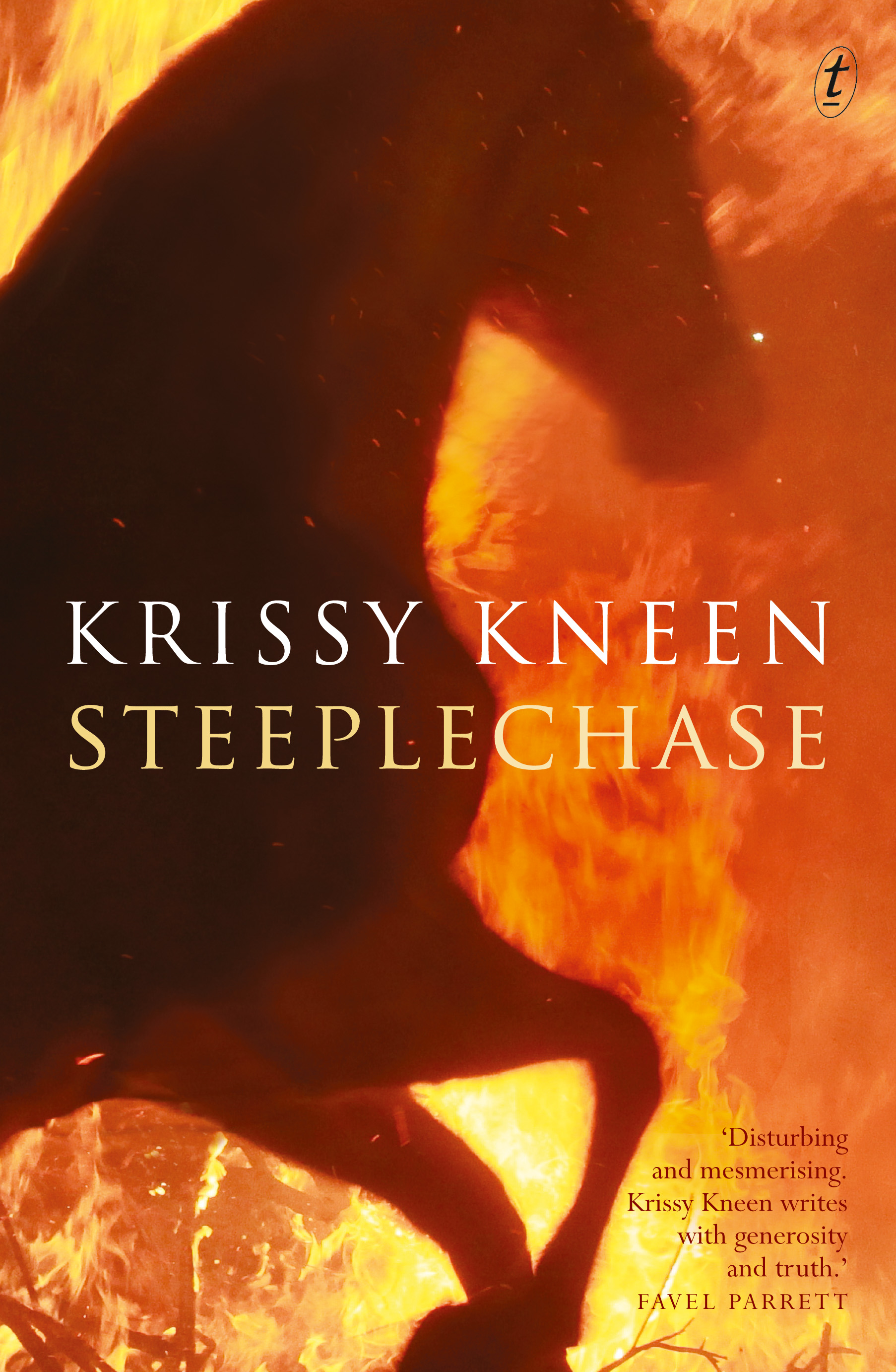
Krissy Kneen, Steeplechase (Review)

Krissy Kneen, Steeplechase

Cover: WH Chong (Courtesy: Text Publishing)

Darn that Australian Women Writers  Challenge! It has introduced me to a bunch of Aussie women writers I hadn’t heard of previously, one of whom is today’s author, Krissy Kneen. I may not have read her quite as soon as I have – there are so many I want to read – if it hadn’t been for Text Publishing sending me Steeplechase. It’s Kneen’s third book but first novel. She has also written Affection: An intimate memoir, which was shortlisted in 2010 for the non-fiction prize in the (now-defunct) Queensland Premier’s Literary Awards, and Triptych a work of literary erotica. Steeplechase, the frontmatter tells us, is Kneen’s first non-erotic work.

It is a contemporary novel about two sisters, told in first person by the younger, Bec. Both are artists, but while Bec is an art teacher who also paints and exhibits, her sister Emily is a wildly successful artist whose works have been sold for astronomical prices by Sotheby’s. Bec, 40, lives in Australia, and Emily in China. They hadn’t seen or spoken to each other for 23 years when, out of the blue, at the beginning of the novel, Emily calls Bec and invites her to Beijing, telling her she has already bought the plane ticket. So the novel begins, and gradually the cause of their separation, “the terrible thing”, is revealed. It involves madness … Madness and art. An irresistible subject.

Kneen plots the story well, interspersing the present chronology with flashbacks. The sisters’ mother, we’re told, was mentally ill, and the three of them – mother and daughters – lived in the country with their grandmother Oma, an art conservator. She’s a strong woman, a matriarch, is Oma. The steeplechase metaphor is introduced in the first chapter, through imaginative play directed by Emily in which the girls pretend to be horses galloping and jumping through a course designed by, yes, Emily. “The steeplechase is dangerous”, Emily explains to Bec.

At first it seems that Emily is the typical bossy big sister, who likes to control and scare her little sister. And Bec is the typical younger sister, adoring and long-suffering. Gradually though it becomes clear that something is not quite right with Emily, that she is going the way of her mother. Around this time we “meet” Raphael who may, or may not, be Emily’s lover and who, on one dramatic night, seems to also become 15 year-old Bec’s lover. But, is he real? (According to the 16th century art historian and biographer, Vasari, the artist Raphael died prematurely due to a fever brought on by a night of excessive sex! I suspect the choice of name isn’t a coincidence.) Kneen teases us throughout with questions of reality and fantasy, drawing us into a world where it’s hard to know where “madness” may start and end.

Meanwhile, in the present, the novel starts with Bec recovering from gall-bladder surgery. She returns to work where we meet, among her students, 23-year-old John who is her lover. Bec, “the good girl”, feels guilty about this, recognising the ethical dilemma it creates.

But, that’s enough of the plot … It’s certainly more than I usually provide in my reviews but this is, largely, a plot-driven book. How is Emily now? Will Bec go visit her? What was “the terrible thing”? Why is Bec signing paintings in Emily’s name? Does John really love Bec? Is Bec a good artist? And, even, is Bec herself sane? These are some of the questions that arise as the novel progresses.

Australian Women Writers ChallengeSteeplechase is compelling. It’s well-written and surely structured, with the shifting between present/life and past/memory all but coalescing at the climax. Kneen draws clearly but not slavishy on the traditions of the Gothic and mad-women. She teases us with paradox – Emily’s calm ordered room versus Bec’s messy chaotic one – and irony. Are they really “safe, protected, locked up tight” when Oma closes up the house at night?

I enjoyed her sensitive depiction of sisterly relationships, of the rivalry that runs parallel to unconditional love. She explores what happens when two sisters end up in the same career, one successful and the other not obviously so, and the lack of confidence that can ensue. We believe Bec’s self-assessment that she’s lesser, though there is a hint partway through the novel that she may be better than she thinks. Kneen weaves this though a story that explores madness, art, and memory that threatens to derail. My only reservation is that for a book which ponders the complexity of love (sibling and romantic), the nexus between madness-sanity and art, and the role of memory in constructing self, the resolution is just a little too neat. But that may just be me! It is, for all that, a darn good read.

Lisa (ANZLitLovers) also enjoyed the book.

Krissy Kneen
Steeplchase
Melbourne: Text Publishing, 2013
224pp
ISBN: 9781922079879

(Review copy courtesy Text Publishing)

What is literary fiction? A personal manifesto!

I was pottering around the Internet last night, as you do, and found myself on a State Library of Victoria page titled Novels: Finding Literary Reviews and Criticism and there I saw this definition of Literary Novel:

Literary fiction focuses on the subjects of the narrative to create introspective, in-depth studies of complex characters. The tone of literary fiction is usually serious, it has layered meanings and the pace is slower than lighter fiction. Much of this literature remains relevant for generations, even centuries.

There’s no source for this definition – though it may have been partly drawn from Wikipedia. This definition is followed by one for Popular or Genre Novel:

Usually the plot is important in the popular novel, the pace is faster and the characterisation is uncomplicated. Action is more important than reflection. Murder/mysteries, thrillers and romances fall into this category.

Help Books Clker.com

(Courtesy OCAL, via clker.com)

Now, I’m particularly interested in this topic at the moment because I’m coordinating the “Literary” category for the Australian Women Writers’ Challenge. Each month I write a round-up of the previous month’s reviews for literary fiction (and literary non-fiction, but that’s not my topic here). The first thing I do is review the reviews (ha!) to see what has been categorised as “literary” – and each month I change a few, mostly by adding “literary” to some titles that haven’t been so classified.

My challenge is to have some basis for making these decisions. Fortunately, it’s not brain surgery so, while feelings may be hurt at times – though I really hope that doesn’t happen – no-one is going to die if I do or don’t label a book as “literary”. Phew!

I don’t fully agree with the State Library of Victoria’s definition, though it has some validity. Being multi-layered, particularly in terms of meaning, and being universal or likely to have longevity are valid criteria – and they certainly play a role in my categorisation. Characterisation is a bit trickier. Genre fiction can have complex characters, though perhaps not quite so much complex characterisation, if that makes sense.

Risky business …

But, the defining characteristics for me have to do with language and with innovation. Fiction I classify as “literary” uses language that challenges its readers. This isn’t to suggest that “genre” fiction is badly written, but that the focus of “genre” fiction is something else, usually plot or character. It also doesn’t suggest that genre fiction writers can’t have a message or serious intent. They can, but they want to convey that primarily through the story, rather than through linguistic devices.

Fiction I classify as “literary” also tends to be innovative. That is, it may play with voice, narrative structure, grammar and syntax, with imagery, form, tone, and/or expectations. This doesn’t mean that “genre” fiction can’t also be literary. It can, but I would call it literary when the writer manipulates or diverges in some way from the expectations of the genre.

Literary fiction, in other words, tends to take risks. Take some (mostly Australian) examples:

  • Courtney Collins’ The burial (my review) is historical fiction, perhaps even historical crime, but I’d label it literary for a number of reasons, one being its voice. It is told in the voice of a dead baby, who operates mostly as an omniscient narrator but who, occasionally, injects her own feelings.
  • Carrie Tiffany‘s Mateship with birds (my review) could also be labelled historical fiction but I’d label it literary on multiple fronts, one being form. Interspersed with the main narrative are a log book documenting the life cycle of a kookaburra family, a nature journal, various lists, a bit of a diary, to name a few departures from straight story-telling. These are not just there for the sake of it; they enhance the meaning.
  • Martin AmisTime’s arrow (read before blogging) is a Holocaust novel that plays big-time with narrative structure. It’s graphically told in rewind – and, in doing so, manages to increase the horror.
  • Markus Zusak‘s The book thief (my review) is another Holocaust novel. It plays with tone (and related to that, voice). It’s humorous – a Holocaust novel humorous? – and is narrated by Death. Shocking! And therein lies its impact.
  • Peter Carey’s True history of the Kelly Gang (read before blogging) and Louis Nowra’s Into that forest (my review) disobey the rules of grammar and syntax to create unique voices for their protagonists, the uneducated Ned Kelly for Carey, and a feral child for Nowra. Doing this risks alienating readers but, on the other hand, increases the realism.

But, do we want to classify “literary fiction” …

I think we do, mainly because many readers do have reading preferences. If we don’t have a “literary” category, how would readers like me find the sorts of books we like to read? And, where would those books that don’t seem to fit any “genre” go? Bookshops differ of course. Some categorise the main genres – crime, fantasy, etc – and lump the rest as general fiction. Others don’t categorise at all and simply shelve alphabetically, while others do have a literary fiction section. They may not always get it right – by my definition – but I appreciate that they try.

The point is, this is not about snobbery. It’s not about good-versus-bad. That’s a completely different judgement, one that can occur as much within as between genres/categories – and is why there are genre-based awards, as well as literary awards. No, it’s simply about making it easy for readers to find the sort of books they like – and surely, that’s a good thing?

Do you have thoughts on the subject?

Monday musings on Australian literature: Specialist presses

I’ve written Monday musings before about publishers, including posts on small presses and university presses. Today I’m bringing you another – about publishers which specialise in a certain “type” of literature. As with my other posts of this type, this won’t be comprehensive, but will comprise a selection whose specialties interest me! Here they are – listed in their order of longevity, as far as I can tell.

Currency Press

subtitles itself, “the performing arts publisher”. It’s the one I’ve known for the longest, which is partly due to the fact that it’s over 40 years old and partly because its subject area crossed my professional life. It started in 1971 as a publisher of plays, but has expanded significantly since then to “screenplays, professional handbooks, biographies, cultural histories, critical studies and reference works” in the performing arts area. In 2011, its 40th year, Currency Press received an AWGIE Award for its outstanding contribution to the performing arts. Among their new releases is a book that was launched at the Sydney Film Festival today. It’s by film academic, Sylvia Lawson, and is about my favourite Australian documentary, The Back of Beyond (1954). If you want to find the script of a film or play by Australian greats like, say, Andrew Bovell or David Williamson, Currency Press would be your first stop.

Five Islands Press

is one of several small publishers which specialise in Australian poetry. I’ve chosen them to represent this special interest area because it is one that I often see around the traps though I haven’t yet reviewed any of their publications. They were established in 1986, and aim to publish both established and emerging poets. In 2012 they published Lisa Jacobson’s verse novel, The sunlit zone, which was shortlisted for this year’s inaugural Stella Prize.

Magabala Books

describes itself as “Australia’s oldest independent Indigenous publishing house”. It was established in 1990, and is located in gorgeous Broome. It is a non-profit organisation that aims “to preserve, develop and promote Australian Aboriginal and Torres Strait Islander cultures”. It has, to date, published more than 100 titles in a wide range of forms and genres from children’s picture books to adult fiction, from poetry to contemporary non-fiction. Their list of authors is extensive and would be a great place to start, particularly for authors not well-known in the mainstream.

Spinifex Press

describes itself as “an award-winning independent feminist press, publishing innovative and controversial feminist books with an optimistic edge”. I’ve read a few books from them during my blogging career – Merlinda BobisFish-hair woman, Francesca Rendle-Short’s Bite your tongue, Sefi Atta‘s A bit of difference and, just yesterday, Susan Hawthorne’s Limen. According to the About Us page on their site, the press was established by Susan Hawthorne and Renate Klein in 1991, one year after Magabala, and now has over 200 titles in print. They were, they say, the first publisher to set up an interactive site based on a book (for Building Babel in 1996) and the first small press in Australia to release eBooks through an eBookstore attached to their own website. They publish Australian and overseas writers, including many works in translation. I’ve thoroughly enjoyed the books of theirs that I’ve read. Their books aren’t all overtly political but all deal in some way with women’s experience. Spinifex seems to be a good example of what a small publisher with a very focused goal can do.

Spineless Wonders

is a relatively new kid on the block, having been established, as far as I can tell, around 2011. (Don’t you wish all organisations included a little bit of their history on their websites?) Anyhow, Spineless Wonders is “devoted to short, quality fiction produced by Australian writers … [to] brief fiction in all its forms – short story, novella, sudden fiction and prose poetry”. Their name refers to the fact that their publications are “delivered to readers via  smart phones and laptops”, but they do publish in print form, and also audio. Check Litblogger Angela Meyer’s interview at crikey.com with the founder, Bronwyn Mehan, for some background to her philosophy.

To conclude …

That’s five, and probably enough to get you thinking about the breadth of publishing out there. There are plenty of others, including publishers for genre fiction (such as Pulp Fiction Press), children’s literature (such as New Frontier Publishing), regionally-focused publishers (such as Backroom Press in the Kimberleys), not to mention education publishers, religion publishers, and so on.

Do you have any favourite specialist presses you go to for specific reading interests?