Man Asian Literary Prize 2011 Shortlist announced

Shadow Man Asian Literary Prize 2011 Badge

Image created by Matt Todd of A Novel Approach

… And my preferred two books – those by Ahmad and Yoshimoto – of the three I’ve read are in the final seven books. Woo hoo … but I have a lot to read to catch up to the rest of the team.

The shortlisted books are:

  • Jamil Ahmad’s Wandering falcon
  • Jahnavi Barua‘s Rebirth
  • Rahul Bhattacharya’s The sly company of people who care
  • Amitav Ghosh‘s River of smoke
  • Kyung-Sook Shin’s Please look after mom
  • Yan Lianke‘s Dream of Ding Village
  • Banana Yoshimoto‘s The lake

You can find our  Shadow team’s reviews by clicking the team logo in the blog sidebar or by clicking on the Man Asian Literary Prize 2011 page.

Monday musings on Australian literature: Guest post from Kim of Reading Matters

This week’s Monday musings brings you my fourth guest post, this time from Kim of Reading Matters. Like Guy, Kim started commenting on my blog in its infancy and I soon discovered that this blogger from England was actually an Australian. Naturally we developed a rapport. I have appreciated Kim’s support of my blog – through regular commenting  (particularly in my fledgling days) and through inviting me to be a Triple Choice Tuesday guest. She is one of England’s top litbloggers and this month is hosting an Australian literature month as I advised in last week’s Monday Musings.

I’m thrilled that Kim decided to write on children’s literature. Her guest post on children’s classics beautifully complements Louise’s recent post on current writers/illustrators.

Australian classic books from an Australian childhood

When you are an Australian expat who’s lived overseas for as long as I have (13 years and counting…) it’s easy to think you’ve never lived anywhere else. Then you have little “cultural blips” that rudely remind you that you grew up on the other side of the world.

For me, these “blips” usually occur when friends and colleagues start reminiscing about sweets (or should that be lollies?) from their childhood that are no longer available, or British TV shows they watched when they were growing up which were never screened in Australia. Once I had to sit in on a lengthy discussion about children’s literature where many of the references went completely over my head.

This got me thinking about my favourite books from childhood, all by Australian authors, which do not appear to have ever attracted an international audience. Here are three classics, none of which have been out of print in Australia, that mean a lot to me:

Blinky Bill by Dorothy Wall

Dorothy Wall (1894-1942), a New Zealand-born Australian, originally illustrated books for other writers before creating her own series about a mischievous male koala called Blinky Bill. The first book — Blinky Bill: The Quaint Little Australian— was published in 1933 and two others followed — Blinky Bill Grows Up (1934) and Blinky Bill and Nutsy (1937).

My aunt had three books in one beautifully bound volume. I still remember the distinctive red cover and the cheeky little picture of Blinky Bill, wearing bright orange trousers, toting a swag and billy can on a stick slung over his shoulder. It was always a real treat when I was allowed to take the book down from the shelf and look at the colour-plates inside. I remember turning the pages with awe and being very careful not to mark the book in any way.

Funnily enough I can’t really remember what the stories were about, but I remember the pictures with almost perfect clarity, they were so vivid and funny.

I’m delighted to say that you can read the text online at Project Gutenberg Australia

The Muddle-Headed Wombat by Ruth Park

The muddle-headed wombat by Ruth Park, book cover

Ruth Park (1917-2010), yet another New Zealand born author who called Australia home, also turned to Australian wildlife for inspiration.

Her main character was a wombat — a creature with which many non-Australians may not be familiar, think of a very cute furry pig with a cheeky face and short stumpy legs — whom was very muddle-headed.  He spoke in spoonerisms and misused similar sounding words — for instance “sensibubble” instead of “sensible” — which meant he often said very funny things without realizing it.

Wombat, as he was officially known, had two friends — a skinny grey cat called Tabby and a practical female mouse called Mouse — whom accompanied him on all kinds of adventures.

I can only recall vague details of particular stories — there were more than 16 in the series, all written between 1962 and 1971 to accompany an ABC radio show, which was cancelled by the time I was born. For instance, in one story Wombat bought a bicycle with shiny red wheels and in another he ate some chalk that made him sick.

But it was the quite hilarious illustrations that I remember most — along with the cute red jacket and floppy purple hat Wombat used to wear!

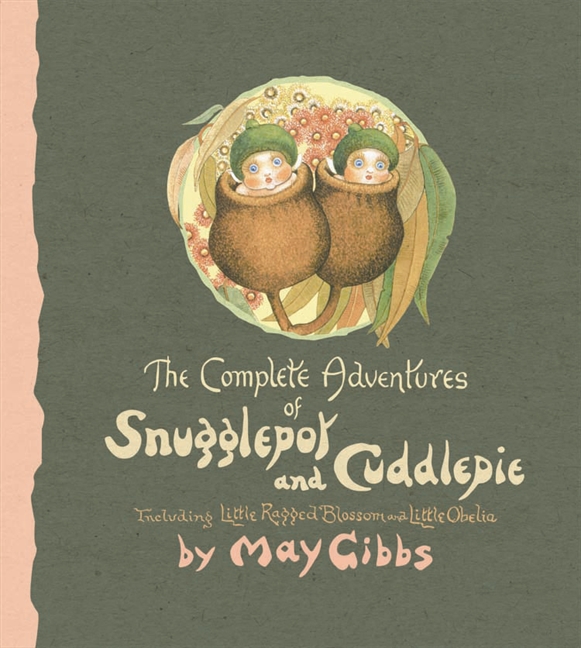
The Adventures of Snugglepot and Cuddlepie by May Gibbs

May Gibbs' Snugglepot and Cuddlepie

May Gibbs (1877-1969) was an English-born Australian writer and illustrator whose stories were inspired by Australian native flora.

She’s probably best known for her gumnut babies, Snugglepot and Cuddlepie, who are cute little foster brothers that resemble eucalyptus nuts.

The pair go on an adventure in the Australian bush, but they have to take care not to run into the big bad Banksia men — horrible creatures modeled on banksia cones, which are a bit like hairy pinecones.

As a child I remember being physically scared of the Banksia men, but as ever in the world of children’s literature, good overcomes evil and they sink to the bottom of the sea!

The best part about Snugglepot and Cuddlepie, which was first published in 1918, are the truly beautiful illustrations by the author. To this day these illustrations are used on all kinds of merchandise, but what I hadn’t realized until I started writing this piece is that all profits go to UNICEF, the Spastic Centre of NSW and the NSW Society for Crippled Children (now the Northcott Society), according to the wishes of May Gibbs’ bequest.

May Gibbs home Nutcote, on the shores of Sydney Harbour, is also open to the public.

I suspect that all three books, with their emphasis on Australia’s unique plants and animals, may be responsible, not only for my love of Australian literature, but my love and respect of the Australian bush, too.
Shadow Man Asian Literary Prize 2011: Reviews from the week January 1-7

Shadow Man Asian Literary Prize 2011 Badge

Image created by Matt Todd of A Novel Approach

Week 8 of our Shadow Man Asian Literary Prize 2011 longlist reviewing project and we now have only a few days to the shortlist announcement on January 10. This week’s reviews are:

  • Tahmima Anam’s The good Muslim (Bangladesh) by Fay of Read, Ramble. She says “it is beautifully structured, the story well told, the characters alive” and believes it will be one of the short-listed novels. We’ll soon know!
  • Tahmina Anam’s The good Muslim (Bangladesh) by Mark of Eleutherophobia. He concurs with Fay and our other reviewers that it is a strong contender for the shortlist. He calls it “a brave and important book”.
  • Jahnavi Barua’s Rebirth (India) by Stu of winstonsdad. Stu makes a great point about its universality, which makes me keen to read it … but this book has been one of the two most difficult of the longlist to track down.
  • Rahul Bhattachariya’s The sly company of people who care (India) by Lisa of ANZLitLovers. She says that “this is a remarkably clever book; I’m not surprised that it won the Hindu Literary Prize.”
  • Mahmoud Dowlatabadi’s The colonel (Iran) by Fay of Read, Ramble. She found it an intense read, “a powerful book. Overpowering”. I feel this is one I should read.
  • Tarun Tejpal’s The valley of masks (India) by Matt of A Novel Approach. He loved it but called it “the black sheep of the list”. Now that’s got me intrigued!
  • Banana Yoshimoto’s The lake (Japan) by Mark of Eleutherophobia. He’s not greatly enamoured saying it “drowns in introspection and self-doubt” but he says he’d read another Yoshimoto (so it’s clearly not all bad!)

Other Shadow Man Asian news

  • The shortlist will be announced next week, on January 10th … watch our spaces!
  • I have made it easier for you to find all our reviews now by creating a page listing the books in alphabetical order by author, with links to our team members’ reviews. Click on the Man Asian Literary Prize page tab or our Shadow Man Asian Logo in my sidebar to access the list.
  • If you missed it, I posted my third review this week:  Jamil Ahmad’s The wandering falcon. I do hope that one of two of those I’ve read make the shortlist!

Jamil Ahmad, The wandering falcon (Shadow Man Asian Literary Prize 2011)

Map of Pakistan

Pakistan, with borders (Courtesy: Omer Wazir via Flickr using CC-BY-SA 2.0))

I’m not sure how to describe Jamil Ahmad’s Man Asian Literary Prize novel, The wandering falcon. Is it a disjointed novel, a picaresque, or a collection of connected short stories? It doesn’t matter greatly – it is what it is – but at least by raising the question I’ve given you a sense of how it feels to read this book.

There’s much to fascinate here, not least of which is that this is a debut novel by an author who was born in 1933. Another late bloomer (though he apparently wrote the stories back in the 1970s). Ahmad worked in the Pakistani Civil Service and spent many years in the region he writes about. The book is set in the decades before the rise of the Taliban and presents – explores – life in the multi-tribal region on the borders of Pakistan, Afghanistan and Iran. Fascinating stuff for a reader whose knowledge of this area is general.

There are nine chapters/stories, each having a unique title like “The sins of the mother”, “A point of honour”, “A kidnapping” and each telling a story from the life of a tribe/clan in the region. What unifies these is the character, Tor Baz, who is the wandering falcon of the title. He is born in the first chapter to a couple on the run for disobeying tribal laws of marriage. This chapter, “The sins of the mother”, sets a rather brutal tone for the novel, a tone that carries through into many of the succeeding stories (or events). This is a region where people live by tribal loyalties (and, of course, rules) and where the imposition of borders cuts across tribal life, particularly for those tribes that are nomadic. In the third story, “The death of camels”, the nomadic Pawindahs want, indeed need, to cross borders as they always have, but are told they need travel documents. Their leader says to the government official:

‘… We are Pawindahs and belong to all countries or to none. [ …] What will happen to our herds? … Our animals have to move if they are to live. To stop would mean death for them. Our way of life harms nobody. Why do you wish for us to change?’

Why indeed?

As you will have guessed from my opening sentence, this is not a strongly plot driven book. Ah, now this is where form becomes an issue. We don’t expect a collection of short stories (connected or otherwise) to have a strong plot and so this, probably, is what it is. But there is a linear chronology running through the book. It’s tracked through our falcon Tor Baz who pops up, for one reason or another, in different tribes, from his birth in the first chapter to the end when he’s a man. We see him in various roles, including informer and guide, but we never really get to know him – and for some reason this doesn’t seem to matter. It simply adds to the feel of the book, which is simultaneously fabular and grounded in reality.

The voice is third person, with the startling exception of one story that is told first person by an outsider, a part Afridi returning to his father’s birthplace. If I have a criticism of the book it’s that occasionally the voice becomes a little didactic, a little inclined to tell us some facts rather than show us, but this isn’t often and it’s not heavy-handed enough to spoil the read.

What makes this book stand out is the writing. It beautifully (if one can use such a word for the world it depicts) evokes the landscape we’ve become familiar with through television news and movies. Here is the novel’s second paragraph, describing a military post:

Lonely, as all such posts are, this one is particularly frightening. No habitation for miles around and no vegetation except for a few wasted and barren date trees leaning crazily against each other, and no water other than a trickle among some salt-encrusted boulders which also dries out occasionally, manifesting a degree of hostility. (“The sins of the mother”)

Hmm … “lonely”, “frightening”, “crazily” and “hostility. With words like this on the first page, you know you are not in for something light and cheery. The interesting thing though is that the book does not read as a diatribe or even as a plea. It’s more a description of people who accept their lives, despite the harshness and difficulty, lives where, for example,

If nature provides them food for only ten days in a year, they believe in their right to demand the rest of their sustenance from their fellow men who live oily, fat, comfortable lives in the plains. To both sides, survival is the ultimate virtue. In neither community is any stigma attached to a hired assassin, a thief, a kidnapper or an informer. (“A kidnapping”)

The book chronicles this life – its unforgiving landscape and sometimes brutal justice – and the changes that are starting to threaten centuries old traditions:

The pressures were inexorable. One set of values, one way of life had to die. In this clash, the state, as always, proved stronger than the individual. The new way of life triumphed over the old. (“The death of camels”)

This is a mesmeric book. We feel the author’s affection for the people, their traditions and the land, and we go with his acceptance of lives whose bases are so different to ours. It’s a book born of the earth but its spirit won’t be pinned down. An eye-opener, in more ways than one – and a worthy contender for the prize.

Note: For other Shadow Man Asian Literary Prize reviews, see Lisa of ANZLitLovers, Mark of Eleutherophobia, and Stu of Winstonsdad.

Jamil Ahmad
The wandering falcon
London: Hamish Hamilton, 2011
181pp
ISBN: 9780241145425

Monday musings on Australian literature: Some Australian Literature online events for 2012

What better way to kick off Monday Musings in 2012 than by heralding some exciting Australian Literature initiatives from around the ‘net. Here they are, in no particular order:

Australian Women Writers Challenge 2012 Badge

Badge (Design: Book'dout - Shelleyrae)

Australian Women Writers Challenge 2012 by Elizabeth Lhuede. Her aim is to promote women writers across all fields and genres of writing. The challenge involves signing up to read books – in any genre – by Australian women writers. You can focus on one genre or many, you can choose a level that suits you. I don’t usually do challenges, but this one is a no-brainer for me since I always try to read a goodly quantity of Australian literature each year and I love to read books by women. Last year I reviewed at least 14 Australian women writers and, in addition, wrote several posts on specific women writers and women’s literature issues. My aim will be to achieve a Franklin-fantastic Dabbler, that is, I’ll read (and review) at least 10 books by Australian women writers in more than one genre.

Australian Literature badge, by Reading Matters

One of the Australian Literature Month badges (by Reading Matters)

Australian Literature Month by Kim of Reading Matters. She plans to read lots of Australian books during her cold northern January (she would leave Australia!) and encourages readers of her blog, to do the same. As an incentive she has created several gorgeous badges for bloggers to attach to their posts reviewing Aussie books. Since seeing a platypus in the wild is on my bucket list, I have chosen her platypus badge for this post.

Australian National Year of Reading 2012 by WeLove2Read. This project is “a collaborative project joining public libraries, government, community groups, media and commercial partners, and of course the public. As well as creating specific new campaigns for the National Year of Reading, we’ll be using our joint efforts to bring together and showcase the wonderful projects and organisations across Australia which already exist to promote reading and literacy”.  (From the website) Keep an eye on the website for activities and events as they occur during the year.

2012 Aussie Author Challenge by Booklover Book Reviews. The challenge is to “read and review books written by Australian Authors – physical books, ebooks and audiobooks, fiction and non-fiction” (from the blog). There are two challenge levels and, like most challenges, a badge to add to your site. (I added this challenge after the post was published, as the result of Tony‘s recommendation. Thanks Tony.)

And so …

As you start your 2012 reading, do consider including some Aussie Lit into the mix and please let the people above know when you do. They will appreciate knowing that their work has hit some paydirt.

If there are other initiatives that I haven’t listed here, please let me know in the comments below and I will update this list.

Shadow Man Asian Literary Prize 2011: Reviews from the week December 26-31

Shadow Man Asian Literary Prize 2011 Badge

Image created by Matt Todd of A Novel Approach

Week 7 of our Shadow Man Asian Literary Prize 2011 longlist reviewing project and we’re moving along with less than two weeks now to the shortlist announcement. This week’s reviews are:

  • Jahnavi Barua‘s Rebirth (India) by Fay of Read, Ramble who thinks it has some interesting things to say about women’s lives in contemporary India but feels that it’s not fully successful as a novel
  • Amitav Ghosh‘s River of smoke (India) by Mark of Eleutherophobia. Mark liked it, with some reservations. He feels it’s a little overambitious, trying to do too much, but nonetheless calls it an “epic, intense, richly rewarding novel”.
  • Haruki Murakami‘s IQ84 (Japan) by Lisa of ANZLitLovers. Lisa didn’t like it much, echoing many of the bloggers’ reviews I’ve read, including Matt who has also reviewed it for our project.
  • Kyung-Sook Shin’s Please look after mother (Korea) by Mark of Eleutherophobia who liked it, calling it “a quaintly crafted story”.

And, of course, if you missed it, I posted my second review for the project this week: Banana Yoshimoto‘s The lake. My next one will be Jamil Ahmad’s The wandering falcon.