Monday musings on Australian literature: On the making of a classic

Having completed the book, I tried to get it published, but everyone to whom I offered it refused even to look at the manuscript on the ground that no Colonial could write anything worth reading. They gave no reason for this extraordinary opinion, but it was sufficient for them, and they laughed to scorn the idea that any good could come out of Nazareth – i.e. the Colonies. (Fergus Hume in the Preface to the 1898 revised edition of his The mystery of a hansom cab)

Rather coincidentally, I finished reading Fergus Hume’s The mystery of a hansom cab a few days after I wrote last week’s Monday Musings on nurturing Australian classics. The quote above doesn’t exactly relate to today’s topic on the creation of a classic but to the difficult business of getting published in the first place. However, it does lead nicely into today’s discussion, partly because a book must be published before it can hope to be a classic (duh!), but mainly because today’s topic was inspired by the new introduction to Sydney University Press’s 2010 edition of Hume’s novel.

In this introduction, Robert Dixon of Sydney University commences by stating that when people are asked to nominate the most popular Australian writers of the late nineteenth century they tend to name Marcus Clarke (The term of his natural life), Rolf Boldrewood (Robbery under arms), Banjo Paterson and Henry Lawson. They do not, in other words, mention Fergus Hume whose book achieved “impressive sales”. Nor do they mention writers like Ada Cambridge (whom I’ve featured in a past Monday musings). Why?

Dixon has some suggestions. One is commercial, that is availability. He quotes another academic in the field, Paul Eggert, as saying that a “consensus about the nineteenth-century classics emerged quite suddenly among reviewers around the Centenary year of 1888, which hardened into an orthodoxy” in early histories of literature. This resulted in Clarke’s, Boldrewood’s and Kinsley’s (The recollections of Geoffrey Hamlyn) novels becoming available cheaply and in quantity. But why these particular works? Well, Dixon says that there was a growing interest in the colonial past, an “emerging literary nationalism”, which

not only displaced a generation of female authors of domestic realism, such as Catherine Spence, Ada Cambridge and Catherine Martin, but also male writers of urban-based popular fiction, including Fergus Hume and Nat Gould.

He continues:

By the time the first critical evaluations of Australian literature came to be written in the early decades of the new century, Eggert notes, ‘the die had been cast’. The mystery of a hansom cab was urban, not pastoral, international rather than national in outlook, and ‘neither a detective story nor a turf tale* was going to compete seriously with the Kingsley-Clarke-Boldrewood trio’.

Interesting, eh? The logical outcome, of course, is that if a book is overlooked early in its life (due to “fashion” or the “fickle finger of fate”) it has a hard road back to serious recognition. But then, feminist studies over the last half century have already shown us how books (art, music, or whatever endeavour you care to mention) by women have regularly been overlooked by the creators of “the canon”.

It would be nice to think that “quality” (I’m not going to get into definitions of that now) will rise to the top but, while we probably agree in general that those books currently labelled “classics” are so, it’s pretty clear that there are many more works out there equally deserving of the label – if only we knew about them. That’s the real pity of it … so I’d like to thank all those publishers who, over recent years, have sussed out “quality” older works and re-introduced them to us. I hope they keep doing so.

All that said, it begs the question about today’s authors and books, doesn’t it? Will the swag of awards we have now be the arbiter of what become future classics? Or will best-selling status be the go? Will future publishers suss out the overlooked – and what will they be? Oh for a crystal ball.

Addendum to last week

In last week’s post I reported that Melbourne University did not teach one Australian literature course in 2011. Here is student Stephanie Guest’s take on the situation as she reported in the Australian Book Review (undated):

… at the University of Melbourne, there was only one subject on Australian literature, ‘The Australian Imaginary’. To my chagrin, the handbook reported that it was not available in 2011. There may be specialised branches of Australian literature taught in Croatia and Texas, but at Melbourne there was not even a general course on offer. The carelessness towards Australian literary studies was clear from the listing in the course curriculum of Murray Bail as ‘Murray Bird’.

The head of the English department told me that staff shortages, reduced funding for the Arts Faculty, and low student interest in the subject were responsible for the absence of Australian Literature in 2011.

* Nat Gould’s milieu
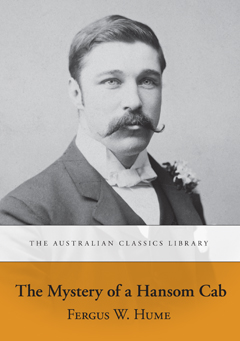
Fergus W. Hume, The mystery of a hansom cab (Review)

Hume Mystery of a Hansom Cab

The mystery of a hansom cab (Courtesy: Sydney University Press)

Sometimes you just have to break your reading “rules” don’t you? Two of mine are that I’m not much into detective fiction (despite having reviewed Peter Temple’s Truth here) and I don’t read self-published books – but then along came Fergus Hume‘s The mystery of a hansom cab. It’s a classic Australian crime novel – and it was “originally” self-published (says she cheekily)!

I’m not, you now know, an aficionado of crime fiction, so my assessment of this book may be the skewed one of a newbie not versed in the intricacies of crime writing. However, I must say that I found this a thoroughly enjoyable and engaging book, and would recommend it to crime and non-crime readers alike, for reasons that will soon become obvious. But first, the plot.

The story commences with a newspaper report of a murder that takes place in a hansom cab, and over the next few chapters we learn the name of the victim (a young man, Oliver Whyte, who was drunk at the time of his death) and that he was killed by a passenger who got into the cab, ostensibly to see him safely home. The detective on the case fairly quickly deduces that the murderer is a rival for the affections of a young society woman … and from here, as it always does, the plot thickens. The accused murderer declares his innocence, that he indeed has an alibi, but he will not divulge the information it would “curse” the life of his fiancée. The trial occurs and is resolved halfway through the novel. The rest explores … but wait, if I tell you this, I’ll give too much away, so I’ll stop here. The resolution, when it comes, is not a complete surprise but neither is it completely predictable. At least, not to non-aficionado me.

Australian Literature Month Platypus logo

Read for Reading Matters' Australian Literature Month

Now, why do I like it? To start with, it’s a well-told story, with nicely delineated characters. Then there’s the setting: it is primarily set in Melbourne, with a little excursion into the country, in the 1880s. This was a boom-time for what was known then as “Marvellous Melbourne” and Hume describes life in this well-to-do post-Gold Rush city with gorgeous clarity. Most of it concerns the middle classes – the professionals and self-made men – but we are also taken into the slums where prostitutes struggle to survive. Hume does not have the social justice goals of, say, William Lane (in The workingman’s paradise) but he doesn’t shy from describing some of the seamier aspects of the city:

Kilsip and the barrister kept for safety in the middle of the alley, so that no one could spring upon them unaware, and they could see sometimes on the one side, a man cowering back into the black shadows, or on the other, a woman with disordered hair and bare bosom, leaning out of a window trying to get a breath of fresh air … Kilsip, turning to the left, led the barrister down another and still narrower lane, the darkness and gloom of which made the lawyer shudder, as he wondered how human beings could live in such murky places.

Hume then describes the woman they had gone to meet, Mother Guttersnipe (how Dickensian is that?):

… a repulsive-looking old crone; and in truth, her ugliness was, in its very grotesqueness well worthy the pencil of a Doré.

This brings me to another aspect I enjoyed. It is chockablock with allusions to Shakespeare and the classics, and references to what the writer of the introduction describes as the “middle-brow, middle-class, international entertainment culture of North America and Europe”, such as the artist Doré, the composer Offenbach, and the writers Poe, Dickens and De Quincy. There’s also a cheeky reference to novelist Mrs Braddon – “Murdered in a cab … a romance in real life, which beats Mrs Braddon hollow” – containing a clue that readers of the time might have picked up.

There’s the 19th century style – third person omniscient, descriptive chapter titles, a touch (but not too much) of melodrama, light satire and humour, the use of little homilies (often to introduce chapters), and a (very) neatly tied up conclusion. This is not ponderous, heavy-handed 19th century writing, but good well-paced story-telling supported by lovely description and observations. Most of the light relief comes through minor characters, like the landlady Mrs Sampson and the young-man-about-town Felix Rolleston. Here is Mrs Sampson:

She was a small, dried-up little woman, with a wrinkled yellow-ish face. She seemed parched up and brittle. Whenever she moved she crackled, and one went in constant dread of seeing a wizen-looking limb break off short like the branch of some dead tree. When she spoke it was in a voice hard and shrill, not unlike the chirp of a cricket.

She is, for all this, a warm-hearted woman, but whenever she appears so do such words as “crackle’, “rustle”, and “chirp”. Beautifully vivid, but nicely controlled.

It is of course also 19th century in its worldview … and so has a patriarchal flavour. Our “plucky” heroine, Madge, buys “a dozen or more articles she did not want” writes the author. And in the resolution the men decide what they will and will not share with the women involved – “it would be useless to reveal” the truth to one female character as “such a relevation could bring her no pecuniary benefit”, and to another because “such a relation could do no good, and would only create a scandal”. The infantilisation of women, eh?

Fate also makes its appearance in the novel, from early on when the accused murderer’s life “hangs on a mere chance” to late in the novel when the author makes his position clear. He writes that men:

… created a new deity called Fate, and laid any misfortune which happened to them to her charge. Her worship is still very popular, especially among lazy and unlucky people, who never bestir themselves … After all, the true religion of fate has been preached by George Eliot when she says that our lives are the outcome of our actions. Set up any idol you please upon which to lay the blame of unhappy lives and baffled ambitions, but the true cause is to found in men themselves.

I’ve said it before, and I’m sure I’ll be saying it again: I could write on and on about this book. It has so much to explore and it would be fun to do so, but at this point I’ll simply recommend it to you and hope that you’ll find time to discover and enjoy it too. It was, in its time, a best-seller …

Fergus W. Hume
The mystery of a hansom cab
(The Australian Classics Library)
Sydney: Sydney University Press, 2010
(Orig. pub. 1886)
293pp.
ISBN: 9781920899561

(Review copy supplied by Sydney University Press)

Delicious Descriptions from Down Under: Francesca Rendle-Short on writing

In my recent review of Francesca Rendle-Short’s fiction-cum-memoir, Bite your tongue, I concluded on the suggestion that for Rendle-Short the act of writing, as well as of reading, “changes things”. Today I thought I’d share two excerpts from her novel that confirm this, one from her fictional persona of Glory, and the other from her writing as herself.

First, Glory:

Glory decides writing is a way of thinking: to think, to write, is dangerous. Transgressive. It is no small thing for Glory to tell this story in Glory’s way, to put into words things that until now have been left unspoken, to pin her heart to the page. Writing changes things, changes everything. It’s a risky business. (end Ch. 9)

And then, Francesca:

Looking at photographs is a bit like reading books; they invite acute feeling. You reveal yourself in the most intimate of moments. They elicit desire; illicit desire. Because in my family desire was illicit, like alcohol, like dancing. If you pay enough attention to small things, there is a chance for connection, a chance for transformation and transfiguration to occur. Writing grows skin, grows bones, a new heart. Just watch. D. H. Lawrence knew this. He attests that Lady Chatterley’s lover* was a beautiful book, that it was tender like a naked body. (end Ch. 25)

This is pretty raw stuff … and it tells us a bit about what sort of writer Rendle-Short is, about why she writes, about what literature means to her. It also, by-the-by, gives a good sense of her rhythmic, evocative style. I did like this book.

* Lady Chatterley’s lover was, of course, on her mother’s “burn a book a day” death list.

Monday musings on Australian literature: On nurturing Australian literary classics

Over the weekend an article appeared in The Age describing the parlous situation regarding recognition of classic Australian literature. Written by Michael Heyward of Text Publishing, it’s titled “Classics going to waste” and argues that those who have the power

to choose and influence what people might read – publishers, professors, teachers, journalists, commentators, editors – have done a lamentable job of curating the primary materials of our literary history.

Heyward provides some embarrassing arguments to support his case. Here are three of them. In 2011, he says:

  • Melbourne University did not offer one course in Australian literature;
  • not a single (university, I presume) course taught Henry Handel Richardson‘s The fortunes of Richard Mahony, which he equated with not one Russian University teaching Anna Karenina; and
  • David Ireland‘s The glass canoe, which won the Miles Franklin in 1976, was not in print, while new copies can be bought of that year’s Pulitzer Prize winner, Saul Bellow‘s Humboldt’s gift.

The good old cultural cringe is with us still. I was very disappointed when in the late 1990s/early 2000s my children were taught little or no Australian literature at high school but were taught, instead, books (albeit worthy) like Steinbeck’s Of mice and men. They read, while growing up, a lot of excellent Australian children’s literature but as soon as they moved into adult literature the situation changed, particularly in terms of their formal studies. Heyward quotes a Melbourne University academic, GH Cowling, saying, admittedly back in 1935, that

The rewards of Australian literature are not good enough to make it attract the best minds … Good Australian novels which are entirely Australian are bound to be few … Australian life is too lacking in tradition, and too confused, to make many first class novels.

Really! Really? This rather reminds me of VS Naipul’s recent statement that no women writers are his literary match because of their “sentimentality, the narrow view of the world”. Both views are pretty prescriptive, and seem to define good literature more by the importance of its subject matter rather than by the quality of its expression of ideas and experience. It’s why many people still – men more often – discount Jane Austen. But I digress!

Heyward then announces that Text plans to help rectify the accessibility issue by publishing a series of cheap versions of Australian classics – which seems, in publisher jargon, to include books only 20-30 years old, but who’s going to quibble? Good for them, I say. However, there are other publishers working in this arena. Here (excluding libraries and secondhand booksellers) are some current sources of Australian Classics:

For these initiatives to succeed, we need to buy the books. But to buy them we need to know they exist. How do we do that? Well, through reviews (hail litbloggers, for a start), through film and movie adaptations (of which there aren’t enough, says Heyward), through their being taught in schools and universities, and through online initiatives such as those I wrote about earlier this month.

Do you have any other ideas? And what, if any, is your favourite Aussie classic?

Shadow Man Asian Literary Prize 2011: Reviews from the week January 15-21

Shadow Man Asian Literary Prize 2011 Badge

Logo by Matt Todd of A Novel Approach

Week 10 of our Shadow Man Asian Literary Prize 2011 project and, as I reported last week, we are still reading and reviewing. We are, however, slowing down now as most of our team have finished, or nearly finished, their reviewing. This week:

  • Jamil Ahmad’s The wandering falcon (Pakistan) by Matt of A Novel Approach. He thought it was an interesting description of time and place, but as a whole it left him cold. I was so tempted to buy the Granta Pakistan issue the other day but the TBR pile is so-o-o high.

And, if you missed it, I posted my review of Kyung-Sook Shin’s Please look after mom earlier this week.

Other Asian Literature News

The DSC Prize for South Asian Literature 2012 has just been announced and the winner is Chinaman by Sri Lankan writer Shehan Karunatilake. The novel is about a retired, alcoholic cricket writer. According to the article in the Times of India, Karunatilake was awarded the prize for “exploring cricket as a metaphor to uncover a lost life”. Ah, cricket … perhaps that means The sly company of people, which is also about a cricket writer, will win our prize! Just joking!

Note: The DSC prize is for novels exploring South Asian themes. The writer can be of any ethnicity or nationality.

Quick links to Man Asian Literary Prize posts

  • Click Badge in sidebar for all longlist views to date
  • Click Shadow Man Asian Literary Prize 2011 tag in the Tag Cloud for all my posts on tawkward.

Bettye Rice Hughes, A Negro tourist in Dixie (Review)

"Colored" waiting room sign, Roma, Georgia, 1943

Colored Waiting Room sign, Roma, Ga, 1943 (Public Domain: Library of Congress, via Wikipedia)

I have plenty to read at the moment, but when I see a Library of America story come through that is set in the early days of the Civil Rights Movement in the American South, well, I can’t resist. I’ve never heard of  the author Bettye Rice Hughes, which turns out to be not surprising as the Library of America people don’t know much about her either. In fact, at the end of their brief, but always interesting, introductory notes they write “If any of our readers happens to have additional information about Bettye Rice Hughes, we’d love to hear from you at lists@loa.org.” So, if you do, please contact them!

Anyhow, the article. LOA starts with some background, describing the Freedom Rides which occurred in the American South in 1960-1961. Their aim was to test compliance with the September 1960 Interstate Commerce Commission‘s (ICC) rules prohibiting interstate carriers from using segregated bus terminals, and mandating that seating on buses be “without regard to race, color, creed, or national origin.” Despite this and an earlier Supreme Court decision prohibiting segregation in interstate bus terminals, several Freedom Ride buses had met with violence, two being firebombed. In the wake of all this, in 1962, Miss Hughes set out alone, on a bus

to see at first hand how many Southern states were complying with the ICC ruling; and I also wanted to see if a female Negro tourist traveling alone – unheralded and unprepared for – would receive a different reception from that which had greeted the Freedom Riders.

What a brave woman! She travelled through Arkansas, Tennessee, South Carolina, Florida, Alabama, Georgia and back home via Texas but, she writes

interstate passengers going from east to the west by Greyhound bus over the southern route never set foot on Mississippi soil.

In fact, the bus took a circuitous route to drive around Mississippi! I guess we ca guess why …

Without spoiling anything – after all this is an article not a piece of fiction – I can report that she returned home unscathed. But that’s not to say it was all smooth sailing. In most of the places she visited she found that the letter of the law was being followed. However, the segregated areas – waiting rooms, cafeterias and toilets – still existed and her black American co-travelers continued to use them. Hughes though always used the “main” facilities and while on occasions the staff tried to move her on to “the other restaurant where you belong”, she stood her ground and was (eventually) served. As her journey wore on, she felt she was being watched by her black travel companions:

The other Negro passengers, who went to the waiting rooms formerly designated as “Colored”, had started watching to see what I was going to do at rest and lunch stops. Several of them asked me, ‘Are you riding for us?’ I said that in a sense I was. But no one offered to go into the main waiting area with me.

She provides several anecdotes to describe her experience, and the article – less than 6 pages – is worth reading for these and for her reflections on them. While she made it through safely, she says, “the threat of violence was always there”. She concludes that “the advances that have been won through group action” now need to be “reinforced by individual action”. Southern white people need to “get used to seeing Negroes in waiting rooms, rest rooms, and cafeterias” and Southern Negroes also need “to get used to seeing other Negroes bypassing the segregated areas so that they may take courage and insist on the best facilities and services available for their money”.

All I can say, again, is, what a brave woman … and what a shame we don’t know more about her.

Bettye Rice Hughes
“A Negro tourist in Dixie”
First published in The Reporter, April 26, 1962
Available: Online at the Library of America 

Kyung-Sook Shin, Please look after mom (Review for the Shadow Man Asian Literary Prize 2011)

Shadow Man Asian Literary Prize 2011 Badge
Image by Matt Todd of A Novel Approach

Am I right in thinking that mothers are more often the subject of novels and memoirs than fathers? Or, is it just that I’m a woman and am subconsciously (or even consciously, if I’m honest) drawn to the topic? Of course, with the Shadow Man Asian Literary Prize reviewing project I didn’t really have a choice. Kyung-Sook Shin’s Please look after mom (or, mother in the British edition) has now been shortlisted for the prize. So, here I am again, reading about a mother!

And I liked it – for a number of reasons. But, before I explain that, a quick overview of the plot. The book commences with the line “It’s been one week since Mom went missing”. We learn pretty quickly that the mother and father had been in Seoul to visit some of their children and had become separated when trying to board the subway together, with the mother being left behind. The rest of the book chronicles the family’s search for the mother and, as they search, their reflections on her life and their relationship with her.

So, what did I find fascinating? Firstly, of course, is the fact that it is set in South Korea. I haven’t been there, and I don’t think I’ve read any Korean literature before, so I was predisposed to be interested before I started it. I wasn’t disappointed. The novel is contemporary but spans a few decades, decades in which many of the current parental generation were still living fairly traditional rural lives while their children were being educated and moving to the city to chase “bigger” dreams. Through flashback reflections of the various characters we learn about this time of transition, and the challenges both generations faced in coping with the change. We learn of the mother’s determination that her children be educated, the lengths she went to to obtain the money to pay for this education, and her disappointment when one daughter trained to be a pharmacist but then married and had three children in pretty quick succession. It’s a story that’s been repeated around the world over the last century or two, and the usual universals are there – the economic challenges and all those big and little conflicts that attend social change – but each situation has its particularity. In this book it’s in how this specific family functions – the mother’s determination springing from her own lack of education, the self-centred father’s unreliability resulting in increased poverty for the family, the sibling relationships characterised by a mix of mutual responsibility, love and exasperation.

The next thing of interest is the form. Readers here know I like books which play around with form and voice, and this is one of those books. The story is told in five parts, using four points of view and three different voices. Got that? To make it easy, I’ll list how it goes:

  • “Nobody knows”, told by the elder daughter (but second eldest child), Chi-hon, in second person
  • “I’m sorry, Hyong-chol”, told by the eldest child, son Hyong-chol, in third person
  • “I’m home”, told by the father/husband, in second person
  • “Another woman”, told by the mother, Park So-nyo, in first person
  • “Epilogue: Rosewood rosary”, told by Chi-hon (again), in second person.

As is common in multiple point-of-view novels, the main narrative, the story of the search, progresses more or less chronologically through these parts, with each part also incorporating some back-and-forth flashbacks in which we learn about that person’s relationship with “mom”. This multiple point-of-view technique provides a lovely immediacy to the different perspectives. The choice of different voices – first, second and third – though, is an intriguing one. Here is how I see it. First person for “mom” makes sense since she is the subject. Second person feels like a half-way house between the intimate first person and the more distant third person. Using it for Chi-hon and her father, to speak about themselves, subtly conveys a tension between their responsibility for “mom” (which would be expected of their roles as elder daughter and husband) and their regret and guilt for their failings. Third person, on the other hand, seems appropriate for Hyong-chol who, as the oldest in the family, carries the major weight of familial responsibility into the future. It’s the most distant voice and gives, I think, a layer of gravitas to his role.

And last is the theme – or, should I say, themes? The lesser, if I can call them that, themes include the country-vs-city one, particularly in relation to values; literacy and education; and our mutual responsibility for others (something, the family discovers, “mom” took seriously for friends and strangers as well as her family throughout her life). The overriding theme, though, is that of guilt and regret, of having taken “mom” for granted. They all assumed she liked cooking and being in the kitchen, day in day out. The children forgot to call her regularly and didn’t always come home for special occasions. Her husband remembers all the times he failed to help her, while she would put herself out repeatedly for him. It’s a pretty common story but the way Kyung-sook Shin tells it – the form, the reflective tone, the characterisation, the setting – makes this universal story about respect, a very personal one. I admit to being a little choked up at the end!

I have one little query though, and that relates to the invocation of Catholicism in the end. “Mom” does, early in the novel, ask about a rosewood rosary, thus providing a link to the Epilogue, but where did this interest in the rosary come from, given the frequent references to the more traditional ancestral rites during the book? Mom doesn’t explain it – “I just want prayer rosary beads from that country”, “the smallest country in the world”, she says. I assume it has something to do with the recent growth of Catholicism in South Korea. It didn’t spoil the book for me, but it provided a somewhat odd note. All I can say is read the book for yourself, and see what you think.

Please click on my Man Asian Literary Prize page link for reviews by other members of the team.

Kyung-Sook Shin
Please look after mom
(trans. by Chi-Young Kim)
New York: Alfred A. Knopf, 2011
237pp.
ISBN: 9780307593917

Monday musings on Australian literature: Australia’s first Children’s Laureates

Australian Children's Laureate logo

Logo Courtesy: Australian Children's Laureate

It has been so busy here at Monday Musings that I am late with this announcement … but that doesn’t mean it’s not worth making! On December 6th, 2011, the idea of an Australian Children’s Laureate was inaugurated with the appointment of not one, but two, children’s authors to the role. They are

Alison Lester and Boori Monty Pryor

and they will be our laureates for two years, 2012-2013. I understand that the idea of a Children’s Laureate was instigated in the United Kingdom in 1999. In 2008, the Library of Congress inaugurated a similar role, but called theirs National Ambassador for Young People’s Literature. What’s in a name, eh? The main point is that these initiatives promote reading among children. The Australian program is organised by the Australian Children’s Literature Alliance and on their Laureate website they describe the laureate’s role as follows:

The Children’s Laureate will be an Australian author and/or illustrator of children’s and/or youth literature who is making a significant contribution to the children’s literature canon of this country. The Laureate will be appointed on a biennial basis and will promote the transformational power of reading, creativity and story in the lives of young Australians, while acting as a national and international ambassador for Australian children’s literature.

So, a little about Australia’s inaugural laureates …

Alison Lester (b. 1952)

I became aware of writer-illustrator Lester through my own children when, like most parents who are readers, I sought out good books to read aloud to them. Lester is an author/illustrator best known for her picture books, though she has also written a couple of young adult novels. My favourites were two of her picture books, Imagine (1988) and Rosie sips spiders (1989), and the “chapter” book (as new readers like to call them) Thingnapped, written by Robin Klein and illustrated by Lester. She has a lovely sense of fun while also conveying important values to children (such as respecting difference, a critical value at a time when rejecting other seems to be on the rise again.)

Boori Monty Pryor (b. 1950)

I did not know of Boori Monty Pryor – writer, artist, performer, storyteller – when my children were growing up. In fact, I only heard of him a couple of years ago when a friend lent me his memoir Maybe tomorrow which I reviewed in the early days of this blog. I came across him again last year when he was on the Prime Minister’s Literary Awards panel I attended. He impressed me – in both “meetings” – with his strength, his humour, and his ability and willingness to overcome his anger at the way his people have been treated. He’s an indigenous Australian, and he’s committed to forging good relationships among all Australians while at the same time shoring up traditional culture and values among indigenous people. No easy task, but his appointment to the laureate role is testament to his achievements.

To conclude, I must note that our inaugural laureates are a woman and an indigenous Australian. I’m sure there are many worthy white male contenders out there, but I believe that Lester and Pryor were not token appointments. They are worthy recipients who have proven track records in the quality and significance of their contributions to encouraging reading, story-telling and self-expression among Australian children.

Shadow Man Asian Literary Prize 2011: Reviews from the week January 8-14

Shadow Man Asian Literary Prize 2011 Badge

Image created by Matt Todd of A Novel Approach

Week 9 of our Shadow Man Asian Literary Prize 2011 project and the shortlist has now been announced, as I reported earlier this week. However, we are still reading and reviewing in preparation for announcing “our” Shadow winner in early March, just before the announcement of the winner. This week’s reviews are:

  • Amitav Ghosh’s River of smoke (India) by Matt of A Novel Approach. Like me, Matt has not read the first book (Sea of poppies) in the planned trilogy, but he says he is now sold on the trilogy. Can’t think of higher praise than that I reckon.
  • Yan Lianke’s Dream of Ding Village (China) by Lisa of ANZLitLovers. She describes it as a “powerful book” that shows “how quickly a society can degenerate under pressure”.
  • Anuradha Roy’s The folded earth (India) by Lisa of ANZLitLovers. Lisa calls this “a superb novel” and said she “enjoyed reading it the most”.

Shortlist news

Matt and Fay bravely posted their shortlist “picks” before the announcement, and Mark and Lisa discussed theirs in comments on Lisa’s blog. Stu and I did not have a go at shortlisting. Here is a summary of their selections:

  • Only one book was selected by all four – River of smoke – and it was selected by the judges.
  • Only one book was selected by only one, Matt, of the four – The lake – and it was selected by the judges, too!
  • Three books were selected by Fay, Mark and Lisa – Wandering falcon, The good Muslim and The sly company of people who care – and the first and third of these were also selected by the judges.
  • Please look after Mom was selected by Matt, Fay and Mark and by the judges.
  • Dream of Ding Village was selected by Matt, Fay and Lisa and by the judges.
  • The folded earth and The valley of masks were selected by Matt and Lisa but not by the judges.
  • Rebirth was selected by the judges but by none of our four, but then only one of them had read it due to limited availability for this title.
  • The colonel and IQ84 were not selected by our four or by the judges.

There’s a fair degree of unanimity regarding the shortlist, but this doesn’t mean that picking “our” Shadow winner will be straightforward. There are some strong feelings about some of the differences … Let’s just hope there won’t be blood on the floor! We’ll keep you posted!

Meanwhile, if you want a succinct rundown on the shortlisted books, you can read team member Mark’s article, “Your guide to the Man Asian Literary Prize shortlist”, in the online magazine, The Millions.

Francesca Rendle-Short, Bite your tongue (Review)

Francesa Rendle-Short book cover Bite your tongue

Bite your tongue Bookcover (Courtesy: Spinifex Press)

How much do you think about the first sentence of your review? Like me, you probably try to find some anchor or point of interest to lead off from, but my problem with novelist-journalist Francesca Rendle-Short‘s fiction-cum-memoir, Bite your tongue, is that I have too many angles to choose from. Which one do I use? Do I go with the unusual form of this fiction-cum-memoir? Do I talk about my old friend synchronicity and how one of my first reviews in 2011 was a (semi)autobiographical novel about an Australian childhood, Barbara Hanrahan‘s The scent of eucalyptus? Or, do I talk about how I’m sure Spinifex Press had no idea how close to my heart this book would be when they offered it for review – how I (more or less) share a late 1950s/early 60s Brisbane childhood with Rendle-Short and how the very word “spinifex” is nostalgic for me due to my mid-1960s years in the mining town of Mount Isa? There, I’ve covered them all … so now I can get on with the review!

This is a mother-daughter story. How many of those have you read? I’ve certainly read a few in the last decade or so, including straight memoirs (such as Jill Ker Conway‘s The road from Coorain) and thinly veiled fictional pieces (such as Kate JenningsSnake). These books can be challenging for daughters to write, particularly when there is significant pain involved. Rendle-Short’s solution is to (mostly) tell from a “fictional” standpoint. She creates names for the family, including MotherJoy for the mother, Glory for herself, Gracie for her nearest and youngest sister, and Onward for her father. The last-name she devises for this family is Solider, which is an anagram of “soldier”. With the father being Onward, and the family being devoutly Christian, the hymn “Onward Christian Soldiers” must surely have inspired her naming. Rendle-Short writes, in the introduction, about how she chose to tell the story:

Some stories are hard to tell, they bite back. To write this one, I’ve had to come at it obliquely, give myself over to the writing with my face half-turned; give my story to someone else to tell. My chosen hero is a girl named Glory …

Australian Literature Month Platypus logo

Reading Matters’ Australian Literature Month

Why is this story so hard to tell? Well, Glory’s (Rendle-Short’s) mother was “a morals crusader, an ‘anti-smut’ campaigner. An activist. She was on a mission from God to save the children of Queensland” (from the Prologue). This mission involved banning “lewd” and “pornographic” books (of which 100 are listed at the back of the book in “Dr Joy’s Death List: Burn a Book a Day”). Clearly Rendle-Short (aka Glory), the fifth of six children (all girls in the book, five girls and a boy in reality), had a painful childhood. It’s not that she and her siblings weren’t loved – they clearly were – but it was a hard love, a love based too much on a narrow Christian ideology and too little, it seems, on the needs of children. One of the most painful scenes in the book is when Glory visits her mother in hospital after heart surgery and wants to kiss her but can’t bring herself to do so! Can’t kiss her old mother! That shows more than words ever could the pain in this relationship.

The book pretty well covers the story from Glory’s birth to MotherJoy’s death in her 80s, though it focuses primarily on Glory’s school years. There are 100 chapters in less than 250 pages. Most of these chapters are told third person, from Glory’s point of view. What makes this book particularly interesting form-wise, though, is that 14 chapters are written in first person, memoir-style. That is, Francesca speaks of herself and her mother, Angel, using their real names. In these scattered first person chapters, Francesca writes on her research, on how she pieced together her mother’s story through, for example, research at the National Library of Australia and the National Archives of Australia. She also occasionally comments on where the “fact” diverges from the “fiction” such as:

Unlike Glory, I wasn’t in Brisbane when my mother died, I was at home in Canberra where I was living at the time – because there was a scene. There was always a scene with Angel, especially where her children were concerned, the ‘jewels in her crown’, and on her deathbed it was no different. All six children had been at her bedside while she was dying …

And then, without describing exactly what happened, she tells us that, despite all of them having made the effort to get there, including from overseas, “seven days before she took her last breath, all six of us walked out on her. We had to do it …”.

Australian Women Writers Challenge 2012 Badge

Australian Women Writers Challenge (Design: Book’dout – Shelleyrae)

Now, if you are a reader who likes closure, who wants to know exactly what happened, you are not going to get it in this book, not specifically anyhow, but you will, if you read the clues, know what life was like in that family, at least what it was like for Glory/Francesca. You will know that she loved her mother, and wanted her mother’s approval, but that she had other attitudes and other feelings that were clearly not in accord with her mother’s. We are given enough “scenes” involving her mother (directly or indirectly) to tell us all we need to know. A particularly excruciating example is when Glory is cruelly bullied by her school “peers” (one can’t say  “mates” in the context) because of her mother’s views. (Where her father, an academic in pediatrics and a creationist, stood in all this is unclear. He’s there in the book, but we see little active parenting from him.)

Oh dear, I have so much to say on this book that I could easily turn this post into an essay, so I will finish here. I thoroughly enjoyed this book … on multiple levels. The writing is good, comprising many of the things that appeal to me – wordplay, lovely rhythm, effective imagery (such as the “tongue” motif). The story is easy to follow, despite changes in voice and chronology (as we flip backwards and forwards from childhood to MotherJoy/Angel’s old age). There are universals about love and forgiveness (real and wished for) between parents and children. And, there is love for books (in all their glory!):

Books show us how to love, really love body to body between the pages. Love perhaps where we’ve never loved before. That’s what Glory hopes.

Reading changes things …

… as, I suspect for Rendle-Short, does writing!

Francesa Rendle-Short
Bite your tongue
North Melbourne: Spinifex Press, 2011
246pp.
ISBN: 9781876756963

(Review copy supplied by Spinifex Press.)

Review to count towards the Australian Women Writers 2012 Reading and Reviewing Challenge.