Winners of the 2011 Prime Minister’s Literary Awards

National Library of Australia, photo taken by ...

NLA, 2004 (Image courtesy John Conway, via Wikipedia, using CC-BY-SA 3.0)

Brought to you straight from the afternoon presentation with Caroline Baum in the National Library of Australia Theatre:

  • FictionTraitor, by Stephen Daisley
  • Non-fictionThe hard light of day, by Rod Moss
  • Young adult fictionGraffiti moon, by Cath Crowley
  • Children’s fictionShake a leg, by Boori Monty Pryor and Jan Ormerod

This afternoon’s panel discussion followed the formal announcement and presentation of the awards this morning. The afternoon session, chaired by journalist and broadcaster Caroline Baum, involved a panel of three winning authors (Stephen Daisley, Rod Moss and Boori Monty Pryor) and one shortlisted author (Laura Buzo).

Baum led off her discussion with a question to the authors about their use of technology. It turned out that they were generally a conservative lot though Pryor did admit to having, and using, a laptop. A later question from the audience brought the response from Moss that while he did not use technology in a sophisticated way he was happy for publishers to apply whatever technology they saw fit to get the works out there. Our audience member was wanting more though. Perhaps aware of the recent apps for TS Eliot’s The waste land and Jack Kerouac’s On the road, he was hoping the authors were thinking more imaginatively about using technology in the creative process rather than for distribution after the fact … but these authors were not quite there yet it seemed.

Another question Baum asked was to Stephen Daisley on writing about place. She said that roughly 50% of authors writing about foreign places say they must visit a place to write about it, while the other half argue that visiting the place isn’t necessary. Daisley admitted that he had not visited all the places he’d written about in his novel Traitor, which of course led Baum to ask how one can write about a place without going to it. Daisley’s answer? One word: Google!

I won’t summarise the full discussion, but will mention one other issue Baum raised, and that was to do with indigenous Australians and the problems they – and we – are facing. Pryor (an indigenous Australian) and Moss (whose book is about his experience as an artist working amongst indigenous Australians) answered along similar lines. Moss suggested that he had no “answer” but that what is missing is “genuine friendship” between black and white Australians. Pryor said that it was up to each person to make their own journey but that a true recognition of the special nature and importance of indigenous language, land, art and storytelling would have a ripple effect. In other words, what I “heard” them both saying – and what I’ve heard others say – is that more important than such things as health and education programs is, simply, the showing (or, should I say, feeling of) real respect. Not lip service, not a “send them here, send them there” attitude, but a true respect for the people and their culture. From that all else should logically flow. A sobering but not negative conclusion to what was a fascinating hour or so spent in the company of some very thoughtful people.

Postscript: Some interesting changes are occurring in the literary prize community. This year the Miles Franklin award and the Prime Minister’s Literary Awards included prize money for the shortlisted books too. This is, don’t you think, a great step, recognising, if in a small way, that such awards do have a strong subjective element. So, in the Prime Minister’s Literary Awards the overall prize money remains the same in 2011 as it was last year: $100,000 for each of the four categories. But this year the winning book in each category will win a tax-free prize of $80,000, and each short-listed book (to a maximum of four in each) will receive $5000. I do hope the winners are happy with their reduced purse!

Amazon: The good, the bad and the …

Book Stack

Books, where next? (Courtesy: OCAL, from clker.com)

Well, let’s not go there because, really, we all want convenient, economic access to good books don’t we? And Amazon has done a great job of forging/championing a whole new world of book distribution – both through their online service for  selling traditional books and then their development of the Kindle and eBook distribution. (I know Amazon was not necessarily the first in all these services, but it has certainly brought them into the mainstream.)

This is not to say I haven’t had my grumbles –  about such things as freight costs (no supersaver deals for we downunder) and the more limited availability of eBook titles for our market – but I am glad such online services exist. I have been able to purchase books that would previously have been difficult if not impossible to get any other way. Similarly, readers overseas (that is, over the seas from me!) who find it hard to locate Australian literature can purchase Australian titles from Amazon, including more obscure works like those from Sydney University Press‘s Australian Classics Library. Now that’s what I call a good Amazon deal! And then there’s the fact that people living in remote areas where bookshops don’t exist and housebound people have been able to purchase books far more easily than they could before. There is a lot to like.

But of course, it’s not all good. What change is? Monopolies (and near-monopolies) are rarely beneficial in the longterm (for consumers anyhow), so the news of an Amazon-Book Depository merger is rather concerning. But it’s not a fait accompli (yet). And the continuing loss of traditional face-to-face book stores is also disappointing – but I don’t understand the economics enough to know where and how this one can be resolved. We like to browse bookshops but we also like the convenience, and sometimes cheaper prices, of online and/or eBook purchase. Can we have our cake and eat it too? If someone knows the answer to this one, I’d love to hear it.

I am not defending Amazon per se. Nor am I cheering on their Book Depository merger plans. We should feel concerned. We are right to question. But, I’d like to recognise what Amazon has achieved and what we have gained. I (selfishly) wish I knew how we can keep the industry (authors, publishers, distributors) strong so that we readers can get what we want, when we want it, at a price that is reasonable for all. Ideas anyone?

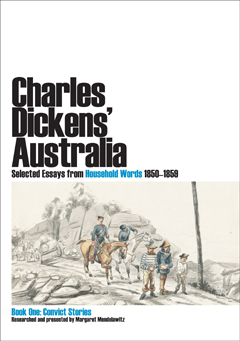
Margaret Mendelawitz, Charles Dickens’ Australia. Book 1, Convict stories

Charles Dickens' Australia, Book 1

Book cover (Courtesy: Sydney University Press)

So true may fiction be in the hands of a genius
(from “Convict in the gold region”, by Richard Horne)

Richard Horne, in his article “Convicts from the gold region”, describes a scene from Don Quixote in which Quixote meets and sets free some convicts by driving away their guards, only to have his generosity (which included delivering them “a noble speech”) met by ridicule and “a volley of stones”. Horne suggests that the convicts he met would do “the same thing to any eccentric philanthropist in a broad-brimmed hat who should set them free and make them an address on liberty and humanity”. An interesting analogy to draw and one, I might add, that he doesn’t test, but I did like the way he used it to see the truth in fiction!

Anyhow, I have now read Book 1 in this fascinating set of books from the Sydney University Press, and it pretty well does what Mendelawitz says in her introduction. That is, it provides a first-hand, informative and entertaining insight into mid-19th century Australia – in this case, relating to the role of convicts in that society. The focus is on social conditions and social justice but there’s no heavy-handed proselytising. Dickens’ aim was to create a magazine that would be “cheerful, useful and always welcome” but that would also “assist the reader’s judgement in his observation of men”. Badness and wrongdoing aren’t glossed over but, wherever possible, mitigating circumstances are also provided.

There are 15 articles in the book, written by 9 different authors, some in collaboration. The last 6 are written by Australian-born barrister, journalist, novelist John Lang and are short case studies of individual convicts, including those who were unjustly (or, at least, unfairly) transported, those who deserved what they got but made good, and those who couldn’t give up their criminal ways. Representing this last group are the convicts described in “Three celebrities”. Fox, Pitt and Burke were three thieves who were “transported under the names of the three most celebrated orators of their time”. For whatever reason, they did not knuckle down to honest work in the colony, but instead escaped and operated as bushrangers. Even in their story, though, a positive is given: by the time they were captured they had set up a well-stocked farm with an abode that “was in the neatest order” and land that “was very well-tilled”. At the opposite end of the spectrum is the rather melodramatic tale of star-crossed love and a stolen horse resulting in the transportation of young “Kate Crawford”. Noticed by Mrs Macquarie, the wife of Governor Macquarie, and placed in the home of the chief constable in Parramatta, she was pardoned within three years and (eventually) died a very wealthy woman. These 6 stories are told with a light touch and in a conversational tone as tales relayed by a woman who knew the convicts in question.

A few of the articles are set in – or tell of – the Norfolk Island penal colony, a colony I have written about before in reviews of Jessica Anderson‘s The commandant and Price Warung‘s Tales of the early days. Both of those were written after the events and people they describe, and it is reassuring to our search for the “truth” that the articles here basically confirm the worst and best of the colony as conveyed by Anderson and Warung in their fictional pieces.

The centrepiece of this volume though is the story of William Henry Barber, who was transported to Norfolk Island in 1844. The story, told over two articles “Transported for life [Part One]” and “[Part Two]”, chronicles his imprisonment, trial and conviction for a crime he claims he did not commit,  his transportation to Norfolk Island (including details of the long boat journey) and subsequent removal  to Van Dieman’s Land from where he was, in 1847, released. Not long after, he received a free pardon with acknowledgement of his innocence. The articles are told first person but in fact were written by journalist and novelist William Moy Thomas. The Notes on Contributors suggest that the articles were based on the account Barber wrote in 1853 of his experiences, an account which is known to have been in Dickens’ library. The aim, as stated at the beginning of the first part, was to show “what transportation, at the present time, really is”.

In my overview of this set I wondered whether Dickens’ tight control over style would result in the articles being somewhat formulaic but I’m pleased to say that they aren’t. While the tone is overall more light than heavy and the content informative with a light persuasive edge, the style does vary. Some are factual chronicles of a life or situation while others have a more literary bent, some use dialog while others comprise descriptive prose, some are a little more obviously didactic while others simply present the situation for the reader to draw conclusions. The message, though, is always there, whether stated or not, and it is essentially this:

It is no miracle that has been here performed; men bred to crime in England by the ignorance and filth we cherish, are bred out of crime again in Norfolk Island, by a little teaching and a little human care. (from “Norfolk Island”, by Irwin and Henry Morley).

I must add, in the services of “truth”, that Norfolk Island had a mixed history regarding treatment of convicts but there was a short period, under Alexander Maconochie, when rehabilitation was taken seriously.

To conclude I can’t resist a quote from pickpocket Barrington in another of John Lang’s case studies, “An illustrious British exile”:

There was a time when ladies boasted of having been robbed by Barrington. Many whom I never robbed gave it out that I had done so; simply that they might be talked about. Alas! such is the weakness of poor human nature that some people care not by which means they associate their names with the name of celebrity.

And we thought the celebrity culture was new? Once again history tells us otherwise!

Margaret Mendelawitz
Charles Dickens’ Australia: Selected essays from Household Words 1850-1858. Book 1, Convict stories
Sydney: Sydney University Press, 2011
187pp
ISBN: 9781920898670

(Review copy courtesy Sydney University Press)

Monday musings on Australian literature: the National Centre of Biography

What is life? Life itself, as you will realise if you consult a dictionary, is hard enough to define. But what is a life? And why does it matter? For itself (a question of honour)? Or for what one can make of it as a biographer (which may mean trespass)? I am old-fashioned enough to believe that it matters for and in itself. But what precisely is it that I am trying to honour and how do I do that? (Veronica Brady, on writing about Australian poet Judith Wright)

Do you like to read biographies? I do, though I don’t read as many as I would like to because fiction tends to have the edge in my reading priorities. Nonetheless, it is a form (genre?) that fascinates me. How do you structure the story of a person’s life? What do you do about the gaps in knowledge? (Even in a well-documented life you are not going to “know” all of your subject’s feelings and motivations.) How do you handle the ethics (not to mention legalities) of revealing perhaps “uncomfortable” truths? How do you make it readable? And so on …

Biographies of course take many forms – from the brief overview documenting the key points in a person’s life to a narrative telling the story of someone’s life. In Australia, one of the best examples of the former is the Australian Dictionary of Biography (ADB) from the Australian National University (ANU). First published in 1966, the ADB now contains “concise, informative and fascinating descriptions of the lives of over 12,000 significant and representative persons in Australian history” (from the website), and is also available online. The online version largely parallels the printed version. In other words there is a long lead time (we are talking years, here) between when the articles are written and their appearance in print and online. (Surely this has to change?) Currently, ADB is working on entries for people who died between 1991 and 2000, with the edition covering those who died between 1981 and 1990 due for publication in 2012! It is, however, despite this lag time, a useful starting point for research into Australians.

In 2008, the ANU established the National Centre of Biography (NCB). It is now responsible for the production of the ADB, but it has a wider mandate, relating to fostering and encouraging expert and innovative biographical writing in Australia through such activities as teaching, conducting public lectures and symposia, and inviting international scholars to the Centre. Exciting stuff, eh?

This year, the NCB also launched Obituaries Australia. Their stated aim is to “collect every obituary that has been published and to index them so they can be searched by researchers”. Currently though the site contains only around 2000 entries, which is why almost every search I tried came up blank. You have to start somewhere though …

All this suggests that biography is, in fact, alive, well and taken seriously in Australia. In addition to the work being fostered at the ANU, there are a number of literary prizes here for biographical or life writing. They include:

There are also several non-fiction awards, such as The Age Non-fiction Award and the non-fiction and history categories in the Queensland Premier’s Literary Awards, for which biographies are eligible and have in fact won.

I will come back to biography again in a future Monday musings, but, in the meantime, would love to know whether you read biographies and how well you think the form is supported by the literary or cultural establishment in your country.

Delicious descriptions from Down Under: Melbourne scenes, 1850s

One of the contributors to Charles Dickens‘ weekly magazine Household Words was Richard HorneAccording to the notes on Contributors in Margaret Mendelawitz’s five-volume set, Charles Dickens’ Australia, which I reviewed last week, Horne was an English-born author who lived in Australia from 1852 to 1869. He agreed to write travel pieces for Household Words “in return”, say the notes, “for advances to equip the expedition and for regular payments to his wife”. (Apparently Dickens refused to have anything to do with Horne when he returned to England due to the minimal contributions Horne had made to his wife’s support while he was away. Given Dickens’ own less than admirable treatment of his wife this smacks a little the pot calling the kettle black, methinks)

Anyhow, one of Horne’s articles for Household Words is included in the first book of Mendelawitz’s set. The article, published in 1853, is titled “Convicts in the gold region” and discusses convicts in the Melbourne area. I enjoyed some of his descriptions and thought I’d share a selection with you.

on Melbourne

… Melbourne, famous, among other things, ever since it rose to fame two years ago, for no roads, or the worst roads, or impassable sloughs, swamps, and rights of way through suburb wastes of bush, and boulder stones, and stumps of trees …

I was going to use this to talk about how stereotypes start but in fact Melbourne’s roads aren’t particularly bad these days, even though it does have a reputation for its strange road rule, the hook turn. The next description, however, is more typical of Melbourne:

It is night; a cold wind blows and a drizzling rain falls.

And yet again I jest a little when I say typical. Melbourne is famous for having four seasons in a day so cold and rain are not the only weather you experience there!

at the Pentridge Stockade

Pentridge prison was built in 1850 to cater for the growing number of prisoners resulting from increased crime due to the gold rush. Horne had a reason for describing Melbourne’s roads at the beginning of his article, because the road to Pentridge itself was a beautiful one. It was built using convict labour.

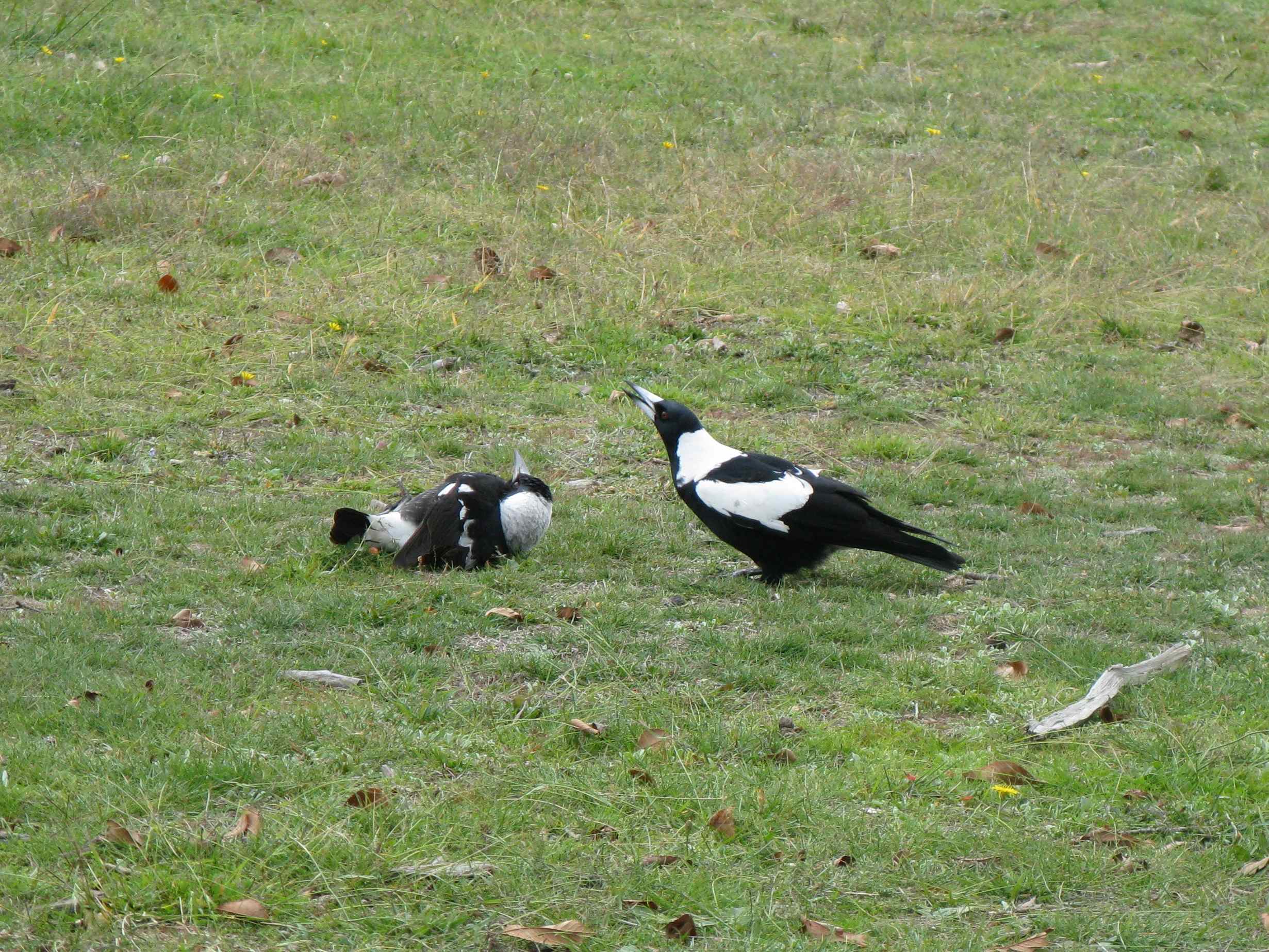
Magpies at Tidbinbilla

Not on broken granite, but magpies nonetheless

The yard is covered with loose stones of broken granite; and I notice close to my feet and looking directly into my face, a magpie. He also, holding his head on one side interrogatively, seems to ask my business here. I take a fresh breath as I look down at the little thing, as the only relief to the oppressive nature of prison doom that pervades the prison scene.

This man is clearly a writer … the contrast he draws here is both pointed and poignant.

I have taken a stroll around the outskirts of the Stockade, and, while gazing over the swampy fields, now wearing the green tints of the fresh grass of winter which is near at hand, and thence turning my gaze to the bush in the distance, with its uncouth and lonely appearance, I hear …

And now we’re really talking … because this description of the Australian bush as uninviting and unappealing was widely held by our 19th century colonials. And, I’d venture to say, Australian culture didn’t really start to come into its own until we started to appreciate the beauty of our bush!

TS Eliot’s The waste land, app-style

TS Eliot plaque SOAS London

Would Eliot have liked this new way of publishing? (Image, via Wikipedia, released into Public Domain by Man vyi)

Hands up if you’ve seen Touchpress‘s gorgeous iPad app for TS Eliot‘s poem The wasteland? Now, if your hand is up, why didn’t you tell me about it? Luckily, though, I have a real-life, dinky-di librarian friend who told me what my online friends didn’t!

This is not going to be a proper review as I only downloaded it yesterday, but it’s worth sharing sooner rather than later. At least , I think it is, because it’s a great example of how technology can enhance our reading experience, particularly of complex texts. The app comprises the following menu items:

  • Poem (the full text)
  • Performance (a filmed performance of the full poem by Fiona Shaw. You can watch the performance on its own, or with the text synced to it!)
  • Manuscript (facsimile of the original typed manuscript showing Eliot’s handwritten edits)
  • Perspectives (commentary on the poem and Eliot, by various people including Seamus Heaney and Jeanette Winterson)
  • Readings (several audio renditions of the poem, including two by Eliot himself, and others by Alec Guinness, Ted Hughes and Viggo Mortenson)
  • Notes (annotations and references explaining the poem)
  • Gallery (images relating to the poem).

There is a Home icon so you can quickly return to the menu screen to navigate around the app. And there are also well thought through navigations on other screens. For example, on the screen containing the straight text of the poem are icons linking directly to the annotations (Notes) and the list of audio versions (Readings).

I feel like the proverbial child in a lolly shop. Where do I start? Do I simply read the poem? Probably not, since if that’s all I wanted to do I’d have taken my lovely old Collected Works down from my bookshelf. So, what do I do? Do I read it with the annotations? Or listen to TS Eliot read it or watch Fiona Shaw perform it? Or do I play around with the edited manuscript facsimiles? Whatever I do, though, I’ll be in good company. The app – for a rather challenging poem, remember – was one of the topselling apps the week it was released and was named “app of the week” in the US.

I read, much of the night, and go south in the winter
(line 18, The waste land)

It will take many nights to read, watch and absorb this terrific production, but it’s winter here so I’m starting now…

TS Eliot
The waste land
iPad app (AUD16.99) 
Touch Press and Faber and Faber, 2011
951mb