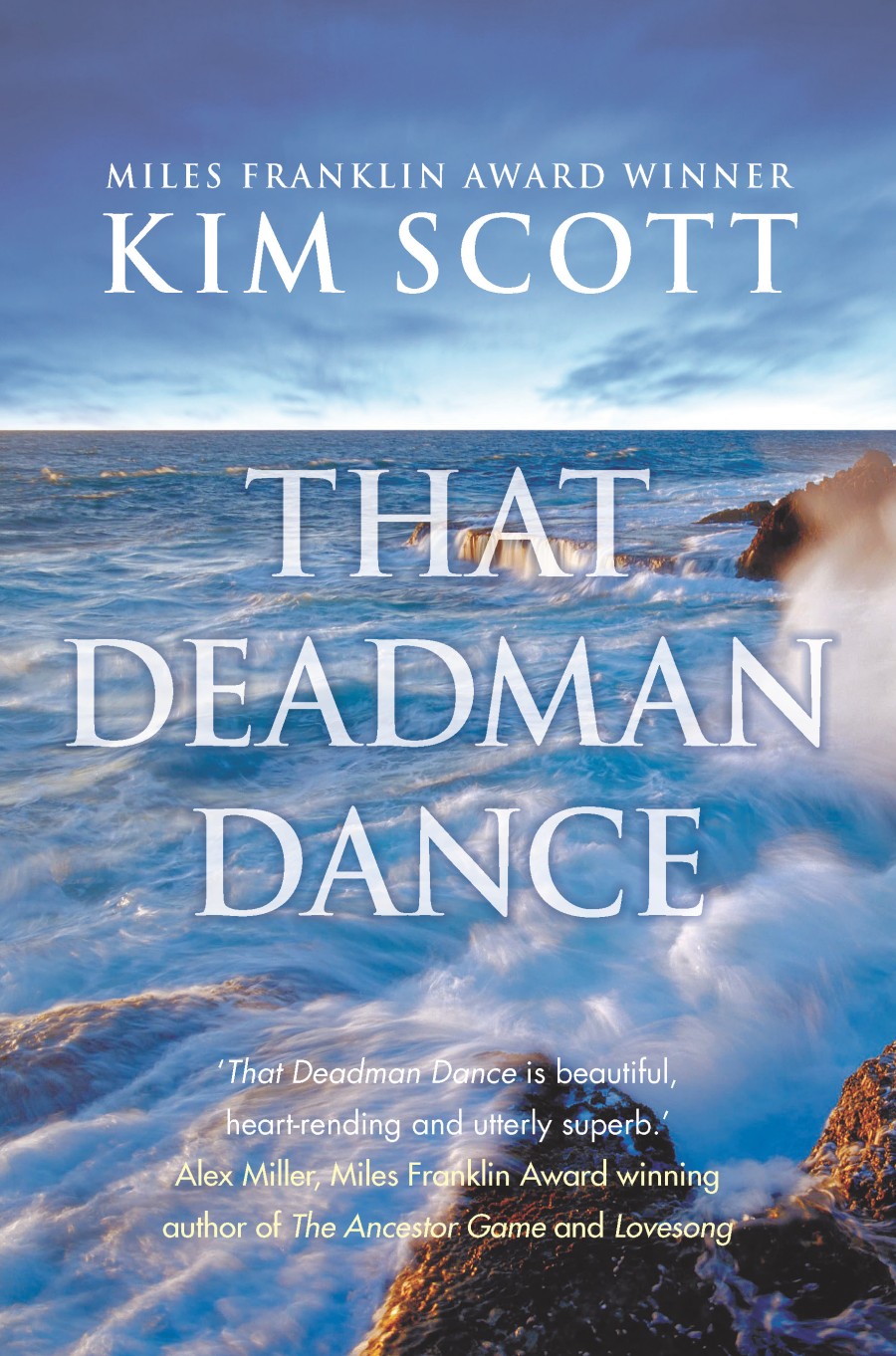
Here is the first of two or more (depending on how the spirit moves me) Delicious Descriptions from Kim Scott‘s book That deadman dance.
My first one presents two excerpts which describe people confronting the new. First, the British settlers during their expedition to find land:
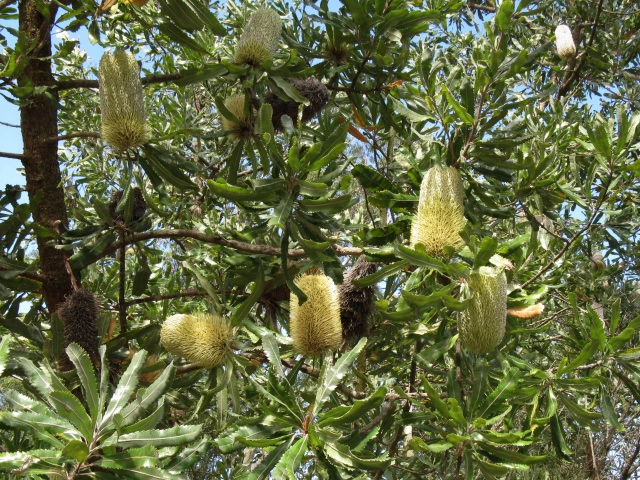
They found a path, rocky and scattered with fine pebbles that at one point wound through dense, low vegetation but mostly led them through what, Chaine said, seemed a gnarled and spiky forest. Leaves were like needles, or small saws. Candlestick-shaped flowers blossomed, or were dry and wooden. Tiny flowers clung to trees by thin tendrils, and wound their way through the shrubbery, along clefts in rock. Bark hung in long strips. Flowering spears thrust upward from the centre of shimmering fountains of green which, on closer inspection, bristled with spikes.
Modern-day Aussies would recognise most if not all of these plants, but I can imagine how strange they would have been to people who came from the soft landscapes of England and Ireland.
By contrast, here is Wunyeran describing his experience on a ship to an elder:
It was hard to describe the food, he said. Some of them had tasted it before on ships, but other tastes too and … all very strange. There were many things … He tried to explain the tube you looked through that brought you close; the scratched markings one of the men made on something like leaves. Book, Journal, they said.
They gave him a good koitj, he said, and showed his people the smooth axe…
Throughout the book we to and fro between the British and indigenous ways of doing, being and seeing … but I particularly loved these two concrete descriptions of people reacting to new sights and experiences.
About a third of the way into Kim Scott‘s novel That deadman dance is this:
We thought making friends was the best thing, and never knew that when we took your flour and sugar and tea and blankets that we’d lose everything of ours. We learned your words and songs and stories, and never knew you didn’t want to hear ours.
And, it just about says it all. In fact, I could almost finish the post here … but I won’t.
That deadman dance is the first Indigenous Australian novel I’ve read about the first contact between indigenous people and the British settlers. I’ve read non-Indigenous Australian authors on early contact, such as Kate Grenville‘s The secret river, and I’ve read Indigenous authors on other aspects of indigenous experience such as Alexis Wright‘s Carpentaria and Marie Munkara’s Every secret thing. Kim Scott adds another perspective … and does it oh so cleverly.
The plot is pretty straightforward. There are the Noongar, the original inhabitants of southwest Western Australia, and into their home/land/country arrive the British. First, the sensitive and respectful Dr Cross, and then a motley group including the entrepreneurial Chaine and his family, the ex-Sergeant Killam, the soon-to-be-free convict Skelly, the escaped sailor Jak Tar, and Governor Spender and his family. The novel tracks the first years of this little colony, from 1826 to 1844.
That sounds straightforward doesn’t it? And it is, but it’s the telling that is clever. The point of view shifts fluidly from person to person, though there is one main voice, and that is the young Noongar boy (later man), Bobby Wabalanginy. The chronology also shifts somewhat. The novel starts with a prologue (in Bobby’s voice) and then progresses through four parts: Part 1, 1833-1836; Part 2, 1826-1830; Part 3, 1836-1838; and Part 4, 1841-44. And within this not quite straight chronology are some foreshadowings which mix up the chronology just that little bit more. The foreshadowings remind us that this is an historical novel: the ending is not going to be fairytale and the Indigenous people will end up the losers. But they don’t spoil the story because the characters are strong and, while you know (essentially) what will happen, you want to know how the story pans out and why it pans out that way.
What I found really clever – and beautiful – about the book is the language and how Scott plays with words and images to tell a story about land, place and home, and what it means for the various characters. His language clues us immediately into the cross-cultural theme underpinning the book. Take, for example, the words “roze a wail” on the first page:
“Boby Wablngn” wrote “roze a wail”. But there was no whale. Bobby was remembering … “Rite wail”. Bobby already knew what it was to be up close beside a right whale …
Whoa, I thought, there’s a lot going on here and I think I’m going to enjoy it. Although Bobby’s is not the only perspective we hear in the book, he is our guide. He is lively and intelligent, and crosses the two cultures with relative ease: just right for readers venturing into unfamiliar territory. He’s a great mimic, and creates dances and songs. The Dead Man Dance is the prime example. It’s inspired by the first white people (the “horizon people”) and evokes their regimented drills with rifles and their stiff-legged marching. There’s an irony to this dance of course: its name foretells while the dance itself conveys the willingness of the Noongar to incorporate (and enjoy) new ideas into their culture.
In fact there’s a lot of irony in the novel. Here is ex-Sergeant Killam:
Mr Killam was learning what it was to have someone move in on what you thought was your very own home. He thought that was the last straw. The very last.
And who was taking his land? Not the Noongar of course, but the Governor … and so power, as usual, wins.
The novel reiterates throughout the willingness – a willingness supported, I understand, by historical texts – of the Noongar to cooperate and adapt to new things in their land:
Bobby’s family knew one story of this place, and as deep as it is, it can accept such variations.
But, in the time-old story of colonisation, it was not to be. Even the respectful Dr Cross had his blinkers – “I’ve taken this land, Cross said. My land”. And so as the colony grew, women were taken, men were shot, kangaroos killed, waters fouled, whales whaled out, and so on. You know the story. When the Noongar took something in return such as flour, sheep, sugar, they were chased away, imprisoned, and worse.
I’d love to share some of the gorgeous descriptions in the book but I’ve probably written enough for now. You will, though, see some Delicious Descriptions in coming weeks from this book. I’ll finish with one final example of how Scott shows – without telling – cultural difference. It comes from a scene during an expedition led by Chaine to find land. They come across evidence of a campsite:
You could see where people camped – there was an old fire, diggings, even a faint path. Bobby was glad they’d left; he didn’t want to come across them without signalling their own presence first, but Chaine said, No, if we meet them we’ll deal with them, but no need to attract attention yet.
Need I say more*?
The book has garnered several awards and some excellent reviews, including those from my favourite Aussie bloggers: Lisa (ANZLitLovers), the Resident Judge, the Literary Dilettante, and Matt (A Novel Approach). Our reviews differ in approach – we are students, teachers, historians, and librarian/archivists – but we all agree that this is a book that’s a must to read.
Kim Scott That deadman dance Sydney: Picador, 2010 400pp. ISBN: 9780330404235
* I should add, in case I have misled, that for all the truths this novel conveys about colonisation, it is not without vision and hope. It’s all in the way you read it.
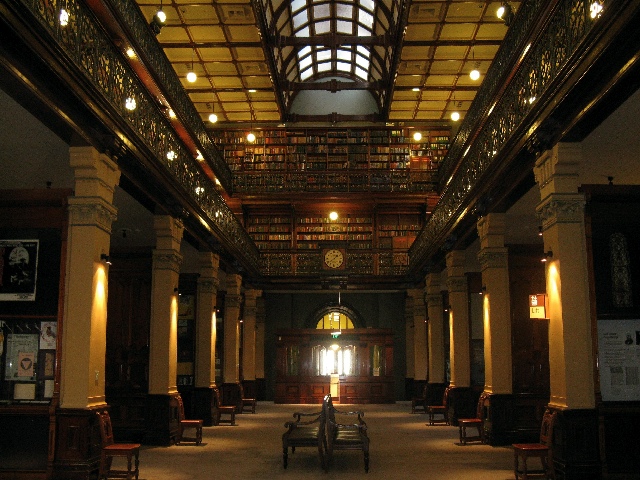
Mortlock Wing (1884), State Library of South Australia
In the decade from the late 1960s to the late 1970s, South Australia, under premier Don Dunstan, was Australia’s most progressive state. I won’t list all the achievements – you can read them in the Wikipedia article linked on his name – but there were big social justice ones including the recognition of Aboriginal land rights, decriminalisation of homosexuality, and abolition of the death penalty. Dunstan was also known for supporting the arts … and South Australia became a mecca for anyone interested in the arts. Things have changed now, as they always do, but the Dunstan legacy remains in the Adelaide Festival Centre, probably Australia’s first real multi-purpose arts centre.
The state also hosts an internationally recognised arts festival, the Adelaide Festival of the Arts, and Australia’s oldest writers’ festival, the Adelaide Writers Week, which has run for over 40 years. And yet, most Australians would probably be hard-pressed to name writers from the state. In fact, probably the best known writer now living in the state is J. M. Coetzee! A great writer, but in my state-focused posts I like to look at writers’ formative years …
And so who? Well, I’ll name a few but I must admit I couldn’t think of many myself:
Barbara Hanrahan (1939-1991) whose The scent of eucalyptus I reviewed some months ago. That book – autobiographical fiction – is an idiosyncratic (but universal too) evocation of an early-mid twentieth century Adelaide childhood. She was also an artist of note. But, she is no longer alive.
Peter Goldsworthy (b. 1951) whose Three dog night I read, and enjoyed, before I started blogging. He is also a poet, librettist and screenwriter. His daughter, Anna Goldsworthy, has written a well-reviewed memoir, Piano lessons (which is on my virtual TBR).
Colin Thiele (1920-2006) who wrote primarily for children – for the late primary-early secondary years. He is most famous for his novel Storm Boy which was made into a highly successful movie by another of Don Dunstan’s initiatives, the South Australian Film Corporation. I don’t usually include children’s writers in my lists but his writing is so evocative of South Australian landscapes that it seemed wrong to omit him.
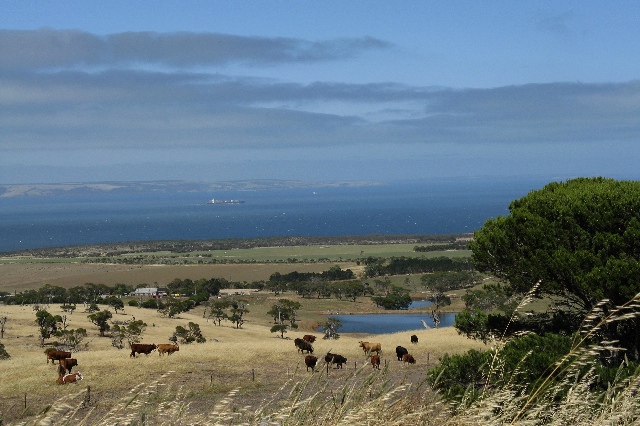
Fleurieu Peninsula, South Australia
South Australia, like each state, has a distinctive geography, which ranges from its golden Mediterranean-like south to its arid north, with lakes, mountains and pockets of lush green in between. I’ll end with an excerpt from a Peter Goldsworthy poem titled “Yorke Peninsula, Easter”:
Returning to childhood.
To fields of sweat and dust,
scraps of eucalypt,
wheezing crows.
Several well-known Australian authors currently live in South Australia – including Brian Castro and children’s writers, Mem Fox and Gillian Rubinstein – but I’d love to hear of any other (reasonably) contemporary South Australian writers.
Mr Darcy, illus by CE Brock (Presumed Public Domain, courtesty Wikipedia)
Was Mr Darcyautistic? Phyllis Ferguson Bottomer, a Canadian speech pathologist, suggests that he was in her book So odd a mixture. Her theory has not been taken seriously, but it throws up an issue I’ve confronted before, the pathologising of fictional characters.
Take M.J. Hyland for example. I have read two of her novels and must admit that, as I read them, the word “autism” did cross my mind more than once. I did not, however, define the characters as such in my reviews, though I did footnote my temptation to do so in my post on This is how. I didn’t succumb to the temptation because I’m not sure it is relevant or helpful to ascribe to a fictional character a condition that the writer him/herself has not identified.
And, as it turns out MJ Hyland herself has something to say on the matter, at least as far as her works are concerned. She said in an interview on Slow TV that many people suggest her characters have autism but she does not, she said, want to “pathologise” her characters, she does not want such a neat cause and effect. She explains this further by saying that she does not want to present her characters as victims but rather, she wants them to be “as complicated as we are”. I like that … her characters are highly complex and would become immediately less so if she identified them as having a diagnosed condition.
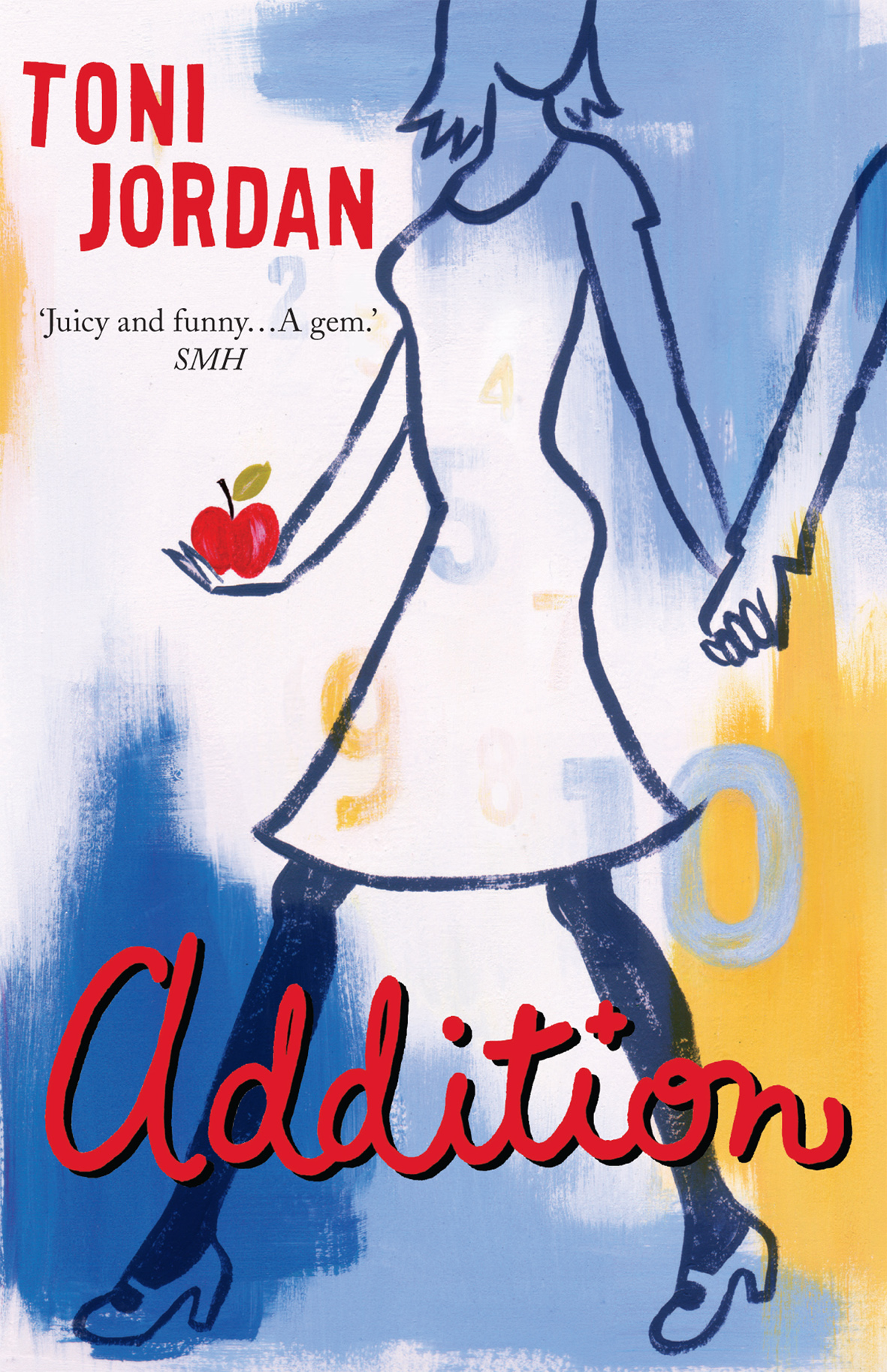
Addition Paperback cover (Courtesy: Text Publishing)
What is it that makes readers want to “diagnose” characters? Is it a desire to do the opposite to what Hyland wants, that is, to simplify them, to put them in neat explainable boxes rather than allow them all the messiness that make us human? By saying this I am certainly not suggesting that “real” people with these conditions are simple. Far from it. But I am suggesting that making such diagnoses, extratextually, can be used to simplify the fictional world. Labelling Darcy as autistic denies us the challenge of teasing out who he is, and why he does the things he does. Or what about Albert Camus‘ Meursault from L’étranger? Had Camus labelled him autistic, as some critics/reviewers have suggested, would we, could we, analyse the book in the same way? Or Patrick Suskind‘s Grenouille from Perfume? Does it help or hinder our analysis to call him a sociopath? I don’t have an answer to this except to say that I like to proceed with caution when I go beyond the text on the page.
Of course, there are books in which characters are ascribed conditions by their creators. Think Mark Haddon‘s The curious incident of the dog in the night-time in which the protagonist defines himself as having “behaviour difficulties” (though nothing more specific than that) and Toni Jordan’s Additionin which the heroine has OCD. Because these characters admit to their conditions, the focus of their novels is different. They deal more directly with the issue of how these characters face the challenges of their particular “condition”.
Anyhow, what do you think? How far do you think it is reasonable to go in terms of describing fictional characters – and why?
Jeanette Winterson, 2005 (Image: Courtesy Mariusz Kubik, via Wikipedia using CC-BY-SA 3.0)
We are all everyone and everyone is us. (Fiona Shaw, talking about The waste land)
Last weekend I finished the Perspectives section of The waste land app, by listening to Fiona Shaw, Frank Turner and Jeanette Winterson. The fascinating thing is that they all say the same things, albeit in slightly different ways.
Timeless, universal, undated
Shaw talks about the timelessness of the poem, saying it doesn’t need to be brought up to date. Cities still exist, we still commute, we still visit suspect clairvoyance, she says. She also argues for its universality in the sense that we can be Hector sitting in the chair, or ourselves. We may only have one life but through poems like this we can also have many different lives. But we readers know this don’t we.
Turner’s take is a little different. He likens Bob Dylan to Eliot suggesting that both were “bottom feeders of the culture around them”. Putting it another way, he says they both have a “prophetic voice of judgement”, like prophets from the Old Testament. And you can’t get more timeless than that!
Winterson argues that Eliot, way back in 1922, saw where we were going: The waste land, she says, is “about now”, and is not “dated in any way”.
Captures the twentieth century
I love Shaw’s description that Eliot
Scraped a rake around the 20th century and gathered a leaf mould heap of what it was about.
Not bad, if you agree with her, for a poem written in the first quarter of the century.
Turner, similarly, describes the poem as “zeitgeisty”. He says Eliot identified that the forward progression that had been happening from the Renaissance to the first World War had come to an end. The waste land documents, he says, the failure of the progressive idea.
Winterson and Turner both call it a prophetic poem. While many saw a bright future after World War I, Eliot, says Winterson, saw the spiritual malaise coming. She suggests that if Eliot visited London and New York today he would not be surprised to see the economic crisis we are in, the way we have forgotten all values except “making money”.
Reinventing the language of poetry
Shaw talks of the way Eliot mixes banality (the throbbing of cities and machines) with lyricism (“the violet hour” for example). Turner, likewise, talks of how Eliot’s language can be angular and uncomfortable, and then suddenly be intersected with something lyrical, with more traditional “poesy”. Winterson articulates all this beautifully by describing how Eliot recognised (consciously or unconsciously?) that the language of poetry needed replenishing. He used, she says, fresh, direct, colloquial language, “the language of the everyday” to express “eternal things, the big ideas”.
As I listened to these various perspectives and how each saw the relevance of The waste land to now, I wondered whether it has been continuously relevant over the nearly 90 years since it was published – and somehow I think it has been. World War 2, the Cold War, the Vietnam War, the troubles in Ireland, not to mention strife in the Balkans, the Middle East, Africa and South America. Even when on the surface – as in the 1920s – life has seemed comfortable for many, there has been something not quite right, and so:
What is the city over the mountains
Cracks and reforms and bursts in the violet air
Falling towers
Jerusalem Athens Alexandria
Vienna London
Unreal
(from “V. What the thunder said”)
Printed and eBooks for Jane Austen's Sense and sensibility
First off, the disclaimer: I don’t know a lot about what is happening with eBook publishing in Australia, so my goal here is as much to find out more from readers of this post as it is to impart knowledge.
I thought a good place to start would be the Australian Publishers Association (APA) but didn’t find a lot to excite me. The Association has 11 committees, but a search on “electronic” on the page listing these committees brought up only two which include electronic publishing in the description of their goals/activities – the Tertiary and Professional Publishers, and the Scholarly and Journals Publishers! Oh dear that’s not looking very proactive. Maybe they just haven’t updated their info on the APA website?
Because trade publishers are producing electronic versions of their books. Text Publishing, for example, told us in their February newsletter about the eBooks service being offered by independent Melbourne bookseller, Readings. Text wrote that:
In collaboration with local software developer Inventive Labs and SPUNC (the Small Press Network about whom I’ve written previously), Readings is now able to offer Australian ebooks that are readable on any device, from phone to PC to dedicated ereader.
Readings was, apparently, the first independent bookshop in Australia to offer locally published eBooks to its readers. This means, for example, that works by such Text authors as Peter Temple, Kate Grenville, Kate Holden, Toni Jordan, and Madeleine St John can now be bought from Readings in electronic format (using, as I understand it, the book.ish service. This is a bit of a problem for Kindle users who, I understand, can only access book.ish eBooks online).
Back to publishing though. A year ago, in July 2010, a report by Jenny Lee titled Digital Technologies in Australia’s Book Industry was published. It was prepared for the Book Industry Strategy Group and is 72 pages long. I have only skimmed it. It looks at the whole supply chain – Authors, Agents, Publishers, Printers, Distributors, Retailers, Libraries, and Readers – but my focus here is on publishers because, arguably, they are the critical point in the chain. What Lee found regarding publishers – a year ago so things may have changed – was that electronic publishing (and delivery) is strongest in the scholarly and higher education area. Well, that’s not surprising given what I found at the APA website is it? Regarding trade publishing she wrote:
Publishers of consumer/trade books have generally been hesitant about producing ebooks because of concerns about piracy and price, but many are now producing a selection of books in electronic form and in some cases making them available through their websites.
And so, it is starting, albeit slowly and moving from publisher websites to sellers like Readings.When the Kindle first appeared, we Australian readers complained about the lack of suitable content, particularly Australian content. More Aussie content is available now, but I’d love to know what readers here think. Is enough available? How do you know what is available? Is it available on the format you want and at a price you are happy to pay? I expect to return to this issue, but would love to know what people are finding now (here and in other countries).
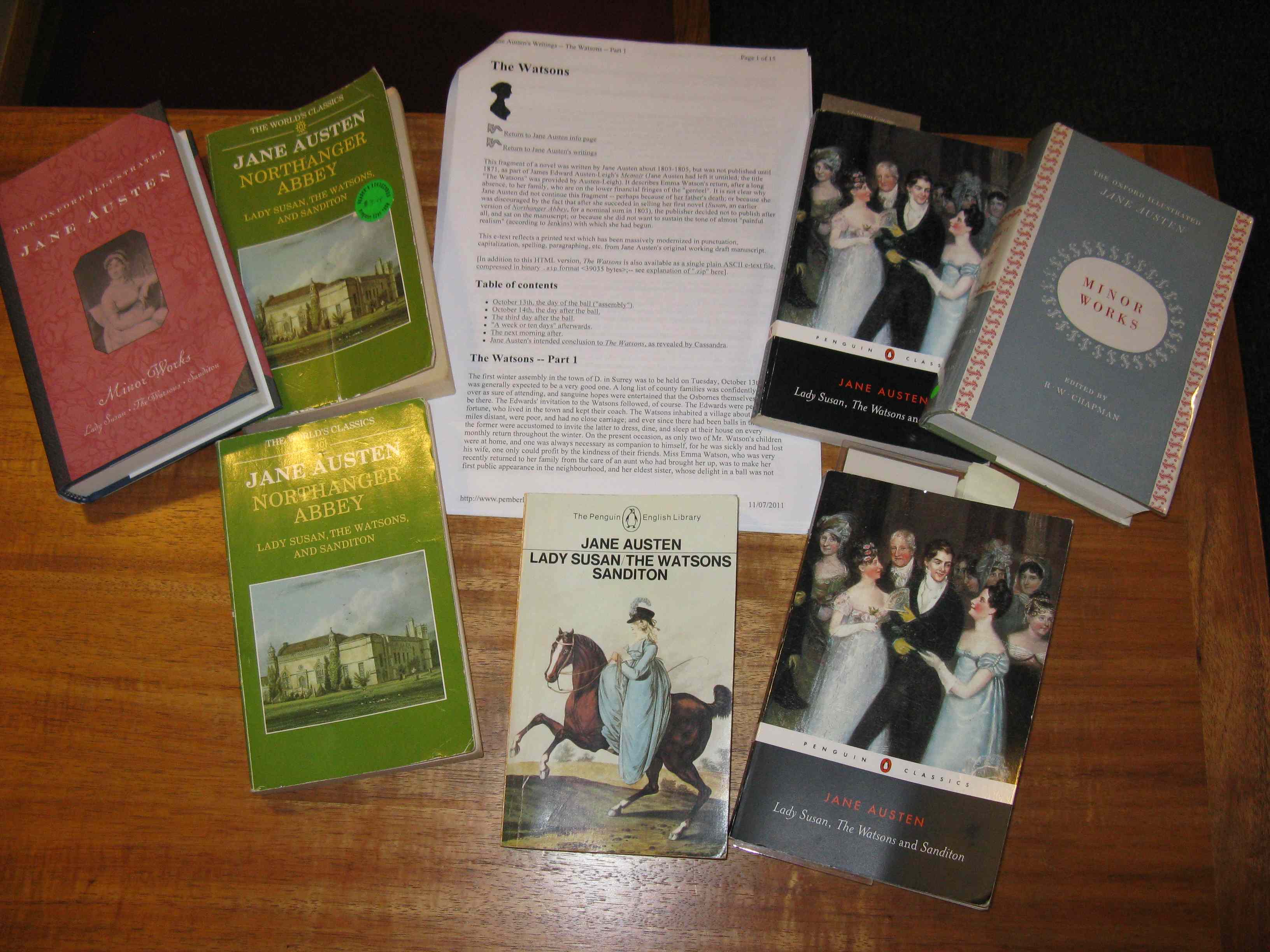
In one of those coincidences that we often bother about in fiction, my local Jane Austen group scheduled Jane Austen’s unfinished novel, The Watsons, for our July discussion. A coincidence because, if you are an Austen fan, you’ll know that just this week the manuscript was sold at auction for nearly £1 million. Thank goodness it was bought by an institution – the Bodleian at Oxford. Next time I’m in England I know where I’ll be going!
Anyhow, onto The Watsons. This unfinished novel was written in Bath probably around 1803-1805, though there is not consensus about this. A common belief is that she abandoned it after her father’s death due to sadness and the resultant uncertainty in her living conditions. Whether this is true or not, it is a fact that she didn’t take up serious writing again until she settled in Chawton in 1809 – which gives rise to the more interesting challenge. That is, why didn’t she take this one up again as she did with other early works such as First impressions which became Pride and prejudice. Enough of that, however, as all we can do is speculate. Let’s look at the work instead.
English novelist Margaret DrabbledescribesThe Watsons as “tantalising, delightful and highly accomplished”. And it certainly is tantalising. We have only 68 pages (manuscript count). The story concerns 19-year-old Emma Watson who has returned, after living with her well-off aunt and uncle for 14 years, to her “poor” family. At the time of her return, just her oldest sister, the 28-year-old Elizabeth, is at home with their invalid father. The family however comprises four daughters and two sons, of whom only one son is married. The main plot-line is, of course, likely to be marriage, and so in these first chapters we are introduced to three men who could vie for Emma’s hand. We are also introduced to the characters belonging to Austen’s favourite subject, “3 or 4 families in a Country Village”. We know, from her sister Cassandra, how Austen intended the plot to play out. So tantalising that we never saw her do it!
Drabble’s next word is “delightful” and it is that too … because it contains those wonderful character descriptions and social observations that we have come to expect of Austen. I’ll share just a couple. The first one describes Emma (at the Ball where we meet three potential beaux):
… a lively Eye, a sweet smile, & an open Countenance, gave beauty to attract, & expression to make that beauty improve on acquaintance …
Contrast this to the following description of her sister Margaret:
Margaret was not without beauty; she had a slight, pretty figure, & rather wanted Countenance than good features; – but the sharp & anxious expression of her face made her beauty in general little felt.
There are also those delightful little set pieces we are used to finding in Austen, pieces that illuminate character as much as they move the plot along. One concerns Emma’s offer to dance with a 10-year-old boy when the snooty aristocrat Miss Osborne, doesn’t follow through on her promise to dance with him. “Oh Uncle”, the young lad says to one of the possible beaux, “do look at my partner. She’s so pretty.”
Sweet as she is, Emma proves herself to be well able – rather like Elizabeth Bennet – to hold her own. She refuses to pander to the flirtatious Tom:
Emma’s calm curtsey in reply must have struck him as very unlike the encouraging warmth he had been used to receive from her Sisters, & and gave him probably the novel sensation of doubting his own influence, & of wishing for more attention than she bestowed.
The last sentence of The Watsons starts, “Emma was of course uninfluenced …”. How sad we didn’t get to see more of this resourceful, delightful heroine.
Finally, “highly accomplished“. I’m not sure I totally agree with Drabble here. What we have is intriguing, tantalising us with its potential. It demonstrates much of what we know and love about Austen – and yet, despite evidence of extensive editing in the recently auctioned manuscript, it has (to my mind anyhow) an element of clumsiness. I find this particularly in an overuse of dialogue to convey information which the characters involved would surely already know – such as Elizabeth’s saying to her sister, Emma, “though I am nine years older”. It works well enough in the context but I believe the later, experienced Austen would have better conveyed this through authorial comment.
Nonetheless, it is accomplished. Its realism is remarkable and, like all her novels, it is clear from the beginning just what the targets are going to be. In this case, I see a major theme being the contrast between exterior and interior “refinement”. The fragment we have focuses heavily on the distinctions of class, often contrasting the superficiality of those who possess this so-called “class” with Emma whose refinement is more of the interior kind. This has the makings of a fascinating novel.
And yet, while it was not to be, we can point to many characters in later books who seem to draw, albeit with variations, from the characters here: the invalid father in Emma, the money-fixated brother in Sense and sensibility, the independent-thinking heroine in Pride and prejudice, the flirty young man of means in Mansfield Park, to name just a few. For whatever reason, Jane Austen did not return to this manuscript, but it’s obvious that she did not forget the characters nor some of the ideas behind their creation.
Jane Austen
“The Watsons”
in The Oxford illustrated Jane Austen. Vol VI, The minor works (ed. R.W. Chapman)
London: Oxford University Press, 1969
pp. 315-363
Willa Cather's childhood home, Nebraska (Public Domain, By Ammodramus, via Wikipedia)
Willa Cather‘s short story, “A Wagner matinée”, was Library of America’s “Story of the Week” back in May. However, I was busy then, but I like Cather, so I put it aside to read later. And later has finally come!
I’ve reviewed another Cather short story here, “The sentimentality of William Tavener”, which was published in 1900. “A Wagner matinée” was first published a little later, in 1904. Like the previous story, and the novels of hers that I’ve read, this short story deals with her favourite preoccupation, the tough life of the pioneer. It is not, though, set in the midwest, but in Boston. The plot is slight, and can be summarised in a couple of sentences. The first person narrator’s aunt comes to visit him in Boston from Nebraska to which she’d eloped, against her family’s wishes, some three decades previously. Our narrator, Clark, has “a reverential affection” for this aunt who’d provided him with “most of the good that ever came my way in my boyhood” and so he decides to treat her, an ex-music teacher, to an afternoon concert of Wagnerian music. The story chronicles the emotions aroused by this visit.
As usual, the Library of America’s brief introductory notes are illuminating. Apparently Cather attracted a degree of wrath after its publication, from Nebraskans and from her family. A Nebraskan editor slammed her depiction of prairie life suggesting that fiction writers who portray Nebraska should “look up now and then and not keep their eyes in the cattle yards”. If they did “they might be more agreeable company”. Take that, Willa!
Her family was upset because they felt she’d based the story’s Aunt Georgiana on her Aunt Franc who, like Georgiana, had lived in Boston and studied music before marrying and moving to Nebraska. Cather was apparently hurt by this as she’d maintained an affectionate correspondence with her aunt. Nonetheless, the notes say, when she revised and shortened the story for her 1920 collection, “she altered the portrait of Georgiana out of consideration for her Nebraskan family”. Hmmm … I should do my research and find the original as I believe the version provided by the Library of America is this 1920 one. In it, Georgiana seems a fairly sad case so I’d love to see what she’d written first. Regardless, it reminds me yet again of that fine line between fact and fiction that novelists who draw from life must tread.
Anyhow, the story. Aunt Georgiana arrives in a somewhat “battered” state, partly due to the arduous journey and partly, Clark implies, due to the hardness of her life. “For thirty years my aunt had not been farther than fifty miles from the homestead” which she had established side-by-side with her husband. Clark describes the time he’d spent out west with his aunt and the support and encouragement she’d given him. He also remembers her telling him once when he was “doggedly” practising a piano piece:
Don’t love it so well, Clark, or it may be taken from you.
What was taken from her? Her music? Her old life? Was it taken or did she, willingly at the time, give it up? Her pain made clear, nothing more is said on this point. And I like the writing for it. The rest of the story describes the matinée and how he and his aunt react. The language is clear and strong, as you can see from this excerpt roughly half-way through the story. It describes the first piece in the concert, the Tannhaüser overture, which is particularly meaningful for me as Tannhaüser was my first opera:
… When the horns drew out the first strain of the Pilgrim’s chorus, Aunt Georgiana clutched my coat sleeve. Then it was I first realised that for her this broke a silence of thirty years. With the battle between the two motives, with the frenzy of the Venusberg theme and its ripping of strings, there came to me an overwhelming sense of the waste and wear we are so powerless to combat; and I saw again the tall, naked house on the prairie, black and grim as a wooden fortress …
Pretty stark stuff … and it becomes more stark as he describes his aunt’s physical reactions to the music and draws his own conclusions from it. Here she is reacting to “The prize song”:
Her eyes were closed, but the tears were glistening on her cheeks … It never really died, then – the soul which can suffer so excruciatingly and so interminably; it withers to the outward eye only; like that strange moss which can lie on a dusty shelf half a century and yet, if placed in water, grows green again.
Why Wagner, I wondered when I saw this story? It would be anachronistic to invoke our era’s discomfort with the man and, in fact, LOA tells us that Cather was passionate about Wagner. His is powerful, emotional music: this seems to be its relevance here. It is music which can stir the soul – and Georgiana’s soul has been stirred. She is no longer “semi-somnambulant” as she was when she arrived. Clark leaves us contrasting his emotional aunt with the “black pond” and “unpainted house” of home. However, because the story is told through Clark’s – albeit loving and sympathetic – eyes we cannot know what this all means for her. Instead, we are left to think about the sacrifices that attend the decisions we make and whether or not we can live with them. A thoughtful, moving story.
Henry Lawson, circa 1902. (Presumed Public from the Sydney University library, via Wikipedia)
It seems appropriate now, when I’ve been exploring the iPad app for TS Eliot‘s The waste land, to introduce the Australian Poetry Library website that was launched in late May. Essentially a digital library, it contains over 42,000 poems from over 170 poets. That’s a pretty good start, particularly when the poets range from pioneers like Henry Lawson to current poets like Les Murray, Tracy Ryan and Alan Gould (whose novel, The lakewoman, I reviewed recently).
The home page is clean and bright, if a little busy. Here is the main content (of which some is dynamic ensuring new content for each return visit):
Talking poetry: a selection of poems. Click on a poem and you are taken to a page for that poem where you can hear it read, and follow further navigational links. When I looked at it today, two of the six poems were by Gould, and one was by Rosemary Dobson whose late husband used to work in the office next door to mine (way back when). These readings must surely engage more people in poetry.
Featured glossary term: a definition of a poetic term – sestina when I looked – plus the opportunity, a click away, to explore the glossary further. I can see myself checking this out in future.
Features: a selection of poets. Click on a poet and you are taken to his/her page containing an image; a biography, bibliography and a further reading list; and a list of poems that you can click on to read. I would love it if the further readings – particularly journal articles – were hyperlinked to the full content, but I didn’t find any that were. I expect copyright is an issue.
Review: a review of a poem
Poems: a couple of poems from the site
Themes and occasions: a list of categories to help find poems on likely topics such as Animal poems, Anniversary poems, Love poems and so on. A nice idea.
Poetic forms: a list of forms and styles, such as Iambic Foot, Haiku, that can be clicked on for a definition. (Strangely, the clicked-to page contains some empty clickable headings for titles, surname, and first name, as well as the definition.)
Search
There are also useful menu bars/tabs. The main one for the site contains the following self-explanatory options regarding the content: Home, Poets, Poems, Guest collections. The other is geared to the users of the site: For teachers, Glossary, Poetry resources, FAQ and My selections. Overall, the site is easy to navigate, and should appeal to (and be useful for) the general public, educators and students, and the poets themselves.
So that’s the rundown. It’s a lovely site. I checked for several poets and most of them were there – with access to extensive lists of their poems. For Geoff Page, whose verse novel The scarring I reviewed here, there are 857 poems. That alone would keep me well occupied for the next little while! But, not all poets are there. Bruce Dawe and Kevin Hart, for example, are not. Chances are, as the FAQs tell us, this is because permission was not given (by the poet, or the publisher, or whoever owns those rights) to reproduce the poems. This is a POETRY not simply a POET site, so providing the poems is integral – and must have been a challenge to negotiate. The site does, however, allow for some monies to be paid to the poets, when visitors to the site choose to download their “My selections”.
There is an issue though regarding updating. According to the FAQs, no more poems are being added at present. They say: “It is intended that subject to funding, the editorial team will open the site for inclusion of more poetry”. This runs a little counter to the media release on the site’s launch. It says: “The site will continue adding new poets as well as critical and contextual material including interviews, photographs and audio/visual recordings which will be a boon for students, teachers and other researchers.” Hmm … according to this release, the project received the highest ever ARC Linkage Grant for a humanities project and yet, ongoing funding is clearly an issue. I do hope that this great start is not all it is!
And now, just because I do like a bit of nonsense, and because this poem is about poetry and is out of copyright, I’m going to end with “Who wrote the Shakespere plays”, by W.T. Goodge (1862-1909):
No lover of poetry, I,
For the qualification is lacking,
And indeed it were vain to deny
That I couldn’t tell Browning from Blacking.
But Shakespere’s the author, I’ll vow,
And nothing my faith can be shakin’,
For it would be ridiculous, now,
If we talked about “Lamb’s Tales of Bacon”.
Reading TS Eliot's Selected poems (Image: Courtesy RubyGoes via Flickr, using CC-BY 2.0)
Breakfast in bed is my weekend treat. It’s when I kick back with a book and simply relax – except this weekend and last I kicked back instead with my iPad and app for TS Eliot‘s The waste land. What fun I am having and intend to have over a few more weekends.
So, what have I been doing?
Fiona Shaw’s performance
Well, last weekend I pottered around the app checking out what’s there and how to navigate it, trying a couple of the readings (but not listening to the whole), and so on. And then I listened to/watched Fiona Shaw‘s performance of the poem. This is a performance rather than a reading. She uses gesture and limited movement (around the upper storey room in a house in Dublin somewhere) to convey the drama, humour and mystery of this rather tricky poem. If you hold the iPad in landscape orientation, Fiona Shaw’s performance fills the screen. However, if you rotate it to portrait orientation, the poem appears below the image with the text synchronised to the performance. This is what I did and, being a textual person, I preferred it this way. I loved seeing the words played out on the screen – and she was almost word-perfect. I didn’t time it properly but it took, I’d say, 15-20 mins. I’d recommend this as a good way to start re-acquainting yourself with the poem if, like me, it’s been an embarrassing number of decades since you last read it.
I said above that I am a textual person and that’s true but, paradoxically I suppose, the thing that most grabs when I’m reading is rhythm and sound (something I’m loving in my current read, Kim Scott‘s That deadman dance, but that’s for later). And so, I have always loved TS Eliot:
In the room women come and go
Talking of Michelangelo
(from ‘The love song of J. Alfred Prufrock”)
And now a gusty shower wraps
The grimy scraps
Of withered leaves about your feet
And newspapers from vacant lots.
(from “Preludes”)
We are the hollow men
We are the stuffed men
[…]
This is the dead land
This is the cactus land
(from, of course, “The hollow men”)
Here is no water but only rock
Rock and no water and the sandy road
The road winding above the mountains
Which are mountains of rock without water
(from “W. What the thunder said” in The waste land)
… and so on. Staccato or sing-song, repetition or not, rhyming or not. It gets into your bones.
This weekend I decided to explore the Perspectives section of the app which is where various luminaries talk about aspects of Eliot and the poem. I listened to/watched Irish poet Seamus Heaney, poetry editor from Faber and Faber Paul Keegan, Eliot expert Jim McCue, and English poet and academic Craig Raine …. and I gained some new perspectives! I’m not going to comment on all they say since you really should explore this app yourself (if, that is, you have access to an iPad). I’ll just focus on an aspect that most comment on, one way or another – Eliot and sound.
Heaney comments on the “musicality” of the poem. Paul Keegan goes a little further. He suggests that
“acoustic things, tonalities” are what attracts people more, today, to the poem than the “monolithic meanings”. These “acoustic things” though do convey meaning, don’t they, particularly when the allusions elude us. I do not, I admit, “get” all the allusions, but I love the sound of the poem and can sense his concerns even if I may not be able to articulate them in an analytical way.
Somewhat related to this, Keegan argues that Eliot showed it was possible for a poet to write without knowing exactly what larger meanings he was conveying. He suggests that Eliot didn’t necessarily know what he was getting off his chest and that he was more interested in “what poems do than in what they say”. This rather ties back to sound doesn’t it? Or, it does for me. What his poems “do” to me is complex – they move me emotionally but can often mystify me intellectually. They can sound at times like nonsense and yet you “feel” or “hear” something profound. How does he do that? Anyhow, Keegan expands his point, suggesting that Eliot’s poetry encouraged a new fearlessness about poetry “having to make sense, forensic sense”. It freed up, he says, some of those questions*.
Jim McCue’s contribution is a short but interesting one on the history of the poem’s publication. And then, Craig Raine takes up the sound issue again, but from a slightly different perspective. He describes Eliot, the American born English poet, as, really, a world citizen. The waste land is full of “voices” – something conveyed well by Shaw in her performance – from around the world including, most obviously, Germany, France and India. It’s like, Raine says, changing the radio dial (which was still a fairly new technology then.) He also describes the poem as “a fantastic operatic selection”, a not surprising description, I suppose, for a poem which Eliot considered titling “He do the police in different voices”!**
A technical (sort of) note
The app doesn’t always behave exactly as I would expect or like. Changing the orientation will sometimes bring a surprising result and take you away from where you were. It’s not hard to get back as there’s always the Home icon available at the bottom, but it can be disconcerting.
* I will though come back to meaning in my next post after I’ve finished the “Perspectives” section of this App.
** From Dickens’ Our mutual friend





 Whispering Gums