Lisa Kenway, All you took from me (#GuestThoughts)

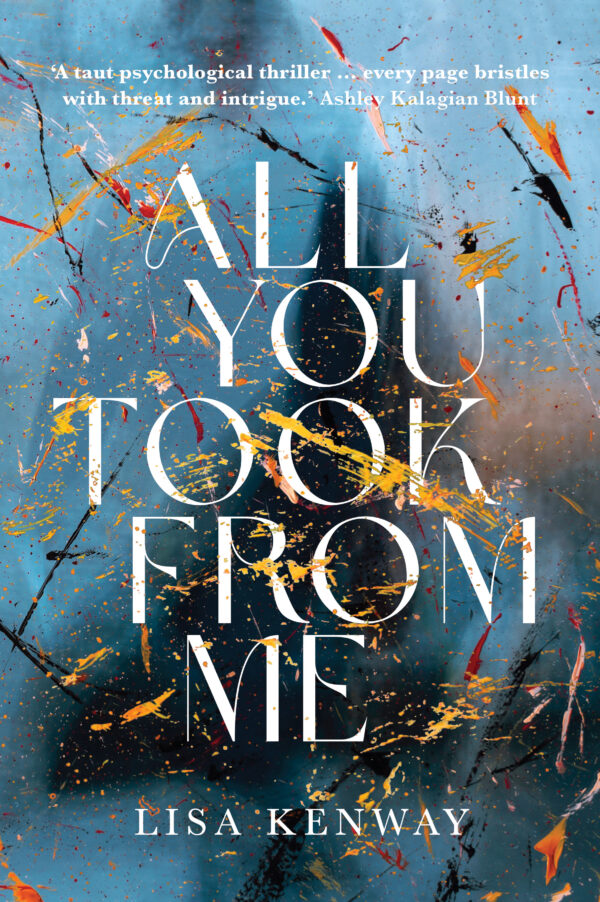
With my Review TBR pile teetering on the brink, I decided to call in a favour from Mr Gums, and handed him Lisa Kenway’s debut novel, All you took from me, thinking it might be up his alley.

Now, a word about Mr Gums. He is an engineer by training, and not the world’s biggest reader. When he does read – in the past at least – his go-to has been Jane Austen (whose books he has read multiple times, including more than once in German) and other classics. However, with more time at his disposal since retirement, he has started reading a little more broadly. He likes to be “entertained”, not overly challenged in his reading. (Apparently, reading Mansfield Park in German is not challenging!) Life is challenging enough, he says. So, crime fiction seemed to be a good fit, and he’s been trying out several authors with varying success. Chris Hammer is a big hit. Garry Disher goes down pretty well too. Peter Temple not so much. He has also read non-Australian crime writers – English, and others, including, recently, a Japanese author (thanks to JacquiWine). As you can tell from his Austen love, he is more than happy to read women writers, and has crime by Dervla McTiernan and Shelley Burr, and recently, Dinuka McKenzie’s first novel. So, why not Lisa Kenway?

So, Lisa Kenway. According to the media release that came with my review copy, she is an Australian writer and anaesthetist. This debut novel, All you took from me, was “inspired by her longstanding fascination with memory and consciousness”. An earlier manuscript version was longlisted for Hachette’s Richell Prize for Emerging Writers in 2020 (out of over 800 submissions). That must have given her confidence to keep working on it, because here it is, published by Transit Lounge in 2024.

Anyhow, the novel is set in two places – the Blue Mountains (which I love) and Sydney. The protagonist, Clare Carpenter, is an anaesthetist – write what you know! – whose husband has died in a single-vehicle car accident which also caused her to lose her memory. Soon after, she senses she is being followed by a stranger. Why? Finding the answer becomes her mission, but it is hampered by her loss of memory. Can she reverse that? Of course nothing is simple, and the risks and threats mount. This novel is not Mr Gums’ (nor my) preferred type of crime, which is the police procedural. It is, instead, as the blurbs say, a psychological thriller.

Mr Gums was intrigued by this debut, but he had reservations. He particularly liked the set up – the protagonist as anaesthetist. It was different, and an interesting idea. He enjoyed reading the technical details about anaesthesia, and liked the attention paid to details in those parts of the story. (Like me, he enjoys it when novels teach him about a world he doesn’t know much about.) However, this is also where his main reservation came, because, scientifically trained himself, he found Clare’s behaviour hard to believe. The risks she took, her foray into unscientific ideas, lost him. Mr Gums, though, has not been in the position Clare found herself in. Perhaps, in the same desperate circumstances, he might try anything too?

All you took from me is told first person, and the voice rings true. Clare is articulate and intelligent, and honest, as she starts to uncover less pleasant things about herself. The novel opens in the hospital a month after the accident, with Clare starting to return to her – new – consciousness. From here, the plot picks up, becoming increasing dramatic and sensational, as you’d expect for its genre, with Clare’s shaky memory, and her attempts to recover it, underpinning much of the intrigue. There are the usual red herrings and misleading threads, which kept Mr Gums challenged as he tried to work out what was true and what wasn’t.

Overall, Kenway’s novel is not Mr Gums’ preferred crime genre. He prefers more dogged analysis in his crime to the stress and tension of a thriller. However, he did conclude that All you took from me was “strangely entertaining”, which suggests to me that Kenway’s debut should not be the last novel she writes. I’d love to know if anyone else has read it?

Lisa Kenway
All you took from me
Melbourne: Transit Lounge, 2024
328pp.
ISBN: 9781923023123

[Review copy courtesy Transit Lounge (via Scott Eathorne of Quikmark Media)]
Jane Caro, The mother (#BookReview)

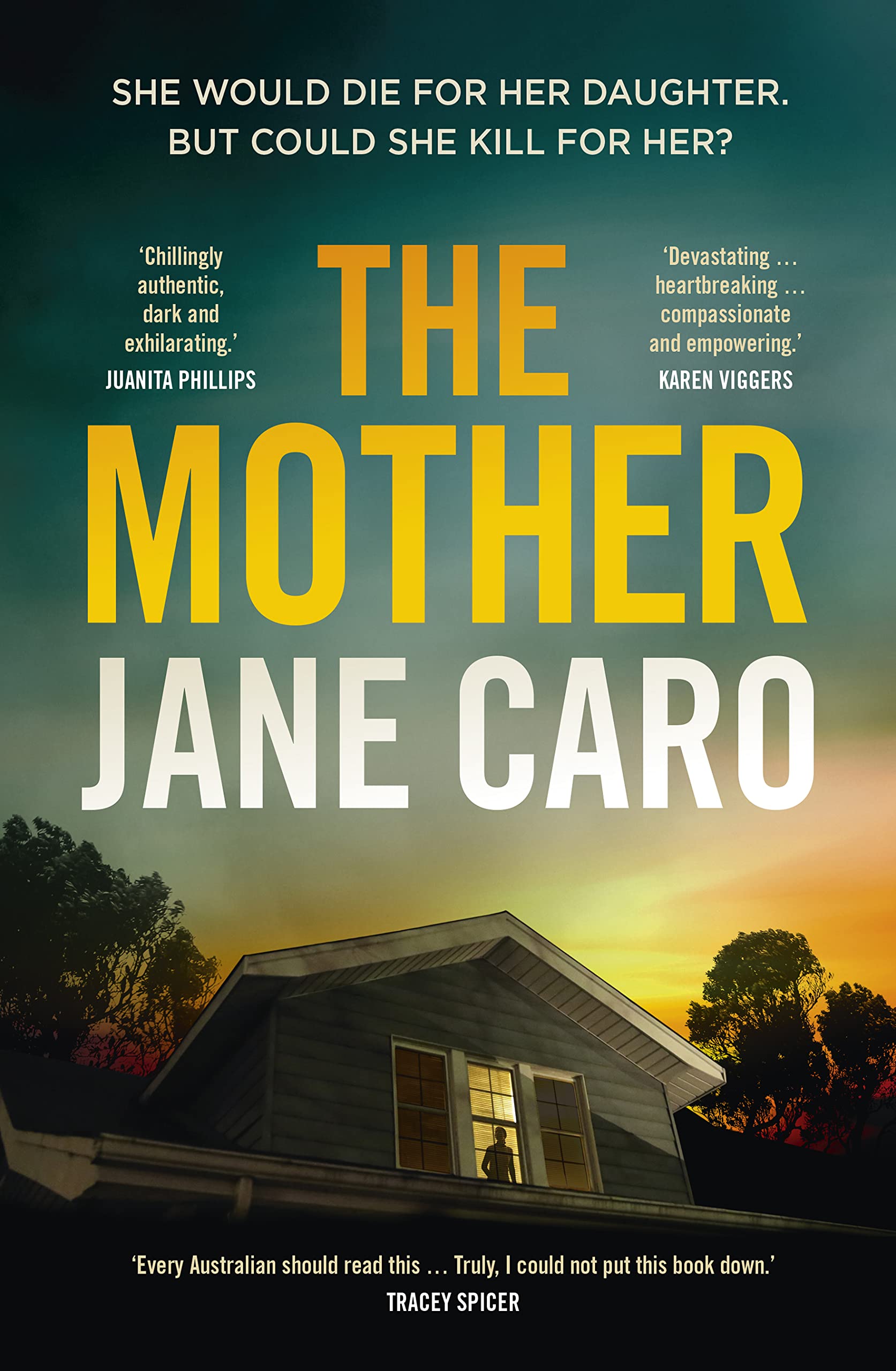
When my reading group scheduled Jane Caro’s debut novel, The mother, I was, I admit, not exactly enthusiastic, because my sense was that it was not going to be the sort of, shall I say, subtle writing I prefer. My sense was right, but I am not sorry I read it – partly because of the engaged discussion we had and partly for Caro’s intention.

The mother, then, is not a literary award-winner – the writing is fine but not exciting or breath-taking in the way I like – but, and it is a big but, it is an accessible, fictional exposé of the main points Jess Hill makes in her Stella Prize-winning See what you made me do: Power, control and domestic violence (my review). Hill explores family and domestic violence from every angle, but the most shocking and enlightening part for me concerned children, particularly the Family Court’s inability or refusal to see the risks to children from its parent access orders, even when the children themselves express fear. This point is powerfully made by Caro in her novel*.

But, let me step back a bit. The mother tells the story of 60-something middle-class Miriam Duffy who, widowed early in the novel, is pleased – and indeed grateful – when her emotional daughter, with whom she has had a tricky relationship, marries a perfect-seeming man. Gradually, however, little niggles about this relationship become bigger until one day they are confirmed when Ally returns home with two little children in tow, having left her husband. From here the situation deteriorates as the husband Nick escalates his bullying, predatory behaviour, and Miriam and Ally realise that the law is unable to protect them. The novel is described as a thriller, so I’ll give you just one more piece of information. It opens with a Prologue in which Miriam buys a handgun.

This brings me to the structure. After this Prologue, the novel is divided into two parts. In Part 1, Ally marries and soon after, Miriam is widowed. There is also a second, older, daughter who is in a stable marriage and has two children. During this part, Caro slowly drips out many of the flags that constitute coercive control, but that on their own don’t initially look like it or can be explained away – things like isolation from family and friends, use of a (demeaning) pet-name, jealousy, charm that is turned on and off at will, and surveillance, moving into sexual violence and gaslighting. This part ends with Ally’s return home. Part 2 commences four years later, and we are reminded of the Prologue, because Miriam is researching where she can buy a gun. Miriam and Ally have been systematically intimidated by Nick, and have reported his transgressions against Ally’s AVO (Apprehended Violence Order) again and again, but

Eventually they had stopped going to the police. It wasn’t that the cops weren’t sympathetic; it was just that they could not do anything.

In this part, Caro ratchets up the sense of helplessness (and hopelessness) the two women feel as Nick finds new ways to harass and terrify them. As I read it, I couldn’t help but think about all the news stories of recent years about murdered women and children. Nor could Miriam and Ally, but they turned the TV off the minute these stories came on. They were too close to home!

Like many issue-driven books, The mother did, as many in my reading group commented, feel didactic at times, and it is somewhat predictable. Some of us also felt that it was a little laboured in places. However, offsetting this is the novel’s characterisation and understanding of human nature. Caro conveys the complex human emotions we all experience under stress. She explores the lines and balance between what is acceptable in relationships and what is not, the fears about when to speak up, the justifications we try to find when things feel awry, and the feelings of guilt (particularly in mothers).

The mother is unapologetically a novel with a cause. With its compelling storyline and believable characters, it has a chance of reaching those who do not understand what coercive control is, and who do not realise that it crosses all demographics. Nick, for example, is a vet and Ally a PhD candidate. Miriam, a successful businesswoman, lives in comfortable North Shore Sydney.

This novel is being promoted primarily as a thriller, but I’m more inclined to see it as belonging to that long tradition of social problem novels. It may not be as sophisticated as the best of them, but its intention is clear, to drive social change. I hope it succeeds. I don’t imagine Jane Caro, or Jess Hill for that matter, will let matters lie until we see real, sustained change happening – and nor should we.

* This month there has been news about changes in family law in Australia, including removing the presumption of equal shared care, putting a focus on prioritising children’s best interests, and revamping the role of independent children’s lawyers. Time will tell what difference this makes in practice.

Jane Caro
The mother
Allen & Unwin, 2022
368pp.
ISBN: 9781761063893 
ASIN: B09MQ3PN1W

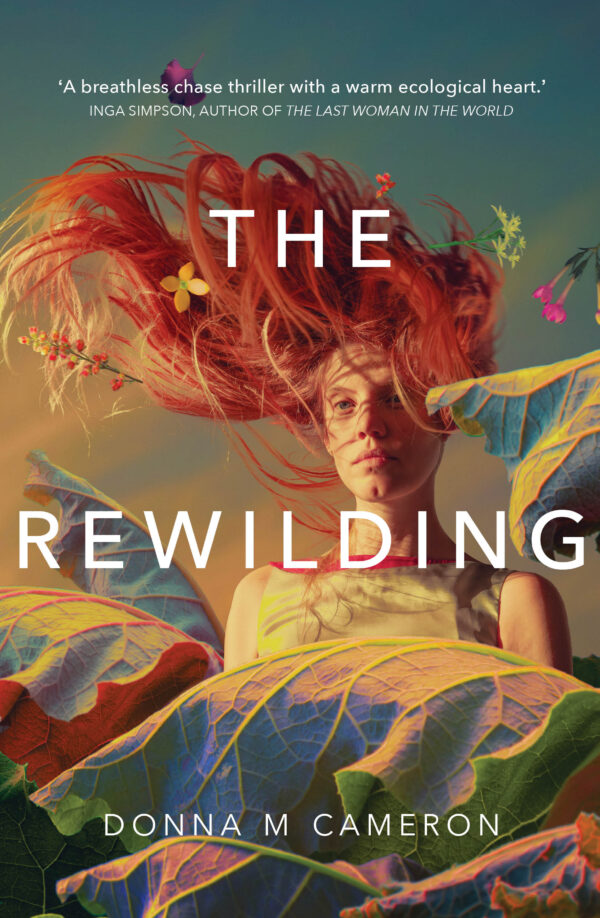
Donna M. Cameron, The rewilding (#BookReview)

Quite coincidentally, earlier this month, I read and posted on Willa Cather’s short story “The bookkeeper’s wife” which commences with a young man, Percy Bixby, sitting in his office deciding to do something in order to keep his flashy fiancée Stella. That was published in 1916. I have now just finished Donna M. Cameron’s novel, The rewilding, which was published in 2024. It commences with another young man, Jagger Eckerman, is sitting in his office deciding to do something that will lose him his flashy fiancée Lola. Both young men are caught up in fraud, Percy of his own making, Jagger unwittingly, though that doesn’t make him entirely blameless. From here the stories part company, so we will leave Percy, whose story I’ve already told, and look at 27-year-old Jagger.

Jagger has been living the high life. Caught up in his own privileged lifestyle, he’s been carelessly signing documents he shouldn’t, until finally the penny drops and he wakes “up to the fact that every aspect of his life is a farce”. So, he clicks Send on his whistle-blowing email and scarpers. The problem is that the only place he can think to scarper to is a cave in a national park south of Sydney, and when he gets there he finds someone else already holed up in the same spot, the 24-year-old “feral” eco-warrior, Nia Moretti. As the accompanying publicity sheet says, it is hatred at first sight, but they soon realise they need each other, whether they like it or not.

The rewilding starts with a bang and barely lets up for the length of its 300 pages. It’s a genre-bending work of eco-literature that combines thriller, road story and romance. The central thriller-driven plot is not my favourite type of story – I’m not much interested in watching or reading about chases, violence and suspense – but Cameron handles her material confidently, creating a book that I enjoyed reading despite myself. I just hurried through the bits that were less interesting to me. Why I was happy to read it is what I want to focus on here.

First, there’s the genre-bending aspect. Cameron balances the thriller components with more reflective and tender sections, with moments of interpersonal tension, with touches of humour, gorgeous natural descriptions, and serious themes. Second, the story is well-paced, and the writing fresh but accessible. It is primarily told third person through Jagger’s perspective, but this is occasionally interspersed with short chapters in Nia’s voice, in which she speaks to a mysterious “you”. These provide additional insights into Nia that Jagger can’t know, while also increasing the mystery. Who is this “you”? What has happened to Nia? Third, the two main characters are nicely developed. Jagger is on the run, scared and uncertain about what his future holds. Still grieving his mother’s death and the mistakes he’s made, he is fundamentally decent and an optimist. Nia, on the other hand, is an uncompromising idealist, and pessimistic, but reveals a softer side. Gradually, as is typical of the romance genre, the antagonism between them is relaxed, although not, of course, without setbacks.

“a capitalist suit” versus “the feral”

And finally, there are the themes. For me, a good story isn’t enough. I need some meat, some ideas that make the time I put into reading worthwhile, and this book has meat – personal and political. In the personal realm, Jagger is a young man who had lost his way but, when some truths become clear to him – when he realises his relationship had been built on a lie and his workplace was engaging in a waste removal scam – his better self, the one his recently dead mother had so carefully tried to engender in him, comes to the fore. In his suit and fancy shoes, he surprises Nia with his deep knowledge of and love for nature. Likewise, Nia is struggling with a personal loss. She is resentful of the “capitalist suit” who comes into her cave, and finds ways of using him – and his money – to her own ends but, despite her toughness, she has a heart. So, on the personal level, The rewilding is a novel about values, about the lines you draw, about the life you choose to live and what that means personally and …

politically, because this is also a novel about climate activism. Nia and her radical Earth Rebellion mates, the Lorax, are determined to save the planet. Their focus is a mining operation in northern Queensland which is about to proceed without permission. First, though, she has something to do in disaster-struck, flooded Brisbane, something that puts her and Jagger’s lives at risk. On the run, and being followed by hit men, he has no option but to go along with the only person who can help him. It is at this point, before the final dramatic confrontation at the mine, that Nia starts to unbend a little towards Jagger and his perspective.

“Why be scared of change?”

The rewilding is a wild, dramatic novel. It does push the boundaries of credibility at times, but probably no more than you expect in a thriller. Ultimately, through her characters and their fierce, lively conversations, and through her fast-paced plot which offers a few scenarios, Cameron explores the critical issues confronting us and asks the big questions we are asking, without resorting to overt didacticism.

Climate change novels can be bleak, but many authors, even those writing the bleakest of stories, talk at writers festivals about wanting to leave their readers with some hope. That this was Cameron’s intention is foreshadowed in the epigraph from Tolkien’s The lord of the rings, “Where there’s life, there’s hope”. So, at the end, certain rapprochements are achieved, but the conclusion is real rather than simplistic. It recognises that life is messy and change is hard but that it’s worth keeping on trying. The rewilding is a worthy addition to Australia’s eco-literature field.

Donna M. Cameron
The rewilding
Melbourne: Transit Lounge, 2024
309pp.
ISBN: 9781923023062

(Review copy courtesy Transit Lounge, via publicist Scott Eathorne of Quikmark Media)

The Hunter (movie)

The Hunter. Daniel Nettheim. Porchlight Films, 2011

Tasmanian Tiger (lithograph)

Lithograph of the Tasmania Tiger, after H. C. Richter's illustration in The Mammals of Australia (Gould) (Public Domain, via Wikipedia)

A guilty confession. I hadn’t heard of or read Julia’s Leigh’s apparently highly acclaimed novel, The Hunter, before this recent Australian movie was made. I’m not quite sure why that is. Maybe it was just child-rearing busy-ness at the time of its publication. Anyhow, the film is now out and I saw it this weekend. It was produced – but not directed – by the same people who made the excellent Animal Kingdom, and its cast includes Willem Dafoe (as “the hunter”), Sam Neill and Frances O’Connor. All actors I am always happy to see. And it was set in our beautiful southern island state, Tasmania.

The basic plot is straightforward. Martin (Dafoe) is a mercenary sent by a biotech company to find and kill a Tasmanian Tiger in order to bring back the necessary biological specimens for, it appears, biological warfare purposes. Now, if you know your Tasmanian history, you’ll know that the Tasmanian Tiger has been officially extinct since 1936 – but, like the Loch Ness Monster, there are always reports of sightings. The story, of course, has complications. The company organises for Dafoe to stay with a widow (well, her husband has been missing for a year) and her two young children who live on the edge of the bush … and from there the mystery thickens somewhat. What did happen to her husband?

The movie tos-and-fros between Dafoe “hunting” in the bush and spending time in the large log house with Sally (O’Connor) and her young daughter and son. Dafoe, established in the opening scene as a task-oriented person who likes cleanliness and order, a loner, arrives at Sally’s cabin to find the children running free, the house dirty and disordered, and the mother out-to-it (from, we soon learn, prescription drugs) in bed. He finds nowhere else in town: the logging-oriented townsfolk mistake him for a “greenie” and are therefore not willing to accommodate him, so he settles into Sally’s house, fixing it up to suit his needs. While doing so, he starts to engage with the two children and then the mother, which doesn’t endear him to Jack (Sam Neill).

This is billed as a thriller, and there certainly is tension. Can he find a Tasmanian Tiger? And do we want him to? What happened to Sally’s husband? Is Jack hiding something? Does Bike (Sally’s son who doesn’t speak) know something? The film doesn’t quite have the sophisticated moral and emotional complexity of Animal Kingdom. It is more a film of archetypes: the hunter who becomes the hunted, the silent child who knows something, the withdrawn grieving wife, and so on. The tension is enhanced by the remote, forbidding landscape, and the cinematography used to convey it. The colours are cold blues and greens, the lighting dark. There is also the sense of menace suggested first by the loggers but then by something less definite, more mysterious. Is it animal or human?

This is a difficult film to review. I enjoyed the movie, but had some reservations. The performances are excellent, particularly the taciturn but expressive Dafoe, and the two children. The pacing is slow, and yet it’s not too long. The cinematography is captivating overall, though I didn’t always like the unsubtle way parts of a scene would move in and out of focus. The soundtrack – the natural sounds in the bush, and Martin’s classics set against Sally’s Springsteen in the domestic scenes – is effective. The plot is perhaps its main problem. The initial set-up – that of expecting to find an extinct animal – needs a major suspension of disbelief, which was not a problem on its own, but the plot is then so tightly managed it was a little difficult in the end to know exactly who had been implicated in what. And this leads, I think, to a confusion of themes.  The logger-environmentalist conflict is introduced but never really developed. Was it there for necessary background*, or for its red herring purposes? There’s a bevy of themes concerning nature and extinct animals versus man, science and corporate greed. These are all touched upon and developed to some degree, but not as strongly as they could be. The overriding theme though is probably Martin’s emotional journey – from an isolated, self-contained man at the beginning to … well, I don’t want to give away the plot, but his character’s development was, though somewhat predictable in that archetypal way, nicely and movingly done.

Having seen the film, I’d rather like to read the book – to see how I would interpret the characters, plot and themes. In the meantime, I would recommend the film … it may not be perfect but it has plenty to recommend it and is well worth the price of a ticket.

* For more on why this could be so, see my review of Into the woods.