This will be a short post, tonight, mainly because I couldn’t find, in the time I had available, enough information for my original idea – which was to discuss The Australian Women’s Weekly’s support for Australian writers. This was inspired by my coming across, during last week’s research into Currawong Publishing Company, an article about a prize for writers being offered by The Weekly (as it is known, familiarly) in 1941. There were two prizes, one for a short story and one for a serial. The reason it popped up during my search was because M.L.L. Woolacott of Currawong Publishing Company was one of the people quoted as supporting the prize. S/he said:
It is gratifying to see a publication such as The Australian Women’s Weekly play a leading role in the movement towards firmly establishing literature in Australia. For this is the moment to give Australian writers every opportunity.
Before I continue to the main matter of today’s post, I’d like to share what a couple of other people said. Novelist Katharine Susannah Prichard (see my review of her The pioneers) said:
Australia has many writers who would produce fine stories and novels if only they could be assured of having their works published in Australia. This competition being launched by The Australian Women’s Weekly is going to give them that chance.
And novelist Eleanor Dark (see my review of her Juvenilia), whose book The timeless land had just been selected as book-of-the-month in the USA, said that “Literature in Australia needs encouraging, for without encouragement the growth will be slow.”
So, a lot of positive support, but I had trouble tracking down an announcement of the winners, and whether the competition was run again. The information could be there, but there’s only so much time …
However, as I was researching this, I did discover that during the 1930s to 1950s, The Weekly regularly published complete novels in an issue, often in a supplement. They were, I’d say, more like novellas or very-long-form short stories, but what a great service the magazine provided to readers – and presumably to the writers whose work was published.
Now, reader, you know what I did next: I checked out these novels and writers to see if any were recognisable. I only checked a handful – there’s only so much time, you know – but I found that mostly the names were not known to me, nor to Professor Google or AustLit. Some were, though, such as T.C. Bridges whose Messenger’s millions appeared in 1935 and C.K. Thompson whose The third man (not THE third man, of course!) also appeared in 1935. The third man Supplement is headed “complete book-length novel”. A book-length novel? I wonder what other sorts of novels there are? Anyhow, Thompson was a journalist based in the Hunter Valley of New South Wales. T.C Bridges, on the other hand, was born in England and worked primarily as a freelance writer. Although he was clearly published in Australia, AustLit says that they have no evidence that he visited Australia.
This was then popular literature, perhaps even pulp fiction, but I’m impressed that during a time when people didn’t always have a lot of disposable income they could find books in their magazine. (Of course, there were also the public libraries.)
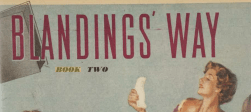 But now, I said this was going to be short, and I’m going to stick to that promise, so I’m concluding with a summary of “the story so far” for Book Two of Blanding’s Way, written by Eric Hodgins and published in 1952:
THE STORY SO FAR: In their Dream Home at Lansdale the Blandings had all sorts of exciting things happen. The vegetable garden produced a record crop, the fields caught fire, thirteen-year-old Joan became a prize-winning essayist, and Mr. Blandings was elected to the school board. NOW
I do love that the exciting things included producing a record crop, becoming a prize-winning essayist, and being elected to the School Board. Sounds right up my alley! Oh, in case you are interested, the “book” occupies 10 multi-column-tiny-font pages of the magazine. If you tried to print the “book” it would, according to my system, take 64 pages.
Note: The National Library of Australia has produced a discovery page for The Weekly, from which their digitised articles can be accessed directly. You can in fact, locate and read any issue published between establishment in 1933 and 1982. Now, if I had the time …
 Whispering Gums