Over the years I have written posts about and reviews of books with strong socioeconomic underpinnings. In the nineteenth century these novels tended to be described as Social Novels (and I am have just an English one for reading group, review coming) or were seen under the banner of the Realist movement. In the early to mid twentieth century, books dealing with these concerns were seen as part of the Social Realism movement. I’m playing a bit loose here, because I don’t intend to get into the weeds about definitions. I simply want to note that these novels, to quote Wikipedia’s article on Social Realism, aim to explore the “socio-political conditions of the working class as a means to critique the power structures behind these conditions”. I have written at least two Monday Musings about writing in this area, one on Factory Novels and one on Realism and Modernism, but the issues have popped up frequently in individual reviews too.
In recent years, new terms have entered the popular sociopolitical lexicon, and these include “precarity” and “late capitalism”. Precarity, with its focus on the lack of job security and all the social and psychological ills that flow from this, may be a relatively new term in sociopolitical discussion, but its broader meaning encompassing the idea of living precarious lives, has underpinned most nineteenth and early twentieth century “Social” and “Realist” novels.
Similarly, Late Capitalism is a complex “term” with a history going back many decades, but is popping up increasingly frequently across all types of writing. Wikipedia covers it in detail, but I’m using one definition from PhD student David Espinoza at the University of Sydney (2022). If you are interested, you can read more at both sites. Basically, Espinoza says that the term wasn’t taken up widely until Belgian Marxist economist Ernest Mandel’s treatise on the topic was published in English in 1975. Espinoza says that
Mandel used the idea to describe the economic expansion after the second world war … a time characterised by the emergence of multinational companies, a growth in the global circulation of capital and an increase in corporate profits and the wealth of certain individuals, chiefly in the West.
For Mandel, “late capitalism” is not so much a change in what capitalism is as “expansion and acceleration in production and exchange”. He says that “one of the main features of late capitalism is the increasing amounts of capital investments into non-traditional productive areas, such as the expansion of credit”. Espinoza says late capitalism is behind the increasing number of financial or economic crises we have had since the 1970s.
There is more, but this is the essence. It’s a bit loosey-goosey I know, but I’m not an expert in economics. However, I hope this is accurate enough and makes enough sense for our needs.
Now, last week’s Monday Musings was inspired by critic/artistic director/literary judge Beejay Silcox’s article in The Guardian on new Australian releases. As I wrote in that post, Silcox grouped the releases under headings. One was “Eco-lit flourishes”, which I discussed last week because it’s an area that interests me. Another area of interest also caught my eye, the one she called “The cost of living”. It inspired this post. Don’t worry, I am not going to go through her whole article in this way. That would be too cheeky for words!
Precarity and Late Capitalism in Australian fiction
I don’t want to repeat the books I included in those previous Monday Musings, but I will name a handful of other Australian novels (and short satires) that I’ve read that encompass these issues (though probably the most searing fictional critique I’ve read recently is Scottish writer Andrew O’Hagan’s Caledonian Road):

- Donna M. Cameron, The rewilding (my review): capitalism and its impact on climate
- Julie Koh, Portable curiosities (my review): satirical short stories which skewer multiple aspects of capitalist culture, including housing and banking
- Paddy O’Reilly, Other houses (my review): social mobility and the desire to provide better opportunities for children
- Heather Rose, Bruny (my review): satire, on globalised capital, and the conspiracies and political corruption that ensue
These books show there are many ways in which contemporary authors approach this topic, from a more traditional working-class novel (like Paddy O’Reilly’s) through to thrillers and eco-literature, and that satire is still alive as a means to expose the extremes. I would also argue that many of the recent novels by First Nations Australian writers, like Melissa Lucashenko, encompass responses to the depredations of late capitalism.
Now to Beejay Silcox’s list of what is coming in 2026. She introduced this section with the statement that “From the housing crisis to the care sandwich: an emerging and caustic theme in Ozlit (and beyond) is late capitalism and financial precarity”. As with my Eco-literature post, I will dot point the books she lists, in alphabetical order by author, for simplicity’s sake, but will include any description she provided:
- Alan Fyfe, The cross thieves: “set in a riverside squat”, Transit Lounge, March, on my TBR
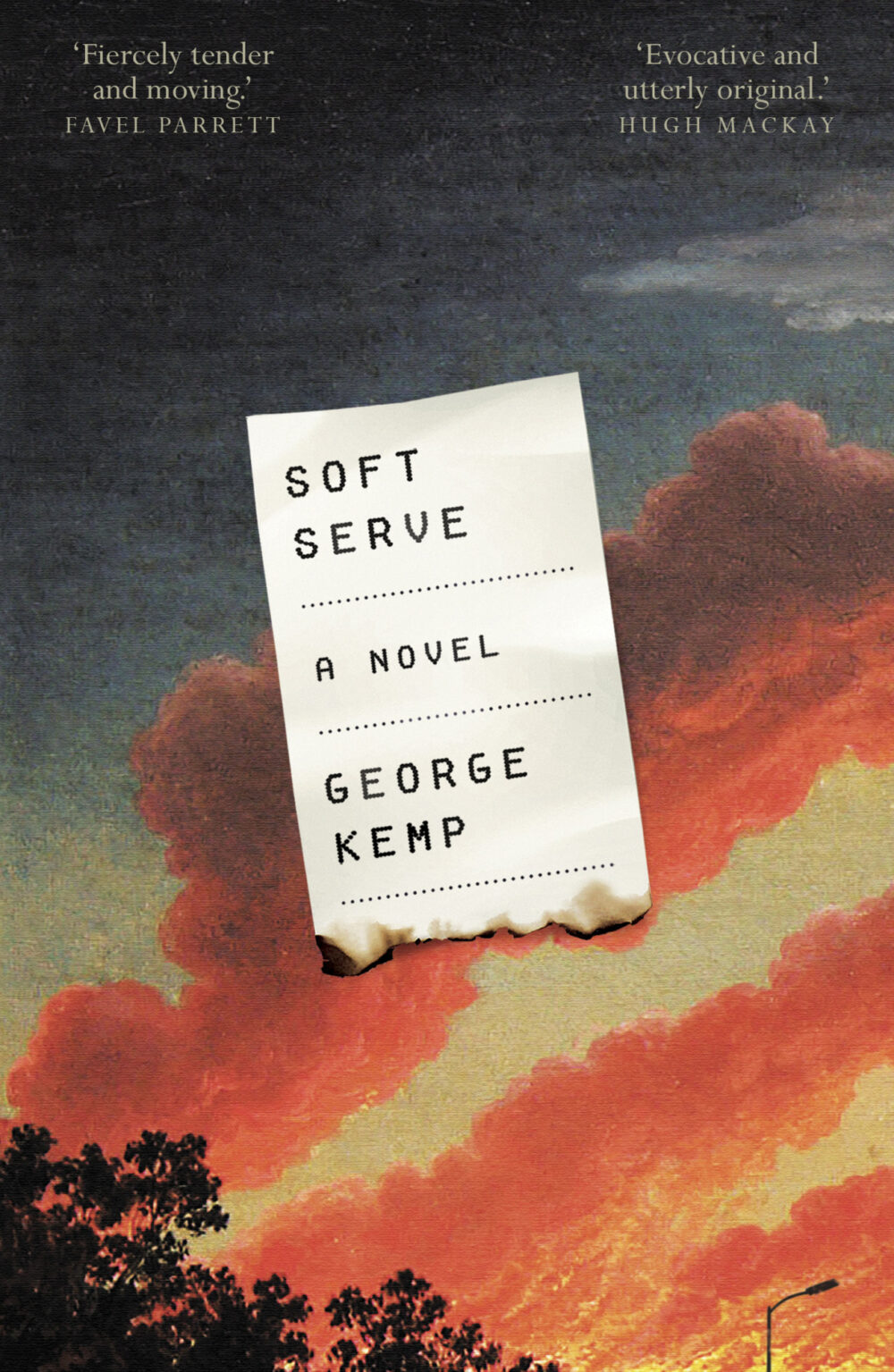
- George Kemp, Soft serve: “traps his cast in a regional McDonald’s as a bushfire closes in”, UQP, February, on my TBR
- Jordan Prosser, Blue giant: “sends a hungover millennial to Mars”, UQP, August
- Ellena Savage, The ruiners: “follows an anarchist waiter from inner-city Melbourne to a decrepit Greek Island”, Summit, April
- Fiona Wright, Kill your Boomers: “captures the mood”! Harumph, says this Boomer, watching her back (though, having children, I do understand), Ultimo, March
For the record, Silcox also names a couple of nonfiction titles on the theme: Lucinda Holdforth’s Going on and on: Why longevity threatens the future (Summit, April), and Matt Lloyd-Cape’s Our place: How to fix the housing crisis and build a better Australia (Black Inc, September).
Can you recommend any standout books you’ve read about contemporary precarity and late capitalism? Doesn’t have to be Australian. I’d love to hear.
 Whispering Gums