Shelley Burr, Vanish (#BookReview)

With Vanish, the third novel in her Lane Holland series, Burr mixes it up yet again, which appeals to me because my main reason for not liking genre fiction is that it can be formulaic. I know this is why many like it, and I understand that need for comforting reading. It’s just not my need.

So, a brief recap. In Wake (my review), we are introduced to a private investigator, Lane Holland, who arrives in a remote, outback, fictional town to investigate an old missing persons case. He’s keen and caring, but he also has his own agenda – and the resolution is shocking. The next book, Ripper aka Murder town (my review), is set in a different country town. It initially looked like something different, as Lane is in prison from Wake‘s fallout, but it soon becomes a dual investigation story that coalesces when it turns into both a murder and a missing persons case.

And now, book 3. It seems you really can’t keep a good PI down, even if he is in prison! Vanish is set a few years later. Lane is still in prison but, because of prison governor Carver’s vested interest, he soon manages to get himself on a pre-parole release program in order to continue the unsolved investigation from Ripper. If you’ve read Ripper you’ll know what that is, and if you haven’t, it becomes clear very soon. My point, though, is that once again Burr has produced a highly readable crime novel that manages to be a bit different from the preceding book, while retaining enough familiarity for those invested in her characters and worldview. It’s a fine balance that Burr has trodden nicely.

Like its predecessors, Vanish belongs to the rural noir sub-genre, and is consequently, noir-ish – or Australian Gothic – in tone. It features characters we have met in the previous novels, including Lane Holland, his sister Lynnie, and his first client Mina McCreery. Further, its plot centres again on a missing person. In Vanish, however, there’s more than one missing person. A serial missing persons case!

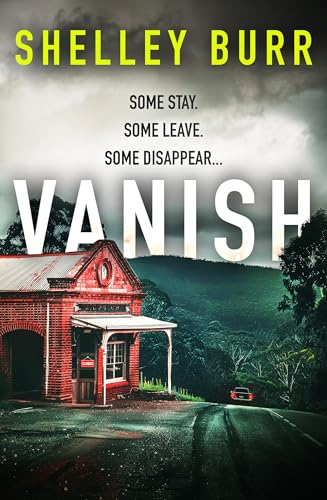
Some stay. Some leave. Some disappear.

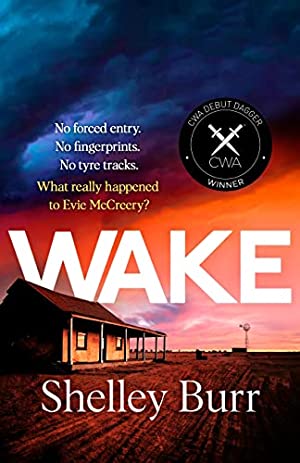
“Some stay. Some leave. Some disappear” appears above the title in the book’s first Australian edition (as you can see in the cover pic above). What it references is the main setting of the novel – a farm near Hume Weir, southeast of Albury, an area Burr knows well. At the novel’s opening, Lane has tracked down several missing people as having visited this farm, then disappearing from view – hence the tag line. What is this farm, and why have some people disappeared? Lane wants to find out and Carver, with his daughter still missing, is happy to help him do so.

Consequently, with ankle bracelet, a prison guard minder, and an agreement for him to work at the farm, Lane arrives – but not without a mysterious-sounding death having just happened on the road in. This, of course, captures Lane’s attention – and we’re off.

Now Lane is, of course, your suspicious type. He takes nothing at face value, and he closely observes all that’s going on around him. There’s something about this farm that doesn’t feel right. Is it a community of like-minded people who want to escape their old lives and live more simply, growing their own food and reducing their energy impact on the world? Or is it a cult? How genuine is the owner Sam Karpathy, not to mention his recently deceased father? What do the people in the nearby township know, and why do they seem evasive when Lane tries to find out? And, why is a certain person from a previous novel there too?

Oh, and who is the trapped, sick, or injured person whose story is told in short italicised sections interspersed with the main narrative? (It added to the intrigue, and I didn’t guess it at all.)

As in her previous novel, Burr’s builds her crime story around wider issues. In Ripper for example it was “dark tourism”. Here, it is the idea of people wishing to live eco-minded, sustainable lives. So, as the investigation progresses, Burr also interrogates what this sort of life means in terms of whether or not you compromise and why, whether you stockpile for an end-of-world scenario, whether you eschew western medicine, and so on. These are questions Lane considers as he tries to understand the community he is living in. And it starts with the controlling Karpathy.

Lane, as he needs to be, is a trustworthy narrator for us. The novel is told third person, through his eyes, and he brings us along with him, sharing his thoughts and explaining his processes. His awareness of body language and his experience of human behaviour guide his actions. I loved those details. There’s risk and tension, some creeping around the farm at night, a locked room, magic mushrooms, and more. I didn’t find it edge-of-the-seat suspenseful, but I don’t like that anyhow, so the level of stress was just about right for me. The plot builds slowly, sending us off in various directions, and keeping us uncertain as we consider what Lane sees and questions. Is Karpathy, for example, coercive or simply wanting to keep control of a dream he is vested in. The denouement, when it comes, unfolds quickly, and at just the right time.

I enjoyed the read. I have been invested in Lane from the beginning, and he continued to interest me in this book. He’s conscientious, intelligent and decent, but, appealingly, is not always sure of himself, particularly when it comes to relationships. Also, Burr evokes place well. The farm, which is set in mountains just far enough from a little town to feel isolated, feels believable, as do the natural disasters – flood and bushfire – which threaten it.

My only question now is, will we see more of Lane? As a convicted felon he will not be able to renew his investigator licence. There is a hint at the end that there might be a way around it. Time will tell, but if you are a Lane Holland fan, I think you can have hope.

Shelley Burr
Vanish
Sydney: Hachette Australia, 2023
384pp.
ISBN: 9780733652158

(Review copy – an uncorrected book proof, hence no quotes – courtesy Hachette Australia)
Stephen Orr, Shining like the sun (#BookReview)

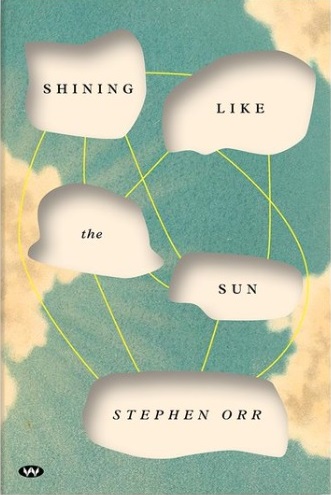
A question that confronts many young people as they reach adulthood – in western cultures at least – is, should I go or should I stay? This is particularly so for young people in small rural towns, and is the issue at the heart of Stephen Orr’s latest novel, Shining like the sun. Wilf Healy, the oldest of three brothers, stayed in Selwyn which is now dying, while his brother Colin left for the bright lights of America, as soon as he could. Now eighty years old, the widowed Wilf is confronting the rest of his life, and he is again pondering the question, except he is not thinking of heading for the bright lights but for Louth, the island on which he grew up. The thing is, that island is empty. No-one lives there now. But this doesn’t dissuade Wilf from his dream. Meanwhile, his 17-year-old great-nephew Connor is about to lose his Mum to cancer and sees no life for himself in Selwyn.

That is the basic plot. Selwyn is a fictional wheatbelt town in South Australia – only identified because Louth Island is a real island off the coast. Selwyn has “three hundred people coming and going, dying, lost in the cracks”, plus one of those signposts pointing to far-flung places around the world. Wilf lives and works in Monk’s pub, delivers the mail (not to mention vegetables and pharmaceuticals) around the community, and drives the school bus, all because he can’t say “no” when yet another job needs doing. However, as the novel opens, he’s had enough. He wants to retire, but his plans to leave are half-hearted at best – and not just because of his sense of responsibility for his sick niece Orla and her son, the disengaged Connor. Why?

The three epigraphs provide a clue, but so of course does the story. We follow Wilf through his days, as he engages with the people of Selwyn, people whom Orr paints beautifully with a description here, a piece of dialogue there. Take young Connor, “an out-of-tune whistle that just needed a breath of air”, or Bobby, the 85-year-old vegetable grower and builder of a kit plane “who is too old to deliver vegetables, but not fly”. Take the school principal, Noah, for whom Wilf drives the school bus. He’s a weak man, who, when a certain crunch comes, cannot stand up for right. And take Wilf’s school bus passengers who are so entertainingly individuated from the opinionated Sienna to the JK Rowling-wannabe Luke, from the withdrawn Trevor to the entitled bully Darcy. The bus-rides are interspersed through the novel, providing perfectly pitched comic relief while also playing an important role in moving the narrative along. It is something that happens on the bus that triggers the novel’s main crisis.

But, Wilf and Connor provide more than two ends of the “do I leave” spectrum. Wilf’s reflections on his growing up provide a stark contrast to the lives of Connor and his peers. Wilf, of course, came from the often brutal “spare the rod, and spoil the child” era, when you did what you were told and expected little else, whilst Connor is growing up at a time when young people are not directed, but encouraged to find themselves. Orr does not judge either way, but lets his readers see and ponder how it all plays out in a life.

I opened this post on the question of staying or going, identifying it as the novel’s central issue – which it is. However, this is not the theme. Rather, it is the question which gives the theme its push. The theme, itself, is something deeper, something so fundamentally human that it could almost sound trite, except it’s not. I’m talking about the idea of community, of connection, of being where you are part of something bigger, where you can make a difference to the lives of others. This might sound schmaltzy. However, because Orr’s characters are fallibly human, and because the socio-economic challenges facing small towns (in particular) are real, connection doesn’t come easily. Shining like the sun, with its cast of authentic characters and array of specific, yet also typical situations, teases out whether this connection, this idea of community, can in fact still fly.

“the possibility of being happy” (Connor)

Orr’s intention? There is surely some political intent, some wish to convey the value and importance of these towns which are being allowed to die through neglect and poor policy (“farms flattened”, and so on). But, it is also personal in terms of exploring what sustains human beings the most – a fancy job or house? Or connections with your community? Mr Gums and I wait for the cliched “tight-knit community” which is unfailingly trotted out after whatever disaster (natural or personal) is on the day’s news. Like most cliches, however, it has an element of truth. A “real” tight-knit community is worth its weight in gold – another cliche for you. Orr knows this, so does Wilf. There is nothing romantic to this story, just real life with all its questions and toughness alongside moments of humour and mutual support in which, even Connor realises, there is “the possibility of being happy”.

Shining like the sun, then, is another special Stephen Orr novel. It is not fancy in voice or structure. That is, it is told third person – albeit a first person narrator opens the proceedings – and is told chronologically, with occasional flashbacks as Wilf remembers his past. What makes it special is the quality of the descriptive writing, the knowing characterisation, the authentic dialogue, and the serious but warm tone leavened by natural humour that comes from ordinary people going about their business.

I read this novel immediately after my return from touring outback Queensland. We saw many small country towns, most of which were variations on the theme. Orr’s story rings true to these towns. Indeed, to end on a cliche – because, why not? – Shining like the sun is a love letter to an Australia little known to its mostly urban inhabitants. It has much to offer on both political and personal levels, but, beyond that, it is just a darned good read.

Stephen Orr
Shining like the sun
Mile End: Wakefield Press, 2024
313pp.
ISBN: 9781923042278
Review copy courtesy of Wakefield Press.

Shelley Burr, Ripper (#BookReview)

When I started reading Ripper, Shelley Burr’s follow-up novel to her bestselling award-winning debut novel Wake (my review), I thought about crime novels, about how they are often written in series and how I am not a big series fan. Ripper looked to me like a stand-alone novel – and it is, somewhat! I say somewhat, because a few chapters in we come across one Lane Holland.

The plot thickens…

Lane Holland, I thought. I know that name. Sure enough, Lane Holland is the private investigator protagonist of the aforementioned Wake. However, he is not the prime investigator in this novel, because he is in prison as a result of his previous investigation. (You’ll need to read Wake to find out more!) The result is an intriguing crime novel in which we have our prime, self-appointed amateur investigator, Gemma, plus the police working away in the background, and Lane who is pulled into the investigation by his prison governor, Patton Carver. Yes, you’ve guessed right, the plot thickens – except I haven’t really told you about the plot yet.

Ripper is set in a fictional town called Rainier, which, as Burr confirms in her acknowledgements, is partly based on the town of Tarcutta. Seventeen years before the novel opens, three murders had occurred in this little country town, the last one outside the door of Gemma’s little teashop. She – and the town – have never fully recovered from these events. The town has stagnated under its black reputation, and Gemma herself suffers PTSD from what she had experienced. Now a tour company has arrived wanting to run a true crime or dark tourism walking tour of the Rainier Ripper’s murderous path, but Rainier’s residents have mixed feelings about the idea. On the eve of the trial tour aimed at garnering their support, the tour operator is killed in what looks like a copycat murder. It has to be copycat because the Rainier Ripper is in prison, the same prison as Lane Holland. As I said, the plot thickens, and part of the thickening springs from why prison governor Carver is interested.

Once again, I enjoyed Burr’s story, because once again it is more than a crime story, exploring issues like the impact on a small town of having a reputation for violence, the impact on people who have been close to a violent crime, the idea of dark tourism, and the murky world of police investigations and the ways in which confessions are elicited. I am not an expert but Burr’s research into the relevant issues, including prison life, felt thorough but lightly applied.

I also enjoyed Burr’s characterisation. Gemma and Lane are well-evoked. Other characters are necessarily more sketchy, but they are individualised enough to lift them above pure stereotype, to make them feel true. There is an engaging exploration, through Gemma’s daughter and her friends, of how teenagers cope with a complex adult world. There are some truly “tangled” family relationships in the town. There is some diversity, including a non-binary teen and a Wiradjuri woman, which Burr introduces without trying to appropriate other experiences. There are farmers, business people, pub owners, and doctors whose lives are entwined through marriage and murders. It’s a lot to convey, and there are plenty of names, but I rarely got lost!

Ripper has some similarities with Wake, in addition to also belonging to the rural noir sub-genre. It’s told through roughly alternating third person voices (Gemma and Lane); the protagonist is privately investigating; and it deals with a cold case, which involves a missing person. But it is significantly different, too, including the fact that Gemma is an amateur unlike Wake‘s Lane, and that it is set in a different place with different issues to confront. This means that it is not formulaic, which keeps us readers on our toes. We can’t assume anything about where Burr is going.

Now, I am not a big plot-follower, by which I mean I don’t put serious brainpower into trying to work out who dunnit. Rather, I read crime like I read most books, that is, with a focus on the characters and the issues being explored. But of course, I can’t help following the actual plot, particularly when the characters have engaged me and I want them to fare well. In Ripper, I worked out one of the plot twists, but it had several – like those Christie and Christie-like TV shows I watch – and they left me for dead. They did make sense, though, which is the important thing.

On the basis of her manuscript for Wake, Burr won a two-book deal with Hachette, and Ripper is the second book. I do hope she is offered more book deals because, while there is absolute closure on this book’s crimes, there is also a clear hint at the end about where a next book might go – and I’m intrigued. Burr is a clever writer, with her wits about her. Ripper’s readers will guess the main investigation Burr plans for her next novel, but what will the context be this time? What will be the issues? Time will hopefully tell.

Shelley Burr
Ripper
Sydney: Hachette Australia, 2023
346pp.
ISBN: 9780733647857

(Review copy courtesy Hachette Australia)

Robbie Arnott, Limberlost (#BookReview)

Where should I start my discussion of Robbie Arnott’s third novel, Limberlost? Perhaps with the epigraph. It’s by Gene Stratton Porter, and says, “In the economy of Nature, nothing is ever lost”. I have posted on Porter – on her essay, “The last Passenger Pigeon”. She was, says Wikipedia, an author, nature photographer, naturalist and silent-film producer.

Some of you will know her for her now classic novel, Girl of the Limberlost (1909). My mother adored it, and passed it on to me. I adored it too, and passed it on to my daughter, who adored it in her turn. It is a beautiful book about love of place (Indiana’s Limberlost Swamp) and a young woman, Elnora, living with a wounded, neglectful, widowed mother. It is about how Elnora obtains sustenance (physical and emotional) from nature. Yes, it’s a bit sentimental, in the style of the time, but Porter won me over with her description of the Limberlost Swamp and with her young protagonist Elnora’s strength. (Oh, and with Elnora’s beautiful lunchbox, which, apparently, also impressed author Joan Aiken! I wanted one.)

So, Robbie Arnott’s Limberlost … it draws more than a little – but also not a lot – from Porter and her novel. It is about a teenage boy Ned who, though not neglected like Elnora, is living with a loving but stressed and often remote father. It is set in a stunning and beautifully-rendered-by-Arnott environment, in this case northeast Tasmania, in the Tamar River valley. There are enough similarities to suggest that Arnott also loved Porter’s novel. However, Arnott has taken this kernel – troubled teenager left frequently alone in a beautiful environment – and woven a more subtle story about, well, let’s talk about that now …

Fundamentally, Limberlost is a coming-of-age novel but one that also happens to tell a whole life from childhood to 90s – in just over 200 pages. That’s impressive writing. If you like family sagas, this is not for you, but if you are interested in what makes a life a life then Arnott has written just the book. In this case, we are talking specifically the life of a man. I have reviewed a few books over the years that explore manhood – Christos Tsiolkas’ Barracuda (my review) and Sandy Gordon’s Leaving Owl Creek (my review), being two. Arnott’s book has its own take on this question.

He’d never felt so brotherless

The central narrative takes place over summer, near the end of World War 2, when Ned is 15. With his mother having died within months of his birth, and his two older brothers, Bill and Toby, being away at war, it is just Ned and his father on the family orchard, until big sister Maggie arrives to make it three. The core chronology follows Ned through summer, but the narrative shifts back and forth in time as events segue to other experiences in Ned’s life.

Ned is a sensitive, reflective young man. The novel starts with a scene from when he was 5. The community was awash with rumours and fears about a mad whale causing death and destruction at the mouth of the river, so Ned’s father had taken his three boys out in a boat to the eye of the storm, as it were. This little incident is key to the novel, because it is about facing fears, about checking the truth of stories, about memory – and about fathers and brothers. Throughout the novel, Ned struggles to remember what really happened in the various events of his life, starting with this one. Which brother had given him a coat that night when he’d shivered with cold? This bothers him, but what is more important is that “he remembered the warmth of the wool”.

It is perhaps the challenge of being the baby brother, but for Ned the struggle to feel competent – like his father, like his brothers – is ongoing. At 15, he dreams of having a boat, and he works hard to realise it, by trapping rabbits and selling the pelts. Achieving this dream would bring him two victories: “He’d have the boat, and he’d have people’s shock at the casual totality of his competence”. There is a guilty niggle, though, because his trapping for pelts looks “nobler” – providing pelts for slouch hats, while his brothers are at war – than he knows in his heart it is.

Limberlost, however, is not only about manhood and brotherhood. It is also a work of eco-literature (about which I’ve written before). The novel’s epigraph, along with the opening “mad whale” scene, clues us into this. Nature – the natural world – thrums through the novel – from the whale, the rabbits, and the quoll he mistakenly traps, to the beautiful giant manna gums (or “White Knights”) that Ned logs in a short stint on a logging crew. Many of the descriptions of the animals, plants and landscape are visceral in the way they act upon Ned’s emotions and consciousness. Ned’s relationship with this world is complex – at times it terrifies, at times it nurtures, at times he takes from it (such as logging and rabbit-trapping) and at times he gives back (such as returning the quoll), but it is always there. Arnott’s natural world is beautiful but fierce. It is also threatened – by man’s actions upon it – which Arnott shows graphically but not didactically.

There are many strong, dramatic descriptions of nature in the novel, but I’m gong to share a rare joyful one. It comes during Ned’s honeymoon, after he had experienced the true joys of lovemaking (in one of the best sex-scenes I’ve read for a while):

Afterwards he’d driven them across the plateau through white-fingered fog, through ghostly stands of cider gums, through thick-needled pencil pines, through plains of button grass and tarns, through old rock and fresh lichen, until the road twisted and dived into a golden valley. Here at winter’s end, thousands of wattles had unfurled their gaudy colours. As they descended from the heights their vision was swarmed by the yellow fuzz. Every slope, every scree, every patch of forest, every glimpse through every window was a scene of flowering gold.

The rolling, breathlessly joyful rhythm of this description is very different to that in the next paragraph where Ned’s old fears return, and the sentences become clipped, and staccato-like.

Arnott also refers to the presence of local First Nations peoples, to Ned’s awareness of their knowledge of the land. “At no point, Ned had heard, were they hungry” – not the way he and Callie were as they struggled to make their little orchard work. Some members of my reading group, with whom I read this book, felt this was anachronistic, but the Tasmanians amongst us argued that northern Tasmanians have long been aware of First Nations presence.

The final point I want to make concerns dreams and imagination. Ned, as I wrote above, feels guilty about his boat-dream when others think his rabbit-trapping is war-effort related, but it’s the dream that sustains him. When crisis comes and dreams are shattered – not in the way you are expecting so this is not a spoiler – Ned is devastated:

He wanted something to do, something to love. He had … nowhere to push his imagination, nothing to dream of … nowhere to turn his thoughts from reality … He felt cut loose from the anchors he’d been dropping all summer. He’d never felt so brotherless.

Limberlost is a great read. It is imbued with warmth for its world and characters, but it is not sentimental, nor simplistic, and no answers are given – except for one, the ties that bind, family. The novel starts and ends with father and brothers – but in between are real lives lived authentically in a vividly-rendered landscape that has its own life. Beautiful.

Several bloggers got to this before me, including Lisa, Kimbofo and Brona.

Robbie Arnott
Limberlost
Melbourne: Text Publishing, 2022
226pp.
ISBN: 9781922458766

Shelley Burr, Wake (#BookReview)

Regular readers here will know a few things about me. One is that I don’t regularly read crime, and another is that for three years, before the pandemic struck, I was the litblogging mentor for an ACT Writers Centre program. One of the last two participants in that program was Shelley Burr, author of the just-published crime novel Wake.

In my post on that 2019 program, I introduced Shelley as follows:

Shelley Burr is working on a novel, and took part in the ACT Writers Centre’s well-regarded Hard Copy program last year … She is particularly interested in what she calls “drought noir”, which term sounds perfect for some of the crime coming out of Australia at present. Shelley has had her writing place well in the Stockholm Writers Festival First Pages program.

That novel she was writing was Wake. It won the CWA Debut Dagger in 2019. It was also shortlisted for the 2019 Kill Your Darlings Unpublished Manuscript Award, which gave her a Varuna fellowship, and the 2020 Bath Novel Awards, which is an international award for emerging writers. Judge for the Bath award, literary agent Jenny Savill, wrote of Wake:

With forensic attention to detail, the reader is effortlessly drawn into the small town, rural Australian setting and a community in mourning. Immersive and riveting.

Savill was right on all fronts. Burr’s attention to detail is forensic, and readers (even non-crime readers like me) are “effortlessly drawn in”. I was thoroughly engaged from the opening pages, and this is because, besides being a crime novel, it’s a novel about character, and what happens to people when terrible things happen to them. How do people respond, and why do different people respond differently? It confronts readers to think about our own responses. How would we respond if it happened to us? And, how would, or do, we respond when it happens to others?

Wake is about a cold-case that took place on a remote farm some twenty years before the novel opens. Nine-year-old Evelyn (Evie) McCreery disappeared from her bed one night, never to be seen again. This means the novel alludes to a longstanding Australian writing tradition, that concerning the lost child. However, this motif has layers of cultural complexity that are not central to this novel, so I’m just mentioning it and moving on.

Now, the plot … as the book’s promotion says, “no forced entry, no fingerprints, no footprints, no tyre tracks”. Evie’s twin sister, Mina, has grown up in the wake (pun intended!) of that disappearance. She has never fully recovered and is quietly trying to solve the mystery on her own. The novel opens with the clearly fragile Mina doing her shopping under the kindly eye of a local shopkeeper. A stranger, who turns out to be private investigator Lane Holland, approaches her, but she is not interested. The novel progresses from this point with the twists and turns typical of the genre until its inevitable – though not completely expected – resolution.

Wake is carefully plotted, with, for example, hints concerning Lane Holland and why he has chased this particular case being gradually shared. Wake is also well-paced, starting slowly, and gradually building intrigue until near the end when the pace hots up. Suddenly, the chapters become shorter, causing the alternating perspectives, which characterise the narrative, to become more urgent.

As I mentioned above, the characters are a major strength of the novel. Mina and Lane are sensitively developed. Both are driven by past trauma, and can be tough and prickly, but both also exhibit moments of vulnerability and tenderness which help us care about them. There are a few other characters, the main ones being Mina’s more together friend Alanna whose sister had also disappeared around the same time as Mina’s, and Lane’s much younger sister Lynnie. Though minor, they too have flesh.

The narrative is chronological, with occasional flashbacks filling in some gaps. Other gaps are cleverly filled in by entries on a social media forum, MyMurder, which open some of the chapters. They add a thoughtful layer to the story, by conveying how such mysterious cases catch the public attention and how obsession with them can play out. They show how crime aficionados, conspiracy theorists, and others, can spear wildly away from the truth and potentially, if not actually, cause mental harm to those most touched by the crime.

So, yes, I was impressed. The writing and plotting is so sure, and Burr’s exploration of the crime is considered, sympathetic, and grounded in reality. There is drama – of course – but it properly serves the story and the complexity of the emotions, reactions and consequences that Burr is exploring. This made for engrossing reading for a non-crime reader like me, but Wake is also, if the awards tell us anything, great crime reading. It’s a page turner, with depth.

Now, I’d better at least mention the setting, given I’ve referenced Burr’s interest in “drought noir”. Wake is set in rural central New South Wales. Burr, herself, grew up in regional New South Wales, and her grandparents had a farm in regional Victoria, so her writing of place and country life felt authentic. The setting adds tension because Mina and her father Liam’s property is remote, remote enough that they have installed alarms on the gates to announce the arrival of visitors. You can’t be too careful when you live so far away from help.

However, the property also neatly reflect the challenges being faced by Australian farmers in climate-change-affected times. It was a working farm, but the disappearance of Evie consumed the family’s energy so much that viable farming fell by the wayside. In a nice political touch that speaks to our times, Burr has Mina and her father moving into working it as a conservation project.

Wake earned Shelley a two-book deal with Hachette, and is about to be published in the USA. Having now read it, I’m not surprised. I recommend it.

Shelley Burr
Wake
Hachette Australia: Gadigal Country/Sydney, 2022
360pp.
ISBN: 9780733647826

(Uncorrected proof courtesy Hachette Australia)

Carrie Tiffany, Mateship with birds (Review)

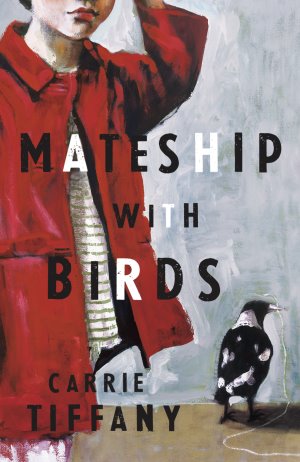
Mateship with Birds (Courtesy: Pan MacMillan)

Book Cover (Courtesy: Pan MacMillan)

Carrie Tiffany is on a roll. Last month her second novel, Mateship with birds, won the inaugural Stella Prize, and this month it won the Christina Stead Prize for Fiction at the New South Wales Premier’s Literary Awards. It has also been shortlisted for the Miles Franklin award. Many bloggers* have already read and reviewed it so, once again, I’m the last kid on the block, but I have finally got there.

Like her gorgeous first novel, Everyman’s rules for scientific living, Mateship with birds is set in rural Victoria in the past, this time, the early 1950s. Its central characters are the lonely, gentle dairy farmer, Harry, whose wife has left him, and his also lonely neighbour, Betty, who has brought her fatherless children to the country and who works in the local aged care home. The novel takes place over a year, a year that is paced by the life-cycle of a kookaburra family which Harry watches and documents in the spare righthand column of his old milk ledger. These notes, which are interspersed throughout the novel, are delightful and poetic, albeit brutal at times:

They work in pairs
against a fairy wren.
Dad buzzes the nest,
the wren throws herself on the ground
to draw him away.
She pluckily performs her decoy
– holding out her wing as if it is broken.
A small bird on the ground
is easy picking.
Club-Toe finishes her off.

They also provide commentary on the main story which is, as you’ve probably guessed, a love story. It is, however, no traditional romance. The boy and girl, Harry and Betty, are well past their youth and are cautious, given their previous experiences of love and relationships. They reminded me a little of Kate Grenville‘s rather dowdy protagonists in The idea of perfection. They care for each other in all sorts of practical ways: Betty cooks meals for Harry and tends his health, and Harry looks out for Betty and her children, fixing things when he can. A sexual tension underlies all their interactions – over many years – but it’s not openly expressed.  (“When he’s invited to tea he leaves immediately the meal is finished, as if unsure of what happens next”). Harry gradually takes on the role of “father figure” for Michael. However, when Michael becomes interested in a girl and Harry decides to pass on some “father-son” knowledge (“an explanation of things – of things with girls? Of … details of the workings”), including some rather specific physical advice regarding women, Betty is not impressed.

It sounds pretty straightforward, doesn’t it, but there’s something about Tiffany’s writing that makes it feel fresh, original. Part of it stems from her particular background as a scientist and agricultural journalist. Again, like her first novel, she grounds the story in her knowledge of farming life, but not in so much detail as to be boring. Rather, her descriptions give the novel its underlying rhythm – the landscape and the creatures inhabiting it (the kookaburras, owls, magpies, and so on); the milking; the driving into town; the way country neighbours help each other out; the sense of life going on regardless of the little dramas, the kindnesses and the cruelties, that occur. The writing is evocative but has a resigned and rather laconic tone that fits the rural setting.

Although a short book – a novella, really – it’s richly textured. There’s the main narrative drive which flips between Harry and Betty and includes flashbacks to their past, occasional dialogue, gorgeous descriptions (“The eucalypts’ thin leaves are painterly on the background of mauve sky – like black lace on pale skin”), and lists of plants, animals, medications, and so on. Interspersed with this main narrative are Harry’s kookaburra log, Betty’s notebook, Little Hazel’s nature diary, and Harry’s letters to Michael. And all this is layered with imagery involving mating, mateship, birds and humans. You can imagine the possibilities that Tiffany teases out from these. It’s all carefully constructed but doesn’t feel forced. It just flows.

In other words, this is a clever book, but not inaccessibly so. It’s generous, not judgemental. It’s also pretty earthy, with regular allusions to and descriptions of sex. If I have any criticism, it’s  in the persistent references to sexuality. At times, I wanted to say, “ok, I get it, sex – in its beauty, carnality, and sometimes cruelty and brutality – is integral to life” but I kept on reading because … of the writing. I love Tiffany’s writing. I mean, how can you not like writing like this description in which Harry compares Betty to Michael’s girlfriend Dora:

Not like Betty. His Betty is heavier, more complicated. Betty meanders within herself; she’s full of quiet pockets. The girl Dora might be water, but his Betty is oil. You can’t take oil lightly. It seeps into your skin. It marks you.

Australian Women Writers ChallengeI also kept reading because I wanted to know what it was all about. Why was Tiffany writing this particular story, I kept thinking. For some reviewers (see the links at the end), it is primarily about family, for others it is about the relationship between men and women, but for Tiffany it’s about desire. I can see that it is about all these things, but here’s the thing, the book starts with the description of four attacks by birds on humans followed by a description of cockatoos damaging crops. This, together with the sexual imagery, the frequent references to animal behaviour and to humans’ relationships with animals, suggests to me another theme to do with the nature of life, with the nature of our relationships with animals, and with how we accommodate the animal versus the human within ourselves. I’ll give the final word to the birds:

Mum, Dad, Club-Toe
break off their
preening,
squabbling,
loafing,
to attack.
They lose themselves in the doing.
I struggle to tell them apart.
Knife-beaked,
cruel-eyed,
vicious;
there is no question
they would die for the family
– that violence is a family act.

This book packs a punch!

* You may like to read the reviews written by Lisa (ANZLitLovers), John (Musings of a Literary Dilettante), Matt (A Novel Approach) and Kim (Reading Matters).

Carrie Tiffany
Mateship with birds
Sydney: Picador, 2012
208pp.
ISBN: 9781742610764

Gillian Mears, Foal’s bread (Review)

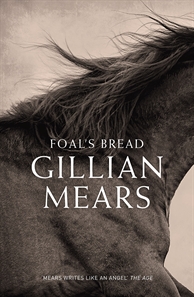
Gillian Mears' Foal's bread

Foal's bread cover (Courtesy: Allen & Unwin)

Foal’s bread is Gillian Mears’ first novel in around 16 years, though she has published short stories in the interim. This is a shame because she is a beautiful writer, particularly when she writes about the place she knows best, the farms of the New South Wales north coast.

Foal’s bread is about the Nancarrow family. Most of it takes place between 1926 and around 1950, as it follows the fortunes of Noah (Noey/Noh), her husband Roley (Rowley), and the extended family with which they live. Their main business is dairying, but their passion is the sport of horse high jumping. At the beginning of the novel, Roley is an Australian high jump champion and Noey a young 14 year-old girl with promise. They meet, marry (early in the novel, so no spoilers here) and start working hard to achieve their dream of having their own high jumping team. Hope on, Hope ever, is their motto. That’s the broad plot; the story is far more complex.

This is an archetypal story of strong country people coping (or not) with “luckiness and unluckiness” in life. In its depiction of hardship, stoicism and the will to survive in rural families, it reminded me – in tone if not in story – of Geoff Page’s The scarringThe hardship may come from different quarters, but in both there is a sense of forces out of one’s control combining with things of the characters’ own making. That mix – of characters’ judgement or behaviour clashing with luck (usually bad) – tends to make for a good story, in the right hands. It’s a bit Shakespearean in a way, the clash of character with “the elements”.

Australian Women Writers Challenge 2012 Badge

Australian Women Writers Challenge (Design: Book'dout - Shelleyrae)

In Foal’s bread, the “bad luck” has many sources, some human and some natural, such as incest, lightning strikes, giving birth to a disabled child, war and drought. How the characters cope with the trials confronting them is the core of the novel. Unfortunately, more often than not, they don’t cope very well. Why? Mainly due to their very human failings. Noey and Roley, whose marriage commences with great love and big dreams, don’t know how to communicate when calamity hits. Noey’s mother-in-law, Minna, lets her jealousy (“of the happiness she’d never seen before”) get the better of her and prefers to increase the tension between her son and his wife rather than to ameliorate it.

By now you’ll be thinking this sounds like a miserable story, and in some ways it is. But it’s not all darkness. While the novel has an almost elegiac tone, its movement is towards light. It has a three-part structure. There’s a very short Preamble which sets a tone of harshness and brutality with its references to incest, bushfires, floods, and animal cruelty.”Watch out you don’t cry” we are warned. Then there is the bulk of the novel in which the story of Noey and Roley is played out. This is followed by a Coda, set some 50 years later, in which we learn that “the old voices remain … funny, flinty, relentless”. These voices are carried into the future by Lainey, the strong, resourceful daughter of Roley and Noey, “her mother’s daughter through and through”.

A strong story, but what gives this novel its real power is the writing. Mears mixes the rough, ungrammatical country-speak of the era with glorious, rhythmical language describing the magpies, butcherbirds, trees, creeks and hills of One Tree Farm. The “one tree” is a jacaranda, and it features throughout the novel. It could almost be, dare I say it, a character. Early in the novel, when all is full of hope, it quivers “to create the feeling of a big bosomed woman wanting to waltz”. Later, as things start to collapse, it loses its leaves, but at the end “the old tree lives on … like a huge purple cloud hiding the rooflines”.

And then, of course, there are the horses. Reading this book reminded me a little of reading Tim Winton’s Breath. Mears does for horse high-jumping what Winton did for surfing. She made me feel the joy and beauty of the jump, of pushing oneself to achieve just that little bit more in a risky sport, of having a dream that keeps you going, of doing “the impossible”. Mears, like Winton, knows her subject inside out, and you feel it in her writing.

I fear I haven’t done the book justice. I’ve not really described its complex plot. I’ve named only a few of its large cast of colourful characters. It’s an ambitious book with big themes and a big style. Not everyone loves it. Some find the dialogue tricky or some descriptions overdone; some think the ending is disappointing; some think it’s stereotypical in places. I think none of these things. I’d love to know what you – if you’ve read it – think!

Gillian Mears
Foal’s bread
Sydney: Allen & Unwin, 2011
370pp.
ISBN: 9781742376295

(Uncorrected proof copy received from Lisa of ANZLitLovers in a blog giveaway)