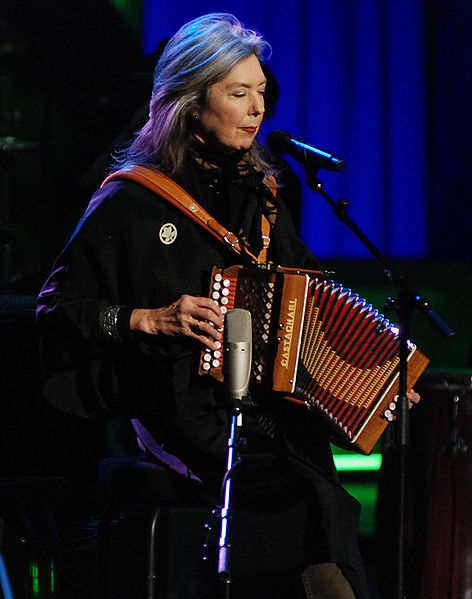
Kate McGarrigle, 2008 (Courtesy: Dfrancois, via Wikipedia, under CC-BY-3.0 Unported)
Last week I read on Cat Politics’ blog that Kate McGarrigle – one part of the Kate and Anna McGarrigle duo – had died just shy of her 64th birthday. How very sad. Like Cat Politics I discovered the McGarrigles in the 1970s, and over the years have acquired a few of their albums:
All wonderful. For those rare ones of you out there who don’t know them, they sing, write songs, and play instruments. Kate was married to musician Loudon Wainwright III (who wrote that silly fun song of my youth, “Dead skunk in the middle of the road”!) and is mother to musicians Rufus and Martha Wainwright. Oh, and they are Canadian.
And like that other wonderful contemporary Canadian singer-songwriter, Leonard Cohen, Kate and Anna are poets. I know that’s a bit simplistic – most songs can be seen as poetry (or at least as verse!) – but Kate and Anna’s words (with sometimes unusual rhythms) and music, in songs like “Heart like a wheel” (Anna) and “Talk to me of Mendocino” (Kate), have a plaintive beauty that resonates long after the song is over. Add to this their mesmerising voice tones and lovely harmonies and you have the whole package.
There are many obituaries out there and so I am not going to ramble on but, for those interested – and who haven’t seen it already – here is a link to Kate and Anna singing “Heart like a wheel” in 1990.
And let the sun set on the ocean
I will watch it from the shore
Let the sun rise over the redwoods
I’ll rise with it till I rise no more
Sometimes a bloke gits glimpses uv the truth (“In Spadger’s Lane”)
I wasn’t sure, really, that I wanted to read CJ Dennis’ verse novel, The moods of Ginger Mick, which I received as a review copy from the Sydney University Press as part of their Australian Classics Library – but have surprised myself. I rather enjoyed reading it and am glad that I had this little push to do so!
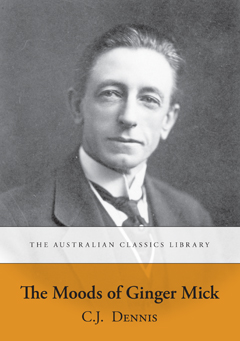
The moods of Ginger Mick cover (Courtesy: Sydney University Press)
The moods of Ginger Mick was published in 1916 just weeks before the big Conscription Referendum, according to Philip Butters who wrote the new introduction to this edition. It does not however buy into that debate. The book comprises 15 poems “written” by Dennis’ other character, The Sentimental Bloke, at whose wedding Mick was best man. The poems introduce us to Mick and his larrikin life before the Great War and then go on to chronicle his life as a soldier.
Dennis writes his poems in broad Australian slang (but there is a glossary at the end). Most are 6-line stanzas with an ababcc rhyme (the same as Wordsworth’s “Daffodils”!) but every now and then there is a different rhyme scheme which mixes it up a little. The sweet poem “The singing soldiers”, for example, has a sing-song aab(with an internal rhyme)acc, while the poignant “Sari Bair” about the eponymous battle has 4-line stanzas with a simple aabb rhyme.
I enjoyed reading the poems, not only for their evocative language but also for their subject matter. While their setting and language make them very much of a particular time and place, their concerns have some universality. They are about egalitarianism vs class difference, and about what it means to be a man (a “bloke” as it were). Mick starts off as a bit of a larrikin – one who cares not for the “toffs” and for whom the “toffs” care not! As he says in an early poem:
But I’m not keen to fight so toffs kin dine On pickled olives … (“War”)
What sends him to war in the end is “The call uv stoush” but, when he gets there, he starts to discover that in uniform all men are equal, that
… snobbery is down an’ out fer keeps, It’s grit an’ reel good fellership that gits yeh friends in ‘eaps. (“The push”)
This poem, “The push”, provides a wonderfully colourful roll call of the sorts of men who enlisted. Other poems cover the support of women at home, hopes for work when they return home now they’ve proved themselves (after all the “‘earty cheerin’ … per’aps we might be arstin’ fer a job”) and the sense that Australia has grown up as a nation (“But we ‘av seen it’s up to us to lay our toys aside”). There is ironic humour (as in “Rabbits”) and pathos (as in “To the boys who took the count” and “The game” in which Ginger Mick finally realises that he’s found his metier). There’s also some racism that was, unfortunately, typical of the time. And of course there is patriotism, with some rather lovely descriptions of the Australian landscape. I just have to mention here some references to gums:
An’ they’re singin’, still they’re singin’, to the sound uv guns an’ drums. As they sung one golden Springtime underneath the wavin’ gums. (“The singing soldiers”)
An’ we’re ‘opin’ as we ‘ear ’em, that, when the next Springtime comes, You’ll be wiv us ‘ere to listen to that bird tork in the gums (“A letter to the front”)
As a group, the poems offer an interesting insight into Australia’s experience of the First World War, particularly given their mix of realism and romanticism that belies perhaps the recent glorification that’s developed around our ANZAC heritage. If you are interested in Australia’s cultural and literary heritage, it is well worth giving this short little book a look.
C.J. Dennis The moods of Ginger Mick Sydney: Sydney University Press, 2009 (orig. pub. 1916) 87pp. ISBN: 9781920898984
Is this starting to sound like a carol you know? Anyhow, I did say in a comment on my first Christmas book post that I had received another book for Christmas, The best Australian poems 2009 (edited by Robert Adamson). DKS’s comment about the value of this annual series to the cause of poetry made me think that I ought give it its own post.
I wouldn’t call myself a poetry expert, but I have mentioned poetry several times in this blog’s short life because I do enjoy reading it and wish, really, that I spent more time with it. Australian surgeon Mohamad Khadra, in his rivetting memoir, Making the cut, talks about the value of poetry, about how each day on his hospital teaching rounds he would begin by having his students recite a poem that might offer some entrée to understanding their patients’ states of mind. His view is that, as doctors deal daily with humanity, they, and by extension we, can learn from poets who have spent lifetimes making a study of humanity. Each chapter of his memoir commences with a poem.
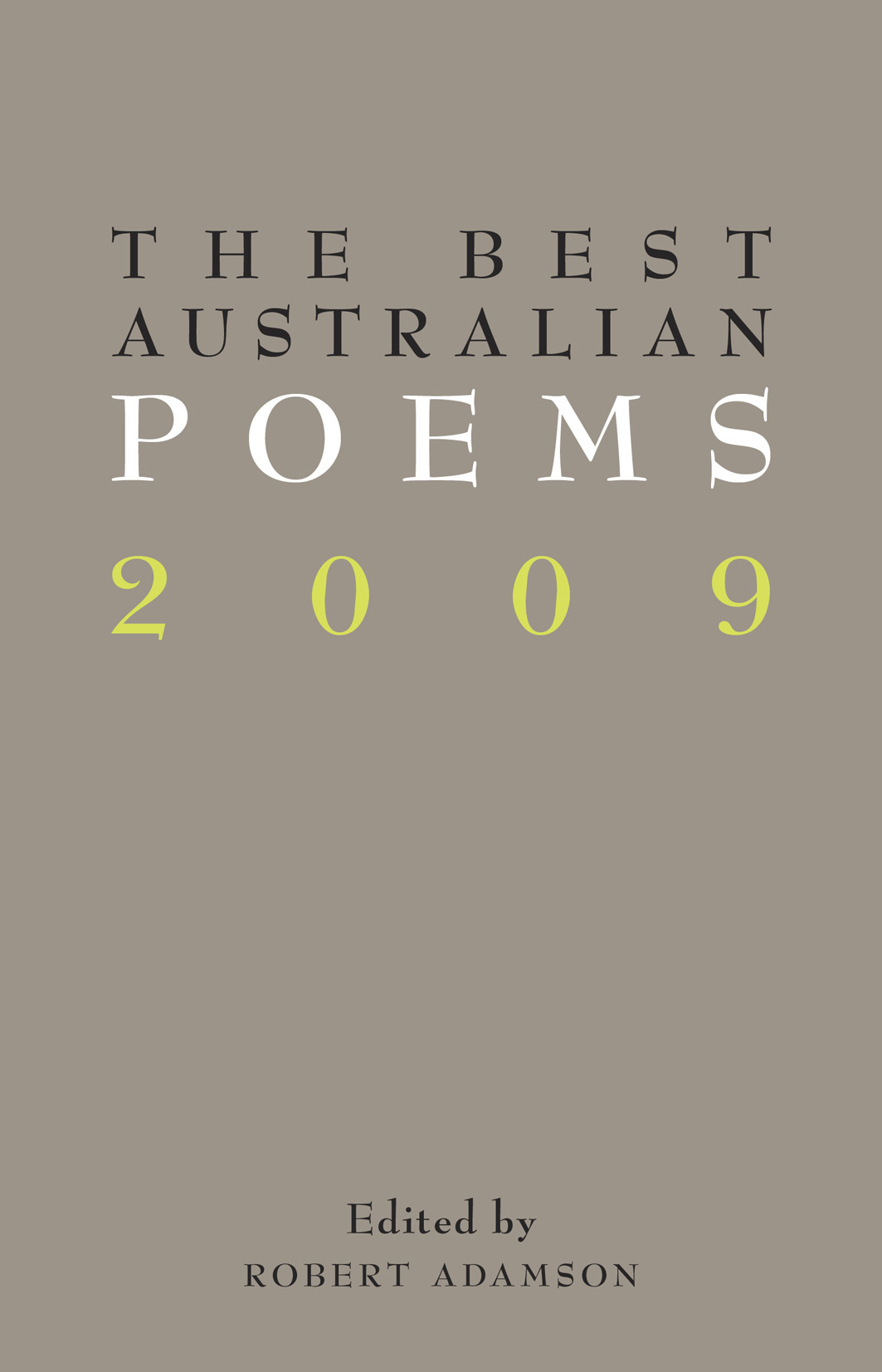
Cover image (Courtesy: Black Inc)
But I digress. Robert Adamson mentions three poets in the first paragraph of his introduction – Irish WB Yeats, English Gerard Manley Hopkins (one of my favourites) and Australian Meg Mooney – referring to use in their poems of birds and song. He says that there are many birds and lyrics in the anthology. I’m not quite sure why he singles out these two particular ideas in what is a general anthology – but maybe I’ll know by the time I’ve read all the poems?
To make the selection for this volume he “read all the poetry in the print publications as well as many of the electronic journals and even blogs that feature poems”. Isn’t it great seeing the blog world becoming an integral part of the publishing industry! He says about his selection that he “wanted to create a rhythm for the reader: shorter lyrics and some satirical poems, then hopefully a few love poems, poems of weather, landscape poems and, of course, bird poems.” Ah, the birds again…and then comes the explanation:
People ask me, why are so many bird poems being written and published? I have a theory : we miss having poets among us who can imagine that a soul can ‘clap its hands and sing, and louder sing’ [Yeats], that we need to acknowledge visitations by intense psychological presences, and that birds are the closest things we have, more or less, to angels.
Wow! I’m not quite sure how to respond to that.
The anthology commences with a lovely poem by Martin Harrison titled “Word” written for Dorothy Porter, after her death:
in which briefly suddenly one voice’s glimmer is lost
The anthology also includes a poem by Porter and, indeed, contains for the first time apparently more poems by women than men. The poems are listed alphabetically by poet – saves need of an index not to mention the problem of how to sequence the poems (and all those questions about how one poem’s proximity to another will affect its impact or meaning). He has also included a lot of new poets, more perhaps than in the past, as well as the tried and true. And that is how I like it (just as I like a “classical” music concert to mix it up a bit).
I think that’s about enough on a book I haven’t fully read, so I’ll just finish with some lines from Meg Mooney to whom Adamson referred in his opening paragraph:
The large, brown shapes of the wedgebills
their cheeky crests
disappear as I get closer
like they’re telling me
you can’t just look
and expect to see
in this country
What can ail thee knight at arms,
Alone and palely loitering?
The sedge has wither’d from the lake,
And no birds sing.
I have always loved these opening lines of John Keats‘ “La Belle Dame Sans Merci”. The first two lines with their mystical, but also traditionally Romantic, melancholy, just roll off the tongue. You want to read them out loud. The third line though, with its harder sounds, starts to suggest something different, and this difference is delivered in the wonderful shock of the shorter last line with its more staccato like rhythm. This, by the way, is my rather idiosyncratic introduction to the recent biopic, Bright Star, about John Keats and Fanny Brawne. I’m not being totally idiosyncratic though as several lines of the poem are recited in the movie…
Bright Star, which is also the title of a Keats’ poem, was written and directed by the wonderful Jane Campion (whom we Aussies like to call our own though she was born in New Zealand). According to the credits she based much of her script on a biography of Keats by Andrew Motion. The film is set in the last years of Keats’ life (surely this is not a spoiler?) between 1818 and 1821, so the fashions are exactly those I love – Regency. Through this and a host of other details, the film feels historically accurate – in tone and look at least. I only know the basics of Keats’ life so can’t really comment (without doing a lot of research!) on its veracity to the details of his and Fanny’s story. But, as I’ve said before, I’m not sure that matters if the essence of their story is achieved, and I believe it is.
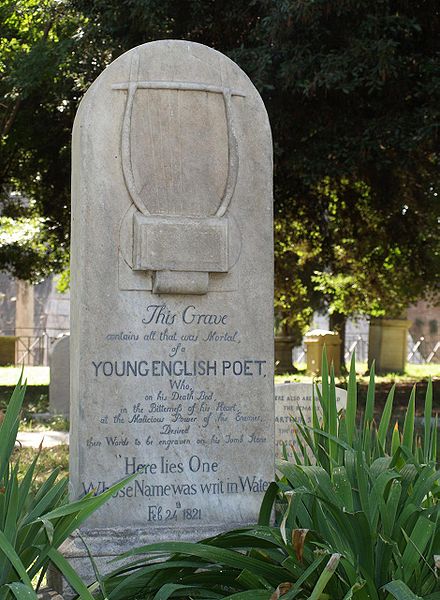
John Keats grave, Rome (Courtesy: Piero Montesacro, via Wikipedia, under CC-BY-SA-3.0)
The film has an elegaic feel – in its muted colours, slow pace, and the rather (unusually so for a period piece) spare music. This spare use of (spare!) music is carried through to the credits during which, instead of music, we hear Ben Whishaw recite Keats’ poetry. Despite its slow march towards its inevitable conclusion, however, the film also has some light moments, many of them in the lovely family scenes which include Fanny’s brother and sister.
One of the endearing things about the film is Fanny’s comment early on that poetry “is a strain” to understand. Poetry is not an easy art form – how many people have you heard say “I don’t get poetry”? – and there is something reassuring in having that validated. After all, Fanny is, in a way, everygirl – compassionate but also a little wilful, somewhat coy but at the same time rather knowing. She is, as conceived by Campion and played rivettingly by Australian actor Abbie Cornish, entirely believable as a universal teen girl, but one living in the early 19th century.
In a scene between the lovers (albeit an unconsummated love), Whishaw, as Keats, recites the film’s eponymous poem:
Bright star, would I were steadfast as thou art–
Not in lone splendour hung aloft the night
…
Still, still to hear her tender-taken breath,
And so live ever–or else swoon to death.
Here is Keats expressing the paradoxical nature of life and love, the way permanence and impermanence can exist side by side. This is rather poignant given the facts of his life: he died at just 25 years of age but his poetry has become firmly entrenched among our classics.
If you are interested in Keats’ story, or if you like films that slowly but beautifully evoke a past era, then this is likely to be a film for you. If, on the other hand, you like something with a bit of zing and an element of surprise, then you might best look elsewhere… For me though, this film is “a thing of beauty”.
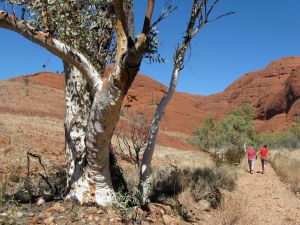
River Red Gum, Valley of the Winds Walk, Kata-Tjuta
River Red Gums, or Eucalyptus Camaldulensis, are among our most ubiquitous of gum trees, but that doesn’t mean they’re a boring tree. As their name implies they grow along watercourses – including ones that are very very dry such as those you find in Central Australia. They are also a significant part of what makes the Murray River such a gorgeous old river. Apparently, though, they are not found in Tasmania.
One of the well-known places to see these gums is the beautiful Barmah Forest of the Murray-Darling Basin. It boasts trees that are over 500 years old. Sadly, though, there are concerns that due to the extended drought that area has been experiencing, many trees are threatened, if not already dying. I’ve been to this forest and it is a treasure – it would be tragic to lose it.
Being ubiquitous – and beautiful – they feature regularly in Australian arts (in poetry, song, fiction, and art). Of course, they feature in Murray Bail’s captivating novella Eucalyptus:
Warty River Red Gum, Jessie Gap, East MacDonnells
Over time the River Red Gum (e. camaldulensis) has become barnacled with legends… there’s always a bulky Red Gum here or somewhere else in the wide world, muscling into the eye, as it were: and by following the course of rivers in our particular continent they don’t merely imprint their fuzzy shape but actually worm their way greenly into the mind, giving some hope against the collective crow-croaking dryness. And if that’s not enough the massive individual squatness of these trees, ancient, stained and warty, has a grandfatherly aspect; that is, a long life of incidents, seasons, stories.
River Red Gum, Bond Gap, West MacDonnell Range
Too many poets to mention have written about this gum. I thought I’d choose just two. First is David Campbell, who addresses the threat to their continuation. Here are some lines from his poem “The Last Red Gum”:
So we stand, me and my brothers, just the bones of ancient trees
that have lined the riverbank since time began.
In a bare and barren landscape, fed by red dust on the breeze,
we’ve been ravaged by the careless hand of man.
Second is Lisa Bellear, an indigenous poet who, in her poem “Beautiful Yuroke Red River Gum”, uses the Gum to symbolise the post-colonial history of Aboriginal Australians. The poem starts:
Sometimes the red river gums
rustled
in the beginning of colonisation
when
Wurundjeri
Bunnerong
and other Kulin nations
sang and danced
and
laughed
aloud
Not too long and there are
fewer red river gums, the
Yarra Tribe’s blood
becomes
the river’s rich red clay
If this isn’t poignant enough, the poem concludes with:
Red river gums are replaced
by plane trees from England
and still
the survivors
watch.
Cover for The man from Snowy River and other verses (Courtesy: Sydney University Press)
Is there an Australian out there who doesn’t like Banjo Paterson? Who can’t sing “Waltzing Matilda”, or quote a line or two from “The Man from Snowy River” or “Clancy of the Overflow”? While some of the 12 titles chosen for publication by Sydney University Press in its first set of Australian Classics Library might be surprising, the selection of A.B. Paterson’s The man from Snowy River and other verses should not be. Indeed, Peter Kirkpatrick writes in his introduction to this edition that “You’re about the read the most famous book of Australian poetry ever published”. As well as having been published in entirety many times over the more than 100 years since it first hit the streets in 1895, its poems have also appeared in collected works editions and too numerous to count anthologies. This then is not really the sort of book a reviewer “criticises” in the traditional sense of the word.
Perry Middlemiss, at the appropriately named Matilda, recently reprinted an 1895 Brisbane Courier review of the first edition. This review makes it clear that many of the poems were already well-known and quoted “all over Australia”. And nothing, I’d say, has changed in the intervening century or so! Why is this? In Derek Parker’s new biography, Banjo Paterson: the man who wrote Waltzing Matilda, Paterson is quoted as saying:
Poetry is older than civilisation … and it will make men laugh or weep or fight better than any acting or speech-making. Of course, this only applies to real poetry, and not to the verse that most of us write. There is a great difference between poetry and verse, and when a man speaks of real poetry, he should always take his hat off.
So Banjo, it seems, didn’t make great claims for art…I’m not so sure about that.
Paterson was 31 when this collection was published. Many of the poems had been published in The Bulletin, whose editor, according to Peter Kirkpatrick, wanted his readers in the lead up to Federation in 1901 “to imagine the kind of nation Australia might become”. Paterson was an important tool in his vision-making armoury. This provides an interesting hook from which to view the poems. What is the Australia and what are the values that Paterson espouses?
Paterson was born in the country but at the time of writing these poems was a city solicitor. Many of the poems, though, romanticise the country over the city, such as “the foetid air and gritty of the dusty, dirty city” versus “the vision splendid of the sunlit plains extended” (“Clancy of the Overflow”). And many, in a similar vein, champion the underdog – the working man versus the toff or boss. It’s not always simple black and white though. If you only knew Paterson from his well-known poems like “The Man from Snowy River”, “Clancy of the Overflow” and even “The Geebung Polo Club” you would be forgiven for thinking his view of the bush and bushmen was romantic. This is not completely so, though. Paterson in fact chronicles human behaviour in all its diversity. Alongside the hardworking drovers and shearers (albeit some with a touch of cunning) like “Saltbush Bill” and the characters in “A Bushman’s Song” and “The Droving Days”, there are the easily duped “Man from Ironbark”, the rogue Ryan who is helped to escape the law by his loyal girl in “Conroy’s Gap”, and the cheating horse-owners whose attempt to sell off a poorly performing horse comes back to bite them in “Our New Horse”. Having read William Lane’s The workingman’s paradise I was tickled to see a reference to shearers and unions in “A Bushman’s Song”: “‘We shear non union here,’ says he. ‘I call it scab’, says I”.
Many of the poems are humorous: there are characters whose gullibility lets them down as in “Johnson’s Antidote” and others who fail in their attempts at trickery (often to do with horse-racing). Paterson lauds ingenuity, but not when it is deceitful. There are also the nostalgic poems yearning for the romance of the simpler past (before money and business got in the way), such as “On Kiley’s Run”. And then, of course, are the tragic ones, speaking directly of the hardships of life. The saddest has to be one of my childhood favourites, “Lost” (“Though far and wide they sought him, they found not where he fell;/For the ranges held him precious, and guarded their treasure well”). Another is “Only a Jockey” about a 14-year-old jockey who dies in a training accident (“What did he get from our famed Christianity?”).
While all the poems are rhyming, Paterson uses a great variety of rhythms and rhyming schemes to match the tone of his “verse” – from the heroic, romantic and elegaic to comic. There’s also intertextuality (such as Clancy appearing in “The Man from Snowy River”) and a good deal of irony. I like the self-conscious story-telling in poems like “Conroy’s Gap”:
And that’s the story. You want to know If Ryan came back to his Kate Carew; Of course he should have, as stories go, But the worst of it is, this story is true: And in real life it’s a certain rule, Whatever poets and authors say Of high-toned robbers and all their school, These horsethief fellows aren’t built that way.
Not all the poems work equally well – some are a little awkward and clumsy – but, taken as a whole, recognising the spirit in which they were written, they present an intriguing insight into late 19th century Australia and values, and make entertaining reading as well. Whether you call it poetry or verse, I take my hat off to Banjo!
A.B. Paterson The Man from Snowy River and other verses Sydney: Sydney University Press, 2009 (orig. pub. 1895) 128pp. ISBN:9781920899035
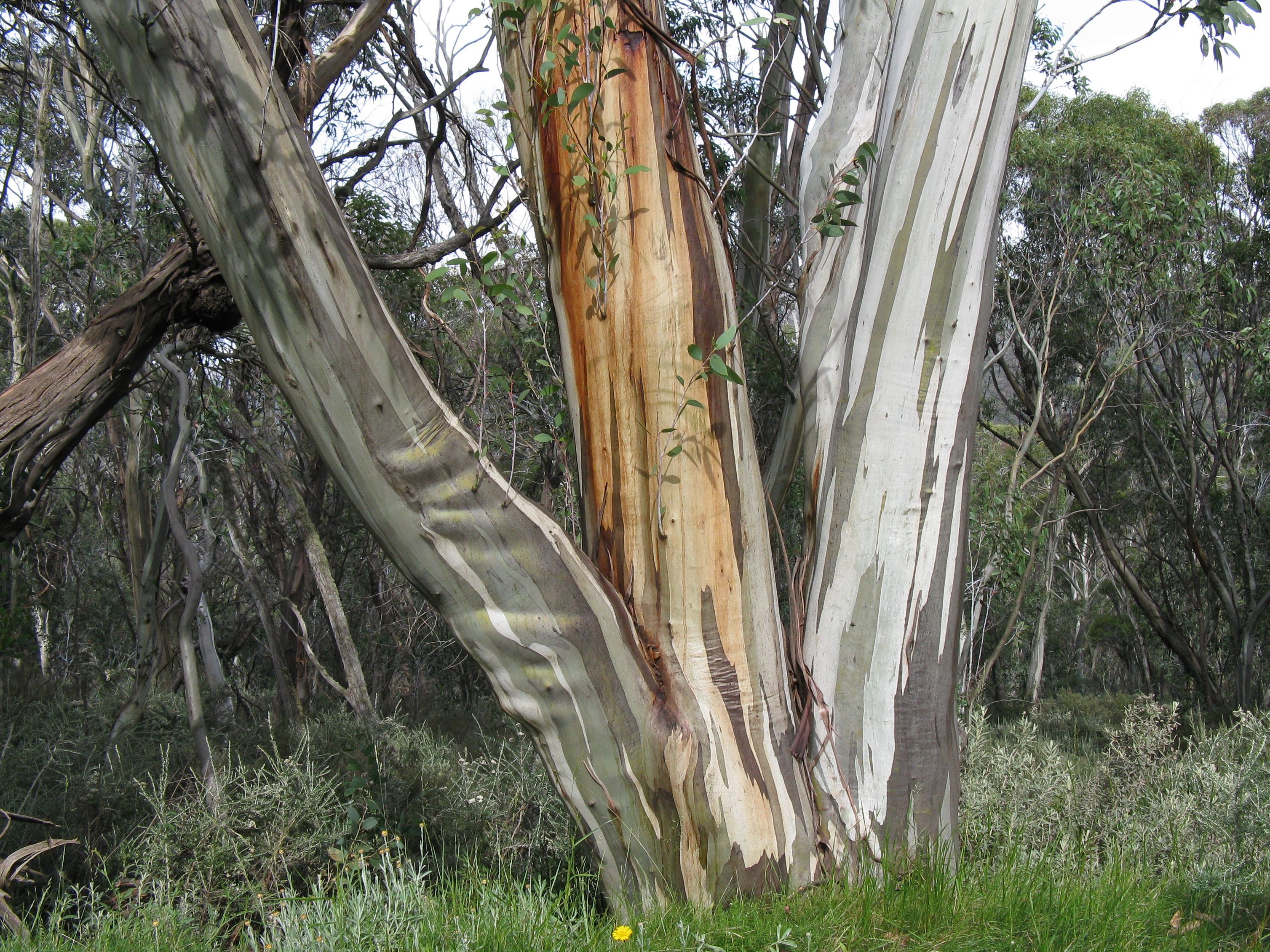
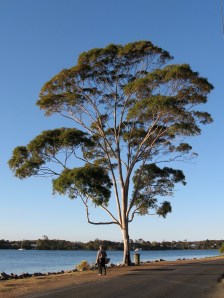
This is, I believe, a Sydney Blue Gum (Eucalyptus saligna) though I could also be wrong as I’m very much an amateur when it comes to tree identification. It does look like: they can be found up and down the east coast of New South Wales, of which the Hastings River is part, and they can grow to 60 or more metres tall which this one certainly seems to be aiming for. Whatever it is, I couldn’t resist photographing it. It rather dwarfs Mr Gums below doesn’t it?
Blue Gums are apparently the trees referred to in Henry Lawson’s 1919 poem, “Chatswood”:
And a little wood was on it, and the trees were tall and good,
And his young wife used to dream there, so he called it “Chattie’s Wood”.
“Chattie’s Wood” has long since gone, and shops are standing in a row
Where the young wife went a-dreaming in a the days of long ago,
Chattie was apparently Charlotte Harnett, the second wife of Richard Hayes Harnett, a North Shore Sydney landowner in the 1860s and one-time Mayor of Willoughby, and she did wander the Blue Gum High Forest of Chatswood West. The trees have long disappeared (from there anyhow) and some suggest that Lawson played a little loose with the specific details of their story but it is generally agreed that Chattie’s Wood is the origin of the name of the Sydney suburb of Chatswood.
Another poem, “Blue Gum Forest” (1976) by Roland Robinson, was also inspired by these trees:
The blue gums soar, naked
smooth, to where they over arch …
This year Australian composer Matthew Orlovich set this poem to music for a capella choir. I’d love to hear it one day. Anyhow, these are just two examples I found by doing some quick research. It seems that while the Sydney Blue Gum may have made way for shops in Chatswood, they still survive – in both physical and imaginative form. Long live the gum!
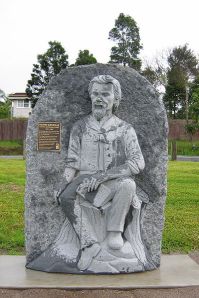
Statue of Henry Kendall, on an inclement day in Kendall, NSW
…is the Australian poet, Henry Kendall. Except, he’s not REALLY a son – he was not born there, and he only lived there for 6 years, from 1875 to 1881, when he was New South Wales’ first Forest Inspector. But, you know the story, when you are on a good thing…! And, anyhow, as a lover of Australian literature, I’m not going to argue against naming a town after one of our favourite poets. Anything that keeps our writers front and centre is fine by me.
Henry Kendall’s most famous poem is “Bell-birds”. It’s not quite as famous as Dorothea Mackellar’s “My country” and Banjo Paterson’s “Waltzing Matilda” but it is definitely up there. It is, for example, included in last year’s anthology, 100 Australian poems you need to know. It was written in 1869, two years before he went to Camden Haven (ie, Kendall as it was then known) and it reflects his love of nature – the sort of temperate forest landscape he would have found around Kendall. You can imagine the bell-birds in this scene can’t you? The first verse goes like this:
Driving towards Kendall
By channels of coolness the echoes are calling,
And down the dim gorges I hear the creek falling:
It lives in the mountain where moss and the sedges
Touch with their beauty the banks and the ledges.
Through breaks of the cedar and sycamore bowers
Struggles the light that is love to the flowers;
And, softer than slumber, and sweeter than singing,
The notes of the bell-birds are running and ringing.
And I will close on this little Henry Kendall taster … posting from an iffy Internet Cafe in sunny Port Macquarie (about 30mins drive from the little village of Kendall).
Within the next few weeks I will be reviewing the Australian Classic Library’s re-release of Paterson’sThe man from Snowy River and other verses, so this post is just a teaser. It was inspired by a column in The ABC Weekly (of 22 February 1941). Paterson died on 5 February 1941 – and less than three weeks later Australian novelist and critic, Vance Palmer, wrote a short item on Paterson’s impact on him:
I very well remember the excitement that filled me when, as a boy, I came across his new book, “The Man From Snowy River”, and I know that others around me shared the excitement. Here was the life we had known, suddenly given meaning, significance, a fresh interest. … It was as if a word had been uttered that was to awaken a dumb country, giving it a language of its own, and spreading a sense of fellowship between one man and another.
They were different times then – The man from Snowy River was first published in 1890, when Vance Palmer was 5 years old. We now have a language of our own, and we are a far more urbanised society than the one Paterson wrote about, and yet, I too have a soft spot for Paterson. Like Palmer, my love for Paterson also started when I was a child – when my father would read Paterson’s ballads to us. And in fact, I shared this Paterson-love only recently in an exchange with American blogger, Waltzing Australia, after she quoted “The Man From Snowy River” poem in full on her blog. We traded some favourite poems and lines, but I have to give her the award for the best response when she quoted these lines from his poem, “An Answer to Various Bards”, in which he responds to poets such as Henry Lawson with “their dreadful, dismal stories”:
If it ain’t all “golden sunshine” where the “wattle branches wave.” Well, it ain’t all damp and dismal, and it ain’t all “lonely grave.” And, of course, there’s no denying that the bushman’s life is rough, But a man can easy stand it if he’s built of sterling stuff…
Yes, I can take a lot of Banjo – and so I greatly look forward to reading the recent re-release with its new introductory comments. Watch this spot!
I fell in love with Kath Walker, as she was known then, in my teens and bought her book of poems, My people. I loved her passion for her people and the intensity but accessibility of her poems. Every now and then I look at them again. Today, however, my mum gave me a dear little illustrated book produced by the National Library of Australia called Little book of dogs. It contains a small selection of Australian poems on, well, dogs. One of them was also in My people, and is called “Freedom”. It’s a powerful little poem about man’s (and the implication is white man’s) desire to tame “all things wild and tameless”.
Brumbies on the run in Central Australia
For copyright reasons I don’t believe I can quote the whole poem – it only has four verses – but here is the first verse:
Brumby on the wild plain
All men out to break you,
My warm fellow-feeling
Hopes they never take you!
Simple stuff really but, if you have a message you must get across to as many people as possible, simple is sometimes best.