What do Di Gribble and Steve Jobs have in common?

MabBookPro

My current beloved MacBook Pro - aging but still fine

You probably think it’s strange to put these two luminaries together – one a lesser-known Australian publisher and entrepreneur and the other an international icon in personal computing. But the thing is, you see, that besides the fact that they both died this week – from cancer – Gribble and Jobs both entered my life in the mid 1980s. And their impact was significant. I have consequently decided to add my cyberspace tribute to these two people.

Di Gribble first. With Hilary McPhee, Di Gribble established a significant small Australian publishing house, McPhee Gribble. That was in 1975, but the real impact for me was about a decade later when I returned to reading Australian literature with a renewed enthusiasm – and it was through imprints like McPhee Gribble that Aussie literature was encouraged and promoted. McPhee Gribble were, in fact, the first to publish Helen Garner, Murray Bail and Tim Winton, all of whom I have reviewed here. Wonderful Australian writers, and we’ll surely be seeing tributes from them in the coming days and weeks. The company was sold to Penguin in 1989, with Gribble and McPhee going onto other things – but remaining in the Australian literature fold. Gribble’s post-McPhee Gribble ventures included the publishing company Text Media (later also sold, and still going strong as Text Publishing) and the independent digital media publishing company Crikey. She was, as they say, a goer – and we, in Australia at least, will miss her.

(You may also like to read Lisa’s tribute at ANZLitLovers)

And now Steve Jobs. Our first personal computer was one home-built by Mr Gums in the late 1970s. It was a great little computer – and as a librarian I was of course drawn by its possibilities, particularly for information management and retrieval. Our first database was one to manage our wine cellar! An excellent joint project to test the possibilities. This computer was, however, not particularly user-friendly. Mr Gums, the engineer, was well into DOS command lines but the computer didn’t easily engage we laypeople. Then along came Jobs, and Mr Gums, always on the lookout for improved technologies, saw the new world of personal computers coming. So, in 1985, we bought one of the first Macintosh models available in Australia – and I was hooked. The mouse, the GUI  interface with its WYSIWYG style, the continual improvements, not to mention the gorgeous designs (I even loved my often-maligned little clamshell laptop) have kept me in the orchard. Apple products are just so delicious! As most of my friends know, it is hard to separate me from my Mac (not to mention other Apple products, such as my latest gadget, the iPad2). Thanks Steve, we’ll miss you too.

Monday musings on Australian literature: Japanese poetry in Australia

Engraved writings by Suiin Emi, Onomichi

Haiku by Suiin Emi, along the Path of Literature in Onimichi, Japan

Papa Gums loves to give me clippings of obituaries that he knows will interest me. Last week, from his hospital bed, he gave me one for an Australian poet I’d never heard of, Janice Bostock. She was, according to the obituary in the Sydney Morning Herald, “one of Australia’s leading writers of Japanese poetic forms”, and won awards here and overseas. She particularly loved haiku.

Haiku, I must say, was the only form of Japanese poetry I had heard of until my first trip to Japan in 2006 when, on the railway station of our son’s tiny town of Tsugawa, we met an ex-teacher at his school who was heading off to her annual tanka conference. Tanka? Well, we discovered that tanka is an older Japanese verse form than haiku, and its basic structure is 5-7-5-7-7 “onji” (which we roughly translate to “syllables”). I guess most people reading this blog will know that haiku’s structure is 5-7-5. And here endeth the lesson on Japanese verse forms because the story is far more complicated than I’ve presented here, both in terms of these forms and other forms I haven’t mentioned. You can Google if you want to know more!

Bostock, who is briefly mentioned in the Wikipedia article on haiku in English, described haiku as “one-breath poems”, meaning that each poem “spans the length of one breath”. She also, and this was another new thing to me, practised a variation of haiku called “one line haiku”. Here is one quoted in her obituary:

no money for the busker I try not to listen

The obituary says that Bostock created the market for haiku in Australia by founding a journal called Tweed. She also wrote – and this of course appeals to me – The gum tree conversations. This was a series of articles aimed at showing “the relevance of haiku to the Australian landscape and experience”. Eventually her work led to the foundation of the Australian Haiku Society in 2000, of which she was patron at the time of her death. She was clearly a busy, engaged and passionate woman.

And so, haiku is alive and well in Australia … and it seems appropriately so. John Bird, who co-edited The first Australian Haiku Anthology with Bostock, has described haiku as follows: “a brief poem, built on sensory images from the environment. It evokes an insight into our world and its peoples.” As I understand it, haiku tends to involve the juxtaposition of two ideas or images in a way that a relationship is drawn between them. Australia, with its stark, dramatic environment, its odd vegetation and its strange creatures, must provide excellent subject matter for this sort of writing. Here is an Aussie haiku by E.A. Horne:

Brown paddock
Brown sheep
Blue bloody sky.

You can feel the pain of a farmer facing drought! It’s from an article first published in 2006 in the Australian poetry magazine, Five bells. Reeves, the author, says that “Contemporary haiku rarely consist of 17 syllables, may be written in one to four lines, and don’t have to be about the seasons. What they seek to retain is the brevity, clarity, immediacy and resonance of Japanese haiku and to record and share a moment of seeing”. I’m no expert in haiku, but it’s a form that appeals to me – because of this brevity that gives rise to a spareness, an attempt to pare to the essence of a thing. There’s no opportunity in haiku for effusive or loquacious explorations!

Tanka poems show a similar restraint and so, because it’s nicely appropriate, I’ll conclude with one of those:

our front yard gum
grown from a sapling
to a giant –
all those black cockatoos
fair exchange for a lawn

(Michael Thorley, Eucalypt Issue 1, 2006)

Are you familiar with – and do you like – these tiny poetic forms?

Monday musings on Australian literature: the National Centre of Biography

What is life? Life itself, as you will realise if you consult a dictionary, is hard enough to define. But what is a life? And why does it matter? For itself (a question of honour)? Or for what one can make of it as a biographer (which may mean trespass)? I am old-fashioned enough to believe that it matters for and in itself. But what precisely is it that I am trying to honour and how do I do that? (Veronica Brady, on writing about Australian poet Judith Wright)

Do you like to read biographies? I do, though I don’t read as many as I would like to because fiction tends to have the edge in my reading priorities. Nonetheless, it is a form (genre?) that fascinates me. How do you structure the story of a person’s life? What do you do about the gaps in knowledge? (Even in a well-documented life you are not going to “know” all of your subject’s feelings and motivations.) How do you handle the ethics (not to mention legalities) of revealing perhaps “uncomfortable” truths? How do you make it readable? And so on …

Biographies of course take many forms – from the brief overview documenting the key points in a person’s life to a narrative telling the story of someone’s life. In Australia, one of the best examples of the former is the Australian Dictionary of Biography (ADB) from the Australian National University (ANU). First published in 1966, the ADB now contains “concise, informative and fascinating descriptions of the lives of over 12,000 significant and representative persons in Australian history” (from the website), and is also available online. The online version largely parallels the printed version. In other words there is a long lead time (we are talking years, here) between when the articles are written and their appearance in print and online. (Surely this has to change?) Currently, ADB is working on entries for people who died between 1991 and 2000, with the edition covering those who died between 1981 and 1990 due for publication in 2012! It is, however, despite this lag time, a useful starting point for research into Australians.

In 2008, the ANU established the National Centre of Biography (NCB). It is now responsible for the production of the ADB, but it has a wider mandate, relating to fostering and encouraging expert and innovative biographical writing in Australia through such activities as teaching, conducting public lectures and symposia, and inviting international scholars to the Centre. Exciting stuff, eh?

This year, the NCB also launched Obituaries Australia. Their stated aim is to “collect every obituary that has been published and to index them so they can be searched by researchers”. Currently though the site contains only around 2000 entries, which is why almost every search I tried came up blank. You have to start somewhere though …

All this suggests that biography is, in fact, alive, well and taken seriously in Australia. In addition to the work being fostered at the ANU, there are a number of literary prizes here for biographical or life writing. They include:

There are also several non-fiction awards, such as The Age Non-fiction Award and the non-fiction and history categories in the Queensland Premier’s Literary Awards, for which biographies are eligible and have in fact won.

I will come back to biography again in a future Monday musings, but, in the meantime, would love to know whether you read biographies and how well you think the form is supported by the literary or cultural establishment in your country.

Vale Ruth Park

“Harp in the South silenced: author Ruth Park dead at 93” confronted me this morning on page 3 of our daily newspaper. I guess it had to happen, but it is nonetheless sad to see such a grand dame of Australian literature leave us. I have referred to her several times on this blog, three of those times being focused specifically on her – reviews of Swords and crowns and rings, and Missus, and a Monday Musings dedicated to her – so that will give you some measure of my regard for her and, really, of her standing in Australia.

Susan Wyndham, who wrote the announcement I read, concluded with the following:

Park’s publisher at Penguin, Robert Sessions, once said that she was one of three older women who had a huge impact on him, along with the writer Thea Astley and the legendary editor Beatrice Davis. All have now died.

Astley and Park both had huge stature in Australian literature and they had that rare combination of talent and strength and humility, he said.

What more can I say, except, well done Ruth, we’ll miss you – but we’ll keep on reading you.

Vale Kate McGarrigle

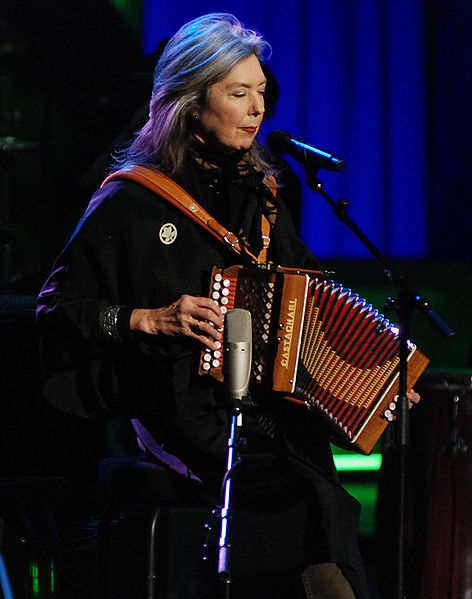
Kate McGarrigle

Kate McGarrigle, 2008 (Courtesy: Dfrancois, via Wikipedia, under CC-BY-3.0 Unported)

Last week I read on Cat Politics’ blog that Kate McGarrigle – one part of the Kate and Anna McGarrigle duo – had died just shy of her 64th birthday. How very sad. Like Cat Politics I discovered the McGarrigles in the 1970s, and over the years have acquired a few of their albums:

All wonderful. For those rare ones of you out there who don’t know them, they sing, write songs, and play instruments. Kate was married to musician Loudon Wainwright III (who wrote that silly fun song of my youth, “Dead skunk in the middle of the road”!) and is mother to musicians Rufus and Martha Wainwright. Oh, and they are Canadian.

And like that other wonderful contemporary Canadian singer-songwriter, Leonard Cohen, Kate and Anna are poets. I know that’s a bit simplistic – most songs can be seen as poetry (or at least as verse!) – but Kate and Anna’s words (with sometimes unusual rhythms) and music, in songs like “Heart like a wheel” (Anna) and “Talk to me of Mendocino” (Kate), have a plaintive beauty that resonates long after the song is over. Add to this their mesmerising voice tones and lovely harmonies and you have the whole package.

There are many obituaries out there and so I am not going to ramble on but, for those interested – and who haven’t seen it already – here is a link to Kate and Anna singing “Heart like a wheel” in 1990.

And let the sun set on the ocean
I will watch it from the shore
Let the sun rise over the redwoods
I’ll rise with it till I rise no more

(Talk to me of Mendocino, Kate McGarrigle)

Vale Frank McCourt

Frank McCourt, 2007 (Photo by David Shankbone, used under Creative Commons Attribution ShareAlike 3.0)

Frank McCourt, 2007 (Photo by David Shankbone, used under Creative Commons Attribution ShareAlike 3.0)

I’ve only read one of Frank McCourt’s books, his Pulitzer Prize winning memoir, Angela’s ashes. I loved it, but for some reason didn’t really feel the need to read more, though I’m sure I would have enjoyed them if I had!

Angela’s ashes was such a visceral read. I’ve never read quite such a vivid description of poverty as I found in this book. I know there are some who claim that he exaggerated it but who cares? My sense is that what he described was “real” – real either because it “really” did happen that way or because it genuinely conveyed what deep poverty “feels” like. And, the fact that he could describe such poverty in a way that could make you laugh and cry at the same time marked him out as a true storyteller. One of the, little really, scenes I remember is when he was in hospital and isolated in a ward on his own. The nurse wouldn’t let him talk to the equally lonely and isolated girl in the ward next door. The nurse would yell out to them, “Diphtheria can’t talk to Typhoid” (or vice versa). Oh dear! Just as well he had a sense of humour I reckon.

I saw the film, too, of course. As I recollect it was true to the facts but it somehow managed to convey the grimness without the accompanying humour. That was a shame really.

Anyhow, now McCourt has died. I’m sure his death will result in a resurgence of interest in his books. Commercial, yes, but why should new readers not have his books brought to their attention? There are far worse books they could be reading! Just ask Tom Keneally, who knew McCourt and was interviewed on the radio today. He said :

He is the only man I’ve known who in his mid-60s went from a school teacher pension to being a multi-millionaire and also remaining the same bloke he’d been before it all happened to him. The same whimsical, ironic, very Australian sense of humour he had. …

In the first paragraph [of Angela’s ashes] he mentions the fact that in Limerick the churches were full but he says that was because it rained all the time. It was not piety but hypothermia that filled the benches and I think you would have to search a long way back into Irish history to find such a funny line as that.

I am missing him even now. I have to say starting, as old men do, to get teary that such a grand spirit has departed this earth …