Nigel Featherstone, Bodies of men (#BookReview)

Nigel Featherstone, Bodies of menNigel Featherstone’s latest novel, Bodies of men, is a brave book – and not because it’s a World War 2 story about love between two soldiers at at time when such relationships were taboo, though there is that. No, I mean, because it’s a World War 2 story that was inspired by Featherstone’s three-month writer-in-residence stint at the Australian Defence Force Academy, in 2013. That’s not particularly brave, you are probably thinking, but wait, there’s more. What’s brave is that this novel, this story inspired by that residency, is about some darker sides of war – it’s about deserters, and violence from your own side, for a start … It’s certainly not about heroics, or, to be accurate, not the sort of heroics you’d expect. Courage, it shows, comes in many forms.

Here is what self-described pacifist Featherstone wrote in his blog two months into his residency:

I came here with the idea of exploring ‘masculinity in times of conflict’ …  Perhaps, like always, I’m being driven by that central question: what does it mean to be a good man, which, of course, is almost exactly the same as asking, what does it mean to be a good person?  But the military, especially the Australian kind of military, is all about men, isn’t it, the warrior, that iconic ‘digger’, that myth of our country, that brave saviour of everything we’re meant to stand for (whatever that is).

Those men who could do no wrong.  Except I don’t believe that for a second.

So, what did Featherstone actually write? It’s the story of two Australian soldiers from Sydney. William is from a conservative, well-to-do North Shore Sydney family, with a Member of Parliament father, while James comes from a poorer working class family, with a widowed mother who runs a shop but who’s also a socialist, a pacifist, and committed to helping homeless people. The boys had met and spent a few times together in their youth, but had lost touch for some years – until they find themselves in Egypt in 1941.

The novel opens with a reconnaissance that turns into an ambush. At an important moment, William, just off the boat, prevaricates, but James, there with a different military section, takes the initiative, and saves the day. The men vaguely recognise each other – “The officer”, thinks James, “does look familiar … but no it can’t be” – but have no opportunity to follow up, each returning immediately to their sections. From here the narrative, told third person from the alternating perspectives of William and James, follows the two men on their different paths. William, soon to be a lieutenant, is sent to manage a training camp in the desert. Believing he needs to redeem himself from that first experience of action, he sees this as an opportunity. He excels as a leader of men, finding the right balance between toughness and friendliness, but is dogged by his cold father’s voice, and worries about his ability to be the man his father expects. However, his mind is on that young man he glimpsed. Meanwhile, James goes AWOL on a military motorbike, which he crashes. Luckily, a family takes him in, a family which has its own tricky background and secrets, but James is just the right person to not rock their boat, so a warm relationship develops.

It’s not long before William works out a way of tracking James down. The story is told chronologically, but with frequent flashbacks which fill in that boyhood friendship. It was short, but intense. Both felt it, but William, in particular, struggled to understand it. It is therefore James, who, upon their renewed acquaintance, takes the lead – and the novel becomes, in part, a love story. Featherstone finds the right balance, here, conveying their tenderness and warmth, without sentimentality. We are never allowed to forget that this is war-time, and that both William and James are taking serious risks in their desire to be together.

However, this is not simply a boy-meets-boy, boy-loses-boy, boy-finds-boy again story. As mentioned above, Featherstone’s goal was to explore what it means to be a good man, against the backdrop of war. We do see some action, besides that opening scene, and there is an over-riding sense that something sinister could happen at any moment, but the main theme concerns men and their reactions to their circumstances – soldiers, men in hiding, men displaced, men in resistance. Each of these men provides the reader with a perspective on how men might choose to be. Courage and risk-taking, passion for a cause, recklessness, fear, commitment to helping others, tenderness and kindness – all of these come into play as the story progresses. And, as in all good novels, there are no simple answers. A love story this might be, but a genre romance or war-story it’s not.

How does Featherstone achieve this? Well, sometimes it’s hard to pinpoint these things, isn’t it? In a later post on his blog, Featherstone says that he wrote 38 drafts. You can tell this, and yet you can’t tell. You can tell, because you can feel the craft in the book. You can’t tell, because it also feels organic, not overworked. There’s skill in that. This skill includes the characterisation. William and James are sensitively fleshed out, well individuated, and grow through their experiences. But there are other characters too, including two strong women characters. James’ grounded, supportive mother is one, and open-minded Yetta, the woman who cares for James after his accident is another. It is she who articulates some of the novel’s main messages, including:

‘People must care for people. It’s not more complicated than that.’

There’s skill also in the narrative structure. The novel has a lightly episodic touch, with little breaks marked on the paper between “scenes”, but the story nonetheless flows. These breaks simply provide a way for the narrative to be progressed without unnecessary explication.

And, of course, there’s the writing. It’s spare, and yet perfectly evocative – of life at William’s desert camp, of the nervous busy-ness of war-time Alexandria where wells of quietness can also be found, and of William and James’ love. Here’s an example showing the edgy sort of tone Featherstone creates:

But now, something new: he was – he and James both were – sliding into the back seat of a car. They were being driven along one of Alexandria’s palm-lined boulevards; before long they were surrounded by blackness. William wound down his window and was about to yell, BUGGER THE WAR! – the night was getting away from him – but he managed to drag the words back down to where they belonged, in the pit of his gut.

Bodies of men, then, is a war novel that questions war. But, it is told with a generous touch that doesn’t undermine or betray those who choose to go. It’s a page-turner, underpinned by a fundamental understanding of humanity. It’s a very good read.

Nigel Featherstone
Bodies of men
Sydney: Hachette Australia, 2019
324pp.
ISBN: 9780733640704


A lovely night out … at the theatre

You know the year has really started when the concerts and shows start up again – and for us they’ve started with a bang. We had three events in four days: A Pacifist’s Guide to the War on Cancer (Playhouse) on Saturday night, The Weight of Light (Street Theatre) late Sunday afternoon, and the first Musica Viva concert (Llewellyn Hall) on Tuesday night. This post, though, will just discuss the middle one, because it’s Australian, having been written by local author Nigel Featherstone who has featured on this blog several times. I’m not, however, an experienced theatre reviewer. I don’t have the language, and as a reader, I find it challenging seeing something only once, and not being able to go back to check something out, as you can with a book!

The Weight of Light

I’ve been surprised in recent years to discover how many Australian novelists are also librettists. David Malouf, Peter Goldsworthy, Dorothy Porter (ok a poet but also a verse novelist), and Louis Nowra immediately spring to mind – and now, local novelist and short story writer Nigel Featherstone can also claim this title. Described as a song cycle, The Weight of Light had its origins in a residency the very peaceful, non-warlike Featherstone had at the Australian Defence Force Academy in late 2013. I remember it well because he wrote about it on his blog. It all came to a head in 2014, when time came for him to do a presentation on his three months. He wrote:

I already had the questions – What is a man?  Who is a good man?  Who is a good being? – but I didn’t have the stories, or anything remotely resembling stories.  Bearing in mind that my intention in doing the residency wasn’t to write about war as such; I’m disinterested in guns, and the infinitely complex political contexts require a much bigger brain than mine.  I was interested in the small moments, the hidden fears and thoughts and dreams.

So there, in 2014, he had an idea in mind about soldiers. Then, later that year, as Featherstone tells it, Paul Scott-Williams from the Goulburn Regional Conservatorium met Nigel and told him that he wanted to create “an original song cycle”. He felt that “art song did not have much of an Australian tradition”, and wanted to do something about it, starting with Nigel as librettist. From there, the project slowly grew. Nigel has documented the process on his blog. The end result was the highly moving performance we saw on Sunday afternoon.

How to describe it? We entered the lovely Street Theatre to be faced with a minimally lit stage, comprising a minimal set. There were two large crisscrossed beams, a wire wending across the stage like a fence, brown fabric on the floor emulating a river, and, to the right, a grand piano. The show started with Alan Hicks on piano, with singing starting up soon after from somewhere backstage. The voice, coming from baritone Michael Lampard, turned out to be a mother calling her soldier-son home to the farm.

From here Lampard, with Hicks at the piano, took us on a journey, through fourteen songs, in which the soldier faces a tragedy at home which recalls to his mind a secret tragedy that had occurred during his tour (that’s a weird word really, isn’t it, for a military posting) of Afghanistan. It’s a dark story, a grim one at times, as the soldier confronts a number of challenges in his life. But, it’s also a beautiful show. If that makes sense.

This was the whole package – words, music, performance, set and lighting. Lampard’s vocal range was impressive, enabling him to differentiate characters (his mother, father, girlfriend) as they interacted with him. The lighting remained dark throughout, in keeping with the theme, though placement and levels did vary with the mood. The set was in that modern minimalist style in which a few objects are used to convey different ideas or places at different times – in this case, both the field of war and the fields of a farm. The two large semi-reclined crossed beams also, I thought, conveyed an idea of the cross, which, at one of the darker points in the performance, our soldier seemed to shoulder, recalling Christ’s journey to Calvary.

And then there was James Humberstone’s music. It included elements, we felt, of art-song, opera and church music, and was completely involving – both the sound of it and the performance of it, which included both Lampard and Hicks bowing the piano strings to create a mournful atmosphere. Other effects included paper being laid across the strings creating a fluttery, buzzing effect, and Hicks hitting the strings with small mallets. None of these were tricks for tricks’ sake, but enhanced the meaning or mood of the story.

I found these demos below on SoundCloud. They’re from earlier in the development when the program was still called Homesong, but they give an idea of the range we heard, from the sweetly lyrical to the more sombre, minimalist pieces.

I would love to be able to share some of the words with you, but not having the libretto and having only seen the performance once, that’s not possible. I did find it hard to hear them all with so much going on, but I loved the poetry of them, the use of repetition, and the imagery – of birds in particular. In the second last song, I think it was, our soldier needs to make a decision. Can he be strong, or will he give up? “Be brave enough to stay” is the call to him. The program ends, happily, on a note of hope.

Mr Gums, two acquaintances and I enjoyed, at the end, sharing notes on the performance, combining our various impressions. We all felt we’d experienced something special. I’d say Paul Scott-Williams has got what he wanted – a quality contribution to Australia’s art-song repertoire, with a story that’s right up to the moment in its concerns. I hope it gets more outings.

The Weight of Light
Words by Nigel Featherstone
Music by James Humberstone
The Street Theatre, 4 March 2018, 4pm

Nigel Featherstone, The beach volcano (Review)

Courtesy: Blemish Books

Courtesy: Blemish Books

Back in 2010, Featherstone spent a month, on a writer’s retreat, at Kingsbridge Gatekeeper’s in Cataract Gorge, Launceston. He writes on his blog that he left Launceston with sketches for three novellas. The beach volcano is the last of these, the other two being Fall on me (my review) and I’m ready now (my review). Before I talk about the novella, though, I must compliment Blemish Books on the production of these three books. They are gorgeous – they have appealing, stylish cover designs; they are a perfect size, fall open easily and have lovely, clear print; and together they look like a set. Well done Blemish, I say.

Now, to the book itself. Featherstone has appeared a few times on this blog, via my reviews of the first two novellas, a guest post in 2012, and a five-part interview that I ran over the summer of 2012-2013 when the magazine it was destined for, Wet Ink, folded. Through all of these, one particular idea or theme has been consistent – and it is, as he formally stated in his guest post, that “family is the guts of the contemporary Australian story”. He mentioned several writers, such as Kate Grenville, Craig Silvey and Gillian Mears, for whom this is clearly true, and then turned to his own work:

My main characters are usually men and women (always a good start!) who have children, who want to be parents, who struggle to cope, who feel the pressure of internal and external expectation, who fail and fall into a heap but pat themselves down and have another crack at it.

And so, Fall on me centres on father and teenage son, Lou and Luke, while I’m ready now is about a fifty-something mother and thirty-year old son. In The beach volcano, we’ve moved on again in age. The father here is 80 years old, and the son 44. I’m not sure whether this age progression drove the order in which the books have been published, but it does have a certain neatness. Luke, the teenager in the first book, is pretty wise for his age but he is still a young man sorting out his identity and his separation from his father. Thirty-year-old Gordon, on the other hand, is confronting turning 30 and, not comfortable with what this implies, embarks on a risky “Year of living ridiculously”. This brings us to 44-year-old Canning (aka successful rock musician Mick Dark) who has returned home for the first time since he was 17 to celebrate his father’s 80th birthday. He has come primarily because he wants to discover the “full” truth about a story told to him by his aunt, the estranged sister of his father. I should add here, in case I’ve given the wrong impression, that the first two books don’t focus solely on the son, whereas The beach volcano is very definitely Canning’s story.

The thing about Featherstone’s books – at least these three – is that there’s potential in each for high drama, or, to put it more crudely, for violence and/or death. But, Featherstone is not a writer of crime or thrillers. He’s interested in family and human relationships, and so, while dramatic things happen, the drama never takes over the story. In The beach volcano, terrible things involving abuse of boys by men have happened before the novel starts. They resulted in family secrets to do with a false alibi – and who knows what else, we wonder as we read. This is what Canning has come home to discover.

The story is told, first person, through a traditional linear narrative, with flashbacks to fill us in on relevant background. It starts with Canning’s arrival on Friday, late, for the pre-birthday dinner for the immediate family, and continues to the end of the weekend when all has been revealed, to Canning at least, and he is able to make some decisions about where to from here. Throughout the weekend, Canning has one-on-one conversations with different members of his family, his parents, his two older sisters, a brother-in-law, and a nephew. We to-and-fro between love and hate, welcome and aggression, as this family tries to keep conflict at bay, while threatened by a secret that they refuse to openly confront. Family secrets, gotta love them! But, Canning wants truthful relationships with his family now:

I’d come to Sydney to tell the truth, but it was important to be selective about the truth, and to have good timing in the telling, to be cautious. Because the truth, I thought, was a disturbance. The truth took things apart and put them back together in a different but better shape. But what exactly was a better shape?

This is the question Canning needs to answer, and is why he bides his time. He needs (and wants) the truth to be a positive force, not a destructive or simply life-sustaining one.

Featherstone’s language is clear and evocative, with lovely descriptions of coastal Sydney and realistic dialogue. Canning’s voice feels genuine, if a little inclined at times to over-explain. The “beach volcano” of the title works on both the literal level as an activity that Canning and his father share, and that he then wants to pass onto to his newly-met nephew, and as a metaphor for simmering tensions that threaten to erupt. You’ll have to read the book though if you want to know what erupts and how. It is, in its measured way, quite the page-turner.

In a sense, this is a reworking of the prodigal son story, except that in this version the son returns as a success and is, perhaps, the one who extends the greatest generosity. Like the original, it is about love and acceptance, but has the added theme – one that Featherstone explores in the three novellas – of the need to face the past before you can truly progress into your future.

The beach volcano makes a fitting conclusion to Featherstone’s novella set. I have enjoyed the time I’ve spent with his unique but real families and look forward to seeing what he comes up with next.

Nigel Featherstone
The beach volcano
Canberra: Blemish Books, 2014
140pp
ISBN: 9780980755695

(Review copy courtesy Blemish Books)

Fridays with Featherstone, Part 5: The wrap

Today’s post concludes my Fridays with Featherstone series. It comprises my follow-up interview with Nigel wherein I … well, you’ll see soon enough …

INTERVIEWER (C’est moi!)

I enjoyed reading your interview with Susan Errington of Wet Ink, Nigel, but of course that was prepared before the publication of your latest book, the novella I’m ready now. What intrigued me about this and your previous novella, Fall on me, is that the main characters in both are somehow stalled by their pasts. What is it about the past that draws you to write about it?

FEATHERSTONE

Milan Kundera wrote that the novel mustn’t be the writer’s confession, and I agree with his statement, but it does seem as though most writers find themselves exploring the same or similar ground over a series of works, perhaps it’s all they’ll ever write about; whether this is a confession or not I’m uncertain, but perhaps these patterns point to something important in the writer’s psyche.
Nigel Featherstone, I'm ready now

Cover (Courtesy: Blemish Books)

In his illuminating On writing: a memoir of the craft (2000), Stephen King talks about how he has really only one theme – that it’s difficult to put everything back in Pandora’s box once it’s opened.  Tim Winton, of course, has his lifelong infatuation with the south-west coast of Western Australia and the men who people the place, especially the men who are trying to work out their masculinity and what role they can play in the family environment.

In terms of my own writing, you’re spot-on that both I’m ready now and Fall on me are about people – men and women – who are trying to work through something from their pasts.  What are these things we all have that might hold us back or anchor us down?  What stops us from becoming the people we want to be?  What if we pretend that there’s something in our past that seems fine but really isn’t?

In Fall on me, Lou Bard has had to survive the murder of his wife, and he’s done this with considerable focus and tenacity, but it’s meant that he’s never found anyone to share his life with in a romantic way – though by story’s end things are looking much more hopeful.  In I’m ready now, mother Lynne finds herself remembering a great but fraught love from her late-teen years, while son Gordon believes that a year of running amok will ameliorate the impact of what happened to him at the very beginning of his life.

Novellas/novels are always about time, and the past is an endlessly fascinating element of time. The past is also about the present and the future, so it’s the foundation of all of us.  Done well, the exploration of a character’s past can be analogous to a country’s past.  If a character’s past is difficult then their country’s past may well be difficult too.  Australia’s past is difficult.  Perhaps all its fictional characters must be difficult?

INTERVIEWER

In the third part of your Wet Ink interview, you say, ‘That’s my mission as a writer: to gently lead people into the darkness and show that there’s not a lot to be scared about’. As a reader, I’m intrigued by writers’ intentions and would love you to tell us what’s behind this mission of yours.

FEATHERSTONE

Featherstone, Fall on me

Fall on me bookcover (Courtesy: Blemish Books)

This is something that I’ve only recently started to think about, primarily with the publication of my novellas.  I try to write in a very accessible way – I want to be read and I also want to be read by a diversity of people.  That’s not to say that I’m disinterested in the musicality of prose, or that I’m not fond of the odd literary firework or two.  It’s just that I don’t aim to be difficult.  However, I do write about things that some readers may feel is difficult, and indeed correspondence I’ve received seems to indicate this.  As mentioned, Fall on me is about a man struggling to come to terms with the senseless end of his wife’s life almost two decades ago, and how their son, who’s now a teenager, persists in doing bravely creative – if not ridiculously dangerous – things with his body and life.

I’m ready now is dark in other ways: just after her husband’s death of a heart-attack, Lynne Gleeson finds herself thinking about a love affair from her childhood, a love affair that gave her a son; meanwhile that son, now an adult, is papering over the fractured start to his life by conning himself that he’s happy and simply being playful.  Whilst I’m not a horror writer, nor do I read horror, in some ways these are horrible – as in ghastly, shocking, almost unspeakable – predicaments for these characters to be in, but my intention is to write about it all in a way that allows everyone inside.

In his profoundly moving collection of essays A way of being free (1997), Ben Okri says, ‘A true storyteller suffers the chaos and the madness, the nightmare – resolves it all, sees clearly, and guides you through the fragmentation and the shifting world.’

Whether or not I’m a true storyteller, I have no idea, but I do adore Okri’s words.

INTERVIEWER

Your novella Fall on me is told in third person, while I’m ready now is told in alternating first person voices. How do you decide what person/voice to tell a story in, and can it change during the writing process?

FEATHERSTONE

These are the choices a writer makes, and sometimes the choices are made at the very beginning of the writing process and they stick, other times there’s a change of mind (or heart) halfway through the writing, even during final editing, and things are altered.  However, with both these novellas I was clear from the first few marks of the pen what I wanted to do.  I’m ready now would be told in the first-person voice – I wanted the sense of intimacy that this brings – and also that the story would be told through both the mother’s and the son’s point of view, so we see their similarities and differences.  Even though Fall on me was published first, it was actually written after I’m ready now, and I made the decision that having just finished writing a first-person narrative I wanted to write a third-person narrative; thankfully this particular story works much better for the distance and perspective that the third-person mode brings; as the writer I was able to be less emotionally entangled.

It’s true that there can be changes through the writing/editing process.  My novel Remnants was drafted first-person but much later was changed to third-person.  I’ve heard that other novelists have done similar last-minute surgeries.  However, I do think that the point-of-view schema of a work is so important – so incredibly integral – that if there needs to be such a significant change then it’s quite possible that something at the core of the story’s construction isn’t working.

INTERVIEWER

Another comment you made in the third interview struck me. You said: ‘I’m interested in place as character’. Many years ago I was in an online reading group in which this topic caused much angst: some members argued that place can’t be a character, and others argued just as vociferously that it could. I’d love to know what you mean by “place as character” and the role you see it playing in your writing.

FEATHERSTONE

Oh yes, place can be character!

There’s a fantastic book that’s very relevant here called Place and placelessness (1976) by the urban geographer Edward Relph.  It’s as rare as hen’s teeth, but thankfully the National Library of Australia has a copy.  I’d like to offer two quotes:

A deep relationship with places is as necessary and perhaps as unavoidable as close relationships with people; without such relationships human existence, while possible, is bereft of much of its significant. (p41)

A deep human need exists for associations with significant places.  If we choose to ignore that need, and to allow the forces of placelessness to continue, then the future can only hold an environment in which places simply do not matter. (p147)

So, houses and farms and towns and cities, even whole countries, can be places that we connect with as though they are living and breathing entities, and this notion is such a great thing for writers to explore.  A fiction writer’s job is to make all the elements of a narrative come truly alive for the reader, and we do this through drawing connections and relationships that matter to the people of the work.  As mentioned earlier, Tim Winton writes about the closeness but almost unknowable vastness of Western Australia, and Randolph Stow did something similar, particularly in The merry-go-round in the seaMarion Halligan often writes about her relationship with Canberra, and, of course, Kate Grenville has a long-time fascination with the Hawkesbury – I have no doubt that the river is as alive to her as the characters.

INTERVIEWER

Can you let us in on your next writing project?

FEATHERSTONE

For some years now I’ve not discussed works-in-progress, primarily because I believe that I’ll jinx it, and jinx it in a negative way (as I hinted with Susan Errington).  It’s as though the work is unravelled as soon as it’s discussed publicly.  It’s not a superstitious thing.  All the effort and energy and intelligence one can muster should be focussed on the writing of the work.  If I tell someone the story of what I’m working on, then the telling is done and there’s no need to finish the thing.  So I’ve always found that it’s best to leave the discussion until the work is properly primed for the world, as in it is published, or very soon about to be.  Then I’m happy to talk about it until the cows come home!

Having said all that, I’ve always believed that Fall on me and I’m ready now are two novellas in a set of three, each of them explorations of modern Australian family life.  So we’ll see what happens with that.

INTERVIEWER

You are the founder of the online literary magazine Verity La. What inspired you to start it, and what are your aims for it?

FEATHERSTONE

One night back in mid-2010 I was watching High fidelity, the fine movie adaptation of the excellent novel by Nick Hornby.  In it, the main character owns and runs a record shop but he also has a record-label, which impressed me.  I thought, I’d love to make a contribution in a similar way but to writing.  I’d been running a personal blog, Under the counter or a flutter in the dovecot, for a year or so, and even though I enjoyed writing for the thing it did seem a little self-focussed.  What if I created a blog that other people wrote, and all the writing was fiction or poetry?

As soon as the movie finished, I poured myself a glass of wine, fired up the laptop, and started work on Verity La – by the time I went to bed the guts of it was more or less ready to go.  The mission statement I wrote that night remains the same: ‘Bravery is essential in the Verity La neck of the woods, which means creative risk-taking, freedom, and – above all else – being no one but yourself.  We are interested in new voices, different voices, progressive voices; we like writing that gets you in the head as well as the gut, that has a point, that isn’t afraid.’

Realising that it would be difficult to run a literary site by myself, I contacted Melbourne writer Alec Patric, who whole-heartedly embraced the idea.  Alec left Verity La at the beginning of 2012, and since then the site’s been considerably redeveloped so it’s now as much a fully-fledged journal as possible.

My aims for Verity La haven’t changed – I still want it to be one of the edgiest Australian literary journals.  In some ways I’m inspired by Oz from the 1960s, but I’m also inspired by the little photocopied and hand-stapled zines that sometimes you find at markets.  I don’t want Verity La to be polite or precious or pretentious; there’s enough of these things in literature already.  I continue to want the journal to provide maximum opportunities and exposure for the writers it publishes, but for it also to be light-weight infrastructure – by this I mean that I don’t want it to be administratively burdensome.  My main game is being a writer, not an editor, so I have to keep this in perspective otherwise Verity La could end up occupying the majority of each week.

Having said that, even though there’s no money in the Verity La universe and everyone involved volunteers their time, I’ve always wanted it to be as professional as possible.  Despite the sometimes hand-made aesthetic of the journal, if we are going to publish writing then we’re going to do it to the highest possible standard in terms of editorial practices.  At the end of last year, Verity La received a Canberra Critics Circle Award, which recognises all those who’ve contributed to the journal, either as writers, readers, editors, or web-developers, but it’s a sign that we’re doing something worthwhile.

As is, it must be said, Whispering Gums.

INTERVIEWER

Given the recent demise of Wet Ink, how does the future look for literary magazines?

FEATHERSTONE

It was very sad to see Wet Ink disappear towards the end of last year – in a relatively short period of time it became one of the most eminent journals in Australia.  However, and I apologise if this next comment appears a little callous, I’ve been writing for twenty years now and journals have always come and gone during this time, and this continual evolution is important to a healthy literary community, even though the changes can be difficult to swallow.

The online environment provides many opportunities for new and exciting journals – there used to be the problem of design and production and distribution, but the internet, to a certain extent at least, has solutions for these things.  Verity La has proven that free blogging software can be used to start up a journal within a matter of hours (though it should be noted that more recently we’ve had professional assistance from the very generous Canberra-based graphic design/web-development firm New Best Friend).  Social media together with smart phones and tablet-computers offers extraordinary opportunities – in the past, we had to physically search out a journal, but these days once we’ve subscribed to a site then the literature comes to us and we can read it wherever we are.  Poetry in particular will thrive in this environment.

That’s not so say that everything’s peachy.  It continues to be a challenge to build an audience around literary writing, and I have no idea how an economy can develop in this context where writers can be paid.  Will readers pay to subscribe to an online literary journal?  If newspapers can’t make it work, then what hope do we have!  There are the other challenges of professionalism, standards and quality control.  It might be very easy to establish an online journal, but I’m a firm believer in the importance of excellence at all levels of the operation.

Here’s a thing.  There are approximately 30 tertiary creative writing course in Australia, and enrolment numbers for each are somewhere between a dozen and two hundred.  So that’s potentially a couple of thousand creative-writing graduates each year.  If only 1% started up a literary journal, then we’d be all better off!  So I’m a practical optimist and on the whole am excited about all the opportunities that we have now or will have very soon for writers and readers.

Despite all this, it’d be wrong if I misrepresented myself: I do read short works on-line, but I much prefer a hardcopy book, a cup of coffee, and a long afternoon spent on the couch.

INTERVIEWER

You are also involved in an arts advocacy group, the Childers Group. Given there are many groups advocating on behalf of the arts, what particular role do you see this group playing?

FEATHERSTONE

This is an interesting question because whilst there are organisations that have been established to develop various art forms – the ACT Writers Centre, for example – there are very few whose sole mission is to be an advocate for the arts in general.  In fact, up until the Childers Group was established in late 2011, there was no arts advocacy body in the ACT region, and there’d been only one or two in the last couple of decades.  Nationally, there’s Arts Peak, which is made up of the various art form associations, like the National Association for the Visual Artists as well as Ausdance, but regionally-based advocacy bodies around the nation are very rare indeed.  So, for the ACT and surrounding area, the Childers Group certainly fills a gap; it may well be that this model and style of operation is actually a first for the arts in Australia.

The Childers Group was originally inspired by the Wentworth Group of Concerned Scientists, which brings cool, calm, considered thinking to environmental conservation matters, so we aim to bring cool, calm, considered thinking to the arts.  The arts are too important for there not to be a unified voice based on logic, research and thoughtful conclusions.  The ACT is very lucky to have, generally speaking, bipartisan support for the arts and at approximately $15M per year is by far the most important ongoing investor into the creative life of the region.  However, step over the border – I’m a Goulburn resident – and things are a bit different, so much so that the NSW Government will no longer be subsidising a range of fine-arts courses.  There’s poverty and substantial social and economic hardship in the regions and involvement in the arts provides many people with a way of building their skills and self-esteem.  This decision is short-sighted and, for want of a better word, ugly.

Going back to Ben Okri and his way of being free, he says two things: ‘Creativity of any valuable kind is one of the fullest expressions of the human and the godlike within us’ and ‘The imagination is one of the highest gifts we have’.

He’s right.

INTERVIEWER

And now, for fun.  What is your favourite gum tree (because, of course, as an Aussie, you must have one)?

FEATHERSTONE
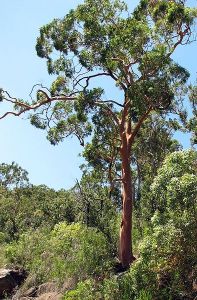
Angophora Costata

Angophora Costata (Courtesy: Eug, using CC-BY-SA 2.5, via Wikipedia)

Ah, you know I love this and when I first scanned the list of questions I thought, well, that last one is easy – the Angophora costata, that’s my tree.  But then I realised that it’s not technically a gum, because it’s not a eucalypt.  Except I just can’t change my mind.  So, the Angophora costata it is.

I grew up on the North Shore of Sydney, right on the edge of the Kuringai Chase National Park.  The angophora, or Smooth-barked Apple, loves that hot and dry sandstone country, and we had a very large one in our front yard.  They’re magnificent trees with great, smooth, orange-red trunks and twisted, gnarly, sculptural canopies.  My mother must have been worried that our tree was getting too big and maybe one day would drop something on me or my two older brothers, so she got around a tree surgeon to take out the odd precarious branch.  She must also have been worried about its health in general – being a keen gardener she didn’t want the tree gotten rid of – so, using screwdrivers, we dug little holes in the ground and filled them with a fertiliser called Poplar Special and the tree continued healthily.

One year when I was about fifteen or sixteen – I’m not making this up at all – I was mowing the front yard, which was never a task I enjoyed, and still don’t, to the point that I have next to no lawn, when a sugar-glider floated down out of the angophora and landed on the handle-bar of the mower.  The animal was so small and delicate and cute, it’s little white-tipped ‘wings’ folded up on each side.  I was utterly entranced, enthralled.  Not wanting to frighten the thing, I carefully turned off the mower’s engine.  The sugar-glider stayed there on the handle-bar, and I thought that maybe he’d come for a cuddle, maybe even some love.  So, extra gingerly, I went in to pick him up.  My hands got closer and closer.  Just as my fingers reached his fur, he turned his head and bit me badly on the finger, drawing blood.  He leapt off the mower, and sprinted to the angophora’s trunk and made his way back to the faraway crown.

This was such a magical event that maybe, in old age, when I’m about to draw my last breath, it’ll be this story that’ll dart through my mind.

INTERVIEWER

Thanks Nigel for these wonderfully thoughtful – though I’d expect no less – responses to my questions. I can see myself coming back to them a few times to digest the ideas you’ve shared with us. I love your favourite gum, by the way. Eucalypt or not, it’s still a gum, and what a pretty one.

Finally, thanks again to you and Susan for offering the Wet Ink interview to me. I’m thrilled to have this record on my blog.
Fridays with Featherstone, Part 4: On writing and admired writers

Today, I bring you the final part of Susan Errington’s Wet Ink interview with Nigel Featherstone. In this part Nigel talks primarily about some of the writers he admires or who have inspired him – and how they relate to his writing. I love the fact that many of the writers Nigel admires are also favourites of mine, such as … but no, if I tell you now that will spoil the interview. Read on …

INTERVIEWER

You seem interested in troubled or fractured families, especially in Remnants. Is the family dynamic something you want to expand on in future writing and perhaps bring to the forefront?

FEATHERSTONE 

Families are both fascinating and frightening.  As a writer I’m asking, what makes up a family?  It’s not just husband and wife and two children.  A family can be a group of people living in a share-house.  It can be a rock band.  It can be three kids on a road-trip.  It can be an old woman and her twenty cats; Eva Hornung explored human-animal relationships as family in her extraordinary novel Dog Boy.  Families can be forces for good, and forces for evil; more often than not, they are both at once – this is what Anne Enright was doing in her Man Booker prize-winning The Gathering.  Whenever I hear someone say that family is ‘the bedrock’ of society I want to reach for my pen and get to writing.  Family might be the traditional bedrock in terms of procreation, but it certainly isn’t the emotional bedrock for many individuals.

INTERVIEWER

Your Australian families lack the hysteria of Patrick White’s and remind me more of the quiet honesty of Randolf Stow’s. What’s important to you in creating a family in your work?

FEATHERSTONE

You’re not the first person to mention Randolf Stow in relation to my stories, and it always fills me with a warm inner glow.  I read The Merry-Go-Round in the Sea back in high-school and I was rapt, and that rapture has continued after all these years – and I haven’t read it since, although recently I bought another copy and it’s on the bedside-table pile.  Quiet honesty.  I like that.  Is that what attracted me to Stow?  Who can tell?  In terms of technics, what’s important in creating a fictional family is life, depth of character, and conflict.  It’s also important, I think, for the family to want something, resolution, revelation, salvation, disintegration, even if they don’t know it.

INTERVIEWER

Who are the important novelists for you?

FEATHERSTONE

J.M. CoetzeeDisgrace is the perfect contemporary novel.  Colm ToibinThe Blackwater Lightship, a story about three generations of Irish women, is told in the simplest, most direct voice, but it dives so confidently into the depths.  Alan Hollinghurst – the language in The Line of Beauty never ceases to amaze me, and the author is invariably hilarious.  Kazuo IshiguroA Pale View of Hills and The Remains of the Day are two gorgeous novels, both being vast wells of intimacy.  Graham SwiftLast Orders is a novel I return to regularly.  Morris WestEminence is built around a terrific what if (what if the next Pope was agnostic?).  Truman CapoteIn Cold Blood is a book that has had a huge impact on me because it’s the portrait of friendship and family and landscape.  Harper Lee – the burning desire for justice in To Kill A Mockingbird.  The verse-novelist Dorothy Porter – what she could conjure on the page!  Helen Garner – although not fiction, Joe Cinque’s Consolation shows all the hallmarks of what makes a novel.  It may appear odd in this company, but Flann O’Brien’s The Third Policeman is the most audacious of stories.  The names Tolstoy and Chekhov have to appear in this paragraph.  As does Flaubert’s; Madame Bovary is the truly great novel.

INTERVIEWER

Writing is a tough and often lonely gig.  Where do you draw your inspiration?

FEATHERSTONE 

From the things that happen around me, or happen around other people.  That makes it sound easy.  You’re right: it’s not.  There are days when I’d like to chuck it all away, but my life would be dreary without writing and reading.  And music.

INTERVIEWER

What are you working on at present?

FEATHERSTONE

Nigel Featherstone, I'm ready now

Cover (Courtesy: Blemish Books)

Going back to where we started, the second of those Launceston novellas is being published by Blemish Books in November this year*, so over the coming months I’ll be working on the nips and tucks required by the publisher (it’s already been through quite a few rounds of these), getting the story as perfect as humanly possible.  What can I tell you about it?  Perhaps, after all this talk about men and their trials and tribulations of forming relationships and trying to have meaningful lives, it might be a surprise to tell you that this second novella, which is called I’m Ready Now, is a story about a mother and son.  The mother has reached a fork in her life, and so has the son, and both are in the midst of making decisions that will change the course of their lives and their relationship(s).  It’s told from both points of view, and I enjoyed writing the mother as much as the son, perhaps even more so.  And I’m always working on short stories, and creative journalism.  And, yes, there’s a bigger project but I can’t talk about that because I’ll jinx it.  But for the next few months, much of whatever brain-power I have will be occupied with bringing I’m Ready Now into the world.

* This interview was prepared many months ago for publication in Wet Ink during 2012. Readers of this blog will know that I’m ready now was indeed published in November and reviewed by me that month.

If you missed Part 1, click here, for Part 2 here, and for Part 3 here.

Thanks again to Susan Errington for supporting my running this interview after the demise of Wet Ink. I’m sorry that Wet Ink no longer exists, but it’s been a pleasure to share this great interview with readers here.

Fridays with Featherstone will finish next Friday with my follow-up interview with Nigel…

Fridays with Featherstone, Part 3: Using the Arts and Landscape in fiction

Today, I bring you the third part of Nigel Featherstone’s Wet Ink interview with Susan Errington. One of the things that stands out in the two novellas I’ve read by Featherstone is the way he uses the arts. Even though the title of the first novella, Fall on me, is a direct reference to the REM song of the same name, Featherstone’s use of and allusion to the arts is not heavy-handed in his writing. It’s there however, suggesting that a life that incorporates the arts is important to him. And don’t we all (readers here, at least) agree! In this part of the interview, Susan talks with Nigel about the way he uses the arts in his writing, and they talk a little at the end of landscape as well. I was intrigued when I first read the interview to discover that Featherstone grew up in the part of Sydney that I spent my teen years in. Small world. Anyhow, here goes part 3 …

INTERVIEWER

In Fall on Me, the main character, Lou, must deal with his son’s decision to open his art exhibition, which consists of naked photos of his seventeen-year-old body. What attracted you to this idea?

FEATHERSTONE

Three years ago I attended a final-year student exhibition at the Canberra School of Art. One of the pieces was a large photo – a self-portrait – of a young man dressed as a woman reclining on a bed in a dilapidated house. I became aware that two friends of mine – a husband-and-wife couple – were standing next to me. I said, ‘Isn’t this a striking image?’ And they replied, ‘We’re glad you think so because our nephew is the artist.’ That set off my imagination: were the aunt and uncle at the exhibition because the young man’s parents had refused to attend? Back home later that night I jotted all this down in my journal. When I was in Launceston I rediscovered the idea and still felt curious about it. In the planning of the story, the young man became a high-school student, because that would be more dangerous. Enter Luke Bard, who’s someone else I’d like, because he too refuses to be anyone but himself.

INTERVIEWER

Nakedness has often proved to be dangerous terrain for visual artists over the centuries and still is. What are you saying about this in your novella?

FEATHERSTONE

Some people have commented that in Fall on Me I’m drawing on the whole Bill Henson saga. I don’t recall Bill Henson cropping up in my thinking at any point during the writing and editing of the novella. To make the story have impact, Luke Bard simply had to do the most radical and, yes, dangerous thing he could: which was display photos of his naked body in public. But why is this dangerous? Why are we so hung about images of naked bodies, no matter what the age? I think it taps into something deep within us that makes us feel terribly uncomfortable. As I worked on Fall on Me, and reworked it, I realised that Luke’s nakedness was less a physical act and more a symbolic act: it was all about being revealing, not so much himself, but his father. While we’re on the topic, I was surprised how some readers initially found Luke’s actions – and his father’s actions – quite difficult to accept, but, thankfully, it all seemed to make sense at the novella’s conclusion. That’s my mission as a writer: to gently lead people into the darkness and show that there’s not a lot to be scared about.

INTERVIEWER

A number of writers have spoken of the importance of visual art to their writing; I’m thinking of Steven Carroll and John Banville, for example, where visual art has an important part to play in their stories just as photography does in your novella. Robert Hughes is an art critic but also a poet, essayist and biographer. Patrick White actually wanted to be a painter. Why is your character Luke a photographer and not, say, a performance poet?

FEATHERSTONE

The short answer is that I think I can imagine how a photographer’s brain might work; who can imagine a performance-poet’s brain? Also, for Fall on Me to come together, I needed to put in the reader’s mind the images that Luke had made of himself, and I did this by describing them to the best of my ability. A better writer than me might have been able to achieve this through having Luke use performed words rather than pictures.

INTERVIEWER

Are the visual arts integral to your writing or is it simply that words have lost the power to shock?

FEATHERSTONE

Oh words can shock. They’ve always been able to shock, and they’ll continue to be able to shock. You only have to look at a cleverly crafted newspaper headline or a sound-bite prepared for a politician to see how words can deal blows. However, I’m also a fan of visual art, particularly photographs – there’s nothing like a haunting black and white image. And there’s a parallel between photography and writing: both start with the blank page and through artistry people and/or places come to life and a story is told. I’m going to use that word again: both are magic.

INTERVIEWER

Remnants is much more about the revealing power of words, in personal letters and secret novels for example. What are you trying to say there?

FEATHERSTONE

When I wrote Remnants, which was between 2000 and 2005, letter-writing was still a part of my life, albeit a rapidly fading part, so it felt natural to bring letters into the story. Also, I was writing about people in their seventies and eighties – they’d be well and truly in their nineties now – and most people of that generation would have collected boxes or suitcases of handwritten correspondence. More broadly, as each day goes by, I’m astounded by how story-telling is an integral part of life. A status update on Facebook or a few flicked off words on Twitter or a brief piece of correspondence sent by the increasingly old-fashioned email is about character and event, if not story, as rudimentary as it may be. And it’s all to do with words and how they’re used.

INTERVIEWER

Fall on Me is the title of an REM song and this band’s music is important to the character, Lou. I think writers who refer to contemporary music are quite brave because they risk dating their work or limiting their audience. Tell us about your decision to use this music and whether it is also important to you.

FEATHERSTONE

During the writing of the first draft, REM’s pop-song gem ‘Fall on Me’ just – well – fell into the story. I’ve always liked the song, but I wouldn’t say it’s one of my all-time favourites, or one I’ve played regularly; it just seemed to fit Lou and his life. But as the writing of the story progressed, the song became more and more important, until by the end it had become a physical presence in the story, before it eventually took over the whole thing and demanded to be the title. Shockingly, it wasn’t until after the novella was published that I understood it had a deeper meaning: Lou lost his wife through tragic circumstances and he is, in effect, saying to her, fall on me and I’ll save you. Now that I have even more distance from the making of the story, I realise that it’s an example of character being very real to the author, even if the author doesn’t know it at the time.

INTERVIEWER

What is the role of music in your writing generally?

FEATHERSTONE

Music is the foundation of my life – it means the world to me. But I don’t write to music; I get too distracted. However, if I’m trying to get in a certain mood to write, or trying to bring to a story a certain aesthetic, I might listen to a particular song or piece of music, but it’s always turned off as soon as the pen goes down on the page. Just to prove that every project is different, I wrote some of the drafts of Remnants to Arvo Part’s Alina. It is such simple and repetitive music that I was able to play it and still hear the words in my head. I think I needed it to access the sense of longing that was required for the novel.

INTERVIEWER

In Remnants the different landscapes are a powerful presence and richly described. It seems as if the changes in landscape are reflecting the mood and action of the novel. Was this your intention?

FEATHERSTONE

My childhood was spent exploring the wild edges of the Ku-ring-gai Chase National Park, the sea-and-sand-scapes of the northern beaches, and the almost prehistoric Blue Mountains. Even today, as I drive around the Southern Tablelands, I’m struck by the character of the landscape, its moods, its reticence, but always the amplification of self. As a writer, I’m interested in place as character as much as I am in human beings as character. Remnants was set in a small village in the Blue Mountains that I know very well; in a way I spent the first eighteen years of my life there. The vast majority of the story is concerned with the train trip from Perth back to the Mountains, so the narrative becomes a cross-section through the heart of the nation.

Look for Part 4 next Friday …

If you missed Part 1, click here, and for Part 2, here.

Fridays with Featherstone, Part 2: Writing about men

Today, as promised last week, I bring you the second part of Nigel Featherstone’s Wet Ink interview with Susan Errington. But first, a brief intro. Back in early November, Nigel wrote a guest post for my Monday Musings series on writing about family, on how this is what he finds himself writing about. In this part of the interview, Susan talks with Nigel about his writing about relationships, and particularly his writing about men. Read on …

INTERVIEWER

Your first novel Remnants asks the big questions about life’s meaning. Fall on Me seems to be on a more intimate scale, about the relationship between a father and son. Do you agree? Tell us about the different development of these works.

FEATHERSTONE

Remnants began as a manuscript developed during my studies for a Master of Creative Arts (Creative Writing) at the University of Wollongong, which I completed in 2001. The idea was to pit a conservative older brother against a radical younger brother and send them across Australia in the Indian-Pacific train. But after graduation, the characters and their story wouldn’t leave me alone, so for five years I kept working on the manuscript, until Ian Templeman at the now defunct Pandanus Books accepted it for publication. The novel has a quote from George Bernard Shaw as an epigraph: ‘Man can climb to the highest mountains; but he cannot dwell there long.’ I wrote the book during the long, twisted guts of John Howard’s reign over Australia, and even though it’s a gentle tale it’s a rallying against the one-eyed – and treacherously arrogant – culture of wealth that was so prevalent at the time (and hasn’t really abated). Where Remnants took six years from idea to bookshelf, the first draft of Fall on Me was written in seven days during that crazy month in Launceston, and then reworked over eighteen months before it was published at the end of 2011; it was a quick gestation. And you’re right: it’s a more intimate book. Being a novella its stage is necessarily smaller, focussing on a father-son relationship under strain. Perhaps there’s something about Tasmania that’s in Fall on Me, a sense of smallness, inwardness even.

INTERVIEWER

Central to your work is the variety of male relationships, fathers, sons, brothers, friends, colleagues, lovers, husbands or partners. These relationships are sharply and distinctly drawn and matter a great deal to your characters. Why do you explore these relations so deeply in your work?

FEATHERSTONE

I’ve always been nosy about what makes men tick. I’m the youngest of three brothers. I went to an all-boys private school on the north shore of Sydney, although it was sufficiently enlightened to have girls for the final two years. Growing up in the seventies and eighties, those post-women’s-movement decades, might have given me a sense that women were – at last – able to claim what was rightfully theirs. As a result, perhaps, some men have been asking themselves: where do we fit in, what are we meant to be, how are we to contribute? I’m not sure that they’ve found the answers. As a writer, I’m interested in the grey areas (it’s my middle name – literally), so I want to know how men relate to each other: unreconstructed men, reconstructed men, gay men who find themselves attracted to women, straight men who find themselves having an intense relationship with another man. Having said that, I’m interested in the feminine as much as the masculine. The feminine is alluring, because it feels powerful, whereas there’s a flatness to masculinity that can be difficult to penetrate.

INTERVIEWER

Why do they matter to you?

FEATHERSTONE

Well, they say it’s important to write about what you know. More seriously, I think I’m writing about what I’d like to know better. I think gender and sexuality is endlessly intriguing; it’s rarely black and white, and it always makes rich pickings for fiction.

INTERVIEWER

Do you believe male relationships have been neglected in literature or overshadowed by female ones?

FEATHERSTONE

The only way I can answer this question is by saying that as reader I look for life on the page, or, as James Wood in How Fiction Works calls it, “lifeness”. It doesn’t matter whether the story is about men and men or men and women or women and women. As a reader I want to be moved. As a writer I want to move readers. I’m not aiming to address any kind of imbalance.

INTERVIEWER

Do male writers often view this as a difficult or even dangerous area?

FEATHERSTONE

I don’t know what male writers consider difficult or dangerous, but someone like Christos Tsiolkas has shown that stories that traverse the full spectrum of gender and sexuality can be popular.

INTERVIEWER

In Fall on Me, the principle character Lou grapples with the idea that his son is open to male influences beyond his parental one, in this case the artist Marlow. Yet as a character Marlow has already left Launceston and the novel. Why remove him before the action starts?

FEATHERSTONE

Good old Lou – the more I think about him, the more people ask about him, the more I love him. He’s someone I’d enjoy being with in person: he’s open-minded and progressive, but also aware of his limits, even elements of his thinking that are conservative; he knows he’s a contradiction; he also fights to be himself, and will fight for everyone else to have that right. But to your question. Sometimes in smaller communities someone – including an artist – can have a profound impact. For the past two years I’ve lived in Goulburn, a regional town on the Southern Tablelands of New South Wales, so I’ve been able to observe how some individuals can have considerable influence. In Fall on Me, Marlow flies over from London to live in Launceston for a month; he plays his role of inspiring people and then leaves. Luke, an intelligent but impressionable teenager, is stirred to take risks, very real risks, which may put his somewhat precarious family-life in danger. In the writing of the novella I was keen to explore the father-son relationship more than the artist-boy relationship, so the novella starts with Lou being forced to find out what his son has done.

INTERVIEWER

In Remnants, the role of absent but influential male is played by the dead father. Are you saying something about male power here?

FEATHERSTONE

I think I’m saying more about the power of the past than male power, or any kind of gender power. The novel’s main character, Mitchell Granville, a retired barrister, has gone through his life believing that he’s done the right thing by his father, who wanted his younger son out of the family and never to return. However, during the course of the story, Mitchell is forced to realise that he did the wrong thing. There’s a line in the novel that I’ve never forgotten: ‘obedience breeds loneliness’. (It may seem big-headed to quote dialogue that I’ve written, and perhaps it is, but in this case I feel as though the dialogue is the novel’s, and that novel no longer feels like mine.) To me, I was writing about how sometimes it can take us years, decades even, to find the right path by being disobedient. And sometimes it’s important to disobey men, and sometimes it’s important to disobey women.

INTERVIEWER

By contrast your female characters in both novels are very nice people, some might say too nice to be true. How do you develop a female character in your writing?

FEATHERSTONE

This is probably a fair criticism of my work and perhaps one day I will do something about it. In my own life, my closest female friends are such strong women, witty and clever and independent and brave and tenacious and – sometimes – contrary. They are loving, and they can be sweet, but I’d hardly call them nice because they’d hate me for it. In terms of writing, regardless of the character’s gender, it all comes down to this: what sort of people need to be in the story so that it becomes breathtakingly alive? When a character is working they have a spirit, a moral fibre, and a sense of history. I’m not the kind of writer that has a checklist of characteristics: black hair, short of stature, a pink plastic ring on the left-hand forefinger, that kind of thing. As much as possible I try to go with instinct: who am I really seeing in my mind’s eye? Perhaps my mind’s eye is better at seeing men than women.

Look for Part 3 next Friday …

Fridays with Featherstone, Part 1: Thoughts on literary form

What do writer Nigel Featherstone and the now sadly defunct literary magazine Wet Ink have in common? An unpublished interview, that’s what! When Nigel approached me, with the agreement of his interviewer Susan Errington, asking whether I would like to run the review on Whispering Gums, I of course said yes – for several reasons. Over the last year I have reviewed two lovely novellas by Nigel Featherstone, Fall on me and I’m ready now. Nigel also wrote a guest post for Monday Musings on the relationship between family and children in some recent Australian fiction, including his own. And, yesterday, Nigel won the fiction section of this year’s ACT Writing and Publishing Awards for Fall on me. Then I read the interview – and I enjoyed it. Not only does it provide insight into Nigel’s writing, but he speaks on a range of issues regarding literary style and form and, of course, divulges some of his favourite writers. How could I not take up the offer?

It’s a long interview – magazine essay-length – but it breaks neatly into some thematic sections, so with Nigel’s agreement I am running the interview over a few weeks, followed by an updating interview between Nigel and me. So, with thanks to Nigel Featherstone and Susan Errington, here is Part 1 …

Featherstone, Fall on me

Fall on me bookcover (Courtesy: Blemish Books)

INTERVIEWER

You describe your latest work, Fall on Me, as a novella, but many current novels are not much longer. What is it about this story that makes it a ‘novella’?

FEATHERSTONE

Perhaps the best way to answer this question is to briefly talk about how Fall on Me came into being. In early 2010 I spent a month in Launceston as part of the Cataract Gorge Artist-in-Residence Program. Up until that point I’d spent five years working on a major project that had gone close to publication but in the end it got the red-light, not the green-light. More than a little wounded, I took the opportunity of the Launceston residency to return to where I’d started my writing ‘career’ back in the early 90s: creating short stories. I set myself a goal of writing the first draft of six stories. But there were other goals, too: write by hand, as in pen to pad; write what I wanted to write and what I’d like to read; and take creative risks, meaning don’t censor myself.

At the end of the first week I had the sketchy draft of what I supposed was a very long story, something around the 30,000-word mark. The second week I again tried to write a short story, but at the end of that week I again had the sketchy draft of a very long story around 30,000 words. And so it went until, after a 28-day mad storm of writing, I had the sketchy drafts of three of these very long stories. What had happened to me in that dark, dark Launceston gorge? I remember jumping on the plane to come home and thinking, what on earth am I going to do with these? What I did was keep working on them – editing, rewriting, polishing, editing some more – until, damn the bloody things, they grew in length; I’d had hoped they would go in the opposite direction. But there was something about the length that I really liked: story concentration, but also character expansion, and it intrigued me.

Thankfully Blemish Books, a Canberra-based independent press, was looking for fiction manuscripts up to 40,000 words so I submitted the first two of my novellas. And here we are. In the end, I think, that time in Launceston was all about psychology: I conned myself into believing that I was only writing short stories, and I certainly didn’t want to attempt another novel, so somehow I decided to write in that halfway space that novellas like to inhabit. Of course, there’s more to it than that: as a reader I love a book that can be gobbled up in one sitting, for example Hemingway’s The Old Man in the Sea, or The Sense of an Ending by Julian Barnes. What these two books achieve with a minimum of words is astonishing.

INTERVIEWER

You have also published a large number of short stories, at least forty I think, as well as two collections. What attracts you to the short story?

FEATHERSTONE

Short stories are closer to poetry than novels: they’re great at suggesting, rather than explaining every crinkle in the forehead. And they have focus – amazing focus, the focus of poetry. A well-structured short story is exquisite. Although it’s at the longer end of the spectrum, Annie Proulx’s ‘Brokeback Mountain’ is mind-blowing. Or Chekhov’s ‘Gusev’ – what that man achieves with this story, which is one of his shortest works, is truly miraculous. The making of short stories is interesting, too. Sometimes I’ll have an idea logged in my journal for months, if not years. Then something happens – the stars align – and I’m ready to write the thing. I like to write the sketchy first draft in a day, type it up the next day, and then there’ll be months, if not years of rewriting, editing and polishing; one story took five years to find a home in a journal. In terms of short stories, I always come back to that word: miraculous. Short stories are indeed almost inexplicable, especially those that do so much with so few words. Take Hemingway’s classic six-worder: ‘For sale: baby shoes, never used.’ Or Margaret Atwood’s: ‘Longed for him. Got him. Shit.’ See? Miraculous.

INTERVIEWER

What for you is the critical difference between short stories and novels, or novellas for that matter?

FEATHERSTONE

I wish I knew. That sounds off-hand, and for that I apologise. But every short story is different, every novella is different, every novel is different – in the writing, in the reading. Every story has its own internal logic, its own ecology, if you will. Established writers say that each time they start a new story they have to relearn the craft, and they’re speaking the truth. However, perhaps we can define the categories, just for the heck of it. If short stories are about brevity, novels are about complexity. So that’s what I might love about working with the novella: they offer the best of both worlds: succinctness and sophistication. Thomas Mann’s Death in Venice and George Orwell’s Animal Farm are cases in point. Of course, these definitions of story form are ultimately meaningless: some short stories are about complexity, while some novels use up 200,000 words by saying not much about anything. A story must find its natural length, that’s the beginning and end of it.

INTERVIEWER

Which short story writers are important to you?

FEATHERSTONE

I mentioned Chekhov before, and Tolstoy is a hero, too – what he does in The Death of Ivan Ilyich is almost hard to believe. (At heart I’m a melancholic, and the Russians know all about melancholia, don’t they.) Proulx, of course, needs a second mention. I much prefer Peter Carey’s short stories to his novels – ‘The Last Days of a Famous Mime’ has had a huge influence on me because of its playfulness. Speaking of playfulness, the last collection I read that I fell in love with was Shooting the Fox by Marion Halligan – she really knows how to put words and sentences and characters together so sparks fly. But if my house was burning down and I had only a nano-second to make a decision, I’d clamber for my Chekhov and Tolstoy books. These two men strip back life until the truth is almost too much to bear.

Look for Part 2 next Friday …

Nigel Featherstone, I’m ready now (Review)

Featherston, I'm ready now, book cover

Book cover (Courtesy: Blemish Press)

Way back in my youth when I started studying literature, I thought I had to get the “right” interpretation. It made reading a little scary, I must say. However, as I gained confidence, I discovered that there are as many responses to a novel as there are readers, something I was reminded of when I attended this week’s launch of Nigel Featherstone’s novella, I’m ready now. And here’s why…

The book was launched by Canberra journalist and biographer, Chris Wallace. She spoke eloquently about the book telling us that it’s about how you can make a change in your life no matter how old you are – whether you’re 30 as Gordon is in the book or 50 as his mother, Lynne, is. She said too that it promotes the idea of living an imaginative life. I thought, yes, she’s right, it does do these things. And then Nigel spoke, and he said that for him the book can be summed up in one word, liberation. And I thought, yes, I can see how it’s that. But I had framed it a little differently from my reading.

Before I give you my different-but-on-a-similar-track take, I’d better tell you something about the plot. It has a small cast of characters, which is pretty much what you’d expect in a novella. They are Gordon, a gay man turning 30 who lives in Glebe and works as a photographer; his old schoolfriend Shanie, who followed Gordon to Sydney; Levi, Gordon’s boyfriend of a year or so; and Gordon’s mother Lynne who, recently widowed, comes up from Hobart to stay with Gordon for a short while. Lynne has put the large family home on the market, and the auction will be held while she’s away. Meanwhile, Gordon is almost at the end of his Year of Living Ridiculously, which is a year of rather self-destructive high living that he designed, and is doggedly keeping to, for his 30th year. He plans to crown this year with something he calls The Ultimate. But then Mum, Lynne, arrives, and puts The Ultimate at risk. What Gordon doesn’t know is that his mother has a grand plan herself, now that she’s free. (Ha! Liberation you see.)

This sounds pretty simple, really, doesn’t it? However, there are complications. Lynne’s husband, Eddie, was not Gordon’s father. Gordon’s father, Patric Finn, walked out on him and his mum when he was around a year old, and neither has completely resolved the abandonment. It’s not that Eddie wasn’t a good husband and father, because he was, but he never fully understood Gordon, and for Lynne he was “a head kind of love, not a heart kind of love”.

What is lovely about Featherstone’s writing – as I also found in his Fall on me – is that he manages to build tension and mystery around his characters’ behaviour without undermining their realness or humanity, and without alienating us readers. We warm to them even while we wonder about the wisdom of their decisions and motivations. Featherstone also uses imagery and allusions lightly. Water, for example, can be a cliched symbol in stories of change and growth, but here it’s appropriate and not laboured. What more logical thing is there to do on a hot night in Sydney than to go for a dip in the sea?

Besides the characterisation, I also like the novella’s voice and structure. It’s told first person in the alternating voices of Lynne and Gordon, and is effectively paced, largely through varying the length of the chapters*. The book opens with a mere half-page chapter in Lynne’s voice, and then moves to mostly longer ones in the main part of the book. They shorten towards the end as the pace builds, keeping us involved and wondering what these two will finally decide to do and what role Shanie and Levi might play in it all.

Now though to how I would describe the novel – and for me it is about coming to terms with the past. Both Gordon and Lynne have not had unhappy lives but both have in some way been damaged by their abandonment. Almost half way through the novel, they both say something significant. Lynne, reflecting with real generosity on Patric’s unheralded departure, says

I think he wanted to be free, a free young man. There have been times – many times – when I’ve found myself actually admiring his audacity to grab life, to run with it, to run as far as he could.

She then tells us that her plan is to leave Australia to live in “a farmhouse on a hill in the beloved country [Ireland] of my mother”. In the next chapter, Gordon’s, we learn in a flashback why he commenced his Year of Living Ridiculously. It’s to discover “what it is that makes me feel most alive”. He wants to “to lean over the cliff, figuratively speaking … to live as vividly as possible” – but his chosen method is clearly not working. The idea, though, reminded me of Fall on me in which the son tells his dad that “safety doesn’t always equal life”. Both these novellas, in a way, explore what Wallace described as “living an imaginative life”.

They are both, too, about something Lynne says towards the end, which is that “life must move forward; anything else is sacrilege”, and yet, paradoxically, her wish for Gordon could be seen to be the opposite: she wants him to go back to find what “hurt him all those years ago”.

And so for me, the book is about “living imaginatively” and about liberation, but it is also about how the past can stall us if we don’t get it in the right perspective. Featherstone opens the book with two epigraphs, one being TS Eliot’s “Home is where one starts from”.  I think that, in a way, says it all.

Nigel Featherstone
I’m ready now
Canberra: Blemish Books, 2012
156pp.
ISBN: 9780980755688

(Review copy supplied by Blemish Books)

* for want of a better word for the numbered parts.

Monday musings on Australian literature: Guest post from Nigel of Under the counter or a flutter in the dovecot

This is embarrassing but I really can’t remember how and when I first met Nigel. Actually let me rephrase that: I do remember when I met him in person because I’ve only met him once (at a literary event earlier this year), but who stumbled across whose blog first I have no idea. I’m glad we did though, because in Nigel I’ve discovered not only a lovely writer (see my review of his novella Fall on me) but an active supporter of Australian literature through such activities as the online creative arts journal VerityLa and the arts forum, the Childers Group. I also enjoy his reflective blog, Under the counter or a flutter in the dovecot. And so I was thrilled when he said yes without apparent demur to my request for a guest post. Thanks Nigel …

Real or imagined, raising children makes a great story

The game now finished and the speeches in full swing, the camera panned left to take in the players who were standing off to one side and looked worn-out and knocked around, a few with mud on their faces, a bit of blood too, but smile they did because they’d won and were elated. After a moment, the camera went back to whoever it was that hadn’t yet finished his speech (why is it that a man with a microphone will always go on too long?). For the first time in my life I was grateful when the TV channel cut to an ad break.

When the NRL grand final coverage resumed – I’d not watched the actual game, and had only stumbled on the closing minutes of the concluding celebrations by lazy accident – the victorious players were wandering around the field, or ‘paddock’ as it’s apparently called, many with their young children in hand. It’s this that struck me: rugby league boofheads wanting to be with their kids in these lingering moments of sports elation.

It looked – it felt – amazingly non-sensical.

I’m not one for children; never have been, never will be. I am, in fact, the least paternal person on Earth. At no point in my life have I ever wanted children. Which is, now I examine my life with precision (the process of writing does that), a bit of a lie. I remember that as a teenager I did have day-dreams of raising children, except in those day-dreams my wife was always absent, to be accurate she was dead, which left me to be a hip young single father, and I was very good at fathering, and my kids adored me and I adored them back. Once I was old enough to understand why my wife was always cactus, my mind – my conscious mind – turned to things closer at hand, and much more real. Which is why, aged forty-four, I’m blissfully childless. When on the rare occasions something good happens to me (though for some reason these events are never televised), I reach for a bottle of nicely chilled verdelho and a slice of blue cheese on a cracker.

Not having children, not wanting children – now that I have a fine appreciation of the opportunities and constraints of my life, I desire children as much as I desire the idea of a car-alarm going off in the middle of the night, and if ever I find myself day-dreaming, which is, I should say, a lot, it’s about having a crumbling hut in some far-flung place that you can only access by barging a rusty old four-wheel-drive across seven creek-crossings – is problematic for someone like me, a writer of all things, that ridiculous trade that’s getting more and more ridiculous as each day goes by. For family is the guts of the contemporary Australian story – it is, to throw into the mix some suitably highfalutin French, its raison d’etre.

I’ve just finished having a private Australian literature festival, reading some blisteringly powerful novels by our nation’s finest (who too don’t get to parade their children in front of TV cameras). Kate Grenville’s Sarah Thornhill, Craig Silvey’s Jasper Jones and Gillian Mears’ highly distressing but remarkable Foal’s Bread. All three novels explore family and the impacts on children, but also the desire for children, that procreating is the usual path, the standard, the predictable, how it is just what you do. How the desire to continue your bloodline is simultaneously overwhelming and underwhelming. It is refreshing that both Foal’s Bread, which is largely set between the world wars, and Sarah Thornhill, which has as its backdrop our morally bankrupt colonial times, explore women who aren’t just mothers, whose dreams are bigger and wider and deeper.

*

In my own writing, my own attempts at making words come to life on the page – it always seemed so easy as a boy: you wrote what happened and that was that – I too explore family. My main characters are usually men and women (always a good start!) who have children, who want to be parents, who struggle to cope, who feel the pressure of internal and external expectation, who fail and fall into a heap but pat themselves down and have another crack at it.

Featherstone, Fall on me

Fall on me bookcover (Courtesy: Blemish Books)

My novella Fall on Me (Blemish Books, 2011) is about a single father who has to cope with his precocious seventeen-year-old son who insists on turning his naked body into an art exhibition. Lou and Luke: how through writing their story I’ve gotten to know them well, so well, despite everything how they created a family for themselves, and the addition to that family, Anna Denman, their housemate who became much more. To the point that I still think about them. And it’s always gratifying – and humbling – when readers say they think about them too.

In my forthcoming novella, I’m Ready Now, to be launched in Canberra on 22 November by Blemish Books, I write about a very different family. The story is a simple one, but it’s told from two points of view: a mother’s and a son’s. Lynne Gleeson is a fifty-year-old ‘corporate wife’ (that’s how she describes herself) whose husband Eddie, a man who inherited his family’s property-development business, has died of a heart-attack. Theirs was a perfectly functional if not loving relationship, one of considerable wealth and privilege – the family home is a daunting historic mansion called Gleeson House in Battery Point, Hobart. Now that Lynne is alone, she has decided to sell this property, and the family’s other houses, including an architect-designed getaway on Magnetic Island, Queensland. Effectively homeless, she leaves Tasmania to spend a fortnight in Sydney, staying with her son Gordon. But Lynne has plans. Big plans.

Nigel Featherstone, I'm ready now

Cover (Courtesy: Blemish Books)

Meanwhile Gordon, a professional freelance photographer, is thirty now, and despite being in a relationship of five years’ standing, is having what is described as a ‘Year of Living Ridiculously’ – it involves spending his weekends out in Sydney’s bars and clubs, taking drugs, and having promiscuous sex. For his thirtieth birthday, which his step-father’s death prevented the family from celebrating, Gordon has secretly arranged ‘The Ultimate’, which threatens to tear everything and everyone apart. It sounds heavy, it sounds grim, but it’s just about family. So it’s the truth. And, yes, I really think I can say that: the truth.

Family: there are plenty of other things to write about. Fighting wars amongst far-flung stars. Cornering yellow-teethed bad-guys. Hacking up zombies. Sex, which as I know better than anyone, doesn’t always have to result in something altogether gruesome nine months later. But still it’s family that I write about, the desire to raise someone in your own likeness, to have your best go at doing a decent job of it, to leave something worthwhile behind. All I’m going to leave behind is a handful of stories in the flickering fluorescent-light basement of the National Library of Australia.

*

Last month my older brother and his fourteen-year-old son dropped in on their way to the snow-fields. We went down to a café in the mainstreet for lunch and caught up on all that was happening in our various worlds. An hour later it was time for them to continue on their way south. The day was cold and blustery, the sort that makes my hands turn blue and my mood turn a similar colour. Dust was being flung around and as my brother and his son got into their brand-new four-wheel-drive I began to cough and splutter wildly.

My nephew, who’s not big on conversation and his favourite thing ever is his skateboard, wound down the window and stared at me fair-square in the face and said, ‘Are you sick?’ He looked genuinely concerned. ‘No,’ I said, ‘there’s a typhoon going on out here and it’s hit the back of my throat.’ His eyes brightened right up and he laughed. As my brother drove the two of them away, I sent my nephew a text message: ‘Have a great time on the slopes.’ He wrote back: ‘Have a good week.’ When was the last time someone had wished me a good week? I couldn’t remember. But I loved those words. They moved me. And they still do.

If I have a motivation to write, it’s to move people.

So, despite everything I know about myself, after forty-four years of determined self-direction, to the point that I’m now, to put a twist on something Quentin Crisp once said, one of the stately homos of Goulburn, I watch the dying moments of a rugby league season and can’t take my eyes off the men – proud, probably even gentle men (when they need to be) – who lead their children around a football field; it’s not the men who fascinate me, but the big hands holding the little hands. And I read great Australian novels about family and generations and personal history amongst the maelstrom that is the bigger political and social context. And I write stories about people who do their utmost to raise the best of kids. And I keep in my mind a simple text-message from my nephew.

But I also recall something the US poet and civil rights activist June Jordan once wrote: ‘In the name of motherhood and fatherhood…we threaten and suffocate and bind and ensnare and bribe and trick children into wholesale emulation of our ways.’ My unborn children should be grateful that they had me as a father. Hopefully the ones that live on the page are much more optimistic about their chances in the world.