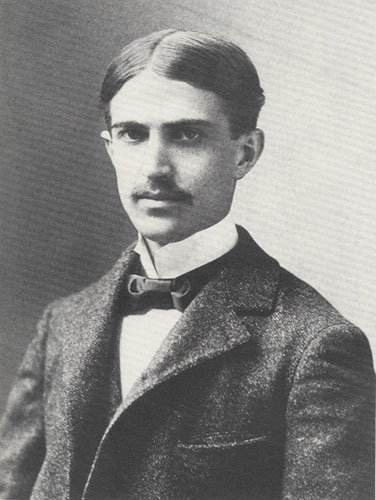
Stephen Crane (Presumed public domain, via Wikipedia)
This week’s Library of America offering is a sketch/article by Stephen Crane. Now, while I suppose most Americans have read what I believe to be Crane’s most famous work, The red badge of courage, I’m afraid I haven’t – and so, when this opportunity to read something by him arose, I was more than happy to take the opportunity. You can too, by reading it here. (It’s well worthwhile, and is less than 5 pages.)
According to the Library of America’s notes, the story was published in 1894 in The New York Press under the following heading:
When man falls, a crowd gathers
A Graphic Study of New York Heartlessness
Gazing with Pitiless Eyes
“What’s the Matter?” That too Familiar Query
That pretty much sums it up really. The notes also say that it was based on a real incident. It’s a simple story: a man and a boy are walking in the street one evening, when the man suddenly falls to the ground. Immediately a crowd gathers, ready to criticise (“Oh, a jag, I guess”) rather than help. The boy indicates, however, that it’s a fit but this still doesn’t result in any obvious sympathy or assistance. Instead, the crowd pushes closer and closer wanting a view. The language used to describe the crowd’s behaviour leaves us in no doubt as to the intent:
Those in the foremost rank bended down, shouldering each other, eager, anxious to see everything. Others behind them crowded savagely for a place like starving men fighting for bread.
This is writing that pulls out all stops to make its point: the rhythm (“shouldering each other, eager, anxious to…”), the word choice (“savagely”) and the imagery (likening their behaviour to that of survival) work together to create a powerful picture in just two sentences. The language continues in this vein building up a tension between the crowd, which shows more interest in the spectacle, and the helpless boy who is unsure what to do to help his companion. It’s not until halfway through the story that someone offers some help – but still the majority stands by:
There were men who nearly created a battle in the madness of their desire to see the thing.
Meanwhile others with magnificent passions for abstract statistical information were questioning the boy. “What’s his name?” “Where does he live?”
Eventually, a policeman (“a man whose life was half-pestered out of him by the inhabitants of the city”) appears, exhibiting “the rage of a placid cow”. (A wonderful oxymoron that reminded me of Tony’s recent post on the subject.) Gradually, but with continued difficulty described in similar evocative language, the man is helped.
This is delicious writing: it’s almost, but not quite, over the top in the way it piles up the imagery. What saves it from being hyperbolic is that it is, unfortunately, all too believable – for then, and for now. It’s not for nothing I think that Crane titles it “when man falls” not “when a man falls”, making it rather clear that this is not a one-off situation. What a shame Crane (1871-1900) died so young.




 Whispering Gums