I only have myself to blame! I asked for readers to suggest topics they’d like to see in Monday Musings and two suggestions came back, one from novelist Angela Savage asking for a post on libraries and librarians in Australian fiction. Her request was inspired by her recent appointment as the CEO of Public Libraries Victoria. I was interested, but it’s not an easy subject to research …
However, before I get to the post proper, I must share this article that Paula (Book Jotter) included in her Winding Up the Week post: “Since the pandemic, an Australian library called 8,000 elderly patrons just to check in”. What this Victorian public library service did is inspiring.
Now, my post … most us probably know some of the famous novels which feature libraries and/or librarians, like Umberto Eco’s The name of the rose and Carlos Luis Zafon’s The shadow of the wind, but how many of us remember libraries and librarians in Australian novels? It’s hard, but here is a selection.
 In many cases, authors refer to libraries or librarians positively, often to establish a character as thoughtful, considered, intelligent, open-minded. Craig Silvey’s Charlie in Jasper Jones (my review), for example, visits the local library early in the novel, when he is at loose ends. He’s comfortable there – like “visiting an elderly aunt” – and he knows how to use it, from genre books to newspapers.
Wendy Scarfe’s librarian, Joe Pulham in Hunger town (my review), introduces her protagonist, Judith, to the Aristotelian idea of living moderately. There is also a librarian in Christos Tsiolkas’ Barracuda (my review). His protagonist finds himself in jail, and while there becomes an avid reader. Tsiolkas, perhaps partly self-mockingly, has the prison librarian comment on Danny’s reading choices:
‘Why are you always buried in those old farts?’ Danny would accept the teasing good-naturedly for he knew it was apt. Contemporary writers annoyed him, he found their worlds insular, their style too self-conscious and ironic.
The point, though, is that Danny’s becoming a reader is a positive thing in his development as a thinking person.
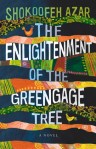 In the opening chapter of Shokoofeh Azar’s The enlightenment of the greengage tree (my review), our narrator’s brother dies in a fire started by revolutionaries in the father’s library. Here the point is that our narrator’s family comprises educated progressive thinkers, just the sort of people abhorred by the leaders of Iran’s 1979 Revolution. A more famous personal library occurs in Markus Zusak’s The book thief (my review) in which young Liesel steals books from the local mayor’s wife’s library. For Leisel, the library evokes a calm, safe place, as well as a place of words whose power, she understands, can do ill and good.
Elizabeth Jolley’s grandmother protagonist in The orchard thieves (my review) ponders, on her way home from the library, the value of libraries to people who may never have had an opportunity to use them. She thinks about intruders and muggers:
… she might be held at knife point by someone in the street. She would offer all she had in her purse, small change, pension cheque and the library-book tickets. There would be absolutely no need for the villain to either strangle or stab her in order to snatch her purse. She would hold it out to him and tell him he could have it and be off. She would tell him this in plain words. The library-book tickets might even make a changed man of him, especially if he had never had a chance to use a public lending library during a life with all the deprivation brought about by being on the run.
This is quintessential Jolley (whose husband, you may know, was a university librarian.)
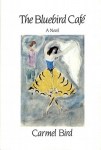 Jolley talks about library-book tickets, prerequisites for borrowing library books. Carmel Bird’s The Bluebird Cafe features another library based on a private collection – The Charles Dickens Library, which is classified as a “national treasure” – but there’s also reference to a library-book reading barmaid who gets “so bored” on her days off “when there’s nothing to read”. I haven’t read this novel, but the excerpts on Google Books show me it’s another delightful, cheeky Bird. Commenting on Angela’s request for this post, Carmel also mentioned her novel The white garden. GoodReads describes it as follows:
Carmel Bird’s examination of the secrets of the human mind is a chronicle of tragedy that is inadvertently revealed in the search for a lost library book.
Sometimes, authors describe library buildings. Steve Toltz does in Quicksand (my review). His character is sent by a bookshop to the local public library, which, when he gets there, is a “bland underwhelming brick building behind the train station” (though – phew – the library does come up with the goods). Later, he is taken to “an abandoned-looking prison courtyard reminiscent of a library on Sunday”. Hmmm, these images of libraries don’t posit them as inviting places, but Toltz’s novel is satirical, so perhaps it’s good that he thinks libraries are worth noticing?
 Dymphna Cusack also mentions a library building in her debut novel Jungfrau (my review), when her young university student character passes one in a distressed state:
The palms swayed under the light like green fountains in the wind, and their shadows danced grotesquely on the walls of the Public Library.
Why choose the library in particular? Perhaps because this between-the-wars novel is about three young women enjoying new freedoms for women, something that libraries could be seen to epitomise.
I’ve only dipped my toes into this topic. There are many more libraries and librarians out there in Australian novels – David Malouf’s Johnno, for example, which I read long ago – but I hope this little discussion gets the rest of you thinking. You know what to do!
 Whispering Gums