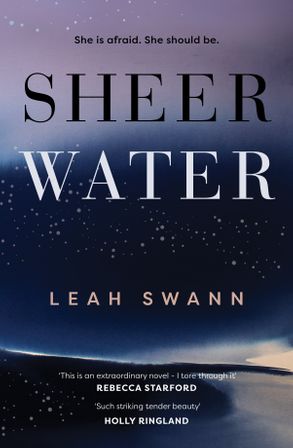
I’ve been wanting to read Leah Swann’s Sheerwater, having read and enjoyed, a few years ago, her short story collection, Bearings (my review). However, I didn’t get around to buying a copy, so was pleased to see it available as an audio book when I was looking for listening matter for our recent Melbourne trip. I thought we’d finish it on the trip but, in the end, the sightseeing was so interesting that we listened less than we thought we would. We’ve finished it now!
But, how to write about a crime book in which the main mystery – the disappearance of two boys – is resolved for us early on. At least, resolved in the sense that we discover what has happened to them and who was involved. As it turns out, though – and we learn this quickly – there’s another story to tell, and it’s a powerful, terrifying and unfortunately only too relevant one, a story of domestic violence, of power and control that isolates those who are vulnerable.
Interestingly, the novel’s opening reminded me strongly of the unforgettable opening to Ian McEwan’s Enduring love, which, as it happens, is also about dysfunctional love, albeit a different sort. There is also an ironic allusion to Australian literature’s “lost child” motif, when Ava thinks “this was a Continent where you could still get lost”, because these children aren’t “lost” – per se!
Anyhow, the story takes place over three days, and is told in alternating 3rd person voices, primarily those of the mother Ava, father Laurence, and 9-year-old Max who is the older of the two sons. Swann does an impressive job of getting into the heads of these disparate characters. Each one feels psychologically real, and their stories are compelling – well, most of their stories. Laurence is way too chilling to be compelling, but he is scarily real.
Now, I’m not going to write my usual sort of review, because listening to a novel (particularly while driving) doesn’t provide the same opportunity for reflection (and note-taking) that reading does, and certainly not for recording quotes, though I did jot down a few when I wasn’t the driver. The novel falls into the literary crime category, I’d say, for several reasons: it’s not a traditional crime novel; it’s told from multiple points of view; and the language is highly descriptive, if not poetic.
The title Sheerwater, for example, has multiple meanings. There’s the literal one, it being the name of the town that Ava is escaping to, and a literal and metaphorical one in that shearwaters (or, mutton birds), at the time the book is set, are doing their big migration south. They start the novel and each of the three days (if I remember correctly). There’s a sense that their impressive endurance mirrors that of women like Ava, and their arduous journey that of the boys. If we push it, there could also be a play on the words “sheer water” given the multiple meanings of “sheer” (pure, perfect, precipitous) and the role of water and the sea in the novel.
“We become evil when we hide the truth from ourselves” (Mother)
Swann creates a melancholic tone early on with phrases like “no pity under its wings”, and “sea of shipwrecks and stolen lives”. The no-nonsense but ultimately supportive policewoman Ballard is described by Ava as having a face like the “impermeable slap of seawashed stone”. It’s not all completely grim though. There is a lot of love, and Ava’s comment on one person’s kindness being enough to sustain a whole childhood is beautiful albeit, in a sense, prophetic.
So, was this book good to listen to? Yes, and no. Katherine Tonkin reads it well, including bursting into little verses of song when required. I didn’t find her voice intrusive, which can be a problem with audiobooks. However, for me, such highly descriptive books are better read than listened to. Somehow, when listening, there’s a greater sense of wanting to get on with the story. The descriptions and internal ruminations got in the way of that, whereas reading it would have allowed me to better absorb the language and descriptions, to feel and consider them, so I’m sorry about that.
Still, the narrative is strong, and it grabbed our attention, forcing us to think hard about each character, their truthfulness, their motivations, and the soundness of their actions. Who would you believe, and what would you do (if you were any of the characters involved), are the questions you confront as you read. The ending is also strong, emotional – and, dare I say it, appropriate.
In Sheerwater, Swann uses fiction to put flesh on the media stories we hear about domestic violence, encouraging us to see behind the stories to feel the confusion, roller-coaster emotions, helplessness and terror that those involved experience. Sheerwater is a book that says something.
Read for Reading Matters Southern Cross Crime Month.

Leah Swann
Sheerwater
(Read by Katherine Tonkin)
Bolinda/HarperCollins Audio, 2020
8hrs 44min (Unabridged)
ISBN: 9781460782354
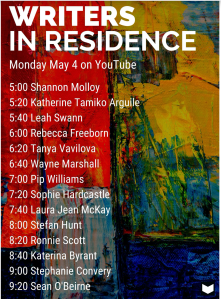 With information coming from every which way, I’m not sure how I heard about the
  Molloy’s book, simply titled Fourteen, was published in March. It is an autobiographical coming-of-age memoir about being a gay teen. It is set in Yeppoon, in regional Queensland, in 2000. Molloy admitted that his story is harrowing, but believes it also has a strong message of hope. He wants kids “to know there is an end in sight”.
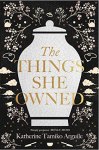 Arguile’s debut novel, The things she owned, was published in late April. Describing herself as “from all over the place”, Arguile, was introduced by Orton as a Japanese-British-Australian artist and journalist. She explained the title of her book. The things are objects which the protagonist, Erika, inherited from her mother, Michiko. Erika is half-Japanese like Arguile, and the novel draws from her own experience. However, as she stressed, The things she owned is a novel, and Michiko is nothing like her own mother.
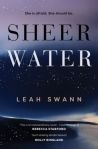 Swann’s novel Sheerwater, which was published in March, is garnering a lot of reviews for the Australian Women Writers Challenge. (I’ve
 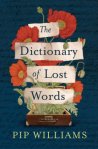 The dictionary of lost words, published in late March, is Pip Williams’ debut novel, though she has written other books. She was one of the reasons I was keen to register for this event as I gave this book to my mother for Easter. She, a retired lexicographer, loved it.
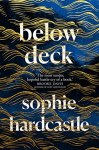 Artist and writer Hardcastle’s novel Below deck, was published in March and is her first novel for adults. It is divided into four parts, with the last being set in Antarctica. Hardcastle had had, she said, an artist’s residency in Antarctica. She wanted to write a work that explored “climate change and our relationship with the natural world.” She thought that a story of the body being violated could work as a metaphor for the environment being violated. The rest of the conversation, however, didn’t really discuss this aspect further.
 McKay’s novel, Animals in that country, was published in late March. It’s another I had bought as an Easter gift, because, not only did it seem appropriate for the times, given it involves a flu pandemic, but it sounded innovative and feminist. Right up Daughter Gums alley! The novel does have talking animals, including a dingo called Sue! McKay had spent time in a Northern Territory wildlife park as part of a writer-in-residence program, and got to know some dingos here. Sue was apparently inspired by an actual dingo.
 Whispering Gums