Sofie Laguna in conversation with Karen Viggers

I don’t know how it has happened, but tonight’s conversation between Sofie Laguna and Karen Viggers is the first ANU/Meet-the-Author event I’ve attended this year. I did book one featuring Omar Musa a month ago, but I came down with laryngitis, as did, I believe, his interlocutor. (The show went on, with Karen Viggers, in fact). My problem is a busy schedule combined with regular trips to Melbourne and a couple of holidays. They get in the way of normal life!
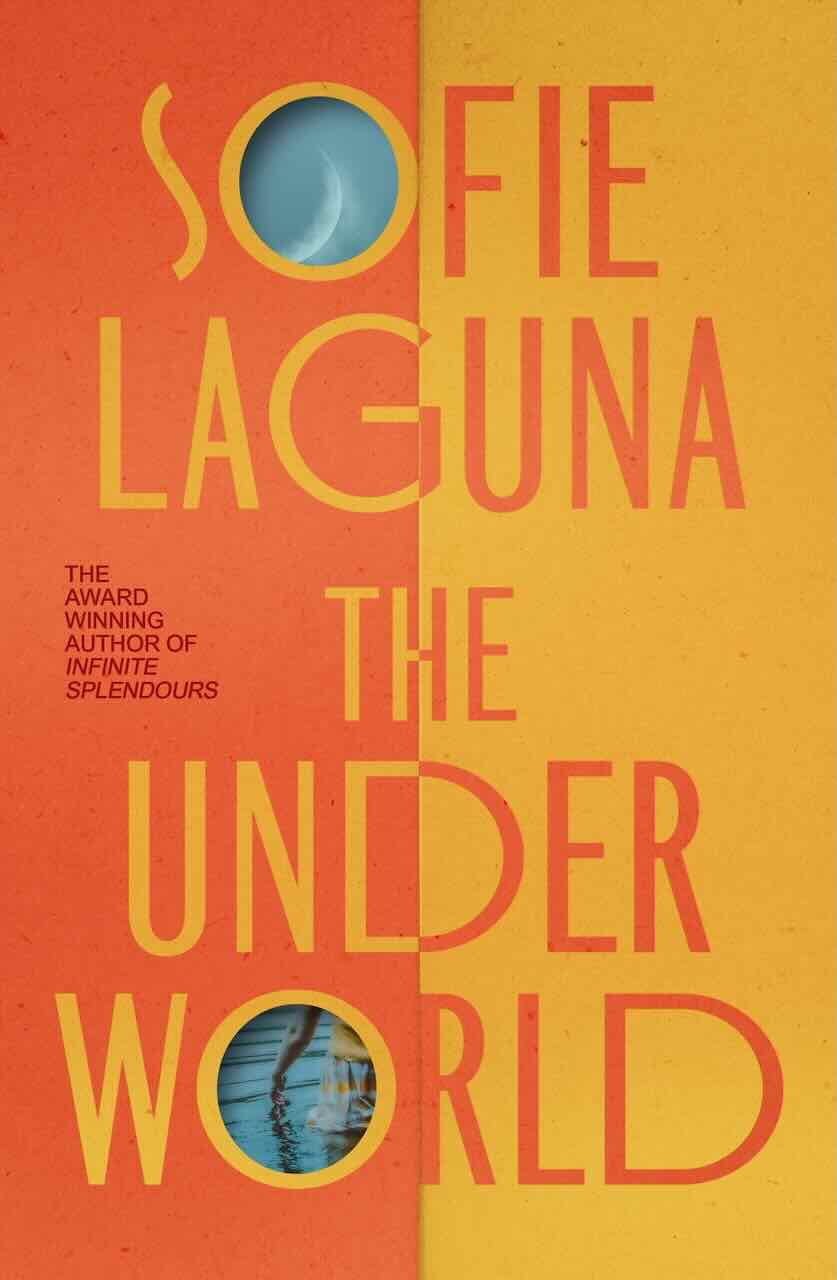
Anyhow, the event – which was for Sofie Laguna’s latest novel, The Underworld – started as usual with Colin Steele acknowledging the traditional owners, introducing the participants and thanking supporters, before handing the floor to Karen Viggers. He thanked Karen in particular for turning up because last Sunday, while in Ubud for the Writers Festival, she was run down by a motorcycle and was somewhat bruised and battered!

The conversation
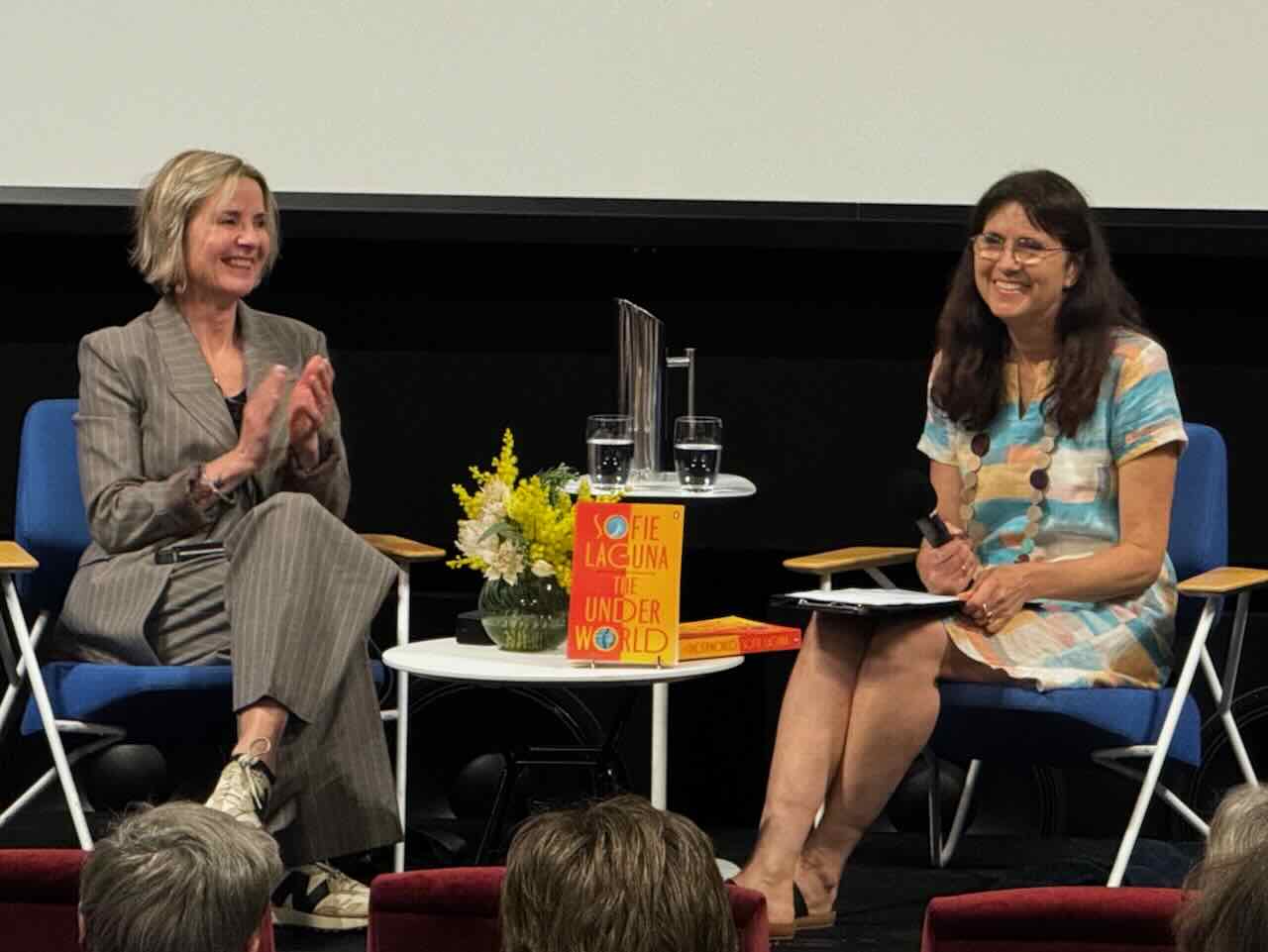
Now, I have seen Karen converse with Sofie Laguna before (back in 2017) and it was one of the most delightful conversations I’ve attended, so, I was looking forward to this one. It didn’t disappoint. Sofie Laguna is a joy and a hoot, in the open way she engages in discussions about her work. It’s a way that manages to feel fresh, as though the conversation is a journey for her, not the same-old same-old. Whether that’s Sofie or Karen or the chemistry they have, I don’t know, but it works.

On coming-of-age and young people

Karen started by introducing the novel as a coming-of-age story, which encompasses violence, love and transformation. She loved that Sofie takes the reader on a journey with Martha. The novel starts in 1973, with her protagonist Martha in Year 9 – at which point there was a little discussion between Sofie and Karen about how old that made her, and whether that was the same as Third Form. Whatever! The point is she’s around 13 or 14, is at an elite private boarding school in the Southern Highlands, and has parents who are ”trapped in a loveless marriage”. Here, there was another little discussion about whether they were in fact “trapped” and whether it really was “loveless”. As you can see, this really was a conversation.

Karen asked Sofie about the dedication, which she suspected implied a spark? It is an In Memoriam to her Latin teacher, who was both dedicated and elitist, but created a dynamic learning space. This led to a discussion about the role of teachers in guiding young people, and the fact that teachers are woven in different ways through most of Sofie’s novels. She doesn’t do this consciously, but realises teachers have had a pivotal role in her books. They have an incredible influence, they can draw out of students who they are. For Sofie, whose home was unconventional, school was a safe place, that gave her boundaries.

On the writing

We then moved on to voice, and the fact that Martha’s voice came to Sofie at a basketball gym where her son was playing. She began writing there and then in the voice of a women in her 50s, a woman who was funny, heartbroken, intellectual. She “knew something had happened”. She felt an urgency, and it was exciting because things were coming out that she didn’t know she knew. This sort of writing is easy to do because it wants to happen, but the book wasn’t easy.

She knew she had to go back and learn what Martha’s life was like at 14. It would be untidy. Puberty is messy, and she’d never properly written about it before. It’s a time of transition, challenging for everyone, as our bodies, ideas, sexuality change.

Karen then returned to why this book had been difficult. Was it because she was closer to Martha? Yes, but it was difficult in many ways – more difficult to get a sense of the whole, more difficult to get a straight line, more nuanced. And then as Sofie does, she asked Karen whether that made sense!

Karen noted that Martha attends a privileged private boarding school, which is a shift from the hardscrabble lives she usually writes about. This resulted in Sofie sharing another difficulty she’d had. Was she was “allowed”, in current times, to describe wealth, privilege? Was it permissible to describe pain experienced by a privileged white person? But, that’s who Martha was! So, she kept on, but she had to work hard to give herself permission to do this.

She wishes she’d kept a diary, that she’d captured this “dance” she’d had between the conscious and the subconscious as she worked through the issues.

On the Underworld

Next was the Underworld, Martha’s place of escape. Sofie explained that the Underworld, which comes from Greek and Roman mythology, is not the same as the Christian idea of hell. Everyone goes to the Underworld. We all know about Charon the Ferryman who takes souls across the river, but what is the Underworld? How did it work? Was it a watery place? There are many interpretations, but nobody knows, which gave Sofie – and Martha – the freedom to imagine it for themselves.

For Martha, suggested Karen, it is layered – mythic, sexual, academic, and more. Sofie agreed. It’s a metaphor for the darker parts of our psyche. Martha is obsessive, which makes it difficult to grow up, difficult to come to terms with her self, so the Underworld is a safe place.

On family and pets

Karen and Sofie then discussed Martha’s family. The opening paragraph describes the distance between mother and daughter. The mother, Judith, is aloof, remote, beautiful, tall, comes from old money, and is largely unavailable, though Martha remembers a time of closeness – underwater in a pool – when she was young.

Martha is more like her father, Andrew, but he is absent physically and emotionally. Her parents shared a love story. He was from the wrong side of the tracks, so why did Judith choose him? Was she rebelling against controlling mother, Babs, a snob who is the third party in the marriage?

They all love Martha, but they all fail her. Yet, Babs could be seen to save Martha. She’s an example of a character who starts as a role or function, but who becomes fully human with good traits and flaws.

Pets also play a role in the novel. They are like teachers. Martha’s grandmother has little dogs, but then Martha meets three big Irish wolfhounds, who ground her, who see her need. This scene at the farm was a joy to write. Sofie tries to write her novels from beginning to end, but if a scene needs to be written she will do it, and slot it in later. She returned to the idea of difficulty, and how surprising it was to find it so easy to write that scene but not the scenes before and after it.

Sofie said that Martha doubted herself, and this was what the writing was like. Some scenes would drag. She has depended all her writing life on her intuition, but with this book she needed an outside eye in a way she never has before. When she got that, she was able to write “with gusto”. That person gave her “permission”, reminding her that certain scenes can happen off the page, which is something she normally knows herself. This book she did the hard way, but she couldn’t give up on Martha!

On the 1970s setting

Sofie said there is some crossover between her life and Martha’s. This was a time when it was taboo to be gay, and feminism was growing but Martha could still cut off. Sofie found the research “thrilling”, and loved it when she found the extant female poet Sulpicia, whose authorship was contested by male academics. This was a great way for Martha to enact her own form of feminist activism.

During the Q&A, there was a brief discussion between Sofie and Karen re trauma, after Karen commented that there is trauma in each of Sofie’s books. Trauma, which comes from the Greek word for “wound” said Sofie, shapes people. All lives have “trauma”. You can’t avoid heartbreak, loss, acute pain. Karen observed, however, that trauma’s impact can depend on how and when it happens.

Before we went to the Q&A, Sofie apologised for being tired and getting tongue-tied, but we didn’t notice.

Q & A

On whether Martha represents Sofie (whom this questioner knew at school as a warm, passionate and curious girl) or a combination of girls: Both, she is a combination but also a “more true me”, said Sofie. She is awkward, prickly, can’t do eye-contact, until she meets horses and dogs. She’s a presence outside of Sofie, but is also “a soul twin’; she is both Sofie and separate.

On whether she had to kill any darlings: No, because whatever she killed were not darlings, as they were not working. Her aim is to find the structure, the shape, so she is always happy to lose things that are spoiling the shape, that are distracting from the story. Sofie laughed that she was using various metaphors – music, forest, sculpture – to answer this question, but essentially, once she has the path it’s a joy filling in the picture.

Vote of thanks

Features editor, Sally Pryor – who wore orange especially to coordinate with the book’s cover – gave the vote of thanks. Martha felt so much like a real person, she said, but is really just words on a page. How does that happen? Sofie replied that those marks on a page go from her soul to ours!

Another great meet-the-author event! We are very lucky, as Sally said.

ANU/The Canberra Times Meet the Author
MC: Colin Steele
Kambri Cinema, Australian National University
6 November 2025

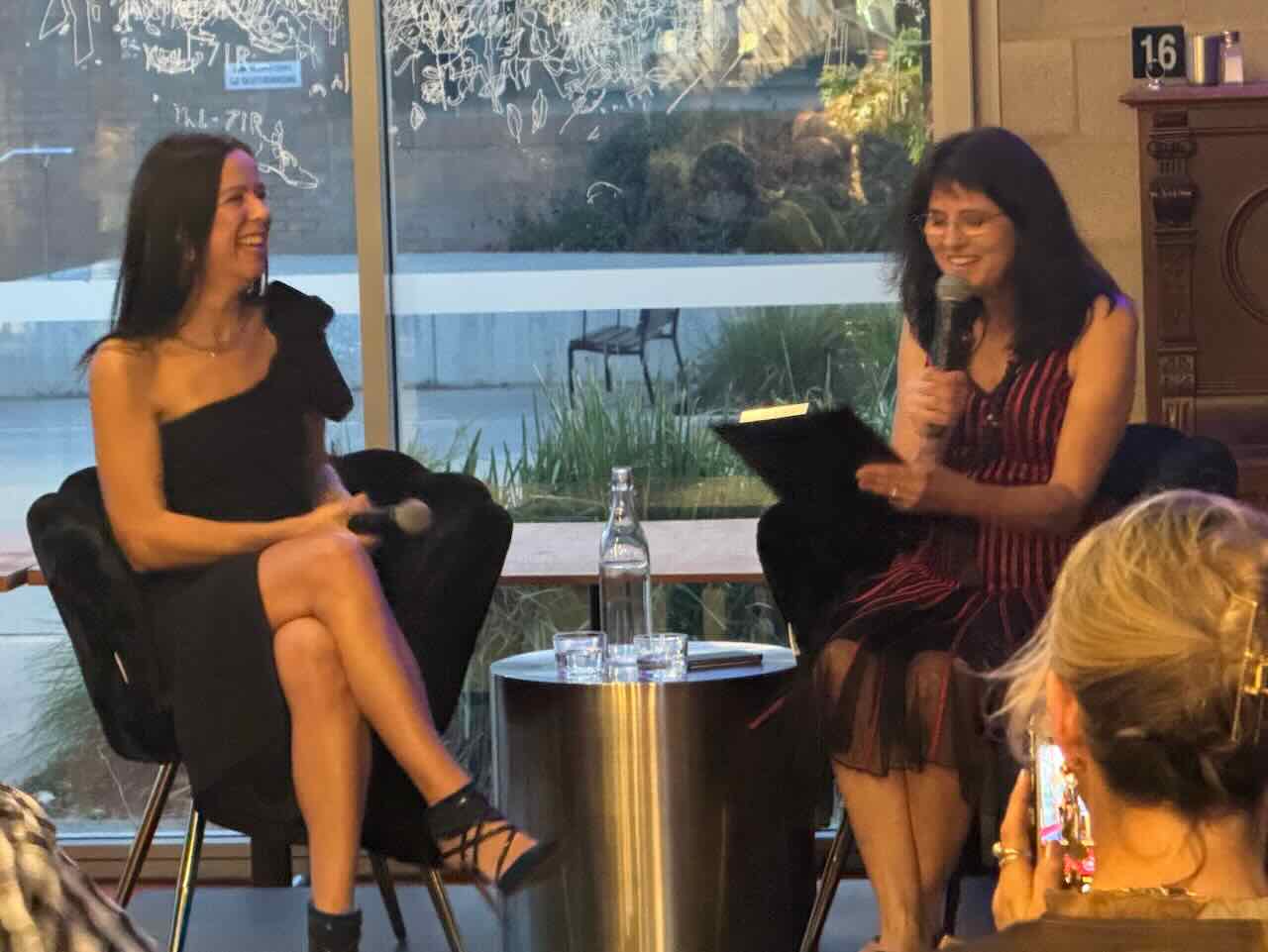
Irma Gold in conversation with Karen Viggers

The Canberra launch of Irma Gold’s latest book, her second novel Shift (my review), was a joyful affair that reminded me of other launches of books by Canberra writers, such as Karen Viggers’ Sidelines and Nigel Featherstone’s My heart is a little wild thing. Canberra is a comparatively small jurisdiction so when one of our own launches a book, local authors, booksellers, publishers, editors, critics, reviewers and readers turn out to cheer them on. Such was the case tonight when Irma Gold came to town to launch Shift. She now lives in Naarm/Melbourne, but was active in the Canberra literary community for over a decade.

Both Irma Gold and Karen Viggers have appeared many times in my blog, so I won’t introduce them again, but I will remind you that they now jointly produce the Secrets from the Green Room podcast. They are clearly simpatico, and the conversation, as a result, flowed easily while still covering meaningful ground.

The conversation

Karen commenced with an acknowledgement of country and a rundown of Irma’s many achievements, and then led into the conversation with a cheeky question …

Had the several outstanding reviews she’d received in the first month after publication gone to her head? It has been a dream response, admitted Irma, but what means most to her are the supportive messages she’s received from her friends in Soweto.

Karen then briefly summarised the book. It’s about portrait photographer Arlie who goes to Kliptown, in Soweto, partly because his South African mother refuses to talk about it. The sensitive and somewhat lost Arlie needs to know more, to understand his mother, and, he’d like to prove himself to his father. Karen said she found the ending deeply moving.

Why South Africa? Irma’s father was born there, so she’s always been interested. This was further sparked in her teens when she read Biko, resulting in her reading more about freedom fighters and South Africa more widely. She didn’t get to South Africa until her 40s, when she went with her youngest brother. Through a chance meeting, they were introduced to Kliptown, a community with no electricity, school or sewerage, among other things. A seed was sown then. She visited again, with another brother (a trip which I followed through Irma’s Instagram account. It was fascinating, if I can use such a shallow-sounding word for such a poorly supported community.) Karen then asked how dangerous it was. Irma felt safer in Kliptown, despite its reputation for violence, than in other parts of South Africa, mainly because she and her brother were working in and for the community.

On the haves vs have-nots. Karen spoke of how well Irma had illustrated the gap between the haves and have-nots; how she’d shown Arlie displaying his privilege without always being aware of it, while other times he’d catch, and be embarrassed by, his stumbles in this regard. Irma shared an anecdote about giving money to someone who had been their guide, and the difference it had made for him. She felt guilty all the time. As she was writing the novel she reflected constantly on how, by virtue of birth, she lives here in privilege and they live there.

On creating a great sense of place. Irma kept notebooks, and took lots of phots and videos. Watching the videos would take her right back there, and she’d remember more including things she hadn’t written down. People didn’t mind her taking photos. In fact they loved it, but she was working with the community.

On the characters and their names. Irma has no idea where Arlie came from. He was in her head when she made her first trip to South Africa. Also, she didn’t specifically choose photography for him but in retrospect, she realises it’s the perfect choice, because photography is all about different ways of seeing things. She’s always loved photography, but she did have expert advice from a photographer in the Canberra writing community. Jigs, Arlie’s brother’s fiancee, also just came to her, but the spark for Glory came from seeing a gorgeous young woman in a local gospel group. As for her African characters’ lively names, many of the Africans she met know what their names mean, why they were given their names. Being an “over-sharer” herself, she loves their openness and willingness to tell their stories.

On Mandela. Irma was shocked to find that Mandela was not the hero in young Africans’ eyes as he was in hers. They feel they’ve been sold a “broken dream”, that things have not improved as they were promised. Bob Nameng of SKY (Soweto Kliptown Youth) kept telling her that she had to write about the situation because no one is listening, nothing changes. This is not to say that Kliptown is all tragedy. There is also a lot of joy. She saw so much art and music in the community, and an overall “lust for life”.

On relationships. Karen was particularly interested in what Irma was trying to show in Arlie’s difficult relationship with his father. Irma said that Arlie judges his father harshly, but Glory suggests to him other ways of looking at the situation. Forgiveness and openness are important in relationships.

What is she asking of her readers? Irma liked the idea that she was “making the invisible visible”. She grew up in a family that had strong feelings about injustice. Ultimately, the book is about people. They are the most important thing to her. Kliptown is its people. She also likes Charlotte Wood’s idea of following “wherever the heat is”.

Q & A

On the title: It was a complicated process. Her original title was either disliked or deemed forgettable. In the end she produced a list, from which the publisher made a selection, and she chose one of those! She now likes her title.

On being published in South Africa. Currently only Australia-New Zealand rights have been sold. It’s difficult getting books into other jurisdictions.

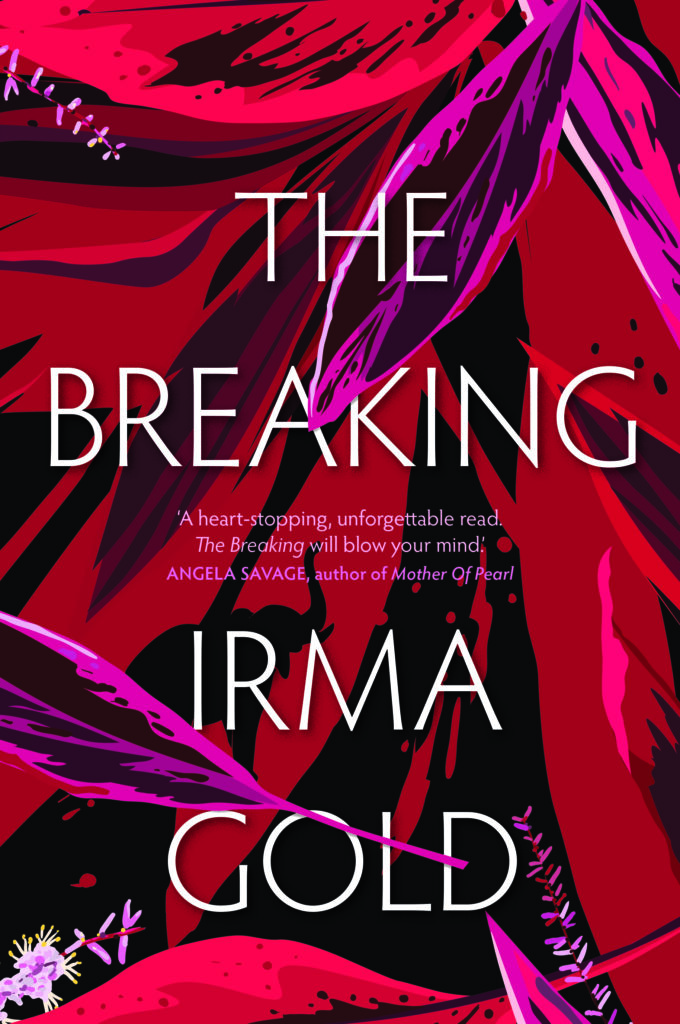
Karen concluded by asking whether there was a “drive for change” in the novel. Although Irma had said that people and relationships are her over-riding interest, she admitted that change is also part of what it is about. Yes! I remember that Irma also said her first novel The breaking was primarily about the relationships. However, it too is about an issue – elephant tourism – that she would like to see changed. The way I see it is that her novels are inspired by justice-related issues that she would like to see changed, but that relationships are what fascinate her. In truth, you probably can’t solve big issues without having good relationships. Combining a passion for driving change and for good relationships between people makes, I’d argue, for good reading.

Thanks

The evening concluded with Irma thanking many in the Canberra community who had helped her, including of course Karen Viggers, but also John Clanchy who had read many drafts and whose honest feedback was instrumental in the book’s coming into being, Dylan Jones for being her photography consultant, the wonderfully supportive Canberra writing community, ArtsACT for helping her with some funding (again), and the Street Theatre for hosting the event.

Irma Gold – Shift: Book Launch
The Street Theatre, Canberra
9 April 2025

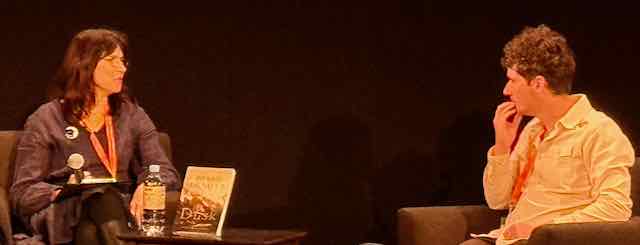
Canberra Writers Festival 2024: 4, Your favourites: Robbie Arnott

In conversation with Karen Viggers

Karen Viggers is no stranger to this blog (my posts), and I have read Robbie Arnott’s previous novel, Limberlost (my review). One of several “Your favourites” sessions with loved authors, this one was described as

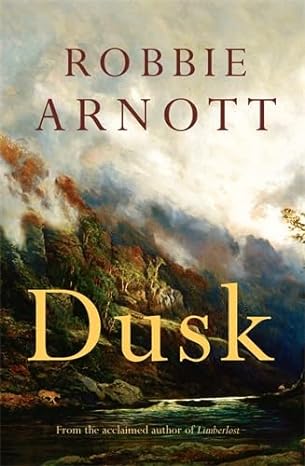
Robbie Arnott’s fiction is steeped in the wild: women return from the dead as walking ecosystems; mythic birds circle the skies; the water calls to us. In writing these sumptuous, near-sentient landscapes, he grapples with our most wrenching and necessary questions: eco-grief, stolen land and human frailty. He joins local author Karen Viggers to talk about his new novel, Dusk, a tale of a feral creature loose in the Tasmanian highlands.  

Karen commenced by acknowledging the Ngunnawal people, their generosity and their stories, and spoke with passion about the importance of stories in our lives.

She then introduced herself, explaining that as an animal and landscape person, she relates to Robbie’s books and was keen to conduct this conversation for the Festival. She then introduced Robbie, his four books to date, and his many awards – Flames (2018), Rain heron (2020), Limberlost (2022), and Dusk (2024). Wildness and landscapes feature in all his work.

This was a fascinating but sometimes somewhat anarchic discussion in which Robbie didn’t always quite answer the question being asked, or, perhaps, not in the expected way. But Karen is an expert at going with the flow, so we got great insights into Robbie and his approach to writing – which is what it’s all about.

On how the accolades make him feel and their effect on his writing

It’s nice to be acknowledged, but living in Tasmania, away from the literary scene, they don’t make much difference to his daily life. Career-wise they’re good, but they don’t affect his writing. He is all about his work, to the detriment of his other responsibilities.

On the novel’s origin

Dusk is about twins Iris and Floyd joining the hunt for a feral puma, the titular Dusk, because a bounty has been offered. Karen described it as a story of wildness, freedom, connections, relationships, and asked about its origin. Robbie said it goes back to his childhood, and times in the bush when they would see feral deer which shouldn’t be there. He wanted to write this story.

On the siblings and their relationship to their parents

Iris and Floyd are 37-year-old twins whose parents had been convicts, then bushrangers, and had dragged their children through their life of crime. Now these children want to live straight. They need the bounty cash, but they have no idea about what they are doing.

He wanted two protagonists who have a close relationship, like siblings do. He didn’t make them twins for any particular twin-connection idea, but because he wanted a flatness of hierarchy between them. However, Karen felt that the sort of connection twins have comes through.

Karen wondered about the twins’ outsiderness, and whether it comes from within himself. Robbie, though – and this was reiterated throughout the interview – said he had no idea about himself. He hasn’t had therapy! They are outsiders because we live in colonial landscape. The other characters – except for some near the end (First Nations I’m guessing) – are outsiders too, but don’t realise it.

Later, Robbie talked about the deep trust Iris and Floyd have in each other. They are committed completely to each other, they rely on each other, despite frequently irritating each other.

On Dusk the puma, and wild beast myths

Dusk was not inspired by big cat stories but people are more scared of cats. They are terrifying, and play into our idea of wild landscapes. He is interested in outsiders tracking outsiders, in the strangeness of the colonial landscape. Colonists would bring things to new countries to hunt, also to rid other pests, so he had the idea that someone might bring a cat over to get rid of deer. But his pumas were more interested in easier animals than deer, like sheep. Like the cane toads brought over to eat cane beetles, but which ended up eating other things. (And, to extend this example, before the cane toads, the sugar cane itself was introduced, which then led to blackbirding.)

As for the name, Dusk, he didn’t choose it for any metaphorical meaning, but liked it as a name for a creature which appears at a liminal time of day.

Robbie doesn’t seek metaphor when he’s writing. It feels more like cleverness than openness. Karen suggested that a joy for writers is when readers see things that the writer doesn’t see. Robbie agreed, sharing Richard Flanagan’s advice that the least interesting thing in a novel is the writer’s intention. Flanagan, we learnt, is a friend and writing mentor for Robbie.

Despite this, readers did, said Karen, think about metaphorical meaning of Dusk!

On the wild and dangerous creatures in his novels, their source, relevance, meaning

Robbie has had no therapy, he reiterated, so can’t explain why! But, currently there is a focus in writing on the self and raising mundanity to art. However, he is interested in the world outside humanity. In stories, wild animals are often the impetus for change, but animals don’t work like that. They just are, going about their lives.

The discussion then turned to savagery and brutality. Humans can be as savage and brutal as wild animals, but in urban societies we fear wildness and savagery, and try to keep it at bay. However, we keep bumping up against the edges of it. Robbie has had publishers and readers complain about brutality in his novels, though it’s drawn from reality. For example, Iris and Floyd slaughtering bobby calves with sledgehammers comes from a friend’s experience in 2012. In another novel, his publisher tried to talk him out of a scene involving the skinning of rabbits. Where do they think meat comes from, Robbie asked. Savagery and brutality are part of us.

We have become separated from the bush. We say we love it but is our attitude to it essentially about power and control? For Robbie, taming the wilderness is ridiculous. He shared a scene from Richard Powers’ beautiful novel, Overstory, in which people suggested removing sticks and natural debris from the forest floor.

Staying with the idea of animals, Karen spoke of Iris and Floyd living in a savage world but taking such exquisite care of their horses. She asked Robbie about his thoughts on the human-animal bond. He wanted to show the intensity of the relationship, that it was an unquestioned one, and a necessity.

On what landscape means to him, and how he writes it

Robbie always starts with the landscape, not plot or character, and then thinks about who would be there. Landscape moves him. It offers the greatest way to feel small, the most beautiful form of insignificance. To write about landscape with feeling, the first thing he does is to free it of baggage, like the idea that the forest is green. He describes it as it is, which is not green, and then focuses on emotional reactions to it. For him, the aim of fiction is not to render the world as it is but how it feels.

To write freshly about landscape he gets out into it, and draws on his memory (memory is critical). He searches for the “atmosphere”. He most enjoys a book when he has slid into its atmosphere.

Staying with the idea of feelings, Karen asked him about the feelings he wanted for Dusk, who is omnipresent from the beginning. Robbie said that it wasn’t quite menace but a “hauntedness”. She’s not vengeful. He wanted her to feel alive.

On his novel as Western (and more!)

Robbie has described the novel as being something like a western, in that it is framed like a western, like a quest. It is also a journey novel, which makes it fun to write and enjoyable for the reader.

The discussion got into other aspects of his writing, such as his blurring of the line between realism and the magical in most of his books. It’s about, he said, conveying how the world feels. The magical wasn’t needed in Limberlost which was inspired by his grandfather. He edits a lot out, because it must feel real.

Karen loves the opening of Rain heron, and suggested that cutting out is an art. Robbie doesn’t want to waste anyone’s time. He wants to keep his books vivid, vibrant, alive. He doesn’t write drafts, but writes sentence by sentence, crafting each one carefully as he goes, so that by the end he has his book.

On Iris

Is Iris looking for belonging? Robbie said Iris feels connection to the landscape, and realises she doesn’t want to leave but she also recognises that she has no cultural connection to the place. Does she have a right to stay? This is the unanswered question – for Iris and for us. She does her best but the question is never resolved.

This point, this, above all else, makes me keen to read Dusk.

Q & A

On his becoming a writer, and his influences: He was a bookworm from the start (as soon as he learnt his sister got to stay up later because she could read!) He started writing when he was 11 or 12. There was never a decision, he just started writing. His literary influences are many, but he loves Annie Proulx for her amazing descriptions of the world; he loves Denis Johnston “at the sentence level”. He thinks Kevin Barry’s new novel is excellent, and later he mentioned David Mitchell and Claire Keegan.

On his thoughts about relationships between humans and wild animals (like the seal and fisherman in Flames): He agrees with ecologists who advocate staying away, but narratively he is pulled to these relationships.

On how he manages to keep his unique, glorious style: He can tell when he Is writing like himself, and when he “is wearing his influences too heavily”. When this happens, he writes a description of something he knows – not necessarily related to his current project – to get back to his own style.

On other art forms that influence or inspire his writing: Photography; poetry for its imagery; oh, and when he is writing he often puts on moving image of salmon leaping and grizzly bears trying (and usually failing) to catch them. This live and unscripted action inspires him.

Karen concluded by simply saying that Robbie’s writing is magical. This conversation would surely have convinced anyone not already in agreement.

Canberra Writers Festival, 2024
Your favourites: Robbie Arnott
The Arc Theatre, NFSA
Saturday 26 October 2024, 2-3pm

Shankari Chandran in conversation with Karen Viggers

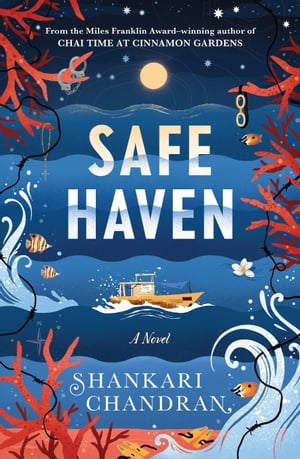
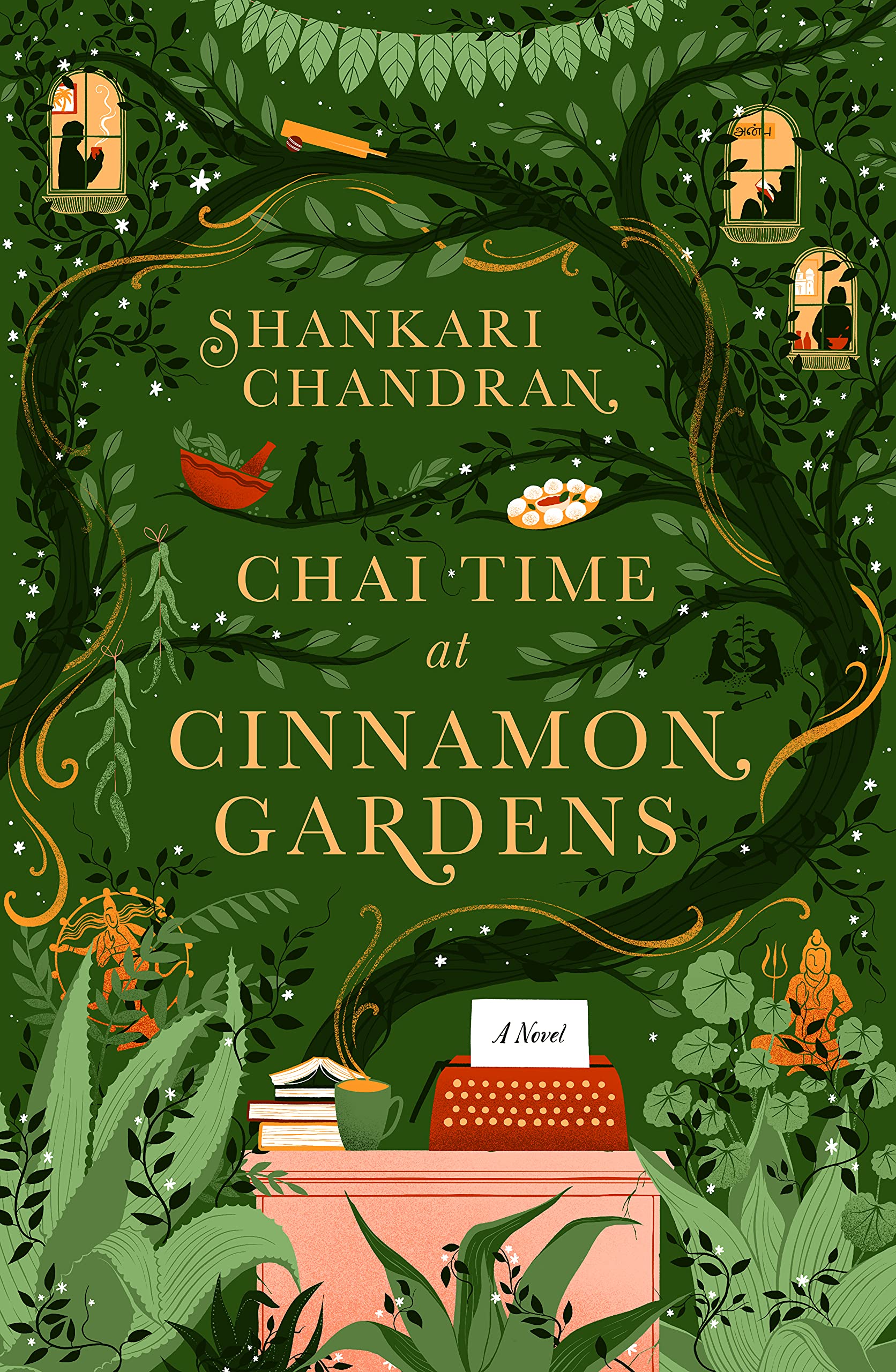
Shankari Chandran’s conversation with Karen Viggers is the second Meet the Author event I’ve managed to attend this year, and it reminded me how much I wish I could get to more of these sessions. This one featured Shankari Chandran, author of the Miles Franklin winning novel, Chai time at Cinnamon Gardens (my review), in conversation with Karen Viggers, who was on the other side of the table at the last session I attended. Karen has appeared several times on my blog, most recently for her novel Sidelines. And Shankari was appearing at this session for her latest novel, Safe haven.

This was a wonderful session, which featured intelligent questions and thoughtful answers from two writers who care deeply about justice and how we find and express our humanity. Their backgrounds might be different, but their hearts not so.

The conversation

MC Colin Steele opened proceedings by acknowledging country and introducing the speakers. He then introduced the conversation, describing Safe haven as appearing to be about displacement and seeking refuge, but in the end, he said, it’s about finding home.

Karen started by congratulating Shankari on winning the Miles Franklin award last year. She wanted to know how Shankari felt the moment she heard she’d won, and its impact on her life and career. Shankari told a funny story about not answering the phone at first – because it came from an unknown number – and then not believing it when she finally answered and got the news! However, of course she was thrilled, and it has been extraordinary for her career. It has affected sales, and it created a spotlight on all her works, not just the winning book, and on her ongoing themes of injustice and dispossession. She also hopes that her win has helped and encouraged other writers of colour.

Shankari also made the point that it was great to win such a prize for a diasporic migrant story, one that is not only set partly elsewhere, but that interrogates who gets to define identity to the inclusion of some and the exclusion of others.

Sticking with the getting-to-know-you theme a little longer, Karen wanted to know how Shankari manages her busy life with four children, a law career, and writing. “Very badly” was the response, accompanied by some self-deprecating humour, followed by a recognition that she has a great team in all aspects of her life.

Karen then moved onto Safe haven, using descriptors like “moving”, “confronting”, “shines a shaming light” on detention, and creating “humans we come to care about”, and noting that the book contributes to an ongoing discussion about racism and exclusion in this country. Shankari talked about the approach she’d chosen, which was to write a romance and murder-mystery set in an off-shore detention centre. Her two main characters are the nun, Sister Fina, who seeks asylum, and special investigator Lucky, sent to investigate the death of a detention guard. Was it suicide, or was it not? Shankari described her book as being about the lengths people will go to to find safety and home.

Wanting to explore the romance-and-mystery approach a bit more, Karen commented that it was a surprising decision. And here a major theme of the discussion came to the fore, Shankari’s belief in storytelling. She wanted to elevate the lived experience of marginalised people, and likes to use fiction/storytelling to take readers into a place of discomfort but one where they can feel safe to reflect and think about the ideas. She wanted a storytelling mode that is compelling, entertaining, interesting. John Le Carre used the literary thriller model to explore macro themes of injustice, so she “wanted to give it a go”.

This led to continued discussion about using fiction to draw people and explore themes, and to the specific question of what Shankari wanted readers to take away from the book. She wants people to not forget the detention centres and what is happening to people in them. Politicians – and the media – too easily appeal to our baser instincts and encourage moral panic. But, she says, there are Australians who see the situation differently – like the people of Biloela for example, people who understand why others get on a boat, risking everything, to seek safety in another country. She wanted to elevate that aspect of what it means to be Australian. (Shankari used the word “elevate” several time during the conversation, and I like it. It’s powerful, and conveys something active and positive, active.)

Shankari talked about her two main characters, and what inspired them. Sister Fina stemmed from her admiration of people whose faith calls them to the sort of bravery seen in religious people during the terrible last days of the Sri Lankan Civil War. Special Investigator Lucky, on the other hand, was fun to write, because she could have Lucky do the sorts of investigation she’d like to do. Of the friendship that develops between these two, Shankari wanted characters who help each other, not one being saviour and the other the saved.

The conversation then moved onto the book’s tougher sections, and how Shankari researched and handled writing them – the scenes at the detention centre, for example. Here, we got a clear sense of Shankari’s ethical and compassionate approach to her work. She set herself some parameters. For example, she would not try to go to a Detention Centre, because she dislikes the voyeurism involved. For this same reason, she did not want to speak to the Biloela family whose story had provided inspiration for the book. At the time of writing they were still in a difficult place. It was not her place to draw fiction from their specific experience. So, she used research undertaken by civil organisations and activists; she read memoirs; and she used her experience of working in justice. If she had a superpower, she said, it would be that through her life people have given her their stories. These recorded truths, she’s been privileged to hear.

But, obtaining these stories, including those she needed for the brutal Civil War flashbacks, requires sensitivity. Interviewing people about their trauma can re-trigger that trauma. When people do want to tell her their story, she is careful about process because they don’t aways know how telling the story will affect them. She is careful, also, to ask whether they want their “lived experience to be conveyed in fiction”. Most respond that there are few safe places in our culture for the truth except in fiction! That feels like an awful indictment on our nation, but a powerful argument for the role of fiction/storytelling in our lives.

Indeed, a strong message I took away from the conversation was absolute belief in fiction being a way to tell important truths, but awareness that those whose truths are being told may not like them fictionalised.

The novel is not all grim, however. Karen turned to the scenes in Hastings (which were inspired by Biloela). What did Shankari want people to glean from them? That strangers can become family, she said, and that we should celebrate that capacity in us. Rural communities are often remote. They only have each other, and can develop an incredible ethos. Hastings offers a moral counterpoint to the other parts of the novel, but also offers readers a place of fun and joy.

Karen raised Australia’s policy regarding asylum seekers, and our use of privatised services to manage detention centres, particularly given these companies can employ people who “have done terrible things”. And why do we not have compassion for asylum seekers? The government’s arms-length management of asylum seekers, said Shankari, erodes accountability and transparency. Her novel asks the questions. It doesn’t provide answers.

As for our lack of compassion, Shankari said she struggled to understand the high level of xenophobia she found in Australia regarding migrants. She was horrified when she returned to Australia with her children – telling them it was “home” – only to find strong racial profiling of “friend” and “foe”. It’s disturbingly easy for politicians and media to trigger xenophobia – and not just in Australia. But she believes we are capable of integrity and intellectualism. This experience, and talking with Aboriginal activists, led her to think about the creation of nation, about the mythology of a nation’s founding and how we construct identity from this, one that involves the inclusion of some and the exclusion of others. She saw a link here with Sri Lanka’s founding mythologies. Does our concept of being Australian really need us to create “other” to maintain it?

Shankari believes that we have a choice in how we want to be – to face the future with fear, or with compassion!

Finally, Karen asked Shankari about how, with such a serious subject, she manages to achieve her light touch. It’s not conscious, but she’s a funny person, said Shankari – and life is tragic and funny. There’s irony too, including in the title. As to whether humour helps keep her sane, Shankari said that a lot of her work deals with trauma. She relies on humour to enable her to keep writing and her readers to keep reading. Writing trauma is traumatic, but she’s writing about the experience of people who have suffered but have survived, who are resilient. Their lives need to be elevated and remembered.

Q & A

On how children of disaporic migrants can broach their background with colleagues and friends. Books and stories, said Shankari, offer a good way in. Also, curiosity and questioning, and trying to meet people where they are. She shared advice she once received from a First Nations Australian, which was to “listen in order to listen, not to react and respond”. (What great advice.)

On how she, not Sri-Lankan born, knew all the details she used in her book, and how she decided on the Cook issue in Chai time in Cinnamon Gardens. For the first, Shankari laughingly credited the talkativeness of her extended family, but regarding the second, she reiterated her point about the creation mythologies in Australia and Sri Lanka and the role they play in forming national identity.

Vote of thanks

Sally Prior, literary editor of The Canberra Times offered a brief but heartfelt vote of thanks. She commented on the lack of curiosity in Australians regarding asylum seekers – who they are and why they want to come – and said she was inspired by Shankari’s persistence. She thanked all involved for an excellent conversation, to which all the audience could say was, hear, hear.

ANU/The Canberra Times Meet the Author
MC: Colin Steele
Australian National University
13 May 2024

Karen Viggers, Sidelines (#BookReview)

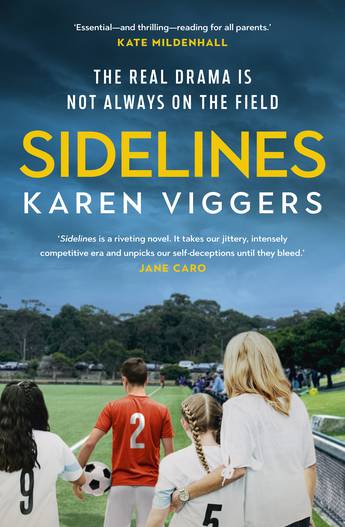
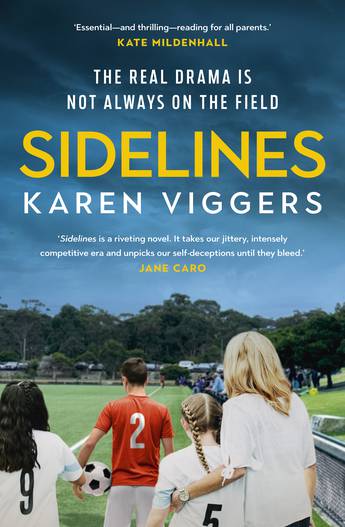
I don’t usually start a book review by relating its content to my own experience, but local author Karen Viggers’ latest novel Sidelines invites exactly this. Sidelines is about children’s sport and what happens when the competitiveness gets out of hand. It was largely inspired by Viggers’ own experience as the mother of sporty children, and by an ugly parental brawl at a children’s football match that happened during those years.

My children’s sport experience was blissfully different. Our son played cricket, and his coach’s last name was McPhun – I kid you not. He was the perfect children’s sport coach. His focus was on “phun” and teamwork. He encouraged those kids, was fair about opportunity, did not favour his own son, and we parents had the best time. I loved seeing the enthusiasm with which the kids played, and their resilience when they were out for a duck, despite having gone in to bat with dreams of sixes and high scores. You won’t be surprised, perhaps, to hear that our kids were not in the elite division, but this should not make any difference. Unfortunately, however, it probably does.

So, Sidelines. As Viggers explained at the meet-the-author event I attended – and as is obvious if you read it – her novel has a structure rather like Christos Tsiolkas’ The slap*. This means that the novel’s story or plot is progressed through a sequence of different, third person, points of view encompassing the parents and children involved in the sport. Sidelines is a little different though because in Tsiolkas’ book, the slap occurs in the first chapter and we then watch the fall-out from that action. Viggers’ novel commences with a prologue describing an ambulance arriving at a sports ground where a badly injured child is lying far from the goal-posts. “What the hell happened here?” We then flash back to nine months earlier and, through those sequential voices, we work our way towards what had happened and why.

“It’s not meant to be fun” (a football father)

The novel focuses on two families – the well-to-do Jonica, Ben, and their 13-year-old twins, Alex and Audrey; and the Greek-Australian working class family of Carmen, Ilya, and their daughter Katerina. Into this mix comes Griffin and his single-parent Dad, Lang. Griffin is a natural, and his appearance upsets the team’s sporting and interpersonal dynamics. The characters telling the story are Jonica, Carmen, Audrey, Katerina, Ben, and finally, Griffin. For each voice, there is a thematic word or phrase that provides insight into, and commentary on, that character.

The first voice, Jonica’s, initially made me feel I was reading one of those stories about a dysfunctional family. You know, the well-to-do family with the successful, professional, and controlling husband, the privileged children, and the wife and mother caught somewhere in the middle. And there is some of this aspect in the novel, because, as becomes clear, part of the story Viggers is telling is one of class. So, in Jonica’s story we see the tropes of her class. Everything is laid on in a material sense, but the two females, in particular, aren’t happy. Jonica, like her husband, is a lawyer, but she is frustrated about not working. Ben, you see, “likes having her at home”, and insists she is needed to look after the children. He will “support her” (and the family) while she supports the children. There’s an irony in this word, “support”, which is Jonica’s theme, because, as Viggers said during the author talk, there’s a fine line between “support” and “pressure”. Audrey certainly feels more pressure than support.

The next voice is that of the other mother, Carmen, whose daughter, Katerina, like Audrey, is trying out for a place in the boy’s team where, as Ben had told Jonica, girls will learn “speed and aggression”. While Jonica tries, unsuccessfully, to resist her husband’s pressure to push the children, Carmen is more like Ben. She wants her daughter to achieve where she had failed, and she will manipulate and kowtow as much as is necessary to ensure this happens. Her theme or motif is “goal poacher”, the one who “attempts to shoot goals from loose balls … and uses other non-traditional ways of scoring”. Perfect for the resourceful Carmen.

And so the novel progresses through to Audrey’s and Katerina’s voices, where we see the pressures that their parents don’t. These girls do want to play well, but they also want other things in their lives. They are teens, for heaven’s sake! And Viggers’ rendition of them convinced me.

The penultimate voice is Ben’s, and here, in particular, is where Viggers’ choice of a multi-voice structure shines, because, while he’s still unlikable, we also see his point of view. Ben is the alpha male, no doubt about it, but he loves his family and he’s not so tuned out that he doesn’t sense something is wrong with Audrey in time to take critical action. This is the value of reading, being able to see a situation from another point of view. We don’t have to agree with Ben – I’m sure few of us do – but we can see where he’s coming from and that he’s human. This awareness can be achieved with third person voices, of course, but Viggers has effectively used first person voice here to directly confront readers with her protagonists’ thoughts.

By the end of the novel I was impressed by the careful and sophisticated way in which Viggers had developed and explored her main idea, which is to encourage us to think about our attitudes to and behaviour around competitive children’s sport. She offers no easy solutions. This is not a didactic book. There are many points left open for readers to think about. Can you play for fun, for example, and what does that look like?

In the above-linked interview with Viggers, she said she has realised that she is an issues-based writer. This is exactly what I thought as I started reading Sidelines. On the surface, it departs from her previous, environment-themed novels but, in fact, like those novels, it takes an issue Viggers cares about and explores it through characters who are real on the page. I enjoyed the read, but more than that, I hope it gets read and talked about in places where it matters.

* Interestingly, another Tsiolkas book, Barracuda (my post), starts with elite children’s sport, but while class is also an element, it takes a long view of what happens when things don’t go to plan.

Karen Viggers
Sidelines
Crows Nest: Allen & Unwin, 2024
343pp.
ISBN: 9781761470714

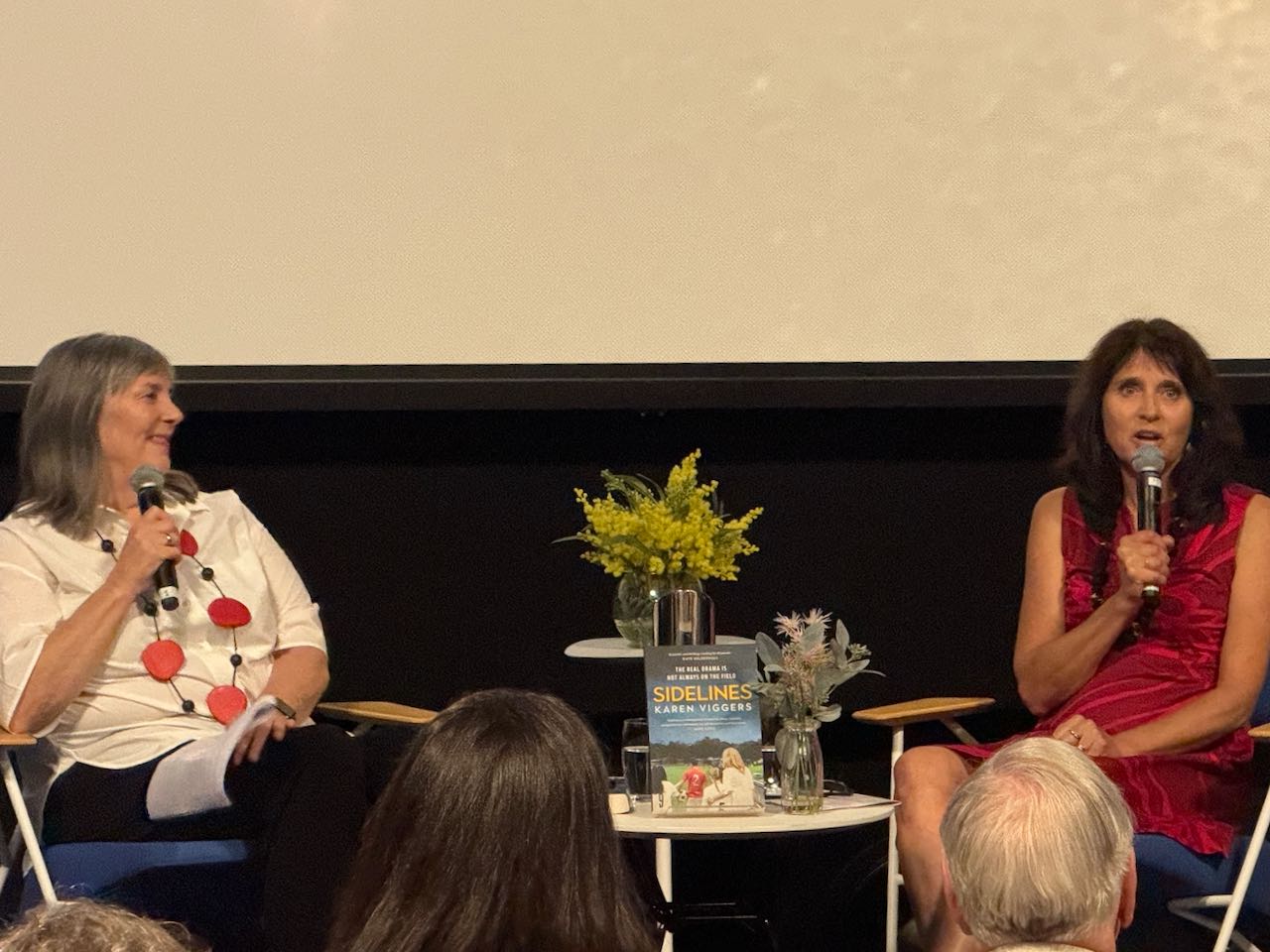
Karen Viggers in conversation with Alex Sloan

When Colin Steele emailed out the schedule, to date, for this year’s Meet the Author series, I immediately marked in my calendar those events I could attend. There weren’t many, as life is busy with yoga, tai chi, reading group and concert subscriptions, but the first I could attend was local author Karen Viggers (who has appeared several times on my blog) in conversation with Alex Sloan about her latest novel, Sidelines.

The conversation

MC Colin Steele, who was so deservedly made a Member of the Order of Australia in this year’s Australia Day Honours, opened proceedings by acknowledging country and introducing the speakers. He then paid tribute to Marion Halligan who had died this week, and who had planned to attend this event. There was an audible sigh in the audience because she really was much loved here. But, moving on, as we must … Colin introduced the conversation, describing Sidelines as “social commentary on modern society”, before passing us over to another local luminary, Alex Sloan.

Alex opened with a point I had planned to make in my post on the book, which is that it’s quite a departure from Viggers’ previous environment/landscape-based novels. Sidelines is set in the suburbs, whereas her previous four novels are set in “wild, rugged places”. But then, on reflection, she added, suburban Sidelines is “rugged” too. It “has teeth”.

However, before asking Karen about her novel, she too paid tribute to Marion Halligan. How could she not, given this week, this place, and this interviewee? Karen responded by saying what a “terrible loss” Marion’s death is. She had been a “huge supporter” and friend, and had lived life right to the end. Isn’t that how we’d all like to go?

Karen then shared a statement made by Marion, in an interview with Gillian Dooley, about what novels are about:

It seems to me that novels are very much about this question of how shall we live, not answering it but asking it, and what novelists do is look at people who live different sorts of lives, and often people who live rather badly are a good way of asking the question.

This is so Marion! Karen suggested that Sidelines looks at people living badly … but not at bad people. There’s a difference – one that people don’t always make, I think.

She also said – and this is the other thing I was planning to raise in my (coming-soon) post on the book – that she realised she is an “issues-based writer“. She can only write what is inside her. This book grew partly out of her thinking of her own behaviour but was also inspired by an Under-12 Canberra football game in 2014, which had ended in parents brawling on the field. Were these, she wondered, really bad parents or parents who had got carried away?

There is a line between support and pressure, and she wanted to use fiction to consider the issue – not just in sport, but in society overall. Where is the line drawn?

Alex asked about the fact that she has said that her first draft was written in anger. Karen explained that she had seen her son, a volunteer referee, cop a lot of abuse which has resulted in his giving up refereeing. This and other injustices she’d seen had made her angry.

Alex then moved to the characters, asking Karen to talk about them and their role in the novel – the well-to-do Jonica and Ben who start the book, and the succeeding characters who include the working-class Greek-Australian family, Carmen and Ilya, and the young talented player Griffin. Alex, as became clear through the rest of the interview, disliked Ben and loved Griffin.

Karen teased out her characters a little. Ben is one of those fathers who have to win at everything. For him winning at sport is all, and it gives social currency. However, Karen wants people to think about what success really is. Sport brings very different people together, people who may not otherwise ever meet each other. Choosing this subject-matter gave her an opportunity to explore class.

Turning to Griffin, Karen talked about how sport can also be a way out of poverty. She wanted to include all the different elements of sport – class, cultural, economic, and so on. She said if a child shows an ounce of talent, parents are sold the idea that their child can play for Australia, but only a tiny percentage do. Later in the conversation, Karen said that the lovely Griffin had been inspired by a particular young player she knew. He provides one of the novel’s epigraphs.

Karen said she had started this novel thinking she was writing about sport, but soon realised that, in fact, she was writing about modern society and parenting.

Alex mentioned the dog Honey and its importance to teen Audrey, noting that there’s always a dog in Karen’s books. Doglover Karen commented that animals are a great support to families, and that we can’t underestimate their role in our mental health. (Yes! Like her character Audrey, I found much-needed solace from my beagle when I was a teen.)

The conversation then segued to how well Karen had got into the heads of teens. We often forget the pressures of being a teen, Karen said, and how something like sport, which is meant to be fun, becomes pressure.

From here, we moved on to writing characters. Karen said she likes it when her characters start to take over and tell her who they are. Her first angry draft was too black and white. It needed more nuance. Alex, still disliking Ben, asked about the writing of badly behaving characters. Karen didn’t see the characters as all unlikable, and anyhow, she said, characters don’t have to be likeable. The structure of Sidelines is like The slap (my post). It is told chronologically but through six different characters, with each character picking up the story from the one before.

Alex mentioned the references to the arts in the novel. Had Karen specifically intended to pit the arts against sport? Audrey, said Karen, is a teenager who is interested in many things. She did want to play for Australia, but she also wanted to try other things like theatre. However, her father had told her to choose what you are best at. The arts vs sports question hadn’t been a conscious theme, but she had pared the novel back to leave gaps for people’s own thoughts. She didn’t want to be didactic.

The conversation turned to specific examples of young talented sportspeople and the role of parents in their lives – like Jelena Dokic (whom the world had watched being abused by her father), David Beckham whose parents had different ideas about their role in his success, and Ellyse Perry whose parents had never applied pressure but had always supported her. There is, said Karen, a wide range of parental behaviours and she wanted to leave space for readers to think about all this, particularly in terms of expectations and ambitions.

Regarding writing about the actual playing of sport, Karen said that watching someone who is really good is a form of beauty, like experiencing poetry or music. Alex suggested that beauty is usually revealed in her novels through nature, but in Sidelines we see it through Griffin.

Given how well Karen had captured teens, Alex wondered whether this novel would be suitable for schools. Karen felt that it could work for, say, Year 10, but is more interested in seeing it discussed in book and sports clubs. She’d like people to think about about how to be better parents, how to be better sports parents, and, more broadly, about our society and its attitude to competitiveness. She shared the story of a child being asked about the best thing about playing sport, and answering that it was the time with her friends before and after their games. If we want children to keep playing sport through childhood and into adulthood – something that is good for people’s health – we need to tap into how to make it enjoyable.

Q & A

On her professional versus writing life, and how the former helps the latter: Karen said her work as a vet keeps her in touch with the real world, and enables her to meet people from all walks of life.

On what talented athletes need besides their natural talent: Karen felt it was all those obvious things, like grit, the inner desire to play, support from others, persistence, willingness to take risks, knowing what to do afterwards (which Audrey points out to Griffin in the novel). In particular, she said, it’s the ability to be a team player, and being able to make the team look great as well as oneself.

On (referencing the Adam Goodes booing affair) being a good watcher: Karen talked about the importance of adults role-modelling good behaviour. When parents and coaches abuse referees, so will children. She hopes her novel will stimulate discussion about these sorts of issues.

On her popularity in France and how she thinks this book will go: The novel is currently being translated. The French love her “big landscapes”, but they also like philosophical questions so she hopes this novel will appeal to them for that.

On whether parents and children have different wants, different attitudes to winning and losing: After some sharing of quotes about winning and losing, Karen said that “how” you win or lose is more important than “whether” you win or lose.

Vote of thanks

Emma Pocock, wife of Federal independent senator David Pocock, gave the vote of thanks. (Pleasingly, it was Emma, not the organisers, who referred to her husband. She was introduced in her own right, as the founder of FrontRunners and an emerging writer). She shared a poem she had written at the end of her husband’s sporting career. It concludes with a reference to all those winning trophies/cups. They are, she wrote, all hollow, and must now be filled with something tangible, something that was really him.

Sidelines isn’t, she said, about neatly sorting characters into good and bad – as she’d initially tried to do – but about our behaviour individually and collectively. It asked her, she concluded, to think.

This was a lively but warm-hearted evening at which the local literary community came out in numbers to hear and talk about Karen’s timely book, to think about its intent, and to share in some camaraderie in a sad week.

ANU/The Canberra Times Meet the Author
MC: Colin Steele
Australian National University
22 February 2024

Monday musings on Australian literature: Secrets from the Green Room

I have planned to write about the Secrets from the Green Room podcast series pretty much since it started in late 2020, but for one reason or another time has got away from me and here we are, some four years later … and I’m finally there. The good thing is that it is still going so, you know, better late than never.

Book cover

This podcast series was created by two (then) Canberra-based writers, Irma Gold and Craig Cormick (links on their names go to my posts featuring them), and first went to air, mid-pandemic, in November 2020. The latest episode, no. 40, went live just a week ago, on 30 January. During this time, Irma Gold moved to Melbourne, and Craig Cormick handed over his baton to another Canberra author, Karen Viggers, but, the show went on …

As I’m sure you all know, there are thousands of literary podcasts out there. I don’t listen to many because, despite my enthusiasm for literary matters, when I get a spare moment I tend to go for quiet. You just can’t do everything. But, for podcast lovers, it can be hard to track down what to listen to. Early this year The Conversation shared “15 literary podcasts to make you laugh, learn and join conversations about books”. The article’s writer, Amber Gwynne, quotes another writer Tom McCallister who claims that ‘while traditional reviews may be in decline, literary podcasts are not just “filling the void”. They’re “fracturing and reshaping” the “world of book discussion”’.

Gwynne adds that

like community reviews and the more recent surge of #BookTok and #Bookstagram content on social media, literary podcasts feed the rich social networks that form around books. They transform what’s often a solitary activity – reading – into a widely (but intimately) shared experience.

These networks are what keep most of us bloggers involved in social media, aren’t they? But, back to Gwynne. She explains that the format’s mainstays are author interviews and criticism that ranges from comprehensive reviews to casual banter, with the end result being that they “invite audiences to engage with books and writing in all kinds of ways”.

Some podcasts work primarily for readers. They introduce us to loved authors or to new authors; they show us other ways of finding out about the literary landscape; and they offer us options to focus narrowly on specific genres or to cast our nets more widely. Whatever your reading interest, there is likely to be a podcast out there. Many of these podcasts have a side-benefit for authors. By providing opportunities for writers to do readings and/or engage in conversations, podcasts can help promote authors. Indeed, as Gwynne says, podcasts “can be a valuable platform for emerging authors, providing exposure and amplifying diverse voices.”

Other podcasts, though, focus specifically on the writers. Their aim is to support writers and help them develop their craft. This latter is where Secrets from the Green Room primarily slots. The title, in fact, gives that away. Promotion for the series explains that in each episode the hosts

chat with a writer about their experience of the writing and publishing process in honest green room-style, uncovering some of the plain and simple truths, as well as some of the secrets — whether they be mundane or salubrious — and having a lot of fun in the process.

The episodes usually start with the hosts chatting about their own practices and experiences – such as whether they find writers’ retreats useful, or how much (or whether) they plot out their stories in advance, or whether they take notes and if so how, and so on. Then they move onto, mostly, a conversation with a single author, who is drawn from across the spectrum (literary, crime, cli-fi, to name a few). The conversation focuses on the craft aspect – how do they write, how did they get published, how did they find the editing process, and so on. But, there are also episodes devoted to other aspects of the trade that could be useful to writers, such as conversations with booksellers, a sales rep and a festival director. Again, the focus is on what writers need to know about these activities and functions. Should writers, for example, turn up at a bookshop offering to promote their book? Are there right and wrong ways to go about approaching a bookshop? This must surely be gold (excuse the pun) for writers, but for readers like me who are interested in – nay fascinated by – the wider literary landscape, this “stuff” is just wonderful to hear.

Book cover

Gwynne’s The Conversation article starts with Australian podcasts, and has Secrets from the Green Room second in the list. Her description is that Irma and Karen “invite guests to candidly share their own experiences navigating the world of publication, landing on topics as varied as ghostwriting [Aaron Faaso and Michell Scott Tucker], the “creep” of imposter syndrome [Nikki Gemmell], and the challenges of teaching writing at university [Tony Birch]”.

Secrets from the Green Room is available, free of charge and from multiple platforms, like most podcasts that I know, but here is the Spotify entry with list of episodes.

Do you listen to literary podcasts, and, if so, care to make a recommendation or two?

The Constructive Critic (Panel discussion)

For some reason that I can’t quite explain – a sudden rush to the head methinks – I agreed to be part of a panel being organised by the ACT Writers Centre for this year’s Design Canberra Festival. The panel, called The Constructive Critic, was described as
a unique panel discussion about art criticism across multiple disciplines including visual arts, design, theatre and literature, and its importance and impact.

What is the point of arts criticism? What has changed now everyone has a voice via social media? What is the relationship between artist and critic, and what about the blurred lines of artists who critique others?

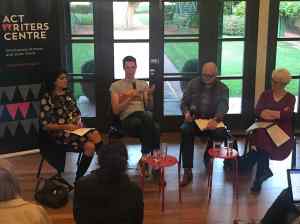
The panelists (check bios on the event website) were art curator and critic Peter Haynes (also the moderator), local authors Jack Heath and Karen Viggers, and me. This is not one of my verbatim reports because I was too busy taking part, but I want to document some of the things I remember that we discussed.

It was an enjoyable evening – for me, anyhow – largely because both the panel and the audience were friendly and engaged. We didn’t always completely agree on topics, but the ensuing discussion invigorated rather than diminished our thoughts and ideas.

My favourite description of arts criticism came from the most experienced critic amongst us, Peter, who said that:

For me writing criticism is about opening a dialogue and first the critique is for me to explore the work. Whatever medium. A review should start with a question. The critic opens the questions that the artist and curator have posed. (Tweeted by the ACT Writers’ Centre whom I thank for capturing this so nicely!)

I love this, the idea of opening the questions posed by the creator of the work (the book, the play, the exhibition, the film, etc), and will try to do it more. [PS: I forgot to say that we later talked about how social media at its best can encourage this dialogue/conversation.]

The topics we covered included defining what criticism is, what creators want from criticism, who criticism is for, the role of social media in contemporary criticism (is everyone really a critic?), the economic impact of criticism, whether creators can critique or review each other’s work, and what we think about negative criticism.

Most of us seemed to agree that there is a review-criticism continuum. The highest level of criticism we saw as comprehensive, academic, knowledgeable about the wider culture/genre/context within the work fits, while reviewing at its most basic can be short, narrowly focused and, perhaps, more oriented to promoting the work. This is not to say, however, that high level criticism can’t/doesn’t promote a work too, but the link is, I’d say, more tenuous.

Related to how we define criticism is the question of who/what criticism is for. For some critics*, it seems to be for the consumer (the reader, for example), for some it can be for the creators (the authors), and for others seems to be more for the producers (the publishers). At least, this last is how it looks when you get to the emerging “influencer” role, upon which we touched briefly. For the authors in our panel, the second was particularly relevant. They appreciate criticism which can help them develop their own work. There is a fourth option, which is the one I ascribe to. It’s that criticism is about contributing to the wider culture. While of course what critics write will encourage or discourage people from reading the book, going to the show, whatever, the main loyalty is to the culture. This means I’m keen to see the work I’m discussing within the context of both literary and social culture, to talk about how it adds to the body of work to which it belongs and how it addresses or contributes to the society in which we live. Looking at it this way, I’m less interested in ascribing value – this is a “good” or “bad” book – than in where it fits. I’m not sure I achieve this, but that’s my goal.

We talked briefly about social media: the destructive impact of thoughtless negative comments on authors; the positive and negative economic impact social media can have; the impact and application of ratings (like those on GoodReads); the current plethora of free review copies which can result in reduced early sales; and the value of hindsight versus the immediate response that is common in social media.

Opposing opinions were offered about whether artists can critique artists. The affirmative suggested that artists know what’s involved in creating the work and can therefore bring that understanding to their review, while the negative suggested that it is hard to properly critique people you know, and that creators, knowing the techniques involved, will often focus on technical aspects rather than the work as a whole.

Negative reviews came up several times throughout the discussion, and again at the end. Peter announced early on that he didn’t write negative reviews, which, regular readers here know, would appeal to me. What he meant by this – and how I also see it – is that if he doesn’t like something, he won’t review it. However, he will, in an overall positive review, refer to aspects that might not have worked so well. Yes! However, a question came from the floor about negatively reviewing a work that is against current social values – that is blatantly sexist, racist, ableist, for example. Karen spoke for all of us when she said that such ideas should be called out. Jack, earlier in the session, had entertained us by describing how he had learnt from a one-star review. The reviewer had missed the main point of his work he felt, but nonetheless the comment had made a valid observation, one that he used in the next book in his series!

Of course, like my old school exam days, I came away thinking about all that I could have, or wished I’d, said. One issue we didn’t discuss in any detail was the critic him/herself: the degree to which critics should aim to be “impartial” (whatever that is) versus put their preferences and background on the table, and, indeed, whether, in our current environment regarding who can write what, whether there’s also a question concerning who can critique what? But, I’ll leave those for another day!

Meanwhile, thanks to Paul and the ACT Writers Centre for asking me to be on the panel, and to Peter, Karen and Jack for being such fun and so interesting to talk with.

* I’m using the term “critic” broadly in this write-up to cover the whole continuum of arts writers, and my examples are mostly from the book world (but in most cases you can substitute your art form of choice!)

The Constructive Critic
Design Canberra Festival 2019
Gorman Arts Centre, Main Hall
12 November 2019

Canberra Writers Festival 2019, Day 2, Session 3: In our backyard

Suddenly it was my last session! How quickly the two days went. The reason I chose In Our Backyard is obvious. It was described as “Get up close and personal with four of Canberra’s literary gems”, and was moderated by ABC journalist, Emma Alberici.

It was a warm-hearted session, characterised by a sense of respect between the writers made most evident in their friendly banter and genuine interest in each other.

Alberici introduced the four writers:

  • Nigel Featherstone, novelist, Bodies of men (my review)
  • Karen Viggers, novelist, The orchardist’s daughter (my review)
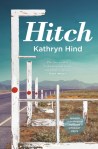
  • Kathryn Hind, novelist, Hitch
  • Patrick Mullins, political biographer, Tiberius with a telephone: The life and stories of William McMahon.

Four very different books, said Alberici, so she suggested they start with their book’s genesis.

Genesis

Karen Viggers, The orchardist's daughterKaren Viggers: Is passionate about Tasmania, wilderness, freedom, empowerment, forests, and friendship. Her novel is about three outsiders in a small timber town, and explores how people create bonds and belonging in such places.
Patrick Mullins: Did his PhD in political biography at the University of Canberra in 2014, but hadn’t written one. He looked around and Billy McMahon was there for the taking (with “good reason” he added!) Researching McMahon, he became intrigued by the disconnect between the reputation (the derision) and the reality (twenty plus years covering all major portfolios as well as prime minister.) Further, his unpublished autobiography indicated he had a divorced-from-reality view of himself, which suggested themes about the myths we can create about the past.

Kathryn Hind: Enrolled in a creative writing masters in the UK. She had to write something. She looked to her  experience of travelling around the world alone for a year, during which she found that she needed, as a young woman, to be hypervigilant, always. Suddenly, Amelia and her dog by the side of the road appeared to her. Neither she, Amelia, nor she, the author, knew what would happen to her!

Nigel Featherstone, Bodies of menNigel Featherstone: Wanted “to piss off Tony Abbott”. Seriously though (or, also seriously), the book resulted from a “strange decision” to apply for an ADFA (Australian Defence Force Academy) residency in 2013, despite having no interest in war. Of course, the residency did come with $10K! Featherstone’s overriding interest was to explore different expressions of masculinity under military pressure. Eventually, he found two books in the ADFA Library: Deserter, by American Charles Glass, which explored desertion as an act of courage, and Bad characters, by Australian Peter Stanley, which included the story of a soldier who, during World War 1, had been caught in a homosexual act, been found guilty, and never turned up to board the ship to take him home to prison! There’s my novel, he decided. Had he had any reaction from ADFA to the book, Alberici asked. No.
Place

Given the narrow “backyard” framing of the panel, Alberici took it upon herself to broaden the theme to “place” in general. Suited me. I love hearing authors discuss place.

Karen Viggers: All her stories come from a spiritual connection to place. (I follow Karen on Instagram and can attest her love of place!) She gives her place a fictional name, because she, like Tara June Winch said in the morning, didn’t want to impose her views on real towns (but it is set in the Geeveston/Huonville/Hartz Mountain region of southern Tasmania). She wanted to focus on different types of violence, besides physical, including psychological and economic control. In small towns people know this is going on and can’t pretend they didn’t know. She also wanted to bring back park ranger Leon from a previous book. And, most of all, she wants people to visit, love, and support Australia’s places.

Book coverKathryn Hind: Believes her senses were heightened because she started writing in England, when she was missing Australia. She couldn’t do physical research so would “drop a pin on map”. She named real places. She didn’t feel she had to capture exact their reality, but the timings of Amelia’s journey had to be right. I love that she used online traveller reviews to inform herself. For example, a review of a hotel in a little town mentioned being kept awake by trains shaking the walls at night. She used that! She wanted to truly test Amelia to bring out her strength.

Nigel Featherstone: Hadn’t been to Egypt, so had some initial creative concerns. Then he realised that 1940s Alexandria no longer exists, which that freed him to rely on research. He knows very well the other main place in the book, Mt Wilson. He also talked about writing by hand (which astonished journalist Emma Alberici!) He has gradually learnt that writing is a whole of body activity.

Book coverThen it was Patrick Mullins. He was tricky in terms of “place”, so Alberici asked him about the title. Mullins admitted that his publisher chose it – using Gough Whitlam’s description of McMahon’s scheming by telephone. Mullins’ own title is the subtitle. Alberici asked if he had any cooperation from the family. None, said Mullins, though he sent messages and did have coffee with one member. So, he couldn’t access the 70 boxes of McMahon’s papers at the Archives. He understood, he said. Children of politicians have crappy lives, and, anyhow, it freed him from feeling beholden to the family. Silly family, eh? Fortunately, he had access to one of McMahon’s autobiography ghostwriters who had seen the papers. The most startling revelation, he said, responding to another question from Alberici, was that McMahon was “more admirable than we would have thought”. He racked up several significant achievements, including taking us to the OECD, and showed impressive persistence/resilience.
Q&A

It was a quality Q&A. The first questioner asked the writers to share the best part for them about writing:

  • Viggers loves the first draft, the joy of going on the ride, and taking the tangents. She also loves those rare moments when the words start to sing!
  • Featherstone found it a hard question, but said one part is when you feel you have written a good sentence, one that feels alive. (One that sings, perhaps?) This happens about once a month, he said. He quoted novelist Roger McDonald, who says that writing is putting sentence after sentence after sentence.
  • Hind’s favourite moments were making discoveries in her own work, the moments when you forget to eat and drink, the moments when you feel “this is what I’ve done”, and when you know your novel so well you can defend it against an editor (albeit her editor was great, she hastened to say.)
  • Mullins gave a non-fiction writer’s answer: It’s when you get access to material, when you find that special piece of information, the little details.

Another question concerned characters “taking over”. Does this happen, and how did they feel about it? Viggers said that for her it’s less that the characters dictate and more that the publishers want her to go deeper, while Hind said that there were times when she wished Amelia would tell her more! Amelia divulging much, even to her author! Featherstone gave the answer of the session. He said that around draft 20 (of the 40 he wrote), he pretended he was a journalist and interviewed his main characters. He asked them to give him an object that represented them, and to tell him a secret about themselves, which he promised not to put in the book. They did, and he didn’t!

Another asked for the best piece of advice they’ve received. Featherstone said it was “to write about what makes you blush”, while Viggers said it was “to get it down, then get it right.” Her husband also says that writing is not about inspiration but getting “bum on seat” and doing it. Hind said her tutor told her that she writes very plainly, which upset her – until he added, “a bit like Tim Winton”! That’s ok then! Mullins said he’d been told that a book about McMahon would be short. It’s not, it’s nearly 800 pages. So, his response was, don’t follow advice!

A good place to end my report of my Canberra Writers Festival. Phew. To those still with me, thanks for following along!

Karen Viggers, The orchardist’s daughter (#BookReview)

Karen Viggers, The orchardist's daughterThe orchardist’s daughter is local author Karen Viggers’ fourth novel, but the first that I’ve read. She has, however, appeared on my blog before, being the person who conversed with Sofie Laguna about her novel, The choke. It was one of the most entertaining conversations I’ve ever attended.

Now, if you haven’t read or heard of Karen Viggers before, there are some facts worth knowing about her. Firstly, she’s a vet with special training in native wildlife health – and this background informs most if not all of her novels, I believe. It certainly informs The orchardist’s daughter. Another significant fact is that she’s a best-selling author in France! How wonderful that a novelist who writes strongly Australia-centric books does so well in France! Her previous novel, The lightkeeper’s wife, was, in fact, awarded the Les Petits Mots de Libraires literary prize.

So, an interesting author, and The orchardist’s daughter is an interesting, enjoyable book. It is set in a small logging town in Tasmania, and has quite a formal structure, starting with a Prologue, followed by four parts – Seeds, Germination, Growth, Understorey – and ending with an Epilogue. It is told third person through the perspective of three characters – Miki, the titular orchardist’s daughter who is 17 years old for most of the novel; Leon, a Park Ranger, who is 25 years old at the novel’s start; and Max, a 10-year-old boy who is Leon’s neighbour. Miki and Leon are relative newcomers to the town, Miki arriving with her older brother Kurt to run the town’s takeaway shop after they lose their home, farm and parents in a fire, and Leon moving from his Ranger job on Bruny Island to the mainland. All three are outsiders and serve to illuminate the tensions existing in the town.

Around these characters is a community comprising mainly logging families, Max’s being one of them. However, there are others who round out the town a little, including policeman Fergus and his sons, Geraldine who runs the information centre, and vet Kate. The narrative develops around a couple of situations. One is a mystery surrounding Miki’s brother Kurt. What does he do by himself in the forest when he insists that Miki wait in the ute, and what does he do during his weekly solo trips to Hobart (during which he locks Miki inside their shop/home)? The other concerns logging, and the dangerous unrest that develops when a temporary ban is placed on logging around a certain ancient tree. Jobs are at risk, the loggers believe, and the butt of their anger is of course Parkie Leon. From these two situations, Viggers builds tension slowly but inexorably, with the Kurt-and-Miki story becoming the prime focus, of course, given the book’s title.

So, there is a strong plot to the novel, but this plot, while driving us on to read, is there to serve some issues that Viggers wants to explore. These concern logging and the environment, bullying and domestic violence, not to mention more personal ones like freedom. These are big issues, and not only is Viggers clearly passionate about them, but her writing about them feels authentic. The characters may be a little less complex than, say, those in Lucashenko’s Too much lip, but they are believable. Logger and vicious bully Mooney is offset against Robbo, who is equally single-minded about logging but seeks more peaceful, law-abiding means of protest. Similarly, Max’s father Shane, another logger who is violent, is offset against colleague Tobey who has a tender, caring relationship with his wife. All of this is observed by Miki from her shop-counter – and she makes her own little attempts to lighten the lives of the bullied and the ostracised, by sneaking treats into their take-away bags. Through this little subversive action, we sense Miki’s inner strength and resourcefulness, something she takes to another level when she works out ways of escaping her “prison” while Kurt is away.

Freedom is one of the novel’s underlying drivers. Miki’s imprisonment is literal, but imprisonment takes many forms – the wives who are abused but feel incapable of escaping, and young Max who is bullied to behave in ways antithetical to his nature. Some of these are resolved, but Viggers recognises that there’s no magic wand for domestic abuse. The first step is moving from passive awareness (or acceptance, even) to taking action, and this starts to happen in the novel.

In the Tarkine, NW Tasmania

The book really stands out, however, in its writing about nature. A Booktopia interview with Viggers tells us that she grew up in the Dandenongs and has been to Antarctica. She has also spent time in Tasmania (and immersed herself in Tasmanian-set books, including two I’ve read, Anna Krien’s Into the woods, and Louis Nowra’s Into that forest). All of this has given her a sure feel for the wilderness, so much so that it’s difficult to choose an excerpt to share, but here’s one:

Miki loved the trees and the birds, but what she loved most couldn’t be seen. The way she felt in the forest. The scent of the bush after the rain. The sound of bark crackling. Branches squeaking. The feeling of patience and agelessness, growth and renewal. The aura of trees. The sense of connectedness. Of everything having its place. She could stay here all day, breathing with the tree, drawing its life into her lungs.

These forest descriptions move into Tasmanian Gothic realms during the climactic chase. The experience is both “terrifying and surreal” for our character who crawls and runs through, burrows and squats in the forest, “slipping from the thicket and weaving though the trees, ducking under tree ferns, past the tipped-up end of a fallen tree whose buttressed roots made a wall he could hide behind.” It’s muddy and dangerous with sword grass that scratches you and bark mounds that can trip you up. Viggers knows this landscape – and how to make it terrifying.

In the end, The orchardist’s daughter is about community and compromise, and about the courage to break free. It straddles the boundary between commercial and literary fiction. It is accessible, it has a strong plot and easy-to-engage-with characters, and it is hopeful (not that literary fiction can’t be!!) But, it is also gritty in subject matter and doesn’t offer neat solutions to the important environmental and social issues it raises. I like that in my reading!

Theresa (Theresa Smith writes) also loved the novel.

AWW Challenge 2019 BadgeKaren Viggers
The orchardist’s daughter
Crows Nest: Allen & Unwin, 2019
389pp.
ISBN: 9781760630584

Review copy courtesy the author, Karen Viggers.