George G. Foster, The eating-houses (Review)

Some of you will know that Mr Gums and I love to eat out. So, when I saw a Library of America (LOA) Story of the Week titled “The eating-houses” by one George G Foster appear in my in-box at the end of last year, I knew I had to read it. I just had to find the time to slip it in. I eventually did, and here I am.

The first thing to say about it is that those of us who thought our era of conspicuous dining-out was a new thing are wrong. Foster writes in the opening paragraph of his article that:

We once undertook to count these establishments in the lower part of the City, but got surfeited on the smell of fried grease before we got half through the first street, and were obliged to go home in a cab. We believe, however, that there can’t be less than a hundred of them within half a mile radius of the Exchange. They are too important a “slice” [see publication details below to understand this reference] of New York to be overlooked …

This reminded me of my return last year to the little suburban shopping centre of my teen years – Wahroonga, in Sydney. I looked across the street, from where I was standing, to the local supermarket on the corner and ran my eyes down from it to the other corner. Just a short distance. And it was wall-to-wall cafes with nary another business in between. That was just that little side of that street. There were a couple of cafes on my side, and around both corners, and across the other street as well. Amazeballs as the young would say! Clearly Mr Gums and I are not alone in our predilection for eating out.

Anyhow, back to Foster. You might have gathered from my excerpt that he was not much in favour of these establishments, and you’d be right. He satirises them, and their denizens, pretty mercilessly. He clearly thinks home-cooked meals are  better – “the fare is generally bad enough — not nearly equal to that which the cook at Home above Bleecker* saves for the beggars”. He ridicules their lack of style and taste:

It is really wonderful how men of refined tastes and pampered habits, who at home are as fastidious as luxury and a delicate appetite can make them, find it in their hearts—or stomachs either—to gorge such disgusting masses of stringy meat and tepid vegetables, and to go about their business again under the fond delusion that they have dined.

He categorises the three main styles of eating-houses – satirically referencing the great Swedish botanist and taxonomist Linnæus – and satirises the diners. He describes a journalist ordering “rosegoose”: “when goose leaps suddenly in front of a poet of the Press, who ordered it probably through a commendable preference for a brother of the quill”.

At the cheap Sweenyorum “sixpenny eating-house” style of place, you only get a spoken menu which, he says, “does away with lying in print, to which bills of fare as well as newspapers are too much addicted”. Still, beware here, he advises, of added extras, or your sixpenny cut will suddenly be “seven shillin'”! Just order “a small plate of roast beef mixed, (this means mashed turnips and potatoes in equal quantities)”, add some bread perhaps, and a glass of free water. Then you will “pay one shilling for the whole, and go about your business like a refreshed and sensible man”.

He briefly mentions the cake and coffee shops which are open all night, and therefore frequented by journalists, firemen, and the like. He reserves special praise for the latter:

They are generally far more moderate than politicians and less noisy than gentlemen. At the first tingle of the fire-bell they leap like crouching greyhounds, and are in an instant darting through the street towards their respective engine-houses—whence they emerge dragging their ponderous machines behind them, ready to work like Titans all night and all day, exposing themselves to every peril of life and limb, and performing incredible feats of daring strength, to save the property of people who know nothing about them, care nothing for them, and perhaps will scarcely take the trouble to thank them.

Oh dear – I do hope their “plate of biscuits with a lump of butter in the belly for three cents, and a cup of coffee for as much more” provided them with enough sustenance! And did you note the reference to politicians?

His final paragraph is reserved for the “expensive and aristocratic restaurant of which Delmonico’s is the only complete specimen in the United States”. I was rather intrigued by this because he argues that, at a place like this, you will get

a dinner which is not merely a quantity of food deposited in the stomach, but is in every sense and to all the senses a great work of art.

“A great work of art” is how many of our top chefs like to see their food today. Paying large sums for food like this seems, in one sense, insensitive. And yet, does art have to last forever, or can it be enjoyed in the moment before we move on? I’m still pondering this.

The interesting thing is, as LOA’s notes tell us, that Foster’s “preference for high-society haunts like Delmonico’s ultimately caused his downfall”. He was imprisoned for forging cheques, and spent 9 months in prison the year before he died. His obituary in the New York Times described him as

a remarkable example of the worthlessness of a brilliant talent unguided by a moral purpose, or a decent regard for the proprieties of civilized society.

Do consider reading this article. It’s short and entertaining – and is a fascinating piece of 19th century social history.

George G. Foster
“The eating-houses”
First published: In New York in slices, by an Experience Carver, 1849.
Available: Online at the Library of America

* A residential area of New York.

Mark Twain, How to cure a cold (Review)

I haven’t reviewed anything by Mark Twain on this blog, though I have posted on an interview with him by Rudyard Kipling, so when his story “How to cure a cold” appeared in December as a Library of America Story of the Week, I figured it was time.

Mark Twain, by Matthew Brady, 1871 (Public Domain in the US, via Wikipedia)

Mark Twain, by Matthew Brady, 1871 (Public Domain in the US, via Wikipedia)

According to LOA’s notes, “How to cure a cold” was written in response to a serious cold followed by bronchitis that Twain suffered through the summer of 1863 – during the American Civil War, in fact, though you wouldn’t really know it from the story. He wrote several letters and reports detailing his experiences to newspaper editors in Virginia City (Nevada) and San Francisco, but didn’t write this dedicated piece until he arrived in San Francisco in September of that year. LOA says that this is one of the few pieces from his early years that he republished, revising and polishing it several times. He included it in his first book, The celebrated jumping frog of Calaveras County (1867), and in a collection of his sketches published in 1875.

As you can probably imagine, given the topic and the Mark Twain factor, the piece – barely 6 pages in my version – is replete with all sorts of weird and wonderful cures. LOA tells us that the editors at the University of California Press,  which publishes Twain’s writings, say that ‘the remedies described by the author, although they seem ludicrous today, “were standard prescriptions of folk medicine …”‘.

I’m not going to write a long post about this piece, because it is short enough that you can read it quickly yourselves – at the link below, if you are interested. But, what I particularly love about this article – besides Twain’s trademark humour, and its careful construction – is that whole plus ça change thing. After taking a page to tell us how he got the cold – a page full of tongue-in-cheek humour – he tells us:

The first time I began to sneeze, a friend told me to go and bathe my feet in hot water and go to bed.

I did so.

Shortly afterward, another friend advised me to get up and take a cold shower-bath.

I did that also.

You can see where this is going can’t you? What follows is a chronicle of remedy after remedy that he tries – “feed a cold and starve a fever”, take the waters, apply a mustard plaster – and so on. He tries them all, to no avail, but the telling is entertaining. Some remedies are pretty harmless, some are rather enjoyable (like gin, and gin and molasses, not to mention whisky), but some are downright unpleasant, such as the warm salted-water one. He writes:

It may be a good enough remedy, but I think it is too severe. If I had another cold in the head, and there was no course left me but to take either an earthquake or a quart of warm salt water, I would cheerfully take my chances on the earthquake.

He did not like the warm salted-water much!

But honestly, nothing has changed has it? As soon we get sick, our family and friends are ready with remedies. All very kindly meant, but the offerings can be confusing, contradictory, and often ineffective. And if it’s not advice from friends and family, we do it to ourselves by finding concoctions over the counter or natural health remedies over the internet. I love the universality of this – the urge to help, the wanting to get better, and the desire to not offend one’s loving advisers. I’m not surprised Twain kept this story, and that LOA chose it as one to share.

I will leave it there, but before I finish I can’t resist sharing a comment on that opening page where he describes a house fire in which “I lost my home, my happiness, my constitution and my trunk”. He discusses the relative import of these, saying of losing his happiness that

I cared nothing for the loss of my happiness, because, not being a poet, it could not be possible that melancholy would abide with me long.

Ya gotta love it (no offence to poets intended). I do recommend this article.

Mark Twain
“How to cure a cold”
First published: In the San Francisco Golden Era, September 20, 1863.
Available: Online at the Library of America

NB I did say that my first review of 2016 would be for a farm novel. I lied! But it will be coming soon …

Prison post: Letters of support for Peter Greste

GresteNewSouthIf you’re Australian, you’ll know who Peter Greste is. If you’re not, you may know. He was one of three Al Jazeera English journalists* who were arrested in Cairo in late 2013 for “spreading false news, belonging to a terrorist organisation and operating without a permit”. It was a ridiculous charge and we all thought they’d be released quickly, but instead, in June 2014, they were convicted of “spreading false news and supporting the Muslim Brotherhood”, and Greste was sentenced to 7 years in prison. At that point, Peter Greste’s family set up an email account encouraging people to send messages of support to Peter that they would then print out and deliver to him in prison.

After 400 days in prison, in February 2015, Greste was released, that is, deported. His conviction was not overturned. In September 2015, his two colleagues, who had been kept in prison, were pardoned and released. Australia’s Foreign Minister, Julie Bishop, understands that Greste will be pardoned too, but I don’t think this has formally happened yet.

However, this book is not specifically about the legal story. Rather, it comprises a selection of the emails sent to Peter between his conviction on 24 June 2014 and the time of his deportation in early February this year. I have a copy of the book because my wonderful octogenarian mother was one of the correspondents. Some of her messages are included in the book.

To be honest, although I rather enjoy reading letters – you’ve seen posts about them here before – I wasn’t sure I’d enjoy a 200-plus-page book of letters (emails) to one person about one topic. But, I was bowled over, not simply because of the quantity of emails that were written, but because of their warmth, generosity and eloquence. Some are from Peter’s friends, acquaintances and colleagues, past and present, and a few are from well-known people like Julie Bishop and Wendy Harmer. But many are from complete strangers like my mother and, at the other end of the age spectrum, 9-year-old Grace. Grace writes:

Do you like to read? I love reading because when you are stressed or are worried or angry, reading takes you to a completely different world, where all your worries and fears are drowned away from your mind. (Grace Worthing, 11 July 2014)

Some of the strangers are journalists and journalism students. Many of these want to emulate him, while a few admit to lacking the necessary bravery to do so. All of the writers, though, strangers or not, are outraged by the idea and fact of Greste and his colleagues being imprisoned for doing their job, and many express appreciation for the work journalists like him do in telling the truth:

However small, I hope it is some consolation that your cause has given a voice to those of you in the business of giving others a voice. Your situation has highlighted the risks you take, the dangers you face, knowingly, in your dedication to shedding light on injustice and human suffering, and to exposing the truth, from all angles. (Lulu Nana, 25 July 2014)

Some writers tell of tweeting about the injustice of his imprisonment. They describe writing letters to government, diplomats, Amnesty International, or the editor of their local newspaper. They talk of taking part in fund-raisers and benefit shows. They will not, they say, let it rest until he is free.

Not all letters, however, are specifically political. Some are more personal. They want to cheer Peter up, offer him hope or sympathy, or just take his mind off where he is for a moment or two. They do this by telling him stories from their own lives, and or by sharing little jokes, proverbs or inspirational quotes. They quote from Shakespeare, the Bible, or poets like Robert Frost, but you probably won’t be surprised to hear that by far the most commonly quoted is Nelson Mandela. What is perhaps a little more surprising is that these Mandela quotes are all different!

Another common feature of the letters is praise for Greste’s family – his mother and father, his brothers, and his sisters-in-law. They are described as “diamond grade”, as inspirational in their strength, cohesion and dignity. One correspondent even went so far as to write, after Greste’s release:

I hope we don’t lose the Greste family from public life entirely. If any of our leaders, in various fields, have been paying attention they could’ve picked up some excellent lessons. (Amy Denmeade, 8 February 2015)

The letters are presented chronologically, but the chronology is broken into sections: section one, for example, comprising spontaneous responses to the announcement of his conviction; section two, the establishment of the email address and “call to arms”; and section five being letters written in December for his birthday and Christmas. (Several correspondents, including my mum, in fact, sat down and wrote an email on Christmas Eve or Christmas Day.) Each of these sections has a brief introduction describing what is happening at that point in the chronology. There are also a timeline of events at the beginning of the book, a foreword by Greste himself, and an acknowledgement statement by editor-publisher Charlotte Harper.

What more can I say? The book could so easily have been schmaltzy, but it’s not, mainly because the writers, those selected for inclusion anyhow, are too unselfconsciously themselves. After all, when they wrote, they had no expectation that their letters would ever be published, so they wrote from their hearts. This is a book of its time, and yet is also timeless. That is, it relates to a very specific event involving very specific people, and yet it is really about big principles, like justice and truth, and about human values, like empathy and compassion. It is, in other words, a darned good read.

PS: Just in case you are interested, profits from the first year’s sales are going to the Foreign Prisoner Support Service. Digital copies can be ordered for $9.99 from Editia; and print copies for $24.99 from NewSouth Books.

Prison post: Letters of support for Peter Greste
Braddon: Editia, 2015
229pp.
ISBN: 9781942189022

* The other two were journalist Mohamed Fahmy, and their producer Baher Mohamed.

Kathy Marks, Channelling Mannalargenna (Review)

A few weeks ago I wrote a Monday Musings about the Walkley Awards, noting some of the winners that particularly interested me. They included two awards for essays in the Griffith Review, one by Melissa Lucashenko, whose essay “Sinking below sight” I subsequently reviewed, and the other by Kathy Marks whose essay, “Channelling Mannalargenna” is the subject of this post. Both essays deal with indigenous topics but while Lucashenko, who won the award for Long Feature, has Aboriginal heritage, Marks, whose award was for Indigenous Affairs, is English. This adds an intriguing layer to her piece which is about the troubled issue of identity in indigenous Tasmania. Marks has, however, been writing about the Asia-Pacific region since 1999.

Like most Australians of my generation, I grew up believing that genocide had resulted in the elimination of indigenous people from Tasmania. Truganini, we were told, was the last “full-blood” Tasmanian Aboriginal person. She died in 1876. In 1978, the documentary, The last Tasmanian, made by filmmaker Tom Haydon and archaeologist Rhys Jones, popularised this idea. It is, however, not quite as simple as we’d been led to believe – and Marks’ essay chronicles the identification legacy left by a history of being discounted. The Walkley judges described the essay as follows:

An elegantly written essay about a community still wrestling daily with the act of colonisation. Adding poignancy is the hovering myth of extinction, Kathy Marks deftly draws the reader into the everyday of establishing Tasmanian Aboriginal identity, teasing out the tensions, but without seeking catharsis.

It’s a brave essay, I think, something that Marks herself recognises when she said on her win that “I was thrilled to receive the award, not least because of the challenging and sensitive nature of the subject matter.” Being brave, though, is surely the hallmark of a good journalist. And so, Marks tackles the thorny issue regarding the definition of indigeneity in Tasmania.

As I read the essay, I was reminded of remarks made by Anita Heiss in Am I black enough for you? on conflict within the indigenous community regarding Aboriginality. Heiss discusses the different ways people come by their Aboriginality and says:

What age and experience  moving around the country has given me is a better understanding of the complexities around individual and collective Aboriginal identity. One shouldn’t be too quick to judge others, especially when some of us have been fortunate to know who we are all our lives, and others haven’t.

And herein lies the rub in Tasmania. Because of the particular history of indigenous Tasmanians, family lines and connections have been broken, and so the way Tasmanians discover their Aboriginal background is highly varied. In her essay, Marks talks to many of the groups and factions existing in contemporary Tasmania, and describes the bitter lines that have been drawn between some of them. Some of these lines are so strongly defended that one group, the Tasmanian Aboriginal Centre (TAC) in particular, has taken legal action against people who have claimed indigenous heritage. Officially, the definition of Aboriginality in Tasmania is the same as that established by the Federal government – the three-pronged factors of ancestry, self-identification and being accepted by the indigenous community. The TAC, however, demands a family tree as part of this. Marks quotes Michael Mansell who argues that to be accepted as indigenous Tasmanian, people need to:

show that…their families, from every generation back to tribal, have always maintained their connection with being Aboriginal. So that excludes people who undoubtedly have Aboriginal descent but who have been brought up as white people… If there’s been a break in the generations, where someone lost contact, the Aboriginal community’s view is…you can’t revive it.

Not all can provide this unbroken connection. For example, indigenous Tasmanian academic, Greg Lehman, told Marks that people were not keen to admit to indigenous forbears in the 194os and 1950s. And then there’s the devastation – dislocation –  that occurred one hundred years earlier through George Arthur’s infamous Black Line and then George Augustus Robinson’s corralling of indigenous people at the so-called “friendly mission” Wybalenna on Flinders Island in the 1830s.

awwchallenge2014Looking from the outside, I find this conflict all very sad. It’s hard enough when indigenous people suffer rejection and discrimination from the white majority culture, but when it also comes from inside the community it must be devastating. Patsy Cameron, an indigenous Tasmanian whose bona-fide is accepted, would like to see a more inclusive approach. Marks quotes Cameron:

‘Even someone who hasn’t been active in their culture or in the politics of the day,’ she says, ‘it doesn’t make them any less Aboriginal. Anyone who can show their lineage, and their extended family acknowledges them as part of that family, we should be embracing them. We should be embracing people who have been lost, rather than chasing them away and doing to them the exact thing that non-Aboriginal people have done to us in the past: denying us our rights, our identity.’

I’ve only touched the surface of Marks’ essay. It’s an excellent read that starts with a brief history of indigenous relations in Tasmania, including some distressing anecdotes regarding discrimination, before exploring in some depth the essay’s central issue regarding Aboriginal identity. Fortunately, the essay is freely available online via the link below. If you have any specific or general interest in the topic I commend it to you.

Kathy Marks
“Channelling Mannalargenna: Surviving, belonging, challenging, enduring”
Published in the Griffith Review, Edition 39, 2013
Available: Online at the Griffith Review

Monday musings on Australian literature: The Walkley Awards

The Walkley Awards for Excellence in Journalism are Australia’s premier awards for journalists. Last week the winners of the 58th awards were announced.

According to the Walkley Foundation website, the awards were established in 1956 by Ampol Petroleum founder Sir William Gaston Walkley. Apparently, according to the website, William Walkley appreciated the media’s support for his oil exploration efforts. That’s rather telling of a different time isn’t it? Anyhow, as a result, he wanted to recognise and encourage emerging talent in the Australian media.

Back then the award categories – of which there were five – were all for print, even though radio had been around for a few decades. Television, on the other hand, had only just started – that year in fact – in Australia. Over the years the awards have changed, particularly with new categories added. In 2013, however, more changes were added, in categories and criteria, after a review was conducted of the awards, led by Walkley Advisory Board Chair and well-known Australian journalist, Laurie Oakes. The review recognised that modern journalism “draws on a broad range of interactive tools and multi-media platforms”.  It’s interesting that they needed a review to recognise this, that they hadn’t learnt the lessons from the past when new technologies like radio and television appeared. Anyhow, the aim of the awards is still to maintain and strengthen “commitment to the fundamentals of ‘quality, independent journalism'” but appreciates that quality journalism can appear in many different places.

Here’s what the website says:

For the first time, entry was open to Australian journalists who have self-published, including bloggers and independent operators of online news sites. So too, journalism was invited under the sections of text/print; audio/radio and audio-visual/television to better reflect journalism’s digital evolution as well as specialist All Media categories.

In other words, as Oakes said, “if it looks like journalism and feels like journalism it will be treated as journalism.” According to Oakes, the Walkleys are unique in the world for recognising “excellence across all areas of journalism”.

There are now over 30 categories in which awards are made – and as far as I can see there are no specific categories for blogging journalists. I guess it’s more that blog articles will now be considered in the relevant categories. Anyhow, I’m not going to list all the categories and this year’s winners here. There are some, though that particularly interest me.

  • All Media Coverage of Indigenous Affairs was won by Kathy Marks, Griffith Review, “Channelling Mannalargenna”. I don’t recollect having read Kathy Marks before, but apparently she won a Ned Kelly Award for her book Pitcairn: Paradise Lost and has written a few pieces for Griffith Review. This winning piece is about Aboriginal Tasmania, about “a people who were pronounced extinct in 1896, but a century later re-emerged to proclaim their Tasmanian Aboriginal identity, demand land rights and revive traditional cultural practices”.
  • Print/Text Feature Writing Long (Over 4000 words) was won by Melissa Lucashenko, Griffith Review, “Sinking below sight: Down and out in Brisbane and Logan”. Lucashenko has been a regular contributor to the Griffith Review pretty much since it was established. I have reviewed stories and articles by Lucashenko, and have now read this winning essay about poverty in Australia and some of its identifying features. The research is local and, as she says, not statistical but it is powerful nonetheless. I shall write it up separately.
  • Walkley Book Award was won by Pamela Williams for her book Killing Fairfax: Packer, Murdoch and the ultimate revenge, which is, rather ironically I suppose,  about the decline of one of Australia’s oldest and most respected media organisations. It’s a book I’d like to read. Anna Krein’s Night games: Sex, power and sport (which I reviewed here a few months ago) was one of the three books shortlisted for this award from a long list of nine.

As a fan of the Griffith Review, I’m thrilled to see that it picked up two awards. It has won Walkleys before. It’s good to see that this Griffith University initiative which, in each issue, tackles in some depth and from multiple angles a contemporary issue or concern, is being recognised for the quality of its writers and output.

I was rather hoping that one of the new quality on-line sites would win an award but, as far as I can tell from the list of winners I’ve seen, that doesn’t seem to have happened. However, there is an interesting article at The Conversation on the changes to the Walkleys and in regards to changes in journalism. It looks at the old digital versus analogue debate, the role of user-generated content, and our ongoing need for professional journalists to sift through the available information and present it to us in an intelligent way – because, in the end, it’s not the platform that matters, is it, but the content.

At a time when investigative and long-form journalism is being threatened and when the reputation of journalists for ethical reporting seems pretty low, it’s good to see the Walkley Foundation doing its best to support and encourage the best. I think that’s worth celebrating.

Delicious descriptions from Down Under: Melbourne scenes, 1850s

One of the contributors to Charles Dickens‘ weekly magazine Household Words was Richard HorneAccording to the notes on Contributors in Margaret Mendelawitz’s five-volume set, Charles Dickens’ Australia, which I reviewed last week, Horne was an English-born author who lived in Australia from 1852 to 1869. He agreed to write travel pieces for Household Words “in return”, say the notes, “for advances to equip the expedition and for regular payments to his wife”. (Apparently Dickens refused to have anything to do with Horne when he returned to England due to the minimal contributions Horne had made to his wife’s support while he was away. Given Dickens’ own less than admirable treatment of his wife this smacks a little the pot calling the kettle black, methinks)

Anyhow, one of Horne’s articles for Household Words is included in the first book of Mendelawitz’s set. The article, published in 1853, is titled “Convicts in the gold region” and discusses convicts in the Melbourne area. I enjoyed some of his descriptions and thought I’d share a selection with you.

on Melbourne

… Melbourne, famous, among other things, ever since it rose to fame two years ago, for no roads, or the worst roads, or impassable sloughs, swamps, and rights of way through suburb wastes of bush, and boulder stones, and stumps of trees …

I was going to use this to talk about how stereotypes start but in fact Melbourne’s roads aren’t particularly bad these days, even though it does have a reputation for its strange road rule, the hook turn. The next description, however, is more typical of Melbourne:

It is night; a cold wind blows and a drizzling rain falls.

And yet again I jest a little when I say typical. Melbourne is famous for having four seasons in a day so cold and rain are not the only weather you experience there!

at the Pentridge Stockade

Pentridge prison was built in 1850 to cater for the growing number of prisoners resulting from increased crime due to the gold rush. Horne had a reason for describing Melbourne’s roads at the beginning of his article, because the road to Pentridge itself was a beautiful one. It was built using convict labour.

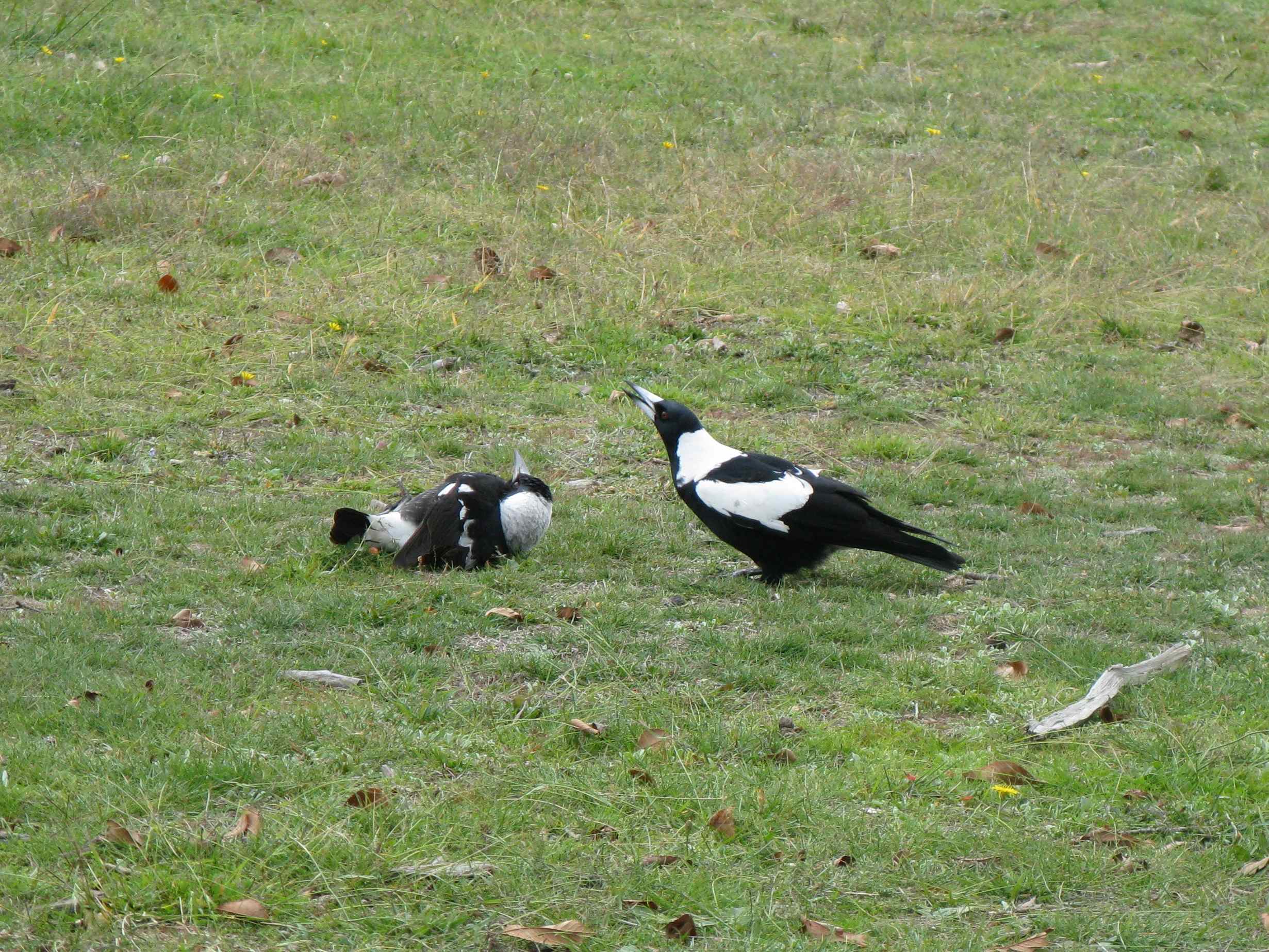
Magpies at Tidbinbilla

Not on broken granite, but magpies nonetheless

The yard is covered with loose stones of broken granite; and I notice close to my feet and looking directly into my face, a magpie. He also, holding his head on one side interrogatively, seems to ask my business here. I take a fresh breath as I look down at the little thing, as the only relief to the oppressive nature of prison doom that pervades the prison scene.

This man is clearly a writer … the contrast he draws here is both pointed and poignant.

I have taken a stroll around the outskirts of the Stockade, and, while gazing over the swampy fields, now wearing the green tints of the fresh grass of winter which is near at hand, and thence turning my gaze to the bush in the distance, with its uncouth and lonely appearance, I hear …

And now we’re really talking … because this description of the Australian bush as uninviting and unappealing was widely held by our 19th century colonials. And, I’d venture to say, Australian culture didn’t really start to come into its own until we started to appreciate the beauty of our bush!

Margaret Mendelawitz, Charles Dickens’ Australia: Selected essays from Household Words 1850-1859

It was not to be a high-brow intellectual periodical. Above all he wanted to reach and entertain the masses and, at the same time, help shape discussion and debate on the important social questions of the time. (from Introduction, by Margaret Mendelawitz)

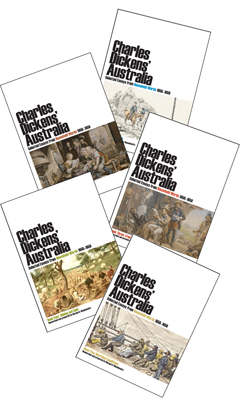
Five covers for the Charles Dickens' Australia set

Set book covers (Courtesy: Sydney University Press)

Charles Dickens‘ Australia is a set of five volumes containing essays, stories and poems relating to Australia from the magazine, Household Words, that Dickens established and editedThe magazine was published from 1850 to 1859 which, as Margaret Mendelawitz says in her introduction, was an “extraordinary decade in Australian and British history”. The discovery of gold in Australia (and California) transformed the world. Social justice was becoming a serious issue for debate and action. And it was when “the age of capital” really began.

So, it is rather fortunate that a writer of Dickens’ calibre produced a magazine in this period – and that he was sufficiently interested in Australia (as I described in a post last year) to actively seek and commission articles about life and social conditions here for his magazine. As you might expect, the magazine is available online (in gorgeous facsimile and for electronic downloading) but the value of these five volumes is that they have been carefully researched by Mendelawitz and contain the articles specifically relating to Australia. According to the Sydney University Press website, of the 3000 articles published in the magazine over its lifetime, only 100 dealt with Australia in some way. Unless you like the fun of the chase, these volumes are an excellent way to get to the Australian content without having to do the searching and sifting yourself.

This isn’t the only reason though for reading the articles via this set. It is a beautifully conceived anthology. Firstly, the articles have been thematically organised into five manageable volumes:

  1. Convict Stories
  2. Immigration
  3. Frontier Stories
  4. Mining and Gold
  5. Maritime Conditions

And there’s more. Each article  starts with a small panel containing a brief description of its content, its publication details (the volume and issue numbers, pagination, and date) and the amount paid for it! The articles are footnoted, with those original to the article clearly identified as such. Curiously, the editorial additions – the introduction, etc – are referenced differently, with the notes placed at the end of each piece rather than in footnotes. The additions are: a foreword by Geoffrey Blainey; an introduction by Mendelawitz; a list of contributors providing a brief, targeted biography and a list of their articles included in the set; and, a short but appropriate bibliography. These are all repeated in each volume, presumably so the volumes can stand alone.

I was initially perturbed that the article authors are not named in the table of contents, but then I read the introduction which tells us that “regardless of their source, all articles appeared anonymously”. Mendelawitz has followed that practice in her table of contents, but has identified the author/s on the articles themselves, providing another reason for reading this set because knowing the authors and their backgrounds adds a further dimension to the reading.

Mendelawitz covers a lot of ground in her introduction. She talks a little about Dickens himself and about the history of Household Words, she describes the era in which it was written, and she discusses the writers, the content and the “house” style. I found these last two particularly interesting. The articles, as I’ve said, were published anonymously. They were also carefully edited to meet what Elizabeth Gaskell called a “Dickensy style”. This meant they had to be bright, regardless of how dry the subject, and would characteristically start with a snappy, provocative paragraph. It also meant that those that did not accord with Dickens’ views were rewritten. I can’t help thinking that, if slavishly enforced, this adherence to a set style could result in the articles feeling formulaic. It’s something I’ll check out as I read the volumes in depth.

The final point I’d like to make in this overview concerns the issue of fact versus fiction. Mendelawitz argues that the articles are “literature, not history”. They are valuable, she says, for the insight they provide into 19th century Australia but this “does not depend on them being the literal truth”. She writes:

As a collection they demonstrate the complementary nature of storytelling between the writing of history and fiction. The stories in Household Words frequently draw a fine line between fact and fiction, giving voice to characters and events that could easily go unrecognised and unrecorded. In many ways they exemplify the fundamental problem  encountered by historians through the ages of how to separate and present fact, fiction, myth and truth.

Regular readers of this blog know that this issue interests me. I expect to come back to it when I review the first volume in the near future … from what I’ve read so far, I think I’m in for a fascinating ride.

Margaret Mendelawitz
Charles Dickens’ Australia: Selected essays from Household Words 1850-1858
5 volumes
Sydney: Sydney University Press, 2011

(Review copies courtesy Sydney University Press)

Anna Krien, Into the woods

How can so many people all be looking at the same thing and see it so differently? The man moseying around in front of me looks at a 300-year old tree and sees a nursing home, while an activist twenty minutes down the road sees a block of flats for furry and feathered creatures.

Vive la différence? Or not! Anna Krien’s Into the woods is an exposé of the decades long battle in Tasmania for its forests, particularly its old-growth native forests. For those who don’t know, Tasmania is Australia’s southern island state. It is famous for its beauty and its wilderness but also, it seems, for its Vs, that is, vitriol, violence and vigilantism. You see, being a small island state, with only 500,000 people, it’s a challenge to keep its economy in the black. Sawmilling and, more recently and more controversially, woodchipping have played an important role in maintaining its economy. It is this controversy – particularly surrounding woodchips – that Krien explores in her book.

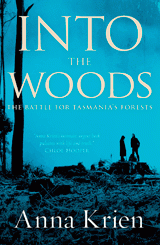
Anna Krien, Into the woods

Cover image (Courtesy: Black Inc

On the cover is a “blurb” by Chloe Hooper who wrote The tall man about the death in custody of an indigenous man on Palm Island. This provides a clue to the book’s style, and that is that the author, like Hooper, engages personally in the situation, meeting with parties on all sides of the conflict. In Krien’s case this meant meeting ferals, environmentalists, politicians, loggers, whistleblowers, craftsmen and businessmen.

Krien has organised the book into five thematic sections:

  • Ratbags: the new generation protesters, or ferals, who live pretty primitively on/near the site  they are protecting and who are often in conflict with older activists
  • Loggers: the logging industry workers who range across a wide range of jobs in the industry and are also often conflict with each other
  • The company: Gunns Ltd, the main player in the Tasmanian logging industry, meddler (if so benign a term can be used) in politics, and initiator of the Gunns 20 lawsuit
  • Groundswell: change agents such as whistle blowers, proponents of the “rights” of nature, and shareholders wanting ethical investments
  • The mill: Gunns pulp mill saga, the beginning of the an end?

The story is a complex one, delving into competing interests within the logging industry itself – sawlogs versus woodchips, old-growth versus regrowth native forests versus plantations, public versus private forests – not to mention dissension amongst environmentalists and some very dirty politics. It is a story about jobs versus the environment and the “rights” of nature, of different value systems that set “unmanned” pristine forests against “manned” ones. It is a story of blaming and buck passing. And it is a story of half-truths and distorted truths, all in the name of defending one’s own patch. “I am on a journey through selective truths”, she writes at one point in the book.

This issue of “truths” is beautifully conveyed in her discussion of the timber industry’s language:

I find myself constantly having to decipher new words. Nature needs “disturbance”, logging is “harvesting”, deforestation is “afforestation”, burning woodchips for electricity is a form of “bio-fuel” or “renewable energy”. Woodchips are “feedstock”, while the non-commercial attributes of a forest are “non-wood values”.

The word-games though work on both sides. As she says, “evoking napalm, Hiroshima and the holocaust to describe logging is manipulative”.

A major argument presented by the logging workers is the economic one – jobs – but Krien estimates from the information given her that forestry “accounts for no more than 3% of the workforce”. In fact, she suggests that machines may be a bigger threat to timber jobs than “any greenie”. The more cynical amongst us might think that it is not so much about “jobs” but about “big business”. Sometimes, of course, big business means jobs, but that’s not always necessarily so, not if much of the work can be automated (or, sometimes, though not necessarily here, moved off-shore).

I can’t begin to convey all the information she presents in this book – the history, the statistics, the science, the criss-crossing relationships, not to mention the people, the overt and covert deals, and the truly horrifying violence (both actual and threatened). There are times when I started to feel bogged down in the complexity of it all, but I was reassured when I realised she was feeling it too. She is, in fact, like Hooper, taking us on a journey – but it is a journey that, despite her very real efforts to explore the whole story, does lean to one side, that of those who wish to protect not destroy. As she says in the last chapter:

I’ve tried to balance my seesaw heart, carefully weighing up each argument. But there is something about this island that wants you to choose sides.

I can understand that – it is, in many ways, a magical place. However, I do have one complaint about the book – my ongoing one for books of this ilk – and that is its lack of an index. It is jam-packed with people, events, places, philosophies and theories but how can the casual reader or researcher find them?

And so, is there a resolution to it all? Well no, but there is, she says, a universal story:

… in the greater scheme of things, the island is nothing but a drop in the ocean. But the story is universal – and what goes on in Tasmania goes on in the Pacific islands, in other continents, until it all comes back over the ice to Tasmania again. … Deep down in our bones we must know – we must know that nothing we do is done in isolation. Cause and effect: how did it get so noisy in between?

How indeed? Read this thoughtful, throughly researched book, and you will, unfortunately, find out.

Anna Krien
Into the woods: The battle for Tasmania’s forests
Melbourne: Black Inc, 2010
302pp.
ISBN: 9781863954877

(Review copy supplied by Black Inc)

Price Warung, Tales of the early days

Tales of the early days (Cover: Courtesy Sydney University Press)

Tales of the early days (Cover: Courtesy Sydney University Press)

Okay, I admit it, I have convict ancestors (plural even!). Consequently, I was particularly interested to read Price Warung’s 1894 collection of short stories, Tales of the early days, when I discovered it was part of the Australian Classics Library recently published by the Sydney University Press. My convicts include John Warby who, with another labourer, stole two donkeys and was transported to Australia on the Pitt in 1791, and Sarah Bentley who stole several items of clothing from her mistress in 1795 and was transported on the Indispensable. In 1796, John married the 16-year old Sarah. Fortunately (for me and for them), they were a hardworking pair. John had been given land by Governor Phillip in 1792, and he and Sarah made a good life for themselves, so much so that there is now a primary school named after him, the John Warby Public School in the Campbelltown area west of Sydney.

Enough about my family, though. What about Price Warung? He was, in fact, William Astley, and was born in Liverpool, England, in 1855 but came to Australia with his family in 1859. He became, according to the succinct little biography at the back of the book, a radical journalist and short-story writer, with particular interests in transportation (or, convict) literature, and the Labour and Federation movements.

Now to Tales of the early days. This was his second published collection, and comprises 8 stories set in Norfolk Island, Hobart, Sydney and London. They explore various aspects of convict life, and many draw on real people and events. In fact, my city’s new (and first) prison is named after the penal reformer/prison commandant, Alexander Maconochie, who features in the first two stories. The eight stories are worth listing for their titles, most of which convey a strong sense of personality:

  • Captain Maconochie’s ‘Bounty for Crime’
  • The Secret Society of the Ring
  • In the Granary
  • Parson Ford’s Confessional
  • The Heart-Breaking of Anstey’s Bess
  • The Amour of Constable Crake
  • The Pegging-Out of Overseer Franke
  • At Burford’s Panorama

These stories can be described as “historical fiction”. In a new introduction to this collection, Laurie Hergenham quotes Thomas Keneally, who has written a deal of historical fiction. Keneally says:

the novelist need not prove his reliability to scholars … the only warrant a writer needs for his ideas about the past is that they reek of human, poetic, dramatic, symbolic veracity and resound in his imagination.

Like many writers of historical fiction, Warung draws on documentary fact. He writes largely in the social realism style that was typical of the nineteenth century. A strong theme runs through the book, and it can be best described by quoting Robert Burns’ “man’s inhumanity to man”. Warung’s particular argument is that this inhumanity is worse in the “System” (aka The Establishment) than in the convicts.  As one of the convicts says in the longest and, generally regarded to be, the best story, “The Secret Society of the Ring”:

Th’ System finds orl its orf’cers men, an’ leaves ’em orl brutes. Orl o’ we don’t get ‘ardened, but there ain’t one o yer wot doesn’t.

And so Warung, with his own apparently anti-British sentiment in the lead up to Federation (and Australia’s independence), perpetuates the myth that the convicts were poor souls turned bad by the System: “the beast-nature with which the System had superseded that granted unto him by his Creator”. It is true, if you read the histories, that some (many?) convicts were victims of poverty in Britain and were transported for comparatively minor offences, but there were also many who were violent, serial offenders. It is also true, though, that the treatment of convicts in Australia was, overall, very harsh – particularly in the secondary penal establishments like Norfolk Island and Hobart (at nearby Port Arthur). It’s not for nothing that Warung, with the fire clearly in his belly, chooses these as the settings for most of his stories of horror.

The first story, “Captain Maconcochie’s Bounty of Crime” serves as a useful introduction to the longest and most complex in the book, “The Secret Society of the Ring”. It introduces us to Maconochie and his desire to improve “the monstrous conditions of penal life at Norfolk Island” but, we are told, the System does not want him to succeed because his failure would mean “that the System was right and its administrators were wise”. And so, the cynicism (or is it simply realism?) starts:

Therefore the failure was only to be expected. Men do not care about being proved wrong, even if it could be shown that a few dozen souls were saved in the process of correction.

This truth, as Warung conceives it  and which encompasses related truths relating to the behaviour of men in power, is played out again and again in the stories that follow – but it is no more ironically conveyed than in “The Secret Society of the Ring” in which the Ring, which is the convicts’ own “system”, turns out to be every bit as cruel and inflexible as the System that controls them. Maconochie’s attempt to appeal to convicts’ (“society’s wrecks”) sense of fraternity and loyalty to each other – and along the way provide them with a more comfortable prison life – is undermined by the loyalty demanded of the Ring. This is a devastating story – and the most sophisticated in the collection in terms of style and structure.

The third story, “In the granary”, is no less devastating, and turns on the irony of a granary, designed by “a genial officer”, being put to far from genial purposes. This story has an interesting, given Warung’s own work as a journalist, discussion of the power of newspapers. “Parson Ford’s Confessional” is the only one of the collection that doesn’t focus on convicts. Rather it explores corruption among those in power just, I suppose, to make sure we know that this corruption does not only occur in relation to convicts. The next three stories chronicle events in the life of a particular character: Anstey’s Bess, a convict woman whose maternal love nearly brings her down; Constable Crake whose lust does bring him down; and Overseer Franke, the ironically nick-named Cherub who selects the architect of his downfall (but the triumph here is rather Pyrrhic). The final story is set in London and nicely shows us what those “at home” were seeing of the colony while also providing a final opportunity for corruption and power to again ensure that the downtrodden remain that way. (It is also the only story to refer to the Aboriginal people of Australia – and the reference is surely ironic when he describes the “Savage King” Bennelong’s recognition of “the new era of civilisation”!)

Warung’s style is not subtle – he uses irony heavily, foreshadowing, symbolism, some wordplay, the occasional repetition and understatement, and authorial intrusion – and he can over-explain at times, not trusting always that the reader gets it. It would be a very dull reader, though, who didn’t! The tales are, it has to be said, pretty black and white. The System is demonstrated again and again to be corrupt and cruel, with no attempt made to explore the privations those in power also suffered. That said, the stories are powerful and, despite their lack of “balance”, convey enough truths to make reading them worthwhile for both their narratives and the messages underpinning them. It is good to see them brought to life again.

(Review copy supplied by Sydney University Press)

William Lane, The workingman’s paradise

Wealth and Poverty both seem to degrade most of us. (p. 249)

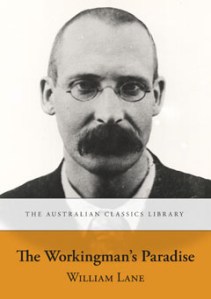
The workingman's paradise (Courtesy: Sydney University Press)

The workingman's paradise (Courtesy: Sydney University Press)

So says Bohemian Connie Stratton to the hero Ned Hawkins in William Lane’s 1892 novel, The workingman’s paradise. William Lane, an English-born journalist, union supporter and socialist, wrote under a number of pseudonyms including John Miller, the name he used for this novel which was re-published this year as part of the Australian Classics Library.

Lane writes in his preface that the book was titled and written “hurriedly”, in order to:

  • raise funds for unionists imprisoned during the Queensland Shearers Strike of 1891; and
  • explain unionism to non-unionists and Socialism “to all who care to read or hear, whether unionists or not”.

If this suggests to you that The workingman’s paradise is a social-realist novel, you would be right. It is very much a novel of ideas, which presents a bit of a challenge: shall I focus on the polemics or on the literary aspects? I will try to cover both – but it is worth reading this edition’s new introduction by academic, Andrew McCann, as it rather nicely explores the politics behind the novel.

As with many polemical novels, the plot is pretty minimal. It concerns two childhood friends, Nellie and Ned, who meet up again in Sydney in the 1880s having not seen each other for many years. Both are children of selectors who have struggled and both have become quite politicised, though at the beginning of the novel Nellie’s understanding of politics is broader and her commitment to the Cause (aka Socialism) more complete than Ned’s. Nellie loses no time in introducing Ned to the underside of Sydney life, and to her friends (who include the Connie of the opening quote). It is through these experiences that Ned’s political education is cemented. Oh, and there is of course an attraction between them!

The novel is divided into two parts: the first is set in the late 1880s when Ned comes to Sydney and meets Nellie and her friends, and the second takes place a couple of years later, on the eve of the Queensland Shearers Strike, when Ned returns to Sydney to garner support for the shearers. Without giving too much away, there is no real resolution to the plot, something which Lane refers to in his preface: “This plot got very considerably mixed and there was no opportunity to properly rearrange it”. If you read for plot, then, you may be disappointed, but if you read for characters, ideas and a fine use of the English language, this is well worth the effort. And there is some effort involved because, while it is not a particularly long novel, its main focus is its ideas and they require a reasonable level of concentration. There are a couple of places, such as socialist Geisner’s long discussion with Ned, which can become a little heavy-going if the subject is not to your interest.

Lane writes in a high rhetorical style that is rather typical of novels whose main purpose is didactic. He effectively uses such techniques as repetition (particularly anaphora), declamatory statements, and classical and biblical allusions to convey his message. This style can feel unsubtle and old-fashioned to modern ears but in Lane’s hands it has a certain beauty. There is, for example, a sophisticated use of repetition at the beginning of Part 2, Chapter 1: The slaughter of the innocent. Nellie is sitting with and thinking about a dying baby and, after each set of thoughts, is the following repetition:

So Nellie thought, sitting there beside it … (p. 152)

So Nellie thought, weeping there beside it … (p. 153)

So Nellie thought, the tears drying on her cheeks … (p. 154)

And that, you think is the end of them (three repetitions, after all, being the most common style), but then two pages later comes:

So Nellie thought, in her indignation and sorrow …

Through these repetitions we feel the buildup of her pain and see the progress of her thought from sadness to indignation.

The novel comprises more than simple argument though. In a nod to the romantic tradition, it is also a very visual novel with some effective descriptive passages, such as those showing us Sydney at its best and worst:

The streets, some wider, some narrower, all told of sordid struggling. The shops were greasy, fusty, grimy. The groceries exposed in their windows damaged specimens of bankrupt stocks, discoloured tinned goods, grey sugars, mouldy dried fruits; at their doors, flitches of fat bacon, cut and dusty. (p. 24)

and

At their feet the faint ripplings of this crystal lake whispered their ceaseless lullaby and close behind them the trees rustled softly in the languid breathings of the sleeping tree. Of a truth it was Paradise, fit above all fitness to gladden the heart of men, worthy to fill the soul to overflowing with the ecstasy of living, deserving to be enshrined as a temple of the Beautiful wherein all might worship together, each his own God. (p. 185)

The ideas expressed in the novel are simple, yet complex too. Through Ned and Nellie, and through discussions between two “masters”, the conciliatory Melsom and the “Capitalism personified” Strong, Lane explains the master-worker divide, the development of unions, and the “freedom of contract” idea. And through the meeting at the Strattons, and Ned’s later meetings with Geisner and then Connie, he conveys his conception of Socialism as a “religion” that “can only come by the utter sweeping away of competition, and that can only come by the development of the socialistic idea in men’s hearts”. (p. 138) True Socialism is defined by Geisner as “men working as mates and sharing with one another of their own free will [ie. not organised by the State]”. (p. 134) After reading this, you probably wouldn’t be surprised to hear that Lane ended up trying to establish a utopian community in Paraguay in 1893.

Using a variety of narrative techniques – including stories of characters met along the way – Lane manages to present a broad picture of working class 19th century Australia: the marine strike, the girls who end up on the street, the piece-workers at home, and the struggle to farm are just some of the stories woven through the book. Reading all this, you would think that Lane was the epitome of all that is humane, but for all the idealism – the arguments for gender equality, for the socialist ideal of equality between worker and master – the book has its discomforting side and this is its racist (specifically anti-Chinese) overtones. From very early in the book, the Chinese are held up, essentially, as the enemy in both city and country:

The fruiterers seemed not to be succeeding in their rivalry with each other and the Chinese hawkers. The Chinese shops were dotted everywhere, dingier than any other, surviving and succeeding, evidently by sheer force of cheapness … The day grow (sic) hotter and hotter. Ned could feel the rising heat, as though he were in an oven with a fire on underneath. Only the Chinese looked cool. (p. 24-25)

and

Then down would come the wages, up would go the hours and in would come the Chinese. (p. 238)

Even idealists, it seems, have their feet of clay!

This is the sort of book that can be read as a work of literature and as a work of political philosophy. While it can happily stand on its own as a literary classic for the quality of its writing, its prime value for me is its evocation of late nineteenth century Australia – an Australia which, you will have realised by now, was no “workingman’s paradise”!

Note on the text: The title page verso advises that the book is “a repaging of text files on SETIS, itself input from the 1892 edition …” I understand this text was input via OCR which is a boon for publishers wishing to reproduce pre-electronic texts but which can also result in a significant number of “artefacts” (misread characters). Sydney University Press has clearly worked hard to clean up the text but a number of these artefacts have slipped through. I understand they will be corrected for future printings.

(Review copy supplied by the Sydney University Press)