Jane Austen on reading novels

Jane Austen’s defence of the novel in Northanger Abbey is famous. Not only does the hero, Henry Tilney, tell the heroine Catherine, that:

The person, be it gentleman or lady, who has not pleasure in a good novel, must be intolerably stupid …

but Austen, in an authorial comment early in the book, says

… there seems almost a general wish of decrying the capacity and undervaluing the labour of the novelist, and of slighting the performances which have only genius, wit, and taste to recommend them. “I am no novel–reader — I seldom look into novels — Do not imagine that I often read novels — It is really very well for a novel.” Such is the common cant. “And what are you reading, Miss — ?” “Oh! It is only a novel!” replies the young lady, while she lays down her book with affected indifference, or momentary shame. “It is only Cecilia, or Camilla, or Belinda”; or, in short, only some work in which the greatest powers of the mind are displayed, in which the most thorough knowledge of human nature, the happiest delineation of its varieties, the liveliest effusions of wit and humour, are conveyed to the world in the best–chosen language.

This is Austen, though, and while she was passionate about the value of reading fiction, she also saw the other side. Not all novels, perhaps, are equal! And so, Catherine, a fan of the Gothic novel, is shown to be a rather silly novel reader, letting her imagination run too far and getting herself into trouble as a result. She does learn, though …

Northanger Abbey was published posthumously in 1817*. However, Austen wrote it in 1798/99, and revised it in 1803, when it was the first of hers to be sold to a publisher – Crosby & Co. They decided not to publish it, and it was bought back in 1816. Austen did further work on it before her death in 1817. My point though relates to the fact that the bulk of it was written in 1798/99. This is interesting, when you compare the excerpt above to this from her letter (no. 14) to her sister written on 18 December 1798:

I have received a very civil note from Mrs. Martin requesting my name as a Subscriber to her Library which opens the 14th of January, & my name, or rather Yours is accordingly given. My Mother finds the Money. …  As an inducement to subscribe Mrs. Martin tells us that her Collection is not to consist only of novels, but of every kind of Literature, & c. & c-She might have spared this pretension to our family; who are great Novel-readers & not ashamed of being so; – but it was necessary I suppose to the self-consequence of half her Subscribers.

Those comments “great Novel-readers & not ashamed of being so” and “The self-consequence of half her Subscribers” tell us very clearly that novel-reading in the late 1700s to early 1800s was seen by many as a frivolous activity. No wonder she, a beginning novelist, felt the need to defend her craft!

* Published in December 1817, but the imprint date is 1818.

Delicious descriptions from Down under: Jane Austen on politics

I was going to label this post “Jane Austen and plus ça change” but then decided to be provocative, because Austen is regularly criticised for not discussing politics, what was happening in her time, in her novels. Of course, I disagree that novelists have to specifically write about the political background to their stories. Those living in her time would have known, for example, about the Napoleonic Wars and their impact on society, about ongoing discussions regarding slavery, parliamentary power, free trade, and so on. Austen didn’t need to explain that background, and those issues weren’t the matters that she wanted to write about. She had something bigger in mind – human nature.

Nonetheless, I was tickled when reading one of her juvenilia pieces, Catharine, or the bower*, the other day, to come across the following**:

the Conversation turning on the state of Affairs in the political World, Mrs Percival, who was firmly of opinion that the whole race of Mankind were degenerating, said that for her part, Everything she believed was going to rack and ruin, all order was destroyed over the face of the World, the house of Commons she heard did not break up sometimes till five in the Morning, and Depravity was never so general before; concluding with a wish that she might live to see the Manners of the People in Queen Elizabeth’s reign, restored again. “Well, Ma’am,” said her Neice [Catharine aka Kitty], “but I hope you do not mean with the times to restore Queen Elizabeth herself.”

“Queen Elizabeth,” said Mrs Stanley, who never hazarded a remark on History that was not well founded, “lived to a good old age, and was a very Clever Woman.” “True, Ma’am,” said Kitty; “but I do not consider either of those Circumstances as meritorious in herself, and they are very far from making me wish her return, for if she were to come again with the same Abilities and the same good Constitution She might do as much Mischeif and last as long as she did before-.”

Of course, this doesn’t address specific political events or situations, but it suggests (to me anyhow) that politics and history were topics of conversation in Austen’s neighbourhood, and that she was well able to satirise the quality of that discussion. It also demonstrates Austen’s ability to describe and satirise her characters through their own mouths!

Oh, and despite – or in addition to – my comments above, I would argue that Austen’s novels can have a political reading, can show how political debate and events were shaping her world, but that’s a topic for a different post.

*Written in 1792, her 17th year
**This rather idiosyncratic-looking text is based on the original manuscript in the British Library from the Oxford World’s Classics edition published by Oxford University Press (on my Kindle)

Jane Austen’s letters, 1796-1800

Austen's desk, Chawton. (Photo: Monster @ flickr.com)

Austen’s desk, Chawton. (Photo: Monster @ flickr.com)

For the past five years my Jane Austen group has been reading Jane Austen’s letters in a rather higgledy piggdledy manner*. We have nearly finished now. We have just done her first letters, and next year we will conclude, logically at last, on her final letters. What a fascinating time we’ve been having.

Jane Austen’s first published letter was written in January 1796, when she was just 20, and it is in this first letter that she mentions Tom Lefroy, the young man, also just 20, with whom she had a romantic attachment. Lefroy later became the Lord Chief Justice of Ireland. When asked many years after her death about his relationship with Austen, he admitted to a “boyish love”. Here is our first mention, in Letter 1:

… I am almost afraid to tell you how my Irish friend and I behaved. Imagine to yourself everything most profligate and shocking in the way of dancing and sitting down together. I can expose myself however, only once more, because he leaves the country soon after next Friday, on which day we are to have a dance at Ashe after all. He is a very gentlemanlike, good-looking, pleasant young man, I assure you. But as to our having ever met, except at the three last balls, I cannot say much; for he is so excessively laughed at about me at Ashe, that he is ashamed of coming to Steventon, and ran away when we called on Mrs. Lefroy [Tom’s aunt and a friend of the Austens] a few days ago.

In Letter 2, a few days later, she mentions a party to be held at the Lefroy home the next night:

I look forward with great impatience to it, as I rather expect to receive an offer from my friend in the course of the evening. I shall refuse him, however, unless he promises to give away his white Coat.

Is she expecting a proposal from Tom? The “great white Coat” is a tongue-in-cheek (and, perhaps, also self-preserving) reference to her comment in the previous letter about his morning coat being “a great deal too light”. Later in the letter, which she started on Thursday and finished on Friday, comes:

Friday. — At length the day is come on which I am to flirt my last with Tom Lefroy, and when you receive this it will be over. My tears flow as I write at the melancholy idea.

The only other reference to Tom Lefroy occurs well over a year later in November 1798, Letter 11:

Mrs. Lefroy did come last Wednesday, and the Harwoods came likewise, but very considerately paid their visit before Mrs. Lefroy’s arrival, with whom, in spite of interruptions both from my father and James, I was enough alone to hear all that was interesting, which you will easily credit when I tell you that of her nephew she said nothing at all, and of her friend very little. She did not once mention the name of the former to me, and I was too proud to make any enquiries [my stress]; but on my father’s afterwards asking where he was, I learnt that he was gone back to London in his way to Ireland, where he is called to the Bar and means to practise.

It’s all very tantalising – but at the very least it’s pretty clear that Jane Austen learnt something about love and loss from this experience. A brief description of the “affair” can be read here on the JASA website.

Austen, though, was not one to wallow. I loved her comment in a later letter (January 1799) that:

I had a very pleasant evening, however, though you will probably find out that there was no particular reason for it; but I do not think it worth while to wait for enjoyment until there is some real opportunity for it. (Letter 18)

A positive philosophy that she does seem to have lived by, if her letters are to be believed.

These letters, like those I’ve written about previously, provide much information about her life and times – about the dangers of childbirth, health and medical treatment, men’s careers, farming, housekeeping and fashion – often delivered in Austen’s witty, often also acerbic tongue. As before, I’ll share just a few here …

Fashion

Austen talks a lot about clothing in the letters, so much so that some readers find it boring. However, her fashion talk tells us more than simply what she and Cassandra are wearing. For example, we learn about the craze for Marmalouc caps, which reminds us of the Napoleonic Wars as the caps were inspired by Egyptian turbans after the Battle of the Nile in August 1798. We learn about Austen’s tight financial situation. Caps and gowns were re-trimmed to suit another Ball or season, items are shared (the Marmalouc cap itself was borrowed from sister-in-law Mary Austen). Best of all, though, we get her wit such as her description of the rage for wearing flowers and fruits (Letter 21) in Bath. In Letter 22, she responds to Cassandra’s request for some Bath fashion, but she’s having trouble deciding:

I cannot decide on the fruit until I hear from you again. – Besides, I cannot help thinking that it is more natural to have flowers grow out of the head than fruit. – What do you think on that subject?

Childbirth, Health and Medical Treatments

I could write a whole post just on her discussion of health-related matters. We hear of women dying in childbirth, of people taking or drinking the Waters in Bath for assorted health concerns, of her mother’s using laudanum for pain, of the use of electricity for pain relief … Again, though, there’s often a sting in the tail. It’s generally believed that Jane had a tricky relationship with her mother who was somewhat of a hypochondriac. In several of these early letters she reports on her mother’s health. Here is one (Letter 18):

She is tolerably well – better on the whole than she was some weeks ago. She would tell you herself that she has a very dreadful cold in her head at present; but I have not very much compassion for colds in the head without fever or sore throat.

In other letters, though, she does show more tenderness!

Writing and novels

Her own writing is rarely mentioned in these early letters, but the first version of Pride and prejudice, then titled First impressions, is referred to a couple of times. Here is a tongue-in-cheek reference to her friend and future sister-in-law Martha Lloyd reading it:

I would not let Martha read “First Impressions” again upon any account, and am very glad that I did not leave it in your power. She is very cunning, but I saw through her design; she means to publish it from memory, and one more perusal must enable her to do it.

But, my favourite comment on writing in this group of letters relates to her assessment of the novel, Fitz-Albini, that she and her father were reading (Letter 12):

We have got “Fitz-Albini;” my father has bought it against my private wishes, for it does not quite satisfy my feelings that we should purchase the only one of Egerton’s works of which his family are ashamed. That these scruples, however, do not at all interfere with my reading it, you will easily believe. We have neither of us yet finished the first volume. My father is disappointed – I am not, for I expected nothing better. Never did any book carry more internal evidence of its author. Every sentiment is completely Egerton’s. There is very little story, and what there is told in a strange, unconnected way. There are many characters introduced, apparently merely to be delineated. We have not been able to recognise any of them hitherto, except Dr. and Mrs. Hey and Mr. Oxenden, who is not very tenderly treated.

The novel was apparently highly autobiographical and in it, according to the Gentleman’s Magazine (1837), Egerton “depicted with the utmost freedom the foibles not only of his neighbours and acquaintances, but even [my stress] those of his own family and relations”.  What I most like about Austen’s comment though is the insight it gives into her views on what makes a good novel. It shouldn’t be so transparently the author’s opinions; it should have a clear storyline; and the characters should have some substance. Ah Jane, she knew how to write …

* Past posts discussing the letters: The first covered her letters from 1814 to 1816, the second from 1811 to 1813, the third from 1807 to 1809, and the fourth from 1801-1806.

Happy 200th birthday to Pride and prejudice

Pride and prejudice book covers

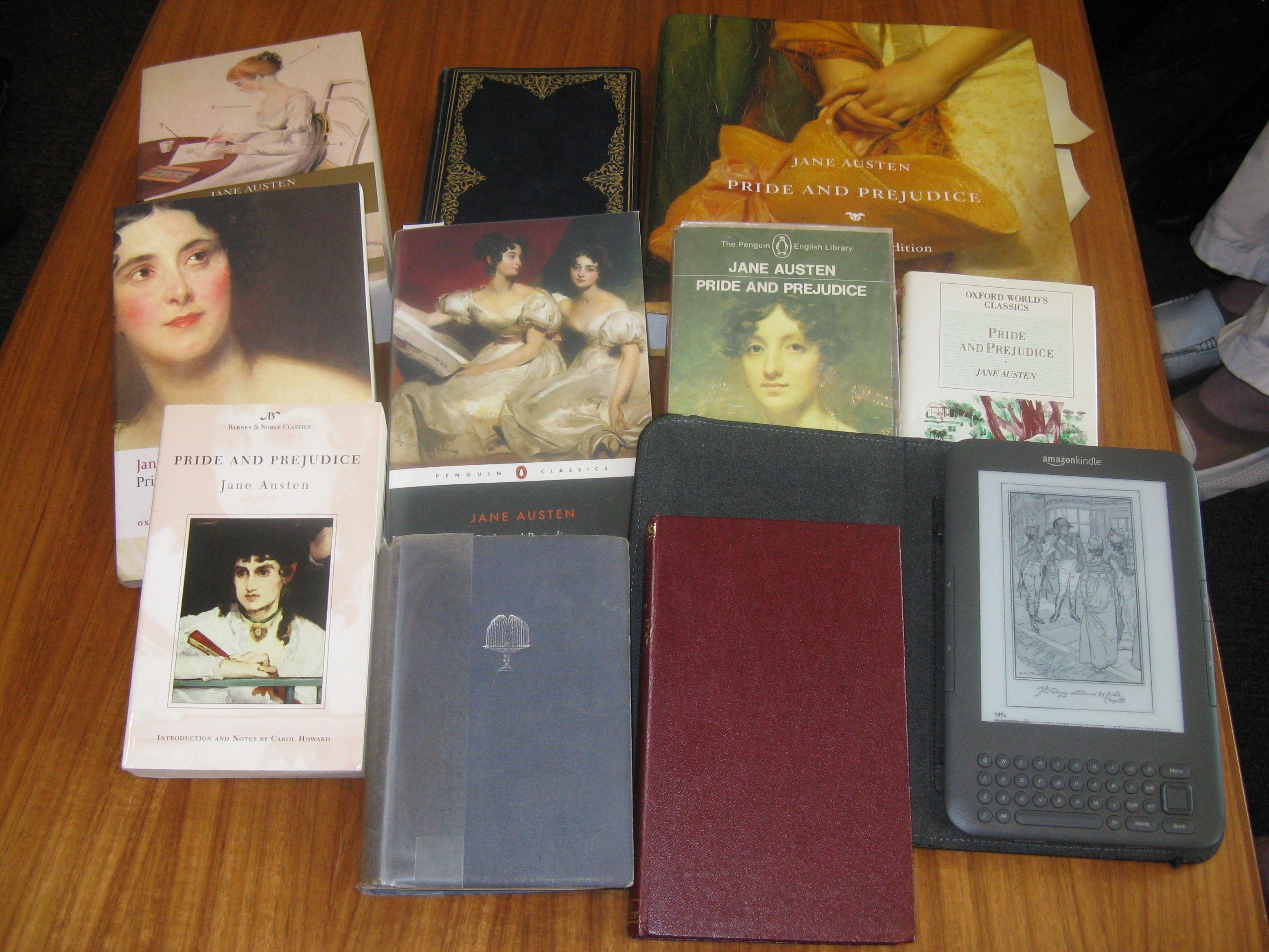
Just a few editions of Pride and Prejudice

It is a truth … no, I can’t go there but, just in case you haven’t caught up with the news, I’m here to tell you that today, January 28, is the 200th anniversary of Jane Austen’s most popular novel, Pride and prejudice.  And so I’ve decided to give Monday Musings a break this week and talk a little about this book. But where to start? What can I say that hasn’t already been said?

How about what the book means to me. It is the book that turned me from being a book reader to a literature lover. I hope that doesn’t sound snooty but what I mean is that Pride and prejudice is the first book to teach me that there can be more to reading books than quick page-turning to find out what happens in the story. There’s nothing wrong with page-turners – they serve a very important purpose in helping us to escape the daily grind – but books can offer a lot more if we want something else from the time we spend reading. They help us better understand the human condition, they can challenge our intellect, and they can appeal aesthetically.

Pride and prejudice, like all of Jane Austen’s novels, satisfies the first of these in spades. Through her characters, Austen demonstrates an in-depth knowledge of human nature. She shows us kindness, compassion, envy, selfishness, stupidity, thoughtlessness, integrity, anger, pride, prejudice and more, including, though Charlotte Bronte (who once wrote that “she ruffles her reader by nothing vehement”) would not agree, passion. Mr Darcy’s ghastly “in vain have I struggled” proposal is nothing if not passionate. I for one don’t need ripped bodices to feel the passion!

Regarding challenging our intellect, one of the delights of reading Austen is the mind games she plays with us – the irony, the wit, keep us on our toes, encouraging us to see the meanings beneath the surface. And, if you read for plot, try reading an Austen novel a second time and you will see how perfectly she plots. Rereading books like Pride and prejudice brings so many pleasures. It’s like meeting an old friend and learning new things about her that enrich your relationship and remind you why she became your friend in the first place.

The aesthetic pleasures are something else – and I fear I’m on thin ground here because I’m probably using the term quite differently to the way philosophers and literary theorists might use it, but it’s the best I can come up with. What I mean is appreciating the novel as a work of art, regardless of its content. Readers from the 20th and 21st centuries can, I think, find Austen’s “art” a little quaint, if not downright dated, but in fact she was innovative. Susannah Fullerton in her latest book, Happily ever after: Celebrating Jane Austen’s ‘Pride and prejudice’, spends a few pages on this. Austen’s main innovation lies in her use of “free indirect discourse” (FID) or “free indirect speech”. She was not the first writer to use it, but was, says Fullerton, “the first English novelist to use FID consistently and extensively”. It is used in third person narratives and involves “hearing” what a character feels or thinks without the use of dialog and not via authorial interaction or the omnipotent narrator. We feel, in other words, that we are in the character’s head rather than being “told” what s/he feels. Austen slips between third-person and this interior mode regularly in her novels. It allows us, in Pride and prejudice, for example, to feel right along with Elizabeth – but the advantage of this technique is that it can shift from character to character in between omnipotent third-person narration. These and the rest of Jane Austen’s grab bag of literary techniques are another reason why she’s such a pleasure to read – and why her books are just plain beautiful.

In other words, Pride and prejudice is the real deal – great story and characters, along with food for the mind, the intellect and the heart. No wonder it has never been out of print.

What did Jane Austen look for in a novel?

There are those who don’t get Jane Austen. Some think her novels are silly romances while others think that she writes stories about the well-to-do who, they feel, aren’t relevant or worthy subjects.

Nothing, really, could be further from the truth. Her novels may be romantic but they are more than simple romances. Jane Austen loved to satirise human foibles (as she did Mr Collins’ pomposity in Pride and prejudice). She cared deeply about the lot of women who had little financial support (such as Jane Fairfax in Emma). With the exception of Emma, in fact, her heroines are not rich, and some are in quite precarious financial situations. However, she wanted them to be able to choose partners they love and respect (as Elizabeth Bennet does in Pride and prejudice) … though she knew that this wasn’t easy or straightforward in Regency times.

But don’t take my word for it. Listen to the author herself – in a letter to her niece Fanny – written only months before she died:

He and I should not in the least agree, of course, in our ideas of novels and heroines. Pictures of perfection make me sick and wicked.

What better manifesto or clearer indication of her novelistic imperative could she have left for us? Life and people weren’t perfect, and nor would her novels be.

William Gilpin, Jane Austen and the picturesque

I was introduced to William Gilpin by Jane Austen. Well, not by her so much as by her brother, Henry, who told us* that she was “enamoured of Gilpin on the Picturesque at a very early age”.

Engraving of Rev. William Gilpin.

William Gilpin (Harper’s New Monthly Magazine, No. 231, August, 1869.Public Domain, via Wikipedia)

This month my local Jane Austen group decided to look a little more deeply at Gilpin, his Picturesque, and what Jane Austen really thought. William Gilpin (1724-1804) was an English vicar, schoolteacher, prolific writer and amateur painter. He is remembered primarily for his theory of “the picturesque”. The “picturesque”, according to my Shorter Oxford English Dictionary, dates back to 1703 with the meaning, “in the manner of a picture; fit to be made into a picture”. In his Essay on Prints (1768), Gilpin defined it as “… a term expressive of that peculiar kind of beauty, which is agreeable in a picture”.

The blogger at Austenonly has written an excellent post on Jane Austen and Gilpin in which she proposes – and my group here agreed with her – that Austen was enamoured of him because he appealed to her sense of the ridiculous. He expresses his opinions so dogmatically, he is so opinionated, that she can’t help mocking him. How could she not satirise a man who seriously suggests (“Essay 1: On Picturesque Beauty”, Three Essays) that, when it comes to a portrait, “the highest form of picturesque beauty” is not “the lovely face of youth smiling with all its sweet dimpling charms” but “the patriarchal head” with its “lines of wisdom and experience … the rough edges of age”. Being a woman of a certain age, I rather like Mr Gilpin! But, seriously, is it really a matter of either/or?

Or someone who writes (in the same essay):

A piece of Palladian architecture may be elegant in the last degree. The proportion of its parts — the propriety of its ornaments — and the symmetry of the whole, may be highly pleasing. But if we introduce it in a picture, it immediately becomes a formal object, and ceases to please. Should we wish to give it picturesque beauty, we must, use the mallet, instead of the chisel : we must beat down one half of it, deface the other, and throw the mutilated members around in heaps. In short, from a smooth building we must turn it into a rough ruin. No painter, who had the choice of the two objects, would hesitate a moment.

We must presume that he is not speaking literally when he suggests taking a mallet to a pleasing building in order to make it picturesque! But Jane Austen is sure to have laughed and, as you’ll read in Austenonly’s post, there are many examples in Austen’s novels, particularly Pride and prejudice, Sense and sensibility and Northanger Abbey, in which she satirises the picturesque.

On the other hand, there are also places where she seems to exhibit an appreciation and understanding of Gilpin’s theory because, while Gilpin could be dogmatic, he also argued convincingly for a seeing nature with “a picturesque eye”. He writes in “Essay 2: On Picturesque Travel” about enjoying “the great works of nature, in her simplest and purest stile, open to inexhaustible springs of amusement”, and says

Nor is there in travelling a greater pleasure, than when a scene of grandeur bursts unexpectedly upon the eye, accompanied with some accidental circumstance of the atmosphere, which harmonises with it, and gives it double value.

I’ll illustrate this with two examples of travellers in Austen. First is her description of Fanny’s return to from Portsmouth in Mansfield Park:

Her eye fell everywhere on lawns and plantations of the freshest green; and the trees, though not fully clothed, were in that delightful state when farther beauty is known to be at hand, and when, while much is actually given to the sight, more yet remains for the imagination.

There is also a lovely, similarly genuine, description of the environs of Lyme in Persuasion in which she writes of a “sweet, retired bay, backed by dark cliffs, where fragments of low rocks among the sands make it the happiest spot for watching the flow of the tide …”

The question that comes to mind then is whether she is satrising the picturesque or slavish adherence to it or, even perhaps, its somewhat slippery nature. In fact, Jane Austen, landscape and the Regency is a pretty inexhaustible topic. And so, while I thoroughly enjoyed my brief introduction to Mr Gilpin, I’d love to find time to read more, particularly his travel writings about various parts of the British Isles. Meanwhile, I can’t resist leaving you with another Gilpin satirist, William Combe (1741-1823), who in 1809, as Dr Syntax, wrote the poem “The Tour of Dr Syntax in Search of the Picturesque”. It starts with

I’ll make a tour – and then I’ll write it.
You well know what my pen can do,
And I’ll employ my pencil too:-
I’ll ride and write, and sketch and print,
And thus create a real mint;
I’ll prose it here, I’ll verse it there,
And picturesque it everywhere.
I’ll do what all have done before;
I think I shall – and somewhat more.
At Doctor Pompous give a look;
He made his fortune by a book:
And if my volume does not beat it,
When I return, I’ll fry and eat it.

What a hoot …

* in his biographical note to the posthumously published first edition of Northanger Abbey and Persuasion

Virginia Woolf on Jane Austen’s Love and freindship

A couple of weeks ago I reviewed Jane Austen‘s juvenilia work, Love and freindship. I wanted, then, to share with you Virginia Woolf‘s take on Jane and the work, but decided it would be better as its own post, so here I am again.

Woolf was quite an essayist, as you probably know, as well as a novelist, and she wrote several essays about Jane Austen (as well as featuring Austen in her famous A room of one’s own). Today’s post was inspired by an essay that is simply titled, “Jane Austen”. You can read it at Project Gutenberg. The essay was published in 1925 in her book, The common reader, though it may have been previously published in a newspaper or journal. It says something, I think, that in an essay of just a few pages she devotes a couple of paragraphs to a piece of juvenilia (that is, Love and freindship). This is what she says:

To begin with, that prim little girl whom Philadelphia [a cousin] found so unlike a child of twelve, whimsical and affected, was soon to be the authoress of an astonishing and unchildish story, Love and Freindship, which, incredible though it appears, was written at the age of fifteen. It was written, apparently, to amuse the schoolroom; one of the stories in the same book is dedicated with mock solemnity to her brother; another is neatly illustrated with water-colour heads by her sister. These are jokes which, one feels, were family property; thrusts of satire, which went home because all little Austens made mock in common of fine ladies who “sighed and fainted on the sofa”.

Brothers and sisters must have laughed when Jane read out loud her last hit at the vices which they all abhorred. “I die a martyr to my grief for the loss of Augustus. One fatal swoon has cost me my life. Beware of Swoons, Dear Laura. . . . Run mad as often as you chuse, but do not faint. . . .” And on she rushed, as fast as she could write and quicker than she could spell, to tell the incredible adventures of Laura and Sophia, of Philander and Gustavus, of the gentleman who drove a coach between Edinburgh and Stirling every other day, of the theft of the fortune that was kept in the table drawer, of the starving mothers and the sons who acted Macbeth. Undoubtedly, the story must have roused the schoolroom to uproarious laughter. And yet, nothing is more obvious than that this girl of fifteen, sitting in her private corner of the common parlour, was writing not to draw a laugh from brother and sisters, and not for home consumption. She was writing for everybody, for nobody, for our age, for her own; in other words, even at that early age Jane Austen was writing. One hears it in the rhythm and shapeliness and severity of the sentences. “She was nothing more than a mere good-tempered, civil, and obliging young woman; as such we could scarcely dislike her–she was only an object of contempt.” Such a sentence is meant to outlast the Christmas holidays. Spirited, easy, full of fun, verging with freedom upon sheer nonsense,–Love and Freindship is all that; but what is this note which never merges in the rest, which sounds distinctly and penetratingly all through the volume? It is the sound of laughter. The girl of fifteen is laughing, in her corner, at the world.

I like the way Woolf looks at Austen with a writer’s eye – in regards to both content and style. I particularly love the line – “She was writing for everybody, for nobody, for our age, for her own; in other words, even at that early age Jane Austen was writing”. I like her recognition of Austen’s technical skill when she describes “the rhythm and shapeliness and severity of the sentences”. On top of all this, Woolf sees Austen’s humour, her ability to laugh at the world. The humour in this little piece of juvenilia is broad, but it’s there and Woolf saw and appreciated it.

And that’s all I’m going to say, because these two paragraphs stand on their own, don’t they?

Jane Austen, Love and freindship (Review)

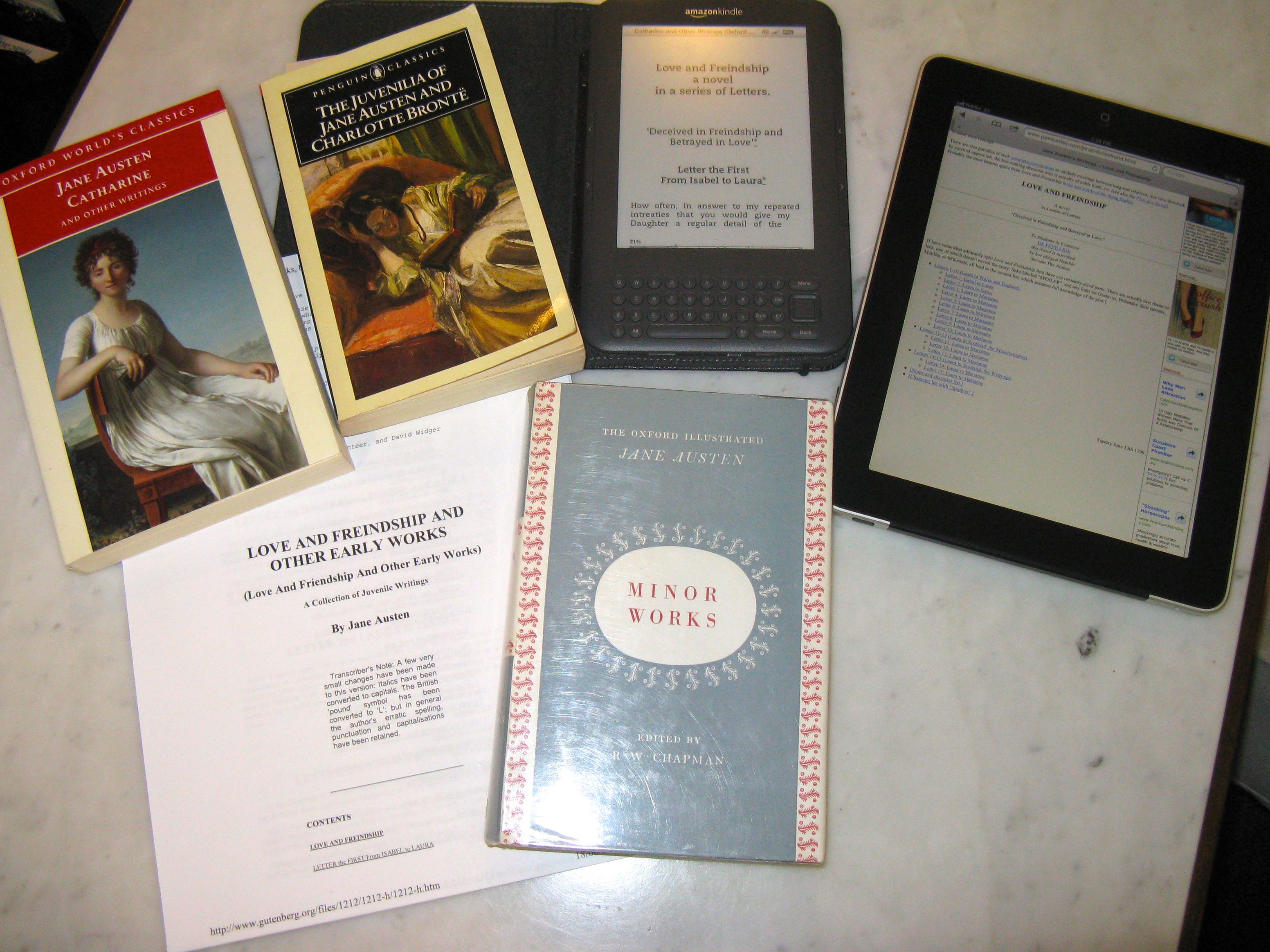
Love and Freindship editions

Love and Freindship editions

If you are a Jane Austen fan, you don’t just read her six novels. You read her letters, her unfinished works and her juvenilia. And you read them more than once. So it is that I have just – for my local Jane Austen group – reread Love and freindship (sic), the short epistolary novel she wrote in her 15th year. It is a fun – and illuminating – read. It’s the illuminating part that I plan to focus on here.

But first, a little about the plot. It commences with a letter in which Isabella asks her friend Laura to tell her daughter “the Misfortunes and Adventures” of her Life. “You are this day 55”, she says, and surely now safe “from the determined Perseverance of disagreeable Lovers and the cruel Persecutions of obstinate Fathers”. Laura, while rejecting that she is too old for such “unmerited” misfortunes, agrees to tell her story  to Isabella’s daughter Marianne as a “useful lesson”. What follows is a melodramatic story of sudden friendships, quick-not-always legal marriages, and wild coincidences, accompanied by much fainting and “running mad”.

This doesn’t sound much like the writer described by Charlotte Bronte as “sensible and suitable” does it? And, in fact, this wildly improbable, effusive story isn’t much like her. Or is it? This is the point I’d like to explore a little in my post, because there are many seeds here of the writer Austen was becoming – of the things that were to concern her and of the style she was developing.

The thing that concerned her most was to make fun of silly or ridiculous people and ideas. The most obvious of these in Love and freindship was the late eighteenth century’s cult of sensibility, which involved the favouring of sensibility over sense, the fostering of an overactive imagination (as evidenced by the popularity of Gothic novels). But what is exaggerated and parodied in Love and freindship become more considered subjects in her first novels, Northanger Abbey and Sense and sensibility.

There are, for example, obvious similarities between Laura, here, Catherine Morland in Northanger Abbey and Marianne in Sense and sensibility, but Laura’s complete refusal to recognise that sense has any place in her life is modified in Catherine and Marianne who learn through experience that their imagination and sensibilities, if left uncurbed, can get them into trouble. (Intriguingly the recipient of Laura’s letters is a Marianne. A little Austen in-joke perhaps?). Pride and Prejudice’s Lydia could perhaps be seen as Laura’s true heir: Lydia is not described in quite the same terms as Laura, but she certainly pays no credence to anything remotely sensible.

Now I’m going to be lazy and simply illustrate Austen’s changed approach with some comparative examples. Here is Laura on an older man, her husband’s father:

for what could be expected from a Man who possessed not the smallest atom of Sensibility, who scarcely knew the meaning of Simpathy, and who actually snored.

And here is Marianne, in love with the dashing Willoughby, on Colonel Brandon:

He was silent and grave. His appearance, however, was not unpleasing, in spite of his being in the opinion of Marianne and Margaret an absolute old bachelor, for he was on the wrong side of five-and-thirty; but though his face was not handsome his countenance was sensible, and his address was particularly gentlemanlike.

While Laura ends her tale with:

I took up my Residence in a romantic Village in the Highlands of Scotland where I have ever since continued, and where I can, uninterrupted by unmeaning Visits, indulge in a melancholy solitude my unceasing Lamentations for the Death of my Father, my Mother, my Husband, and my Freind.

Catherine learns her lesson and

… was completely awakened. Henry’s address, short as it had been, had more thoroughly opened her eyes to the extravagance of her late fancies than all their several disappointments had done. Most grievously was she humbled. … The absurdity of her curiosity and her fears — could they ever be forgotten? She hated herself more than she could express.

Exaggeration and parody are the tools used in Love and friendship, while the adult Austen used the more sophisticated, though no less funny, tools of wit and irony to achieve her satire.  And again, I’ll demonstrate with comparative examples. In Love and freindship she satirises novel-reading with broad humour:

“Where, Edward in the name of wonder (said he) did you pick up this unmeaning gibberish? You have been studying Novels I suspect.”

But in Northanger Abbey, the plot itself demonstrates the foolishness of reading novels unwisely, while a respected character conveys Jane’s truth:

The person, be it gentleman or lady, who has not pleasure in a good novel, must be intolerably stupid.

Love and friendship is unsubtle, and is clearly the work of a youthful writer, but it is a hoot to read and we are lucky to have it (and her other juvenilia) to show us an author in the making.

Note: Love and friendship (1790) is available in many formats and manifestations. My first copy was in RW Chapman’s edition of her Minor works, but this time I read it on my Kindle using a bought version, the Oxford World Classics edition titled Catharine and Other Writings. However, you can read (or obtain) it online at Project Gutenberg.

Jane Austen’s letters, 1801-1806

The  years from 1801 to 1806 were somewhat unsettled if not downright traumatic years for Jane Austen. In December 1800 her father retired and her parents decided to move themselves and their two daughters to Bath. And then in 1805 her father died, suddenly. She writes to her brother, Francis, on 21 January (Letter 40) that “I wish I could have given you better preparation-but it has been impossible”. The impact, though, was greatest on the women. It left them in a difficult and dependent financial position.

Austen writes about the above events in the letters, but there are others about which she is silent. This could be because she and her sister Cassandra, the main recipient of her letters, were together, but it could also be because Cassandra destroyed selected letters after Jane’s death in 1817. One event not in these letters is the famous proposal by Harris Bigg-Wither in 1802. Austen accepted the proposal but the next day changed her mind, and promptly left the Bigg-Wither home with Cassandra. It was a distressful situation, as the Bigg-Withers were family friends.

Something else she doesn’t talk about in this selection of letters is her writing. She didn’t write a lot during this time, and nothing, as far as we know, from the time of her father’s death until they settled in Chawton in 1809. But, she did revise Northanger Abbey (then called Susan) in 1802, selling it to a publisher in 1803, and she started her (unfinished, as it turned out) novel, The Watsons, in 1804.

So, there’s quite a bit she didn’t talk about – in the surviving letters – but there’s still plenty to interest here. These letters were written when Austen was aged 25 to 30 years old, years when she was still relatively young but old enough to have some experience of the world. As with the later letters, there’s a lot of gossip and chat about family and friends, but there are signs of the novelist she was becoming, in addition to insight into life in Georgian England.

As with my last post on her letters, I’ll use headings to structure my discussion.

Georgian England

Jane Austen wrote novels about her own era and in many ways her letters replicate in reality much of what we learn from her fiction. She describes, in these letters, modes of transport and particularly travelling arrangements for women, the boats her Naval brothers worked on, accommodation hunting in Bath, fashion, card games, balls and food. All of these we find in her novels – sometimes with barbed effect.

I particularly liked her descriptions of place. Here is Bath, soon after her arrival:

The first view of Bath in fine weather does not answer my expectations; I think I see more distinctly through rain. The sun was got behind everything, and the appearance of the place from the top of Kingsdown was all vapour, shadow, smoke, and confusion, (Letter 35)

And a little town called Appleshaw:

that village of wonderful Elasticity, which stretches itself out for the reception of everybody who does not wish for a house on Speen Hill (Letter 30)

How could someone who writes that not be a novelist!

Lyme, as Austen readers will know, is where a major scene occurs in Persuasion. What, though, do you think she thinks of the place when you read this description of

a new odd-looking man who had been eyeing me for some time, and at last, without any introduction, asked me if I meant to dance again. I think he must be Irish by his ease, and because I imagine him to belong to the hon(ble) Barnwalls, who are the son, and son’s wife of an Irish viscount, bold queer-looking people, just fit to be quality at Lyme

On her self

Not surprisingly, we learn quite a lot about Austen, directly and indirectly, through these letters. We learn much  about her likes and dislikes. She’s interested in fashion but she doesn’t like “tiny” parties with only a few people “to talk nonsense to each other”. She spanned the Age of Reason and of Romanticism, but she’s more a child of the former: she highly values “wit”, a word that appears repeatedly in her descriptions of people, often defining whether she likes them or not, and she approves rationality. “To be rational in anything”, she says, “is great praise” (Letter 43).

We also learn something about her character. She’s stoical, for example, writing about a disappointment that “there is nothing which energy will not bring one too.” (Letter 33).

Clergy

If you’ve read Jane Austen you know that she has pretty definite ideas on the clergy. She ridicules pomposity (Mr Collins in Pride and prejudice) and vanity (Mr Elton in Emma). She admires sense and responsibility (Edmund in Mansfield Park). I had to laugh, then, when I read this in her letter:

You told me some time ago that Tom Chute had had a fall from his horse, but I am waiting to know how it happened before I begin pitying him, as I cannot help suspecting it was in consequence of his taking orders; very likely as he was going to do Duty or returning from it.  (Letter 44)

How I wish I could write letters like this!

Observations of people

It is her observations of people, however, that most delight readers of her letters and show us her novelistic eye in the making. In this group of letters, for example, is a wonderful description of an older woman that doesn’t take much to remind us of Emma’s Miss Bates:

Poor Mrs** stent! it has been her lot to be always in the way; but we must be merciful, for perhaps in time we may come to be Mrs** stents ourselves, unequal to anything & unwelcome to everybody. (Letter 44)

I would not have wished our Jane to have ended up as impecunious as poor Miss Bates, but I do wish she’d lived a bit longer to give us more novels and more letters to enjoy.

Note: This is my fourth post on Austen’s letters. The first covered her letters from 1814 to 1816, the second from 1811 to 1813, and the third from 1807 to 1809.

PD James, Death comes to Pemberley (Review, sorta)

How do you review or evaluate a Jane Austen “sequel”*? Do we expect, want even, the author to channel Austen? I suspect the answer is as varied as are the readers of sequels, and it probably depends on why we read Austen. Those who are mostly interested in the stories and what happens to the characters are likely to have a completely different perspective from those who love Austen’s language and her very particular wry, sly eye on humanity. I fall into the latter group and this is why I am not drawn to sequels. I want to read Austen for Austen, and other writers for their style and worldview.

I have just read PD JamesDeath comes to Pemberley. I’d describe it as a traditional sequel, with a difference. That is, it picks up the story of Elizabeth and Darcy some six years after their wedding, but it is a crime novel, which adds an extra complication for the reviewer, because not only is there the issue of Jane Austen’s story and characters to consider, but there’s a shift in genre. This, I’ll admit right now, puts me at a double disadvantage: I don’t read Jane Austen sequels and I don’t read crime novels. So why did I read this book? Two reasons really. It was given to me by a friend and my local Jane Austen group decided to discuss it as part of this year’s focus on Pride and prejudice.

I’m glad I read it, mainly because I’ve been wanting to try a “sequel” for some time to understand what they are all about – and a sequel by a writer of PD James’ reputation seemed like a good one to try. However, I can’t say I really enjoyed it. It was, however a quick read – and I did find it intriguing to ponder what sequel readers look for.

Before I discuss that, I’d better say something about the plot, though that’s hard without giving too much away. The story proper starts on the night before a big annual ball. Elizabeth, Darcy, Colonel Fitzwilliam (now Viscount Hartlep), Georgiana and the Bingleys are all at Pemberley getting ready, when a carriage careens into view carrying, we soon discover, an hysterical Lydia claiming that her husband, Wickham, has been shot. Darcy, Colonel Fitzwilliam and a new character and suitor to Georgiana, Alveston, set off into the woods to find out if indeed this has been the case. The novel then, as crime novels tend to do, follows the story of a murder through inquest, trial and resolution. It’s an interesting enough plot, and one whose resolution I didn’t guess. But then, as I’ve already said, I’m not a crime reader.

But now, rather than review the book in my usual way, I’m going to talk about it specifically in terms of its “sequelness”. (Is that an ok neologism?). So here goes…

Characterisation

If there’s one thing a sequel should do, I think, it’s to be true to the characters. No matter what new situation they are placed in, they need to still be them. Unfortunately, in this novel, Elizabeth and Darcy do not come across as Jane Austen’s creations. Darcy spends most of the novel – which, remember, occurs six years after the wedding – bothering about his decision to marry Elizabeth and how it returned Wickham to his world. He’s not sorry about marrying Elizabeth but he mulls and mulls and mulls yet again about the implications feeling, for example, “that he had lost some respect in his cousin’s [Col Fitzwilliam] eyes because he had placed his desire for a woman above the responsibilities of family and class”. That’s not our Darcy!

Similarly, it’s a rather subdued Elizabeth we see. Sure, she’s older but she is still in her 20s. And sure, she’s now the mistress of Pemberley, but that doesn’t mean the young woman who stood up to Lady Catherine, unlike “sensible” girls who recognise their need of a husband, now has to be quiet and, yes, dull. Why doesn’t she tell Darcy of some clues and suspicions that may be relevant to the murder?

Would Charlotte Lucas really harbour resentment towards Elizabeth? James suggests she does:

… but it was unlikely that Charlotte had either forgotten or forgiven her friend’s first response to the news [that she’d accepted Mr Collins].

Style

I’m not sure that a sequel must ape Austen’s style … which is just as well because James doesn’t really. The problem is that I think she tried. She’s clearly a good writer, but it probably would have been better for her to stick to what she does best. There were moments of wit and humour, but much was ponderous. Here is Georgiana’s suitor speaking to Darcy:

Forgive me, sir, but I feel I must speak. You discuss what Miss Darcy should do as if she were a child. We have entered the nineteenth century; we do not need to be a disciple of Mrs Wollstonecraft to feel that women should not be denied a voice in matters that concern them. It is some centuries since we accepted that a woman has a soul. Is it not time that we accepted that she also has a mind?

This is way too didactic and preachy for Austen, particularly for a non-Mr-Collins-like character. The dialogue, overall, lacks Austen’s light touch – and is often stilted without capturing the formality of the period.

There were times too when I felt she was more Dickens than Austen. Some of her characters’ names are pure Dickens, such as Hardcastle, Pegworthy and Belcher.

However, I understand that James is known for her settings – something that Austen did not focus much on – and her descriptions of place are generally evocative and effective.

Observations

Along with her style, it’s the way Austen hones in on human behaviour and describes it with brevity and wit  that keeps me coming back to her. James was clearly keen to match Austen in this area and occasionally made me smile, as with this description:

… had exacerbated a disagreement common in marriages wherein an older husband believes that money should be used to make more of it, and a young and pretty wife is firmly of the view that it exists to be spent; how otherwise, as she frequently pointed out, would anyone know that you had it?

And this comment by the imperious Lady Catherine:

I have never approved of protracted dying. It is an affectation in the aristocracy; in the lower classes it is merely an excuse for avoiding work.

These little commentaries were like beacons in the forest … and showed me that, despite the misses in the novel, James does “get” Austen.

Genre

Then there’s the genre shifting. This is both a crime novel and historical fiction. I can’t speak much for the crime aspect except to say I thought it was well plotted and kept me guessing. I didn’t work out whodunnit, but when it came, the clues generally made sense. James also incorporated some Gothic elements – nature awry, dark woods and possible ghosts – something that Austen didn’t write, though she did spoof readers of Gothic fiction in her Northanger Abbey.

The historical fiction aspect was mixed for me. James had clearly researched the period thoroughly and I enjoyed learning about the practice of law, in particular. However, there were times when it felt that she just had to impart some information, whether or not it was essential to the story. Interesting enough, but it got in the way of her story.

Unlike Austen, who is often criticised for not writing about current events, James makes regular references to the Napoleonic war – and to English nationalism. This is fine. I don’t think a sequel has to limit itself to Austen’s subject matter.

I’d love to write more, but have already taken up way too much of your precious reading time. I’ve probably panned the novel more than I originally intended to. This is because it’s not the book for me – but it’s by no means a “bad” book. If you like Austen sequels, you’ll probably like it. If you like crime novels or are a fan of PD James, you could very well like it. But if you like Austen for her Austen-ness, then, like me, you’d probably rather read Pride and prejudice  – again. Horses for courses, as they say.

Death comes to Pemberley
London: Faber and Faber, 2011
310pp
ISBN: 9780571283583

*  Sequel in this Jane Austen context are books written by other writers based in some way on Austen’s novels. They can be “real” sequels (or prequels) in that they take an existing novel and tell us what happened next (or before); they can be retellings of a particular novel; or they can take another approach, such as tell the story of, or from the point of view of, another character.