My literary week (11), in the theatre

I thought I’d join the world of fake news – why not? – and make my post title a lie, a double lie in fact. It’s not really “literary” (though it has its moments) and it’s not about a week (spanning, in fact, May 24 to June 13). However, the lies end here, as this post is number 11 in my “literary week” series, and it is all about theatre – of all sorts, the concert hall, the movie theatre, the dance theatre, and the drama theatre. Here goes …

Tafelmusik (Llewellyn Hall)

JS Bach, Leipzig

In May, we saw our third concert by the exciting Canadian baroque or early music ensemble, Tafelmusik. They are exciting, because their performances tend to be multimedia – comprising images and/or props, and, often, narration – because, uncommon for ensembles, they play from memory. That’s impressive on its own. The also play on period instruments.

This latest concert was titled Bach and his world and so, not surprisingly, was devoted to the music of JS Bach. But – and here comes a literary bit – it was tied together with a narration, presented by Blair Williams, telling the story of Leipzig and Bach’s time there. The narration started by introducing us to the patron gods of Leipzig, Apollo (the god of music) and Achilles (the god of trade and invention). From here we learnt about the invention of early musical instruments – and about those who made them – and about the making of the paper and pens needed to write the music. And so on … Given Bach was a church musician, we were intrigued by the focus on Greek Gods – but the reason was valid, and it was certainly illuminating.

It was a delightful and engaging concert – perhaps particularly so for us because we visited Leipzig and Bach’s St Thomas Church in 2013, but the buzz throughout the audience suggested we were not the only ones who enjoyed the concert.

The Merry Widow (Canberra Theatre)

A few days later and we were out again, this time to see the Australian Ballet’s latest performance, The Merry Widow, which was created for them in 1975. It’s a delightfully light ballet – a nice change from the dramas of Giselle (one of my favourites) and Swan Lake – and it was performed with a lovely sense of fun. The widow was danced by Dimity Azoury, who hails from neighbouring Queanbeyan.

One of the highlights for us, was seeing, in character roles, two older dancers we loved seeing in our earlier ballet-going days, David McAllister (now the Ballet’s artistic director) and Steven Heathcote. A delight.

We stayed for the post-show Q&A – good for avoiding the post-show car-park jam, as well as for learning something about the ballet. Four company members turned up – David McAllister, Dimity Azoury, another dancer, and the orchestra’s conductor. I got to ask my question about adapting to different stages, and we learnt about how much dancers eat, despite their slim appearance. It’s all that dancing you see!

Sense and sensibility (The Playhouse)

Then, two days after the ballet, it was back to the theatre to see a theatrical adaptation of Jane Austen’s Sense and sensibility. What a surprise that was. Adapted by New York playwright, Kate Hamill, and performed by the State Theatre Company of South Australia, it started off with a bang, and never let up until the end. (Check out this promo for the play’s Canberra season.) We lost a few audience members at interval, but most of us got into the style quickly and enjoyed Hamill’s take, which was …

… subversive in terms of the traditional Regency look, with its use of kazoos, roller skates, tricycles, and the like, and highly comic in tone. The unusual props effectively managed time and space, but also captured Austen’s cheeky humour. Best thing though was that all the fun and silliness didn’t detract from the core of the original. I loved how close the production stayed to Austen’s main themes – the havoc that can be wrought on people’s lives (both men and women) by lack of economic independence, the need to balance sense with sensibility, and the challenge of staying moral and true to self in a world where money is used to wield power over others. It was a hoot from beginning to end – but a throughtful, provocative hoot, for all that.

Tea with the Dames (Hoyts, Woden)

And then, phew, I had a break of nearly a week, until this week when I went to see the documentary, Tea with the Dames, not once, but twice – first with a friend, and then with Ma Gums. It was just as good second time around.

The Dames are four doyens of the British theatre – Dame Joan Plowright (b. 1929), Dame Maggie Smith (b. 1934), Dame Judi Dench (b. 1934), and Dame Eileen Atkins (b. 1934). They are filmed at Joan Plowright’s country home, talking to each other, and answering questions from the crew (off camera). There’s a lot of joyful, knowing laughter indicating long professional and personal friendship between the women; much sharing of stories and experiences; and, occasionally, wariness or even reluctance to talk about certain subjects (like ageing!) The documentary feels natural (even where they admit to feeling unnatural), but that’s not to say there’s no art here. It takes work to make something look natural.

In addition to providing insight into the acting life, the film is particularly delightful for the way it exposes the women’s individual personalities: the calm, philosophical Joan (you can tell why she appealed to Laurence Olivier after the dramas of his life with poor manic-depressive Vivien Leigh); the forthright, sometimes acerbic, but also occasionally vulnerable Maggie; the cheeky, light-hearted but also reflective Judi; and the quietly observant, precise Eileen.

Their conversations are interspersed with some wonderful, albeit often poor quality, archival footage, including of early film and stage performances, and more personal images such the women with their children.

The end result is a picture of four women who have lived long, who have survived a tough business, and who continue to engage actively with the world and each other – and who plan to do so until they shuffle off their mortal coils!

The beginning of nature (Premiere @ Canberra Theatre)

Finally, we attended the premiere of the Adelaide-based Australian Dance Theatre’s work, The beginning of nature. What a powerful, enthralling experience. We love modern dance, and this was mesmerising. We’d happily see it again – partly to draw more meaning out of it, though perhaps “meaning” is not the right word. It’s about, the program says, the “rhythms of nature”, rhythms that “permeate all aspects of the material universe.”

And so the 80-minute performance involved the nine dancers creating beautiful forms – sometimes using props like stones, sticks, plants, a conch shell – waving, flowing, leaping, crawling, forming one shape and then breaking apart to form another, and so on. Some of the movements/forms were so beautiful that I didn’t want them to end. The value in seeing the work again would be to rise above the spectacle to better “see” the nature, if that makes sense.

Garry Stewart, Australian Dance TheatreThe dancers wore gorgeous, dark teal-green androgynous costumes; the strong but not intrusive music, composed by Brendan Woithe, was played at the back of the stage by the Zephyr Quartet; and vocalists Karen Cummings and Heru Pinkasova, also at the back, sang in Kaurna (pronounced “garna”), the language of the people of the Adelaide Plains. Apparently, Kaurna was extinct until the local people started reconstructing it from the 2000 words documented in diaries by two German missionaries. (Another wonderful example of a project to recover indigenous language.) We were addressed by the company’s artistic director, Garry Stewart, at the end, and he paid tribute to their indigenous consultant, Jack Buckskin.

Stewart writes in the program that from the beginning he wanted to include human voices, and that “it made much more sense to work with the Kaurna language in a dance work that explores the patterns of nature, than English” because “indigenous languages have been spoken on the Australian continent for some 60,000 years, whereas English for only 230 years.” Fair point, and clearly the local indigenous people were on board with the collaboration. I should say here there’s no sense that the work aims to replicate or represent indigenous dance, but I would also say that in representing nature’s rhythms, it incorporates a sort of universal dance language that we can also see in indigenous dance.

And that, folks, is it for now.

Do you have any cultural outings to share?
Jane Austen, Sanditon (Unfinished) (#Review)

Jane Austen, Lady Susan, The Watsons, Sanditon

I first read Jane Austen’s unfinished novel, Sanditon, in the early 1970s, when I was deep into my love of Austen and had to read everything she wrote. This meant reading her two unfinished novels (the other being The Watsons which I’ve written about here twice before) and her Juvenilia, parts of which I’ve also discussed here. A little later I read the Sanditon completion “by Jane Austen and Another Lady” that was published in 1975. Since then I’ve read Sanditon again, but before I started this blog.

Austen started Sanditon in January 1817, and wrote 12 chapters before leaving it in mid-March, presumably because of her ill-health. She died in July of that year. Like The Watsons, it tantalises Austen fans – even moreso in a way, because we have no information about how she planned to finish it. Here’s what we have …

The novel is set in Sanditon, which Mr Parker and his partner, Lady Denman, are developing into a seaside resort. Due to a carriage accident at the novel’s opening, Mr and Mrs Parker stay at the home of the Heywoods in the country some distance from Sanditon. When they return to Sanditon two weeks later, they bring the Heywoods’ eldest unmarried daughter, the 22-year-old Charlotte, with them. Much of the rest of the novel is seen through her eyes as she meets the various residents of, and visitors to, Sanditon. Like all of Austen’s novels, it is set in a small place and focuses on a few families. But, was it moving in new directions?

The book’s subject is the new fascination with health, and the associated belief in the value of sea-bathing. Some of the fragment’s best comedy comes from descriptions of Mr Parker’s two sisters and brother, Susan, Diana and Arthur, and their various ailments, most, if not all, of which seem imaginary. Indeed, sensible Charlotte suspects “a good deal of fancy” in their “extraordinary state of health.” In her opinion, the number of their “disorders and recoveries” that are “so very much out of the common way, seemed more like the amusement of eager minds in want of employment than of actual afflictions and relief”. She suspects most of their sufferings were

from fancy, the love of distinction and the love of the wonderful. – They had charitable hearts and many amiable feelings – but a spirit of restless activity.

They are kind, and well-intentioned, but she feels

there was vanity in all they did, as well as in all they endured.

Seekers of information about early 19th century health attitudes and practices can learn something from these few chapters.

But there’s more to Sanditon than this health and hypochondria theme, and it relates to money. Of course, money features in Austen’s previous books, but mostly in association with marriage prospects, as it does also in Sanditon. But there’s something new in this novel, something broader about how money operates – about the making of money, and  consumerism. Mr Parker’s sisters are actively involved in finding people to go to Sanditon to take advantage of its health benefits. Mr Parker is thrilled to see cottages in the village “smartened up with a white curtain and ‘Lodgings to let’” signs, but Lady Denman is concerned that lodgings are “underlet”. She is therefore pleased to hear about the possibility of more people coming, through the exertions of Mr Parker’s siblings: “That sounds well”, she says. “That will bring money”. These people include West Indians, who are known to have “full purses” and to “spend more freely.” Lady Denman knows, however, that ensuring stable economics is not simple:

But then, they who scatter their money so freely, never think of whether they may not be doing mischief of raising the price of things – and I have heard that’s very much the case with your West-injines – and if they come among us to raise the price of our necessaries of life, we shall not much thank them Mr Parker.’

Before this, just after Mr Parker had enthused about Sanditon, Mr Heywood had said:

‘Yes – I have heard of Sanditon,’ replied Mr Heywood. – ‘Every five years, one hears of some new place or other starting up by the sea, and growing the fashion. – How they can half of them be filled, is the wonder! Where people can be found with money or time to go to them! – Bad things for a country; – sure to raise the price of provisions and make the poor good for nothing – …’

All this suggests Austen was aware of the changes coming to post-war England. What a shame, she didn’t get to show us what she was thinking.

I’m not going to explore this idea further, nor the tantalising appearance in Chapter 12 of “half-mulatto” Miss Lambe, but move on to a couple of delicious “bits”. One that intrigued me this read is a passing reference to something that’s often discussed, now, regarding the degree to which we separate art from the artist where the artist’s values or behaviour contradict our own. In Sanditon, the man we expect to be the villain, Sir Edward, praises poet Robert Burns. However, our sensible commentator Charlotte is more measured:

‘I have read several of Burns’ poems with great delight,’ said Charlotte as soon as she had time to speak, ‘but I am not poetic enough to separate a man’s poetry entirely from his character; – and poor Burns’s known Irregularities, greatly interrupt my enjoyment of his Lines.

If Charlotte is Austen’s mouthpiece and our guide to life in Sanditon, as she seems to be, this could also be Austen’s condemnation – but with so little of the novel finished, I wouldn’t want to say definitively. However, I love that she raises this contentious issue.

Another “bit” I want to share relates to Austen’s awareness of “modern” expressions. Here she is on the introduction of two sister to Sanditon society:

… the Miss Beauforts were soon satisfied with ‘the circle in which they moved in Sanditon’ to use a proper phrase, for everybody must now ‘move in a circle’, – to the prevalence of which rotatory motion, is perhaps to be attributed the giddiness and false steps of many.

This is pure Austen, complete with a sting in the tail.

I’ll finish here by saying that although Sanditon comprises an early draft of just 12 chapters, and we don’t know where Austen was going, there’s much to enjoy in it – and to ponder, particularly regarding her writing direction – if you love Austen’s work.

Jane Austen
“Sanditon”
in Lady Susan, The Watsons, Sanditon
London: Penguin Books, 1974
ISBN: 9780141907901 (eBook)

Jane Austen, The Watsons (Unfinished) Redux

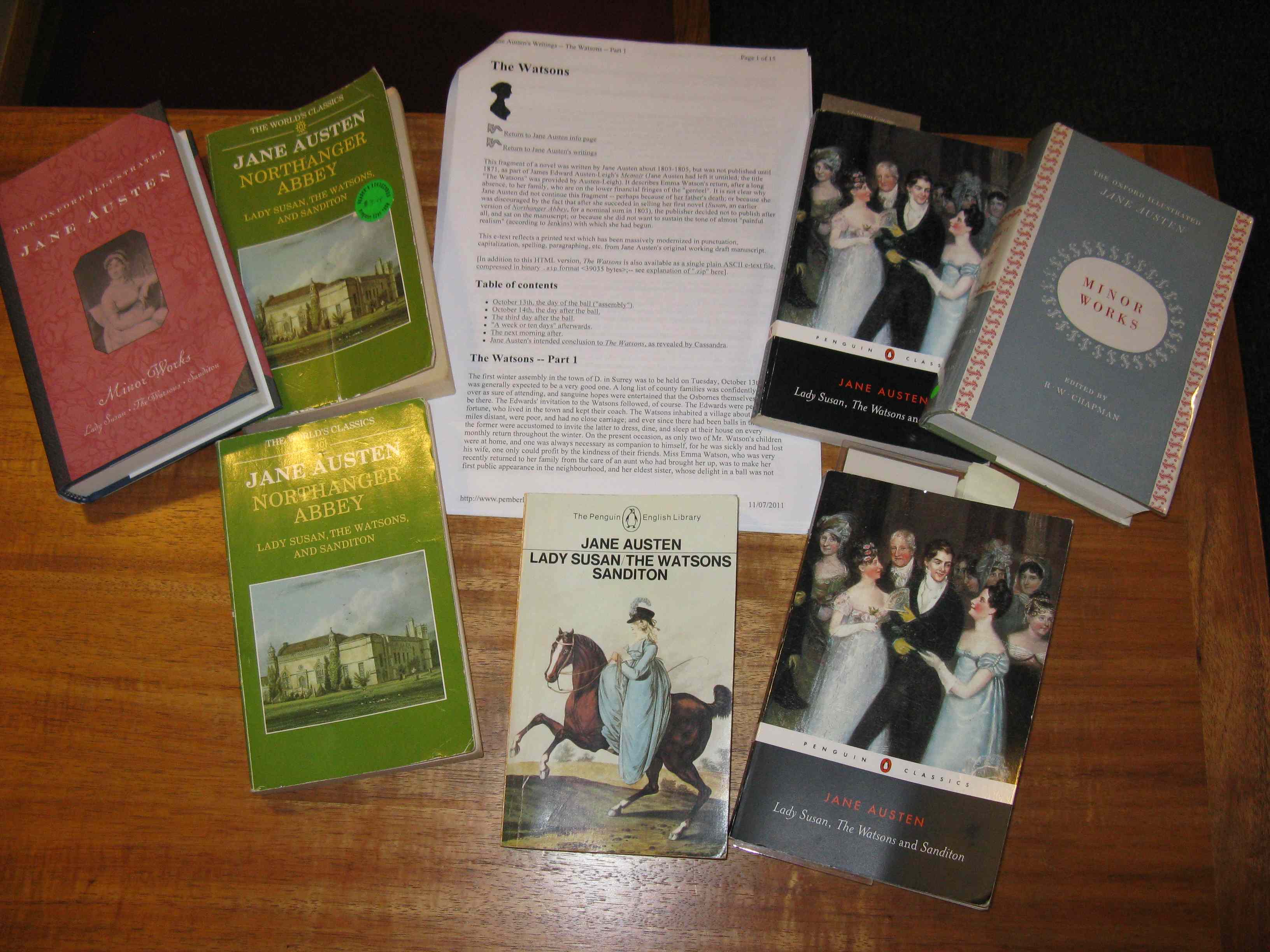
Book covers for Jane Austen's The Watsons

Book covers for Jane Austen’s The Watsons

Jane Austen fans, as you probably know, do a lot of re-reading. Given we only have six complete novels, plus her juvenilia and a couple of unfinished novels, we have little choice. Fortunately, it’s not a chore! And so, having completed rereading all her novels over the last few years for their respective 200th anniversaries, my local Jane Austen group decided to return to her two unfinished novels, starting this month with The Watsons. This was the third time we’ve done it in our relatively short existence. We did it in 2008 and again in 2011 (at which time I wrote my own reflections for this blog).

I do not plan here to write a “proper” review, so if you are interested in my thoughts, please check the link above. However, there are a couple of additional comments I’d like to make, starting with the question I posed in my 2011 post. The question relates to its unfinished nature. There are in fact two main questions regarding this: why did she stop writing it and why didn’t she pick it up again? And here I’ll quickly recap the novel’s background for those who don’t know it. The Watsons was written in Bath probably around 1803-1805, though there isn’t complete consensus about this. It’s commonly believed that she abandoned it after her father’s death in 1805 because of sadness and the resultant uncertainty in her living conditions. Whether this is true or not, it is true that she didn’t take up serious writing again until she settled in Chawton in 1809.

Now, it was at Chawton that she took up two earlier works, which became her first two published books, Sense and sensibility and Pride and prejudice. Why did she not then take up The Watsons and rework/finish it too? This is the more interesting question, I think, than why she stopped it in the first place. There are some theories around, though I haven’t investigated them thoroughly. However, her nephew James Austen-Leigh, who wrote the first “memoir” we have about her life, conjectures that Austen had become aware of “the evil of having placed her heroine too low, in such a position of poverty and obscurity” but I’m not sure I buy it.

My group discussed this idea, and we all felt that Austen had other “poor” heroines, of whom Fanny Price is the obvious example. But, the Dashwood girls were not well-to-do either. It’s true that Austen’s plan for The Watsons, as Cassandra reported, was for things to get worse for our heroine, but still …

No, my idea is different. The Watsons is broadly about four sisters and their marriage prospects – as is Pride and prejudice and Sense and sensibility. When we look at The Watsons, which Austen started after drafting those two books, we can see characters and storylines which remind us of these first two books. And so, I wonder whether, having published P&P and S&S, Austen felt she didn’t have enough new ideas to add to this storyline and wanted to try something different. Certainly, the next book, Mansfield Park, was something different. The marriage plot is still there, but it’s about a poor relation who is taken in by her wealthier ones. The interesting thing is that The Watsons commences with the return of 19-year-old Emma Watson to her family having spent 14 years with a wealthy uncle and aunt. Perhaps Austen decided to explore the story of the poor relation from a different angle, from the time of arrival at the new home?

Another thing about The Watsons is that as well as having characters who remind us of those first two novels, it also has characters reminiscent of some in later books, particularly in Emma. This suggests that while she didn’t finish The Watsons, her work on it wasn’t wasted – and she knew it.

We’ll never know of course. There’s so much we don’t know about our Jane, but it is fun trying to fill in the gaps.

A couple of apposite quotes

There’s more I could explore about this tiny fragment of around 17,500 words, but I’ll save those for the next re-read! Instead, I’ll conclude with two excerpts which grabbed my attention this time.

Gender and money

The first is a conversation between the heroine Emma and the wealthy aristocrat, Lord Osborne, who is interested in her, though his regard is not returned. In this conversation, he suggests that all women should ride horses:

‘I wonder every lady does not. – A woman never looks better than on horseback. –’
‘But every woman may not have the inclination, or the means.’
‘If they knew how much it became them, they would all have the inclination, and I fancy Miss Watson – when once they had the inclination, the means would soon follow.’
‘Your lordship thinks we always have our own way. – That is a point on which ladies and gentlemen have long disagreed. – But without pretending to decide it, I may say that there are some circumstances which even women cannot control. – Female economy will do a great deal my Lord, but it cannot turn a small income into a large one.’

Here we see Emma’s mettle. She stands up to Lord Osborne – to his assumptions about women and to his obliviousness that not all people have the means he has.

On reading to escape

And finally, The Watsons contains another of those wonderful quotes by Austen about books and reading. Here, right near the end of the fragment, Emma is thinking about the downturn in her fortunes through the death of her uncle:

The evils arising from the loss of her uncle were neither trifling, nor likely to lessen; and when thought had been freely indulged, in contrasting the past and the present, the employment of mind, the dissipation of unpleasant ideas which only reading could produce, made her thankfully turn to a book.

So, even in 1805, reading was seen as a way to occupy the mind and so escape, for a while, the troubles of life.

Jane Austen
“The Watsons”
in The Oxford illustrated Jane Austen. Vol VI, The minor works (ed. R.W. Chapman)
London: Oxford University Press, 1969
pp. 315-363

Monday musings on Australian literature: Jane Austen and the Stolen Generations

Yes, you read right, this very brief Monday Musings post is about what Jane Austen might have said – did say in her way – about the Stolen Generations.

What makes great literature great is its timelessness. By this I mean the fact that what is said in, say 1815, is still relevant in, say, 2018. It is this timelessness, in particular, that makes me love Jane Austen. She is so right, so often, about human nature and human behaviour. So, while the quote I’m planning to share comes from British not Australian literature, and from 1815 not 2018, it relates closely to an issue that is currently very important to Australians, the Stolen Generations.

Here’s the quote:

There is something so shocking in a child’s being taken away from his parents and natural home. (Emma, ch. 11: Mrs John Knightley on Frank Churchill being removed from his home after his mother’s death)

“Something so shocking”. There’s nothing much more to say, is there … except that …

… when I drafted and scheduled this on February 7 for posting on Monday February 12, I hadn’t remembered that the next day, February 13, was the tenth anniversary of the Australian Government’s Apology to the Stolen Generations. How freaky – but how appropriate – is that? It’s also rather concerning because, as Reconciliation Victoria says:

As we approach the anniversary of the historic Apology we know that Aboriginal and Torres Strait Islander peoples are still grossly over-represented in our prisons, in out-of-home care, are still dying in custody and are still subjected to racism on a regular basis. There is still much work to do.

It’s a continuing blight on our government, on all of us, that we have achieved (are achieving) so little by most measurable standards.

For those who would like to hear the speech PM Rudd made in the Australian Parliament, here is the YouTube link.

Jane Austen’s Persuasion, Vol. 2

Jane Austen, Persuasion

I recently posted my thoughts on Volume 1 of Persuasion, which I read for my Jane Austen group’s slow reading of the novel. This post, obviously, is on the second (and last) volume. As before, I’ll be focusing on reflections from this read rather than writing a traditional review. And, again, just in case you need a refresher on the plot or characters, please check Wikipedia.

Persuasion

… and Self-interest

Last meeting, my Jane Austen group discussed Lady Russell’s advice to Anne. Some found it wanting while others felt she was justified in recommending that 19-year-old Anne reject Captain Wentworth’s proposal. In Volume 2, we get to question Lady Russell’s judgement again, when she sees Mr Elliot as a good suitor for Anne.

So, we have a conundrum. She’s Anne’s friend and supporter, but she’s also a member of the aristocracy, which is not presented positively in the book, and her judgement is suspect. What are we to make of her?

At the end of the novel, Lady Russell is treated well. Is this because her advice, poor though it is (in hindsight, particularly), doesn’t stem from self-interest? Here is Austen wrapping up Lady Russell at the end:

There is a quickness of perception in some, a nicety in the discernment of character, a natural penetration, in short, which no experience in others can equal, and Lady Russell had been less gifted in this part of understanding than her young friend. But she was a very good woman, and if her second object was to be sensible and well-judging, her first was to see Anne happy.

If we agree that Lady Russell is redeemed because her focus was Anne’s happiness, not self-interest, where does this leave Mrs Smith? She was prepared not to share with Anne her knowledge of Mr Elliot’s character, her reason being:

After listening to this full description of Mr. Elliot, Anne could not but express some surprise at Mrs. Smith’s having spoken of him so favourably in the beginning of their conversation. “She had seemed to recommend and praise him!” “My dear,” was Mrs. Smith’s reply, “there was nothing else to be done. I considered your marrying him as certain, though he might not yet have made the offer, and I could no more speak the truth of him, than if he had been your husband. My heart bled for you, as I talked of happiness.

But, given her hopes for Anne interceding on her behalf with Mr Elliot, is there not some self-interest in her decision not to influence Anne? Mrs Smith’s situation was dire in a way that Lady Russell’s was not, but … Anyhow, she too is treated well in the novel’s wrapping up.

What this says to me is that while Austen gently satirises groups (such as the aristocracy) or ideas (such as persuasion/influence/advice-giving), she is not black-and-white about it. She understands humanity – and would like us to, too!

… or, being persuadable

Last post I commented on Anne’s wondering whether Captain Wentworth, after Louisa’s accident at Lyme, might have realised “that a persuadable temper might sometimes be as much in favour of happiness, as a very resolute character.” Well, in the resolution, we discover that he did!

There, he had learnt to distinguish between the steadiness of principle and the obstinacy of self-will, between the darings of heedlessness and the resolution of a collected mind.

Meanwhile, Anne tells him that, despite the pain it caused, her 19-year-old self was right to listen to Lady Russell:

I must believe that I was right, much as I suffered from it, that I was perfectly right in being guided by the friend whom you will love better than you do now. To me, she was in the place of a parent. Do not mistake me, however. I am not saying that she did not err in her advice. It was, perhaps, one of those cases in which advice is good or bad only as the event decides.

This last sentence reminds me of that “good spirit” narrator in The museum of modern love (my review) who said in the opening paragraph, “It’s a human condition to admire hindsight. I always thought foresight was so much more useful”. If only Anne knew, eh, what the event would decide?

Anne Elliot, Fanny Price and Elinor

Jane Austen fans love to consider her characters, to discuss who is the worst villain or the best hero, or whether character X is like character Y, and so on. So, when my Jane Austen group discussed this volume, one member hesitatingly suggested that Anne Elliot could be seen as a mature Fanny Price (Mansfield Park). Yes, I said, I had the same thought! Not so some other members of the group, but here’s the thing. Both Anne and Fanny resist pressure or encouragement to marry people they don’t love, both have strong moral codes, both nearly lose their “love” to rivals, both are relied upon by their families to provide nurturing and support. There are differences. Anne, with her “higher” social position, has more power and agency than Fanny, the poor cousin, but a couple of could see a distinct similarity.

Another member responded that she saw a likeness to Elinor (Sense and sensibility). There is some argument for that too. Elinor is also a steady, moral character who is relied on by her family, and she too nearly loses her “love” to another. And, like Anne and Fanny, Elinor does not need to learn lessons the way Marianne (Sense and sensibility), Elizabeth (Pride and prejudice), Emma (Emma), and Catherine (Northanger Abbey) do. But she doesn’t have to contend with pressure from others the way Anne and Fanny do, which is why I’d see a closer connection between Anne and Fanny.

The Navy

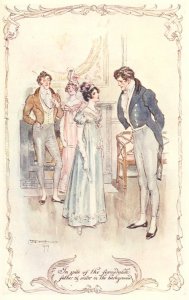
Anne and Captain Wentworth, Ch 20
Anne and Captain Wentworth in front of her “formidable” family (CE Brock, Public Domain)

I said in my Volume 1 post that I’d talk about the Navy in this post, but I’ve ended up talking about other things. However, it’s worth mentioning that in Persuasion, Jane Austen, who had two Naval brothers, presents the Navy positively, as family-oriented men whose values draw more from having good relationships with their families and their “brother” officers  than from status/position. Here is Anne watching Admiral and Mrs Croft in Bath:

They brought with them their country habit of being almost always together. He was ordered to walk to keep off the gout, and Mrs. Croft seemed to go shares with him in everything, and to walk for her life to do him good. Anne saw them wherever she went. …  Knowing their feelings as she did, it was a most attractive picture of happiness to her. She always watched them as long as she could, delighted to fancy she understood what they might be talking of, as they walked along in happy independence, or equally delighted to see the Admiral’s hearty shake of the hand when he encountered an old friend, and observe their eagerness of conversation when occasionally forming into a little knot of the navy, Mrs. Croft looking as intelligent and keen as any of the officers around her.

This continues her feelings from late Volume 1 when the visiting party in Lyme had spent time with Captain Wentworth and his naval friends. She saw their hospitality, their lack of “the usual style of give-and-take invitations, and dinners of formality and display” that typified her circle. “These would have been all my friends,” she thinks, and the idea lowers her spirits. It’s surely no coincidence that in this novel Austen presents some of the worst of the aristocracy with its focus on appearance and position against the best of the Navy with, as Louisa notices, “their friendliness, their brotherliness, their openness, their uprightness”.

And then there’s the last line of the novel:

She gloried in being a sailor’s wife, but she must pay the tax of quick alarm for belonging to that profession which is, if possible, more distinguished in its domestic virtues than in its national importance.

What does this mean, besides the point that being married into the Navy means you will always have the worry of war? Many have discussed the meaning of “more distinguished in its domestic virtues than in its national importance”, with some believing that it is Austen suggesting a new world in which the professional classes, the middle class, represented here by the Navy, is gaining ascendance in English life.

What do you think?

Jane Austen’s Persuasion, Vol. 1

Jane Austen, Persuasion

My Jane Austen group is reading Persuasion – eleven years since we last did it – because 2017 is the 200th anniversary of its publication. Of course I’ve read it several times, so, as you’ll know from my other Austen re-reads, my aim here is to focus on reflections from this read rather than to write a traditional review.

You’ll probably also know that my group often does slow reads of her novels, a volume at a time. Persuasion was published in two volumes, so last month we read Volume One. It finishes at Chapter 12, just after Louisa Musgrove has her fall at Lyme. This post is about this volume.

But first, I want to say something my relationship with Persuasion. I first read it in 1972 when the second TV miniseries was screened in Australia. I was reading it in tandem with the screening, and the night the last episode screened I sat up late to finish the last chapters. I’ll never forget my emotional response to it. I can’t remember whether the miniseries was a good one, but I sure thought the book was. Why?

Persuasion doesn’t have the sparkle of Pride and prejudice, nor the  young spoofy humour of Northanger Abbey, nor even the heroine we love to laugh at in Emma, but it is quiet, emotional and deeply felt. Its heroine Anne, at 27 years old, is Austen’s oldest. She’s caring, intelligent, but put upon by her unappreciative family – and yet we don’t feel she’s a pushover. The novel’s romance, when it comes, feels right and well-earned. No-one ever says that Austen should not have married Anne to her man the way some do about some of her other heroines such as Marianne in Sense and sensibility, and Fanny in Mansfield Park. No, when it comes to Persuasion, Austen fans are generally in agreement: it’s a lovely book in which the hero and heroine belong together. But, it’s about so much more too …

I’m not going to provide a summary, so if you need to refresh yourselves on the plot and characters please check Wikipedia.

A specific setting

I’m not sure why it is, but on this my nth (i.e. too many to count) reading of Persuasion, I suddenly noticed that it was the only book, really, that gives us a very specific date and that is set pretty much exactly contemporaneous with when Austen was writing it. It starts in “this present time, (the summer of 1814)” and ends in the first quarter of 1815. This period pretty much covers the hiatus in the Napoleonic Wars when Napoleon was exiled to Elba – and is why Naval Officers are out and about, on land and available for appearing in Persuasion! Sir Walter’s friend and advisor, Mr Shepherd tells him:

This peace will be turning all our rich Navy Officers ashore. They will all be wanting a home.

It is the appearance of the Navy and Austen’s contrasting the substance of naval officers with the superficiality of the aristocracy that gives Persuasion its particular interest – beyond its lovely story, I mean. It is very much a book about social change. (I should say, here, that Austen was partial to the Navy, having two successful Naval brothers)

Two themes

Anyhow, this idea and that relating to persuasion are developed in Volume 1 through various themes, two of which I’ll discuss here.

Appearance and Social status

That social status is a major concern is heralded on the book’s first page when we are told about Sir Walter’s favourite book: “he was a man who, for his own amusement, never took up any book but the Baronetage”. The narrator tells us soon after that:

Vanity was the beginning and the end of Sir Walter Elliot’s character; vanity of person and of situation.

However, he has not been sensible with his money, and needs to rent out his home Kellynch-hall, hence my earlier quote. But, Sir Walter doesn’t like the Navy, and his reasons convey two of the novel’s themes – the focus on status and the cult of appearance. His response to the idea of renting his home to a Naval officer is:

Yes; it is in two points offensive to me; I have two strong grounds of objection to it. First, as being the means of bringing persons of obscure birth into undue distinction, and raising men to honours which their fathers and grandfathers never dreamt of; and secondly, as it cuts up a man’s youth and vigour most horribly; a sailor grows old sooner than any other man …

This is of course ironic, because the naval officer, Admiral Croft, to whom he eventually agrees to rent the place is a thoroughly decent man (who removes Sir Walter’s myriad “looking glasses” when he takes residence). Croft also, Anne “fears”, looks after the Kellynch estate and its people far better than her family did. However, for Sir Walter, the only thing that matters is status.

As the novel progresses, the difference between the Navy and the aristocracy is further developed, but more on that anon.

Anne’s sister Mary is highly aware of her status as a Baronet’s daughter, and the “precedence” due to her. That she stands on this demonstrates her superficiality and lack of decent human feeling. She complains when she goes to her in-laws’ home that her mother-in-law does not always give her precedence. One of her sisters-in-law complains to Anne:

I wish any body could give Mary a hint that it would be a great deal better if she were not so very tenacious; especially, if she would not be always putting herself forward to take place of mamma. Nobody doubts her right to have precedence of mamma, but it would be more becoming in her not to be always insisting on it.

Later, after Louisa’s fall at Lyme, when it is suggested that calm, capable Anne remain behind to care for Louisa, Mary objects:

When the plan was made known to Mary, however, there was an end of all peace in it. She was so wretched, and so vehement, complained so much of injustice in being expected to go away, instead of Anne;—Anne, who was nothing to Louisa, while she was her sister …

Here again is Mary’s misplaced sense of “precedence”. It is also a lovely example of Austen’s plotting, because only a few chapters earlier Mary had refused to stay home from a family party to look after her own injured little boy, preferring Anne do it. Austen had set us up nicely to see the superficiality of Mary’s desire to care for her sister-in-law. The more you read Austen, as I’ve said before, the more you see how fine her plotting is.

Strength of character versus Persuasion (or the influence of others)

Another ongoing issue in the novel concerns strength of character. Captain Wentworth reflects on Anne’s lack thereof in refusing their engagement when she was 19:

He had not forgiven Anne Elliot. She had used him ill; deserted and disappointed him; and worse, she had shewn a feebleness of character in doing so, which his own decided, confident temper could not endure. She had given him up to oblige others. It had been the effect of over-persuasion. It had been weakness and timidity.

A little later, he praises Louisa Musgrove’s strength of mind, but we, the reader, realise her pronouncements are theoretical. She had not been put to the test. She says:

What!—would I be turned back from doing a thing that I had determined to do, and that I knew to be right, by the airs and interference of such a person?—or, of any person I may say. No,—I have no idea of being so easily persuaded. When I have made up my mind, I have made it.

Meanwhile, Louisa shares gossip about Anne, suggesting that Lady Russell, who had discouraged Anne from marrying Captain Wentworth, had also discouraged her from marrying Charles Musgrove (which of course reinforces for Wentworth the idea of Anne’s weakness of character).

… and papa and mamma always think it was her great friend Lady Russell’s doing, that she did not.—They think Charles might not be learned and bookish enough to please Lady Russell, and that therefore, she persuaded Anne to refuse him.

In this case, though, the decision was all the then 22-year-old Anne’s – but Wentworth only hears the gossip.

Henrietta adds to the chorus about Lady Russell’s persuasive power:

I wish Lady Russell lived at Uppercross, and were intimate with Dr. Shirley. I have always heard of Lady Russell, as a woman of the greatest influence with every body! I always look upon her as able to persuade a person to any thing!

You can see Austen building up the plot here, leading us to see Wentworth as unlikely to be interested in Anne again.

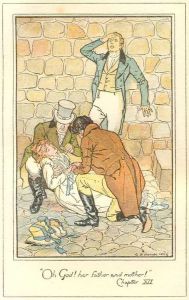
Persuasion, Lyme fall, CE Brock
Oh God! her father and mother (CE Brock, 1893?)

Anne, though, sees that firmness of character can go too far, that Louisa’s wilfulness against the advice of others had resulted in her potentially life-threatening fall. She wonders

whether it ever occurred to him now, to question the justness of his own previous opinion as to the universal felicity and advantage of firmness of character; and whether it might not strike him, that, like all other qualities of the mind, it should have its proportions and limits. She thought it could scarcely escape him to feel, that a persuadable temper might sometimes be as much in favour of happiness, as a very resolute character.

Will he see it her way? We’ll have to read Volume 2 to find out!

There’s a lot more I could say, but I think I’ve said enough. Next post I plan to take up the Navy issue a bit more …

Six degrees of separation, FROM Pride and prejudice TO Northanger Abbey

Pride and prejudice book covers

Just a few editions of Pride and Prejudice

I’m only one day back from California and it’s Six Degrees of Separation time againbut I absolutely couldn’t miss this one as our host Kate (booksaremyfavouriteandbest) nominated Jane Austen’s Pride and prejudice as the starting book. It’s a particularly special choice because last month we commemorated the 200th anniversary of Austen’s death. This meme, as you know, requires us players to create a chain of six more books, linking one from the other on whatever basis we like. I don’t think I need tell you that I’ve read Pride and prejudice, which Austen called “my darling child”, but I’ll confirm that, as always, I have also read all the books in my chain. Moreover, because of Austen’s importance to me and to this year, I’m going to try to make every book in this chain relate to her in some way …

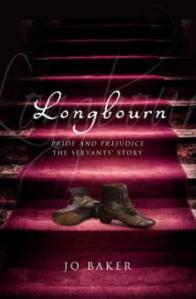
Jo Baker, LongbournI’ll start with an example of the sort of book I rarely read – that is, spin-offs and sequels – and nominate Jo Baker’s Longbourn (my review). Longbourn, as the Austen fans among you will know, is the name of Elizabeth Bennet’s family home, and Baker’s novel focuses on the lives of its servants. I read this for my Jane Austen group, and while most of us found the plot rather far-fetched, as is not unusual with this “genre”, we thought Baker’s research into the lives of servants of the time made the book a worthwhile read.

Elizabeth Jolley, The newspaper of Claremont StreetFrom here, I’m going to nominate a book I read long before I started blogging, but which Guy (of His Futile Preoccupations) reviewed recently, Elizabeth Jolley’s The newspaper of Claremont Street (Guy’s review). I could have linked to a Jolley I’ve reviewed here, as one of the reasons I’ve chosen Jolley is because I sometimes call her my antipodean Austen, but I want to nominate Newspaper because she’s a cleaner, in other words, essentially a servant.

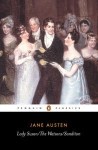
Jane Austen, Lady Susan, Watsons, SanditonMy next link is a cheeky one, Jane Austen’s Lady Susan (my review), the book which marks the transition between her juvenilia and mature novels. It’s a cheeky link because the recently widowed Lady Susan, described by another character in the book as “the most accomplished coquette in England”, is poor. She’s desperate to marry well so that she can be kept in the manner to which she had become accustomed, but as the book opens she can’t afford her own house, let alone servants! By the way, this book contains one of those quotes you often find in those “wit and wisdom” or “favourite quotes” of Jane Austen books: “where there is a disposition to dislike a motive will never be wanting”. Love it.

jane Austen, Love and FreindshipI’m going to continue being cheeky, and name another juvenilia work for my next link, Jane Austen’s Love and freindship (sic) (my review). It wouldn’t be cheeky, actually, if I linked it on the juvenilia theme, but, as some of you will know, the recent film adaptation of Lady Susan (starring Kate Beckinsale) was titled (somewhat irritatingly to Austen fans), Love and friendship. What were they thinking? Anyhow, Love and freindship (yes, she spelt it with an “ei” not “ie”) is an epistolary novel written when she was 15 years old. Its humour is broad, but you can see in it the writer she was to become.

Helene Hanff, 84 Charing Cross RoadAnother epistolary book that I’ve enjoyed, though it’s not a novel, is Helen Hanff’s 84 Charing Cross Road (my review). This is such a classic now that I’m sure you’ll know it but, just in case you don’t, it comprises the delightful correspondence that took place in the middle of the twentieth century between American writer and bibliophile, Helene Hanff, and Frank Doel of Marks & Co, a London secondhand and antiquarian bookshop. It’s the sort of book that booklovers, like me, adore – and I adore it even more because during the correspondence Hanff fell in love with Pride and prejudice and asked Frank to find her a copy. She wrote:

“You’ll be fascinated to learn (from me that hates novels) that I finally got round to Jane Austen and went out of my mind for Pride and Prejudice which I can’t bring myself to take back to the library till you find me a copy of my own.”

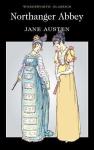
Jane Austen, Northanger AbbeySo now, what to choose for my final book? It has to be one of Austen’s, and I’m going to make it Northanger Abbey (my review), not only because it is 200 years old this year, but because it is the one that contains her famous defence of the novel. I’ve mentioned it so many times before, but I’ll quote it again:

… there seems almost a general wish of decrying the capacity and undervaluing the labour of the novelist, and of slighting the performances which have only genius, wit, and taste to recommend them. “I am no novel–reader — I seldom look into novels — Do not imagine that I often read novels — It is really very well for a novel.” Such is the common cant. “And what are you reading, Miss — ?” “Oh! It is only a novel!” replies the young lady, while she lays down her book with affected indifference, or momentary shame. “It is only Cecilia, or Camilla, or Belinda”; or, in short, only some work in which the greatest powers of the mind are displayed, in which the most thorough knowledge of human nature, the happiest delineation of its varieties, the liveliest effusions of wit and humour, are conveyed to the world in the best–chosen language.

How better to end this post than on such a gorgeous description of the novel!

So, I think I’ve done what I set out to do and made this all about Austen, albeit we have dipped our toes briefly in Australia and the USA along the way. I hope it hasn’t been too boring …

Have you read Pride and prejudice (dare you admit you haven’t)? Whether or not you have, what would you link to? 

Vale Jane Austen: on the 200th anniversary of her death

Jane Austen by sister Cassandra

Today, July 18, marks the 200th anniversary of Jane Austen’s death. Unfortunately, because I am travelling I am unable to join my local Jane Austen group’s wake to commemorate her, but I had to do something of course, so I’ve decided to write a post on Austen biographies. I’m partly drawing from my group’s recent discussion of Austen biographies.

Now, if you are not an Austen aficionado and you’ve looked at my list below, you would probably be surprised to hear that very little, really, is known about Austen, and that what is known is not very exciting. Amazon’s entry on Spence’s book includes a quote from a Booklist review which says that “Jane Austen’s quiet life is not very rewarding biographical material.” And Tomalin, writer of probably the most authoritative biography, concludes that Austen “is as elusive as a cloud in the night sky”.

Yet, the biographies keep coming – and if you look (again) at my list below you will see that the number has increased in recent decades. Has any writer had as many biographies written about them than Austen? When my Austen group discussed them, we decided there were different types of biographies: the straightforward (chronological, womb-to-tomb style); those taking a more thematic approach (like Paula Byrne’s The real Jane Austen: A life in small things); and those wishing to explore specific perspectives/angles (like Helena Kelly’s Jane Austen: The secret radical).

Claire Tomalin, Jane AustenStill, we wondered how many of these biographies really have something new to say, or are most simply jumping on the Jane Austen bandwagon – because the fact is that there are many gaps in what is known about her. That’s largely why she’s so “elusive” as Tomalin says. And it’s why most biographies fill out with a lot of context. They either spend a lot of time on her books (some of which you would naturally expect in a literary biography), or they spend a lot of time talking about her times and/or the lives of members of her family. (And there are some dramatic stories there.)

Of course, there’s always the possibility of new information coming to light. Midorikawa and Sweeney’s work on the literary friendship between Austen and Anne Sharp that I reviewed recently, drew heavily on the unpublished diaries and letters of Jane’s niece, Fanny Knight, which they said had not been seriously mined by scholars. They did admit though that they had to “read between the lines of Fanny’s childish scrawl to decipher the obscured truths”.

And if you expected all this life-of-Austen industry to be as meek and mild as many think Austen was, you’d better think again. Austenites (I’ll refrain from using the more loaded Janeite) can be fiery, as the recent contretemps over the new biography by Lucy Worsley and its alleged similarities to Paula Byrne’s 2013 one.

Who knows the real story here, but there is one truth we can universally acknowledge, and that’s that in this anniversary year of Austen’s death, more books will come out about her.

The not-quite-complete list

  • Amy, Helen. Jane Austen (2013)
  • Auerbach, Emily. Searching for Jane Austen (2004)
  • Austen-Leigh, James Edward. A memoir of Jane Austen (1869)
  • Byrne, Paula. The real Jane Austen: A life in small things (2013)
  • Cecil, David. A portrait of Jane Austen (1979)
  • Grosvenor Myer, Valerie. Jane Austen, obstinate heart: A Biography (1997)
  • Honan, Park. Jane Austen: Her Life (1987)
  • Jenkins, Elizabeth. Jane Austen: A biography (1938)
  • Kelly, Helena. Jane Austen: The secret radical (2016)
  • Le Faye, Deirdre. Jane Austen (British Library Writers’ Lives Series) (1998)
  • Lefroy, Helen. Jane Austen (1997)
  • Midorikawa, Emily and Emma Claire Sweeney. A secret sisterhood. Part 1: Jane Austen and Anne Sharp (2017)
  • Nokes, David. Jane Austen: A life (1998)
  • Shields, Carol. Jane Austen: A life (2001)
  • Spence, Jon. Becoming Jane Austen (2007)
  • Tomalin, Claire. Jane Austen: A life (1997)
  • Worsley, Lucy. Jane Austen at home: A biography (2017)

Emily Midorikawa and Emma Claire Sweeney, A secret sisterhood (Pt 1) (#Review)

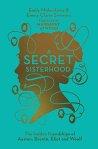
Emily Midorikawa and Emma Claire Sweeney, A secret sisterhoodMidorikawa and Sweeney’s book, A secret sisterhood, published this month, is subtitled The hidden friendships of Austen, Brontë, Eliot and Woolf, by which you might guess why a copy came my way! And so, as homework for my Jane Austen group meeting this month, I’ve just read the first part, which is about Jane Austen and Anne Sharp. If this part is representative of the whole, then I’m going to enjoy the book – but will probably read (and post on it) part-by-part. Not only will that spread my enjoyment, but it will enable me to slip the reading of it in between other books.

The impetus for the book, as Midorikawa and Sweeney (M&S from now on) explain in their Introduction, was to suss out literary friendships among female writers. They argue that literary male friendships, such as between Byron and Shelley, and Hemingway and Fitzgerald, are well-known and documented, but not so much those of women writers. They say, in fact, that “the world’s most celebrated female authors are mythologised as solitary eccentrics or isolated geniuses.” Jane Austen, for example, is seen as “a genteel spinster”, but there is more to her story than that – and M&S set about researching it.

Now, Anne Sharp is not unknown in Austen scholarship, so after reading M&S’s section, I decided to remind myself of what I already knew about this woman. She appears in several of Austen’s extant letters (Deirdre Le Faye’s Jane Austen’s letters) and in many biographies, such as those by Claire Tomalin and Carol Shields. Where she doesn’t appear, however, is in the first official Memoir of Austen written by her nephew, James Edward Austen Leigh in 1869. Why is this?

Jane Austen by sister Cassandra (surely public domain!)

Well, as Austen scholars and aficionados know, the Austen family worked hard to create what they thought was a suitable image of their famous relation. Letters were destroyed, for a start, and Jane Austen’s romances were not mentioned in the first edition. M&S argue that the family wanted to emphasise her neat handwriting, the precise way “she dropped sealing wax on her letters”, her matchless needlework. This is perhaps a little exaggerated, but the Memoir, we know, needs to be treated with some caution.

Anyhow, the real question is: was Austen-Leigh’s omission of Anne Sharp from his memoir justified, or are M&S drawing a long bow? Well, as with all research, it depends a little on your perspective and/or goals. M&S want to argue a literary friendship for Austen, and Anne Sharp would be the closest candidate for this role.

One of the features of Austen section (as I haven’t read the rest) is the insight they give into the challenges of literary research. There is, we know, a dearth of primary sources about Austen’s life. We have her letters – but their value is limited by two main factors. First, sister Cassandra destroyed any she thought were not conducive to the image of Jane that she wanted to leave, but also, Austen’s most revealing letters would have been to Cassandra, and of course she would only have written to Cassandra when they were apart. Consequently, events which occurred when they were together were less likely to have been recorded and would not have been recorded with the same openness. (Austen did write to other people, but we have even fewer of those letters. Hands up who keeps letters!)

However, as M&S found, there are other sources and these have not always been fully researched (or perhaps not even known about). For example, Austen’s niece Fanny, for whom Anne Sharp was governess, kept diaries from the age of 10. M&S write that Fanny’s “unpublished notebooks and letters” have been “largely unmined” by scholars but her writings show what must have underpinned the “deep affection” between Jane and Anne, which is the fact that Anne was a writer.

So, there in Fanny’s diaries are references to Anne Sharp’s playwriting, and M&S spend some time developing their thesis from these diaries, as well as from other sources including sister-in-law Mary Lloyd’s “pocketbook” and references to Anne in Austen’s letters. Along the way, they also research some of Sharp’s own story. M&S argue that although biographers have generally ignored the rapport between the two, Sharp was in fact a “trusted literary friend”. They cite evidence for this, including that Austen asked Sharp for her opinion on some of her novels and that Sharp responded with some writerly commentary.

Also, Sharp was one of the very few non-family members to whom Austen gave one of her 12 presentation copies of the first edition of Emma. Two others went to the Prince Regent (who’d asked for a dedication) and the established author Maria Edgeworth. M&S cite this act as indicative of the esteem in which Austen held Sharp. They also argue that her sending a copy to Edgeworth demonstrates her desire to establish some kind of literary alliance or friendship. Was it that, or did she just want the endorsement of an established author? We don’t know but M&S could be right. Whatever she wanted, however, she didn’t get it from Edgeworth.

More evidence they cite for the importance of Sharp to Austen is that Sharp was, as far as records show anyhow, one of the last people to whom Austen wrote before her death. And, she was one of the people to whom Cassandra sent not only a lock of Austen’s hair after her death, but a couple of other mementoes as well.

Have M&S convinced me of this friendship? Yes, I think so, though I’m not sure they’ve completely proved Austen’s desire for “a literary friendship”. However, this first part of A secret sisterhood is a good read, not just because I love all things Jane but because of the open way they share the process and challenge of literary research. I expect each part will be different because the sources and existing knowledge will be different, but I’m looking forward to reading them and will share my thoughts with you (eventually).

Emily Midorikawa and Emma Claire Sweeney
A secret sisterhood: The hidden friendships of Austen, Brontë, Eliot and Woolf
(Uncorrected proof)
London: Aurum Press, 2017
306pp.
ISBN: 9781781315941

(Review copy received from publisher’s rep)

Northanger Abbey musings (2)

A month ago I posted some musings arising from the first part of my current slow read of  Northanger Abbey with my Jane Austen group. In this post I’ll share some reflections on the rest of the novel, Chapters 20 to 31, which is the part that encompasses our “heroine” Catherine’s arrival in and departure from the Abbey.

On the art of fiction

In my previous post, I discussed how Northanger Abbey spoofs or parodies Gothic novels. Northanger Abbey also contains Austen’s famous defence of the novel. These contribute to one of the pleasures of this novel, which is the joy Austen seems to be having in being an author. She intrudes regularly with her own voice, not only commenting on the characters but on fiction itself. It’s the new novelist having fun, flexing her muscles, and making an argument for more “realistic” fiction over the Gothic novel that was popular in her time.

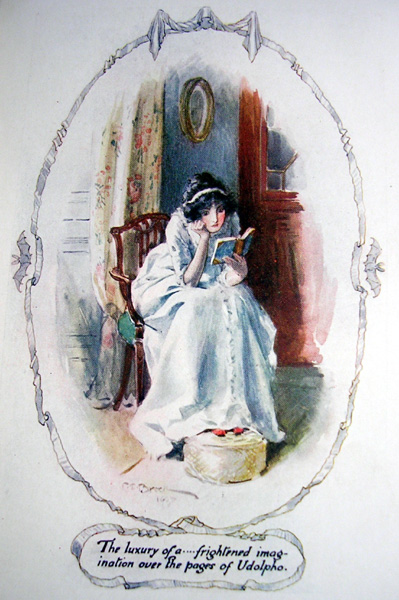
Northerner Abbey illus br Brock

So, for example, here is Catherine, at the Abbey, deciding that the General had been up to no good regarding his late wife:

His cruelty to such a charming woman made him odious to her. She had often read of such characters, characters which Mr. Allen had been used to call unnatural and overdrawn; but here was proof positive of the contrary.

Mr Allen is the sensible neighbour who, with his wife, had taken Catherine to Bath. One of the things Austen does in this novel, and particularly in the second half, is satirise readers of Gothic novels, readers who let their imaginations run away with them. Catherine, our narrator tells us, is too “well-read” to let the General’s “grandeur of air” and “dignified step” dissuade her from her belief about his dastardliness. And so, when at last she is proved wrong (though the General does prove villainous in other ways), Henry admonishes her:

What have you been judging from? Remember the country and the age in which we live. Remember that we are English, that we are Christians. Consult your own understanding, your own sense of the probable, your own observation of what is passing around you. Does our education prepare us for such atrocities? Do our laws connive at them? Could they be perpetrated without being known, in a country like this, where social and literary intercourse is on such a footing, where every man is surrounded by a neighbourhood of voluntary spies, and where roads and newspapers lay everything open?

There is so much to tease out here besides Austen’s satirising the Gothic sensibility … but let’s save them for another re-read, and move on.

Soon after, Catherine considers Henry’s admonition, and thinks:

the whole might be traced to the influence of that sort of reading which she had there indulged. Charming as were all Mrs. Radcliffe’s works, and charming even as were the works of all her imitators, it was not in them perhaps that human nature, at least in the Midland counties of England, was to be looked for.

So, it is human nature that most interests Austen – not the one-dimensional “angel” and “fiend” characters of the Gothic novelists.

Late in the novel, as our hero and heroine are coming together, Austen writes:

Henry was now sincerely attached to her, though he felt and delighted in all the excellencies of her character and truly loved her society, I must confess that his affection originated in nothing better than gratitude, or, in other words, that a persuasion of her partiality for him had been the only cause of giving her a serious thought. It is a new circumstance in romance, I acknowledge, and dreadfully derogatory of an heroine’s dignity; but if it be as new in common life, the credit of a wild imagination will at least be all my own.

Here, I’d say, there are two main things going on. One is the cheeky novelist teasing us with her “new circumstance in romance” undermining the conventional idea of romantic love between heroes and heroines in novels. The other is the more serious Austen making a rather subversive observation about the realities of love and human relationships, because she was a pragmatist at heart. She believed in love, but she also understood the implications of the marriage market.

If all this sounds a little confused, that’s probably because it is. Austen plays around in this novel with ideas about fiction versus reality, Gothic (European) sensibility versus more ordered (English) values, and reading versus readers. To do so, she slips in and out of different modes of narrative, daring us to keep up with her. No wonder it’s the book that has proven the hardest to adapt to film.

More word teasing from Henry

In my last post, I shared Henry’s little tirade about the word “nice”. I can’t resist sharing another little tirade from later in the novel:

“No, and I am very much surprised. Isabella promised so faithfully to write directly.”

“Promised so faithfully! A faithful promise! That puzzles me. I have heard of a faithful performance. But a faithful promise—the fidelity of promising! It is a power little worth knowing, however, since it can deceive and pain you…

Love it …

And here endeth my reflections on my most recent re-read of Northanger Abbey. What a delight it has been, yet again. It may not have the romance of Pride and prejudice or the complexity of Emma, but it has the lively, fresh mind of an author who wants to engage with her readers about the very thing she is doing, writing a novel. I find that irresistible.

Picture credit: From Chapter 9, illus. by CE Brock (Presumed Public Domain, from solitaryelegance.com)