Canberra Writers Festival 2025: 7, All things Austen: Jane Austen anniversary special

Susannah Fullerton, Devoney Looser and Emily Maguire with Jonty Claypole and Sophie Gee.
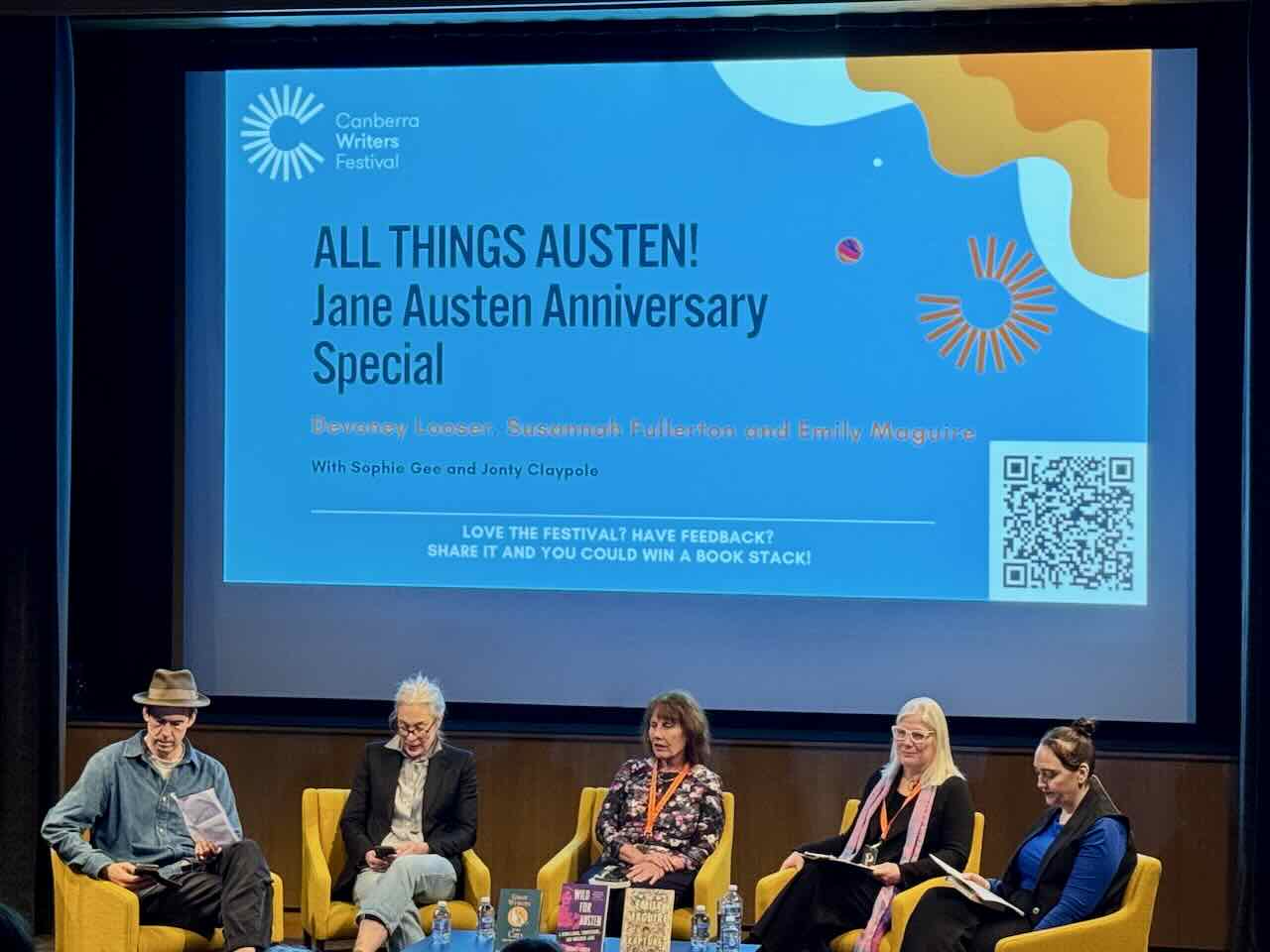
The program described the session as follows:

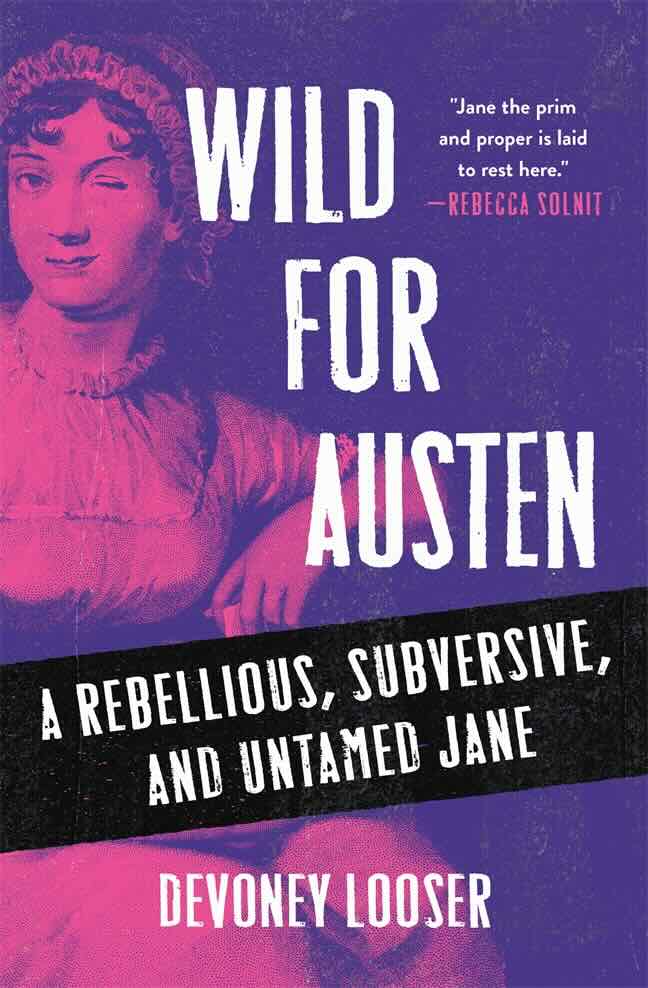
Celebrate all things Austen at this major event! Over 200 years after Jane Austen’s works first appeared, her insights on life, love, and society remain timeless. Join popular Secret Life of Books podcasters Sophie Gee and Jonty Claypole as they bring together an international panel featuring Wild for Austen author Devoney Looser (from the USA), Emily Maguire (Rapture), and Jane Austen Society of Australia president Susannah Fullerton. Join the community, and share your love – because, as Mr. Darcy says, “My feelings will not be repressed!”

Are you tiring of Jane Austen 250th anniversary events? Never fear, the year is nearly over, though her actual birthday is still to come. CWF could not, of course, let the anniversary pass without marking it in some way, and they did it with a five-person panel. The convenors’ aim was to steer away from the Austen of fluffy romances and never-ending rom-com (and other genre) adaptations to the disruptive, subversive, unorthodox Austen that we all believe she was.

The session was being recorded for Sophie and Jonty’s podcast, Secret Life of Books, so it had a particular flavour and style, and there was no Q&A. They started with an interactive game called “Never have I ever” in which the three panelists shared a statement that may or may not have happened to Austen or one of her characters and the audience had to vote true or false. That woke us all up, and then we settled down to the serious business!

The discussion was framed around three themes, in this order:

  • Disruptive Austen
  • Disruptive history
  • Disruptive readings

Disruptive Austen

Unfortunately, I had a technical malfunction with this first question, so I have to rely on memory. Essentially, the panelists were asked to share something they believe reflects disruptive (or subversive) Austen:

Emily chose Lydia from Pride and prejudice, noting that Austen never says the words, but we all know that the reason everyone was upset about Lydia was running off with Wickham was that they were having sex without being married. Once they were married, which of course was orchestrated, all was forgiven, and they went on to live acceptable lives. Lydia’s behaviour put her sister’s chances at risk. Austen shows, said Emily, the hypocrisy of her society.

Devoney and Susannah both read small sections from Austen’s Juvenilia (or teen writings), with Devoney reading the first four chapters of The beautifull Cassandra, and Susannah A letter from a young lady. These pieces exemplify the juvenilia overall. They are absurd, satirical parodies, and contain various scandalous acts, but are well worth reading for all sorts of reasons. (In my post on Volume the First, which includes Cassandra, I quote Looser a couple of times!)

The question put to the panel was, why did she leave this subversive writing? Unfortunately, I didn’t capture the full discussion, but one reason was that the Juvenilia was written to entertain the family, whereas the novels were written for a public audience. There was also discussion about Austen crafting her form. (You can wait for the podcast if you want to hear this and the whole event!)

Disruptive history

Susannah talked about Austen living during tumultuous times. Revolution and war in Europe, and England was unsettled, with changing laws. For example, duelling was illegal but still happening. There is a duel in Sense and sensibility. Austen mentions it briefly, with nothing like the detail a male author would use. But, there is a lot of female verbal duelling in the novel. Also, it is telling, she said, that the person who duels, who engages in illegal behaviour, is one of her most respectable characters, Colonel Brandon. Poaching is mentioned in Mansfield Park by Mr Rushworth, but he has no idea that Henry will poach his wife. In other words, illegal things happen in her novels.

Devoney also talked about the uncertain times. The French Revolution happened as she was coming of age, and then things shifted again in the 1800s. Critics often complain that Austen didn’t deal with war, but Persuasion is full of war, and Austen imagines a wonderful female character in Mrs Croft. However, Devoney said that during the 1800s society was clamping down, there was more censorship. Is that another reason why Austen damped down her Juvenilia? Devoney doesn’t think so. She thinks Austen blew up the form she toyed with in the Juvenilia and then put it together again. Devony saw both political and craft reasons for what Austen did.

Emily returned to her illicit sex argument, and that everyone knew it was happening. She shared the story of Lady Worsley (1758-1818), an Austen contemporary, who had a child that wasn’t her husband’s, was involved in a court case her husband brought against her lover, but ended up inheriting her husband’s estate. There was so much ambiguity in society during Austen’s time.

Jane eclipsed writers of her time, but Jonty and Sophie wanted know if the panel could recommend another writer.

Susannah suggested Fanny Burney. Her novels may not be books you go back to, but she was out there where the action was, unlike Austen, and she underwent (and survived) a mastectomy without anaesthetic. Her letters and diaries are worth reading. Devoney agreed with Susannah that no-one can match Austen, but if we widen our view there are women worth looking at, such as Maria Edgeworth (see my post on her Leonora), the Porter sisters (Jane and Anna Maria), and the Irish novelist Sydney Owenson.

Sophie suggested Mary Wollstonecraft, not only her A vindication of the rights of women but her Letters written in Sweden, Norway, and Denmark. She had child out of wedlock, and died giving birth to Mary Shelley. We don’t know whether Austen read Vindication, but it was in her brother Edward’s library.

The conversation turned to related issues. For example, the first French translator of Pride and prejudice thought Elizabeth was too bold and feisty, so they flattened her.

Disruptive reading

How can Austen be read disruptively? Can she be read against the grain? (Aside: I think my Austen group does this regularly.)

Devoney said she can be read on different levels. Her novels document illicit sex, crime and criminality. She references contemporary issues, such as slavery. There is not enough information about where she stood. Austen was related to people who made money out of slavery, but Mansfield Park was likely named for the man whose judgement played an important role in England’s abolition movement. Not long after Austen’s death, her three brothers were involved in abolitionism. There’s reason to believe that she supported or was moving to supporting that view. Devoney also thinks that Austen did not want to be pinned down, but preferred to leave questions for us to think about. (This feels a modern idea to me, but her novels can support this theory, I think.)

Emily works with teenagers, and loves hearing what they pick up in Austen. They see tiny social signals – a look, a touch of hands – that suggest relationships. Young girls are alert. Looking through the lens of their own culture, they identify, for example, Austen’s “Pick-me” girls, like Miss Bingley.

Susannah spoke to Austen’s feminism, using, for example, Elizabeth’s statement to Lady Catherine that Mr Darcy “is a gentleman, I am a gentleman’s daughter. So far we are equal”. She mentioned Austen’s last poem, “When Winchester races“, written three days before she died. There is a line in it, “But behold me immortal!” Susannah would like to think she knew her own greatness.
And here we ran out of time … so the panel ended with Sophie and Jonty thanking all, and formally ending their podcast.

Not all in my Austen group loved this session, partly because the session was spread rather thin and we didn’t get to hear specifically about Looser’s book. But Mr Gums, my Austen-loving friend Kate, and I enjoyed what was discussed. It was lively, covered some interesting ground, and suited, I think, a broad-based Festival audience.

There will be no Monday Musings this week.

Canberra Writers Festival, 2025
All things Austen
Sunday 26 October 2025, 3-4pm
Jane Austen, Emma (Vol. 2, redux 2025)

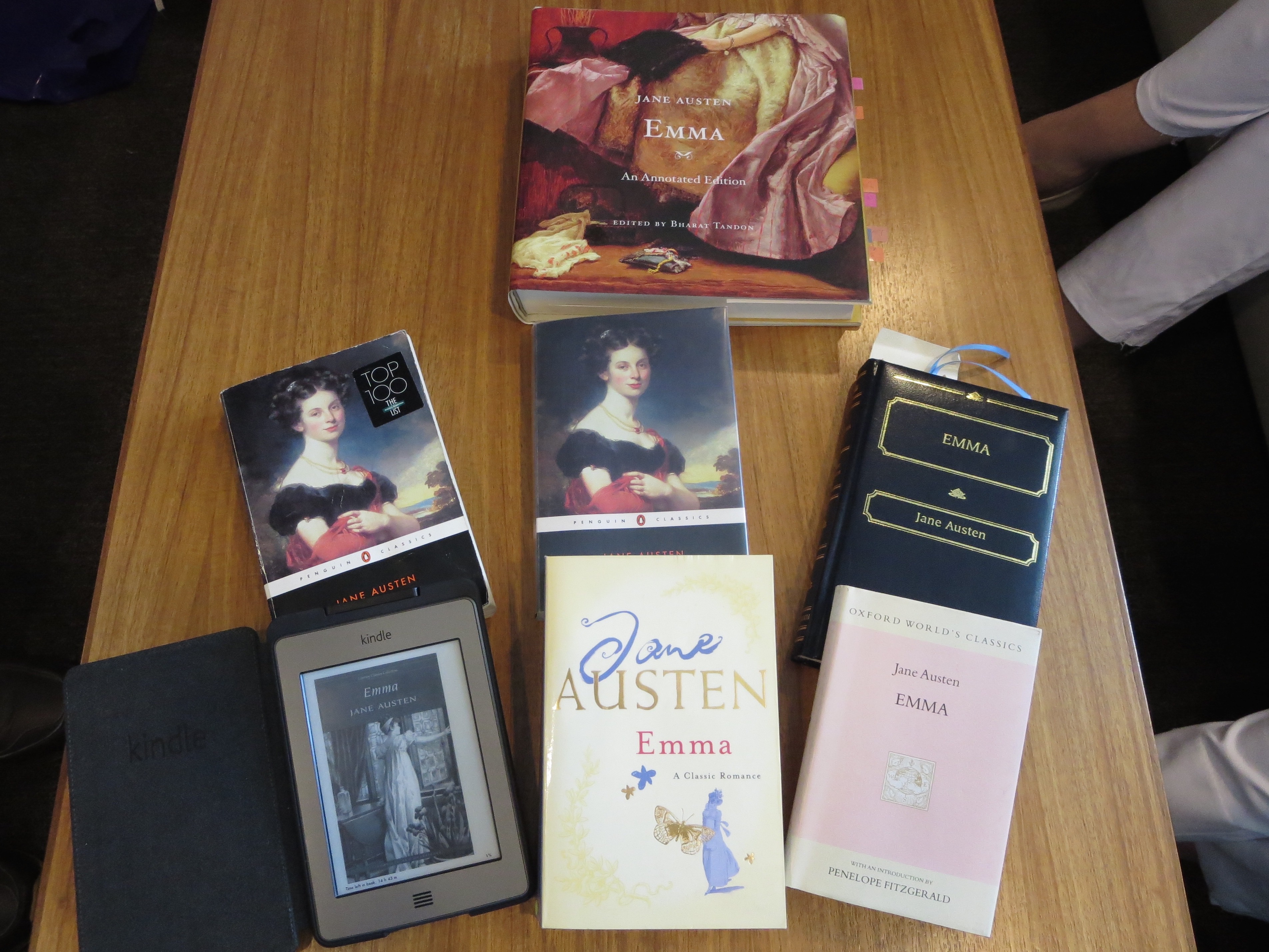
EmmaCovers

In April, I wrote a post on Volume 1 of Emma, sharing the thoughts that had come to me during my Jane Austen’s group’s current slow read of the novel. This month, I’m sharing some ideas that Volume 2 raised for me.

I wrote in my Volume 1 post that, during this read, what popped out for me was the idea of young people lacking guidance. It relates to issues like character development and to themes like parenting (which Austen regularly explores in her novels.) The question with these slow reads always is, will an idea that pops up in one Volume continue in the next? Well, in this case my answer is yes and no.

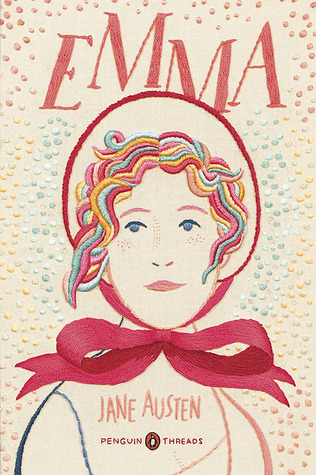
Jane Austen, Emma, Penguin

What I mean by this is that this notion expanded for me in Volume 2 to encompass the idea of “nature versus nurture”. Now, I’m not saying that Austen was specifically engaging in that debate, but that she has a lot to say about both aspects of our character. Before I continue, I will just share that I did wonder when the “nature versus nurture” debate started?

My searches, including via Wikipedia and two AI services, revealed that while ideas about innate (nature) vs. learned traits (nurture) can be traced back to ancient philosophy, the “nature versus nurture” debate, as a formal concept, began in the mid-1800s with Francis Galton, a cousin of Charles Darwin, who coined the term in his 1874 publication, “English Men of Science: Their Nature and Nurture”. In case you are interested, Chat GPT advised that philosophers like Plato and Aristotle debated discussed the role of “heredity and environment in shaping individuals” with Plato leaning towards nature (“innate knowledge”) and Aristotle towards nurture (“experience and environment”). And Wikipedia identifies Chen Seng having asked a similar question in 209 BCE. These aren’t the only people to have thought about the question, and Wikipedia’s article is useful if you are interested. But I’ll move on as the history of the debate is not my focus here.

What kept popping up for me – as I looked to see how my guidance-of-young-people theme was developing – were various comments Austen was making about nature and nurture. I’ll share just a few.

The first one to come to my attention in Volume 2, concerned Jane Fairfax, who was orphaned as a toddler and brought up, at first, by her grandmother, Mrs Bates, and aunt, Miss Bates. Austen describes her as a three-year-old

her being taught only what very limited means could command, and growing up with no advantages of connection or improvement to be engrafted on what nature had given her in a pleasing person, good understanding, and warm-hearted, well-meaning relations.” 

So, “nature had given her” a good start, and her relations had nurtured her as best they could with their “very limited means”. However, soon after, the Campbells (the family of a friend) had taken her in:

“She had fallen into good hands, known nothing but kindness from the Campbells, and been given an excellent education. Living constantly with right-minded and well-informed people, her heart and understanding had received every advantage of discipline and culture”.

And then, Austen seems to make the point that Jane Fairfax’s innate character, her disposition, was such that good nurturing had found fertile opportunity: “Her disposition and abilities were equally worthy of all that friendship could do…” Unfortunately, with no money, her destiny looked likely to be governessing, which the Campbells knew and did their best to prepare her for, but that’s another story …

As for Frank Churchill, in my last post regarding guidance, I noted that Austen suggests that, with his guardian family (his aunt and uncle at Enscombe), he had been left to his own devices with little guidance other than “his own comfort”. In this volume, Austen says more about his nature

“He seemed to have all the life and spirit, cheerful feelings, and social inclinations of his father, and nothing of the pride or reserve of Enscombe.”

It seems that at least some of the Churchills’ nature had not been nurtured into Frank. Ironically, it’s Emma’s father, Mr Woodhouse, who identifies some flaws in his behaviour, calling him “not quite the thing”, though his reasons are fussy.

And then there’s the third character whom we meet in Volume 2, Mrs Elton. These are Emma’s thoughts, and she is a snob, but nonetheless, she hones in on some points relevant to my thinking:

and the quarter of an hour quite convinced her that Mrs. Elton was a vain woman, extremely well satisfied with herself, and thinking much of her own importance; that she meant to shine and be very superior, but with manners which had been formed in a bad school, pert and familiar; that all her notions were drawn from one set of people, and one style of living; that, if not foolish, she was ignorant, and that her society would certainly do Mr. Elton no good.

We don’t know how much of this comes from Mrs Elton’s nature, but Emma does lay a much blame for her behaviour and character on her nurture.

Then there’s sweet Harriet, whom we met in Volume 1, and whom Emma considered, then, “not clever, but she had a sweet, docile, grateful disposition” and only needed to be “guided by any one she looked up to”. In Volume 2, her nature is again referenced, in terms of “the many vacancies of Harriet’s mind”! Poor Harriet. What will happen to her? Wait for Volume 3!

Finally, it’s Emma’s brother-in-law Mr John Knightley, who shows particular sense, when he provides these instructions to Emma on caring for his sons while he’s away:

” .. Do not spoil them, and do not physic* them.” 
“I rather hope to satisfy you both,” said Emma; “for I shall do all in my power to make them happy, which will be enough for Isabella; and happiness must preclude false indulgence and physic.”

[* Meaning, don’t medicate them as their mother, Emma’s sister, is wont to do.]

There’s no reference here to specific moral, or any other education, but we can infer from this, and our knowledge of the man, that he is well aware of the importance of good nurturing to his sons.

Of course, there were other issues that intrigued me in Volume 2, but these ideas are the ones I want to document this go round with Emma.

Any thoughts?

Jane Austen, Mansfield Park (Vol. 3)

Mansfield Park book covers

A year ago, my Jane Austen group did a slow read of Mansfield Park, meaning we read and discussed it, one volume at a time, over three months. I posted my thoughts on volume 1 (chapters 1 to 30), and volume 2 (chapters 19 to 31), but I missed the third meeting, and never wrote up the final volume (chapters 32 to 48). However, this year my reading group scheduled Mansfield Park for our Classic read, so I’m taking the opportunity to share my thoughts on that last volume.

But first, a brief intro. The reading group member who recommended we read Mansfield Park did so because she wanted to see whether she would better like this, her least favourite Austen, on another read. She didn’t. I understand this. Mansfield Park is regularly identified as Austen’s hardest book to like. It feels prudish to modern eyes; its protagonist Fanny isn’t exciting nor is her romance; and it is more serious and certainly less sparkling than its predecessor, Pride and prejudice. Re this latter point, Jane Austen collected opinions on the novel from friends, family and others, and reported that one Mrs Bramstone “preferred it to either of the others — but imagined that might be her want of Taste — as she does not understand Wit.”

Now, my thoughts …

Volume 3 starts the day after Fanny has rejected Henry Crawford’s proposal. As someone in my reading group said, all the novel’s action takes place in the final chapters, and I mostly agree, although significant events do take place in the previous volumes, including the visit to Sotherton and the plan to put on the play, Lovers vows.

I wrote in my first two posts that what was striking me most was the selfishness, or self-centredness, of most of the characters. It suggested to me that Austen was critiquing the selfishness/self-centredness of the well-to-do, and how this results in poor behaviour, carelessness of the needs of others, and for some, in immoral behaviour. (I think we could equate these ideas with today’s concerns about “entitlement”.) This thread continued in volume 3. Indeed, here is where it all comes home to roost, confirming my sense that Mansfield Park is fundamentally about morality.

Fanny is clearly the novel’s moral centre. She quietly observes, and reflects on, what goes on around her. As one of my reading group members said, it is through her eyes, her thoughts, that we see the novel’s world. In the first chapter of volume 3, Sir Thomas speaks to Fanny about Henry’s proposal, explaining why she should accept him. Henry is

a young man … with everything to recommend him: not merely situation in life, fortune, and character, but with more than common agreeableness, with address and conversation pleasing to everybody.

Then he adds pressure. She owes Henry gratitude for his role in obtaining advancement for her brother in the navy, and marrying Henry is her duty to her family as such a marriage can only help them. Sir Thomas is therefore perplexed and shocked at Fanny’s ongoing refusal – despite these persuasions – to consider Henry. He asks:

“Have you any reason, child, to think ill of Mr. Crawford’s temper?”
“No, sir.”
She longed to add, “But of his principles I have” …

However, she feels that to tell Sir Thomas of her observations of Henry’s unprincipled behaviour towards Julia and the engaged Maria would betray them – so, she’s caught and says nothing. She hoped Sir Thomas – “so discerning, so honourable, so good” – would accept her “dislike” as sufficient reason. Unfortunately, not only can he not accept it, but he accuses her of wilfulness and ingratitude. It’s mortifying.

To his credit, however, Sir Thomas backs off, planning to let nature take its course, and, with a little judicious encouragement from the sidelines, he believes Henry will win her round. So Henry continues to press his suit, and Fanny continues to hold steady, reflecting at one point on “his want of delicacy and regard for others”. A few chapters on, Mary Crawford also presses her brother’s suit, but Fanny – she who is called wimpy by many modern readers – pushes back, telling Mary,

I had not, Miss Crawford, been an inattentive observer of what was passing between him and some part of this family in the summer and autumn. I was quiet, but I was not blind. I could not but see that Mr. Crawford amused himself in gallantries which did mean nothing.

While Fanny is coping with this, Edmund is moving forward with his plans to win Mary Crawford’s hand, despite her rather telling hatred of his chosen profession as a clergyman. Fanny – not altogether disinterested it has to be admitted – had observed Mary’s poor values, but it takes Edmund a long time to see her for what she is, for her lack of “principle”, her “blunted delicacy and a corrupted, vitiated mind”. Edmund is convinced that Mary had been corrupted by the influence of others. He talks of “how excellent she would have been, had she fallen into good hands earlier” (instead of those poor influences she had in London. City versus country values is another thread running through this novel.)

I could expand more on this selfishness-leading-to-poor-behaviour-or-immorality theme because examples abound in the volume, but my aim here is to just share some ideas. And, I want to share another one…

I also mentioned another developing theme in my post on volume 1, the education of Sir Thomas. Interestingly, this is related to something I am observing in my current slow read of Austen’s next novel Emma, that of the quality of guidance given to young people and what happens when that guidance is faulty, misguided and/or not grounded in good moral teaching. It’s not a new theme for Austen, as you can see in Edmund’s comments above about Mary Crawford. But, it’s Sir Thomas’s learnings as one of those who does the guiding that I want to focus on.

Like many of Austen’s characters, in fact, Sir Thomas engenders a variety of reactions from readers. Some see him as harsh and uncompromising. It’s easy to argue this when you see the way his children – and niece – fear him. But others, and I am one, see him as a father trying to bring up his children as best he can, with little help from the indolent Lady Bertram. Fanny, our moral centre, talks of his “parental solicitude”. We see hints of his kindness in volumes 1 and 2, but it is in volume 3 that we see what he is really made of. He’s a man of his times, of course, but one who had his children’s best interests at heart and who realised too late that his raising of them had been misguided.

Now, before I continue, I want to make a little comment about style and structure. For most of the book, though there are departures, we are in Fanny’s head, seeing what she sees, thinking what she thinks, but in the book’s final chapter, Austen breaks the fourth wall and talks to us directly. It opens with a favourite quote:

Let other pens dwell on guilt and misery. I quit such odious subjects as soon as I can, impatient to restore everybody, not greatly in fault themselves, to tolerable comfort, and to have done with all the rest.

“I quit”, she says, drawing attention to the fact that she is telling us a story, and she continues this way:

My Fanny, indeed, at this very time, I have the satisfaction of knowing, must have been happy in spite of everything…

The rest of the chapter wraps up the novel and her characters. She devotes a few pages to “poor Sir Thomas”, telling us that he “was the longest to suffer” due to “the anguish arising from the conviction of his own errors in the education of his daughters”. He reflected on the negative impact on Maria and Julia of the “totally opposite treatment” they had lived under

where the excessive indulgence and flattery of their aunt had been continually contrasted with his own severity. […]

Here had been grievous mismanagement; but, bad as it was, he gradually grew to feel that it had not been the most direful mistake in his plan of education. Something must have been wanting within, or time would have worn away much of its ill effect. He feared that principle, active principle, had been wanting; that they had never been properly taught to govern their inclinations and tempers by that sense of duty which can alone suffice. They had been instructed theoretically in their religion, but never required to bring it into daily practice. To be distinguished for elegance and accomplishments, the authorised object of their youth, could have had no useful influence that way, no moral effect on the mind. He had meant them to be good, but his cares had been directed to the understanding and manners, not the disposition; and of the necessity of self-denial and humility, he feared they had never heard from any lips that could profit them.

Just look at those last few sentences … there, I think, is Austen’s driver for this novel. Maria and Julia had been allowed to focus on “elegance and accomplishments” with no attention paid to “the moral effect on the mind”. Mary Crawford is similarly misguided.

Jane Austen, as we know, could be witty and acerbic with the best of them, but in this most serious novel of hers she may have shared the moral and social values dearest to her heart.

Thoughts?

Jane Austen, Emma (Vol. 1, redux 2025)

EmmaCovers

As long-time readers here will know, my Jane Austen group did a slow read of Austen’s novels over several years, starting in 2011. In 2022, we decided it was time to repeat the exercise, and are again reading them chronologically, one each year, making 2025 Emma’s turn.

Our slow reads involve reading and discussing the chosen novel, a volume at a time. We “try” to read as though we don’t know what happens next, to help us focus closely on what we think Austen is doing. Of course, we can’t read like a first-time reader, but it’s a useful discipline.

We always wonder whether this time, after so many reads, we will see anything new or fresh. But, we always do. Just the march of time, with its impact on our knowledge, experience and tastes, means we see the books differently. Take Emma, for example …

Jane Austen, Emma, Penguin

A few re-reads ago, what stood out for me was its beautiful plotting. There’s barely a word or action that doesn’t imply or lead to something telling, even if we are unaware at the time. From my last major re-read, in 2015, I noticed how often the word “friend” or the notion of “friendship” was appearing. The novel starts with Emma losing her governess-then-companion Miss Taylor to marriage. They’ll remain friends but Emma is left alone with her gentle but fussy father. So, she nurtures a friendship with the 17-year-old Harriet. In my post on rereading Volume 1, I explored the idea of friendship, and then watched in Volumes 2 and 3 to see whether the idea continued. It did. This is not to say that what we might identify in a slow read will overtake previous ideas, but that these re-reads enable us to tease out more of the details, which usually results in a deeper understanding of the whole.

So, what would I find this time? I did consider choosing something to look for, like the role of letters or music in the novel, but decided to just see what played out. Sure enough, something popped up, the idea of young people lacking guidance. It relates to issues like character development and to themes like parenting. And, I found it all there in the first few chapters.

The novel begins:

Emma Woodhouse, handsome, clever, and rich, with a comfortable home and happy disposition, seemed to unite some of the best blessings of existence; and had lived nearly twenty-one years in the world with very little to distress or vex her.

This can be teased out in many ways, but, remembering that “very little to distress or vex her”, I’m focusing on where Austen goes next. As explained above, the novel opens with Emma’s governess-then-companion Miss Taylor having just married, so Emma, who lost her mother when she was very young, is left alone with her “valetudinarian” father, “a nervous man, easily depressed”. She indulges him, as only a devoted daughter can, but otherwise, she is untrammelled. Austen describes her life, to this point, in the third and fourth paragraphs:

Emma doing just what she liked; highly esteeming Miss Taylor’s judgment, but directed chiefly by her own.

The real evils indeed of Emma’s situation were the power of having rather too much of her own way, and a disposition to think a little too well of herself.

And there it is, “directed chiefly by her own [judgement]”. Neither Emma’s “nervous” father nor the mildly-tempered Miss Taylor/Mrs Weston question or guide her. However, in the same chapter, we learn that there is one who does, her brother-in-law Mr Knightley, “a sensible man about seven or eight and twenty”. Austen writes that:

Mr. Knightley, in fact, was one of the few people who could see faults in Emma Woodhouse, and the only one who ever told her of them …

We see several examples of his chiding her in Volume 1, including about her interference in Harriet’s response to a marriage proposal. We also see him discussing Emma with Mrs Weston, telling her that she had been a good companion to Emma but had also been better at submitting her will to Emma than in giving Emma the “complete education” he thinks she needed.

Now, moving on to Chapter 2, we hear of another young person, the three or four and twenty, Frank Churchill. His mother, too, had died when he was very young, and, for a number of reasons, he

was given up to the care and the wealth of the Churchills [aunt and uncle], and he had only his own comfort to seek, and his own situation to improve as he could.

The implication here is that he too had been left to his own devices with little guidance other than “his own comfort”. It occurred to me, during this reading, that he is being set up as a parallel and perhaps eventual foil to Emma. But, hold that thought, because Frank does not physically appear in Volume 1. There is, however, a telling discussion at the end of the Volume about his not coming to Highbury to meet his father’s new wife, Mrs Weston. Mr Knightley – note, it’s him again – argues that while Frank’s aunt and uncle are given as the reason:

There is one thing, Emma, which a man can always do, if he chooses, and that is, his duty.

Frank simply needed to use the “tone of decision becoming a man”, and there would have been “no opposition”.

Finally, there is a third example, the aforementioned Harriet Smith, who is introduced in Chapter 4. She

certainly was not clever, but she had a sweet, docile, grateful disposition; was totally free from conceit; and only desiring to be guided by any one she looked up to.

The natural child of an unknown person who had paid for her schooling and now for her boarding at that school, Harriet has no parent to guide her, only school teachers – and now, the flawed Emma. By the end of Volume 1, it is not going well for Harriet, who has lost one real and one imagined suitor due to Emma’s guidance.

So, as Volume 1 progresses through its 18 chapters, we see some of the fallout of Emma’s being a law unto herself and ignoring the wisdom of others. I look forward to seeing if this idea is followed through in Volume 2. Is it important to Austen’s world view? Watch this space …

On the comedy of Jane Austen (1905)

A regular part of my Jane Austen group’s monthly meeting is a show-and-tell which means of course that we share anything new we’ve acquired, seen or heard about relating to Jane Austen. At our February meeting, a member brought along a first edition (I think) of a book a friend had given him as a result of that friend’s downsizing. It pays to have your friends know your enthusiasms!

The book was G.E. Mitton’s Jane Austen and her times, 1775-1817 (1st ed. 1905). We were intrigued as none of us had heard of this book or its author. Who is Mitton? The assumption from some in the group was male, but others of us were not so sure – and we were right to be, because G.E. Mitton is Geraldine Edith Mitton (1868-1955). She was, according to Wikipedia which cites Who’s who from 1907, “an English novelist, biographer, editor, and guide-book writer”.

Wikipedia provides a brief biography for her – drawn primarily from a couple of obituaries – followed by a list of works. It’s not much, but provides some background. She was born in Bishop Auckland, Country Durham, the third daughter of Rev. Henry Arthur Mitton, who was a master of Sherburn Hospital. In her late twenties, Mitton moved to London, where in 1899 she was employed by the publishing company A & C Black, and worked on the editorial staff of Who’s who. In 1920, she became the third wife of colonial administrator Sir George Scott and collaborated with him on several novels set in Burma. (Wikipedia lists four collaborative novels.) Her biography of him, Scott of the Shan Hills (1936), was published the year after his death. Several of her books are available at Project Gutenberg.

I could research her further, and, who knows, I might one day, but she’s not the main point of this post. What I want to share is how she starts her book. Chapter 1 is titled “Preliminary and Discursive”, and it opens with:

Of Jane Austen’s life there is little to tell, and that little has been told more than once by writers whose relationship to her made them competent to do so. It is impossible to make even microscopic additions to the sum-total of the facts already known of that simple biography, and if by chance a few more original letters were discovered they could hardly alter the case, for in truth of her it may be said, “Story there is none to tell, sir.” To the very pertinent question which naturally follows, reply may thus be given.

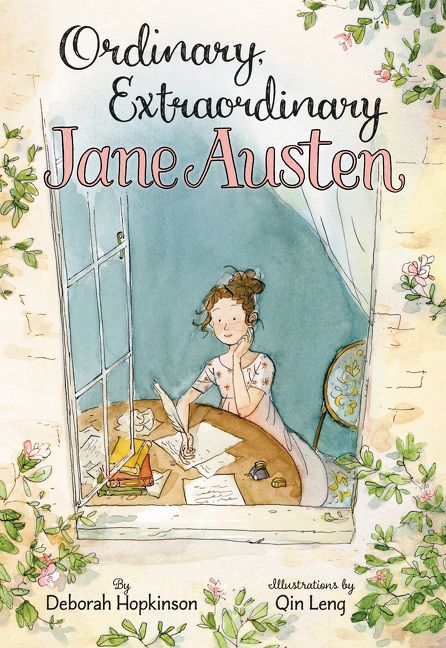
Deborah Hopkinson, Ordinary, extraordinary Jane Austen

Little did Mitton know! Despite the significant gaps in her biography, Austen is surely up there as a biographer’s subject. There have been many traditional biographies, including, in alphabetical order, those by David Cecil, yasmine Gooneratne, Park Honan, Elizabeth Jenkins, David Nokes, Carol Shield and Claire Tomalin. But, perhaps partly because of the gaps and partly because books about Austen are popular (and presumably sell well), her life has been written about from almost every imaginable angle, such as:

  • through the places she lived (Lucy Worsley’s Jane Austen at home) and the objects she owned (Paula Byrne’s The real Jane Austen: A life in small things);
  • through her beliefs and values (Helen Kelly’s Jane Austen: The secret radical and Paula Hollingworth’s The spirituality of Jane Austen);
  • through her relationships (E.J. Clery’s Jane Austen: The banker’s sister, Irene Collins’ Jane Austen: The parson’s daughter and Jon Spence’s “imagined biography” Becoming Jane Austen);
  • through (or by) her fans (Constance Hill’s Jane Austen: Her homes and her friends); and
  • for children (such as Deborah Hopkinson and Qin Leng’s picture book biography, Ordinary, extraordinary Jane Austen: The story of six novels, three notebooks, a writing box and one clever girl).

Need I continue?

But all that’s an aside. The opening paragraph then continues, and here is the main point of my post:

Jane Austen stands absolutely alone, unapproached, in a quality in which women are usually supposed to be deficient, a humorous and brilliant insight into the foibles of human nature, and a strong sense of the ludicrous. As a writer in The Times (November 25, 1904) neatly puts it, “Of its kind the comedy of Jane Austen is incomparable. It is utterly merciless. Prancing victims of their illusions, her men and women are utterly bare to our understanding, and their gyrations are irresistibly comic.”

Remember, this was written in 1905. Austen may not stand “absolutely alone” – and I would hope that women are no longer seen as “deficient” – in having “a humorous and brilliant insight into the foibles of human nature, and a strong sense of the ludicrous”, but I appreciate Mitton’s recognition of her wit. And that last sentence from The Times is close to perfect.

My Jane Austen group plans to discuss this subject later in the year, so you might see more on this topic, particularly regarding whether we see her comedy as “utterly merciless”. Meanwhile, you are more than welcome to share your thoughts.

Jane Austen, Lady Susan, revisited (#BookReview)

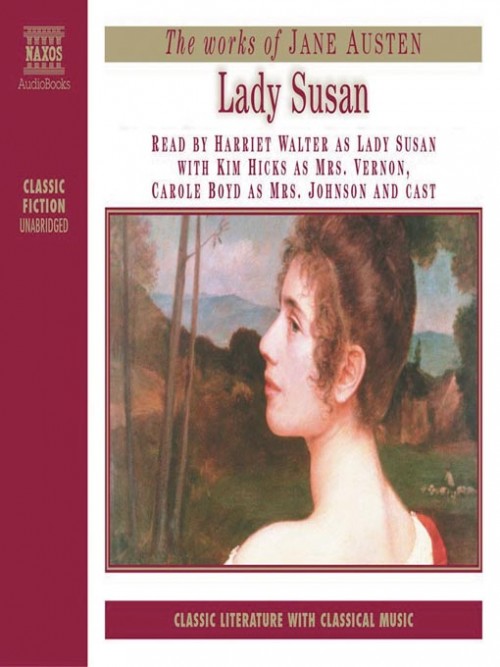
I have read Jane Austen’s Lady Susan several times, including with my local Jane Austen group in 2014 (my review). That now being ten years ago, we decided it was time to read – and consider – it again. However, as my time was tight, I decided to try an audiobook version, and found a Naxos edition in my library. Mr Gums and I listened to it on our 650+ km drive home from Melbourne, and found it excellent.

For those of you unfamiliar with Austen’s minor works, Lady Susan is, as far as we know, the first novel (novella) that Austen completed, but it was not published during her life-time, for the simple fact that she never sent it to a publisher. Written, scholars believe, in 1793/94, when she was still a teen, it was not published until 1871, decades after her death, when her nephew James Edward Austen-Leigh included it in his memoir of her. It has since been adapted to film, television, stage and book. The best known of these is probably the 2016 film, which was titled Love & friendship, a strange decision given that is the title of another work of Austen juvenilia (my post).

I gave a brief plot summary in my previous post, but will again here. Lady Susan is a bewitching, 35-year-old widow of four months, who is already on the prowl for a new, wealthy husband. The novel opens with her needing to leave Langford, where she’d been staying with the Manwarings, because she was having an affair with the married man of the house, and had seduced his daughter’s suitor, Sir James Martin. She goes to stay with her brother-in-law Charles Vernon and his wife Catherine, whom she’d done her best to dissuade him from marrying. She’s not long there before Reginald, Catherine’s brother, arrives to check her out because, from what he’s heard,

Lady Susan possesses a degree of captivating deceit which must be pleasing to witness and detect.

After all, she is “the most accomplished coquette in England”! Of course, the inevitable happens and the artful Lady Susan captivates him. Meanwhile, Lady Susan wants her shy, 16-year-old daughter, Frederica, to marry Sir James, the man she’d seduced away from Miss Manwaring – but sweet, sensible Frederica wants none of this weak “rattle” of a man. And so it continues …

Lady Susan, then, is a fairly simple tale, containing the deceits and silliness common to its 18th century genre, but also showing restraint and innovation which hint of the novelist to come – her wit and irony, her commentary on human nature, and her themes. I wrote about this too in my last post and don’t plan to repeat it here. There are many angles from which the book can be considered, and this time I’m interested in another, its form as an epistolary novel.

The epistolary novel was common in the eighteenth century. It’s something Austen tried again with Elinor and Marianne, which she wrote around 1795 to 1797, but later rewrote in her famous third person omniscient voice. Retitled Sense and sensibility, it became her first published novel in 1811. Pride and prejudice’s precursor, First impressions, may also have started as an epistolary novel. It’s interesting, then, that although she made a “fair copy” of Lady Susan in 1805 she didn’t rewrite it too. Why she didn’t is one of the many mysteries of Austen’s life. Perhaps it was the subject matter, because this is not Austen’s usual fare. Lady Susan belongs more to the 18th century tradition of wickedness, lasciviousness and adultery, forced marriages, and moralistic resolutions. Characters tend to be types rather than complex beings, and the novels are racily written, with a broad brush rather than a fine pen. This is true of Lady Susan, but there are departures. For a start it’s a novella not one of those 18th century tomes!

I might be going out on a limb here, because, while I have read a couple of 18th century epistolary novels, including Samuel Richardson’s, my memory has faded somewhat. However, Wikipedia helps me out a bit. Its article on the epistolary form says that there are three main types: monophonic (comprising the letters of only one character); dialogic (using letters of two characters); and polyphonic (which has three or more letter-writing characters). Lady Susan is an example of the last one. The main letter writers are Lady Susan (mostly to her friend Alicia Johnson in London) and her sister-in-law Catherine Vernon (mostly to her mother Lady De Courcy), but we also see some letters back from these correspondents, making four letter writers. But wait, there’s more! There are also letters – albeit just one in two cases – from others, namely Reginald De Courcy, his father Sir Reginald De Courcy, and Lady Susan’s daughter Frederica.

So, in this short book, we have 7 letter writers. But wait, there’s even more. To conclude the novel, Austen discards the epistolary-form and writes a first person denouement, which includes commentary like this:

Whether Lady Susan was or was not happy in her second Choice — I do not see how it can ever be ascertained — for who would take her assurance of it on either side of the question? The World must judge from Probability; she had nothing against her but her Husband & her Conscience.

The thing that intrigued me most as I was “reading” Lady Susan this time was the form. Austen used it for Love and Freindship, Lady Susan, Elinor and Marianne, and perhaps First impressions. But she abandoned it for the style for which she is recognised as a significant innovator – a third person narrative characterised by free indirect discourse, meaning the narrator’s voice embodies the perspectives of the characters. As John Mullan, writing primarily about Emma, explains: “Before Austen, novelists chose between first-person narrative (letting us into the mind of a character, but limiting us to his or her understanding) and third-person narrative (allowing us a God-like view of all the characters, but making them pieces in an authorial game). Austen miraculously combined the internal and the external”.

So, my thinking is that she started by using a form with which she was familiar as a reader and which was popular with readers of the day, but whose limitations she soon started to feel. Her using a relatively large number of letter writers, enabling us to see Lady Susan in particular from different perspectives, and her turning to an over-arching first person narrator for her conclusion, suggests that she understood the limitations of writing a novel-in-letters in terms of developing complex realistic characters, of managing plot, and of incorporating narratorial commentary. The rest, as they say, is history.

Thoughts anyone?

Jane Austen
Lady Susan (Classic Literature with Classic Music)
Naxos Audiobook, 2005
Duration: 2hrs 30mins

Available in e-text.

Jane Austen, Mansfield Park (Vol. 2)

Mansfield Park book covers

As I wrote last month, my Jane Austen group is doing a slow read of Mansfield Park this year, meaning we are reading and discussing the novel, one volume at a time, over three months. This month was Volume 2 (that is, chapters 19 to 31). It starts with the return of the patriarch, Sir Thomas Bertram, from his plantation in Antigua, and ends with Fanny rejecting Henry Crawford’s proposal.

Last month, I said that the thing that struck me most in volume 1 was the selfishness, or self-centredness, of most of the characters. I wondered whether Austen was writing a commentary on the selfishness/self-centredness of the well-to-do, and how this results in poor behaviour, carelessness of the needs of others, and for some, in immorality (however we define that). Having now read volume 2, I’m still on this path – together with a couple of other, somewhat related ideas, education, which I also mentioned last month, and parenting.

But first, the selfishness and self-centredness continues. In this volume, Maria marries and she and Julia leave Mansfield Park, leaving Fanny the only young woman at the Park. Mary Crawford, over in the parsonage, no longer has a young female friend to entertain her, so her sister Mrs Grant thinks Fanny would suffice:

Mrs. Grant, really eager to get any change for her sister, could, by the easiest self-deceit, persuade herself that she was doing the kindest thing by Fanny, and giving her the most important opportunities of improvement in pressing her frequent calls. 

Here is one of the reasons I love Austen. She knows exactly how we justify our actions to ourselves.

Anyhow, as a result, Fanny spends more time with Mary, as a favour to others, resulting in, Austen writes,

an intimacy resulting principally from Miss Crawford’s desire of something new, and which had little reality in Fanny’s feelings.

Examples like this pepper the volume. Lady Bertram doesn’t want Fanny to accept a dinner invitation because it would affect her “evening’s comfort”. After all, as Austen writes, “Lady Bertram never thought of being useful to anybody”. Late in the volume, Lady Bertram rises to the occasion, or thinks she does. She sends her maid to help Fanny dress for her first ball, and says so during the ball when Fanny’s appearance is complimented. “Chapman helped her to dress. I sent Chapman to her.” Yes, she did, but only after she was dressed and too late to help Fanny who was already dressed! Austen adds:

Not but that she was really pleased to have Fanny admired; but she was so much more struck with her own kindness in sending Chapman to her, that she could not get it out of her head.

Mrs Grant, Mary and Lady Bertram aren’t the only selfish, self-centred people in this volume. There’s the egregious Henry Crawford who had played, in volume 1, with the feelings of Maria and Julia, and then leaves Mansfield, in volume 2, with nary a word to either of them:

Henry Crawford was gone, gone from the house, and within two hours afterwards from the parish; and so ended all the hopes his selfish vanity had raised in Maria and Julia Bertram.

That’s not the end of Henry, though, because he’s soon back, telling his sister Mary, “my plan is to make Fanny Price in love with me”. In my Jane Austen group, we discussed that as his frivolous flirtation moved to something more serious – as he started to truly see, we believe, Fanny’s value – he gives no thought to whether Fanny will love him. That’s a given! He’s a catch!

There’s more I could say on this theme – I haven’t even mentioned Mrs Norris – but there are other ideas to talk about. I started to see in volume 2 that Mansfield Park is also about parenting, and, relating to this, I’d argue that in this volume we see the beginning of the education of Sir Thomas.

However, Sir Thomas is a controversial character in my group. Some detest him, rather like Mr Yates who had never seen a father so “unintelligibly moral, so infamously tyrannical” as Sir Thomas. But, along with some others, I see Sir Thomas differently.  Sure, he’s formal, but he loves his children – and he has no support in that wife of his. When he realises how silly Maria’s fiancé is, he wants to give her an out. Unfortunately, Maria wants to escape home and its restraints, so doesn’t take it. Sir Thomas is – admittedly – relieved because it suits his wish “to secure a marriage which would bring him such an addition of respectability and influence”. An example of new money, he’s a product of his times, and a “good” marriage can only help! However, as the volume progresses, Sir Thomas looks out for Fanny, wanting to give her opportunities, despite Mrs Norris’ attempts to keep puttng Fanny down.

For me, a recurring theme in Austen’s novels, in fact, is parenting. Lady Bertram is completely hands-off, letting Mrs Norris (as I mentioned in volume 1) have too big a hand in her daughters’ upbringing, to their detriment. Sir Thomas, on the other hand, is strict and – well, let’s talk about how it all plays out in volume 3. Here, though, he is kind to Fanny and wants well for her.

I have more to say on this, but I’ll leave it here as there are two ideas I’d like to share from my group’s discussion.

One of our members talked about the Australian critic John Wiltshire’s discussion of the disempowerment of women in his book Jane Austen and the body. He argues that caring for servants and the working class is a traditional role for genteel but otherwise disempowered woman, but that “this benevolence has a Janus face” because it replicates the inferior-superior social relationships that characterise the wider society. Mrs Norris, Wiltshire argues, “punishes others for her own dependency and frustration, whilst being able to hide this from herself in the guise of generosity to the recipients and loyal service to the system”.

Similarly, all at Mansfield Park have, through their adoption of poor Fanny Price “basked in the pleasure of benevolence”. But this has let Fanny become Mrs Norris’ victim. Both Fanny and Mrs Norris, says Wiltshire, are outsiders, “fringe-dwellers”; both are single, defenceless females who are “not part of the family except by courtesy. The one lives in the small White House, on the edge of the estate, the other in the little white attic at the top of the house”. Wiltshire argues that Fanny becomes the scapegoat upon whom Mrs Norris can “exercise her frustrations and baffled energies”. By scolding and punishing Fanny, she can “appease her own sense of functionless dependency and reaffirm the strictness of the social hierarchy which gives meaning to her life”. An interesting idea which I plan to think more about. It doesn’t excuse Mrs Norris, but it might explain her!

The other idea I want to share came from a young American visitor to our meeting. While she had read Austen and other classic authors, she said that her main reading, currently, is romance and general fiction. So, as she was reading Mansfield Park, she looked for tropes common to the romance genre. And, she found two significant ones, which could cement Austen’s reputation as the mother of the romance genre! The first trope is the idea of friends (or, here, cousins) becoming lovers, and the other is the romantic heroine’s belief that she’s “not like other girls”. She’s not as pretty, not as outgoing, and so on, as her rivals. Fanny makes this sort of observation in a discussion with Edmund about how she likes hearing Sir Thomas talk about the West Indies. She says she is “graver than other people” and concludes:

… but then I am unlike other people, I dare say.

I loved this insight from a first-time reader of the novel.

So much more to say … but there will be more opportunities to talk Austen, I dare say! Meanwhile, thoughts?

Jane Austen, Mansfield Park (Vol. 1)

Mansfield Park book covers

This year my Jane Austen group is doing a slow read of Mansfield Park, which involves our reading and discussing the novel, one volume at a time, over three months. This month, we did Volume 1, which, for those of you with modern editions, encompasses chapters 1 to 18. It ends with the return of the patriarch, Sir Thomas Bertram, from his plantation in Antigua.

I’ve said this before, but I’ll say it again. Every time I re-read an Austen novel, I “see” something new, something new to me that is, because I can’t imagine there’s anything really new to discover in these much loved, much pored-over books. Sometimes my “new” thing pops up because in a slow read I see things I didn’t see before while I was focusing on plot, or character, or language, or … Other times, it might arise out of where I am in my life and what experiences have been added to my life since the previous read.

I’m not sure what is behind this read’s insights, but the thing that struck me most in the first volume this time is the selfishness, or self-centredness, of most of the characters. It’s so striking that I’m wondering whether Austen is writing a commentary on the selfishness/self-centredness of the well-to-do, and how this results in poor behaviour, carelessness of the needs of others, and for some, in immorality (however we define that.)

Mansfield Park has been analysed from so many angles. These include that it is about ordination (which Austen herself said was the subject she was going to write about); that it is a “condition of England” novel; and that it is about education. In the first chapter, in fact, Mrs Norris, the aunt we all love to hate, says

Give a girl an education, and introduce her properly into the world, and ten to one but she has the means of settling well, without farther expense to anybody.

The irony of course is that the sort of education that Mrs Norris supplies to the Bertram girls does not do them any favours. That’s not exactly where I’m going now, though we could argue that poor education – or poor upbringing – is behind much of the selfishness we see in the novel. So, maybe, I will end up talking about education by the end of the novel.

For now, however, I will share why I am thinking this way. For those of you who don’t know the plot, it centres around Fanny Price who, at the age of 10, is taken in by her wealthy relations, the Bertrams of Mansfield Park, to relieve her impoverished parents of one mouth to feed. Fanny Price is the Austen heroine people love to hate, but I’m not one of those haters. I believe that if you truly look at her character and her life, within the context of her situation and times, you will see a young girl whose good values and commonsense enable her to make the best of a very difficult situation.

That it is a difficult situation is made clear in several ways, including the fact that we are told in the opening chapter that she is to be treated as a second class citizen in the family. A “distinction” must be preserved; she is not her cousins’ equal. In the second chapter, we are told

Nobody meant to be unkind, but nobody put themselves out of their way to secure her comfort.

As the novel progresses, and the characters are introduced, they are, one by one, shown to be self-centred and/or selfish in one way or another. I won’t elucidate them all, but, for example:

  • Lady Bertram (her aunt) is, from the start, lazy and careless about the needs of others. Her own comfort, and that of her pug, supersedes all.
  • Mrs Norris (another aunt) is judgemental and parsimonious, ungenerous in mind and matter in every possible way.
  • Cousins Maria and Julia show no generosity to Fanny, unless it’s something that doesn’t materially affect them; they are “entirely deficient in … self–knowledge, generosity and humility”.
  • Cousin Tom “feels born only for expense and enjoyment”, and exudes “cheerful selfishness”.
  • Visiting neighbour, Henry Crawford, is “thoughtless and selfish from prosperity and bad example” and amuses himself by trifling with the feelings of Maria and Julia who provide “an amusement to his sated mind”.
  • Henry Crawford’s sister Mary is unapologetic about her selfishness, asking Fanny to forgive her, as “selfishness must always be forgiven…because there’s no hope of a cure”. This surely takes the cake!

And so it continues … the clergyman Dr Grant is an “indolent, selfish bon vivant”; and the self-important Mr Rushworth and the self-centred Mr Yates show no interest or awareness of the needs of others.

There are, of course, some redeeming characters. Cousin Edmund, in the first flush of love, can be thoughtless at times but it is his overall kindness that keeps Fanny going, and Mrs Grant also comes across as sensible and kind.

A couple of significant events occur in this volume – the visit to Mr Rushworth’s place at Sotherton, and preparations for staging a play, Lovers’ vows. These provide ample opportunity for the characters to parade their self-centredness. You can’t miss it. Fanny certainly doesn’t, as she watches those around her jockey for position in terms of their roles in the play:

Fanny looked on and listened, not unamused to observe the selfishness which, more or less disguised, seemed to govern them all, and wondering how it would end.

Fanny, however, also questions her own motives in refusing to take part in the play: “Was it not ill-nature, selfishness, and a fear of exposing herself?” But, in fact, she is the only one who is truly alert to the dangers within.

This “selfishness” theme is not, of course, the only issue worth discussing when thinking about Mansfield Park, as other members in my group made clear with their own discoveries. It is simply the one that stood out for me, during this re-read.

Thoughts anyone?

Jane Austen’s The Watsons in Trove: Finishing the unfinished

While searching Trove recently for my Monday Musings 1923 sub-series, I came across some articles on Jane Austen’s unfinished novel, The Watsons, and can’t resist sharing them with you.

I have written about unfinished books before, including on Jane Austen’s unfinished novels, The Watsons and Sanditon. Unfinished books aren’t to everyone’s taste but, if you love an author, you’ll read anything they wrote. Such is the case for me with Jane Austen.

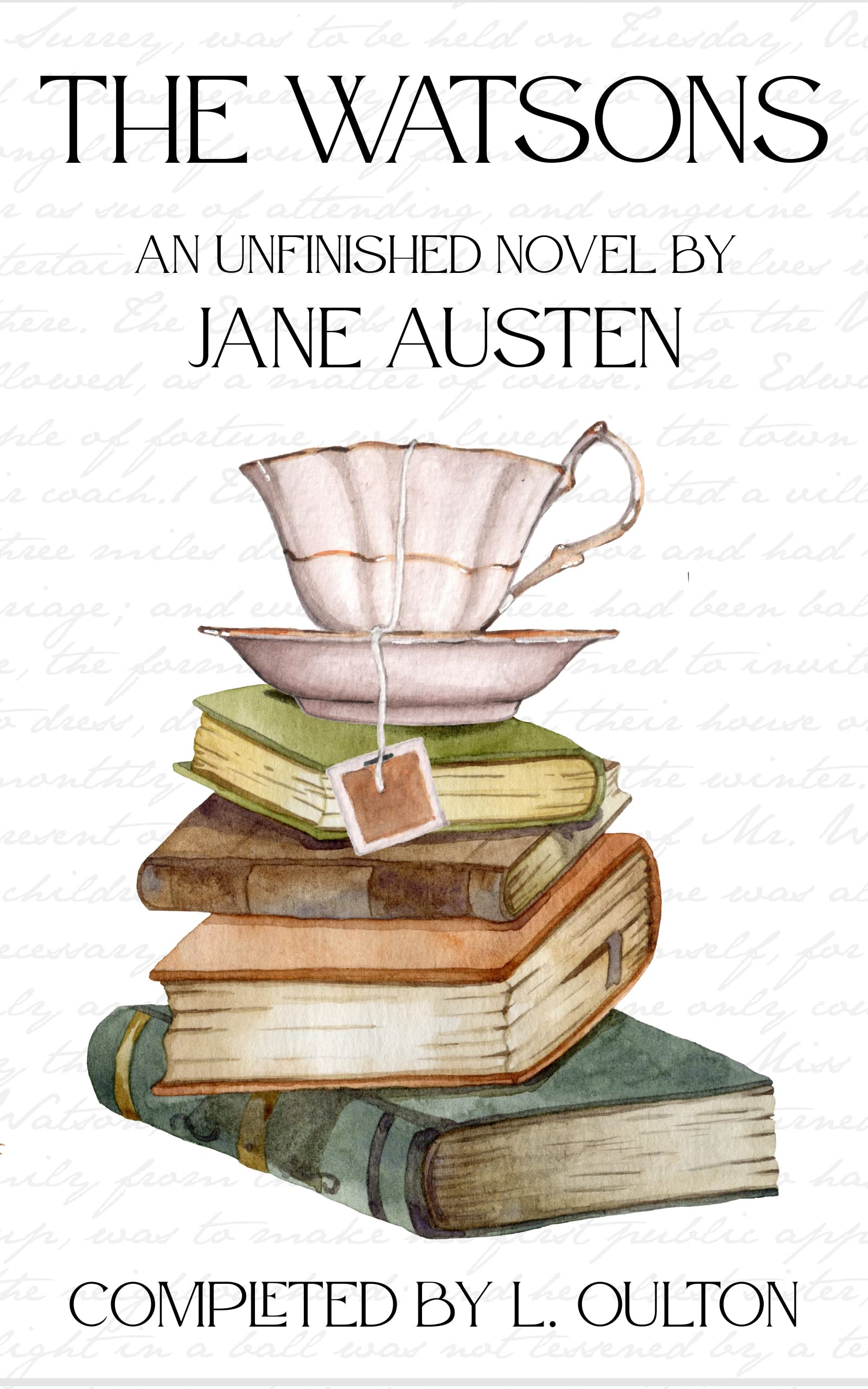
So, The Watsons. Just as writers can’t seem to stop writing sequels, prequels and multifarious other versions of Austen’s six published novels, they are also drawn to her unfinished novels. The Watsons, for example, which Austen abandoned around 1805, has been “finished” several times. The first appeared in 1850, and was not presented at the time as a continuation. Wikipedia provides a good summary, explaining that it was an “adaptation” written by Austen’s niece Catherine Hubback, who titled it The younger sister. The initial chapters were based on Austen’s writing, but Hubback did not copy her words verbatim. The first real continuation came in 1923, and was written by L. Oulton. Since then, there have been several more, including versions of Hubback’s version! And so it goes ….

You can read all about it in the Wikipedia article above. Meanwhile, I’m returning to Trove, and the two articles that inspired this post. Both appeared in May 192 – in Melbourne’s The Age (May 5) and in Sydney’s The Sun (May 13). They refer to the publication of two “editions” that year of The Watsons – an unfinished edition with, says The Age, “a pleasant and informative introduction by A. B. Walkley”, and one completed by “Miss L. Oulton”. The Sun describes these two editions:

One firm publishes this fragment with an introduction by A. B. Walkley; the other firm actually calls upon L. Oulton to finish the story! The reader is advised to read only to the place where Jane Austen threw down her pen.

Good advice, I say – but that’s because I am more interested in Austen’s writing than in what others might think were her intentions. This, however, is not why I wanted to share these pieces. What interested me were their attitudes to Austen.

The Age says:

A return to Jane Austen after a course of modern fiction is an experience. The prim dignity of her diction; her bookish, almost stilted, conversation; her expression of fine sentiments and descriptions of good manners; her special acquaintance with the somewhat narrow insular life of the well-to-do in the English provinces a century and a quarter ago; her well-bred young ladies, whose only ambition in life is to secure husbands; her shrewd insight into the human heart, and her capacity as a storyteller— the reader renews acquaintance with much pleasure.

Not surprisingly, I don’t agree with this assessment of Austen’s writing. “The prim dignity of her diction”? Good diction perhaps, but prim? Not my Jane. Her conversation does tend to be formal compared with today’s writing, but you just have to read Lydia’s slangy “Lordy” to know that Austen can capture the nuance of character through her dialogue. Further, describing her subject matter as “the somewhat narrow insular life of the well-to-do in the English provinces” is, in fact, “somewhat narrow”. Of course, I agree with “her shrewd insight into the human heart, and her capacity as a storyteller”.

It is this – “her well-bred young ladies, whose only ambition in life is to secure husbands” – that most offends. It reduces Austen’s concerns to something not worth reading, or, to something worthy only of a few hours of escapism. Her heroines do tend to be “well-bred” in terms of manners, but many are by no means “well-to-do”. Marriage is the outcome of her novels, but her themes and her heroines’ ambitions are far more complex.

The Sun was more off-handed about why we might read Austen:

The story bears all the characteristics of the author, though it does not compare with her other established works … Through this fragment, however, the modern reader may pleasantly peer at a vanished age, with a ballroom etiquette already long forgotten, sententious speeches, a slavish admiration of “the quality” in the county, love affairs that are hidden by hints and evasions, and a painful obedience to the conventions.

“Pleasantly peer at a vanished age” and “painful obedience to the conventions”? Even in the beginning of The Watsons we see Austen’s eye for superficiality versus substance in her society, and her willingness to expose it. We also see her awareness that not all women were well-to-do, as shown in this quote from the novel. In it, our not-so-well-off heroine Emma speaks to the aristocratic Lord Osborne:

‘I wonder every lady does not. – A woman never looks better than on horseback. –’
‘But every woman may not have the inclination, or the means.’
‘If they knew how much it became them, they would all have the inclination, and I fancy Miss Watson – when once they had the inclination, the means would soon follow.’
‘Your lordship thinks we always have our own way. – That is a point on which ladies and gentlemen have long disagreed. – But without pretending to decide it, I may say that there are some circumstances which even women cannot control. – Female economy will do a great deal my Lord, but it cannot turn a small income into a large one.’

Sure, Austen’s heroines were not in the poor-house, but not all were carefree either when it came to money. Indeed, several – Fanny Price and the Dashwoods, for example – rely on the kindness or generosity of others to live in reasonable comfort. And many minor characters – such as the Bateses in Emma – were identifiably poor. Marriage was a necessity not a luxury for many (Emma’s Emma notwithstanding!)

You are welcome to check my Austen posts to see my thoughts on these and other matters.

I enjoyed finding these articles, but was disappointed to find the same-old misunderstandings of Austen in vogue then as they continue to be now.

Slow reading: Jane Austen’s Pride and prejudice

Pride and prejudice book covers
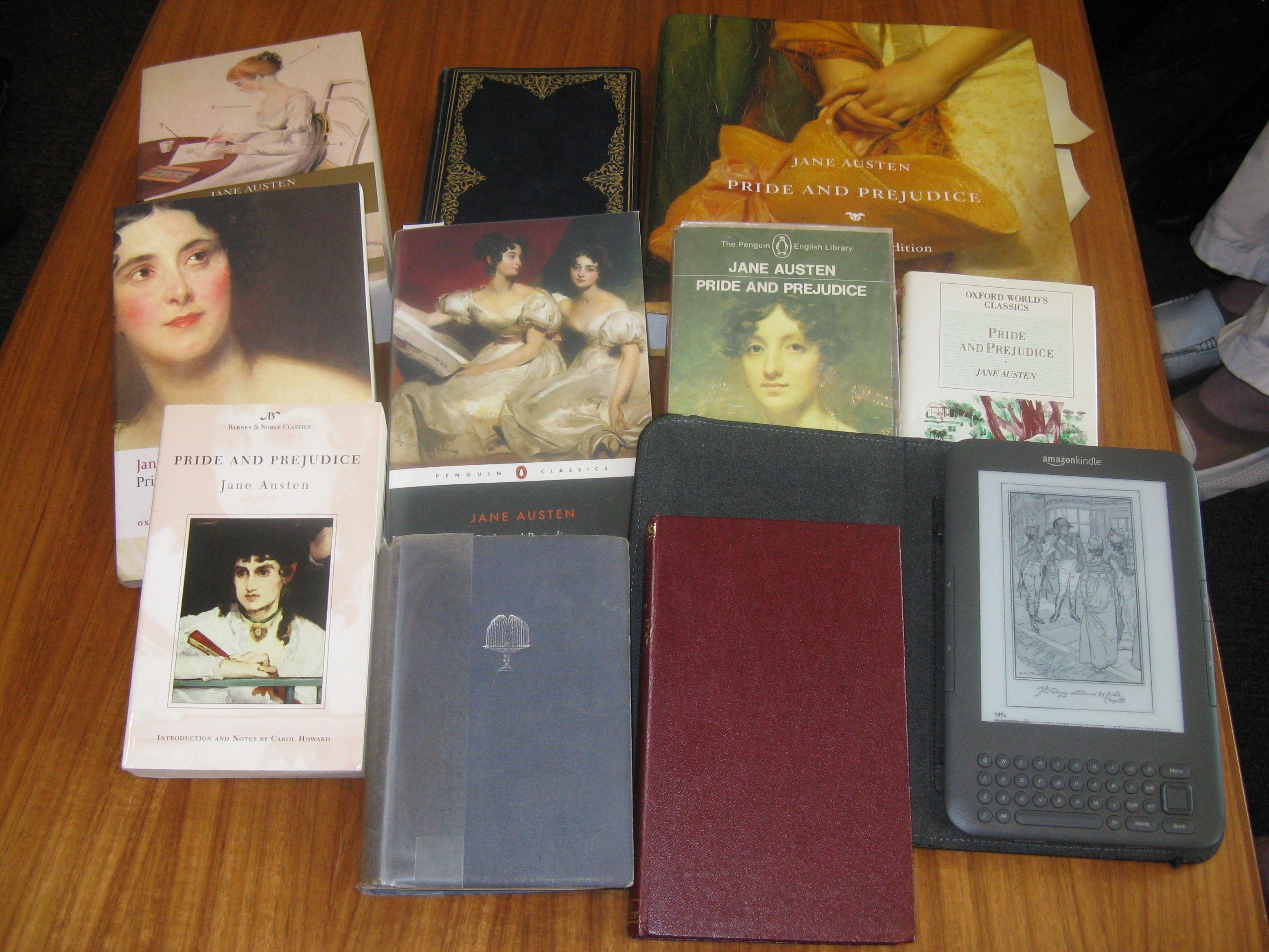
Some of the editions of Pride and Prejudice owned by my JA group

Back in the early to mid-2010s, my local Jane Austen group undertook a program of slow reading Jane Austen’s novels, coinciding with those books’ 200th anniversaries. Given that began around a decade ago, we decided last year that it was time to do another slow read program, and to stick with a chronological approach – that is, chronological in terms of publication. This meant that we did Sense and sensibility last year, and have just completed this year’s book, Pride and prejudice.

It is truly amazing just how much “new” we can find to talk about with books most of us have read not once, not twice, but multiple times, proving I suppose Italian writer Italo Calvino’s definition of a classic. Hmmm, no, not “definition” but “definitions”. He has fourteen of them, but here are the two that are most applicable to my post:

4. A classic is a book which with each rereading offers as much of a sense of discovery as the first reading.

6. A classic is a book which has never exhausted all it has to say to its readers.

These explain why slow reads can be particularly enjoyable with classics: once you know the plot, you are freed to discover how the author did it, to think about why they did it, and to notice more of the things they were telling you that you didn’t notice on the first read in your rush to find out what happens.

So, over the last three months, my group’s discussions have ranged across all of these, including finding some questions that we hadn’t thought to ask before. In Austen there are always those things she doesn’t tell us because they were known to her audience. These are the things we gradually pick up over years of Austen reading and research, such as the entail. But on this read, members raised questions regarding plot events that many of us hadn’t thought to ask before. For example, when Mr Darcy tells Elizabeth, on their meeting accidentally at Pemberley, that his sister “wishes to be known” to her, we wondered what had he told her about Elizabeth? Had he unburdened his heart to this shy young girl? Or, was it just an excuse to encourage Elizabeth to hang around a bit longer? And, when Lady Catherine visits Elizabeth because she fears there’s an engagement (or “an understanding”) between her and Darcy, where had she got this idea from?

We also found – yet again – that we had changed our minds about some of the characters, though sometimes these were diametrically opposed. For example, one remembered that when she first read the book as a schoolgirl, she felt “enormously sorry for ‘poor misunderstood Mrs Bennet’” but now she “would willingly strangle her”. For me, it’s the opposite. I had little sympathy for Mrs Bennet in my first readings, but now, understanding her worries about her daughters’ futures and Mr Bennet’s negligence in providing for them, I feel some sympathy for her – though her behaviour, all the same, is ridiculous. By contrast, in my early readings of Pride and prejudice I was far more sympathetic to Mr Bennet than I am now.

In fact, many of us in fact had little epiphanies regarding different characters that we shared with the group. Sweet Jane Bennet was thought just far too saccharine by one member, but she read some analyses that likened the angelic Jane to the sentimental 18th century heroines. Philosophers David Hume and Adam Smith argued, she told us, that feeling rather than reason provides the grounding for morality – and Jane exemplifies this. She sympathises with everyone, and behaves graciously to all. Our member wondered whether she should temper her view of Jane – though by the end she still felt Jane was just “too nice (to be real)”.

Some of these changes are due to the way slow reading exposes subtle clues that we don’t see on early reads, but some, I’m sure are due to life experiences. Austen is the perfect writer for illuminating (and then informing) our individual experiences of life.

We discussed which characters changed over the course of the novel, and, surprise, surprise, we didn’t all agree. No, let me rephrase that: we all agreed that Elizabeth and Darcy change, but some felt Mr Bennet did too, while others of us felt not – or, perhaps, only for a moment!

And then there’s the writing and the plotting. On each read we find more examples of just how beautifully, and cleverly, Austen writes. As one member said this week, as soon as he starts reading her sentences he’s drawn in – more than with any other writer. And then he shared a funny little quote from the novel that I had picked out too. It’s when Elizabeth first sees Pemberley from the outside, and takes in its beauty and grandness,

and, at that moment she felt that to be mistress of Pemberley might be something!

Book cover

Such an understatement … but of course the novel is full of statements like these, of satire and little ironies, of big and little insights. We also found interesting parallels, such as between those two ridiculous women, Mrs Bennet and Lady Catherine, who, said one member, are silly and illogical in different ways. Which brings me back to sweet Jane. Writing to Elizabeth to tell her about Lydia’s running off with Wickham, she says of her mother’s overwrought behaviour that “Could she exert herself, it would be better; but this is not to be expected.“But this is not to be expected” tells us that Jane knows her mother very well – and more, I’d argue, that Jane, while generous towards people, is not so taken in that she doesn’t see what’s what when it’s there in front of her. She just gives people the benefit of the doubt. I like that.

I fear this has been a self-indulgent ramble that hasn’t said much of substance, but it’s the best I can do right now!

Meanwhile, to those of you who do slow reads, why do you like doing them, and what you most get out of them?