Canberra Writers Festival 2019, Day 1, Session 1: Capital culture

It’s Canberra Writers Festival time again. The theme continues to be Power, Politics, Passion, reflecting Canberra’s specific role in Australian culture and history. I understand this. It enables the Festival organisers to carve out a particular place for itself in the crowded festival scene, but the fiction readers among us hunger for more fiction (and, for me, literary fiction) than we get. And, because the Festival is widely spread with venues on both sides of the lake, it was impossible to schedule as many of my preferred events as I’d like! Logistics had to be considered. Consequently, my choices might look a bit weird, but I think I managed to navigate the program reasonably well.

Note: There is unlikely to be a Monday Musings this Monday 26 August, as I’ll still finishing off my Festival posts!

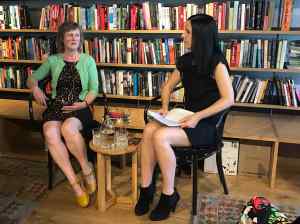
Capital Culture: Panel discussion moderated by Irma Gold
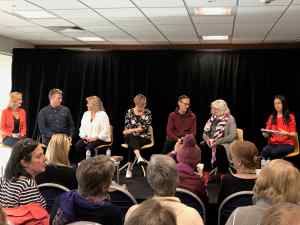
Panel pictureThe session was billed as follows: “Some of Canberra’s finest and most creative writers join forces in this irresistible ode to the national capital. Take a wild ride through a place as described by the vivid imaginations of some of this city’s best talents. Capital Culture brings stories not just of politics and power, but of ghosts and murder and mayhem, of humour and irreverence, and the rich underlying lode that makes Canberra such a fascinating city.”

You can see then why I chose this one – to support our local writing community, and to see writers on the panel who particularly interested me (like Marion Halligan, Paul Daley, and moderator Irma Gold.)

What I didn’t realise when I booked this session was that it was also a book launch. The description says ”Capital culture brings stories …” but oblivious me read that as saying the session called Capital Culture would tell us stories about the capital! The joke was on me, not that it would have affected my decision. Fortunately I discovered my mistake moments before commencement so I was prepared.

The writers were:

  • Paul Daley: journalist and author of Canberra in the Cities series.
  • Andrew Leigh: Australian Labor Party MP, but previously a Professor of Economics at the ANU, and author of several books including the wonderfully titled, Battlers and billionaires: The story of inequality in Australia.
  • Marion Halligan: award-winning Australian writer of novels, short stories, essays and other non-fiction.
  • Tracey Hawkins: award-winning author of children’s and adult non-fiction books.
  • Marg Wade: owner and operator of Canberra Secrets Personalised Tours, and author of three editions of Canberra secrets.
  • Nichole Overall: social historian and author of Queanbeyan: City of champions.

Irma Gold opened the session by referring to the Festival’s theme, Power, Politics, Passion, and saying that Canberra is more than that. This new anthology, which includes fiction, poetry and non-fiction, offers, she said, a nuanced picture of our capital. She also acknowledged country, and noted that it was a privilege to be talking about story on this land that has been full of stories for so long.

Perceptions of Canberra

The discussion started with panel members’ initial response to Canberra. It is a peculiar thing – to me, anyhow, who specifically wanted to come to Canberra – that many who come here hate it at first.

Journalist Daley and police officer Hawkins, for example, found themselves insulated within their professional communities – Parliament House journos for Daley, and police officers, not to mention criminals and dead bodies (!) for Hawkins. It was only when they married and moved into the ‘burbs that they started to enjoy Canberra community life. Daley also discovered the bush (which was something he’d never embraced before as an inner city Melbourne boy.)

Gold also came here not wanting to come, but is now a committed Canberran. Overall’s husband’s family came here in 1958 when his father, John Overall, became the first commissioner of the NCDC (National Capital Development Commission). Although her husband didn’t much like it, his father saw the city’s “unfulfilled potential” and was instrumental in building the capital we have today, including the lake and significant buildings like the National Library of Australia.

Other panelists had slightly different stories. Author Halligan quite liked Canberra when she came here as a student in 1962, but she didn’t expect to stay. Marriage changed that, and she now loves Canberra. She’s on a mission to overturn the ongoing denigration of Canberra through the use of our name as a synonym for the the Government. The whole of Australia elects it (and, in fact, right now the government is not the one Canberra voters would have brought in!) Daley said that this use of Canberra as a synonym for the Federal government is lazy jounralism. We feel abused and misrepresented much of the time, I must say!

MP Leigh talked about his love of the “bush capital”, saying it’s hard to come back from a walk in the bush and not feel good about yourself. Canberra’s bush, he said, is grounding and a leveller, something anyone can enjoy. His responses tended to be those of a politician – not shallow responses, though, but those of someone who sees the city from a certain perspective. He said that

if Canberra was a person, I like to think that it would be an egalitarian patriot, the kind who knows the past but isn’t bound by it.

Tour guide Wade said that her approach to the anthology was to do something fun, so she wrote a story inspired by Canberra’s ghosts, in particular those at the National Film and Sound Archive. She also mentioned ghosts at the Australian War Memorial (the “friendly digger” who opens and closes doors), the Hyatt ghost (who just stands and does nothing), and Sophia Campbell at Campbell House Duntroon (who is a naughty ghost)!

Gold then asked the panelists to comment on the fact that few countries in the world show as much contempt for their capital as Australians do. The term “Canberra bashing”, she said, entered the Australian dictionary in 2013, our centenary year. Of course, Gold was speaking to the converted, but the points were well made nonetheless!

Overall agreed that Canberra is underestimated by others, and that there is more to it than its obvious superficial beauty. Daley commented that Canberra has an intelligent, outward-looking populace. Canberrans are acutely aware of the symbolic nature of place, and the way it encompasses the story of Federation. It’s an egalitarian place, compared, say, to Sydney. Canberra is mostly middle-class with few shows of wealth. He also commented that creative communities can be found all through CBR.

Leigh took up the point about community noting Canberra’s “extraordinary urban design”, including its walkability and plethora of small suburban centres, which facilitates people mixing at local shops, and engaging in community activities at levels higher, apparently, than many Australian cities.

Wade talked about loving to change people’s perception of Canberra, while Hawkins commented on how often, when she travels overseas, people have never heard of Canberra, let alone know it’s Australia’s capital.

Gold asked Halligan about the idea that you shouldn’t set fiction in Canberra. Halligan said that her fiction was not political, but about ordinary people and lives. She talked about her experience of doing book tours with her novel The apricot colonel and the frequent surprised response that Canberrans were normal, just like them. Fiction, she suggested, can help change perception. Overall mentioned the success of Chris Uhlmann and Steve Lewis’ Secret city series.

It’s not all light

Finally, Gold noted that the anthology’s editor Suzanne Kiraly had described hers and Paul Daley’s piece as being the darkest in the anthology. Daley said that while Canberra is egalitarian, it’s not a great place to be poor, and so his second piece in the book is a fiction piece inspired by a young woman busker, the “violin girl”, he used to see. Leigh agreed that there’s no shortage of suffering in Canberra, but also argued that there are many civic entrepreneurs here reaching out to support or help the more vulnerable in the community.

Hawkins added that her story is a murder, that Canberra has crimes like any other community – as she discovered in her early years working here, which took her to, among other places, the old Kingston mortuary.

Gold commented early in the session that Halligan’s piece has a mournful, sorrowful tone. Halligan responded that she was “conscious of the melancholy of things that have been lost” such as the old Georgian vicarage where Glebe Park is now. Overall agreed, saying that we lose our uniqueness and distinctness, our sense of who we are, when we lose our buildings.

Q&A – and some comments

There was a short Q & A, but I’m just going to comment on the one suggesting that Canberra does not have a great depth of multiculturalism, despite our great annual Multicultural Festival. Those panelists who responded generally disagreed, and I could see their point – to a point. However, I had already noted to myself that the panel itself was not diverse. As far as I could tell none had an indigenous nor any other culturally diverse background. And, indeed, I think the whole anthology is the same. A lost opportunity to offer some different voices about our city.

However, the anthology does include contributions from some excellent writers, and I look forward to reading it. I only wish that, like most anthologies I’ve read, the table of contents included the author’s name!

Previous Canberra anthologies I’ve reviewed:
Festival Muse: Question time – Robyn Cadwallader with Irma Gold

Robyn Cadwallader, Irma Gold
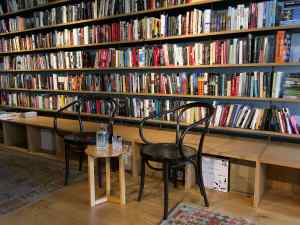
Cadwallader (L) and Gold in the Muse bookshop

Introducing the first event of their Sunday afternoon program, Dan, co-owner of Muse, commented on a peculiarity of Canberra: when they offer sessions on politics or history, they are packed out, but when the focus is fiction, the events are more intimate. Fine by me! I love small, cosy events. But it’s interesting, eh? Anyhow, we then got down to the event, which involved local author and editor, whom you’ve met several times here before, Irma Gold, interviewing local poet, essayist, novelist, Robyn Cadwallader, about her debut novel The anchoress (my review).

It was excellent. Gold structured her questions beautifully, starting with some background questions, moving through well-targeted questions about the book itself – well-targeted for me anyhow because she focused on historical fiction and feminism – and then ending with Cadwallader’s future plans. There was something for everyone – though I suspect most of us were interested in it all.

Gold commenced by providing a quick bio, which included the facts that Cadwallader migrated to Australia with her family when young, and that her background is academic writing. Gold shared Cadwallader’s shock that, when she moved from academic writing to fictional, her struggles with the dreaded term structure followed her! That made me laugh because I love thinking about structure in fiction. Gold also told us that The anchoress had been published in the USA and UK as well as Australia, and has been (or is being) translated into French. She said Marie Claire described The anchoress as “the book the whole literary world can’t stop talking about”. Wow, eh?

The interview commenced then with a brief discussion of Cadwallader’s early interest in books and writing, but let’s get to …

The anchoress

Robyn Cadwallader, The anchoress

The discussion started with Cadwallader doing a reading – and she chose the Prologue. That was great not only because it’s always (hmm, mostly) good to hear authors read from their own work, but also because it refreshed the book and some of its themes for me.

Gold said she’d never heard of anchoresses and asked Cadwallader what sparked Sarah’s particular story. Cadwallader responded that she’d come across anchoresses in her research for her PhD and, like Gold, was both horrified and fascinated by the concept. She said the inspiration for the story came from sitting in an anchorhold, unable to leave it, for an hour or so. It got her thinking about how it would feel to be in such a place forever. What would be the experience? She said her poetry is “about taking a moment and investigating it”. In this book, she took a small space and investigated it. Reinforcing her interest in focusing on the “experience”, she said she’d started writing the novel in 1st person but felt it wasn’t working, so tried 3rd but that didn’t work either. She then realised she had to be there to share the experience. She also made the point that she didn’t want Sarah to speak for all anchoresses.

Gold then honed in on the book’s genre, historical fiction, and asked Cadwallader how she went about separating her research from the writing. Cadwallader said she was lucky because she’d done so much research on the period before she started writing. She had to do a lot of thinking, however, and when she started writing she needed to do extra research on aspects she knew less well, such as village life and monasteries.

Next Gold moved onto how Cadwallader approached incorporating the history into the story. Cadwallader said she knew people would know little or nothing about anchoresses – how right she was! – but didn’t want to do exposition. She used the example of the section where Sarah stands in her cell (anchorhold) for first time. This was hard to write she said without “describing”. She tried to write it from Sarah’s experience in a way that would “show” modern readers, too, what it was like.

Some of the questions at the end concerned the historical fiction issue, so I’m sneaking them in here. Responding to what next, Cadwallader said that some people assumed she’d do a sequel! No, she said, as far as she’s concerned she’d wrapped up Sarah’s life and didn’t have anything more to say. Love it. This points, I think, to a difference between genre and literary-fiction. Genre tends to focus on plot, on the story of characters’ lives. Readers of genre love to get lost in – escape into – the characters’ lives and want to follow them, on and on. Readers of literary fiction – and they can be the same people, so I’m not suggesting a “snooty hierarchy” here – look for different things. They tend to be happy with ambiguous endings, and look forward to moving on to something different. I tend to be one of these readers. You could call me fickle.

Other questions picked up the relationship between fact/history and fiction, about the degree to which historical fiction should focus on the fact versus the fiction. Again, I loved Cadwallader’s considered response. She described historical fiction as an engagement between the present and the past. Writers, she said, need to balance what will communicate effectively with contemporary audiences and what’s accurate. She cited swearing as an example: a medieval oath, like “God’s teeth”, would not convey anger to a modern audience the way a modern swear word would.

Back to Gold now. Her next question concerned feminism. Yes! Was Cadwallader conscious of feminist issues from the start or did they emerge through the writing process. I loved Cadwallader’s answer. She said she was aware of feminist issues and theory from the start because her research had brought her face-to-face with medieval thinking about women, including the belief that women represent the body, and tempt men. However, she is concerned, she said, about historical fiction that wants to be positive about women. Such fiction needs to create strong, feisty women, but she wanted to explore what ordinary women experience.

So, her Sarah pretty soon finds her experience of her body starting “to bump against” the rule that tells her that her body is terrible. Cadwallader wanted to tell about ordinary women doing things that are not “spectacular”. She thinks some readers expected a “spectacular ending” but that would have plucked Sarah out of her context. Her approach to feminism was to describe these women’s experience, to honour them. She didn’t want to exploit them, but explore who Sarah was. She then talked about the village women. (They’re wonderful supporting characters in the book.) She didn’t want them to be “campaigners”, but wanted us to “see” them. It’s too easy for us to miss and not respect the ordinariness of women and what they do.

Muse bookshop

Gold ended with questions regarding how Cadwallader has handled her success and what her future writing plans were. Cadwallader talked about ongoing feelings of self-doubt and how easy it is to buy into criticism (rather, it seems, than praise). She described it – and being a writer, she used a metaphor – as being a headwind that you just have to keep walking into! And yes, she is writing another book. And yes, it’s mediaval-focused – to do with illuminators.

There was a brief Q&A, then it was over. We might have been an intimate group, but what a privilege to have been present at a conversation between an intelligent, warm interviewer and a thoughtful, open interviewee. Lucky us.

Monday Musings on Australian Literature Special: Book Giveaway Winners

Two weeks ago I announced my first blog giveaway, courtesy the generosity of Irma Gold, editor of the Canberra Centenary anthology, The invisible thread. Irma offered me two copies to give away, both signed by most of the authors represented in the anthology – and who are still living of course! Entries closed midnight, AEST, on 31August.

The invisible thread, by Irma Gold

Cover (Courtesy: Irma Gold and Halstead Press)

So, here are the winners, chosen using an Internet-based random number generator:

  • AUSTRALIAN ADDRESS winner is Rosemary, the lucky last Aussie to throw her hat in the ring; and the
  • OVERSEAS ADDRESS winner is Glenda in Switzerland

Congratulations Rosemary and Glenda … And commiserations to all you others. Thankyou though for showing interest. It’s a shame everyone can’t be winners.

Here is the deal, Rosemary and Glenda. You need to email me, at wg1775[at]gmail.com, your postal address by midnight AEST 7 September, 2013. I will redraw a new winner if I don’t have your address by that deadline.

Once again, a big thank you to Irma for offering this giveaway. … it is a real booklover’s treat.

Oh, and the book can be bought from Fishpond so all is not completely lost.

Reminder: a Book Giveaway

Time is running out to win one of the multiply signed copies of The invisible thread. Anyone from anywhere can enter as the editor and donor of the copies, Irma Gold, and I have agreed to quarantine one copy for an overseas address, and the other for an Australian address.

The invisible thread, by Irma Gold

Cover (Courtesy: Irma Gold and Halstead Press)

To read more about the book – gorgeous centenary anthology, The invisible thread, edited by Irma Gold – click on the following links to see my post on its launch, my review, or my description of the beautiful Woven Words event inspired by it.

So to recap the giveaway:

Eligibility:  The giveaway will be open to Australian and international readers, with ONE copy to go to an international reader, and ONE to an Australian reader. I will use a random number generator to identify the winners.

How to enter: Leave a Comment on this post, and state which country you live in so I can place in the right giveaway group. I’d love to hear why you’d like to have the book – but it’s not essential.

The fine print: Entries will close at midnight AEST on 31 August. If you win, you must email me with a postal address by the deadline that I advise in the post announcing the winners. I will redraw a new winner if the deadline isn’t met.

I can’t thank Irma enough for this offer … and hope those of you who lurk here won’t be too shy to enter.  This is a booklover’s treat that doesn’t come around often.

Monday Musings on Australian Literature Special: a Book Giveaway

Actually, the exciting thing is that this is not A book giveaway, as I have TWO books to give away. And, not only are there two books, but the books are signed by multiple authors! Intrigued? Then read on …

The invisible thread, by Irma Gold

Cover (Courtesy: Irma Gold and Halstead Press)

As many of you know this year is Canberra’s centenary. And, if you’ve been reading this blog, you are sure to have seen a mention or two (or more) of the gorgeous centenary anthology, The invisible thread, edited by Irma Gold. If, however, you don’t know what I’m talking about, click on the following links to see my post on its launch, my review, or my description of the beautiful Woven Words event inspired by it.

Hands up if you’d like a copy. Well, now’s your chance. The gorgeous, generous Irma has two copies of the book that have been signed by over 30 of the (still living) authors as well as by the editor (Gold) and the illustrator (Judy Horacek) … and has apparently been wondering what to do with them. To my astonishment, she asked me whether I would like to run a giveaway through my blog. Would I what?

The give-away is being timed to coincide with the last of the many events Irma has organised to promote the book – AN EVENING OF READINGS at the Paperchain Bookstore here in Canberra on Wednesday 28 August. It’s free but RSVPs are requested. Do consider going if you are in town. It will be great.

So to the giveaway:

Eligibility:  The giveaway will be open to Australian and international readers, with ONE copy to go to an international reader, and ONE to an Australian reader. I will use a random number generator to identify the winners.

How to enter: Leave a Comment on this post, and state which country you live in so I can place you in the right giveaway group. I’d love to hear why you’d like to have the book – but it’s not essential.

The fine print: Entries will close at midnight AEST on 31 August. If you win, you must email me with a postal address by the deadline that I advise in the post announcing the winners. I will redraw a new winner if the deadline isn’t met.

I can’t thank Irma enough for this offer … and hope those of you who lurk here won’t be too shy to enter.  This is a booklover’s treat that doesn’t come around often.

Irma Gold and Craig Phillips, Megumi and the bear (Review)

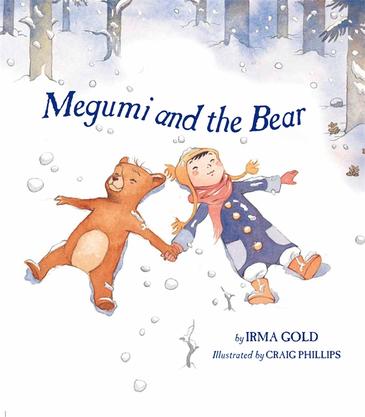
Irma Gold Craig Phillips Megumi and the bear book cover

Courtesy: Walker Books Australia

Now here’s something different at the Gums! I don’t, as you’d know, make a practice of reviewing children’s literature, though I have done a few cross-over adult-young adult novels. So, when Irma Gold and Craig Phillips’ children’s picture book, Megumi and the bear, landed in my letterbox a week or so ago I was challenged. Not only is it a picture book, but its cover – featuring a child and a bear making snow angels – suggest that it has little to do with Australia. Why should Whispering Gums make an exception for this book?

Well, the reasons are twofold. Firstly, I’ve reviewed two works by Irma Gold before (her short story collection, Two steps forward, and the anthology she edited, The invisible thread) and so was intrigued to read something different again by her. She’s one hard-working, versatile author, which I think you have to be if you want to make writing your career. Secondly, while it’s not set in Australia – usually something has to be Australian for me to make an exception – it is set in Japan. At least, Craig Phillips’ illustrations were inspired by his observing a little girl playing in the snow in Hokkaido. I love Japan – and have been to Hokkaido. Exception made!

Now, with two mid-late twenty-something children, I’ve not read a picture book for a long time but, as I picked this up and read it, a whole pile of memories of loved books came back, but first, the story. Like most picture books, its narrative line is simple – a young girl, Megumi, meets a young bear in a forest and they become good friends, playing together again and again until one day the bear doesn’t appear. Megumi is sad, and goes into the forest every day, to wait … until eventually she starts to forget and goes into the forest with her friends … It’s a lovely story about friendship, loss, time and memory.

Craig Phillips’ water colour illustrations are delightful – clear, uncluttered and colourful within a restrained palette. The bear and Megumi’s feelings are nicely conveyed through their facial expression and movement. Irma Gold’s text is also clear and simple, but not simplistic, with a nice use of repetition, “But the bear doesn’t come”, in the central section. The narrative is well-paced, keeping the story moving while providing time to consider (and feel) what is happening. The text is visually appealing. The topic sentence on each double-page spread is presented as a wavy line using an italicised font, with the following sentences in straight-lined plain text. This adds a lovely touch of whimsy to the presentation – and, I suspect, could help the out-loud reader get into a rhythm.

All this made it an enjoyable read – but what I enjoyed most was how it reminded me of other childhood loves, my own or ones made with my kids. The idea of a child playing with a bear brings to mind, of course, Winnie the Pooh. This is not at all a Christopher Robin and Pooh-like story but it plays into that notion of a friendship between children and bears. Going into the forest to play with a wild creature recalls Sendak’s Where the wild things are. Our bear here is not a wild thing – he’s sweet and small – and Megumi and the bear may not engage in wild rumpus, but they do have fun in the forest away from adults. And, this next probably sounds even less likely, but I was also reminded of the song “Puff, the Magic Dragon“. Again a completely different story and theme – and in fact quite the reverse in that here it’s the animal which goes missing – but both explore a friendship with “other” that is made and then lost. Hmm, now I think about it, these connections are pretty loose, but isn’t this partly what reading is about? Enjoying, remembering, connecting, making our own paths through literature and its meanings for us?

The thing is, whatever you make of it, Megumi and the bear is a gorgeous book that I can imagine loving to share with a grandchild, if I had one!

Irma Gold and Craig Phillips (illus)
Megumi and the bear
Newtown: Walker Books Australia, 2013
ISBN: 9781921977909

(Review copy courtesy Walker Books Australia)

Woven Words: What a night!

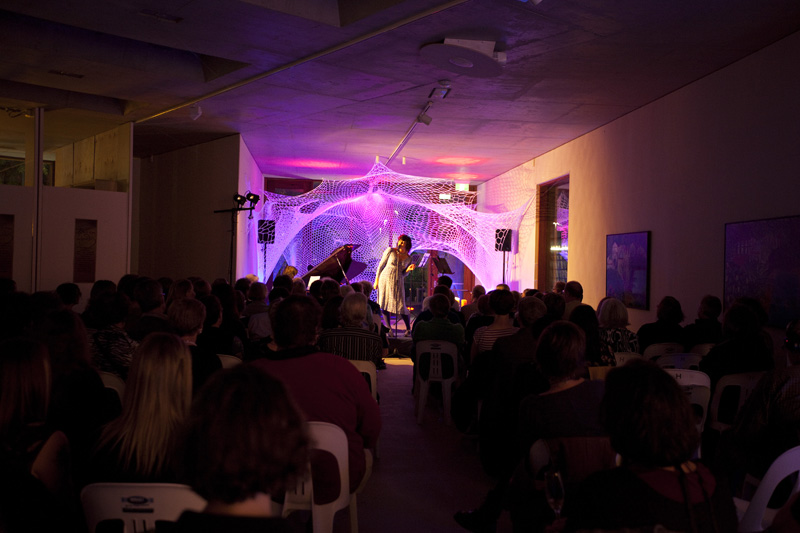
Chanel Cole, Nishi Gallery (Photo: Katherine Griffiths)

Chanel Cole, Nishi Gallery (Photo: Katherine Griffiths)

As we were driving home from Woven Words, the most recent event associated with The invisible thread anthology, it occurred to me that the evening, which blended words with music, was rather like a three movement musical composition. It went a bit like this:

  1. Sara Dowse‘s bright and slightly quirky allegro
  2. Alex Miller‘s intense adagio
  3. Alan Gould‘s cheeky scherzo.

The event took place in an intimate venue in Canberra’s newest inner city precinct, New Acton, which, I understand, is positioning itself as an arts hub. Even before a fire in mid-2011 set the area back, there had been some lovely musical evenings in Flint, one of the precinct’s restaurants. The Nishi Gallery, though, is a very recent player on the block, so recent that I’m not quite sure what its long-term plans are. Last night, however, it became a delightful space in which a gathering of, guessing here, about 100 people heard three great authors read from their works, bookended by music (mostly) chosen by them and performed by local professional musicians. It was, in a word, a blast.

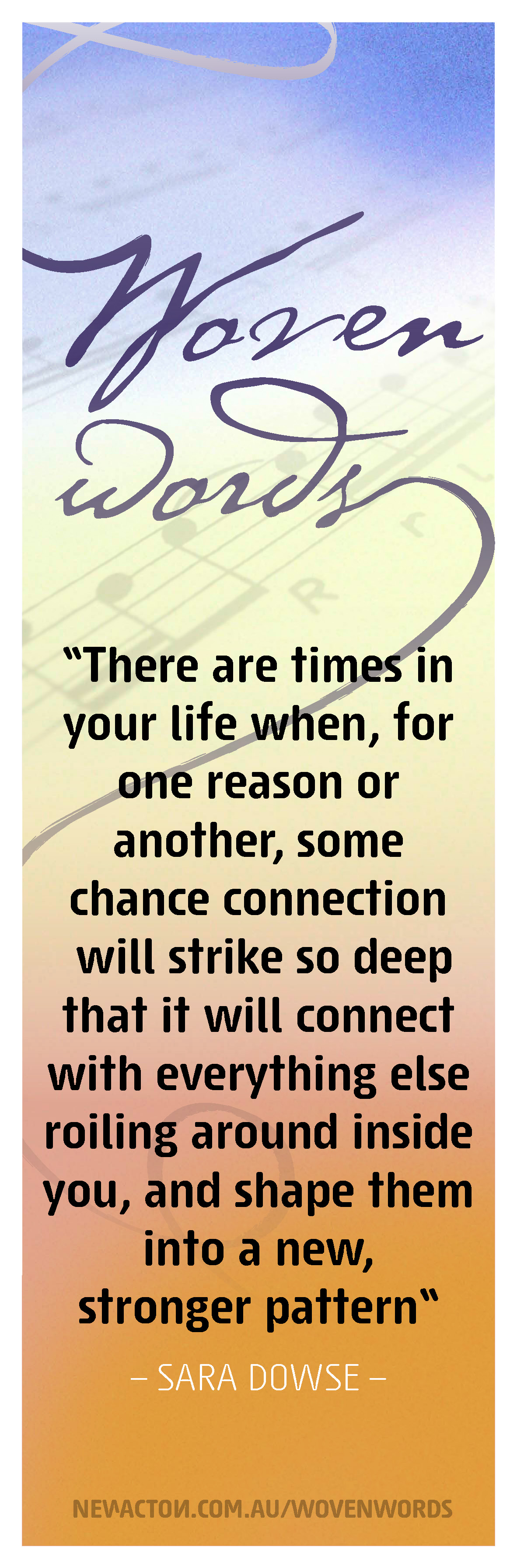
Sara Dowse text

Sara Dowse (Courtesy: NewActon.Com)

After some pre-show piano music performed by Adam Cook, Allegro started with the gorgeous Chanel Cole singing Kurt Weil’s “Speak Low” accompanied by Cook. Sara Dowse chose this because it was the theme song of Ava Gardner‘s film, One Touch of Venus, which is the title of Dowse’s piece in The invisible thread. In it she describes a weekend she spent with Ava Gardner when she was 7 and Gardner about 24. An unusual choice perhaps for a Canberra anthology, but the anthology isn’t solely about Canberra. Dowse’s piece is about those moments in your life in which you learn something precious and lasting. Her time with Gardner provided one of those moments for her. Her movement finished with another jazz piece performed by Cole and Cook, “Old Devil Moon”.

At question time I asked her how someone with such strong creative drive – she sings, writes and paints – ended up working in bureaucracy. She was, for those who don’t know, the first head of the Office of Women’s Affairs which was established by our new reformist Prime Minister, Gough Whitlam, in 1972. Her answer was perfect: They were very creative times, she said.  Can’t argue with that. They were.

Alex Miller

Alex Miller (Courtesy: NewActon.com)

After a short break, it was time for Adagio, my least favourite movement when I was a young music-lover. I was impatient, wanted something faster, with more beat. Now, though, I’ve learnt to enjoy and love the slow and the opportunity it provides to dwell. Tonight’s Adagio provided exactly that … It was bookended by Adam Cook playing the “City of Carcosa” by Larry Sitsky and the CSO (Canberra Symphony Orchestra) String Quartet playing Samuel Barber’s elegaic “Adagio”. Alex Miller has a love-hate relationship with Canberra, mostly the latter it seems! He earned a polite but forgiving (I think) hiss from the audience when he said that no-one chooses to live in Canberra. Wrong! However, he also said that he felt privileged to be involved in the event.

Miller suggested that writers would like to write music, that music manages to express something that writers never quite achieve. Now that’s something for us to ponder. Has it to do with music being the universal language I wonder? Would all writers agree? He talked about writing – about the importance of voice, about the imagination and the act of “imagining something into being”. How to write his novel, The sitters, from which he read, came while he was sleeping on a plane flight between Los Angeles and Sydney. It is about a portrait artist, and explores the nature of “art” and the relationship between artist and subject. The reading ended on:

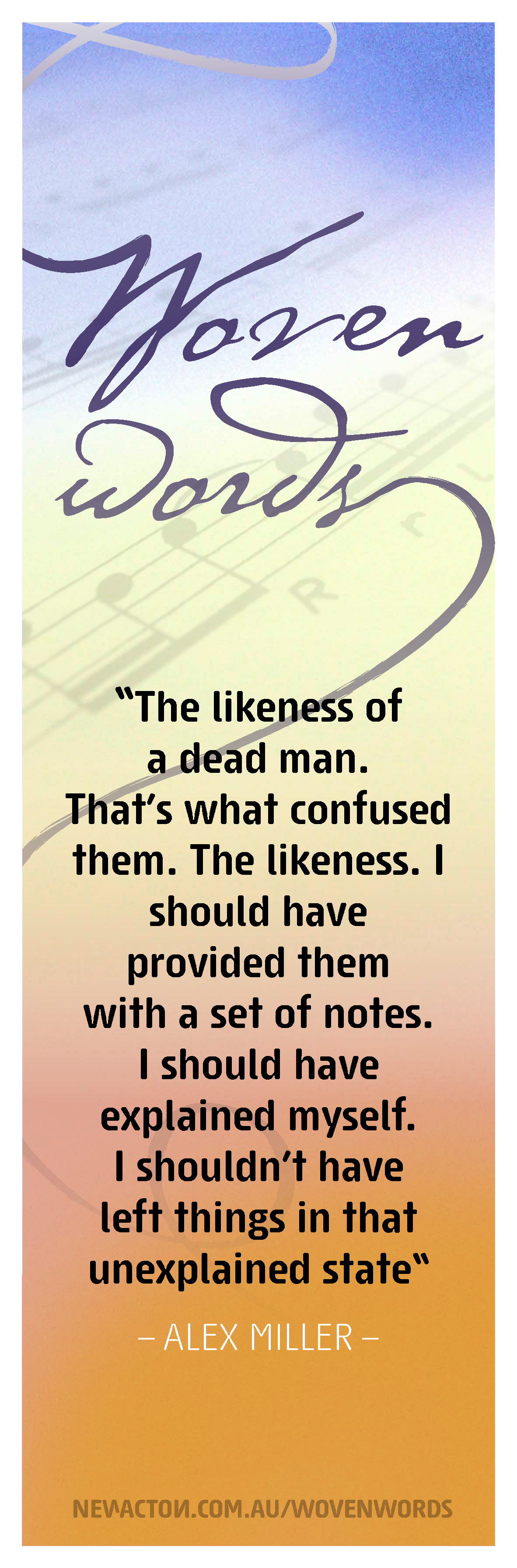
It’s a story not an explanation.

I like that … it sounds simple but packs a lot.

Alan Gould

Alan Gould (Courtesy: NewActon.com)

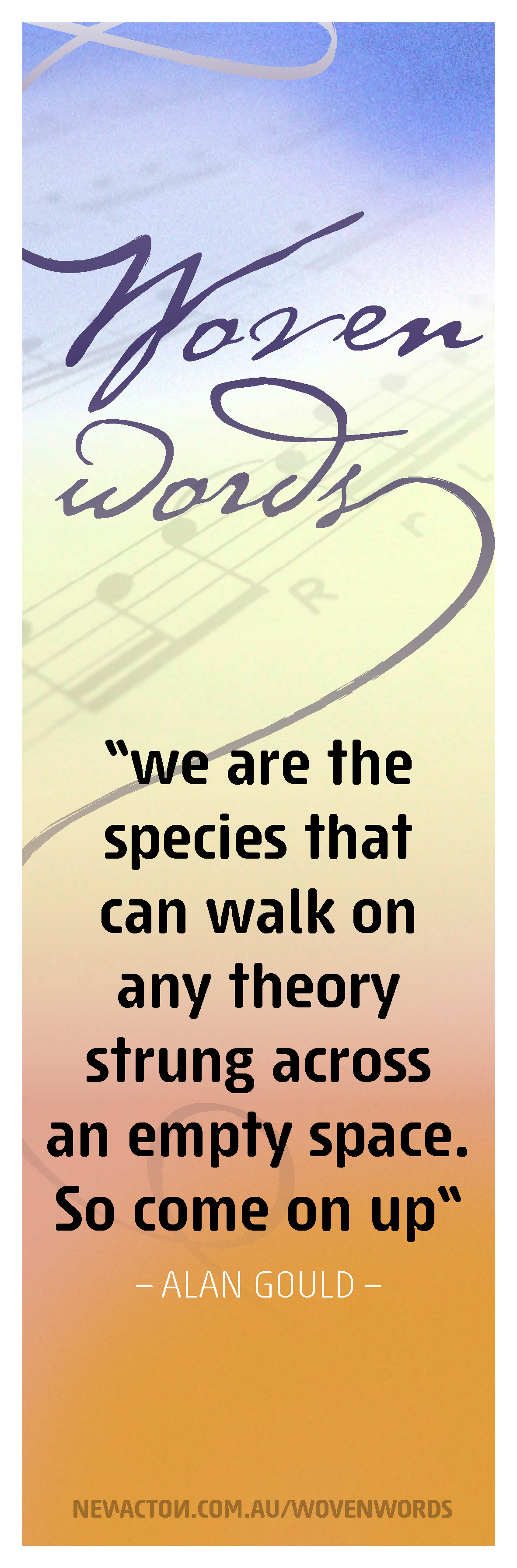
The final movement, Scherzo, belonged to poet-novelist Alan Gould. It started with CSO String Quartet performing Percy Grainger’s “Molly on the Shore”. I noticed Gould’s head, up front, bopping away just like mine. Gould read several poems starting with “The Roof Tilers” which I mentioned in a recent Monday Musings. I love that poem. Gould was an engaging reader, introducing each poem with some background. He read his most recent poem “A Rhapsody for Kenneth Slessor” and “Sea Ballad“. And concluded with two flamenco inspired poems, first describing the challenge of replicating in poetry a flamenco rhythm. He read “Flamenco Rehearsal” and “Flamenco Pair”, at times toe-tapping the rhythm as he went. Appropriately, Gould’s movement ended with guitarist Campbell Diamond performing two Spanish pieces, “Junto al Generalife” by Joaquín Rodrigo and (appropriately) “Finale” by Antonio José.

When asked, at the end, whether a sense of dislocation was important to being an artist, Gould, also a model shipmaker, said that for him it was more a sense of being “oceanic” which he described as “being at home in the unstable element”. That may be why I’m a reader not a writer!

The evening was beautifully em-ceed by ABC 666 Radio announcer, Genevieve Jacobs. She was a charming presenter who engaged well with each writer. And she managed her high heels on the tiny stage with great courage!

The evening had a few little challenges. The microphones did not properly work for the singer who opened the evening, the seats were a little hard after three hours, and the venue has just one all-purpose toilet. These were minor. Far more important was the wine! As an Anything-But-Reisling girl, I do hope a choice of white wine is offered next time …

Seriously though, it was a delightful evening. The writers were generous, the musicians superb. Irma Gold, editor of The invisible thread, is doing a stunning job of exploring and exposing the invisible threads that connect the anthology to other arts, to readers, to Canberra. It’s exciting to be part of it.

POSTSCRIPT: With thanks to Dave, of NewActon.Com, for the images.

Irma Gold (ed), The invisible thread (Review)

The invisible thread, by Irma Gold

Cover (Courtesy: Irma Gold and Halstead Press)

I even get nervous when I open a book, you know, for the first time. It’s the same thing, isn’t it. You never know what you’ll find, do you? Each person, each book, is like a new world … (from Mark Henshaw’s Out of the line of fire, in The invisible thread)

At last, you may be thinking, she’s going to review the whole book. At least, I hope that’s what you’re thinking, because this book deserves a dedicated review rather than the scattered posts I’ve done to date. The book I’m talking about is, of course, Canberra’s centenary anthology The invisible thread.

The aim of the anthology is a little different to that of Meanjin‘s special Canberra issue, which I recently reviewed. While its editor, Sanders, wanted to offer “a taste of Canberra”, Gold’s aim was to present “literature of excellence” from writers, past and present, who have had a significant relationship with Canberra. For her, Canberra is “not the headline act” but provides “the invisible thread” linking the writers to each other and to the rest of Australia. In her foreword, Robyn Archer, the centenary’s Creative Director, puts it this way:

Many of the pieces are not about Canberra, but they reveal a diversity of interest and style among writers in this region, and thus reflect the unique nature of a city which is located rurally, but positioned nationally.

In other words, The invisible thread is not a parochial apologia for Canberra but an intelligent presentation of the city’s and thence the nation’s cultural, political, social and interpersonal life. The nation’s concerns are Canberra’s concerns – at both the macro (war, indigenous-non indigenous relationships, the environment, and so on) and the micro (birth, marriage, death, and everything in between) levels. You would be hard-pressed as an Australian, or even as an international citizen, not to find something in this book to interest and move you.

Reviewing an anthology is tricky though, and this is particularly so with The invisible thread because it comprises highly diverse pieces – poems, short stories, essays, and excerpts of novels and non-fiction works.  The pieces are not grouped by form, like the Meanjin issue, but in a more organic way intended to take us on a journey in which, editor Irma Gold writes in her Preface, “each work is allowed to converse with those beside it”. And so, in preparation for my reading group’s discussion, I went back to the start and read the book in the order presented. What a pleasure that turned out to be because I did indeed discover added meanings that weren’t necessarily apparent from the dipping-in-and-out approach I had been using.

Let me give an example. The anthology opens with an excerpt from war historian CEW Bean’s Anzac to Amiens, itself a condensation of his Official history of the first world war. I knew of Bean but had not read his history. I was surprised by his use of imagery, such as this:

And out on every beautiful fresh morning of spring come the butterflies of modern warfare – two or three of our own planes, low down …

After another war-related non-fiction piece, the anthology segues to a short story (“The Good Shoppers”) by Lesley Lebkowicz, which is about her refugee parents, now old and shopping in the supermarket but still affected by the Holocaust, and then to two poems about age (Judith Wright‘s “Counting in sevens” and AD Hope‘s “Meditation on a Bone”). The “conversation” encouraged by this sequence is complex and, I expect, different for each reader. For me, the juxtaposition suggests an irony: “war” steals “age” from many of the youths sent to it. This is just one small example of the sorts of “conversations” Gold has set up in the anthology. Considering them as I read the book added another layer to an enjoyable reading experience. I like reading that challenges my brain on multiple levels.

Compiling an anthology involves, obviously, selecting what to include. It must be hard enough to choose poems, short stories and essays, but what about writers who are best (or only) known for novels or non-fiction books? They can only be represented through excerpts, but there is the risk that these cut-down pieces will be less satisfying to read. Alternatively, of course, they might encourage us to locate the full work and read it. The Bean example above is an excerpt. There are many others, including those from Kate Grenville’s Sarah Thornhill, Jack Heath‘s Third transmission, and Roger McDonald‘s When colts ran. I have noted many to follow-up, which tells you how I found the excerpts overall!

A trickier challenge, probably, is that of representing diversity – not just regarding chronology, subject-matter, tone, and form or genre, but in terms of the writers themselves, such as their gender, or whether they are of indigenous, migrant or other minority background. What emphasis should be given to these in the selection process? And, anyhow, should the writer’s background be highlighted? I’m not sure what Gold and her committee decided about this but the anthology, while primarily representative of the majority culture, is not exclusively so and probably reflects the writing community it drew from.

This is not the last you’ll hear from me on the anthology. It is much too delicious, much too rich, much too full of “luminous moments”* for me not to continue to draw from it. I’m possibly – probably? – biased, but I believe this book should be on every Australian bookshelf and, without disrespecting Irma Gold’s hard work, I’d say it doesn’t really matter whether you read it in its original order or just dip into it as the spirit moves you. What would matter would be to not read any of  it at all.

Irma Gold (ed)
The invisible thread: One hundred years of words
Braddon: Halstead Press, 2012
256pp.
ISBN: 9781920831967

* from Marion Halligan’s essay “Luminous moments” which concludes the book.

Monday musings on Australian literature: ACT Writers Showcase

It’s been a good week for literature in the ACT. Not only was the UC Book Project announced but on Thursday, our centenary anthology The invisible thread was launched.

Irma Gold, The invisible thread

Irma Gold, editor, at the launch of The invisible Thread

The launch was a well-organised event: it found the perfect balance between formality and informality, and didn’t run too long! The book was launched by writer Felicity Packard, best known as one of the award winning writers on the Underbelly series. She spoke entertainingly about the invisible threads – people, places, events – between her and the book. It was nicely and appropriately done. She was followed by four readings from the book, three by authors Blanche d’Alpuget, Adrian Caesar and Francesca Rendle-Short, and one by Meredith McKinney, daughter of Judith Wright. Being of a certain age, I related to the fact that Wright’s and Caesar’s poems both dealt in some way with age. Editor Irma Gold concluded the launch with the usual thanks … and the whole was emceed by local radio announcer Alex Sloan. The venue – the New Acton courtyard – was perfect for the warm spring evening. It was a treat to be present.

The invisible thread, by Irma Gold

Cover (Courtesy: Irma Gold and Halstead Press)

Irma has also been interviewing many of the still-living authors included in the anthology. The interviews – and the stylish book trailer – can be seen on her You Tube channel. Well worth checking out during those hazy lazy post-Christmas days if you don’t have time now. Nigel Featherstone whom I’ve reviewed is there, as is the exciting poet and rap artist Omar Musa, as is the new-to-me poet Melinda Smith, as is … well you get the point. More interviews are to be added weekly over the next couple of months.

But, these are not, really, the point of today’s post. At the launch Irma announced another initiative associated with the book – wow, that woman has worked hard. It’s the ACT Writers Showcase, a website dedicated to, obviously, showcasing writers from the ACT. Irma explained at the launch that the anthology includes only 70 of the 100 plus writers considered for it. The showcase is an attempt to ensure that all writers are noticed, promoted and, most importantly, receive the due they deserve. Irma, herself, for example, is not in the book – but she is in the showcase.

Authors can be located via the search box or the writers’ index. There is a brief bio and list of publications for each author, and an excerpt of their work. I’m told this is a pretty unique site – but, whether it is or not, it’s not only a great resource for readers but also makes a significant contribution to documenting “all that’s past and what’s to come”* in ACT literary culture.

Are you aware of any similar initiatives in your corner of the world?

* from “A Valediction”, by Adrian Caesar

Monday musings on Australian literature: Canberra’s centenary

The invisible thread, by Irma Gold

Cover (Courtesy: Irma Gold and Halstead Press)

In 2013 Canberra, Australia‘s national capital, will celebrate its centenary. A whole raft of events and activities has been planned to keep us busy and buzzing all year – and I look forward to them – but for me, a reader, one of the most exciting projects inspired by the centenary is The invisible thread. It’s an anthology of fiction, non-fiction and poetry by writers, past and present, who have had an association with Canberra.

Some 75 writers are represented. Seventy-five! Even I, with my now rather long history in the capital, am surprised by the number, which perhaps gives you a hint to the meaning of the title. Robyn Archer, the Creative Director of the Centenary, writes in the foreword that much about Canberra is hidden or invisible but, she says, “just because you don’t see it, it doesn’t mean it isn’t there”. Like, for example, service stations! We do have them, contrary to popular opinion, we just like to keep them tucked away a little! Bill Bryson also noticed this feature of Canberra in his book Down Under. He wrote:

It’s a very strange city, in that it’s not really a city at all, but rather an extremely large park with a city hidden [my emphasis] in it. It’s all lawns and trees and hedges and a big ornamental lake [Lake Burley Griffin] – all very agreeable, just a little unexpected.

Hence The invisible thread!

Now, I haven’t yet read the book, having only acquired my copy last week, but I’ve given it a good look. And within its pages I’ve found many friends – personal and literary. Some are writers I have reviewed in this blog over the last three years or so, namely Francesca Rendle-Short, Alan Gould, Geoff Page, Alex Miller, Nigel Featherstone and Marion Halligan. Others are classic writers I’ve mentioned in various posts, particularly the Monday Musings series. These include some wonderful women, Judith Wright, Rosemary Dobson, Kate Grenville, Miles Franklin and the collaborative team M Barnard Eldershaw. There are writers I’ve known for reasons external to their writing, like Michael Thorley and Sarah St Vincent Welch. There are young writers like the internationally published Jack Heath and rap artist Omar Musa, and older writers like historian Bill Gammage whose The biggest estate on earth won this year’s Prime Minister’s Literary Award and the Victorian Premier’s Literary Award. And there are some of the grand men of Australian letters, like the poets AD Hope and Les Murray and the historian Manning Clark. If all these don’t tempt readers, I’m not sure who will, except perhaps those I haven’t mentioned!

The book is divided into four sections: Looking Backwards, Looking Forwards, Pts 1 and 2, and Looking In, Looking Out, Pts 1 & 2. Editor Irma Gold*, whose collection of short stories I reviewed earlier this year, describes the breakdown as “open-ended and kaleidoscopic”, and says that while Canberra features in the writings,

it is not the headline act. Rather, it supplies the invisible thread that links writers to each other, as one-time or full-time Canberrans, and to everyone who call Australia home. Like writers everywhere, the writers showcased here are looking both in and out, backwards and forwards, conveying the world through the lens of their experience.

Each of these sections is introduced with a delightful cartoon by Judy Horacek, one of my favourite cartoonists.

I plan to return to this book, when I’ve had time to digest it more, so I’ll finish here on a little anecdote. In 1988, some good friends and I started a reading group, one that will celebrate its 25th anniversary next year. Our initial focus was Australian women writers, and so in those early years we read Marion Halligan, Kate Grenville and more. We were Canberra women readers. However, also in 1988, a group of Canberra women writers (which included Marion Halligan and was known as the “Seven Writers”) produced a collection of short stories titled Canberra Tales. Several of those writers are included in this anthology, including Dorothy Johnston. Johnston’s story in that collection, “The Boatman of Lake Burley Griffin”, is also in this anthology. Its opening sentence is:

To look at the lake, you’d think nothing dramatic, scarcely anything human happened there.

But how wrong you’d be …

Irma Gold (ed)
The invisible thread
Braddon: Halstead Press, 2012
256pp.
ISBN: 9781920831967

* To hear interviews with some of the anthology’s authors, check out Irma Gold’s You Tube page