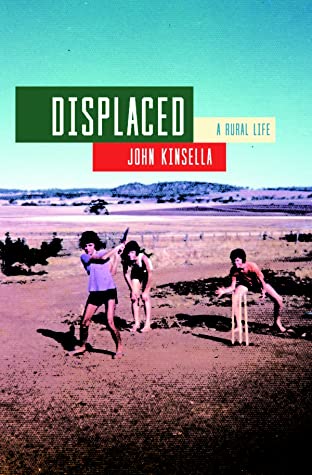
John Kinsella, Displaced: A rural life (#BookReview)

John Kinsella, Displaced

I haven’t talked about reading synchronicities for some time, but when I started reading John Kinsella’s memoir, Displaced, I couldn’t help but think of the book I had just finished, Gay Lynch’s historical novel Unsettled (my review). Both have one word titles which play with opposites; in both cases, those opposites refer to physical meanings and more abstract, intellectual, social and/or emotional ones; and, in both, these meanings draw significantly from the colonial act of settling Australia and displacing its original inhabitants. I enjoy such wordplay that forces us to consider multiple, and sometimes conflicting meanings because it encourages a deeper engagement with the ideas being explored.

Notwithstanding this, reading Displaced was a labour of love, because it is a demanding, and often confronting read. However, I wanted to know about this man who is one of Australia’s leading contemporary poets, so I persevered. My assessment? If you are interested in how one might live life as ethically as possible with regard to justice and the exploitation – of First Nations people and the environment – that is encompassed in the long tail of colonialism, Kinsella’s book is a good place to start.

This leads me, as I’m wont to do, to a consideration of form or genre. Displaced is characterised in promotions as a memoir, but I see it more as a manifesto with memoir elements. Events in Kinsella’s life underpin the book, including his stints in Ohio, Schull and Cambridge, but they are not the focus. Instead, they are used to explicate and exemplify his ethical beliefs and, more, to explore the paradoxes we all live with. These paradoxes provide the book’s main thread. They are expressed in such terms as “belonging and unbelonging”, finding a meaning for “home” that recognises Indigenous “dispossession” and doesn’t encompass the exploitative ideas of “ownership”, and feeling “displaced” while very definitely being in a place. He characterises this as “the ethics of presence”. It’s difficult to get your head around while also being very simple really. In other words, the idea is simple, but the living of it, not so!

Two-thirds through the book, Kinsella talks about conducting peace readings, and says that:

A poet has a job to do – art in itself is meaningless if it does not jolt us into self and collective action.

He then describes a sculpture in the British Museum comprising bits of AK-47s welded together. “The artwork,” he says, “jolts one out of apathy, if not out of complicity”.

For Kinsella then, art is not just for art’s sake. And so, here, this work of art, his “memoir”, has a very specific goal, to raise our consciousness regarding the lives we are living and how colonialism, and the accompanying capitalism, continue to damage both colonisers and colonised. He calls himself an “anarchist”, but not one who subscribes to chaos and disorder. His anarchism, he says, has

the social angle, it has the respect for individual difference. I do not attempt to tell people what to believe, but I do attempt to draw attention to the damage being done.

So now, let me return to my opening comment regarding the title and its multiple meanings. Early in the book, Kinsella talks about growing up in the Western Australian wheatbelt, and about the paradoxical, hypocritical love of nature and place he espoused. “Something didn’t add up”, he says, between the way he “felt about the world” and the way he “acted in it”, his actions drawing from “outdoorsmen activities and the attendant crisis of masculinity.” The things he did – farming, hunting, and so on – were counter to the things he loved. The book chronicles his realisation that

I was part of a colonial invasion force, and I belonged nowhere. What could I do about it? I wandered, displaced as an addict [literally as well as spiritually], and as someone trying to undo my own identity.

Learning a new way of being (“unbecoming what I was, becoming what I might be”) became his lifelong project, one he shares with his wife, the poet Tracy Ryan, and their son Tim. Kinsella puts this thinking into his work – in his writing (as mentioned above) and in his role as Professor of Literature and Environment at Curtin University. He speaks in the book of trying to create a new way of writing about place, “a system for working through the contradictions of presence, of time and space and catastrophe and catastrophising, of the failure of modernity and the consequences of colonial modes and modalities of presence”. That’s a mouthful, but it explains his wish to find a way of expressing how colonialism has negatively infiltrated our lives physically, spiritually and linguistically.

To explain his beliefs, he wanders between childhood, youth and adulthood, amongst relationships with other writers and thinkers, and between his current home, Jam Tree Gully back in the Wheatbelt, and those places he’s lived in overseas. Because – I think – of this to-and-fro structure, there is a lot of repetition of ideas and experiences, and these repetitions did become a little tedious at times. I get it John, I get it, I felt like saying a few times as I read. The other challenge for Kinsella was to not preach or virtue signal. He does come close, at times, but he makes clear that he understands the nuances – how does someone like him, for example, deal with feral cats or weed pests? “There’s plenty of mea culpa in my life”, he says.

In the end, this earnest, frank book is full of heart and commitment. One of the things I’ve taken away from it is a heightened awareness of how “colonialism” has infiltrated our language. Take, for example, an interpretive sign we recently saw on a bushwalk that described a tree trunk as providing “high rise living”. Or, a Wiradjuri country rural town’s proud sign promoting its “170 years of heritage”. Just 170 years? On its website, the Blayney Shire speaks more on this (colonial) heritage, and then mentions its natural environment and Aboriginal heritage. “Aboriginal relics and artefacts”, it explains, “are primarily protected under the provisions of the National Parks and Wildlife Act, 1974. Listed heritage in the Shire is mainly European in nature”. This sort of demarcation in thinking about heritage needs to change.

We can’t turn back the clock, which Indigenous Australians accept, I believe. However, they want and warrant the respect due any human being, recognition of their sovereignty and of their dispossession, and for us to listen to their wisdom and knowledge.

Kinsella, who believes that “poems can stop bulldozers”, includes many in this book. They make good reading. But I’ll end here on a positive note from halfway through the book:

The land is constantly being rewritten. We don’t have to be stuck with the damage. It can be undone.

John Kinsella
Displaced: A rural life
Melbourne: Transit Lounge, 2020
329pp.
ISBN: 9781925760477

Review copy courtesy Transit Lounge, via Scott Eathorne of Quikmark Media

Karen Viggers, The orchardist’s daughter (#BookReview)

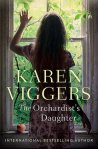
Karen Viggers, The orchardist's daughterThe orchardist’s daughter is local author Karen Viggers’ fourth novel, but the first that I’ve read. She has, however, appeared on my blog before, being the person who conversed with Sofie Laguna about her novel, The choke. It was one of the most entertaining conversations I’ve ever attended.

Now, if you haven’t read or heard of Karen Viggers before, there are some facts worth knowing about her. Firstly, she’s a vet with special training in native wildlife health – and this background informs most if not all of her novels, I believe. It certainly informs The orchardist’s daughter. Another significant fact is that she’s a best-selling author in France! How wonderful that a novelist who writes strongly Australia-centric books does so well in France! Her previous novel, The lightkeeper’s wife, was, in fact, awarded the Les Petits Mots de Libraires literary prize.

So, an interesting author, and The orchardist’s daughter is an interesting, enjoyable book. It is set in a small logging town in Tasmania, and has quite a formal structure, starting with a Prologue, followed by four parts – Seeds, Germination, Growth, Understorey – and ending with an Epilogue. It is told third person through the perspective of three characters – Miki, the titular orchardist’s daughter who is 17 years old for most of the novel; Leon, a Park Ranger, who is 25 years old at the novel’s start; and Max, a 10-year-old boy who is Leon’s neighbour. Miki and Leon are relative newcomers to the town, Miki arriving with her older brother Kurt to run the town’s takeaway shop after they lose their home, farm and parents in a fire, and Leon moving from his Ranger job on Bruny Island to the mainland. All three are outsiders and serve to illuminate the tensions existing in the town.

Around these characters is a community comprising mainly logging families, Max’s being one of them. However, there are others who round out the town a little, including policeman Fergus and his sons, Geraldine who runs the information centre, and vet Kate. The narrative develops around a couple of situations. One is a mystery surrounding Miki’s brother Kurt. What does he do by himself in the forest when he insists that Miki wait in the ute, and what does he do during his weekly solo trips to Hobart (during which he locks Miki inside their shop/home)? The other concerns logging, and the dangerous unrest that develops when a temporary ban is placed on logging around a certain ancient tree. Jobs are at risk, the loggers believe, and the butt of their anger is of course Parkie Leon. From these two situations, Viggers builds tension slowly but inexorably, with the Kurt-and-Miki story becoming the prime focus, of course, given the book’s title.

So, there is a strong plot to the novel, but this plot, while driving us on to read, is there to serve some issues that Viggers wants to explore. These concern logging and the environment, bullying and domestic violence, not to mention more personal ones like freedom. These are big issues, and not only is Viggers clearly passionate about them, but her writing about them feels authentic. The characters may be a little less complex than, say, those in Lucashenko’s Too much lip, but they are believable. Logger and vicious bully Mooney is offset against Robbo, who is equally single-minded about logging but seeks more peaceful, law-abiding means of protest. Similarly, Max’s father Shane, another logger who is violent, is offset against colleague Tobey who has a tender, caring relationship with his wife. All of this is observed by Miki from her shop-counter – and she makes her own little attempts to lighten the lives of the bullied and the ostracised, by sneaking treats into their take-away bags. Through this little subversive action, we sense Miki’s inner strength and resourcefulness, something she takes to another level when she works out ways of escaping her “prison” while Kurt is away.

Freedom is one of the novel’s underlying drivers. Miki’s imprisonment is literal, but imprisonment takes many forms – the wives who are abused but feel incapable of escaping, and young Max who is bullied to behave in ways antithetical to his nature. Some of these are resolved, but Viggers recognises that there’s no magic wand for domestic abuse. The first step is moving from passive awareness (or acceptance, even) to taking action, and this starts to happen in the novel.

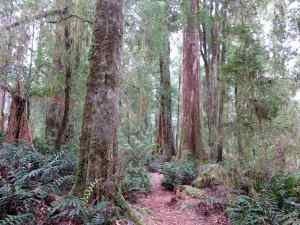
In the Tarkine, NW Tasmania

The book really stands out, however, in its writing about nature. A Booktopia interview with Viggers tells us that she grew up in the Dandenongs and has been to Antarctica. She has also spent time in Tasmania (and immersed herself in Tasmanian-set books, including two I’ve read, Anna Krien’s Into the woods, and Louis Nowra’s Into that forest). All of this has given her a sure feel for the wilderness, so much so that it’s difficult to choose an excerpt to share, but here’s one:

Miki loved the trees and the birds, but what she loved most couldn’t be seen. The way she felt in the forest. The scent of the bush after the rain. The sound of bark crackling. Branches squeaking. The feeling of patience and agelessness, growth and renewal. The aura of trees. The sense of connectedness. Of everything having its place. She could stay here all day, breathing with the tree, drawing its life into her lungs.

These forest descriptions move into Tasmanian Gothic realms during the climactic chase. The experience is both “terrifying and surreal” for our character who crawls and runs through, burrows and squats in the forest, “slipping from the thicket and weaving though the trees, ducking under tree ferns, past the tipped-up end of a fallen tree whose buttressed roots made a wall he could hide behind.” It’s muddy and dangerous with sword grass that scratches you and bark mounds that can trip you up. Viggers knows this landscape – and how to make it terrifying.

In the end, The orchardist’s daughter is about community and compromise, and about the courage to break free. It straddles the boundary between commercial and literary fiction. It is accessible, it has a strong plot and easy-to-engage-with characters, and it is hopeful (not that literary fiction can’t be!!) But, it is also gritty in subject matter and doesn’t offer neat solutions to the important environmental and social issues it raises. I like that in my reading!

Theresa (Theresa Smith writes) also loved the novel.

AWW Challenge 2019 BadgeKaren Viggers
The orchardist’s daughter
Crows Nest: Allen & Unwin, 2019
389pp.
ISBN: 9781760630584

Review copy courtesy the author, Karen Viggers.

World Bee Day 2018 – and literature

Apparently today, May 20, is World Bee Day! Who knew? Not me, until this morning. I understand it was designated last December by the United Nations, on the recommendation of Slovenia. Given the rise of cli-fi literature and the importance of bees to our planet, I’ve decided to give a little shout out to our fabulous bees today.

Actually, I’m not a huge fan of honey. I love the idea of it – of all those exciting flavours you see – but if I can choose between honey and maple syrup, it’s maple syrup I take, I’m afraid. Nonetheless, bees aren’t just about the honey, as I’m sure you know. They are critical to our planet for their busy little pollination activity. The World Bee Day website says that bees and other pollinators pollinate “nearly three quarters of the plants that produce 90% of the world’s food” and that “a third of the world’s food production depends on bees.” In addition, their pollination activity is critical for ecological balance and diversity, so much so that their presence, absence or quantity is a significant indicator of the health of our environment. In other words, we need bees … but they are  are in decline, due to a combination of factors including pesticides, climate change and disease. Hence World Bee Day.

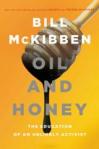
Bill McKibben, Oil and HoneyBack in 2013 I read and reviewed American climate activist Bill McKibben’s book, Oil and honey: the education of an unlikely activist. It’s about the two important things in his life: bees, honey and good farming practice, and oil, or the fossil fuel industry, and its impact on the climate. Oil and honey, climate and farming. They’re all related.

However, that’s a work of non-fiction, but increasingly fiction is dealing with climate-change, resulting in the genre called cli-fi (ie climate change fiction.) I’ve reviewed some cli-fi here, but none focussing on bees, so this post is as much for my benefit as yours. (This is why I love blogging – I get to research something I’m interested in and then share it with anyone who is interested.)

So, here is a small selection, in alphabetical order by author.

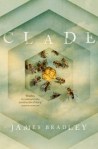
James Bradley, Clade (2015)

James Bradley, CladeAustralian author James Bradley’s book Clade is more broadly about climate change than the other books in my selection here, but it does have bees on its cover. Sydney Morning Herald reviewer, Caroline Baum describes it as follows: “A global deadly virus, the collapse of bee colonies, extreme weather events causing social unrest, eco-refugees, infertility, autism and new advances in technology – these are just some of the themes of James Bradley’s new novel, Clade.” The bees, I understand, mainly feature in a sub-story about a refugee beekeeper who is concerned about Colony Collapse Disorder. However, this sub-story and the presence of bees on the cover suggest their importance to Bradley’s overall theme.

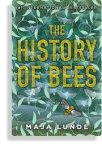
Moya Lunde, The history of bees (English ed. 2017)

Maja Lunde, The history of beesThe Saturday Paper’s reviewer, KN, describing Norwegian author Lunde’s The history of bees as presenting “an original angle” in the cli-fi realm, says that “the dystopian future she depicts hinges on the disappearance of bees from their hives. This is a real-world phenomenon, known as colony collapse disorder, diagnosed as a problem in 2006.” As The Atlantic’s reviewer writes, its premise is simple: what would happen if bees disappeared? The book apparently has three strands – one contemporary, one set in the 19th century, and one in 2098 after “The Collapse”.

I learnt a new term researching this – First Impact FictionLA Times reviewer Ellie Robins says it was coined by novelist Ashley Shelby to describe “fiction set in more or less the present day, which depicts ‘our shared world as the impacts of runaway climate change begin to make themselves known’.”

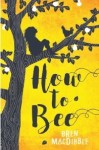
Bren MacDibble, How to bee (2017)

Bren MacDibble, How to beeBren MacDibble is an Australian-based New Zealand born writer. How to bee is a children’s book, which has been shortlisted for multiple literary awards, including the 2108 CBCA Book of the Year for Younger Readers, the 2018 Adelaide Festival Awards for Children’s Literature, the 2017 Aurealis Awards for Best Children’s Novel, and the 2017 Queensland Literary Awards, Griffith University Children’s Book Award. Decent cred, eh?

Publisher Allen & Unwin describes the plot:

Peony lives with her sister and grandfather on a fruit farm outside the city. In a world where real bees are extinct, the quickest, bravest kids climb the fruit trees and pollinate the flowers by hand.

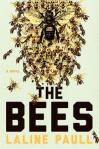
Laline Paull, The bees (2014)

Laline Paula, BeesThe Guardian’s Gwyneth Jones describes British novelist Laline Paull’s The bees as “a debut dystopia set in a beehive, where one bee rebels against the totalitarian state.” It’s apparently a complex story, and Jones concludes her review by saying that “the crisis The Bees invokes is genuine, frightening and getting worse. Hive collapse disease remains a deadly real-life mystery …”

The Bees was Shortlisted for the Bailey’s Women’s Prize for Fiction in 2015.

Now, the question is: can cli-fi help the cause of climate change? Well, coincidentally, a climate change research fellow, Sarah Perkins-Kilpatrick wrote about just that in The Conversation last year. She believes it can. “Through compelling storylines, dramatic visuals, and characters”, she says, cli-fi can make people “care about and individually connect to climate change” and thus “motivate them to seek out the scientific evidence for themselves.” She also argues – but of course this depends on the writer and the work – that cli-fi can deliver a message

of hope. That it is not, or will it be ever, too late to combat human-caused climate change.

Is all cli-fi hopeful?

Do you like cli-fi? And, do you agree that cli-fi can help the cause (assuming, of course, that you agree it is a cause)?

William T Hornaday, The bird tragedy of Laysan Island (Review)

William Temple Hornaday (1854-1937), whose article “The bird tragedy of Laysan Island” was a recent Library of America (LOA) Story of the Week offering, is a tricky man to write about. Originally a taxidermist, he became one of the pioneers of the wildlife conservation movement in America after he realised, around the 1880s, the dire situation regarding the country’s bison population. In this LOA article,  published in 1913, he chronicles the bird massacre on Laysan Island and the role played by President Theodore Roosevelt in helping to end the plumage trade. But he wasn’t without controversy, of which I’ll write more a little further on.

Laysan Island

Laysan Island. By Robert J. Shallenberger, U.S. Fish and Wildlife Service (http://www.doi.gov/photos/06152006_photos.html) [Public domain], via Wikimedia Commons)

“The bird tragedy” is a powerful piece which starts by describing the island as “sandy, poorly planted by nature, and barren of all things likely to enlist the attention of predatory man” but as the home of many varieties of birds, including the “Laysan albatross, black-footed albatross, sooty tern, gray-backed tern, noddy tern, Hawaiian tern, white tern, Bonin petrel, two shearwaters, the red-tailed tropic bird, two boobies and the man-of-war bird.” It was a “secure haven” for them, and, since 1891, had been viewed as “one of the wonders of the bird world”.

But, along came “man, the ever-greedy” looking for ways to make money, first via guano and egg collecting, then feathers for the plumage trade. The culprit was Max Schlemmer, who also introduced rabbits and guinea-pigs which multiplied and started to destroy the vegetation. Hornaday describes the horrendous massacre in 1909 of 300,000 birds for their wings. According to LOA, Hornaday is somewhat wrong in ascribing the massacre to Schlemmer. The say a biography of Schlemmer argues that he was ‘”cash-strapped” and sold the rights to the island to a Japanese entrepreneur. Whatever the situation, the destruction of the birdlife was massive in number and horrific in cruelty. Fortunately, it was stopped before complete destruction by a Zoology Professor who called the Government who in turn sent in the Navy – as you do!

Hornaday’s language makes clear his disapprobation of what happened and of the people who carried it out. His description of the massacre is horrifying, some of it quoted from a report by a 1911 scientific expedition to the island. This report notes that their “first impression” was that the island had been stripped of its birdlife:

Only the shearwaters moaning in their burrows, the little wingless rail skulking from one grass tussock to another, and the saucy finch remained. It is an excellent example of what Prof. Nutting calls the survival of the inconspicuous.

Hornaday says that if the Government had not intervened

it is reasonably certain that every bird on Laysan would have been killed to satisfy the wolfish rapacity of one money-grubbing white man.

Fortunately – albeit a little after the horse had bolted – Roosevelt, in 1909, created “the Hawaiian Islands Reservation for Birds” which includes Laysan and which, Hornaday writes, will ensure that

for the future the birds of Laysan and neighboring islets are secure from further attacks by the bloody-handed agents of the vain women who still insist upon wearing the wings and feathers of wild birds.

However, as Bill McKibben, the environmentalist whose memoir Oil and honey I’ve reviewed, writes in the headnote to the article, Hornaday had his own controversy. He became, in the late 1890s, the head of the New York Zoological Park (the Bronx Zoo), but, as McKibben writes,

a rough sense of the reasons why the social justice and environmental movements have often parted ways may be garnered from the fact that he saw nothing wrong with exhibiting a live African pygmy, named Ota Benga, in the zoo’s monkey house, later remarking that it was the “most amusing passage” in the institution’s history. His 1913 book Our Vanishing Wild Life … has a strongly nativist edge: immigrants and negroes are singled out as villains for their hunting of indigenous fauna.

According to Wikipedia, he was criticised, including by African-American clergymen James Gordon, who said that “Our race … is depressed enough, without exhibiting one of us with the apes … We think we are worthy of being considered human beings, with souls.” With the controversy, Benga was released to roam the zoo, even though Hornaday did not see anything wrong with what he’d done. Benga was later released to Gordon’s custody, but eventually committed suicide at the age of 33 when the start of World War 1 prevented his return to Africa.

Another wonderful LOA offering in a genre I always enjoy reading – nature or environmental writing.

William T Hornaday
“The bird tragedy of Laysan Island”
First published: Our vanishing wild life, 1913
Available: Online at the Library of America

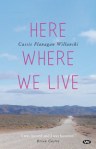
Cassie Flanagan Willanski, Here where we live (Review)

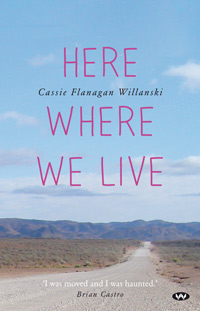
Cassie Flanagan Willanski, Here where we live“Write what you know” is the advice commonly given to new authors – and it’s something Cassie Flanagan Willanski, author of Here where we live, seems to accept. Set in South Australia, where Willanski lives, this debut collection of short stories reflects her two main interests, creative writing and the environment. The book won Wakefield Press’s Unpublished Manuscript Award a couple of years ago, and I can see why.

I wasn’t sure what to expect when I opened the book. Adelaide author and creative writing teacher Brian Castro is quoted on the front cover as saying “I was moved and I was haunted” and on the back “Her stories are as spare and understated as the harsh landscape she describes…” I’d concur. Her stories are not your typical short story. That is, they don’t have tight little plots, nor do they have shock (or even just surprising) endings. They are more like slices-of-life, or like chapters of a novel, in the way they tease out moments in people’s lives that you can imagine continuing into a larger story. And yet, they are complete in themselves and absolutely satisfying.

However, there is more to these stories than “just” slices of life. Willanski writes in her author’s note that they were written as part of her Master of Arts degree, in which she explored “the ways white Australians have written about (and for) Indigenous people in the twentieth and twenty-first centuries”. She introduces the notion of “Indigenous invisibility” which she describes as “ignoring Indigenous Australian people’s current existence, and mourning them as extinct”. She then talks about the issue we’ve discussed here before noting that as white writers became aware of this “Indigenous invisibility” they started to “write about them as characters in their books”. She says she has tried to reflect in her stories the various attitudes she found in her research. I found them authentic and sensitive, but the real judges of whether she’s been successful are indigenous people, aren’t they? There’s a reference to indigenous elder and activist Sue Haseldine in her acknowledgements, which may suggest some acceptance?

There are nine stories in the collection, three told first person, and the rest third person, except for the last and longest story which has two alternating voices, one third, the other second. Her protagonists include a young girl, a young male teacher, a 70-something woman, and a woman grieving for her late female partner. A few stories are connected, but this is not critical to appreciating the collection. Several of the stories, Willanski says in her author’s note, were inspired by real events but in each her imagination has created something new and fictional. Some of these real events are matters of history, such as the Hindmarsh Island Bridge controversy and the Maria shipwreck, while others draw from personal experiences.

Despite the historical inspiration behind some stories, they are all set in contemporary South Australia. The first two are told first person: “This is my daughter’s country” opens the first (“My good thing”) and “The night my husband told me he was going to leave me we were in the middle of a heatwave” starts the second (“Drought core”). Straightaway we are introduced to Willanski’s nicely controlled, pensive tone, and her ongoing themes: family relationships, indigenous issues, the environment and climate change.

The first story is told in the voice of a white woman who has an indigenous husband and a daughter. They are going back to country to clean rockholes. No-one is named – “this is my daughter”, “this is my husband”, “my daughter’s grandmother” – which gives the story a universal, almost mythical sense. There are hints of challenges – subtle references to the Stolen Generations and to environmentally destructive tourism – but it’s a short, warmhearted story about the drive to connect with land and people, and sets up the collection nicely.

I can’t describe every story so I’ll jump to the fourth one, “Stuff white people like”. It is lightly, self-mockingly satirical. It tells the story of a young couple, Oliver and Clay, visiting Ceduna where Oliver is considering a job as a “Nature School Teacher”. They are both earnest, Oliver particularly so, in wanting to understand and relate to indigenous people, so they decide to attend a “healing ceremony” for “‘Maralinga, climate change, feral animals, you name it,’ said the principal vaguely.” It’s an uncomfortable experience, and Oliver doesn’t know how to react to the event which isn’t what he expected. He doesn’t want to be “like the other white people” but how should he be? Clay is able to go with the flow a bit, but not Oliver. Later, on their trip home, she is able to laugh, and take the jokes in the book Stuff white people like, while Oliver is “crippled with self-awareness”. He can’t quite match Clay’s insight. She reads from the book about white people “knowing what’s best” for others:

“Do you think I’m like that?”
“‘Cos you’re excited to get to work with Aboriginal  kids? No!” She stopped for a minute, trying to piece together her thoughts. “Well, I mean–” she said and stopped again.
“What?” said Oliver.
“Well it’s just that Aboriginal people already know about having school outside.”
“I know,” said Oliver. “What’s your point?”
Clay looked at him again, then said, almost irritably, “Well, you’re taking something they’ve been doing for thousands of years and putting the white seal of approval on it.”
“But the missionaries took it away,” said Oliver.
He didn’t say it, but it was implied, and they didn’t know what to do with the implication. Oliver would be giving it back.

I love this on so many grounds – the personal and the political, the desire and the discomfort, the sincerity and uncertainty. These underpin the collection.

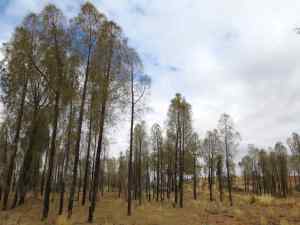
Desert oaks

Desert Oaks, Centralia

There’s only one story in which Willanski speaks “for” or “in the voice of” indigenous people, “Oak trees in the desert”. It’s about the First International Woman Against Radioactive Racism Conference, held in Monument Valley, Utah. This is a fictional conference, but “radioactive racism” is “real” and the aforementioned Sue Haseldine is active in this area.

Willanski opens the story with an indigenous Australian woman introducing herself at the conference. It’s a strong story, with the first-person voices of various First Nation conference attendees interspersed with the third-person story of white Australian woman, 76-year-old Bev, whose late husband had worked at Maralinga and had contracted cancer. There’s also a young white woman activist-organiser providing, again, a light satirical touch. Like many of the stories, it’s very personal but also has a big political message. (I also enjoyed it because I love Australia’s desert oaks, and I’ve driven in the stunning Monument Valley.)

This is getting long so I’ll end with the last story, “Some yellow flowers”, which contrasts a mature love, through the grieving Jean whose partner Nancy has died, with the young love of two teenagers, Loretta and Jackson. This story brings together several of the collection’s themes, including developing and maintaining loving relationships, climate change and caring for the environment, and indigenous-settler relationships. There is a big storm – one of those one-hundred-years storms that are occurring more frequently these days:

The roof shrieks and the sea spray pelts against the front verandah. The separation between land and water, sea and sky, past and present and living and dead becomes more obviously a figment of daytime imagination.

Dreams are had, stories are told, relationships are resolved – not simplistically, but with a sense of continuum.

This is the sort of writing I like: undramatic, understated, reflective stories about ordinary people coping with breakups, death, new relationships, but overlaid with a strong set of values and contemporary concerns, in this case encompassing the intertwined issue of respecting indigenous people and caring for our country. While not always comfortable reading, it’s a hopeful book – and I like that too.

awwchallenge2016Cassie Flanagan Willanski
Here where we live
Mile End: Wakefield Press, 2016
146pp.
ISBN: 9781743054031

(Review copy courtesy Wakefield Press)

Frederick Law Olmsted, Trees in streets and in parks (Review)

I last came across the American landscape architect, Frederick Law Olmsted, a few years ago when I was doing some freelance research for a Canberra 2013 centenary project. This was because Olmsted, who designed New York’s Central Park with Calvert Vaux, inspired Walter Burley Griffin and Marion Mahoney Griffin, the original designers of Canberra. Now, it just so happens, that my current read is a book by Jane Jose, Places women make, about the contributions women make to the development of cities. In it she talks of Marion Mahoney Griffin, and her role in the design and planning of Canberra, a garden city. So, when a piece by Frederick Law Olmsted titled “Trees in streets and in parks” popped up as last week’s Library of America’s Story of the Week, I decided it was for me.

Frederick Law Olmsted

By James Notman, Boston, 1893, engraving of image later published in Century Magazine (Public domain, via Wikimedia Commons)

It’s a fascinating piece for its insight into nineteenth century thinking about trees, parks and cities. The article was published in a journal called The Sanitarian. He commences by disagreeing with an idea promulgated by French art critic, Charles Blanc, that nature is not beautiful, only design can be so described! Olmsted admits that some trees can be poorly or inappropriately planted or maintained but even those can be – well let him say it

But looking up at the continuous green canopy which these maltreated trunks support, swaying in the light summer breeze against the serene blue beyond—swaying not only with the utmost grace of motion, but with the utmost stately majesty—I say that cheaply, inconsiderately as the planting work was done, if the result is not to be called beautiful, it is only because it has more of sublimity than beauty.

Take that Monsieur Blanc! However, sanitation being his apparent main interest, he moves on to talk about parks and their importance to the “sanitary apparatus of a large town”. Parks are important for providing clean air to city residents. Travellers to London, he writes, had until recently described its myriad parks as ‘“airing grounds,” “breathing places,” “the lungs of London”’. Although times are changing, “the atmospheric theory”of the value of parks still holds strong, he says. For people to benefit from this air, the parks have to be attractive, so trees are planted for their decorative value.

However, it is not for their air-purifying value, nor for a decorative motive, that he plants trees in his parks. His reason doesn’t “interfere with or lessen the value of a park as an airing ground”, but not pursuing decoration as a goal results, he suggests, in a more attractive and less costly park. So, what is his purpose? Well, it has to do with defining “sanitation” more holistically: it’s not just about supporting the body but also encompasses the mind. Yet, he realises,

It is plainly not enough to answer that it is to move the mind recreatively, because that is equally the motive of Punch and Judy, of a flower-garden, of a cabinet of curiosities, of jewelry.

Frederick Olmsted

Portrait of Olmsted, at (the beautiful) Biltmore Estate, 1895, by John Singer Sargent (Public domain, via Wikimedia Commons)

Admitting he’s not a scientific expert, he argues that “the recreative and sanative value of large parks” comes from what he describes as an unconscious process. He distinguishes, in other words, between “conscious, or direct recreation, and unconscious, or indirect recreation”. Designing the placement of trees (and other garden objects) to call people “to a halt, and to utter mental exclamations of surprise or admiration” runs counter to this idea of “unconscious recreation”. A park’s highest value lies, rather, in “elements and qualities of scenery” to which the minds of those experiencing them give “little conscious cogitation” at the time. These elements or qualities “are of too complex, subtle and spiritual a nature to be readily checked off, item by item, like a jeweler’s or a florist’s wares”.

He provides an analogy. It’s the difference he says

between the beauty of a common wildflower seen at home, nearby others of its class, peeping through dead leaves or a bank of mossy turf, and that of a hybrid of the same genus, double, of a rare color, just brought from Japan, now first blooming in America, taken from under glass, and shown us in a bunch of twenty, set in an enameled vase against an artfully-managed back-ground.

In other words, coming across a scene, flower, tree unexpectedly and perhaps without even consciously stopping to comment on it, may have “a more soothing and refreshing sanitary influence”. These are the natural, simple pleasures that “cottagers in peasant villagers” have always been able to enjoy. And here he moves to a more political point. With the growth of cities and the development of the rich, with “the prominence given by the press to the latest matters of interest to the rich and the fashion-setting classes”, the problem is that

the population of our country is being rapidly educated to look for the gratification of taste, to find beauty, and to respect art, in forms not of the simple and natural class; in forms not to be used by the mass domestically, but only as a holiday and costly luxury, and with deference to men standing as a class apart from the mass.

This impoverishes us, dissipates tastes that once brought happiness. It’s a very appealing attitude to parks and park-making, though I must say his language is not the most straightforward to read.

The National Association for Olmsted Parks summarises the legacy of Frederick, his sons and their successors as:

The Olmsteds believed in the restorative value of landscape and that parks can bring social improvement by promoting a greater sense of community and providing recreational opportunities, especially in urban environments.

I think this is what you’ll be hearing about again soon, when I review Places women make!

Frederick Law Olmsted
“Trees in streets and in parks”
First published: In The Sanitarian (September 1882).
Available: Online at the Library of America

J. Sterling Morton, About trees (Review)

One of the first Library of America stories I wrote about here was John Muir’s “A wind-storm in the forests“, so when I saw one titled “About trees” pop up recently, I had to read it. By recently, I mean April – as the Library of America published it to coincide with Arbor Day in the US which occurs at the end of April. J. Sterling Morton is credited as the originator of “this tree-planting festival” – in 1872.

JS Morton, ca 1890s (Presumed Public Domain, via Wikipedia)

JS Morton, ca 1890s (Presumed Public Domain, via Wikipedia)

According to Wikipedia, J. Sterling Morton (1832-1902) was a Nebraska pioneer, newspaper editor and Secretary of Agriculture for President Cleveland. According to LOA’s notes, Morton and his wife moved in the mid-1850s “to a bare, windswept 160-acre homestead in newly incorporated Nebraska City”. This is when, LOA says, his “mania for tree-planting” began. I don’t know much about Nebraska – and what I do know has come from Willa Cather’s novel My Ántonia (my review), which was published in 1918 but set around the 1880s. The landscape Cather describes in that novel rings true to LOA’s description of Morton’s Nebraska. Anyhow, like other successful pioneers, Morton gradually expanded his original small house into something much larger – in his case, a replica of the White House, no less! His estate is now the Arbor Lodge State Historical Park and Arboretum.

Now to the article, “About trees”. It is, LOA tells us, the prefatory chapter in a pamphlet titled Arbor Day Leaves that was compiled in 1893 by the chief of the US Forestry Division, Nathaniel Hillyer Egelston. It was intended as “a complete programme for Arbor Day observance, including readings, recitations, music and general information”. Some pamphlet, eh?

Morton starts by praising trees as:

the perfection in strength, beauty and usefulness of vegetable life. It stands majestic through the sun and storm of centuries. Resting in summer beneath its cooling shade, or sheltering besides its massive trunk from the chilling blast of winter, we are prone to forget the little seed whence it came. Trees are no respecter of persons. They grow as luxuriantly besides the cabin of the pioneer as against the palace of the millionaire.

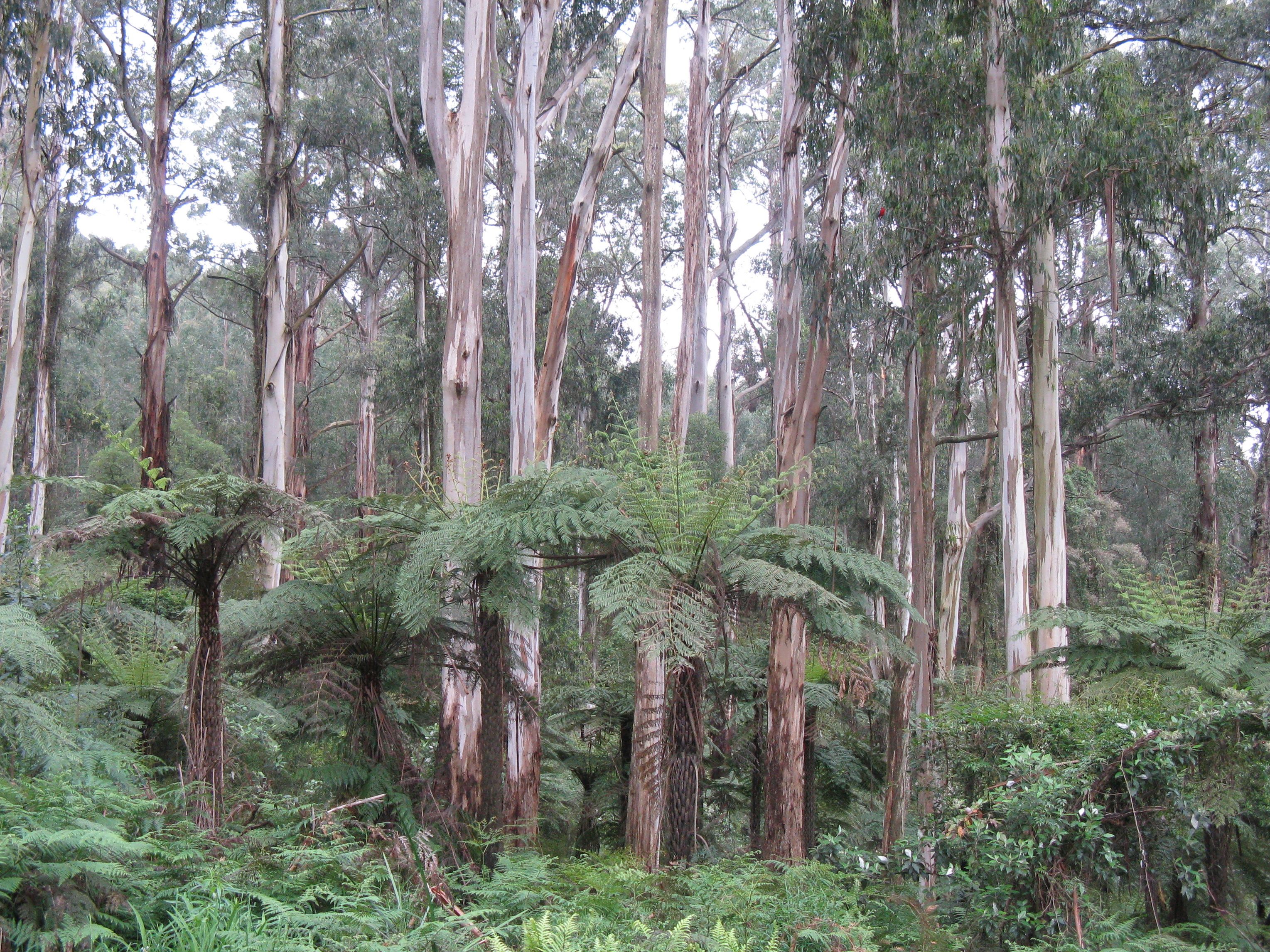
Sherbrooke Forest and Eucalyptus regnans

Sherbrooke Forest (Vic) and Eucalyptus regnans

He says trees are “living materials organised in the laboratory of Nature’s mysteries out of rain, sunlight, dews and earth”, and are the result of a deft metamorphosis. He explains this metamorphosis by telling us more specifically how an oak grows from a planted acorn, and how the earth, through the roots, provides food such as phosphates while:

foliage and twig and trunk are busy in catching sunbeams, air, and thunderstorms, to imprison in the annual increment of solid wood. There is no light coming from your wood, corncob, or coal fire which some vegetable Prometheus did not, in its days of growth, steal from the sun and secrete in the mysteries of a vegetable organism.

I love the John Muir-like romantic prose here! Animal and tree life are, he says, interdependent. Trees are “essential to man’s health and life”. Without vegetable life and growth, animal life would be exterminated:

When the last tree shall have been destroyed there will be no man left to mourn the improvidence and thoughtlessness of the forest-destroying race to which he belonged.

It’s worrying that over a century later, we have Australian Prime Minister Tony Abbott stating that “We have quite enough national parks. We have quite enough locked up forests already. In fact, in an important respect, we have too much locked up forest.” (For one academic’s assessment of the issue, check out forest ecologist Rod Keenan’s* article,  “Abbott’s half right: our national parks are good but not perfect”, at The Conversation.)

Morton argues that “in all civilisations man has cut down and consumed, but rarely restored or replanted, the forests”. In some parts of the world, this has changed, due largely to initiatives like Arbor Day, Earth Hour, not to mention the creation of national parks and reserves. Of course, replanting with (obviously) new trees does change the ecological balance and no matter how carefully managed it is, it is based on knowledge that we know is imperfect. Better then, as much as possible, to preserve forests and let them renew naturally – or so it seems to me!

Anyhow, Morton concludes by reaffirming the importance of planting trees “to avert treelessness, to improve the climatic conditions, for the love of the beautiful and useful combined”.

Arbor Day is, he says

the only anniversary in which humanity looks future ward instead of past ward, in which there is a consensus of thought for those who are to come after us, instead of reflections concerning those who have gone before us. It is a practical anniversary. It is a beautiful anniversary.

When Arbor Day Leaves was published in 1893, forty-four of the USA’s then forty-eight states observed Arbor Day (and by 1920s all states were practising it). What a great legacy.

Later this week, I will post on Australia’s first Arbor Day … watch this space.

J. Sterling Morton
“About trees”
First published: in Arbor Day Leaves (ed. N.H. Egelston), 1893
Available: Online at the Library of America

* I’m no expert, and Rod Keenan is not the darling of all environmentalists, but he offers a reasoned perspective.

Angela Savage, The dying beach (Review)

Angela Savage, The dying beach

Courtesy: Text Publishing

When I received Angela Savage’s novel The dying beach out of the blue last year as a review copy, I didn’t put it high in my list of reading priorities. I had – and still have – a pile of books waiting patiently, and I rarely (never say never) read crime novels. However, two things changed my mind. One is that Christos Tsiolkas dedicated Barracuda to Savage, and the other is that this year, for the first time, I will visit Thailand, which is the novel’s setting. So, I read it!

The dying beach is apparently Savage’s third Jayne Keeney novel. Jayne is a Private Investigator, an expat Australian living in Bangkok. Like many female PIs, she’s gutsy, hard-living, resourceful, somewhat of an outsider, and rather inclined to bristle if her independence is questioned. (Perhaps this latter is not confined to female PIs, but can be said of many women working for a living in a male dominated environment.) In this, her third outing, she’s holidaying in Krabi with her new (I believe) business and romantic partner, Rajiv, an expat Indian. They are a bit of an odd couple, but we all know about opposites attracting:

Jayne had never imagined she could find love with a man five years her junior, whose background was so different from her own. But Rajiv gave her a whole new way of viewing the world. As if he’d walked into her life and drawn back the curtain, revealing a window she hadn’t even known was there.

I love that image of “revealing a window she hadn’t even known was there”. Savage’s writing is pretty direct, keeping a good pace appropriate to its genre, but that doesn’t mean that it lacks lovely descriptions and turns of phrase. Indeed, the language is one of the delights of the book. Without disturbing her pacing, Savage regularly surprises with telling descriptions. This, for example, gives you a perfect picture of Jayne in full flight:

She was like an appliance without an off switch that kept accelerating under pressure until it threatened to short circuit.

The novel opens with a sort of prologue in which Sigrid, who doesn’t play an ongoing role in the novel, finds a body floating in the water at Princess Beach. Sigrid is surprised to discover that it’s the tour guide Pla whom she’d spoken to only that week. She notices some bruises around the neck suggesting Pla “did not die gently”. The novel proper then starts at Chapter 1 with Rajiv and Jayne in bed. It’s here (in the chapter not the bed!) that Savage provides us with the necessary background to their relationship, to where it stands at this point, and implies tensions that may play out in the future – as indeed they do. There is, in other words, a love story to this crime novel. At the end of this chapter they front up to the counter at Barracuda (surely a little homage to Christos Tsiolkas) Tours planning to book a tour with the “exceptional guide” they’d had a couple of days previously – the unlucky Pla, of course. And so the scene is set for their holiday to become another job, albeit unpaid, something that bothers the practical Rajiv but not our justice-seeking heroine.

I’m not going to write a lot more about the story, because it’s the sort of book people read for plot and surprises, and I don’t want to give them away. I will say though that it offers lovely insights into Thai character and culture. It is also unashamedly political with its plot revolving around the conflict between economic development and environmental degradation. The title itself refers to the fact that mass shrimp-farming results in the destruction of mangrove forests which in turn causes the beaches to “die”.

Savage also presents a critique of Australia, when she has Jayne contemplate why she is living in Thailand:

Truth was Jayne had long felt an outsider among her peers. Since her final year of high school, in fact, when she spent six tantalising months on a student exchange in France. When she returned home, her passion for the outside world met with a lack of interest, if not downright hostility – as though it was disloyal to find anywhere as attractive as Australia. […] For all that Australians like to boast about the national larrikin spirit, in reality only irreverence was tolerated. Unconventionality was not.

It’s a little didactic, but ouch! There is, unfortunately, some truth in this.

The final point I’d like to make relates to its narrative style. Having read several complex novels recently, that is, books with shifting points of view and intricate chronologies, I rather enjoyed reading something more straightforward. I say this, however, comparatively speaking, because The dying beach does not have a simple, linear chronology. Not only are there a few flashback chapters interspersed strategically through the book, but occasionally the narrative focus shifts from Jayne and her cohort to a couple of characters who appear to be implicated in at least some of the murders. The voice is essentially third person omniscient, though sometimes we seem to shift inside a character’s head. Savage does it well, and I enjoyed the change after the intensity of my recent reads.

The dying beach is a compelling page-turner that also makes some points about cultural difference and tolerance, the challenge of tourism, and the complexity of environmental management in developing countries. It achieves this without, to the best of my admittedly limited knowledge, deviating dramatically from the conventions of its genre. And that is a good thing, because the result is the sort of novel that could appeal to a cross-over audience. The challenge, though, is how to get readers, like me for example, to cross over.

awwchallenge2014Angela Savage
The dying beach
Melbourne: Text Publishing, 2013
339pp.
Cover design: WH Chong
ISBN: 9781921922497

(Review copy supplied by Text Publishing)

Bill McKibben, Oil and honey (Review)

Bill McKibben, Oil and Honey

Courtesy: Black Inc

It’s coincidental, but nicely appropriate, that the World Meteorological Organisation (WMO) published its Provisional Statement on the Status of the Climate in 2013 last week, just as I was finishing US environmental activist Bill McKibben‘s latest book, Oil and honey: The education of an unlikely activist. It’s likewise coincidental that, three days before WMO’s announcement, Stefanie (of So Many Books) published a post titled Gardening for Climate Change* containing her thoughts on her garden and how climate change might affect it.

WMO’s statement says, among other things, that “During the first nine months of 2013, most of the world’s land areas had above-average temperatures, most notably in Australia, northern North America …”. As you know, I live in Australia; Bill McKibben and Stefanie live in the northern part of the USA. We are seeing (feeling) the changes, and are concerned. What I’m going to say next is pretty obvious, but I’m going to say it anyhow because I always like to start with the basics in discussions like this. There are two critical issues in the climate change debate: Is the climate changing and, if it is, Is it human-caused? It’s hard to imagine, given all the data available, that there’s anyone out there who really believes the climate is not changing, though I believe there are still some who think it’s simply a case of “climate variability”. These people think that the climate will get back to normal (some year soon, they hope). The trickier issue, however, is the causal one. Most of the deniers are not so much denying that the climate is changing, but that we are causing it. This brings me to Bill McKibben.

McKibben does not, in Oil and honey, spend time trying to prove that humans are causing climate change. For him it’s a given. Rather, he shares how he changed from being an environmentalist, who researched and wrote books, to an environmental activist who campaigns (and writes books). It’s an interesting, clearly written book about one man and his path, but can also be read as a how-to for those who want to get active.

You may now, though, be wondering about the title. Oil and honey? I’m sure there’s an ironic allusion here to the biblical “land of milk and honey” (which we are not heading towards), but there is also a literal meaning to the title. The narrative shifts pretty seamlessly between his two main passions. One is to do with bees, honey and good farming practice. The other is oil, or the fossil fuel industry, and how to stop its impact on the climate. Oil and honey, climate and farming. It’s all related.

You may also be wondering, particularly if you’re not American, who Bill McKibben is. As the blurb on the back of my edition says, he has written over a dozen books including the New York Times bestselling Eaarth and The end of nature. He also founded the environmental organisation 350.org and “was among the first to warn of the dangers of global warming”. Despite all this, he did not until recently see himself as an activist. After graduating, he worked as a journalist for The New Yorker for five years, but quit in 1987 when its long-term editor was forced out of his job. Since then he has been a freelance writer.

Oil and honey is his latest book. I’d call it part-memoir part-manifesto, because it is both the personal story of his transition to full-blown activism and the story of his passion for saving the planet. The personal aspect of the book helps make it a good read. We get to understand his thinking, we feel his anxiety about becoming not only an activist but a leader of activists, and we learn that his activist philosophy is inspired by the non-violent resistance ideas of Gandhi and Martin Luther King Jr. We see his love for nature and for working close to the land on the bee-farm he bought for his friend Kirk Webster to run. This farm functions both as respite and as a place for him to see land stewardship working.

That’s the memoir aspect. In the manifesto aspect, he shares with us the development of his ideas and strategies. We learn of various campaigns he has been involved in since 2009, including Step It Up, Keystone XL,  Do the Math. And he explains how he and his co-activists have shifted from focusing on politics and politicians – through such activities as sit-ins at the White House and lobbying politicians – to directly tackling the fossil fuel industry. He came to realise, he says, that the situation was/is becoming so dire there’s no time “for slow graceful cultural evolution”. Consequently, the last part of the book deals with the goal of encouraging educational institutions to divest their investment portfolios of fossil fuel industries. They’ve targeted educational institutions because students represent a significant percentage of climate change activists. For these students the question is simple:

are you paying for our education by investments in an industry that guarantees we won’t have a planet to make use of that learning?

I’ve only touched the surface of what this book covers. Like many books of its type, chances are that it will only be read by the converted. That’s a bit of a shame, but it’s not useless says McKibben:

You might think it’s a waste to preach to the choir, but the truth is, you need to get the choir fired up, singing loudly, all out of the same hymnal. The choir is there, but most of the time it’s just humming in the background, or singing so many tunes that no distinct harmony emerges.

So, if you’re part of the choir, this book is still for you. And if you’re not, think about joining. It could be the most important thing you do.

Bill McKibben
Oil and honey: The education of an unlikely activist
Collingwood: Black Inc, 2013
255 pp.
ISBN: 9781863956178

(Review copy supplied by Black Inc)

* Stefanie has since posted a link to a British blog called Climate Change Garden.

Louis Nowra, Into that forest (Review)

Louis Nowra, Into that forest

Courtesy: Allen & Unwin

Louis Nowra is one versatile and prolific writer, having written novels, non-fiction, plays and screenplays, essays and even libretti. Into that forest is his latest work. It was shortlisted for the Young Adult Novel prize in the 2012 Aurealis awards and the Ethel Turner Young People’s Literature prize in this year’s NSW Premier’s Literary Awards. I read this for my reading group. We don’t often do youth literature but every now and then one pops up that we think might interest us … such as a book by Nowra.

The first thing to say is that the novel is written in a unique voice. Here is its opening:

Me name be Hannah O’Brien and I be seventy-six years old. Me first thing is an apology me language is bad cos I lost it and had to learn it again. But here’s me story and I glad to tell it before I hop the twig.

And what a story it is … this novel feeds into several Australian, and wider, literary traditions. There’s the lost child and the feral child motifs (reminding me of Dog boy). There’s Tasmanian Gothic, and there’s also a bit of the fairy-tale about it. Subject-wise it covers some significant ground: environmental issues (involving both the extinct Tasmanian tiger and the whaling industry) and what we’d now call Post Traumatic Stress Disorder. This might sound rather mechanistic, but there’s no sense of “ticking off”. It’s not didactic, and it’s all logical within the framework of the book.

Set in the late 19th century, it tells the story of two young girls, Hannah (then 6) and Becky (7) who find themselves lost in the bush (oops, forest!) after their boat capsizes in a storm and Hannah’s parents drown. They are taken in by a Tasmanian Tiger pair, and live with them for four years. Meanwhile, Becky’s father, Mr Carsons, is out looking for her. Eventually they are found, but the process of re-integration is not easy. The novel has a small cast of characters, which keeps it tightly focused. Besides Hannah’s parents who die near the beginning, there’s our two young protagonists, Becky’s father, his friend Ernie, the “tiger man”, a few other minor characters – and of course, the tigers, named Dave and Corinna by Hannah.

As in Dog boy, the description of life with the tigers is pretty visceral. At first Becky resists living like a tiger – perhaps because she still has a father whom she hopes will find her – but eventually she too succumbs, if succumb is the word. It is, after all, a matter of survival. And so they shed their clothes, start to move mostly on all fours, and develop keen animal instincts (of sight, hearing and smell). They also develop a taste for raw food and become adept at hunting. The descriptions of killing and eating the prey are not for the squeamish – “I were starving and the taste of blood made me feel even more hungry” and “What were ever in that shiny pink gristle surged through me in waves of ecstasy” – but they are important to our understanding of what their lives had become. Hannah says:

God knows where me sense of survival came from. Maybe it’s natural cos humans are just animals too.

There is a bogey man here – the tiger man or bounty hunter, whom Hannah had met before, through her parents. To the girls he is more brutal than the tigers. He’s “evil”, kills tiger pups, does “stuff to himself that were rude”. But, perhaps, he’s just another survivor, albeit a not very pleasant one?

While Hannah is the narrator, Becky’s character is the more complex one. She struggles more with the change forced upon them:

She didn’t want to forget. Me? I thought it were stupid to try and remember like Becky did. I didn’t see any use for it. Me English started to shrivel up, like an old dry skin a snake gets rid of. It just lies there in the grass rotting away and then vanishes with the wind. I took to talking in grunts, coughs and hoarse barks like the tigers. This annoyed Becky no end. But it were simple – the tigers understood me. Becky warned I were making a mistake. You will forget your language. You will forget your parents. You are becoming an animal, she’d say. Why argue with her? She were right on every level.

Becky initially fights against the brutality of the hunt – there’s a horrific description of the tigers attacking seals – but then surprises Hannah by rather fearlessly exerting some dominance in the pack. She was of course desperately hungry by then, but it shows Hannah that:

she were really stubborn if she wanted something. She were brave, she were stubborn, she were smart, she were tough.

Unfortunately, Becky is not as tough – or as adaptable – as Hannah thought, and consequently precipitates the novel’s rather shocking conclusion.

It’s a pretty bold novel – but less so than, say, Lord of the flies. There’s plenty to discuss, particularly regarding the subjects I suggested at the beginning of the post. The big theme, though, the one common to feral children books, has to do with defining our nature. What separates human from animal? What would you do to survive – and what would that say about the essence of humanity? Good stuff for young adults, and a gripping read too for we older readers.

Louis Nowra
Into that forest
Crow’s Nest: Allen & Unwin, 2012
ISBN: 9781743311646 (Kindle ed.)