Susannah Fullerton, Devoney Looser and Emily Maguire with Jonty Claypole and Sophie Gee.
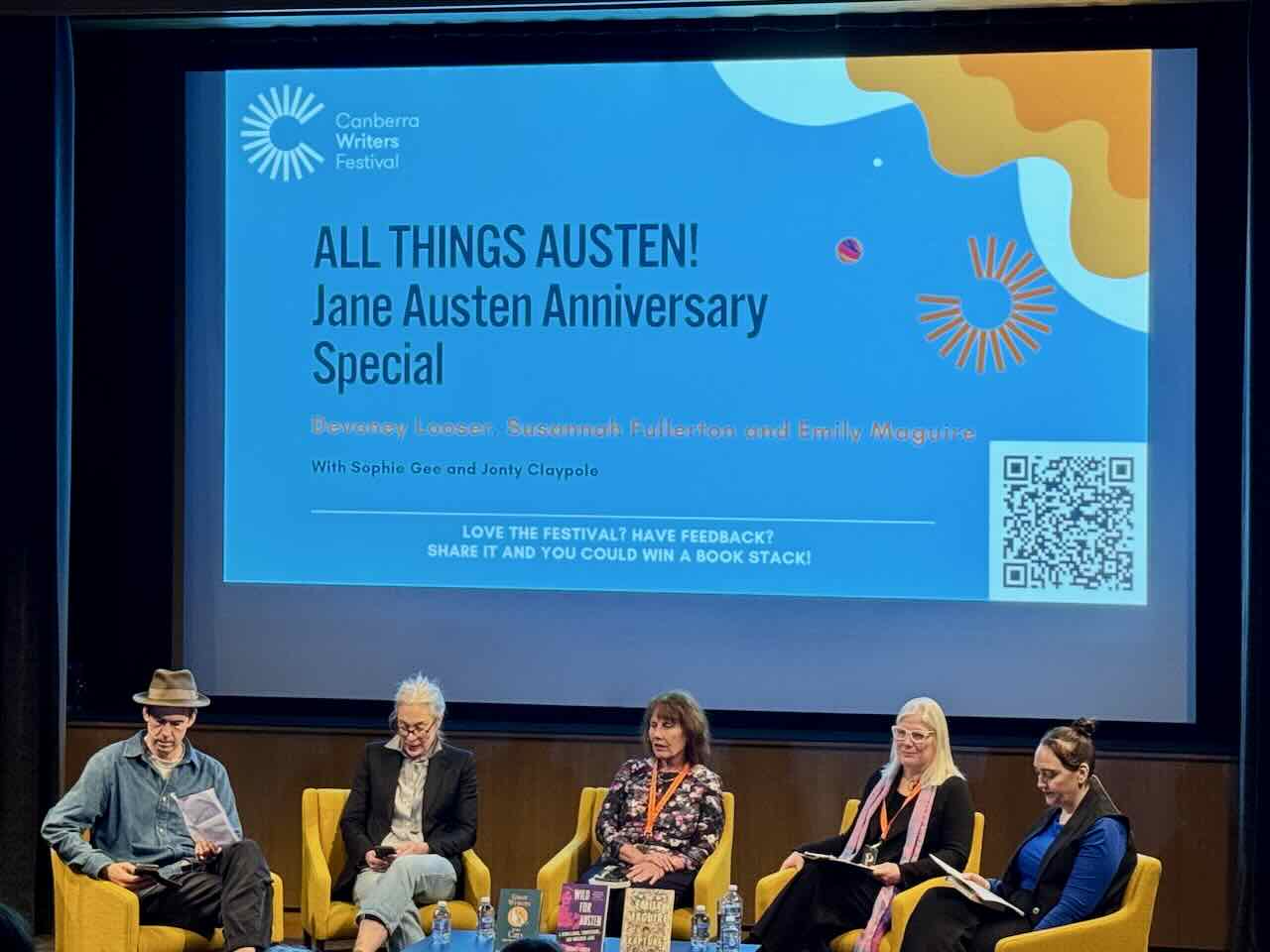
The program described the session as follows:
Celebrate all things Austen at this major event! Over 200 years after Jane Austen’s works first appeared, her insights on life, love, and society remain timeless. Join popular Secret Life of Books podcasters Sophie Gee and Jonty Claypole as they bring together an international panel featuring Wild for Austen author Devoney Looser (from the USA), Emily Maguire (Rapture), and Jane Austen Society of Australia president Susannah Fullerton. Join the community, and share your love – because, as Mr. Darcy says, “My feelings will not be repressed!”
Are you tiring of Jane Austen 250th anniversary events? Never fear, the year is nearly over, though her actual birthday is still to come. CWF could not, of course, let the anniversary pass without marking it in some way, and they did it with a five-person panel. The convenors’ aim was to steer away from the Austen of fluffy romances and never-ending rom-com (and other genre) adaptations to the disruptive, subversive, unorthodox Austen that we all believe she was.
The session was being recorded for Sophie and Jonty’s podcast, Secret Life of Books, so it had a particular flavour and style, and there was no Q&A. They started with an interactive game called “Never have I ever” in which the three panelists shared a statement that may or may not have happened to Austen or one of her characters and the audience had to vote true or false. That woke us all up, and then we settled down to the serious business!
The discussion was framed around three themes, in this order:
- Disruptive Austen
- Disruptive history
- Disruptive readings
Disruptive Austen
Unfortunately, I had a technical malfunction with this first question, so I have to rely on memory. Essentially, the panelists were asked to share something they believe reflects disruptive (or subversive) Austen:
Emily chose Lydia from Pride and prejudice, noting that Austen never says the words, but we all know that the reason everyone was upset about Lydia was running off with Wickham was that they were having sex without being married. Once they were married, which of course was orchestrated, all was forgiven, and they went on to live acceptable lives. Lydia’s behaviour put her sister’s chances at risk. Austen shows, said Emily, the hypocrisy of her society.
Devoney and Susannah both read small sections from Austen’s Juvenilia (or teen writings), with Devoney reading the first four chapters of The beautifull Cassandra, and Susannah A letter from a young lady. These pieces exemplify the juvenilia overall. They are absurd, satirical parodies, and contain various scandalous acts, but are well worth reading for all sorts of reasons. (In my post on Volume the First, which includes Cassandra, I quote Looser a couple of times!)
The question put to the panel was, why did she leave this subversive writing? Unfortunately, I didn’t capture the full discussion, but one reason was that the Juvenilia was written to entertain the family, whereas the novels were written for a public audience. There was also discussion about Austen crafting her form. (You can wait for the podcast if you want to hear this and the whole event!)
Disruptive history
Susannah talked about Austen living during tumultuous times. Revolution and war in Europe, and England was unsettled, with changing laws. For example, duelling was illegal but still happening. There is a duel in Sense and sensibility. Austen mentions it briefly, with nothing like the detail a male author would use. But, there is a lot of female verbal duelling in the novel. Also, it is telling, she said, that the person who duels, who engages in illegal behaviour, is one of her most respectable characters, Colonel Brandon. Poaching is mentioned in Mansfield Park by Mr Rushworth, but he has no idea that Henry will poach his wife. In other words, illegal things happen in her novels.
Devoney also talked about the uncertain times. The French Revolution happened as she was coming of age, and then things shifted again in the 1800s. Critics often complain that Austen didn’t deal with war, but Persuasion is full of war, and Austen imagines a wonderful female character in Mrs Croft. However, Devoney said that during the 1800s society was clamping down, there was more censorship. Is that another reason why Austen damped down her Juvenilia? Devoney doesn’t think so. She thinks Austen blew up the form she toyed with in the Juvenilia and then put it together again. Devony saw both political and craft reasons for what Austen did.
Emily returned to her illicit sex argument, and that everyone knew it was happening. She shared the story of Lady Worsley (1758-1818), an Austen contemporary, who had a child that wasn’t her husband’s, was involved in a court case her husband brought against her lover, but ended up inheriting her husband’s estate. There was so much ambiguity in society during Austen’s time.
Jane eclipsed writers of her time, but Jonty and Sophie wanted know if the panel could recommend another writer.
Susannah suggested Fanny Burney. Her novels may not be books you go back to, but she was out there where the action was, unlike Austen, and she underwent (and survived) a mastectomy without anaesthetic. Her letters and diaries are worth reading. Devoney agreed with Susannah that no-one can match Austen, but if we widen our view there are women worth looking at, such as Maria Edgeworth (see my post on her Leonora), the Porter sisters (Jane and Anna Maria), and the Irish novelist Sydney Owenson.
Sophie suggested Mary Wollstonecraft, not only her A vindication of the rights of women but her Letters written in Sweden, Norway, and Denmark. She had child out of wedlock, and died giving birth to Mary Shelley. We don’t know whether Austen read Vindication, but it was in her brother Edward’s library.
The conversation turned to related issues. For example, the first French translator of Pride and prejudice thought Elizabeth was too bold and feisty, so they flattened her.
Disruptive reading
How can Austen be read disruptively? Can she be read against the grain? (Aside: I think my Austen group does this regularly.)
Devoney said she can be read on different levels. Her novels document illicit sex, crime and criminality. She references contemporary issues, such as slavery. There is not enough information about where she stood. Austen was related to people who made money out of slavery, but Mansfield Park was likely named for the man whose judgement played an important role in England’s abolition movement. Not long after Austen’s death, her three brothers were involved in abolitionism. There’s reason to believe that she supported or was moving to supporting that view. Devoney also thinks that Austen did not want to be pinned down, but preferred to leave questions for us to think about. (This feels a modern idea to me, but her novels can support this theory, I think.)
Emily works with teenagers, and loves hearing what they pick up in Austen. They see tiny social signals – a look, a touch of hands – that suggest relationships. Young girls are alert. Looking through the lens of their own culture, they identify, for example, Austen’s “Pick-me” girls, like Miss Bingley.
Susannah spoke to Austen’s feminism, using, for example, Elizabeth’s statement to Lady Catherine that Mr Darcy “is a gentleman, I am a gentleman’s daughter. So far we are equal”. She mentioned Austen’s last poem, “When Winchester races“, written three days before she died. There is a line in it, “But behold me immortal!” Susannah would like to think she knew her own greatness.
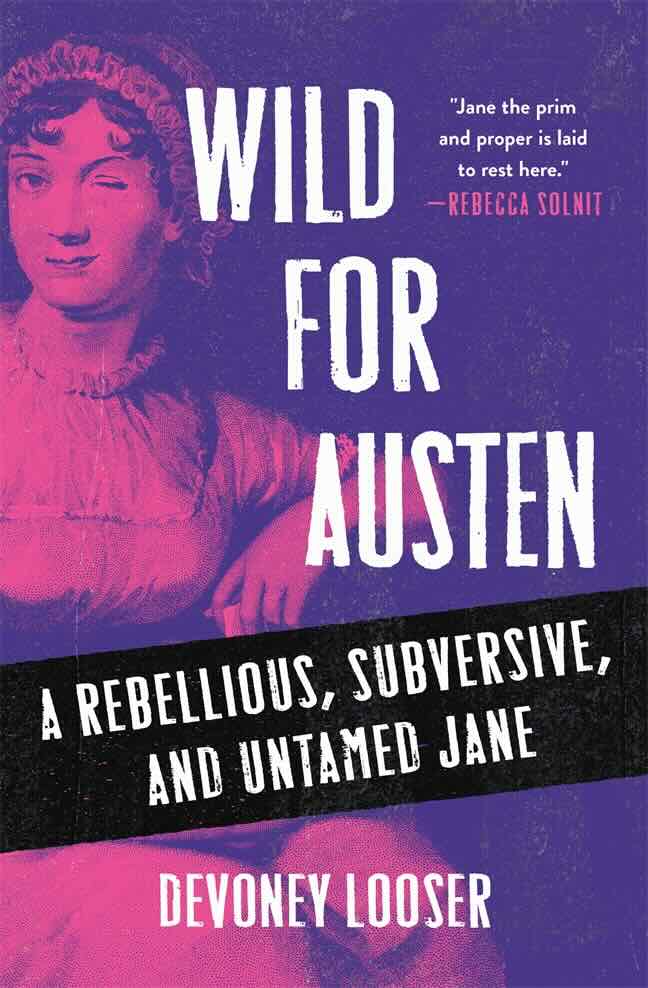
And here we ran out of time … so the panel ended with Sophie and Jonty thanking all, and formally ending their podcast.
Not all in my Austen group loved this session, partly because the session was spread rather thin and we didn’t get to hear specifically about Looser’s book. But Mr Gums, my Austen-loving friend Kate, and I enjoyed what was discussed. It was lively, covered some interesting ground, and suited, I think, a broad-based Festival audience.
There will be no Monday Musings this week.
Canberra Writers Festival, 2025
All things Austen
Sunday 26 October 2025, 3-4pm
 Whispering Gums